Science is a way of understanding how the world and a lot of
things work. For example, the rock that attracts iron is known to be
the black oxide mineral named magnetite, after the city of
Magnesia. This magnetite which acts as a natural magnet is called
lodestone and is used as a leading stone or compass.
The ancient Greeks and Romans knew as well as we do that
lodestone (an iron-rich mineral) can attract other pieces of iron. On
the other hand, the ancient Chinese made magnetic compasses set
in intricate wooden inlays for their practice of Feng Shui (the art of
carefully arranging a room or an environment thousands of years
before interior designers came on board).
Magnetic Materials
Many of us are not familiar with a natural magnet called
lodestone. It strongly attracts iron and steel as well as cobalt and nickel.
These solid substances are said to have ferromagnetic properties or
magnetic properties.
A magnet is an object or material that attracts certain metals. It
can also attract or repel another magnet. Chinese were the first to
discover that lodestone or natural magnet has two magnetic poles.
These are the North-seeking (N) and South-seeking pole.
When magnets are placed near each other, opposite poles
attract and like poles repel each other. This is called magnetism.
Magnetism is a force of attraction or repulsion that acts as a
distance. It is due to the magnetic field, which is caused by moving
electrically charged particles or is inherent in magnetic objects such
as magnets. Various electrical devices make use of magnets.
There are six basic facts about magnets:
1. A magnet has two ends called poles, the north pole or north-
seeking pole and the south pole or the south-seeking pole.
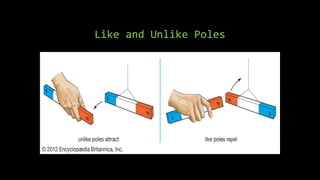
2. Like poles repel, unlike poles attract.
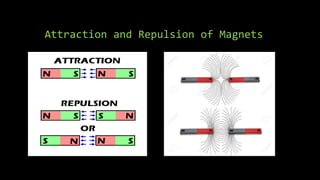
• Attraction – When two magnets or magnetic objects are close
to each other, there a force that attracts the poles together.
• Repulsion – When two magnetic objects have like poles facing
each other, the magnetic force pushes them apart.
Attraction and Repulsion of Magnets
Like and Unlike Poles
3. A magnet creates an invisible area of magnetism all around.
4. The north pole of a magnet points toward the Earth’s north pole
and vice versa, because Earth itself contains magnetic materials and
behaves like a gigantic magnet.
5. If you cut a bar magnet in half, half has its own north and south
poles.
6. If you run a magnet a few times over a unmagnetized piece of a
magnetic material, it turns into magnetic as well.
Types of Magnets
• Permanent Magnets
Permanent magnets are made of materials that are
permanently magnetic. This being the case, their electrons will not
change directions
Examples:
• Magnetite is a magnetic material found in nature. It is
characterized as relatively weak.
• Alloys are permanent magnet that are made up of two
different chemical elements, one of which is metal.
Temporary Magnets
Temporary magnets only exhibit signs of magnetism when
exposed to strong magnetic fields. When temporary magnets are
exposed to permanent magnets, their atomic composition adjusts so
that the poles point in the same direction. After that, they take on
magnetic properties and become either attracted or repelled by other
magnets.
Electromagnets
Electromagnets run on electricity. The strength on electromagnet
can easily be changed by changing the amount of electric current that
flows by it. By wrapping around a wire around an iron or steel core and
running an electric current through the wire, metal, can be magnetized.
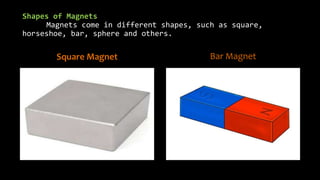
Shapes of Magnets
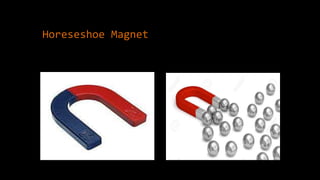
Magnets come in different shapes, such as square,
horseshoe, bar, sphere and others.
Square Magnet Bar Magnet
Horeseshoe Magnet
Electromagnetism

Electromagnetism

  • 2.
    Science is away of understanding how the world and a lot of things work. For example, the rock that attracts iron is known to be the black oxide mineral named magnetite, after the city of Magnesia. This magnetite which acts as a natural magnet is called lodestone and is used as a leading stone or compass. The ancient Greeks and Romans knew as well as we do that lodestone (an iron-rich mineral) can attract other pieces of iron. On the other hand, the ancient Chinese made magnetic compasses set in intricate wooden inlays for their practice of Feng Shui (the art of carefully arranging a room or an environment thousands of years before interior designers came on board).
  • 3.
    Magnetic Materials Many ofus are not familiar with a natural magnet called lodestone. It strongly attracts iron and steel as well as cobalt and nickel. These solid substances are said to have ferromagnetic properties or magnetic properties. A magnet is an object or material that attracts certain metals. It can also attract or repel another magnet. Chinese were the first to discover that lodestone or natural magnet has two magnetic poles. These are the North-seeking (N) and South-seeking pole.
  • 4.
    When magnets areplaced near each other, opposite poles attract and like poles repel each other. This is called magnetism. Magnetism is a force of attraction or repulsion that acts as a distance. It is due to the magnetic field, which is caused by moving electrically charged particles or is inherent in magnetic objects such as magnets. Various electrical devices make use of magnets.
  • 5.
    There are sixbasic facts about magnets: 1. A magnet has two ends called poles, the north pole or north- seeking pole and the south pole or the south-seeking pole. 2. Like poles repel, unlike poles attract. • Attraction – When two magnets or magnetic objects are close to each other, there a force that attracts the poles together. • Repulsion – When two magnetic objects have like poles facing each other, the magnetic force pushes them apart.
  • 6.
  • 7.
  • 8.
    3. A magnetcreates an invisible area of magnetism all around. 4. The north pole of a magnet points toward the Earth’s north pole and vice versa, because Earth itself contains magnetic materials and behaves like a gigantic magnet. 5. If you cut a bar magnet in half, half has its own north and south poles. 6. If you run a magnet a few times over a unmagnetized piece of a magnetic material, it turns into magnetic as well.
  • 9.
    Types of Magnets •Permanent Magnets Permanent magnets are made of materials that are permanently magnetic. This being the case, their electrons will not change directions Examples: • Magnetite is a magnetic material found in nature. It is characterized as relatively weak. • Alloys are permanent magnet that are made up of two different chemical elements, one of which is metal.
  • 10.
    Temporary Magnets Temporary magnetsonly exhibit signs of magnetism when exposed to strong magnetic fields. When temporary magnets are exposed to permanent magnets, their atomic composition adjusts so that the poles point in the same direction. After that, they take on magnetic properties and become either attracted or repelled by other magnets. Electromagnets Electromagnets run on electricity. The strength on electromagnet can easily be changed by changing the amount of electric current that flows by it. By wrapping around a wire around an iron or steel core and running an electric current through the wire, metal, can be magnetized.
  • 11.
    Shapes of Magnets Magnetscome in different shapes, such as square, horseshoe, bar, sphere and others. Square Magnet Bar Magnet
  • 12.