





THE WORLD OF MAG ETS
Nootan Physiotherapy College,
Visnagar.
Prepared By:
Dr. Nidhi Vedawala
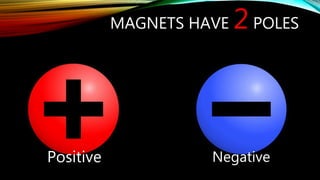
MAGNETS HAVE 2POLES
Positive Negative
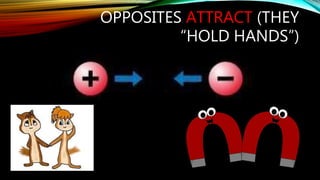
OPPOSITES ATTRACT (THEY
“HOLD HANDS”)
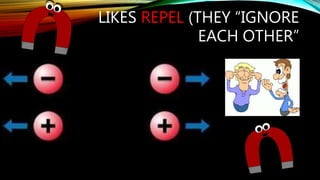
LIKES REPEL (THEY “IGNORE
EACH OTHER”
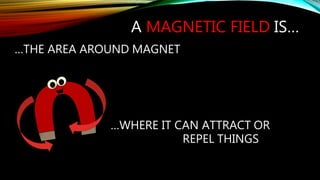
A MAGNETIC FIELD IS…
…THE AREA AROUND MAGNET
…WHERE IT CAN ATTRACT OR
REPEL THINGS
WHAT KINDS OF THINGS ARE
MAGNETIC?
LETS FIND OUT!
USING A ,WALK AROUND THE ROOM
AND FIND DIFFERENT THINGS THAT ARE
MAGNETIC!
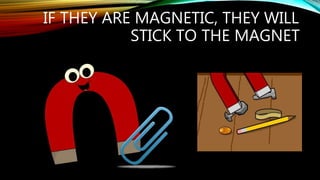
IF THEY ARE MAGNETIC, THEY WILL
STICK TO THE MAGNET
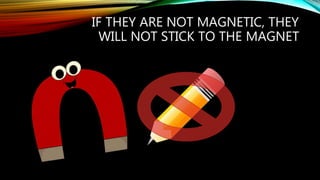
IF THEY ARE NOT MAGNETIC, THEY
WILL NOT STICK TO THE MAGNET
READY SET…GO!
WHAT DID YOU FIND?
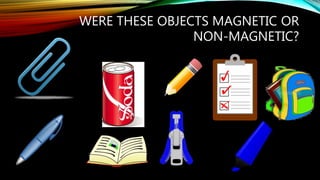
WERE THESE OBJECTS MAGNETIC OR
NON-MAGNETIC?
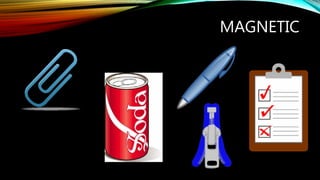
MAGNETIC
NON-MAGNETIC
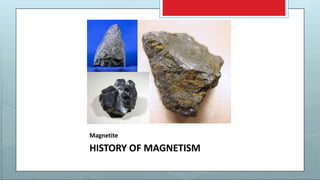
Magnetite
HISTORY OF MAGNETISM
HISTOR
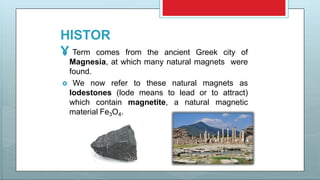
Y Term comes from the ancient Greek city of
Magnesia, at which many natural magnets were
found.
 We now refer to these natural magnets as
lodestones (lode means to lead or to attract)
which contain magnetite, a natural magnetic
material Fe3O4.
HISTOR
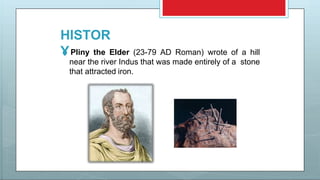
Y Pliny the Elder (23-79 AD Roman) wrote of a hill
near the river Indus that was made entirely of a stone
that attracted iron.
HISTOR
Y Chinese as early as 121 AD knew that an iron rod
which had been brought near one of these natural
magnets would acquire and retain the magnetic
property, and that such a rod when suspended from
a string would align itself in a north-south direction.
 Use of magnets to aid in navigation can be traced
back to at least the eleventh century.
What is magnetism?
 Magnetism is the force of
attraction or repulsion of a
magnetic material due to
the arrangement of its
atoms, particularly its
electrons.
What causes magnetism?
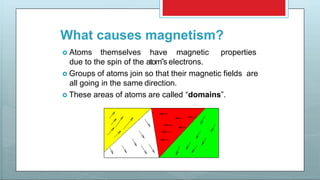
 Atoms themselves have magnetic properties
due to the spin of the atom‟s electrons.
 Groups of atoms join so that their magnetic fields are
all going in the same direction.
 These areas of atoms are called “domains”.
What causes magnetism?
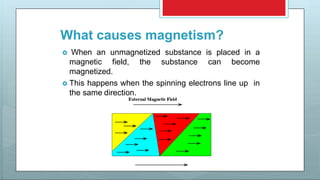
 When an unmagnetized substance is placed in a
magnetic field, the substance can become
magnetized.
 This happens when the spinning electrons line up in
the same direction.
What causes magnetism?
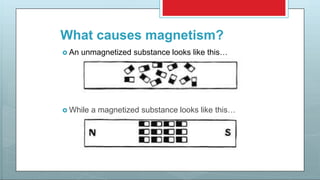
 An unmagnetized substance looks like this…
 While a magnetized substance looks like this…
How to “break” a magnet?
 Drop it.
 Heat it.
 This causes the domains to
become random again!
A big natural magnet..
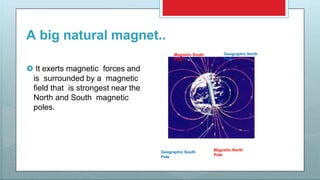
 It exerts magnetic forces and
is surrounded by a magnetic
field that is strongest near the
North and South magnetic
poles.
Magnetic South
Pole
Magnetic North
Pole
Geographic North
Pole
Geographic South
Pole
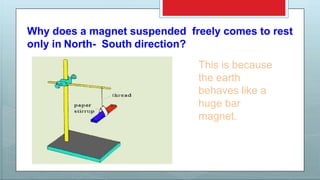
Why does a magnet suspended freely comes to rest
only in North- South direction?
This is because
the earth
behaves like a
huge bar
magnet.
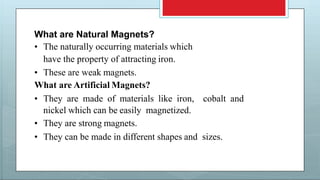
What are Natural Magnets?
• The naturally occurring materials which
have the property of attracting iron.
• These are weak magnets.
What are Artificial Magnets?
• They are made of materials like iron, cobalt and
nickel which can be easily magnetized.
• They are strong magnets.
• They can be made in different shapes and sizes.
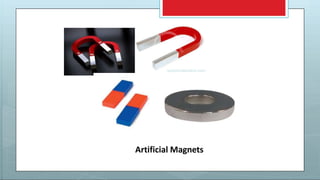
Artificial Magnets
Types of Magnets
 Permanent magnets: are magnets that retain their magnetism
once magnetized.Ferromagnetic material which
include iron, nickel, cobalt, some alloys of rare earth
metals, and some naturally occurring minerals such as
lodestone.
 Temporary magnets: are materials magnets that perform like
permanent magnets when in the presence of a magnetic field,
but lose magnetism when not in a magnetic field. Example :
Electromagnets.
 Electromagnets: are wound coils of wire that function as
magnets when an electrical current is passed through. By
adjusting the strength and direction of the current, the strength
of the magnet is also altered. Often, the coil is wrapped
around acore of "soft" ferromagnetic material such as steel.
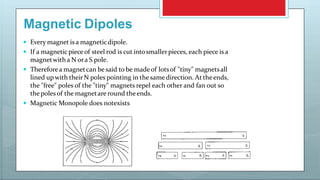
Magnetic Dipoles
 Every magnet is a magneticdipole.
 If a magneticpieceof steel rod is cut intosmallerpieces, each piece is a
magnetwitha N ora S pole.
 Thereforea magnetcan be said to be madeof lotsof "tiny" magnetsall
lined upwith their N poles pointing in the samedirection. At theends,
the "free" poles of the "tiny" magnets repel each other and fan out so
the poles of the magnetare round theends.
 Magnetic Monopole does notexists
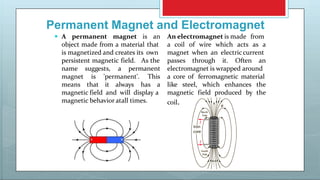
Permanent Magnet and Electromagnet
persistent magnetic field. As the
name suggests, a permanent
magnet is 'permanent'. This
means that it always has a
magnetic field and will display a
magnetic behavior atall times.
 A permanent magnet is an An electromagnet is made from
object made from a material that a
is magnetized and creates its own
coil of wire which acts as a
magnet when an electriccurrent
passes through it. Often an
electromagnet is wrapped around
a core of ferromagnetic material
like steel, which enhances the
magnetic field produced by the
coil.
Permanent Magnet Vs Electromagnet
 1.Properties: Permanent magnet has persistence magnetic field. An
electromagnetic magnet only displays magnetic properties when an electric
current is applied to it
 2. Magnetic Strength: Permanent magnet magnetic strength depends upon the
material used in its creation. The strength of an electromagnet can be adjusted by
the amount of electric current allowed to flow into it
 3. Advantages : The main advantage of a permanent magnet over an
electromagnet is that a permanent magnet does not require a continuous supply of
electrical energy to maintain its magnetic field. However, an electromagnet’s
magnetic field can be rapidly manipulated over a wide range by controlling the
amount of electric current supplied to the electromagnet.
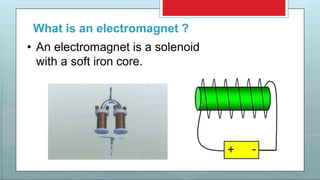
What is an electromagnet ?
• An electromagnet is a solenoid
with a soft iron core.
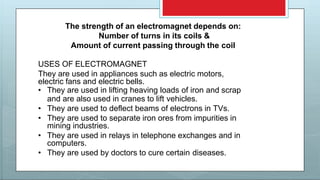
The strength of an electromagnet depends on:
Number of turns in its coils &
Amount of current passing through the coil
USES OF ELECTROMAGNET
They are used in appliances such as electric motors,
electric fans and electric bells.
• They are used in lifting heaving loads of iron and scrap
and are also used in cranes to lift vehicles.
• They are used to deflect beams of electrons in TVs.
• They are used to separate iron ores from impurities in
mining industries.
• They are used in relays in telephone exchanges and in
computers.
• They are used by doctors to cure certain diseases.
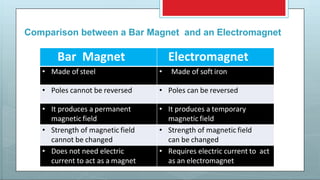
Bar Magnet Electromagnet
• Made of steel • Made of soft iron
• Poles cannot be reversed • Poles can be reversed
• It produces a permanent
magnetic field
• It produces a temporary
magnetic field
• Strength of magnetic field
cannot be changed
• Strength of magnetic field
can be changed
• Does not need electric
current to act as a magnet
• Requires electric current to act
as an electromagnet
Comparison between a Bar Magnet and an Electromagnet
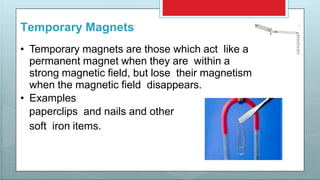
Temporary Magnets
• Temporary magnets are those which act like a
permanent magnet when they are within a
strong magnetic field, but lose their magnetism
when the magnetic field disappears.
• Examples
paperclips and nails and other
soft iron items.
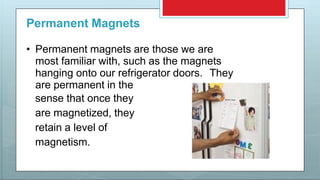
Permanent Magnets
• Permanent magnets are those we are
most familiar with, such as the magnets
hanging onto our refrigerator doors. They
are permanent in the
sense that once they
are magnetized, they
retain a level of
magnetism.
Properties of Magnets
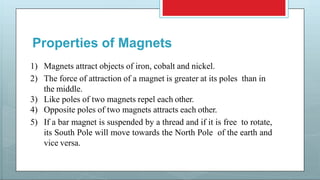
1) Magnets attract objects of iron, cobalt and nickel.
2) The force of attraction of a magnet is greater at its poles than in
the middle.
3) Like poles of two magnets repel each other.
4) Opposite poles of two magnets attracts each other.
5) If a bar magnet is suspended by a thread and if it is free to rotate,
its South Pole will move towards the North Pole of the earth and
vice versa.
North and South Poles, cont.
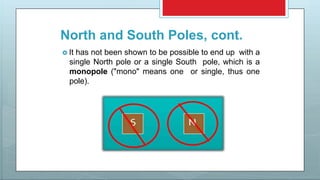
 It has not been shown to be possible to end up with a
single North pole or a single South pole, which is a
monopole ("mono" means one or single, thus one
pole).
North and South Poles
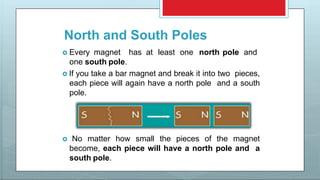
 Every magnet has at least one north pole and
one south pole.
 If you take a bar magnet and break it into two pieces,
each piece will again have a north pole and a south
pole.
 No matter how small the pieces of the magnet
become, each piece will have a north pole and a
south pole.
Magnetic Fields
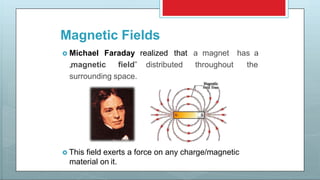
 Michael Faraday realized that a magnet has a
„magnetic field‟ distributed throughout the
surrounding space.
 This field exerts a force on any charge/magnetic
material on it.
Magnetic Fields, cont.
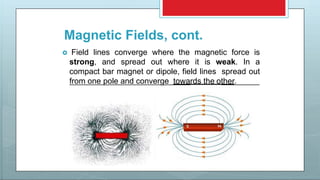
 Field lines converge where the magnetic force is
strong, and spread out where it is weak. In a
compact bar magnet or dipole, field lines spread out
from one pole and converge towards the other.
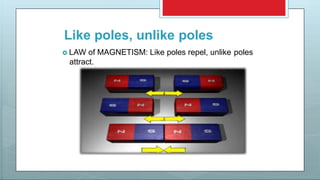
Like poles, unlike poles
 LAW of MAGNETISM: Like poles repel, unlike poles
attract.
Attract only magnetic materials
 Magnets only attract certain types of metals, other
materials such as glass, plastic and wood aren't attracted.
 Metals such as iron, nickel and cobalt are attracted to
magnets.
 Most metals however are not attracted to
magnets, these include
copper, silver, gold, magnesium, platinum, aluminium and
more. They may however magnetize a small amount while
placed in a magnetic field.
 Magnetism can attract magnetic objects or push
them away.
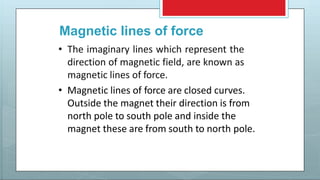
Magnetic lines of force
• The imaginary lines which represent the
direction of magnetic field, are known as
magnetic lines of force.
• Magnetic lines of force are closed curves.
Outside the magnet their direction is from
north pole to south pole and inside the
magnet these are from south to north pole.
Properties of Magnetic Lines of Force
• They are continuous closed curves.
• They travel from North to South pole outside
and from South to North pole inside.
• They curve towards the magnet.
• They never intersect each other.
• They are more concentrated near the poles of
the magnet where the magnetic field is the
strongest.
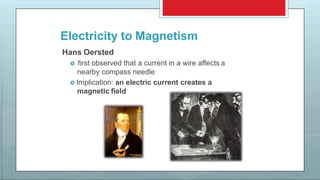
Electricity to Magnetism
Hans Oersted
 first observed that a current in a wire affects a
nearby compass needle
 Implication: an electric current creates a
magnetic field
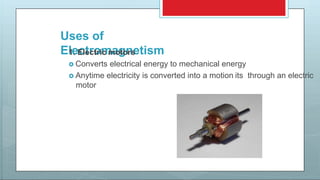
Uses of
Electromagnetism1. Electric motors
 Converts electrical energy to mechanical energy
 Anytime electricity is converted into a motion its through an electric
motor
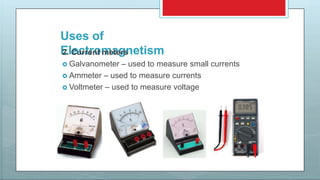
Uses of
Electromagnetism2. Current meters
 Galvanometer – used to measure small currents
 Ammeter – used to measure currents
 Voltmeter – used to measure voltage
Magnetism to Electricity
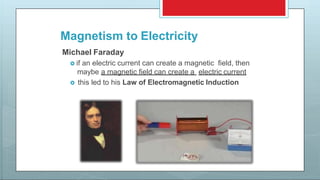
Michael Faraday
 if an electric current can create a magnetic field, then
maybe a magnetic field can create a electric current
 this led to his Law of Electromagnetic Induction

Magnet by dr.nidhi

  • 1.
    THE WORLD OFMAG ETS Nootan Physiotherapy College, Visnagar. Prepared By: Dr. Nidhi Vedawala
  • 2.
  • 3.
  • 4.
    LIKES REPEL (THEY“IGNORE EACH OTHER”
  • 5.
    A MAGNETIC FIELDIS… …THE AREA AROUND MAGNET …WHERE IT CAN ATTRACT OR REPEL THINGS
  • 6.
    WHAT KINDS OFTHINGS ARE MAGNETIC?
  • 7.
  • 8.
    USING A ,WALKAROUND THE ROOM AND FIND DIFFERENT THINGS THAT ARE MAGNETIC!
  • 9.
    IF THEY AREMAGNETIC, THEY WILL STICK TO THE MAGNET
  • 10.
    IF THEY ARENOT MAGNETIC, THEY WILL NOT STICK TO THE MAGNET
  • 11.
  • 12.
  • 13.
    WERE THESE OBJECTSMAGNETIC OR NON-MAGNETIC?
  • 14.
  • 15.
  • 16.
  • 17.
    HISTOR Y Term comesfrom the ancient Greek city of Magnesia, at which many natural magnets were found.  We now refer to these natural magnets as lodestones (lode means to lead or to attract) which contain magnetite, a natural magnetic material Fe3O4.
  • 18.
    HISTOR Y Pliny theElder (23-79 AD Roman) wrote of a hill near the river Indus that was made entirely of a stone that attracted iron.
  • 19.
    HISTOR Y Chinese asearly as 121 AD knew that an iron rod which had been brought near one of these natural magnets would acquire and retain the magnetic property, and that such a rod when suspended from a string would align itself in a north-south direction.  Use of magnets to aid in navigation can be traced back to at least the eleventh century.
  • 20.
    What is magnetism? Magnetism is the force of attraction or repulsion of a magnetic material due to the arrangement of its atoms, particularly its electrons.
  • 21.
    What causes magnetism? Atoms themselves have magnetic properties due to the spin of the atom‟s electrons.  Groups of atoms join so that their magnetic fields are all going in the same direction.  These areas of atoms are called “domains”.
  • 22.
    What causes magnetism? When an unmagnetized substance is placed in a magnetic field, the substance can become magnetized.  This happens when the spinning electrons line up in the same direction.
  • 23.
    What causes magnetism? An unmagnetized substance looks like this…  While a magnetized substance looks like this…
  • 24.
    How to “break”a magnet?  Drop it.  Heat it.  This causes the domains to become random again!
  • 25.
    A big naturalmagnet..  It exerts magnetic forces and is surrounded by a magnetic field that is strongest near the North and South magnetic poles. Magnetic South Pole Magnetic North Pole Geographic North Pole Geographic South Pole
  • 26.
    Why does amagnet suspended freely comes to rest only in North- South direction? This is because the earth behaves like a huge bar magnet.
  • 27.
    What are NaturalMagnets? • The naturally occurring materials which have the property of attracting iron. • These are weak magnets. What are Artificial Magnets? • They are made of materials like iron, cobalt and nickel which can be easily magnetized. • They are strong magnets. • They can be made in different shapes and sizes.
  • 28.
  • 29.
    Types of Magnets Permanent magnets: are magnets that retain their magnetism once magnetized.Ferromagnetic material which include iron, nickel, cobalt, some alloys of rare earth metals, and some naturally occurring minerals such as lodestone.  Temporary magnets: are materials magnets that perform like permanent magnets when in the presence of a magnetic field, but lose magnetism when not in a magnetic field. Example : Electromagnets.  Electromagnets: are wound coils of wire that function as magnets when an electrical current is passed through. By adjusting the strength and direction of the current, the strength of the magnet is also altered. Often, the coil is wrapped around acore of "soft" ferromagnetic material such as steel.
  • 30.
    Magnetic Dipoles  Everymagnet is a magneticdipole.  If a magneticpieceof steel rod is cut intosmallerpieces, each piece is a magnetwitha N ora S pole.  Thereforea magnetcan be said to be madeof lotsof "tiny" magnetsall lined upwith their N poles pointing in the samedirection. At theends, the "free" poles of the "tiny" magnets repel each other and fan out so the poles of the magnetare round theends.  Magnetic Monopole does notexists
  • 31.
    Permanent Magnet andElectromagnet persistent magnetic field. As the name suggests, a permanent magnet is 'permanent'. This means that it always has a magnetic field and will display a magnetic behavior atall times.  A permanent magnet is an An electromagnet is made from object made from a material that a is magnetized and creates its own coil of wire which acts as a magnet when an electriccurrent passes through it. Often an electromagnet is wrapped around a core of ferromagnetic material like steel, which enhances the magnetic field produced by the coil.
  • 32.
    Permanent Magnet VsElectromagnet  1.Properties: Permanent magnet has persistence magnetic field. An electromagnetic magnet only displays magnetic properties when an electric current is applied to it  2. Magnetic Strength: Permanent magnet magnetic strength depends upon the material used in its creation. The strength of an electromagnet can be adjusted by the amount of electric current allowed to flow into it  3. Advantages : The main advantage of a permanent magnet over an electromagnet is that a permanent magnet does not require a continuous supply of electrical energy to maintain its magnetic field. However, an electromagnet’s magnetic field can be rapidly manipulated over a wide range by controlling the amount of electric current supplied to the electromagnet.
  • 33.
    What is anelectromagnet ? • An electromagnet is a solenoid with a soft iron core.
  • 34.
    The strength ofan electromagnet depends on: Number of turns in its coils & Amount of current passing through the coil USES OF ELECTROMAGNET They are used in appliances such as electric motors, electric fans and electric bells. • They are used in lifting heaving loads of iron and scrap and are also used in cranes to lift vehicles. • They are used to deflect beams of electrons in TVs. • They are used to separate iron ores from impurities in mining industries. • They are used in relays in telephone exchanges and in computers. • They are used by doctors to cure certain diseases.
  • 35.
    Bar Magnet Electromagnet •Made of steel • Made of soft iron • Poles cannot be reversed • Poles can be reversed • It produces a permanent magnetic field • It produces a temporary magnetic field • Strength of magnetic field cannot be changed • Strength of magnetic field can be changed • Does not need electric current to act as a magnet • Requires electric current to act as an electromagnet Comparison between a Bar Magnet and an Electromagnet
  • 36.
    Temporary Magnets • Temporarymagnets are those which act like a permanent magnet when they are within a strong magnetic field, but lose their magnetism when the magnetic field disappears. • Examples paperclips and nails and other soft iron items.
  • 37.
    Permanent Magnets • Permanentmagnets are those we are most familiar with, such as the magnets hanging onto our refrigerator doors. They are permanent in the sense that once they are magnetized, they retain a level of magnetism.
  • 38.
    Properties of Magnets 1)Magnets attract objects of iron, cobalt and nickel. 2) The force of attraction of a magnet is greater at its poles than in the middle. 3) Like poles of two magnets repel each other. 4) Opposite poles of two magnets attracts each other. 5) If a bar magnet is suspended by a thread and if it is free to rotate, its South Pole will move towards the North Pole of the earth and vice versa.
  • 39.
    North and SouthPoles, cont.  It has not been shown to be possible to end up with a single North pole or a single South pole, which is a monopole ("mono" means one or single, thus one pole).
  • 40.
    North and SouthPoles  Every magnet has at least one north pole and one south pole.  If you take a bar magnet and break it into two pieces, each piece will again have a north pole and a south pole.  No matter how small the pieces of the magnet become, each piece will have a north pole and a south pole.
  • 41.
    Magnetic Fields  MichaelFaraday realized that a magnet has a „magnetic field‟ distributed throughout the surrounding space.  This field exerts a force on any charge/magnetic material on it.
  • 42.
    Magnetic Fields, cont. Field lines converge where the magnetic force is strong, and spread out where it is weak. In a compact bar magnet or dipole, field lines spread out from one pole and converge towards the other.
  • 43.
    Like poles, unlikepoles  LAW of MAGNETISM: Like poles repel, unlike poles attract.
  • 44.
    Attract only magneticmaterials  Magnets only attract certain types of metals, other materials such as glass, plastic and wood aren't attracted.  Metals such as iron, nickel and cobalt are attracted to magnets.  Most metals however are not attracted to magnets, these include copper, silver, gold, magnesium, platinum, aluminium and more. They may however magnetize a small amount while placed in a magnetic field.  Magnetism can attract magnetic objects or push them away.
  • 45.
    Magnetic lines offorce • The imaginary lines which represent the direction of magnetic field, are known as magnetic lines of force. • Magnetic lines of force are closed curves. Outside the magnet their direction is from north pole to south pole and inside the magnet these are from south to north pole.
  • 46.
    Properties of MagneticLines of Force • They are continuous closed curves. • They travel from North to South pole outside and from South to North pole inside. • They curve towards the magnet. • They never intersect each other. • They are more concentrated near the poles of the magnet where the magnetic field is the strongest.
  • 47.
    Electricity to Magnetism HansOersted  first observed that a current in a wire affects a nearby compass needle  Implication: an electric current creates a magnetic field
  • 48.
    Uses of Electromagnetism1. Electricmotors  Converts electrical energy to mechanical energy  Anytime electricity is converted into a motion its through an electric motor
  • 49.
    Uses of Electromagnetism2. Currentmeters  Galvanometer – used to measure small currents  Ammeter – used to measure currents  Voltmeter – used to measure voltage
  • 50.
    Magnetism to Electricity MichaelFaraday  if an electric current can create a magnetic field, then maybe a magnetic field can create a electric current  this led to his Law of Electromagnetic Induction