Downloaded 195 times
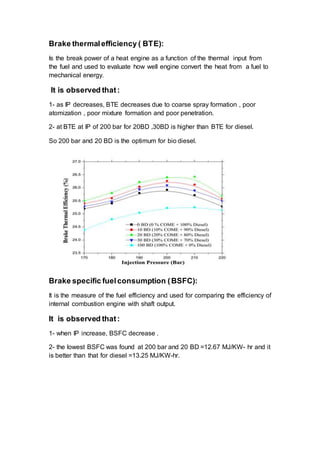
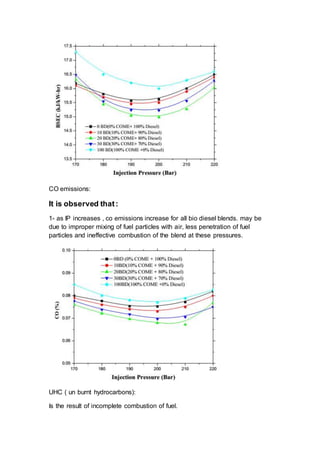
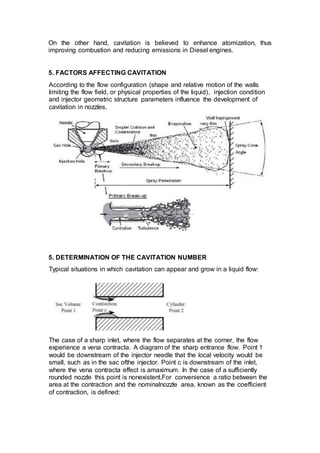
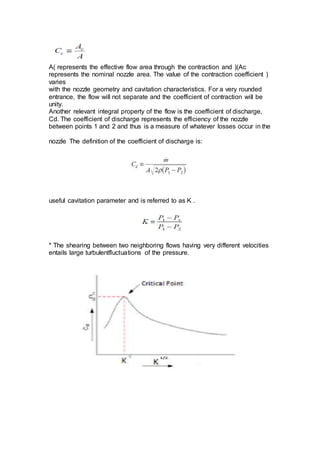
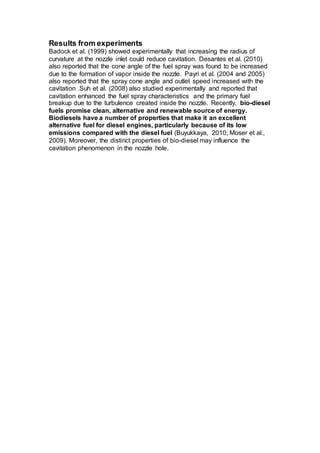
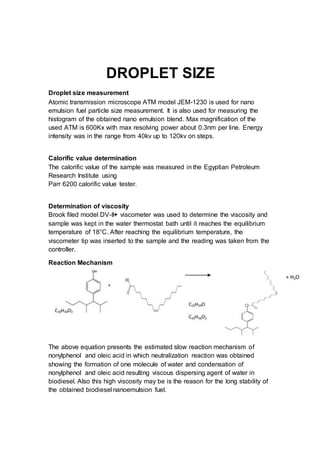
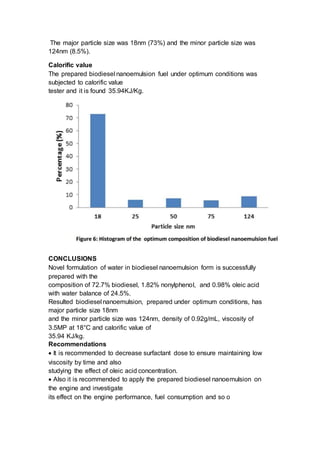
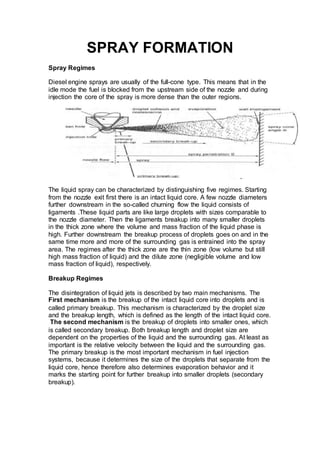
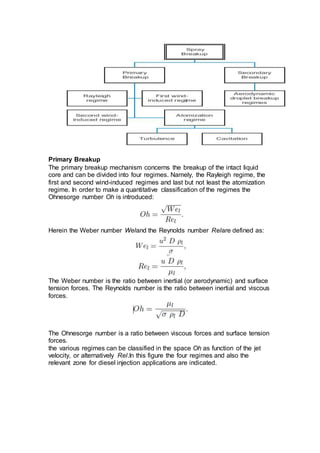
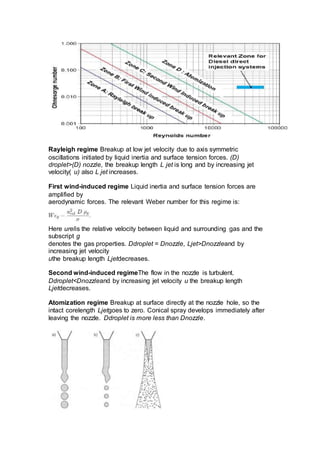
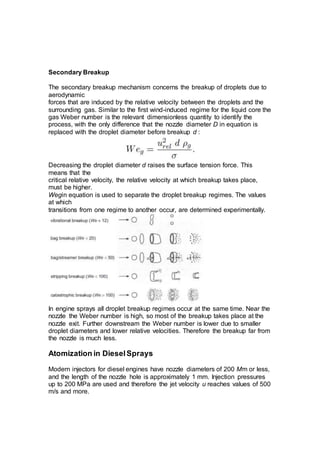
![Some possible sources for atomization are shortly treated in the
following.
Aerodynamic shear forces amplify the surface waves created by the
turbulence in the nozzle hole. The waves separate from the jet and form
droplets. There are two reasons why this aerodynamic source is less
important. First, this process is time dependent, but it is known from
experiments that jets break immediately at the exit of the nozzle. Second,
aerodynamic breakup is a surface effect, so it cannot explain disintegration of
the inner structure.
Relaxation of velocity profileAt the wall inside the nozzle a no-slip
boundary conditions exists. When the liquid exits the nozzle, the velocity
profile will transform into a uniform one. In order to realize that the outer
region of the liquid accelerates, which may cause instabilities and ultimately
result in breakup into droplets. However, in modern diesel engines the length
to diameter ratio of the nozzle hole is typically small ([ L/D]nozzle = 5), so
probably the flow in the nozzle has no time to develop.
Turbulence The presence of radial turbulent velocity fluctuations in the jet
results, if strong enough to overcome the surface tension, in formation of
droplets. Turbulence-induced primary breakup is considered one of the most
important mechanisms in high pressure applications.
Fuel Spray Characteristics
The most important diesel fuel spray characteristics may be classified as
• Macroscopic quantities such as:
– Spray tip penetration
– Cone angle
• Microscopic quantities such as:
– Droplet size
All fuel spray characteristics influence the combustion process
and engine performance.
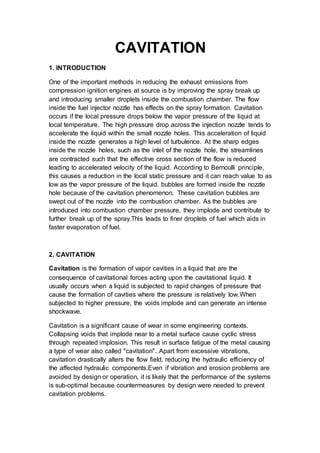
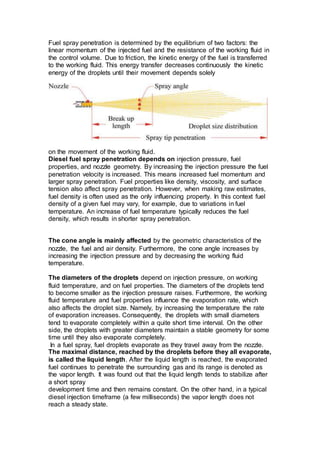
-Fuel spray tip penetration(Lp (is defined as the maximal distance measured
from the injector to the spray tip.
-Spray cone angle(θ) is defined as the angle between two straight lines
originating from the orifice exit of the nozzle and being tangent to the spray
outline. This angle usually ranges from 5 to 30.
-Droplet size is usually measured on an average basis by the medium
diameter of the droplets, called the Sauter mean diameter.](https://image.slidesharecdn.com/1f739297-ccb9-4405-8c78-dd490ba4d4f5-160128203033/85/FUEL-INJECTION-AND-SPRAY-FORMATION-22-320.jpg)
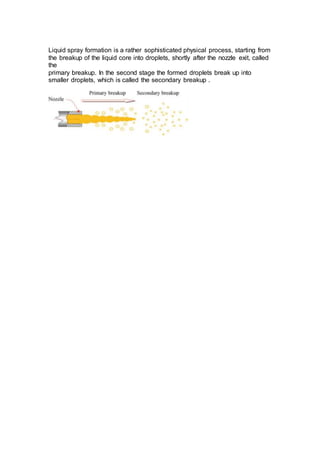

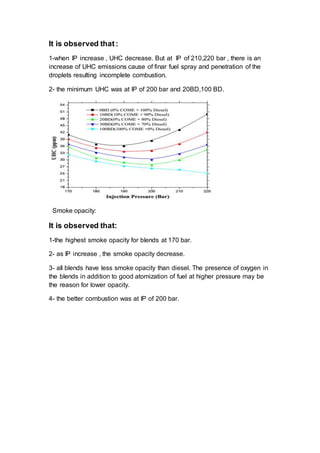
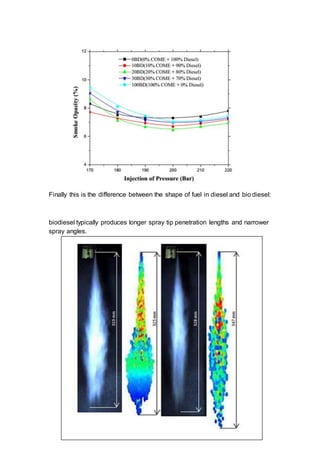
The document discusses fuel injection and spray formation in diesel engines. It examines the effects of injection pressure on engine performance and emissions. The results of an experiment showed that brake thermal efficiency peaked at an injection pressure of 200 bars, while brake specific fuel consumption was lowest. CO and smoke emissions decreased with higher injection pressure, while UHC first decreased and then increased as pressure became too high. Optimal injection pressure was found to be 200 bars for a 20% biodiesel blend. Cavitation in the fuel injector nozzle enhances spray atomization and improves combustion. Nozzle geometry and injection conditions can affect cavitation.


