CRANKCASE VENTILATION
       SYSTEM
  POSITIVE CRANKCASE VENTILATION
              (PCV)
CRANKCASE VENTILATION SYSTEM

 A way for gases to escape in a controlled manner from
crankcase of an internal combustion engine.

 Internal combustion inevitably involves a small but continual
amount of blow-by.

 Occurs when some of the gases from the combustion leak past
the piston rings to end up inside the crankcase.
POSITIVE CRANKCASE VENTILATION ( PCV)

 During World War II, different type of crankcase ventilation be invented
to allow tank engines operate.

 Normal draft tube ventilator allow water to enter the crankcase and
destroy the engine.

 PCV reduces blow-by emissions from the engine.

 20% of HC emissions produced by a vehicle.

 The higher the mileage on engine and the greater the wear on the piston
and cylinders, the greater the blow-by into the crankcase.
MAJOR COMPONENT

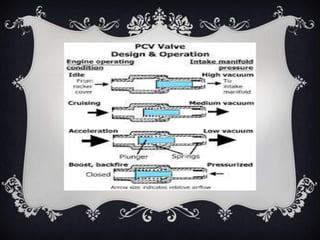
 The major component in PCV are PCV valve, a simple spring-
loaded valve with a sliding pintle inside.
 The pintle is tapered like a bullet so it will increase or decrease
airflow depending on its position.
 The movement of the pintle changes the orifice opening.
 The PCV valve is located in a valve cover or the intake valley,
and fits into a rubber grommet.
HOW PCV WORKS

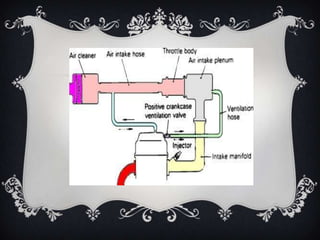
 A hose connects the top of PCV valve to a vacuum port on
throttle body, carburetor or intake manifold.

 This allows the vapors to be siphoned directly into engine w/o
gumming up throttle body or carburetor.

 PCV has the same effect on the air/fuel mixture as a vacuum
leak.
Positive crankcase ventilation

Positive crankcase ventilation

  • 1.
    CRANKCASE VENTILATION SYSTEM POSITIVE CRANKCASE VENTILATION (PCV)
  • 2.
    CRANKCASE VENTILATION SYSTEM A way for gases to escape in a controlled manner from crankcase of an internal combustion engine.  Internal combustion inevitably involves a small but continual amount of blow-by.  Occurs when some of the gases from the combustion leak past the piston rings to end up inside the crankcase.
  • 3.
    POSITIVE CRANKCASE VENTILATION( PCV)  During World War II, different type of crankcase ventilation be invented to allow tank engines operate.  Normal draft tube ventilator allow water to enter the crankcase and destroy the engine.  PCV reduces blow-by emissions from the engine.  20% of HC emissions produced by a vehicle.  The higher the mileage on engine and the greater the wear on the piston and cylinders, the greater the blow-by into the crankcase.
  • 4.
    MAJOR COMPONENT  Themajor component in PCV are PCV valve, a simple spring- loaded valve with a sliding pintle inside.  The pintle is tapered like a bullet so it will increase or decrease airflow depending on its position.  The movement of the pintle changes the orifice opening.  The PCV valve is located in a valve cover or the intake valley, and fits into a rubber grommet.
  • 6.
    HOW PCV WORKS A hose connects the top of PCV valve to a vacuum port on throttle body, carburetor or intake manifold.  This allows the vapors to be siphoned directly into engine w/o gumming up throttle body or carburetor.  PCV has the same effect on the air/fuel mixture as a vacuum leak.