AN INTERNSHIP REPORT
By J.RAMAKRISHNAN (SASTRA UNIVERSITY)
INTERNSHIP DONE UNDER
PROFESSOR
Dr. A RAMESH
(IIT MADRAS)
IN
IC ENGINES LABORATORY
FROM
(MAY 3rd to JUNE 25th)
ACKNOWLEDGEMENT
I WOULD LIKE TO THANK MY COLLEGE SASTRA
UNIVERSITY FOR ALLOWING ME TO PURSUE AN
INTERNSHIP IN IIT MADRAS AND I WOULD ALSO LIKE TO
THANK IIT MADRAS FOR PROVIDING ME THE FACILTIES
FOR COMPLETING MY INTERNSHIP SUCCESFULLY.I
WOULD ALSO LIKE TO THANK PROFESSOR DR.A.RAMESH
FOR PROVIDING ME THIS WONDERFUL OPPORTUNITY TO
PERFORM AN INTERNSHIP IN IIT UNDER HIS REPUTED
CONCERN AND I WOULD ALSO LIKE TO THANK THE
SUPPORT STAFF UNDER HIM WHO HELPED ME IN MAKING
MY INTERNSHIP SUCCESSFUL.
CONTENTS
 BIODIESEL AND ITS CHARACTERTICS ON ENGINE
PERFORMANCE
 AIR COMPRESSOR ENGINE FABRICATION AND
MODIFICATIONS
 LAB VIEW PROGRAMMING IN FIELD OF IC ENGINES
 AUTOCAD DRAWING AND DESIGN OF CAMSHAFT
 BOOST PORT FUEL INJECTION ON 2-STROKE LPG
FUELED ENGINE’S PERFORMANCE AND
CHARACTERISTICS
 LIQUID FUEL INJECTION IN 2 STROKE ENGINES
BIODIESEL
Biodiesel refers to a vegetable oil- or animal fat-based diesel fuel consisting of
long-chain alkyl esters. It is environment friendly and renewable source of
energy which can be used in the engines as a alternative or as blends to the
diesel fuel. Some of the commercially available blends are
 100% biodiesel is referred to as B100, while
 20% biodiesel, 80% petrodiesel is labeled B20
 5% biodiesel, 95% petrodiesel is labeled B5
 2% biodiesel, 98% petrodiesel is labeled B2.
Out of which B5 and B20 are used in IC engines and the better results are
obtained.
ADVANTAGES OF USING BIODDIESEL -:
 It is not toxic.
 It is renewable sourceof energy
 B20 biodiesel blend has been found to provide maximum increase in
thermal efficiency and lowest brake-specific energy consumption
 Biodiesel gives off less new carbon monoxide and carbondioxide, since
the gases released during combustion are essentially the gases absorbed
from the atmosphere whilst the plant growing- unlike the gases released
by burning petrodiesel, which was carbon previously locked away.
 Biodiesel is a better lubricant than petrodiesel, so it helps to extend the
working life of engines.
 Biodiesel gives fewer particulates when burnt, reducing risks from
respiratory problems.
 Biodiesel is easier to ignite than petrodiesel, meaning more complete,
efficient combustion.
DISADVANTAGES OF USING BIODIESEL:-
 Energy output: Biofuels have a lower energy output than traditional fuels
and therefore require greater quantities to be consumed in order to
producethe same energy level. This has led some noted energy analysts to
believe that biofuels are not worth the work.
 High cost:To refine biofuels to more efficient energy outputs, and to build
the necessary manufacturing plants to increase biofuel quantities, a high
initial investment is often required.
 Food prices: As demand for food crops suchas corn grows for biofuel
production, it could also raise prices for necessary staple food crops.
 Water use: Massive quantities of water are required for proper irrigation
of biofuel crops as well as to manufacture the fuel, which could strain
local and regional water resources.
 One of the main concerns regarding biodiesel is its viscosity. The
viscosity of diesel is 2.5–3.2 cSt at 40°C and the viscosity of biodiesel
made from soybean oil is between 4.2 and 4.6 cSt [132] The viscosity of
diesel must be high enough to provide sufficient lubrication for the engine
parts but slow enough to flow at operational temperature. High viscosity
can plug the fuel filter and injection system in engines
 Biodiesel has higher brake-specific fuel consumption compared to diesel,
which means more biodiesel fuel consumption is required for the same
torque
AIR COMPRESSOR ENGINE
A compressed-air vehicle (CAV) is powered by an air engine, using compressed
air, which is stored in a tank. Instead of mixing fuel with air and burning it in
the engine to drive pistons with hot expanding gases, compressed-air vehicles
use the expansion of compressed air to drive their pistons
ADVANTAGES
 The costs involved to compress the air to be used in a vehicle are inferior
to the costs involved to fuel a normal combustion engine.
 Air is abundant, economical, transportable, storable and most
importantly,nonpolluting.
 The technology involved with compressed air reduces the production
costs ofvehicles by 20% because it is not necessary to assemble a
refrigeration system, a fuel tank, spark plugs or silencers.
 Air itself is not flammable
 The mechanical design of the motor is simple and robust
 It does not suffer from corrosiondamage resulting from the battery.
 Less manufacturing and maintenance costs.
 The tanks used in an air compressed motorcan be discarded or recycled
with less contamination than batteries.
 The tanks used in a compressed air motor have a longer lifespan in
comparison with batteries, which, after a while suffer from a reduction in
performance.
 Some of the air used is returned to the air tank.
WORKING
The first air cars will have air compressors built into them. After a brisk drive,
you'll be able to take the car home, put it into the garage and plug in the
compressor. Thecompressorwill use air from around the car to refill the
compressed air tank. Unfortunately, this is a rather slow method of refuelling
and will probably take up to two hours for a complete refill. If the idea of an air
car catches on, air refuelling stations will become available at ordinary gas
stations, where the tank can be refilled much more rapidly with air that's already
been compressed. Filling your tank at the pump will probably take about three
minutes
The first air cars will almost certainly use the Compressed Air Engine (CAE)
developed by the French company, Motor Development International (MDI).
Air cars using this engine will have tanks that will probably hold about 3,200
cubic feet (90.6 kilolitres) of compressed air. The vehicle's accelerator operates
a valve on its tank that allows air to be released into a pipe and then into the
engine, where the pressure of the air's expansion will push against the pistons
and turn the crankshaft. This will produceenough power for speeds of about 35
miles (56 kilometres) per hour. When the air car surpasses that speed, a motor
will kick in to operate the in-car air compressorso it can compress more air on
the fly and provide extra power to the engine. The air is also heated as it hits the
engine, increasing its volume to allow the car to move faster
DESIGNING OF ENGINE CYLINDER HEAD IN A
PERTOL START KEROSENE RUN LAWN MOWER
ENGINE
The design is such that there are 2 inlet valves and 2 outlet valves instead of 1
inlet and 1 outlet valves as already available in the Lawn Mower engine. The
process ofair intake results in four valves and the exhaust also comes out from
the four valves in 2 strokes .The cam shaft is designed in sucha way so as this
operation becomes a successfulone. Our job was to machine the engine
cylinder head and also represent the design of the older cam shaft in 2D using
the auto cad which was done successfully.
LAB VIEW PROGRAMMING IN THE FIELD OF
IC ENGINES
The basics of LABVIEW Software was learnt successfully in the period of our
internship and the basic programs using Shift registers, DAQMX and loops
were done successfully and as time constraint was there we were unable the
learn the full functionality of the lab view .We thank IIT for the opportunity
which was given to us to work on lab view.
BOOST PORT FUEL INJECTION ON 2-STROKE
LPG FUELED ENGINE’S PERFORMANCE AND
CHARACTERISTICS
There are some of the disadvantages in the 2stroke engines
 High speed two stroke engines are less efficient owing to the reduced
volumetric efficiency
 With engines working on otto cycle,a part of fresh mixture is lost as it
escapes through the exhaust portduring scavenging as a result the fuel
consumption gets increased and this reduces the thermal efficiency
 Effective compressionis less as the part of the piston stroke is lost with
provision of port
 With heavy load two stroke engines gets heated due to excessive heat
produced. Also at light loads the running of the engine is not very smooth
because of the increased dilution of charge.
These are some disadvantages in two stroke engines and it can be
minimised by using certain technologies or with certain methods and one
of them is using Boostport injection of LPG in a two stroke SI engine for
reduction in HC emission.
Abstract
The short circuiting of the fuel air mixture during scavenging is the main
reason for the high fuel consumption and Hydro carbon(HC) emissions in
2 stroke engines. Hence the LPG is injected through the boostportto
reduce the short circuiting losses. Here the fuel injector is located on one
of the boostportand air alone is fed through the other transfer and boost
ports for scavenging.
Results
Experiments were conducted at a constantengine speed of 3000 rpm. Higher
and part load operations were carried in experiments at throttle positions of 70%
and 30% respectively. In case of BPI at 70% throttle based on the opening of
boostports injection timing (114 degrees) a TDC were optimized based on
highest thermal efficiency and these were used for 25% throttle.
Conclusions
 Boostport injection of LPG reduces HC emissions at all conditions as
compared to LPG-MI.
Significant reductions were seen at high throttle conditions and also when
rich mixtures were used the same persists.
 At low throttle positions also BPI resulted in lower HC levels than LPG-
MI
 Generally BPI is better with rich than lean mixtures .it is also better at
higher throttle than lower throttle.
 NO emissions are higher with BPI as compared to LPG-MI when
equivalence ratio is greater than 0.9.
 At 70% throttle with lean mixtures lower Brake thermal efficiency ,brake
power and heat release were observed in BPI due to charge stratification.
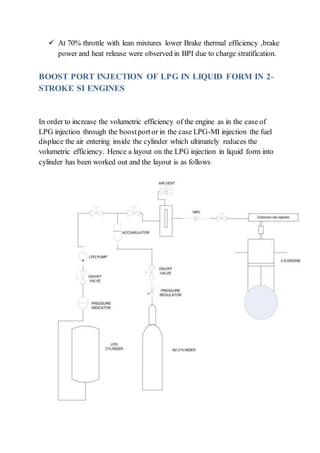
BOOST PORT INJECTION OF LPG IN LIQUID FORM IN 2-
STROKE SI ENGINES
In order to increase the volumetric efficiency of the engine as in the case of
LPG injection through the boostportor in the case LPG-MI injection the fuel
displace the air entering inside the cylinder which ultimately reduces the
volumetric efficiency. Hence a layout on the LPG injection in liquid form into
cylinder has been worked out and the layout is as follows
Conclusion
The projects mentioned are performed by the various Ph.D and M.S scholars
and I take the privilege in thanking them .I also thank ProfDr.A.Ramesh for
giving me this opportunity to pursue an Internship in IIT Madras from (3rd June
to 25th June).It’s my pleasure to do an internship in IIT and it is platform
provided by the IIT to gain knowledge and experience through practise and
intensive research. I thank the Management of SASTRA and IIT MADRAS for
providing the wonderful opportunity. With this report I conclude that I have
worked hard to the best of my satisfaction.
IIT INTERNSHIP REPORT

IIT INTERNSHIP REPORT

  • 1.
    AN INTERNSHIP REPORT ByJ.RAMAKRISHNAN (SASTRA UNIVERSITY) INTERNSHIP DONE UNDER PROFESSOR Dr. A RAMESH (IIT MADRAS) IN IC ENGINES LABORATORY FROM (MAY 3rd to JUNE 25th)
  • 2.
    ACKNOWLEDGEMENT I WOULD LIKETO THANK MY COLLEGE SASTRA UNIVERSITY FOR ALLOWING ME TO PURSUE AN INTERNSHIP IN IIT MADRAS AND I WOULD ALSO LIKE TO THANK IIT MADRAS FOR PROVIDING ME THE FACILTIES FOR COMPLETING MY INTERNSHIP SUCCESFULLY.I WOULD ALSO LIKE TO THANK PROFESSOR DR.A.RAMESH FOR PROVIDING ME THIS WONDERFUL OPPORTUNITY TO PERFORM AN INTERNSHIP IN IIT UNDER HIS REPUTED CONCERN AND I WOULD ALSO LIKE TO THANK THE SUPPORT STAFF UNDER HIM WHO HELPED ME IN MAKING MY INTERNSHIP SUCCESSFUL. CONTENTS  BIODIESEL AND ITS CHARACTERTICS ON ENGINE PERFORMANCE  AIR COMPRESSOR ENGINE FABRICATION AND MODIFICATIONS  LAB VIEW PROGRAMMING IN FIELD OF IC ENGINES  AUTOCAD DRAWING AND DESIGN OF CAMSHAFT  BOOST PORT FUEL INJECTION ON 2-STROKE LPG FUELED ENGINE’S PERFORMANCE AND CHARACTERISTICS  LIQUID FUEL INJECTION IN 2 STROKE ENGINES
  • 3.
    BIODIESEL Biodiesel refers toa vegetable oil- or animal fat-based diesel fuel consisting of long-chain alkyl esters. It is environment friendly and renewable source of energy which can be used in the engines as a alternative or as blends to the diesel fuel. Some of the commercially available blends are  100% biodiesel is referred to as B100, while  20% biodiesel, 80% petrodiesel is labeled B20  5% biodiesel, 95% petrodiesel is labeled B5  2% biodiesel, 98% petrodiesel is labeled B2. Out of which B5 and B20 are used in IC engines and the better results are obtained. ADVANTAGES OF USING BIODDIESEL -:  It is not toxic.  It is renewable sourceof energy  B20 biodiesel blend has been found to provide maximum increase in thermal efficiency and lowest brake-specific energy consumption  Biodiesel gives off less new carbon monoxide and carbondioxide, since the gases released during combustion are essentially the gases absorbed from the atmosphere whilst the plant growing- unlike the gases released by burning petrodiesel, which was carbon previously locked away.  Biodiesel is a better lubricant than petrodiesel, so it helps to extend the working life of engines.  Biodiesel gives fewer particulates when burnt, reducing risks from respiratory problems.  Biodiesel is easier to ignite than petrodiesel, meaning more complete, efficient combustion. DISADVANTAGES OF USING BIODIESEL:-  Energy output: Biofuels have a lower energy output than traditional fuels and therefore require greater quantities to be consumed in order to producethe same energy level. This has led some noted energy analysts to believe that biofuels are not worth the work.  High cost:To refine biofuels to more efficient energy outputs, and to build the necessary manufacturing plants to increase biofuel quantities, a high initial investment is often required.
  • 4.
     Food prices:As demand for food crops suchas corn grows for biofuel production, it could also raise prices for necessary staple food crops.  Water use: Massive quantities of water are required for proper irrigation of biofuel crops as well as to manufacture the fuel, which could strain local and regional water resources.  One of the main concerns regarding biodiesel is its viscosity. The viscosity of diesel is 2.5–3.2 cSt at 40°C and the viscosity of biodiesel made from soybean oil is between 4.2 and 4.6 cSt [132] The viscosity of diesel must be high enough to provide sufficient lubrication for the engine parts but slow enough to flow at operational temperature. High viscosity can plug the fuel filter and injection system in engines  Biodiesel has higher brake-specific fuel consumption compared to diesel, which means more biodiesel fuel consumption is required for the same torque AIR COMPRESSOR ENGINE A compressed-air vehicle (CAV) is powered by an air engine, using compressed air, which is stored in a tank. Instead of mixing fuel with air and burning it in the engine to drive pistons with hot expanding gases, compressed-air vehicles use the expansion of compressed air to drive their pistons ADVANTAGES  The costs involved to compress the air to be used in a vehicle are inferior to the costs involved to fuel a normal combustion engine.  Air is abundant, economical, transportable, storable and most importantly,nonpolluting.  The technology involved with compressed air reduces the production costs ofvehicles by 20% because it is not necessary to assemble a refrigeration system, a fuel tank, spark plugs or silencers.  Air itself is not flammable  The mechanical design of the motor is simple and robust  It does not suffer from corrosiondamage resulting from the battery.  Less manufacturing and maintenance costs.  The tanks used in an air compressed motorcan be discarded or recycled with less contamination than batteries.
  • 5.
     The tanksused in a compressed air motor have a longer lifespan in comparison with batteries, which, after a while suffer from a reduction in performance.  Some of the air used is returned to the air tank. WORKING The first air cars will have air compressors built into them. After a brisk drive, you'll be able to take the car home, put it into the garage and plug in the compressor. Thecompressorwill use air from around the car to refill the compressed air tank. Unfortunately, this is a rather slow method of refuelling and will probably take up to two hours for a complete refill. If the idea of an air car catches on, air refuelling stations will become available at ordinary gas stations, where the tank can be refilled much more rapidly with air that's already been compressed. Filling your tank at the pump will probably take about three minutes The first air cars will almost certainly use the Compressed Air Engine (CAE) developed by the French company, Motor Development International (MDI). Air cars using this engine will have tanks that will probably hold about 3,200 cubic feet (90.6 kilolitres) of compressed air. The vehicle's accelerator operates a valve on its tank that allows air to be released into a pipe and then into the engine, where the pressure of the air's expansion will push against the pistons and turn the crankshaft. This will produceenough power for speeds of about 35 miles (56 kilometres) per hour. When the air car surpasses that speed, a motor will kick in to operate the in-car air compressorso it can compress more air on the fly and provide extra power to the engine. The air is also heated as it hits the engine, increasing its volume to allow the car to move faster DESIGNING OF ENGINE CYLINDER HEAD IN A PERTOL START KEROSENE RUN LAWN MOWER ENGINE
  • 6.
    The design issuch that there are 2 inlet valves and 2 outlet valves instead of 1 inlet and 1 outlet valves as already available in the Lawn Mower engine. The process ofair intake results in four valves and the exhaust also comes out from the four valves in 2 strokes .The cam shaft is designed in sucha way so as this operation becomes a successfulone. Our job was to machine the engine cylinder head and also represent the design of the older cam shaft in 2D using the auto cad which was done successfully. LAB VIEW PROGRAMMING IN THE FIELD OF IC ENGINES The basics of LABVIEW Software was learnt successfully in the period of our internship and the basic programs using Shift registers, DAQMX and loops were done successfully and as time constraint was there we were unable the learn the full functionality of the lab view .We thank IIT for the opportunity which was given to us to work on lab view. BOOST PORT FUEL INJECTION ON 2-STROKE LPG FUELED ENGINE’S PERFORMANCE AND CHARACTERISTICS There are some of the disadvantages in the 2stroke engines  High speed two stroke engines are less efficient owing to the reduced volumetric efficiency  With engines working on otto cycle,a part of fresh mixture is lost as it escapes through the exhaust portduring scavenging as a result the fuel consumption gets increased and this reduces the thermal efficiency  Effective compressionis less as the part of the piston stroke is lost with provision of port
  • 7.
     With heavyload two stroke engines gets heated due to excessive heat produced. Also at light loads the running of the engine is not very smooth because of the increased dilution of charge. These are some disadvantages in two stroke engines and it can be minimised by using certain technologies or with certain methods and one of them is using Boostport injection of LPG in a two stroke SI engine for reduction in HC emission. Abstract The short circuiting of the fuel air mixture during scavenging is the main reason for the high fuel consumption and Hydro carbon(HC) emissions in 2 stroke engines. Hence the LPG is injected through the boostportto reduce the short circuiting losses. Here the fuel injector is located on one of the boostportand air alone is fed through the other transfer and boost ports for scavenging. Results Experiments were conducted at a constantengine speed of 3000 rpm. Higher and part load operations were carried in experiments at throttle positions of 70% and 30% respectively. In case of BPI at 70% throttle based on the opening of boostports injection timing (114 degrees) a TDC were optimized based on highest thermal efficiency and these were used for 25% throttle. Conclusions  Boostport injection of LPG reduces HC emissions at all conditions as compared to LPG-MI. Significant reductions were seen at high throttle conditions and also when rich mixtures were used the same persists.  At low throttle positions also BPI resulted in lower HC levels than LPG- MI  Generally BPI is better with rich than lean mixtures .it is also better at higher throttle than lower throttle.  NO emissions are higher with BPI as compared to LPG-MI when equivalence ratio is greater than 0.9.
  • 8.
     At 70%throttle with lean mixtures lower Brake thermal efficiency ,brake power and heat release were observed in BPI due to charge stratification. BOOST PORT INJECTION OF LPG IN LIQUID FORM IN 2- STROKE SI ENGINES In order to increase the volumetric efficiency of the engine as in the case of LPG injection through the boostportor in the case LPG-MI injection the fuel displace the air entering inside the cylinder which ultimately reduces the volumetric efficiency. Hence a layout on the LPG injection in liquid form into cylinder has been worked out and the layout is as follows
  • 9.
    Conclusion The projects mentionedare performed by the various Ph.D and M.S scholars and I take the privilege in thanking them .I also thank ProfDr.A.Ramesh for giving me this opportunity to pursue an Internship in IIT Madras from (3rd June to 25th June).It’s my pleasure to do an internship in IIT and it is platform provided by the IIT to gain knowledge and experience through practise and intensive research. I thank the Management of SASTRA and IIT MADRAS for providing the wonderful opportunity. With this report I conclude that I have worked hard to the best of my satisfaction.