NMR SPECTROSCOPY IN BIOLOGY
CONTENTS Introduction Basic principles in NMR spectroscopy Instrumentation Interpretation of NMR spectra Applications in the field of biology
Introduction
introduction History First described and measured by Isidor Rabi in 1938. In 1946, Felix Bloch & Edward Mills Purcell refined the technique for use on liquids & solids for which they shared the Nobel Prize in physics in 1952. The observation of resonance frequencies of a molecule allows a user to discover structural information about a molecule. Contd…
Basic Principles in NMR Spectroscopy
basic principle in NMR spectroscopy Magnetic phenomena Atomic nuclei – tiny magnets In external field – align or oppose Number of nucleons  Must be odd for residual magnetism For e.g. Hydrogen exhibits, Deuterium does not Contd…
Resonance condition Transition from low to high energy state occurs h ﬠ  = gßH Either a constant magnetic field is applied and appropriate region of RF is swept Or a constant frequency is employed & the external magnetic field is swept basic principle in NMR spectroscopy Contd…
Chemical shift Arises   from applied field inducing secondary fields at the proton by interacting with adjacent bonding electrons Is measured relative to an internal  standard – TMS Spin – spin splitting Seen in high resolution spectroscopy basic principle in NMR spectroscopy Contd…
E.g. of ethanol a) Low resolution spectrum  b)  High resolution spectrum Contd…
Instrumentation
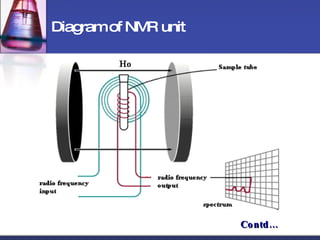
Diagram of NMR unit Contd…
instrumentation Contd…
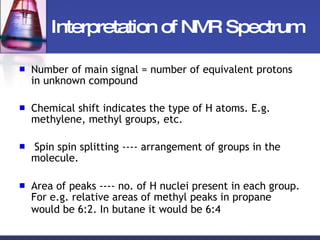
Interpretation of NMR Spectrum Number of main signal = number of equivalent protons in unknown compound Chemical shift indicates the type of H atoms. E.g. methylene, methyl groups, etc. Spin spin splitting ---- arrangement of groups in the molecule. Area of peaks ---- no. of H nuclei present in each group. For e.g. relative areas of methyl peaks in propane would be 6:2. In butane it would be 6:4
E.g. of Ethanol
Application in the field of Biology
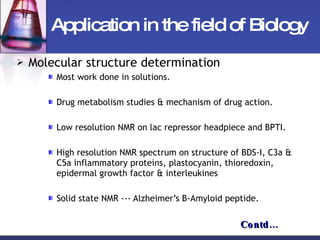
Application in the field of Biology Molecular structure determination Most work done in solutions. Drug metabolism studies & mechanism of drug action. Low resolution NMR on lac repressor headpiece and BPTI. High resolution NMR spectrum on structure of BDS-I, C3a & C5a inflammatory proteins, plastocyanin, thioredoxin, epidermal growth factor & interleukines Solid state NMR --- Alzheimer’s B-Amyloid peptide. Contd…
E.g. of Ibuprofen
Molecular behavior in solutions Results of studies of protein folding are exemplified by ribonuclease A, cytochrome c, barnase, lysozyme, ubiquitin and BPTI. Enzyme kinetics, e.g. : chymotrypsin, trypsin, papain, pepsin, ATPase, ribonuclease, pyruvate kinase, etc. Contd…
Phosphate metabolism 31 P isotope exhibits nuclear resonance Changing concentration of AMP, ADP & ATP in living cells Intracellular & extracellular Pi concentrations Contd…
Nucleic acids Structural studies of DNA & RNA Drug interactions with DNA Interactions between binding proteins & DNA Interaction between protein & lipid bilayers in membranes have been observed. Contd…
Magnetic Resonance Imaging (MRI) Resonance of  1 H is considered. Proton is more sensitive. Present in abundance . Contd…
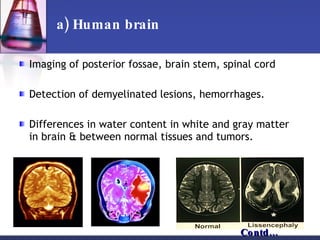
Human brain Imaging of posterior fossae, brain stem, spinal cord Detection of demyelinated lesions, hemorrhages. Differences in water content in white and gray matter in brain & between normal tissues and tumors. Contd…
Abdomen Metabolic liver disease. In adipose tissue --- proton signals from lipids is measurable & hence the fatty deposits can be viewed. Contd…
Advantages of MRI Eliminates risk of X-radiation. Excellent and contrast resolution. Detecting disease at earlier stages.
Advantages of NMR spectroscopy A considerable amount of information can be obtained from a single analysis The technique is non destructive Replicate analysis may be performed Precious samples may be recovered
References Principles and techniques in Biochemistry & Molecular biology, by Keith Wilson & Walker, 8 th  edition. Nuclear Chemistry by R. K. Dave Biochemistry with clinical correlation by Thomas M. Delvin Websites: http://biologyreference.com http://chemnmr.colorado.edu/microinfo

Nmr Spectroscopy In B Iology

  • 1.
  • 2.
    CONTENTS Introduction Basicprinciples in NMR spectroscopy Instrumentation Interpretation of NMR spectra Applications in the field of biology
  • 3.
  • 4.
    introduction History Firstdescribed and measured by Isidor Rabi in 1938. In 1946, Felix Bloch & Edward Mills Purcell refined the technique for use on liquids & solids for which they shared the Nobel Prize in physics in 1952. The observation of resonance frequencies of a molecule allows a user to discover structural information about a molecule. Contd…
  • 5.
    Basic Principles inNMR Spectroscopy
  • 6.
    basic principle inNMR spectroscopy Magnetic phenomena Atomic nuclei – tiny magnets In external field – align or oppose Number of nucleons Must be odd for residual magnetism For e.g. Hydrogen exhibits, Deuterium does not Contd…
  • 7.
    Resonance condition Transitionfrom low to high energy state occurs h ﬠ = gßH Either a constant magnetic field is applied and appropriate region of RF is swept Or a constant frequency is employed & the external magnetic field is swept basic principle in NMR spectroscopy Contd…
  • 8.
    Chemical shift Arises from applied field inducing secondary fields at the proton by interacting with adjacent bonding electrons Is measured relative to an internal standard – TMS Spin – spin splitting Seen in high resolution spectroscopy basic principle in NMR spectroscopy Contd…
  • 9.
    E.g. of ethanola) Low resolution spectrum b) High resolution spectrum Contd…
  • 10.
  • 11.
    Diagram of NMRunit Contd…
  • 12.
  • 13.
    Interpretation of NMRSpectrum Number of main signal = number of equivalent protons in unknown compound Chemical shift indicates the type of H atoms. E.g. methylene, methyl groups, etc. Spin spin splitting ---- arrangement of groups in the molecule. Area of peaks ---- no. of H nuclei present in each group. For e.g. relative areas of methyl peaks in propane would be 6:2. In butane it would be 6:4
  • 14.
  • 15.
    Application in thefield of Biology
  • 16.
    Application in thefield of Biology Molecular structure determination Most work done in solutions. Drug metabolism studies & mechanism of drug action. Low resolution NMR on lac repressor headpiece and BPTI. High resolution NMR spectrum on structure of BDS-I, C3a & C5a inflammatory proteins, plastocyanin, thioredoxin, epidermal growth factor & interleukines Solid state NMR --- Alzheimer’s B-Amyloid peptide. Contd…
  • 17.
  • 18.
    Molecular behavior insolutions Results of studies of protein folding are exemplified by ribonuclease A, cytochrome c, barnase, lysozyme, ubiquitin and BPTI. Enzyme kinetics, e.g. : chymotrypsin, trypsin, papain, pepsin, ATPase, ribonuclease, pyruvate kinase, etc. Contd…
  • 19.
    Phosphate metabolism 31P isotope exhibits nuclear resonance Changing concentration of AMP, ADP & ATP in living cells Intracellular & extracellular Pi concentrations Contd…
  • 20.
    Nucleic acids Structuralstudies of DNA & RNA Drug interactions with DNA Interactions between binding proteins & DNA Interaction between protein & lipid bilayers in membranes have been observed. Contd…
  • 21.
    Magnetic Resonance Imaging(MRI) Resonance of 1 H is considered. Proton is more sensitive. Present in abundance . Contd…
  • 22.
    Human brain Imagingof posterior fossae, brain stem, spinal cord Detection of demyelinated lesions, hemorrhages. Differences in water content in white and gray matter in brain & between normal tissues and tumors. Contd…
  • 23.
    Abdomen Metabolic liverdisease. In adipose tissue --- proton signals from lipids is measurable & hence the fatty deposits can be viewed. Contd…
  • 24.
    Advantages of MRIEliminates risk of X-radiation. Excellent and contrast resolution. Detecting disease at earlier stages.
  • 25.
    Advantages of NMRspectroscopy A considerable amount of information can be obtained from a single analysis The technique is non destructive Replicate analysis may be performed Precious samples may be recovered
  • 26.
    References Principles andtechniques in Biochemistry & Molecular biology, by Keith Wilson & Walker, 8 th edition. Nuclear Chemistry by R. K. Dave Biochemistry with clinical correlation by Thomas M. Delvin Websites: http://biologyreference.com http://chemnmr.colorado.edu/microinfo