Frontal Lobe Syndromes
Dr Zahiruddin Othman
2010
Introduction - definitions
• EXECUTIVE PROCESSES
– Processes that modulate (control) the operation of
other processes and that are responsible for the
coordination of mental activity so that a particular goal
is achieved
• FRONTAL EXECUTIVE HYPOTHESIS
– Every executive process is primarily mediated by the
PFC (prefrontal cortex)
• FRONTAL LOBE SYNDROMES
– Syndrome resulting from frontal lobe damage and
subsequent impairment of executive functions
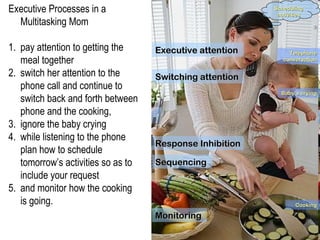
Executive Processes in a
Multitasking Mom
1. pay attention to getting the
meal together
2. switch her attention to the
phone call and continue to
switch back and forth between
phone and the cooking,
3. ignore the baby crying
4. while listening to the phone
plan how to schedule
tomorrow’s activities so as to
include your request
5. and monitor how the cooking
is going.
Executive attentionExecutive attention
Switching attentionSwitching attention
Response InhibitionResponse Inhibition
SequencingSequencing
MonitoringMonitoring
Baby’s cryingBaby’s crying
CookingCooking
TelephoneTelephone
conversationconversation
SchedulingScheduling
activitiesactivities
Motor Cortex
Superior
Temporal Cortex
Occipital Cortex
Executive Attention
STROOP TEST
State the color as fast as you can
colour
GREEN
word
RED
RED
GREEN
Conflict
Monitor
[cingulate]
Attention
Controller
[DLPFC]
INPUTINPUT RESPONSERESPONSE
DLPFC=dorsolateral prefrontal cortex
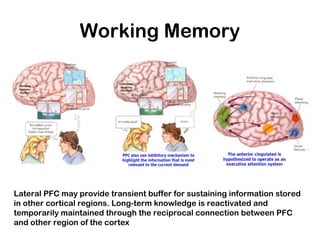
Working Memory
Lateral PFC may provide transient buffer for sustaining information stored
in other cortical regions. Long-term knowledge is reactivated and
temporarily maintained through the reciprocal connection between PFC
and other region of the cortex
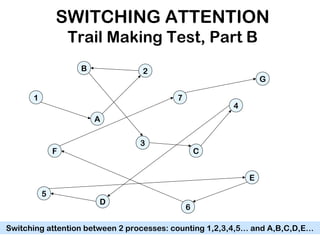
SWITCHING ATTENTION
Trail Making Test, Part B
1
2
3
4
5
6
7
A
B
C
D
E
F
G
Switching attention between 2 processes: counting 1,2,3,4,5… and A,B,C,D,E…
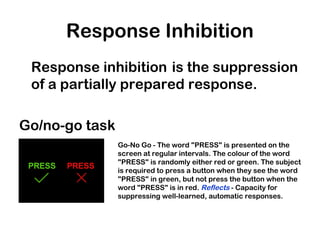
Response Inhibition
Response inhibition is the suppression
of a partially prepared response.
Go/no-go task
Go-No Go - The word "PRESS" is presented on the
screen at regular intervals. The colour of the word
"PRESS" is randomly either red or green. The subject
is required to press a button when they see the word
"PRESS" in green, but not press the button when the
word "PRESS" is in red. Reflects - Capacity for
suppressing well-learned, automatic responses.
PRESSPRESSPRESSPRESSPRESSPRESS
PRESS
PRESS
Go trials, when no inhibition is required
Dorsolateral prefrontal [DLPFC] cortex is activated
No-go trials, when response inhibition is required
DLPFC + Orbitofrontal cortex is activated
1) orbitofrontal cortex
2) lateral prefrontal cortex
3) ventromedial cortex
4) limbic system
Response Inhibition
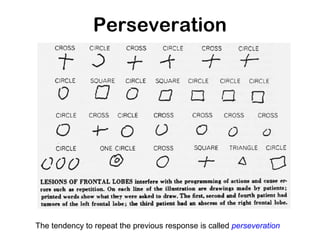
The tendency to repeat the previous response is called perseveration
Perseveration
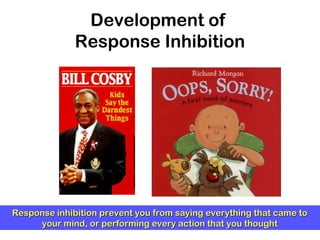
Development of
Response Inhibition
Response inhibition prevent you from saying everything that came toResponse inhibition prevent you from saying everything that came to
your mind, or performing every action that you thoughtyour mind, or performing every action that you thought
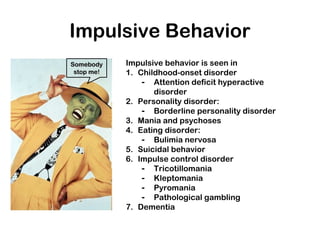
Impulsive Behavior
Impulsive behavior is seen in
1. Childhood-onset disorder
- Attention deficit hyperactive
disorder
2. Personality disorder:
- Borderline personality disorder
3. Mania and psychoses
4. Eating disorder:
- Bulimia nervosa
5. Suicidal behavior
6. Impulse control disorder
- Tricotillomania
- Kleptomania
- Pyromania
- Pathological gambling
7. Dementia
SomebodySomebody
stop me!stop me!
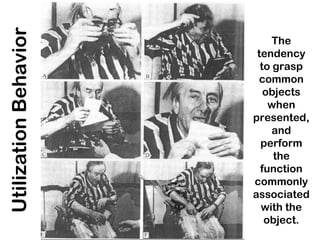
UtilizationBehavior
The
tendency
to grasp
common
objects
when
presented,
and
perform
the
function
commonly
associated
with the
object.
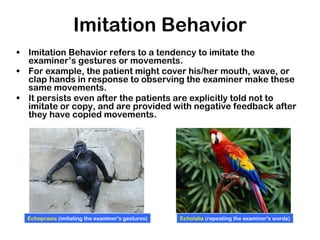
• Imitation Behavior refers to a tendency to imitate the
examiner’s gestures or movements.
• For example, the patient might cover his/her mouth, wave, or
clap hands in response to observing the examiner make these
same movements.
• It persists even after the patients are explicitly told not to
imitate or copy, and are provided with negative feedback after
they have copied movements.
Echopraxia (imitating the examiner's gestures) Echolalia (repeating the examiner's words)
Imitation Behavior
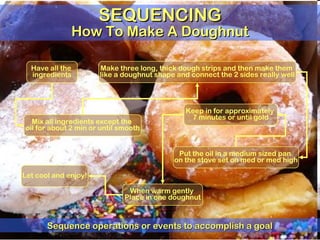
Mix all ingredients except the
oil for about 2 min or until smooth
Have all the
ingredients
Make three long, thick dough strips and then make them
like a doughnut shape and connect the 2 sides really well
Put the oil in a medium sized pan
on the stove set on med or med high
Keep in for approximately
7 minutes or until gold
Let cool and enjoy!
Sequence operations or events to accomplish a goalSequence operations or events to accomplish a goal
When warm gently
Place in one doughnut
SEQUENCINGSEQUENCING
How To Make A DoughnutHow To Make A Doughnut
Monitoring
Monitoring is the assessment of
one’s performance on a task while the
task is being performed. This is to be
distinguished from the ability to assess
(and improve) your performance after
the task is completed, either from
feedback received or your own view of
how things went.
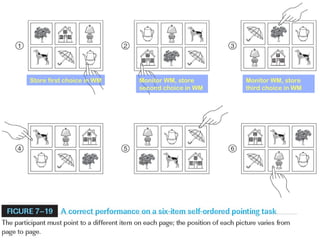
Store first choice in WM Monitor WM, store
second choice in WM
Monitor WM, store
third choice in WM
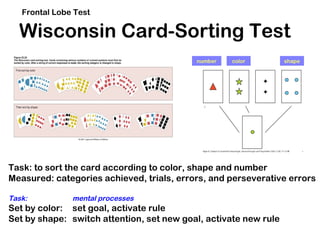
Wisconsin Card-Sorting Test
Task: to sort the card according to color, shape and number
Measured: categories achieved, trials, errors, and perseverative errors
Task: mental processes
Set by color: set goal, activate rule
Set by shape: switch attention, set new goal, activate new rule
number color shape
Frontal Lobe Test
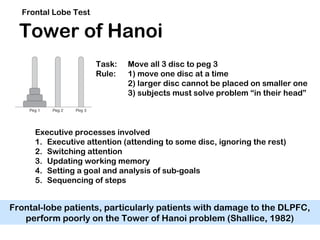
Tower of Hanoi
Frontal Lobe Test
Task: Move all 3 disc to peg 3
Rule: 1) move one disc at a time
2) larger disc cannot be placed on smaller one
3) subjects must solve problem “in their head”
Executive processes involved
1. Executive attention (attending to some disc, ignoring the rest)
2. Switching attention
3. Updating working memory
4. Setting a goal and analysis of sub-goals
5. Sequencing of steps
Frontal-lobe patients, particularly patients with damage to the DLPFC,
perform poorly on the Tower of Hanoi problem (Shallice, 1982)
Executive Functions
and Comportment
"Comportment" is a term that refers to social
behavior, insight, and "appropriateness" in
different social contexts. Normal comportment
involves having insight and the ability to
recognize what behavior is appropriate in a
particular social situation and to adapt one's
behavior to the situation.
For example, while it may be perfectly natural
and acceptable to take one's shoes and socks
off at home, it is probably not the thing to do
while in a restaurant.
Frontal Lobe Syndromes
or Dysexecutive syndromes
• Difficulties initiating behavior
• Perseveration (the inability to stop a
behavioral pattern once started)
• Exaggerated imitative and utilization
behavior
• Difficulties in planning and problem solving
• May be incapable of creative thinking
• Difficulties with holding complex structures
in mind
Orbitofrontal Lobe Syndrome
[disinhibited]
Frontal Convexity Syndrome
[apathetic]
 Impulsive behavior
(pseudopsychopathic)
 Inappropriate jocular
affect, euphoria
 Emotional lability
 Poor judgment and
insight
 Distractibility
 Apathy
(pseudodepressive)
 Indifference
 Psychomotor retardation
 Motor perseveration and
impersistence
 Stimulus-bound behavior
 Motor programming
deficits
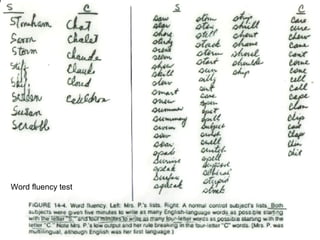
 Poor word list generation
Frontal Lobe Syndromes
Word fluency test
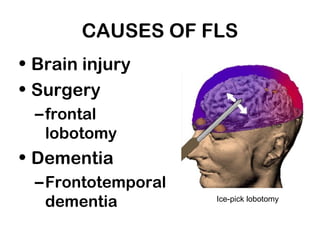
CAUSES OF FLS
• Brain injury
• Surgery
–frontal
lobotomy
• Dementia
–Frontotemporal
dementia Ice-pick lobotomy
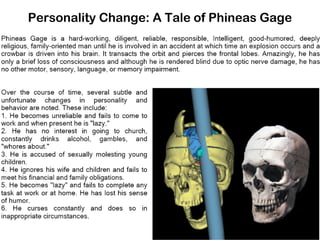
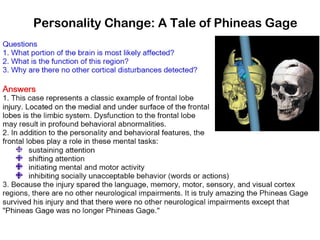
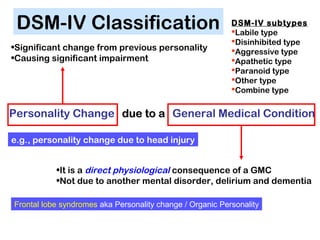
Personality Change: A Tale of Phineas Gage
Personality Change due to adue to a General Medical Condition
•Significant change from previous personality
•Causing significant impairment
•It is a direct physiological consequence of a GMC
•Not due to another mental disorder, delirium and dementia
DSM-IV subtypes
Labile type
Disinhibited type
Aggressive type
Apathetic type
Paranoid type
Other type
Combine type
e.g., personality change due to head injury
Frontal lobe syndromes aka Personality change / Organic Personality
DSM-IV Classification
Behavior in Dementia
Behavior is often disorganized,
inappropriate, distractible, and
restless. There are a few sign of
initiative. Changes in personality
may manifest as an antisocial
behavior, which sometimes
include sexual disinhibition or
shoplifting.
Behavior in Dementia
Goldstein (1975) describes the ways in
which behavior can be affected by
cognitive defects. Typically there is
reduction of interests [shrinkage of milieu]
and, rigid and stereotyped routines
[organic orderliness] and, when the person
is taxed beyond restricted abilities, a
sudden explosion of anger or other
emotion [catastrophic reaction]
Oxford textbook of psychiatry, second edition, page 351
Frontotemporal Dementia
FTD is associated with Kluver-Bucy syndrome [KBS]. The most common
symptoms of KBS in FTD is hyperorality manifested as bingeing, altered food
preferences especially for sweets, food fads, weight gain or increased smoking
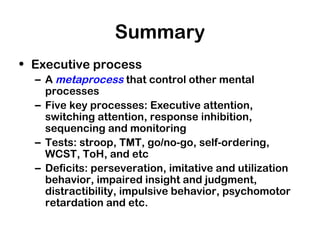
Summary
• Executive process
– A metaprocess that control other mental
processes
– Five key processes: Executive attention,
switching attention, response inhibition,
sequencing and monitoring
– Tests: stroop, TMT, go/no-go, self-ordering,
WCST, ToH, and etc
– Deficits: perseveration, imitative and utilization
behavior, impaired insight and judgment,
distractibility, impulsive behavior, psychomotor
retardation and etc.
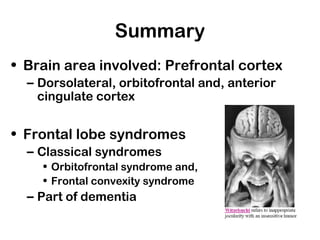
Summary
• Brain area involved: Prefrontal cortex
– Dorsolateral, orbitofrontal and, anterior
cingulate cortex
• Frontal lobe syndromes
– Classical syndromes
• Orbitofrontal syndrome and,
• Frontal convexity syndrome
– Part of dementia
Frontal Lobe Syndrome

Frontal Lobe Syndrome

  • 1.
    Frontal Lobe Syndromes DrZahiruddin Othman 2010
  • 2.
    Introduction - definitions •EXECUTIVE PROCESSES – Processes that modulate (control) the operation of other processes and that are responsible for the coordination of mental activity so that a particular goal is achieved • FRONTAL EXECUTIVE HYPOTHESIS – Every executive process is primarily mediated by the PFC (prefrontal cortex) • FRONTAL LOBE SYNDROMES – Syndrome resulting from frontal lobe damage and subsequent impairment of executive functions
  • 3.
    Executive Processes ina Multitasking Mom 1. pay attention to getting the meal together 2. switch her attention to the phone call and continue to switch back and forth between phone and the cooking, 3. ignore the baby crying 4. while listening to the phone plan how to schedule tomorrow’s activities so as to include your request 5. and monitor how the cooking is going. Executive attentionExecutive attention Switching attentionSwitching attention Response InhibitionResponse Inhibition SequencingSequencing MonitoringMonitoring Baby’s cryingBaby’s crying CookingCooking TelephoneTelephone conversationconversation SchedulingScheduling activitiesactivities
  • 4.
    Motor Cortex Superior Temporal Cortex OccipitalCortex Executive Attention STROOP TEST State the color as fast as you can colour GREEN word RED RED GREEN Conflict Monitor [cingulate] Attention Controller [DLPFC] INPUTINPUT RESPONSERESPONSE DLPFC=dorsolateral prefrontal cortex
  • 5.
    Working Memory Lateral PFCmay provide transient buffer for sustaining information stored in other cortical regions. Long-term knowledge is reactivated and temporarily maintained through the reciprocal connection between PFC and other region of the cortex
  • 6.
    SWITCHING ATTENTION Trail MakingTest, Part B 1 2 3 4 5 6 7 A B C D E F G Switching attention between 2 processes: counting 1,2,3,4,5… and A,B,C,D,E…
  • 7.
    Response Inhibition Response inhibitionis the suppression of a partially prepared response. Go/no-go task Go-No Go - The word "PRESS" is presented on the screen at regular intervals. The colour of the word "PRESS" is randomly either red or green. The subject is required to press a button when they see the word "PRESS" in green, but not press the button when the word "PRESS" is in red. Reflects - Capacity for suppressing well-learned, automatic responses. PRESSPRESSPRESSPRESSPRESSPRESS
  • 8.
    PRESS PRESS Go trials, whenno inhibition is required Dorsolateral prefrontal [DLPFC] cortex is activated No-go trials, when response inhibition is required DLPFC + Orbitofrontal cortex is activated 1) orbitofrontal cortex 2) lateral prefrontal cortex 3) ventromedial cortex 4) limbic system Response Inhibition
  • 9.
    The tendency torepeat the previous response is called perseveration Perseveration
  • 10.
    Development of Response Inhibition Responseinhibition prevent you from saying everything that came toResponse inhibition prevent you from saying everything that came to your mind, or performing every action that you thoughtyour mind, or performing every action that you thought
  • 11.
    Impulsive Behavior Impulsive behavioris seen in 1. Childhood-onset disorder - Attention deficit hyperactive disorder 2. Personality disorder: - Borderline personality disorder 3. Mania and psychoses 4. Eating disorder: - Bulimia nervosa 5. Suicidal behavior 6. Impulse control disorder - Tricotillomania - Kleptomania - Pyromania - Pathological gambling 7. Dementia SomebodySomebody stop me!stop me!
  • 12.
  • 13.
    • Imitation Behaviorrefers to a tendency to imitate the examiner’s gestures or movements. • For example, the patient might cover his/her mouth, wave, or clap hands in response to observing the examiner make these same movements. • It persists even after the patients are explicitly told not to imitate or copy, and are provided with negative feedback after they have copied movements. Echopraxia (imitating the examiner's gestures) Echolalia (repeating the examiner's words) Imitation Behavior
  • 14.
    Mix all ingredientsexcept the oil for about 2 min or until smooth Have all the ingredients Make three long, thick dough strips and then make them like a doughnut shape and connect the 2 sides really well Put the oil in a medium sized pan on the stove set on med or med high Keep in for approximately 7 minutes or until gold Let cool and enjoy! Sequence operations or events to accomplish a goalSequence operations or events to accomplish a goal When warm gently Place in one doughnut SEQUENCINGSEQUENCING How To Make A DoughnutHow To Make A Doughnut
  • 16.
    Monitoring Monitoring is theassessment of one’s performance on a task while the task is being performed. This is to be distinguished from the ability to assess (and improve) your performance after the task is completed, either from feedback received or your own view of how things went.
  • 17.
    Store first choicein WM Monitor WM, store second choice in WM Monitor WM, store third choice in WM
  • 18.
    Wisconsin Card-Sorting Test Task:to sort the card according to color, shape and number Measured: categories achieved, trials, errors, and perseverative errors Task: mental processes Set by color: set goal, activate rule Set by shape: switch attention, set new goal, activate new rule number color shape Frontal Lobe Test
  • 19.
    Tower of Hanoi FrontalLobe Test Task: Move all 3 disc to peg 3 Rule: 1) move one disc at a time 2) larger disc cannot be placed on smaller one 3) subjects must solve problem “in their head” Executive processes involved 1. Executive attention (attending to some disc, ignoring the rest) 2. Switching attention 3. Updating working memory 4. Setting a goal and analysis of sub-goals 5. Sequencing of steps Frontal-lobe patients, particularly patients with damage to the DLPFC, perform poorly on the Tower of Hanoi problem (Shallice, 1982)
  • 20.
    Executive Functions and Comportment "Comportment"is a term that refers to social behavior, insight, and "appropriateness" in different social contexts. Normal comportment involves having insight and the ability to recognize what behavior is appropriate in a particular social situation and to adapt one's behavior to the situation. For example, while it may be perfectly natural and acceptable to take one's shoes and socks off at home, it is probably not the thing to do while in a restaurant.
  • 21.
    Frontal Lobe Syndromes orDysexecutive syndromes • Difficulties initiating behavior • Perseveration (the inability to stop a behavioral pattern once started) • Exaggerated imitative and utilization behavior • Difficulties in planning and problem solving • May be incapable of creative thinking • Difficulties with holding complex structures in mind
  • 22.
    Orbitofrontal Lobe Syndrome [disinhibited] FrontalConvexity Syndrome [apathetic]  Impulsive behavior (pseudopsychopathic)  Inappropriate jocular affect, euphoria  Emotional lability  Poor judgment and insight  Distractibility  Apathy (pseudodepressive)  Indifference  Psychomotor retardation  Motor perseveration and impersistence  Stimulus-bound behavior  Motor programming deficits  Poor word list generation Frontal Lobe Syndromes
  • 23.
  • 24.
    CAUSES OF FLS •Brain injury • Surgery –frontal lobotomy • Dementia –Frontotemporal dementia Ice-pick lobotomy
  • 25.
    Personality Change: ATale of Phineas Gage
  • 26.
    Personality Change: ATale of Phineas Gage
  • 27.
    Personality Change dueto adue to a General Medical Condition •Significant change from previous personality •Causing significant impairment •It is a direct physiological consequence of a GMC •Not due to another mental disorder, delirium and dementia DSM-IV subtypes Labile type Disinhibited type Aggressive type Apathetic type Paranoid type Other type Combine type e.g., personality change due to head injury Frontal lobe syndromes aka Personality change / Organic Personality DSM-IV Classification
  • 28.
    Behavior in Dementia Behavioris often disorganized, inappropriate, distractible, and restless. There are a few sign of initiative. Changes in personality may manifest as an antisocial behavior, which sometimes include sexual disinhibition or shoplifting.
  • 29.
    Behavior in Dementia Goldstein(1975) describes the ways in which behavior can be affected by cognitive defects. Typically there is reduction of interests [shrinkage of milieu] and, rigid and stereotyped routines [organic orderliness] and, when the person is taxed beyond restricted abilities, a sudden explosion of anger or other emotion [catastrophic reaction] Oxford textbook of psychiatry, second edition, page 351
  • 30.
    Frontotemporal Dementia FTD isassociated with Kluver-Bucy syndrome [KBS]. The most common symptoms of KBS in FTD is hyperorality manifested as bingeing, altered food preferences especially for sweets, food fads, weight gain or increased smoking
  • 31.
    Summary • Executive process –A metaprocess that control other mental processes – Five key processes: Executive attention, switching attention, response inhibition, sequencing and monitoring – Tests: stroop, TMT, go/no-go, self-ordering, WCST, ToH, and etc – Deficits: perseveration, imitative and utilization behavior, impaired insight and judgment, distractibility, impulsive behavior, psychomotor retardation and etc.
  • 32.
    Summary • Brain areainvolved: Prefrontal cortex – Dorsolateral, orbitofrontal and, anterior cingulate cortex • Frontal lobe syndromes – Classical syndromes • Orbitofrontal syndrome and, • Frontal convexity syndrome – Part of dementia

Editor's Notes

  • #6 Lateral PFC may provide transient buffer for sustaining information stored in other cortical regions. Long-term knowledge is reactivated and temporarily maintained through the reciprocal connection between PFC and the more posterior region of the cortex
  • #7 To control internal processing, we not only have to be able to attend to some representations and processes, but must also be able to switch our attention from one representation or process to another
  • #9 Response inhibition is vitally important in normal life. If you said everything that came to mind, or performed every action that you thought of, you’d probably soon end up friendless or worse. And a number of psychiatric disorders appear to be marked by a lack of response inhibition: witness the bizarre speech and behaviors that often appear in schizophrenia, or the blatant lack of response inhibition in some obsessive-compulsive disorders, in which patients repeat nonfunctional responses again and again. Or consider the personality trait of being unable to delay gratification, which in adulthood is often a major handicap in dealing with real-life situations, and which may heavily involve a failure of response inhibition.
  • #11 Studies show striking correspondence between the development of response inhibition and the maturation of the PFC
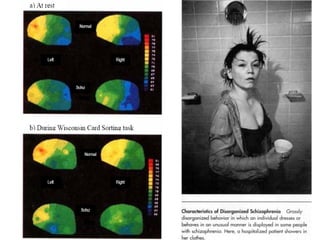
  • #16 Hypofrontality or reduced activity in the prefrontal cortex as measured by reduced frontal perfusion or glucose uptake.
  • #19 Although successful completion of the test relies upon a number of intact cognitive functions including attention, working memory, and visual processing, it is loosely termed a "frontal lobe" test on the basis that patients with any sort of frontal lobe lesion generally do poorly at the test. In particular, patients with lesions of the dorsolateral frontal lobe make a higher number of perseverative errors than control participants