Improving Power Point Presentations K.S. Chew School of Medical Sciences Universiti Sains Malaysia
What’s The Problem With Most Power Point Presentations?
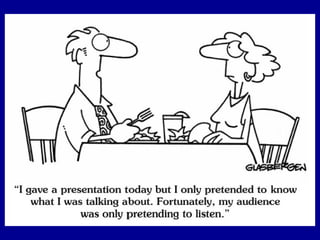
Does this look familiar? What a torture by Power Point Presentation, or is it really?
Basically the problems can be due to the  Presenter   or …the  Slides
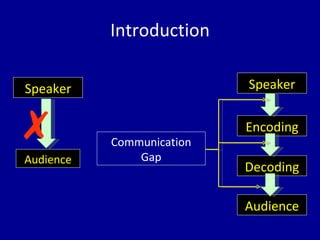
Introduction Speaker Audience Speaker Encoding Decoding Audience Communication Gap ✗
The Communication Gap It is the difference between what: What I meant to say What I actually said What you think you heard What you think I meant
Introduction According to various studies, we can effectively recall 20% of what we hear 30% of what we see 50% of what we hear and see 70% of what we do
THE SLIDES
Three Simple Rules In Preparing Your Slides
RULE #1 : KEEP IT SIMPLE, SWEET (K.I.S.S)
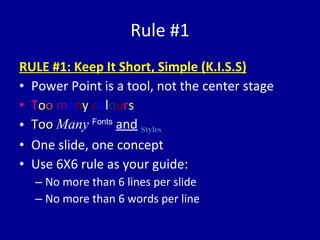
R ule #1 RULE #1: Keep It Short, Simple (K.I.S.S) Power Point is a tool, not the center stage T o o  m a n y   c o l o u r s Too   Many   Fonts   and   Styles One slide, one concept Use 6X6 rule as your guide: No more than 6 lines per slide No more than 6 words per line
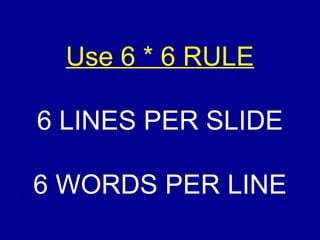
Use 6 * 6 RULE 6 LINES PER SLIDE 6 WORDS PER LINE
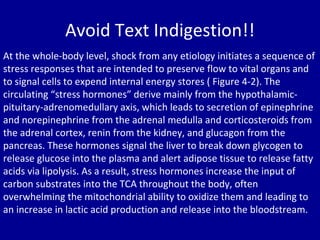
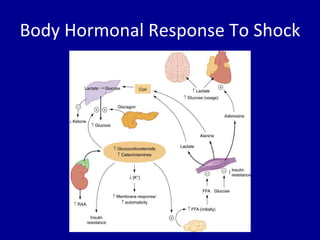
Avoid Text Indigestion!! At the whole-body level, shock from any etiology initiates a sequence of stress responses that are intended to preserve flow to vital organs and to signal cells to expend internal energy stores ( Figure 4-2). The circulating “stress hormones” derive mainly from the hypothalamic-pituitary-adrenomedullary axis, which leads to secretion of epinephrine and norepinephrine from the adrenal medulla and corticosteroids from the adrenal cortex, renin from the kidney, and glucagon from the pancreas. These hormones signal the liver to break down glycogen to release glucose into the plasma and alert adipose tissue to release fatty acids via lipolysis. As a result, stress hormones increase the input of carbon substrates into the TCA throughout the body, often overwhelming the mitochondrial ability to oxidize them and leading to an increase in lactic acid production and release into the bloodstream.
Body Hormonal Response To Shock
But A Picture Paints A Thousand Words
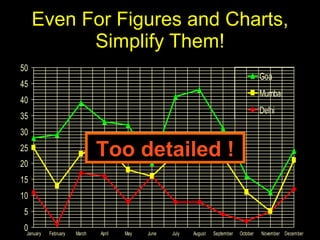
Even For Figures and Charts, Simplify Them! Too detailed !
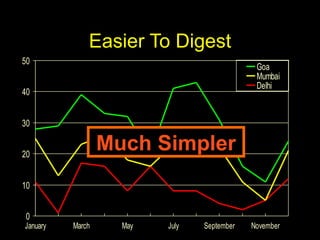
Easier To Digest Much Simpler
RULE #2 : LIMIT THE NUMBER OF SLIDES
Rule #2 RULE #2: Limit the Number of Slides Limit to about three major take home points Audience attention span 20 – 40 minutes
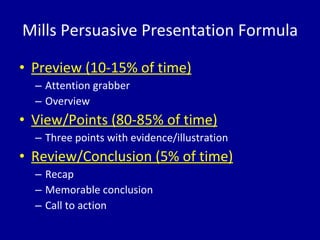
Mills Persuasive Presentation Formula Preview (10-15% of time) Attention grabber Overview View/Points (80-85% of time) Three points with evidence/illustration Review/Conclusion (5% of time) Recap Memorable conclusion Call to action
RULE #3 : USE APPROPRIATE FONTS
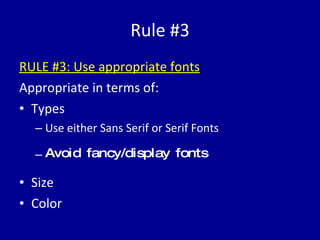
Rule #3 RULE #3: Use appropriate fonts Appropriate in terms of: Types Use either Sans Serif or Serif Fonts Avoid fancy/display fonts  Size Color
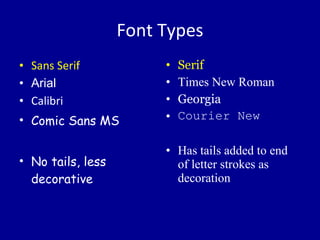
Font Types Sans Serif Arial Calibri Comic Sans MS No tails, less decorative Serif Times New Roman Georgia Courier New Has tails added to end of letter strokes as decoration
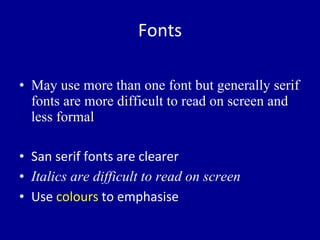
May use more than one font but generally serif fonts are more difficult to read on screen and less formal San serif fonts are clearer Italics are difficult to read on screen Use  colours  to emphasise Fonts
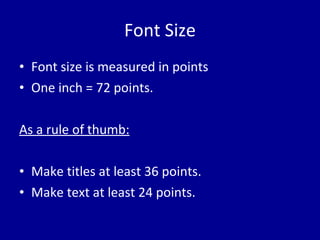
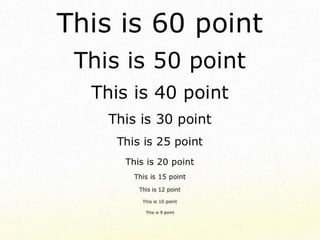
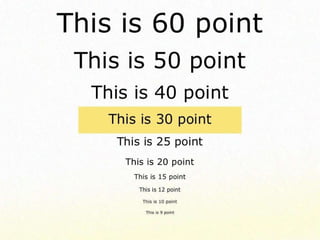
Font Size Font size is measured in points One inch = 72 points.  As a rule of thumb: Make titles at least 36 points. Make text at least 24 points.
 
 
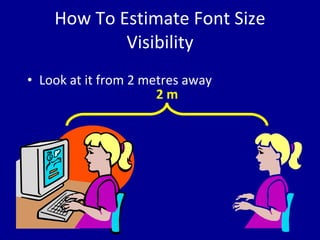
How To Estimate Font Size Visibility Look at it from 2 metres away 2 m
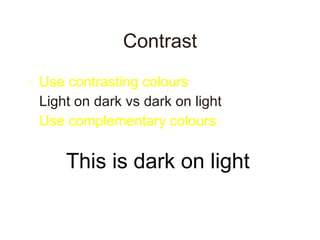
Contrast Use contrasting colours   Light on dark vs dark on light Use complementary colours This is dark on light
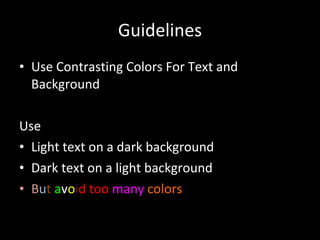
Guidelines Use Contrasting Colors For Text and Background Use Light text on a dark background Dark text on a light background B u t   a v o i d   too   many   colors
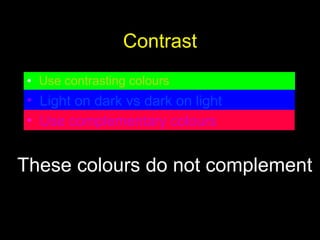
Contrast Use contrasting colours Light on dark vs dark on light   Use complementary colours   These colours do not complement
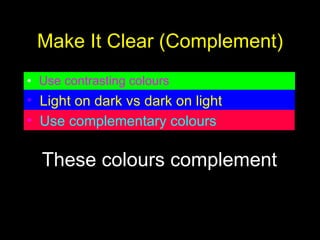
Make It Clear (Complement) Use contrasting colours Light on dark vs dark on light   Use complementary colours   These colours complement
A Bonus Point To Remember Clip arts, animation and transition can be very annoying and distracting! Try using high quality photos rather than clip arts.
THE PRESENTER
Planning To avoid P.A.N.I.Cky situation, plan. P = define your PURPOSE of this presentation A = know your AUDIENCE N = detail your NEEDS I = search for the information C = Prepare your COMMUNICATION
 
Eye Contact
CONCLUSION
Main Points Keep it SIMPLE Use Rule of 6*6 as a guide Use appropriate font type, color and size And don’t just use bullet slides... Have a variety of slides…..
Please have Some Mercy On Your Audience… don’t use too many bullets….
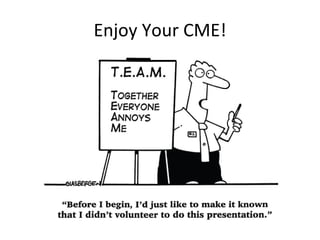
Enjoy Your CME!

Improving Power Point Presentations

  • 1.
    Improving Power PointPresentations K.S. Chew School of Medical Sciences Universiti Sains Malaysia
  • 2.
    What’s The ProblemWith Most Power Point Presentations?
  • 3.
    Does this lookfamiliar? What a torture by Power Point Presentation, or is it really?
  • 4.
    Basically the problemscan be due to the Presenter or …the Slides
  • 5.
    Introduction Speaker AudienceSpeaker Encoding Decoding Audience Communication Gap ✗
  • 6.
    The Communication GapIt is the difference between what: What I meant to say What I actually said What you think you heard What you think I meant
  • 7.
    Introduction According tovarious studies, we can effectively recall 20% of what we hear 30% of what we see 50% of what we hear and see 70% of what we do
  • 8.
  • 9.
    Three Simple RulesIn Preparing Your Slides
  • 10.
    RULE #1 :KEEP IT SIMPLE, SWEET (K.I.S.S)
  • 11.
    R ule #1RULE #1: Keep It Short, Simple (K.I.S.S) Power Point is a tool, not the center stage T o o m a n y c o l o u r s Too Many Fonts and Styles One slide, one concept Use 6X6 rule as your guide: No more than 6 lines per slide No more than 6 words per line
  • 12.
    Use 6 *6 RULE 6 LINES PER SLIDE 6 WORDS PER LINE
  • 13.
    Avoid Text Indigestion!!At the whole-body level, shock from any etiology initiates a sequence of stress responses that are intended to preserve flow to vital organs and to signal cells to expend internal energy stores ( Figure 4-2). The circulating “stress hormones” derive mainly from the hypothalamic-pituitary-adrenomedullary axis, which leads to secretion of epinephrine and norepinephrine from the adrenal medulla and corticosteroids from the adrenal cortex, renin from the kidney, and glucagon from the pancreas. These hormones signal the liver to break down glycogen to release glucose into the plasma and alert adipose tissue to release fatty acids via lipolysis. As a result, stress hormones increase the input of carbon substrates into the TCA throughout the body, often overwhelming the mitochondrial ability to oxidize them and leading to an increase in lactic acid production and release into the bloodstream.
  • 14.
  • 15.
    But A PicturePaints A Thousand Words
  • 16.
    Even For Figuresand Charts, Simplify Them! Too detailed !
  • 17.
    Easier To DigestMuch Simpler
  • 18.
    RULE #2 :LIMIT THE NUMBER OF SLIDES
  • 19.
    Rule #2 RULE#2: Limit the Number of Slides Limit to about three major take home points Audience attention span 20 – 40 minutes
  • 20.
    Mills Persuasive PresentationFormula Preview (10-15% of time) Attention grabber Overview View/Points (80-85% of time) Three points with evidence/illustration Review/Conclusion (5% of time) Recap Memorable conclusion Call to action
  • 21.
    RULE #3 :USE APPROPRIATE FONTS
  • 22.
    Rule #3 RULE#3: Use appropriate fonts Appropriate in terms of: Types Use either Sans Serif or Serif Fonts Avoid fancy/display fonts Size Color
  • 23.
    Font Types SansSerif Arial Calibri Comic Sans MS No tails, less decorative Serif Times New Roman Georgia Courier New Has tails added to end of letter strokes as decoration

  • 24.
    May use morethan one font but generally serif fonts are more difficult to read on screen and less formal San serif fonts are clearer Italics are difficult to read on screen Use colours to emphasise Fonts
  • 25.
    Font Size Fontsize is measured in points One inch = 72 points. As a rule of thumb: Make titles at least 36 points. Make text at least 24 points.
  • 26.
  • 27.
  • 28.
    How To EstimateFont Size Visibility Look at it from 2 metres away 2 m
  • 29.
    Contrast Use contrastingcolours Light on dark vs dark on light Use complementary colours This is dark on light
  • 30.
    Guidelines Use ContrastingColors For Text and Background Use Light text on a dark background Dark text on a light background B u t a v o i d too many colors
  • 31.
    Contrast Use contrastingcolours Light on dark vs dark on light Use complementary colours These colours do not complement
  • 32.
    Make It Clear(Complement) Use contrasting colours Light on dark vs dark on light Use complementary colours These colours complement
  • 33.
    A Bonus PointTo Remember Clip arts, animation and transition can be very annoying and distracting! Try using high quality photos rather than clip arts.
  • 34.
  • 35.
    Planning To avoidP.A.N.I.Cky situation, plan. P = define your PURPOSE of this presentation A = know your AUDIENCE N = detail your NEEDS I = search for the information C = Prepare your COMMUNICATION
  • 36.
  • 37.
  • 38.
  • 39.
    Main Points Keepit SIMPLE Use Rule of 6*6 as a guide Use appropriate font type, color and size And don’t just use bullet slides... Have a variety of slides…..
  • 40.
    Please have SomeMercy On Your Audience… don’t use too many bullets….
  • 41.

Editor's Notes

  • #15 Overview of whole-body hormonal stress response to shock. Upper left, Stress hormones (catecholamines, glucagons) stimulate the liver to increase glucose output, derived from glycogen breakdown and by synthesis from lactate and alanine, which are released from skeletal muscle catabolism (right side). Lower left, Adrenal medulla secretes glucocorticosteroids and catecholamines, which induce glycogenolysis, insulin resistance, hypokalemia, and lipolysis. Juxtaglomerular cells of the kidney release renin, which activates the renin-angiotensin-aldosterone (RAA) system. Upper right, Skeletal muscle becomes more resistant to substrate uptake and continues to release lactate, which becomes the main fuel source for the heart in shock. FFA, free fatty acids.
  • #24 Designers choose serif typefaces because they are easy to read. Our eyes find it easy to follow the baselines of serif type. Sans serif fonts, in which each character is independent from its neighbors, are good for reading shorter pieces of information, such as titles and labels.