Respiratory Emergencies Offshore First Aid Assoc. Prof. Dr Nik Hisamuddin Nik Ab Rahman Consultant Emergency Medicine School of Medical Sciences, USM Malaysia [email_address] http://www.emergencycare.webs.com/
Scope Asthma Causes Recognition Management Other Respiratory Conditions
Objectives Understand the definition, causes and mechanism of asthma Able to recognise and manage an acute asthmatic attack. Able to recognise and perform the general management of other respiratory emergencies.
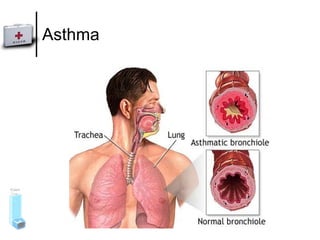
Asthma What is Asthma? Asthma is an allergic reaction resulting in the narrowing of the smaller airways.
Asthma Mechanism: Acute narrowing and spasm of small air passages Swelling of the airway lining Secretion of mucus in the airways
Asthma
Asthma An acute asthma attack can be fatal if not treated properly.  Prompt recognition and first aid are essential.
Asthma Causes of Asthma Cold changes in the weather Allergies Upper respiratory tract infection Exercise  Nervous tension
Asthma Recognition Mild cases: Cough  Rapid breathing  Wheeze  Rapid pulse Wheeze
Asthma Recognition More severe:  Pale Distressed, anxious  Fighting for breath
Asthma Recognition Very severe: Exhaustion Altered conscious state poof Cyanosis (blueness) Difficulty/unable to speak No wheeze at all
Asthma Management If conscious: Reassure Assist victim into a position of comfort - they often prefer to sit upright 4 puffs of a brochodilator medication (1 puff at a time, every 4 breaths) If no improvement, repeat after 4 minutes Call an ambulance promptly if there is no immediate improvement after the initial administration of medication,
Asthma Management (cont’d) If conscious (cont’d) Call an ambulance promptly in a severe attack In a severe attack, 6‑8 puffs may be given to an adult every 5 minutes Even if the medication appears to be effective, medical advice should be sought  If oxygen is available, it should be administered via a face mask with a flow rate of at least 6-8 l/min.
Asthma Management: If unconscious: Seek urgent medical assistance Conduct a Primary Survey and act accordingly Note: If expired air resuscitation is required, a much greater force than usual will be required to inflate the lungs.
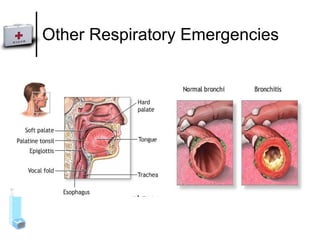
Other Respiratory Emergencies Respiratory emergencies may also arise from: Epiglottitis Respiratory depression from drugs Chronic obstructive airway disease (Emphysema and Bronchitis) Congestive cardiac failure.
Other Respiratory Emergencies
Other Respiratory Emergencies Such problems should be managed by: activating the emergency service (e.g. ambulance),  reassurance of the victim,  assisting them to a position of comfort  continual monitoring of the ABCs.  Supplemental oxygen should be provided where possible.  If the victim becomes unconscious, the airway must be maintained. Resuscitation must be commenced if required.

First Aid for Respiratory Emergencies

  • 1.
    Respiratory Emergencies OffshoreFirst Aid Assoc. Prof. Dr Nik Hisamuddin Nik Ab Rahman Consultant Emergency Medicine School of Medical Sciences, USM Malaysia [email_address] http://www.emergencycare.webs.com/
  • 2.
    Scope Asthma CausesRecognition Management Other Respiratory Conditions
  • 3.
    Objectives Understand thedefinition, causes and mechanism of asthma Able to recognise and manage an acute asthmatic attack. Able to recognise and perform the general management of other respiratory emergencies.
  • 4.
    Asthma What isAsthma? Asthma is an allergic reaction resulting in the narrowing of the smaller airways.
  • 5.
    Asthma Mechanism: Acutenarrowing and spasm of small air passages Swelling of the airway lining Secretion of mucus in the airways
  • 6.
  • 7.
    Asthma An acuteasthma attack can be fatal if not treated properly. Prompt recognition and first aid are essential.
  • 8.
    Asthma Causes ofAsthma Cold changes in the weather Allergies Upper respiratory tract infection Exercise Nervous tension
  • 9.
    Asthma Recognition Mildcases: Cough Rapid breathing Wheeze Rapid pulse Wheeze
  • 10.
    Asthma Recognition Moresevere: Pale Distressed, anxious Fighting for breath
  • 11.
    Asthma Recognition Verysevere: Exhaustion Altered conscious state poof Cyanosis (blueness) Difficulty/unable to speak No wheeze at all
  • 12.
    Asthma Management Ifconscious: Reassure Assist victim into a position of comfort - they often prefer to sit upright 4 puffs of a brochodilator medication (1 puff at a time, every 4 breaths) If no improvement, repeat after 4 minutes Call an ambulance promptly if there is no immediate improvement after the initial administration of medication,
  • 13.
    Asthma Management (cont’d)If conscious (cont’d) Call an ambulance promptly in a severe attack In a severe attack, 6‑8 puffs may be given to an adult every 5 minutes Even if the medication appears to be effective, medical advice should be sought If oxygen is available, it should be administered via a face mask with a flow rate of at least 6-8 l/min.
  • 14.
    Asthma Management: Ifunconscious: Seek urgent medical assistance Conduct a Primary Survey and act accordingly Note: If expired air resuscitation is required, a much greater force than usual will be required to inflate the lungs.
  • 15.
    Other Respiratory EmergenciesRespiratory emergencies may also arise from: Epiglottitis Respiratory depression from drugs Chronic obstructive airway disease (Emphysema and Bronchitis) Congestive cardiac failure.
  • 16.
  • 17.
    Other Respiratory EmergenciesSuch problems should be managed by: activating the emergency service (e.g. ambulance), reassurance of the victim, assisting them to a position of comfort continual monitoring of the ABCs. Supplemental oxygen should be provided where possible. If the victim becomes unconscious, the airway must be maintained. Resuscitation must be commenced if required.