Zahiruddin Othman
Universiti Sains Malaysia
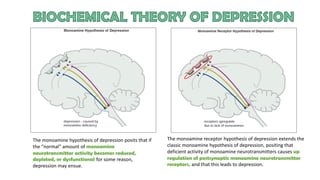
The monoamine hypothesis of depression posits that if
the “normal” amount of monoamine
neurotransmitter activity becomes reduced,
depleted, or dysfunctional for some reason,
depression may ensue.
The monoamine receptor hypothesis of depression extends the
classic monoamine hypothesis of depression, positing that
deficient activity of monoamine neurotransmitters causes up
regulation of postsynaptic monoamine neurotransmitter
receptors, and that this leads to depression.
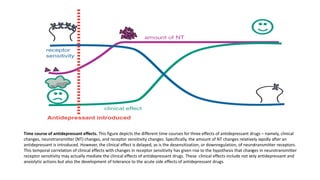
Time course of antidepressant effects. This figure depicts the different time courses for three effects of antidepressant drugs – namely, clinical
changes, neurotransmitter (NT) changes, and receptor sensitivity changes. Specifically, the amount of NT changes relatively rapidly after an
antidepressant is introduced. However, the clinical effect is delayed, as is the desensitization, or downregulation, of neurotransmitter receptors.
This temporal correlation of clinical effects with changes in receptor sensitivity has given rise to the hypothesis that changes in neurotransmitter
receptor sensitivity may actually mediate the clinical effects of antidepressant drugs. These clinical effects include not only antidepressant and
anxiolytic actions but also the development of tolerance to the acute side effects of antidepressant drugs.
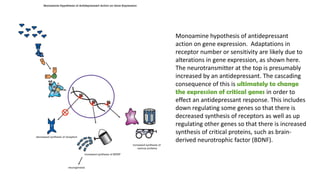
Monoamine hypothesis of antidepressant
action on gene expression. Adaptations in
receptor number or sensitivity are likely due to
alterations in gene expression, as shown here.
The neurotransmitter at the top is presumably
increased by an antidepressant. The cascading
consequence of this is ultimately to change
the expression of critical genes in order to
effect an antidepressant response. This includes
down regulating some genes so that there is
decreased synthesis of receptors as well as up
regulating other genes so that there is increased
synthesis of critical proteins, such as brain-
derived neurotrophic factor (BDNF).
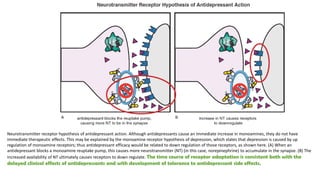
Neurotransmitter receptor hypothesis of antidepressant action. Although antidepressants cause an immediate increase in monoamines, they do not have
immediate therapeutic effects. This may be explained by the monoamine receptor hypothesis of depression, which states that depression is caused by up
regulation of monoamine receptors; thus antidepressant efficacy would be related to down regulation of those receptors, as shown here. (A) When an
antidepressant blocks a monoamine reuptake pump, this causes more neurotransmitter (NT) (in this case, norepinephrine) to accumulate in the synapse. (B) The
increased availability of NT ultimately causes receptors to down regulate. The time course of receptor adaptation is consistent both with the
delayed clinical effects of antidepressants and with development of tolerance to antidepressant side effects.
https://www.youtube.com/watch?v=CdRoOVsa1ag
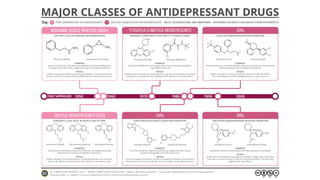
https://doi.org/10.1016/j.ejphar.2014.11.045
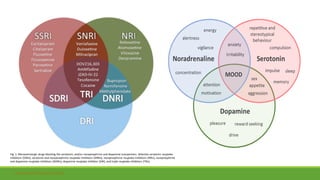
Fig. 1. Monoaminergic drugs blocking the serotonin, and/or norepinephrine and dopamine transporters. Selective serotonin reuptake
inhibitors (SSRIs), serotonin and norepinephrine reuptake inhibitors (SNRIs), norepinephrine reuptake inhibitors (NRIs), norepinephrine
and dopamine reuptake inhibitors (NDRIs), dopamine reuptake inhibitor (DRI), and triple reuptake inhibitors (TRIs)
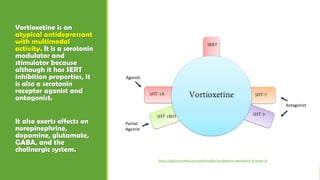
Vortioxetine is an
atypical antidepressant
with multimodal
activity. It is a serotonin
modulator and
stimulator because
although it has SERT
inhibition properties, it
is also a serotonin
receptor agonist and
antagonist.
It also exerts effects on
norepinephrine,
dopamine, glutamate,
GABA, and the
cholinergic system.
Antagonist
Agonist
Partial
Agonist
https://psychscenehub.com/psychinsights/vortioxetine-mechanism-of-action-2/
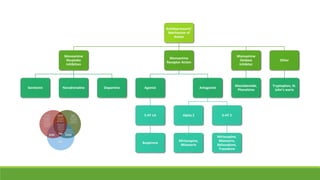
Antidepressants’
Mechanism of
Action
Monoamine
Reuptake
Inhibition
Serotonin Noradrenaline Dopamine
Monoamine
Receptor Action
Agonist
5 HT 1A
Buspirone
Antagonist
Alpha 2
Mirtazapine,
Mianserin
5-HT 2
Mirtazapine,
Mianserin,
Nefazodone,
Trazodone
Monoamine
Oxidase
Inhibitor
Moclobemide,
Phenelzine
Other
Tryptophan, St.
John’s warts
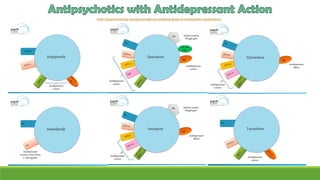
https://psychscenehub.com/psychinsights/a-simplified-guide-to-antipsychotic-medications/
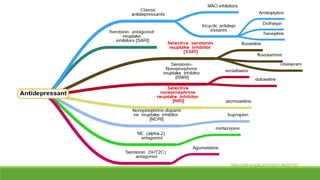
https://www.youtube.com/watch?v=l8pObJTzRzY
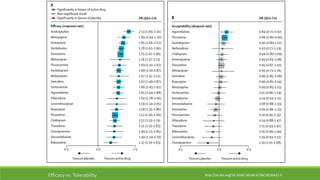
http://dx.doi.org/10.1016/ S0140-6736(18)30421-5
Efficacy vs. Tolerability
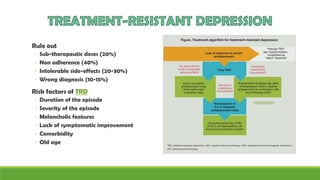
Rule out
◦ Sub-therapeutic doses (20%)
◦ Non adherence (40%)
◦ Intolerable side-effects (20-30%)
◦ Wrong diagnosis (10-15%)
Risk factors of TRD
◦ Duration of the episode
◦ Severity of the episode
◦ Melancholic features
◦ Lack of symptomatic improvement
◦ Comorbidity
◦ Old age
Augmentation
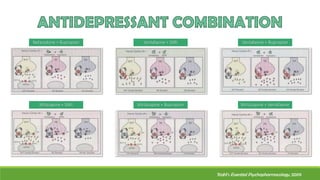
Nefazodone + Bupropion Venlafaxine + SSRI Venlafaxine + Bupropion
Mitazapine + SSRI Mirtazapine + Bupropion Mirtazapine + Venlafaxine
Stahl’s Essential Psychopharmacology, 2009
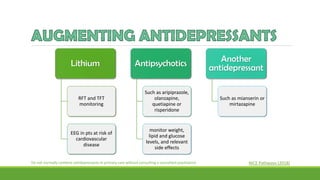
Lithium
RFT and TFT
monitoring
EEG in pts at risk of
cardiovascular
disease
Antipsychotics
Such as aripiprazole,
olanzapine,
quetiapine or
risperidone
monitor weight,
lipid and glucose
levels, and relevant
side effects
Another
antidepressant
Such as mianserin or
mirtazapine
NICE Pathways (2018)
Do not normally combine antidepressants in primary care without consulting a consultant psychiatrist
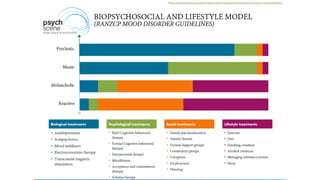
https://psychscenehub.com/psychinsights/clinical-management-depression-summary-ranzcp-guidelines/
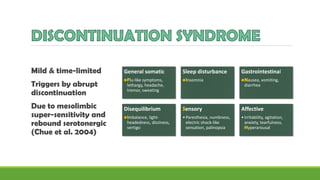
Mild & time-limited
Triggers by abrupt
discontinuation
Due to mesolimbic
super-sensitivity and
rebound serotonergic
(Chue et al. 2004)
General somatic
•Flu-like symptoms,
lethargy, headache,
tremor, sweating
Sleep disturbance
•Insomnia
Gastrointestinal
•Nausea, vomiting,
diarrhea
Disequilibrium
•Imbalance, light-
headedness, dizziness,
vertigo
Sensory
•Paresthesia, numbness,
electric shock-like
sensation, palinopsia
Affective
•Irritability, agitation,
anxiety, tearfulness,
Hyperarousal
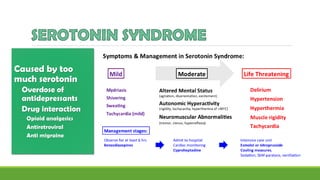
Caused by too
much serotonin
◦ Overdose of
antidepressants
◦ Drug interaction
◦ Opioid analgesics
◦ Antiretroviral
◦ Anti migraine
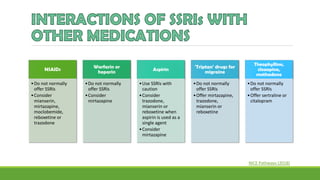
NSAIDs
•Do not normally
offer SSRIs
•Consider
mianserin,
mirtazapine,
moclobemide,
reboxetine or
trazodone
Warfarin or
heparin
•Do not normally
offer SSRIs
•Consider
mirtazapine
Aspirin
•Use SSRIs with
caution
•Consider
trazodone,
mianserin or
reboxetine when
aspirin is used as a
single agent
•Consider
mirtazapine
'Triptan' drugs for
migraine
•Do not normally
offer SSRIs
•Offer mirtazapine,
trazodone,
mianserin or
reboxetine
Theophylline,
clozapine,
methadone
•Do not normally
offer SSRIs
•Offer sertraline or
citalopram
NICE Pathways (2018)
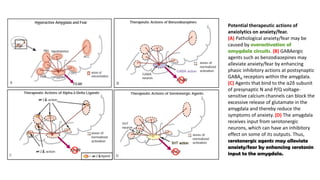
Potential therapeutic actions of
anxiolytics on anxiety/fear.
(A) Pathological anxiety/fear may be
caused by overactivation of
amygdala circuits. (B) GABAergic
agents such as benzodiazepines may
alleviate anxiety/fear by enhancing
phasic inhibitory actions at postsynaptic
GABAA receptors within the amygdala.
(C) Agents that bind to the α2δ subunit
of presynaptic N and P/Q voltage-
sensitive calcium channels can block the
excessive release of glutamate in the
amygdala and thereby reduce the
symptoms of anxiety. (D) The amygdala
receives input from serotonergic
neurons, which can have an inhibitory
effect on some of its outputs. Thus,
serotonergic agents may alleviate
anxiety/fear by enhancing serotonin
input to the amygdala.
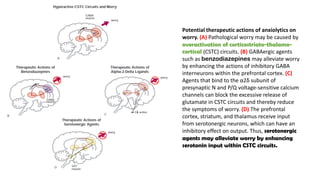
Potential therapeutic actions of anxiolytics on
worry. (A) Pathological worry may be caused by
overactivation of corticostriato-thalamo-
cortical (CSTC) circuits. (B) GABAergic agents
such as benzodiazepines may alleviate worry
by enhancing the actions of inhibitory GABA
interneurons within the prefrontal cortex. (C)
Agents that bind to the α2δ subunit of
presynaptic N and P/Q voltage-sensitive calcium
channels can block the excessive release of
glutamate in CSTC circuits and thereby reduce
the symptoms of worry. (D) The prefrontal
cortex, striatum, and thalamus receive input
from serotonergic neurons, which can have an
inhibitory effect on output. Thus, serotonergic
agents may alleviate worry by enhancing
serotonin input within CSTC circuits.
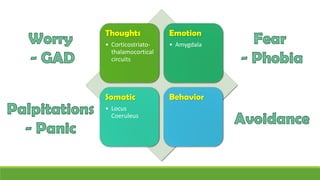
Thoughts
• Corticostriato-
thalamocortical
circuits
Emotion
• Amygdala
Somatic
• Locus
Coeruleus
Behavior
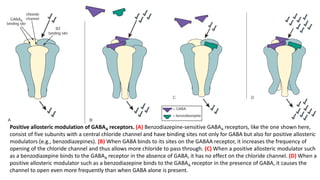
Positive allosteric modulation of GABAA receptors. (A) Benzodiazepine-sensitive GABAA receptors, like the one shown here,
consist of five subunits with a central chloride channel and have binding sites not only for GABA but also for positive allosteric
modulators (e.g., benzodiazepines). (B) When GABA binds to its sites on the GABAA receptor, it increases the frequency of
opening of the chloride channel and thus allows more chloride to pass through. (C) When a positive allosteric modulator such
as a benzodiazepine binds to the GABAA receptor in the absence of GABA, it has no effect on the chloride channel. (D) When a
positive allosteric modulator such as a benzodiazepine binds to the GABAA receptor in the presence of GABA, it causes the
channel to open even more frequently than when GABA alone is present.
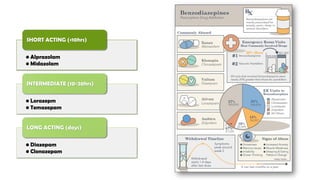
• Alprazolam
• Midazolam
SHORT ACTING (<10hrs)
• Lorazepm
• Temazepam
INTERMEDIATE (10-20hrs)
• Diazepam
• Clonazepam
LONG ACTING (days)
Antidepressants & anxiolytics

Antidepressants & anxiolytics

  • 1.
  • 2.
    The monoamine hypothesisof depression posits that if the “normal” amount of monoamine neurotransmitter activity becomes reduced, depleted, or dysfunctional for some reason, depression may ensue. The monoamine receptor hypothesis of depression extends the classic monoamine hypothesis of depression, positing that deficient activity of monoamine neurotransmitters causes up regulation of postsynaptic monoamine neurotransmitter receptors, and that this leads to depression.
  • 3.
    Time course ofantidepressant effects. This figure depicts the different time courses for three effects of antidepressant drugs – namely, clinical changes, neurotransmitter (NT) changes, and receptor sensitivity changes. Specifically, the amount of NT changes relatively rapidly after an antidepressant is introduced. However, the clinical effect is delayed, as is the desensitization, or downregulation, of neurotransmitter receptors. This temporal correlation of clinical effects with changes in receptor sensitivity has given rise to the hypothesis that changes in neurotransmitter receptor sensitivity may actually mediate the clinical effects of antidepressant drugs. These clinical effects include not only antidepressant and anxiolytic actions but also the development of tolerance to the acute side effects of antidepressant drugs.
  • 4.
    Monoamine hypothesis ofantidepressant action on gene expression. Adaptations in receptor number or sensitivity are likely due to alterations in gene expression, as shown here. The neurotransmitter at the top is presumably increased by an antidepressant. The cascading consequence of this is ultimately to change the expression of critical genes in order to effect an antidepressant response. This includes down regulating some genes so that there is decreased synthesis of receptors as well as up regulating other genes so that there is increased synthesis of critical proteins, such as brain- derived neurotrophic factor (BDNF).
  • 5.
    Neurotransmitter receptor hypothesisof antidepressant action. Although antidepressants cause an immediate increase in monoamines, they do not have immediate therapeutic effects. This may be explained by the monoamine receptor hypothesis of depression, which states that depression is caused by up regulation of monoamine receptors; thus antidepressant efficacy would be related to down regulation of those receptors, as shown here. (A) When an antidepressant blocks a monoamine reuptake pump, this causes more neurotransmitter (NT) (in this case, norepinephrine) to accumulate in the synapse. (B) The increased availability of NT ultimately causes receptors to down regulate. The time course of receptor adaptation is consistent both with the delayed clinical effects of antidepressants and with development of tolerance to antidepressant side effects.
  • 8.
  • 15.
    https://doi.org/10.1016/j.ejphar.2014.11.045 Fig. 1. Monoaminergicdrugs blocking the serotonin, and/or norepinephrine and dopamine transporters. Selective serotonin reuptake inhibitors (SSRIs), serotonin and norepinephrine reuptake inhibitors (SNRIs), norepinephrine reuptake inhibitors (NRIs), norepinephrine and dopamine reuptake inhibitors (NDRIs), dopamine reuptake inhibitor (DRI), and triple reuptake inhibitors (TRIs)
  • 19.
    Vortioxetine is an atypicalantidepressant with multimodal activity. It is a serotonin modulator and stimulator because although it has SERT inhibition properties, it is also a serotonin receptor agonist and antagonist. It also exerts effects on norepinephrine, dopamine, glutamate, GABA, and the cholinergic system. Antagonist Agonist Partial Agonist https://psychscenehub.com/psychinsights/vortioxetine-mechanism-of-action-2/
  • 20.
    Antidepressants’ Mechanism of Action Monoamine Reuptake Inhibition Serotonin NoradrenalineDopamine Monoamine Receptor Action Agonist 5 HT 1A Buspirone Antagonist Alpha 2 Mirtazapine, Mianserin 5-HT 2 Mirtazapine, Mianserin, Nefazodone, Trazodone Monoamine Oxidase Inhibitor Moclobemide, Phenelzine Other Tryptophan, St. John’s warts
  • 21.
  • 22.
  • 25.
  • 27.
    Rule out ◦ Sub-therapeuticdoses (20%) ◦ Non adherence (40%) ◦ Intolerable side-effects (20-30%) ◦ Wrong diagnosis (10-15%) Risk factors of TRD ◦ Duration of the episode ◦ Severity of the episode ◦ Melancholic features ◦ Lack of symptomatic improvement ◦ Comorbidity ◦ Old age Augmentation
  • 28.
    Nefazodone + BupropionVenlafaxine + SSRI Venlafaxine + Bupropion Mitazapine + SSRI Mirtazapine + Bupropion Mirtazapine + Venlafaxine Stahl’s Essential Psychopharmacology, 2009
  • 29.
    Lithium RFT and TFT monitoring EEGin pts at risk of cardiovascular disease Antipsychotics Such as aripiprazole, olanzapine, quetiapine or risperidone monitor weight, lipid and glucose levels, and relevant side effects Another antidepressant Such as mianserin or mirtazapine NICE Pathways (2018) Do not normally combine antidepressants in primary care without consulting a consultant psychiatrist
  • 30.
  • 32.
    Mild & time-limited Triggersby abrupt discontinuation Due to mesolimbic super-sensitivity and rebound serotonergic (Chue et al. 2004) General somatic •Flu-like symptoms, lethargy, headache, tremor, sweating Sleep disturbance •Insomnia Gastrointestinal •Nausea, vomiting, diarrhea Disequilibrium •Imbalance, light- headedness, dizziness, vertigo Sensory •Paresthesia, numbness, electric shock-like sensation, palinopsia Affective •Irritability, agitation, anxiety, tearfulness, Hyperarousal
  • 33.
    Caused by too muchserotonin ◦ Overdose of antidepressants ◦ Drug interaction ◦ Opioid analgesics ◦ Antiretroviral ◦ Anti migraine
  • 34.
    NSAIDs •Do not normally offerSSRIs •Consider mianserin, mirtazapine, moclobemide, reboxetine or trazodone Warfarin or heparin •Do not normally offer SSRIs •Consider mirtazapine Aspirin •Use SSRIs with caution •Consider trazodone, mianserin or reboxetine when aspirin is used as a single agent •Consider mirtazapine 'Triptan' drugs for migraine •Do not normally offer SSRIs •Offer mirtazapine, trazodone, mianserin or reboxetine Theophylline, clozapine, methadone •Do not normally offer SSRIs •Offer sertraline or citalopram NICE Pathways (2018)
  • 35.
    Potential therapeutic actionsof anxiolytics on anxiety/fear. (A) Pathological anxiety/fear may be caused by overactivation of amygdala circuits. (B) GABAergic agents such as benzodiazepines may alleviate anxiety/fear by enhancing phasic inhibitory actions at postsynaptic GABAA receptors within the amygdala. (C) Agents that bind to the α2δ subunit of presynaptic N and P/Q voltage- sensitive calcium channels can block the excessive release of glutamate in the amygdala and thereby reduce the symptoms of anxiety. (D) The amygdala receives input from serotonergic neurons, which can have an inhibitory effect on some of its outputs. Thus, serotonergic agents may alleviate anxiety/fear by enhancing serotonin input to the amygdala.
  • 36.
    Potential therapeutic actionsof anxiolytics on worry. (A) Pathological worry may be caused by overactivation of corticostriato-thalamo- cortical (CSTC) circuits. (B) GABAergic agents such as benzodiazepines may alleviate worry by enhancing the actions of inhibitory GABA interneurons within the prefrontal cortex. (C) Agents that bind to the α2δ subunit of presynaptic N and P/Q voltage-sensitive calcium channels can block the excessive release of glutamate in CSTC circuits and thereby reduce the symptoms of worry. (D) The prefrontal cortex, striatum, and thalamus receive input from serotonergic neurons, which can have an inhibitory effect on output. Thus, serotonergic agents may alleviate worry by enhancing serotonin input within CSTC circuits.
  • 37.
  • 38.
    Positive allosteric modulationof GABAA receptors. (A) Benzodiazepine-sensitive GABAA receptors, like the one shown here, consist of five subunits with a central chloride channel and have binding sites not only for GABA but also for positive allosteric modulators (e.g., benzodiazepines). (B) When GABA binds to its sites on the GABAA receptor, it increases the frequency of opening of the chloride channel and thus allows more chloride to pass through. (C) When a positive allosteric modulator such as a benzodiazepine binds to the GABAA receptor in the absence of GABA, it has no effect on the chloride channel. (D) When a positive allosteric modulator such as a benzodiazepine binds to the GABAA receptor in the presence of GABA, it causes the channel to open even more frequently than when GABA alone is present.
  • 39.
    • Alprazolam • Midazolam SHORTACTING (<10hrs) • Lorazepm • Temazepam INTERMEDIATE (10-20hrs) • Diazepam • Clonazepam LONG ACTING (days)