PRESENTER:DR MEDHA SUBRAMANI(PG)
MODERATOR:DR AKSHATHA J K (ASSISTANT PROFESSOR)
Anatomy of Brain
Introduction to Prefrontal Cortex
Parts of Prefrontal Cortex
Functions
Tests to assess Prefrontal Cortex
Disorders of Prefrontal Cortex
References
TABLE OFCONTENTS
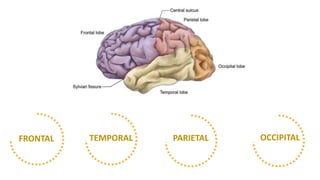
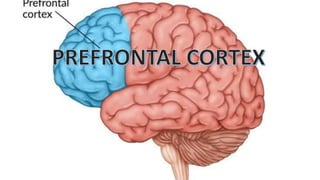
FRONTAL TEMPORAL PARIETAL OCCIPITAL
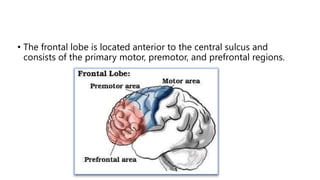
• The frontal lobe is located anterior to the central sulcus and
consists of the primary motor, premotor, and prefrontal regions.
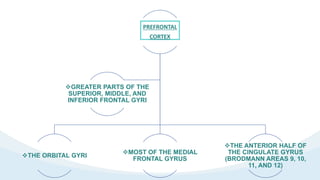
PREFRONTAL
CORTEX
THE ORBITAL GYRI
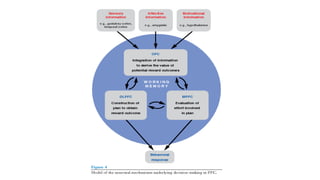
MOST OF THE MEDIAL
FRONTAL GYRUS
THE ANTERIOR HALF OF
THE CINGULATE GYRUS
(BRODMANN AREAS 9, 10,
11, AND 12)
GREATER PARTS OF THE
SUPERIOR, MIDDLE, AND
INFERIOR FRONTAL GYRI
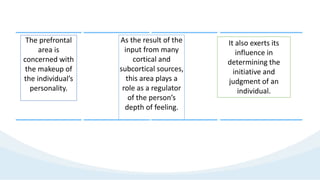
The prefrontal
area is
concerned with
the makeup of
the individual’s
personality.
As the result of the
input from many
cortical and
subcortical sources,
this area plays a
role as a regulator
of the person’s
depth of feeling.
It also exerts its
influence in
determining the
initiative and
judgment of an
individual.
PRE
FRONTAL
CORTEX
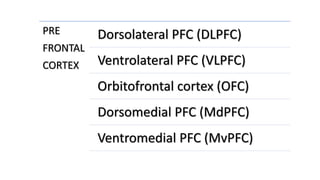
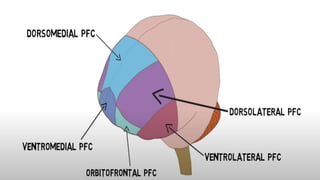
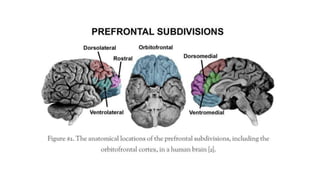
Dorsolateral PFC (DLPFC)
Ventrolateral PFC (VLPFC)
Orbitofrontal cortex (OFC)
Dorsomedial PFC (MdPFC)
Ventromedial PFC (MvPFC)
Lateral Prefrontal
Cortex
• Functional magnetic resonance imaging (MRI) and event-related
potential (ERP) research have defined the spatial and temporal
contributions of lateral prefrontal cortex (LPFC) including portions
of inferior, middle, and superior frontal gyri in language, attention,
memory, response conflict, novelty processing which is crucial for
new learning, creativity.
• This region is also responsible for the temporal ordering of events,
explicit memory, and metamemory.
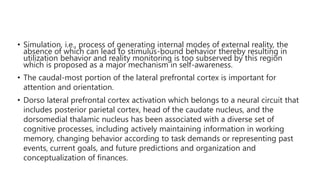
• Simulation, i.e., process of generating internal modes of external reality, the
absence of which can lead to stimulus-bound behavior thereby resulting in
utilization behavior and reality monitoring is too subserved by this region
which is proposed as a major mechanism in self-awareness.
• The caudal-most portion of the lateral prefrontal cortex is important for
attention and orientation.
• Dorso lateral prefrontal cortex activation which belongs to a neural circuit that
includes posterior parietal cortex, head of the caudate nucleus, and the
dorsomedial thalamic nucleus has been associated with a diverse set of
cognitive processes, including actively maintaining information in working
memory, changing behavior according to task demands or representing past
events, current goals, and future predictions and organization and
conceptualization of finances.
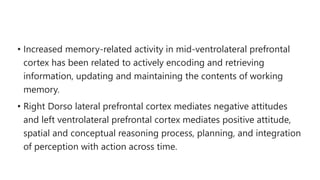
• Increased memory-related activity in mid-ventrolateral prefrontal
cortex has been related to actively encoding and retrieving
information, updating and maintaining the contents of working
memory.
• Right Dorso lateral prefrontal cortex mediates negative attitudes
and left ventrolateral prefrontal cortex mediates positive attitude,
spatial and conceptual reasoning process, planning, and integration
of perception with action across time.
Dorsolateral Prefrontal Cortex (DLPFC)
• Regulates attention and action
• Working memory
• Abstract reasoning
• Planning and organisation
• Insight and judgement
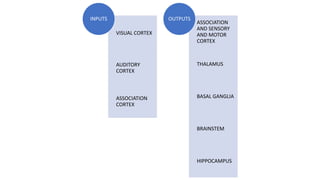
VISUAL CORTEX
AUDITORY
CORTEX
ASSOCIATION
CORTEX
INPUTS
ASSOCIATION
AND SENSORY
AND MOTOR
CORTEX
THALAMUS
BASAL GANGLIA
BRAINSTEM
HIPPOCAMPUS
OUTPUTS
Lesion of Dorsolateral Prefrontal Cortex
1. Executive function deficits: Difficulty in planning, feedback,
learning, sequencing, establishing, maintaining and changing
a set behavior
2. Perseveration
3. Stimulus bound behavior
4. Echopraxia
C/F: General disinterest, apathy, shortened attention, lack of
emotional reactivity.
VENTROLATERAL PREFRONTAL CORTEX
• Brodmann’s area 44,45 and lateral aspect of 47
Includes pars opercularis, pars triangularis , pars orbitalis, Broca’s
area
DOMINANT
• SEMANTIC PROCESSING
• CONTROL OF MEMORY
• EXECUTIVE FUNCTIONS FOR GOAL DIRECTED BEHAVIOUR
NON DOMINANT
• EMOTIONAL ASPECT OF FACES
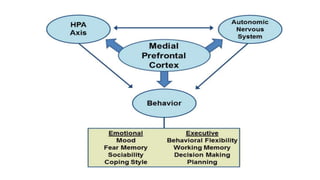
MEDIAL PREFRONTAL CORTEX
• Specifically, the medial frontal region (anterior cingulate area)
appears to be involved in bimanual coordination, attention to
demanding cognitive tasks, modulation of body arousal, spatial
memory, self-initiated movement, and conflict resolution (medial
prefrontal and medial orbital regions).
• The anterior cingulate cortex is also involved in the perception of
pain and possibly in mediating the emotional response behind it.
• Reward and goal-related activity are thought to correspond to the
unique patterns of connections that link the rostral cingulate motor
cortex with the prefrontal and limbic cortices.
• Ventromedial region plays a role in decision making and the
retrieval of information from long-term memory and metacognitive
processes.
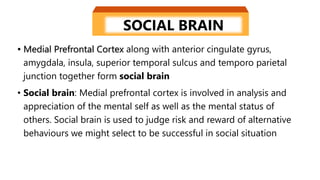
• Medial Prefrontal Cortex along with anterior cingulate gyrus,
amygdala, insula, superior temporal sulcus and temporo parietal
junction together form social brain
• Social brain: Medial prefrontal cortex is involved in analysis and
appreciation of the mental self as well as the mental status of
others. Social brain is used to judge risk and reward of alternative
behaviours we might select to be successful in social situation
SOCIAL BRAIN
DORSOMEDIAL PREFRONTAL CORTEX
• Introspection
• Motivation and initiation of activities
• Regulate our own emotional responses
LESIONS OF DORSOMEDIAL PREFRONTAL
CORTEX
• Apathetic
• Lack of spontaneous movement
• Akinetic mutism
• Paresis and urinary incontinence
• Patients appear indifferent to the problem
VENTROMEDIAL PREFRONTAL CORTEX
• Located inferior to dorsomedial prefrontal cortex
• Receives input from all sensory modalities
• Empathetic and sympathetic aspects of emotion
• Autonomic control of viscera and regulation of emotional state
ORBITOFRONTAL CORTEX
• Brodmann’s area 11,12 and medial aspect of 47
• Location : From gyrus rectus on the ventral surface to the ventrolateral
convexity laterally and from the limen of insula posteriorly to the frontal pole
• Functions :
• Highest integration centre for emotional processing
• Calculation of risk/ reward ratio when selecting behavior
• Suppression of distraction during performance
• Inhibitory control over emotional and social behavior
• Orbitofrontal Cortex functions as a component of the paralimbic ring
involved in autonomic, response inhibition, and stimulus significance
functions, mnemonic functions and delayed response.
• It plays a role in reward expectations and in the anticipation and
processing of outcomes even if the outcome does not produce any
reward.
• This region has been shown to have a significant role in social and
emotional behavior.
• Anterior Orbitofrontal Cortex is activated in case of aversive tastes and
pleasurable taste is mediated by caudomedial regions of PFC.
• Prefrontal Cortex interactions with the hypothalamus mediate
reward aspects of eating like food cravings.
• Ventral Prefrontal Cortex emerging from Orbitofrontal Cortex is
connected with limbic system and is involved in emotional
processing.
• This region is intimately associated with amygdala and anterior
cingulate, and is involved in behavioral self-regulation.
LESIONS OF ORBITOFRONTAL CORTEX
• Disinhibition
• Emotionally labile, irritable and impulsive
• Impaired in the ability to interpret and respond to emotional voice
or face expressions
• May engage in risky and dangerous distractibility
• Choose instant reward over waiting
• Great difficulty in decision making
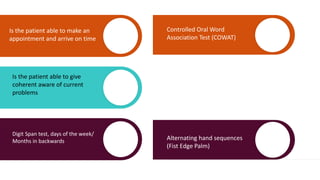
Is the patient able to make an
appointment and arrive on time
Is the patient able to give
coherent aware of current
problems
Digit Span test, days of the week/
Months in backwards
Controlled Oral Word
Association Test (COWAT)
Alternating hand sequences
(Fist Edge Palm)
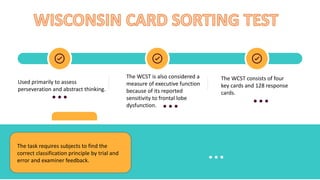
Used primarily to assess
perseveration and abstract thinking.
The WCST is also considered a
measure of executive function
because of its reported
sensitivity to frontal lobe
dysfunction.
The WCST consists of four
key cards and 128 response
cards.
The task requires subjects to find the
correct classification principle by trial and
error and examiner feedback.
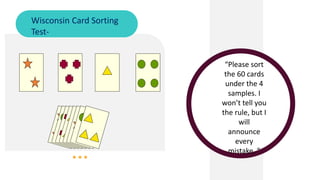
Wisconsin Card Sorting
Test-
“Please sort
the 60 cards
under the 4
samples. I
won’t tell you
the rule, but I
will
announce
every
mistake. ”
Does the patient dress or behave in a
way which suggests lack of concern
with feeling of others
Test sense of smell
GO/ NO GO TEST
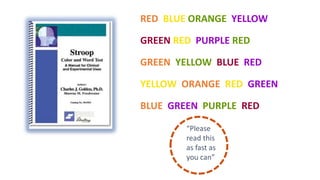
STROOP TEST: Examines ability to inhibit
response
TESTS FOR
ORBITOFRONTAL
CORTEX
RED BLUE ORANGE YELLOW
GREEN RED PURPLE RED
GREEN YELLOW BLUE RED
YELLOW ORANGE RED GREEN
BLUE GREEN PURPLE RED
“Please
read this
as fast as
you can”
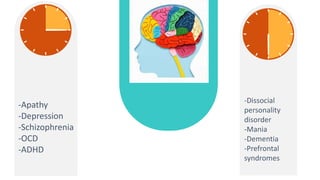
-Apathy
-Depression
-Schizophrenia
-OCD
-ADHD
-Dissocial
personality
disorder
-Mania
-Dementia
-Prefrontal
syndromes
• Prefrontal volume is reduced.
• High density of neurons is found in the prefrontal cortex of
their brain.
• Decrease in the GABAergic axon terminals in the DLPFC
• Reduced number of dopamine D1 like receptor in the PFC
are correlated with cognitive deficiencies
• Increase in the dopamine D1 binding increased in the PFC
correlated with poorer working memory performance
• Positive symptoms are caused by overactivity of the mesolimbic
system or an excess number of D2 like receptors.
• Negative symptoms correlate with a decrease in glucose utilization
in the frontal and parietal cortex. caused due to loss of function of
mesocortical system.
• Excessive synaptic pruning in the frontal cortex is hypothesized to
result in the hallucinated speech.
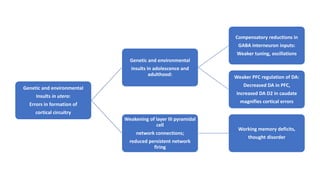
Genetic and environmental
Insults in utero:
Errors in formation of
cortical circuitry
Genetic and environmental
insults in adolescence and
adulthood:
Compensatory reductions in
GABA interneuron inputs:
Weaker tuning, oscillations
Weaker PFC regulation of DA:
Decreased DA in PFC,
Increased DA D2 in caudate
magnifies cortical errors
Weakening of layer III pyramidal
cell
network connections;
reduced persistent network
firing
Working memory deficits,
thought disorder
• Decrease in the glial number and density in the Orbitofrontal
Cortex.
• Neuron cell size but not number is reduced.
• Decreased blood flow to the medial frontal pole appears to be
critical in the depression related cognitive impairment.
• Decreased activity in the PFC in unipolar or bipolar depression
compared to controls.
• Decreased metabolism in the Dorsolateral Prefrontal Cortex, lateral
Orbitofrontal Cortex., anterior insula and in ventral striatum in
depressive phase.(l>r)
• Decreased right Orbitofrontal Cortex. activity dysregulation of
the inhibitory prefrontal amygdala circuit: impulsivity, unstable
• Reduced volume of the Orbitofrontal Cortex
• Increased blood flow and metabolism in the frontal lobe
• Damage to the right medial prefrontal cortex- pathological
hoarding
• PTSD patients with increased autonomic and emotional responses,
have reduced activity in the medial prefrontal cortex and anterior
cingulate gyrus.
• PTSD patients with dissociated responses, have increased activity in
the medial prefrontal cortex and anterior cingulate gyrus.
• Reduced metabolism and volume reductions in the Orbitofrontal
Cortex, cingulate gyrus, hippocampus and amygdala.
• Volume reduction corelated with impulsivity and aggressive
behavior, impaired emotional processing and emotional instability
• Decreased serotonin synthesis capacity in the medial frontal
cortex, anterior cingulate gyrus and posterosuperior temporal gyrus
• Dysregulation of the limbic-orbitofrontal circuitry
• Impaired theory of mind (Medial Prefrontal Cortex)
• Impulsivity: Orbitofrontal Cortex
• Selective attention deficit: d-ACC
• Sustained attention deficit: DLPFC
• Hyperactivity: prefrontal motor cortex
• Presents with features of dementia and behavioural disturbances
• behavioural disturbance: disinhibition, irritability, hypersexuality,
apathy)
• Prefrontal cortex is linked to impulse control
• Damage causes disinhibition
• GABA and DA are responsible for loss of impulse control
• Increases DA release and enhances pleasure feeling
• Alcohol co-binds with GABA to GABA receptor and hyperpolarise
the post synaptic neuron, so ability of neurons in frontal lobe to
inhibit socially unacceptable behavior is reduced
• Most commonly produced by trauma, infarcts, tumors, lobotomy,
multiple sclerosis, or Pick disease
• Consists of slow thinking, poor judgment, decreased curiosity, social
withdrawal, and irritability.
• Patients typically display apathetic indifference to experience that
can explode into impulsive disinhibition.
• Unilateral frontal lobe lesions may be mostly unnoticed because the
intact lobe can compensate with high efficiency.
• Frontal lobe dysfunction may be challenging to detect.
• Frontal lobe pathology may become apparent only under
unstructured, stressful, real-life situations.
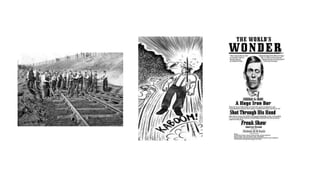
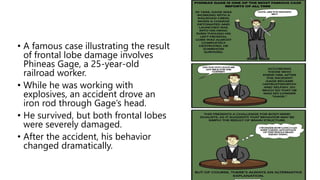
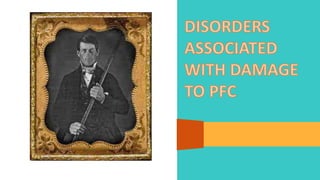
• A famous case illustrating the result
of frontal lobe damage involves
Phineas Gage, a 25-year-old
railroad worker.
• While he was working with
explosives, an accident drove an
iron rod through Gage’s head.
• He survived, but both frontal lobes
were severely damaged.
• After the accident, his behavior
changed dramatically.
• The case was written up by J. M. Harlow, M.D., in 1868, as follows:
[Gage] is fitful, irreverent, indulging at times in the grossest profanity
(which was not previously his custom), manifesting but little
deference for his fellows, impatient of restraint or advice when it
conflicts with his desires… His mind was radically changed, so
decidedly that his friends and acquaintances said he was “no longer
Gage” (Courtesy of Anthony A. Walsh, Ph.D.)
• Deficits in cognitive flexibility, temporal ordering of recent events, planning,
regulating ones actions.
• Unable to retrieve information, impaired working memory
• Diminished judgment, insight, self-care, and there is reduced verbal and
nonverbal fluency.
• Reduced state of mental control, perseveration, and impairment of sustained
attention.
• There is impaired priming of stereotypes if the lesion is of ventromedial PFC.
• The hallmark severe reduction in spontaneity, motivation, and lack
of interest in the environment.
• Recent memory intact. Lesion involving the medial motor cortices.
• OFC damage, disturbance of behaviors.
• Abnormalities in the realms of reasoning, decision-making, and
emotional control.
• Explosive aggressive outbursts characterized by socially
unacceptable, tactless, and vulgar presentation.
Frontal Assessment Battery
• The FAB is a brief tool that can be used at the bedside or in a clinic
setting to assist in discriminating between dementias with a frontal
dysexecutive phenotype and Dementia of Alzheimer‟s Type (DAT).
The FAB has validity in distinguishing Fronto-temporal type
dementia from DAT in mildly demented patients (MMSE > 24). Total
score is from a maximum of 18, higher scores indicating better
performance
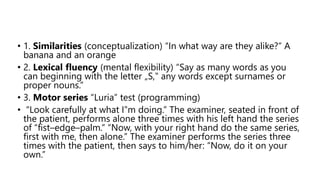
• 1. Similarities (conceptualization) “In what way are they alike?” A
banana and an orange
• 2. Lexical fluency (mental flexibility) “Say as many words as you
can beginning with the letter „S,‟ any words except surnames or
proper nouns.”
• 3. Motor series “Luria” test (programming)
• “Look carefully at what I‟m doing.” The examiner, seated in front of
the patient, performs alone three times with his left hand the series
of “fist–edge–palm.” “Now, with your right hand do the same series,
first with me, then alone.” The examiner performs the series three
times with the patient, then says to him/her: “Now, do it on your
own.”
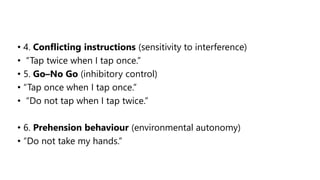
• 4. Conflicting instructions (sensitivity to interference)
• “Tap twice when I tap once.”
• 5. Go–No Go (inhibitory control)
• “Tap once when I tap once.”
• “Do not tap when I tap twice.”
• 6. Prehension behaviour (environmental autonomy)
• “Do not take my hands.”
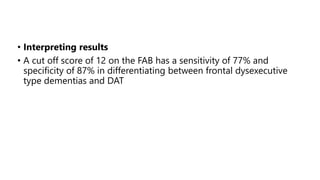
• Interpreting results
• A cut off score of 12 on the FAB has a sensitivity of 77% and
specificity of 87% in differentiating between frontal dysexecutive
type dementias and DAT
References
• Snell’s Clinical Neuroanatomy, 7th Edition
• Vishram Singh’s Textbook of Clinical Neuroanatomy, 2nd Edition
• Lishman’s Organic Psychiatry, 4th Edition
• Strub and Black’s Mental Status Examination in Neurology, 4th
Edition
• Kaplan and Sadock’s Comprehensive Textbook of Psychiatry, 10th
Edition
• Kaplan and Sadock’s Synopsis of Psychiatry, 12th Edition
PREFRONTAL CORTEX.pptx

PREFRONTAL CORTEX.pptx

  • 1.
    PRESENTER:DR MEDHA SUBRAMANI(PG) MODERATOR:DRAKSHATHA J K (ASSISTANT PROFESSOR)
  • 2.
    Anatomy of Brain Introductionto Prefrontal Cortex Parts of Prefrontal Cortex Functions Tests to assess Prefrontal Cortex Disorders of Prefrontal Cortex References TABLE OFCONTENTS
  • 3.
  • 4.
    • The frontallobe is located anterior to the central sulcus and consists of the primary motor, premotor, and prefrontal regions.
  • 7.
    PREFRONTAL CORTEX THE ORBITAL GYRI MOSTOF THE MEDIAL FRONTAL GYRUS THE ANTERIOR HALF OF THE CINGULATE GYRUS (BRODMANN AREAS 9, 10, 11, AND 12) GREATER PARTS OF THE SUPERIOR, MIDDLE, AND INFERIOR FRONTAL GYRI
  • 8.
    The prefrontal area is concernedwith the makeup of the individual’s personality. As the result of the input from many cortical and subcortical sources, this area plays a role as a regulator of the person’s depth of feeling. It also exerts its influence in determining the initiative and judgment of an individual.
  • 10.
    PRE FRONTAL CORTEX Dorsolateral PFC (DLPFC) VentrolateralPFC (VLPFC) Orbitofrontal cortex (OFC) Dorsomedial PFC (MdPFC) Ventromedial PFC (MvPFC)
  • 13.
    Lateral Prefrontal Cortex • Functionalmagnetic resonance imaging (MRI) and event-related potential (ERP) research have defined the spatial and temporal contributions of lateral prefrontal cortex (LPFC) including portions of inferior, middle, and superior frontal gyri in language, attention, memory, response conflict, novelty processing which is crucial for new learning, creativity. • This region is also responsible for the temporal ordering of events, explicit memory, and metamemory.
  • 14.
    • Simulation, i.e.,process of generating internal modes of external reality, the absence of which can lead to stimulus-bound behavior thereby resulting in utilization behavior and reality monitoring is too subserved by this region which is proposed as a major mechanism in self-awareness. • The caudal-most portion of the lateral prefrontal cortex is important for attention and orientation. • Dorso lateral prefrontal cortex activation which belongs to a neural circuit that includes posterior parietal cortex, head of the caudate nucleus, and the dorsomedial thalamic nucleus has been associated with a diverse set of cognitive processes, including actively maintaining information in working memory, changing behavior according to task demands or representing past events, current goals, and future predictions and organization and conceptualization of finances.
  • 15.
    • Increased memory-relatedactivity in mid-ventrolateral prefrontal cortex has been related to actively encoding and retrieving information, updating and maintaining the contents of working memory. • Right Dorso lateral prefrontal cortex mediates negative attitudes and left ventrolateral prefrontal cortex mediates positive attitude, spatial and conceptual reasoning process, planning, and integration of perception with action across time.
  • 16.
    Dorsolateral Prefrontal Cortex(DLPFC) • Regulates attention and action • Working memory • Abstract reasoning • Planning and organisation • Insight and judgement
  • 17.
    VISUAL CORTEX AUDITORY CORTEX ASSOCIATION CORTEX INPUTS ASSOCIATION AND SENSORY ANDMOTOR CORTEX THALAMUS BASAL GANGLIA BRAINSTEM HIPPOCAMPUS OUTPUTS
  • 18.
    Lesion of DorsolateralPrefrontal Cortex 1. Executive function deficits: Difficulty in planning, feedback, learning, sequencing, establishing, maintaining and changing a set behavior 2. Perseveration 3. Stimulus bound behavior 4. Echopraxia C/F: General disinterest, apathy, shortened attention, lack of emotional reactivity.
  • 19.
    VENTROLATERAL PREFRONTAL CORTEX •Brodmann’s area 44,45 and lateral aspect of 47 Includes pars opercularis, pars triangularis , pars orbitalis, Broca’s area DOMINANT • SEMANTIC PROCESSING • CONTROL OF MEMORY • EXECUTIVE FUNCTIONS FOR GOAL DIRECTED BEHAVIOUR NON DOMINANT • EMOTIONAL ASPECT OF FACES
  • 20.
    MEDIAL PREFRONTAL CORTEX •Specifically, the medial frontal region (anterior cingulate area) appears to be involved in bimanual coordination, attention to demanding cognitive tasks, modulation of body arousal, spatial memory, self-initiated movement, and conflict resolution (medial prefrontal and medial orbital regions). • The anterior cingulate cortex is also involved in the perception of pain and possibly in mediating the emotional response behind it.
  • 21.
    • Reward andgoal-related activity are thought to correspond to the unique patterns of connections that link the rostral cingulate motor cortex with the prefrontal and limbic cortices. • Ventromedial region plays a role in decision making and the retrieval of information from long-term memory and metacognitive processes.
  • 23.
    • Medial PrefrontalCortex along with anterior cingulate gyrus, amygdala, insula, superior temporal sulcus and temporo parietal junction together form social brain • Social brain: Medial prefrontal cortex is involved in analysis and appreciation of the mental self as well as the mental status of others. Social brain is used to judge risk and reward of alternative behaviours we might select to be successful in social situation SOCIAL BRAIN
  • 24.
    DORSOMEDIAL PREFRONTAL CORTEX •Introspection • Motivation and initiation of activities • Regulate our own emotional responses
  • 25.
    LESIONS OF DORSOMEDIALPREFRONTAL CORTEX • Apathetic • Lack of spontaneous movement • Akinetic mutism • Paresis and urinary incontinence • Patients appear indifferent to the problem
  • 26.
    VENTROMEDIAL PREFRONTAL CORTEX •Located inferior to dorsomedial prefrontal cortex • Receives input from all sensory modalities • Empathetic and sympathetic aspects of emotion • Autonomic control of viscera and regulation of emotional state
  • 27.
    ORBITOFRONTAL CORTEX • Brodmann’sarea 11,12 and medial aspect of 47 • Location : From gyrus rectus on the ventral surface to the ventrolateral convexity laterally and from the limen of insula posteriorly to the frontal pole • Functions : • Highest integration centre for emotional processing • Calculation of risk/ reward ratio when selecting behavior • Suppression of distraction during performance • Inhibitory control over emotional and social behavior
  • 28.
    • Orbitofrontal Cortexfunctions as a component of the paralimbic ring involved in autonomic, response inhibition, and stimulus significance functions, mnemonic functions and delayed response. • It plays a role in reward expectations and in the anticipation and processing of outcomes even if the outcome does not produce any reward. • This region has been shown to have a significant role in social and emotional behavior. • Anterior Orbitofrontal Cortex is activated in case of aversive tastes and pleasurable taste is mediated by caudomedial regions of PFC.
  • 29.
    • Prefrontal Cortexinteractions with the hypothalamus mediate reward aspects of eating like food cravings. • Ventral Prefrontal Cortex emerging from Orbitofrontal Cortex is connected with limbic system and is involved in emotional processing. • This region is intimately associated with amygdala and anterior cingulate, and is involved in behavioral self-regulation.
  • 31.
    LESIONS OF ORBITOFRONTALCORTEX • Disinhibition • Emotionally labile, irritable and impulsive • Impaired in the ability to interpret and respond to emotional voice or face expressions • May engage in risky and dangerous distractibility • Choose instant reward over waiting • Great difficulty in decision making
  • 33.
    Is the patientable to make an appointment and arrive on time Is the patient able to give coherent aware of current problems Digit Span test, days of the week/ Months in backwards Controlled Oral Word Association Test (COWAT) Alternating hand sequences (Fist Edge Palm)
  • 34.
    Used primarily toassess perseveration and abstract thinking. The WCST is also considered a measure of executive function because of its reported sensitivity to frontal lobe dysfunction. The WCST consists of four key cards and 128 response cards. The task requires subjects to find the correct classification principle by trial and error and examiner feedback.
  • 35.
    Wisconsin Card Sorting Test- “Pleasesort the 60 cards under the 4 samples. I won’t tell you the rule, but I will announce every mistake. ”
  • 36.
    Does the patientdress or behave in a way which suggests lack of concern with feeling of others Test sense of smell GO/ NO GO TEST STROOP TEST: Examines ability to inhibit response TESTS FOR ORBITOFRONTAL CORTEX
  • 37.
    RED BLUE ORANGEYELLOW GREEN RED PURPLE RED GREEN YELLOW BLUE RED YELLOW ORANGE RED GREEN BLUE GREEN PURPLE RED “Please read this as fast as you can”
  • 39.
  • 40.
    • Prefrontal volumeis reduced. • High density of neurons is found in the prefrontal cortex of their brain. • Decrease in the GABAergic axon terminals in the DLPFC • Reduced number of dopamine D1 like receptor in the PFC are correlated with cognitive deficiencies • Increase in the dopamine D1 binding increased in the PFC correlated with poorer working memory performance
  • 41.
    • Positive symptomsare caused by overactivity of the mesolimbic system or an excess number of D2 like receptors. • Negative symptoms correlate with a decrease in glucose utilization in the frontal and parietal cortex. caused due to loss of function of mesocortical system. • Excessive synaptic pruning in the frontal cortex is hypothesized to result in the hallucinated speech.
  • 42.
    Genetic and environmental Insultsin utero: Errors in formation of cortical circuitry Genetic and environmental insults in adolescence and adulthood: Compensatory reductions in GABA interneuron inputs: Weaker tuning, oscillations Weaker PFC regulation of DA: Decreased DA in PFC, Increased DA D2 in caudate magnifies cortical errors Weakening of layer III pyramidal cell network connections; reduced persistent network firing Working memory deficits, thought disorder
  • 43.
    • Decrease inthe glial number and density in the Orbitofrontal Cortex. • Neuron cell size but not number is reduced. • Decreased blood flow to the medial frontal pole appears to be critical in the depression related cognitive impairment. • Decreased activity in the PFC in unipolar or bipolar depression compared to controls.
  • 44.
    • Decreased metabolismin the Dorsolateral Prefrontal Cortex, lateral Orbitofrontal Cortex., anterior insula and in ventral striatum in depressive phase.(l>r) • Decreased right Orbitofrontal Cortex. activity dysregulation of the inhibitory prefrontal amygdala circuit: impulsivity, unstable
  • 45.
    • Reduced volumeof the Orbitofrontal Cortex • Increased blood flow and metabolism in the frontal lobe • Damage to the right medial prefrontal cortex- pathological hoarding
  • 46.
    • PTSD patientswith increased autonomic and emotional responses, have reduced activity in the medial prefrontal cortex and anterior cingulate gyrus. • PTSD patients with dissociated responses, have increased activity in the medial prefrontal cortex and anterior cingulate gyrus.
  • 47.
    • Reduced metabolismand volume reductions in the Orbitofrontal Cortex, cingulate gyrus, hippocampus and amygdala. • Volume reduction corelated with impulsivity and aggressive behavior, impaired emotional processing and emotional instability • Decreased serotonin synthesis capacity in the medial frontal cortex, anterior cingulate gyrus and posterosuperior temporal gyrus
  • 48.
    • Dysregulation ofthe limbic-orbitofrontal circuitry • Impaired theory of mind (Medial Prefrontal Cortex) • Impulsivity: Orbitofrontal Cortex • Selective attention deficit: d-ACC • Sustained attention deficit: DLPFC • Hyperactivity: prefrontal motor cortex
  • 49.
    • Presents withfeatures of dementia and behavioural disturbances • behavioural disturbance: disinhibition, irritability, hypersexuality, apathy)
  • 50.
    • Prefrontal cortexis linked to impulse control • Damage causes disinhibition • GABA and DA are responsible for loss of impulse control • Increases DA release and enhances pleasure feeling • Alcohol co-binds with GABA to GABA receptor and hyperpolarise the post synaptic neuron, so ability of neurons in frontal lobe to inhibit socially unacceptable behavior is reduced
  • 51.
    • Most commonlyproduced by trauma, infarcts, tumors, lobotomy, multiple sclerosis, or Pick disease • Consists of slow thinking, poor judgment, decreased curiosity, social withdrawal, and irritability. • Patients typically display apathetic indifference to experience that can explode into impulsive disinhibition. • Unilateral frontal lobe lesions may be mostly unnoticed because the intact lobe can compensate with high efficiency. • Frontal lobe dysfunction may be challenging to detect. • Frontal lobe pathology may become apparent only under unstructured, stressful, real-life situations.
  • 52.
    • A famouscase illustrating the result of frontal lobe damage involves Phineas Gage, a 25-year-old railroad worker. • While he was working with explosives, an accident drove an iron rod through Gage’s head. • He survived, but both frontal lobes were severely damaged. • After the accident, his behavior changed dramatically.
  • 53.
    • The casewas written up by J. M. Harlow, M.D., in 1868, as follows: [Gage] is fitful, irreverent, indulging at times in the grossest profanity (which was not previously his custom), manifesting but little deference for his fellows, impatient of restraint or advice when it conflicts with his desires… His mind was radically changed, so decidedly that his friends and acquaintances said he was “no longer Gage” (Courtesy of Anthony A. Walsh, Ph.D.)
  • 54.
    • Deficits incognitive flexibility, temporal ordering of recent events, planning, regulating ones actions. • Unable to retrieve information, impaired working memory • Diminished judgment, insight, self-care, and there is reduced verbal and nonverbal fluency. • Reduced state of mental control, perseveration, and impairment of sustained attention. • There is impaired priming of stereotypes if the lesion is of ventromedial PFC.
  • 55.
    • The hallmarksevere reduction in spontaneity, motivation, and lack of interest in the environment. • Recent memory intact. Lesion involving the medial motor cortices.
  • 56.
    • OFC damage,disturbance of behaviors. • Abnormalities in the realms of reasoning, decision-making, and emotional control. • Explosive aggressive outbursts characterized by socially unacceptable, tactless, and vulgar presentation.
  • 57.
    Frontal Assessment Battery •The FAB is a brief tool that can be used at the bedside or in a clinic setting to assist in discriminating between dementias with a frontal dysexecutive phenotype and Dementia of Alzheimer‟s Type (DAT). The FAB has validity in distinguishing Fronto-temporal type dementia from DAT in mildly demented patients (MMSE > 24). Total score is from a maximum of 18, higher scores indicating better performance
  • 58.
    • 1. Similarities(conceptualization) “In what way are they alike?” A banana and an orange • 2. Lexical fluency (mental flexibility) “Say as many words as you can beginning with the letter „S,‟ any words except surnames or proper nouns.” • 3. Motor series “Luria” test (programming) • “Look carefully at what I‟m doing.” The examiner, seated in front of the patient, performs alone three times with his left hand the series of “fist–edge–palm.” “Now, with your right hand do the same series, first with me, then alone.” The examiner performs the series three times with the patient, then says to him/her: “Now, do it on your own.”
  • 59.
    • 4. Conflictinginstructions (sensitivity to interference) • “Tap twice when I tap once.” • 5. Go–No Go (inhibitory control) • “Tap once when I tap once.” • “Do not tap when I tap twice.” • 6. Prehension behaviour (environmental autonomy) • “Do not take my hands.”
  • 60.
    • Interpreting results •A cut off score of 12 on the FAB has a sensitivity of 77% and specificity of 87% in differentiating between frontal dysexecutive type dementias and DAT
  • 61.
    References • Snell’s ClinicalNeuroanatomy, 7th Edition • Vishram Singh’s Textbook of Clinical Neuroanatomy, 2nd Edition • Lishman’s Organic Psychiatry, 4th Edition • Strub and Black’s Mental Status Examination in Neurology, 4th Edition • Kaplan and Sadock’s Comprehensive Textbook of Psychiatry, 10th Edition • Kaplan and Sadock’s Synopsis of Psychiatry, 12th Edition

Editor's Notes

  • #4  The lateral cerebral fissure, also known as the Sylvian fissure  central sulcus, which is the divide between the frontal and parietal lobes the parieto-occipital sulcus divides the parietal and occipital lobes
  • #5 Central sulci…ant to it….precentral gyri….contains motor area Within the precentral gyrus and anterior to the primary motor cortex is the prefrontal cortex
  • #6 The focus of this article is on the prefrontal cortex of the frontal lobe, the largest of the four, and in many ways the lobe which participates most in making us human  It is located at the most rostral (anterior) region of each cerebral hemisphere, separated from the parietal lobe by the central sulci temporal lobe by the lateral cerebral (Sylvian) fissure.
  • #14 Photo by insung yoon on Unsplash Photo by alexandru vicol on Unsplash
  • #33 Photo by PowerPoint Asset
  • #34 Cowat : Controlled Oral Word Association Test, abbreviated COWA or COWAT, is a verbal fluency test that measures spontaneous production of words belonging to the same category or beginning with some designated letter. "Verbal Associative Fluency Test“ The participant is usually asked to name words beginning with a letter, excluding proper nouns, for one minute and this procedure is repeated three times. The most commons letters used are FAS because of their frequency in the English language.[3] The examiner must quickly write down the words provided by the participant on a piece of paper. The whole examination usually takes 5–10 minutes.
  • #35 Photo by Teemu Paananen on Unsplash
  • #36 unsplash.com
  • #37 Photo by Jon Tyson on Unsplash
  • #59  1 (In the event of total failure: “they are not alike” or partial failure: “both have peel,” help the patient by saying: “both a banana and an orange are fruit”; but credit 0 for the item; do not help the patient for the two following items) A table and a chair A tulip, a rose and a daisy 2 “Say as many words as you can beginning with the letter „S,‟ any words except surnames or proper nouns.” If the patient gives no response during the first 5 seconds, say: “for instance, snake.” If the patient pauses 10 seconds, stimulate him by saying: “any word beginning with the letter „S.‟ The time allowed is 60 seconds. Score (word repetitions or variations [shoe, shoemaker], surnames, or proper nouns are not counted as correct responses) > 9 words: 3 6 -9 words: 2 3 -5 words: 1 < 3 words: 0 3 Patient performs six correct consecutive series alone: 3 Patient performs at least three correct consecutive series alone: 2 Patient fails alone, but performs three correct consecutive series with the examiner: 1 Patient cannot perform three correct consecutive series even with the examiner: 0
  • #60 4 To ensure that the patient has understood the instruction, a series of 3 trials is run: 1-1-1. No errors: 3 1 -2 errors: 2 > 2 errors: 1 Patient taps like the examiner at least four consecutive times: 0 5 To ensure that the patient has understood the instruction, a series of 3 trials is run: 1-1-1To ensure that the patient has understood the instruction, a series of 3 trials is run: 2-2-2. 6 Patient does not take the examiner‟s hands: 3 Patient hesitates and asks what he/she has to do: 2 Patient takes the hands without hesitation: 1 Patient takes the examiner‟s hand even after he/she has been told not to do so: 0