Assessment of Executive Functioning in Psychoeducational Domains  CPA 2006 Michael Decaire, M.A. Clinical Measurement Consultant Harcourt Assessment / PsychCorp 1-866-335-8428 [email_address] http://www.harcourtassessment.ca http://psychoed.thedatabase.org (powerpoints)
Agenda Executive Functioning an Introduction EF in Schools Assessment
Executive Functioning An Introduction
Definition Executive Functioning as a defined term is a relatively recent development (a caution!) A fluid definition! Previously assessed primarily by neuropsychologists Most recently it has moved to the domain of psychoeducational assessment as its contributions towards academic difficulty and the benefits of disorder specific remediation have become better known.
A Working Definition Executive Functions are higher order cognitive skills associated with the ability to engage in independent, goal-directed behavior. Draw on fundamental skills to generate higher levels of creative & abstract thought May result in obvious behavior disorder or subtle problems with behavioral regulation Also known as dysexecutive syndrome
A Working Definition Due to the wide ranging complexity of executive functioning it is difficult to produce an accurate single statement to describe the construct or the disorder. As a result it is frequently described by the nature of the dysfunction and the general symptom pattern Impairments in executive functioning have been linked to dysfunction of the frontal lobes
Defining Executive Functions There is certainly a debate regarding how we should exactly define executive functioning or executive functioning impairments Fortunately the assessment of these domains seems to have transcended the bantering of theorists Examining their work, however, does help us better understand what exactly is going on here
Defining Executive Functions Martha Denkla warns us that we should avoid turning executive functions into the neuropsychologist’s “g” Yet other theorists have jumped on this idea (Elkhonon Goldberg refers to executive functions as the “S”(for smart) Factor). Paradoxically, both Denkla and Goldberg use the analogy of the Orchestra Conductor as a metaphor and support structure for executive processes at work.
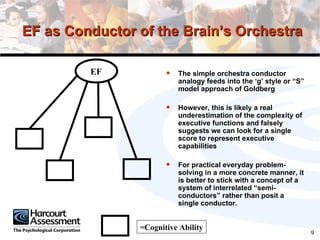
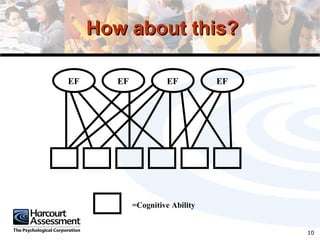
EF as Conductor of the Brain’s Orchestra The simple orchestra conductor analogy feeds into the ‘g’ style or “S” model approach of Goldberg However, this is likely a real underestimation of the complexity of executive functions and falsely suggests we can look for a single score to represent executive capabilities For practical everyday problem-solving in a more concrete manner, it is better to stick with a concept of a system of interrelated “semi-conductors” rather than posit a single conductor.  EF =Cognitive Ability
How about this? =Cognitive Ability EF EF EF EF
That’s Better! =Cognitive Ability EF EF EF EF EF EF EF EF EF EF
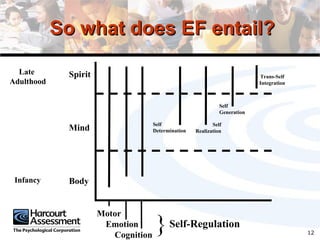
So what does EF entail? Spirit Mind Body Motor  Emotion  Cognition Self Determination Self Realization Self Generation Trans-Self Integration Infancy Late  Adulthood Self-Regulation }
Good Executive Functioning mental flexibility set formation and maintenance behavioral initiation/productivity planning self-monitoring abstract reasoning/concept formation Inhibition of impulsive/pre-potent responses rule learning
Executive Functioning Deficits Disinhibition - lacks behavioral control, impulsive  Perseveration - repeats non-functional behavior, inability to change behavior despite corrective feedback, difficulties learning from experience Forgetfulness - off-task behaviors, mental errors, loses track of what they were doing Inefficiency - takes more steps to complete task than necessary Difficulty understanding consequences and cause-effect relationships Frequently violate rules despite apparent knowledge of the rules Apathetic - lacks motivation, does not set goals, engages in behavior only when prodded
Executive Functioning Deficits Difficulties accessing knowledge Concrete thinking Emotional lability Poor frustration tolerance Disorganized Inconsistent performance on tasks within ability range Difficulties coping with change Poor judgment
What is going on here? Evidence from neuro-science suggests that executive impairment comes from frontal lobe circuit dysfunction Dorsolateral Orbitofrontal Anterior Cingulate
What is going on here? The nature of the impairment can be quite different depending on the area and extent of difficulty. As a result no single score, subtest or criteria can identify all individuals with executive impairment.
Dorsolateral Circuit Subserves executive functions which include the ability to organize a behavioral response to solve a complex problem, activation of remote memories, independence from environmental contingencies, shifting and maintaining behavioral sets appropriately, generating motor programs, and using verbal skills to guide behavior. The big one!
Dorsolateral Circuit Poor Organizational strategies Poor memory search strategies Stimulus-bound behavior/environmental dependency Impaired set shifting and maintenance Verbal-manual dissociation
Poor Organizational Strategies Reflected by: Poor general organization and planning strategies Segmented drawings Impaired organization of material to be learned Poor word list generation Reduced design fluency Poor sorting behavior
 
Organization & Planning Slide Removed – Test Item Content Contact Author for Details
Organization/Planning & Segmented Drawings Slide Removed – Test Item Content Contact Author for Details
Segmented Drawings
Impaired Organization of Material To be Learned Slide Removed – Test Item Content Contact Author for Details
Reduced Design Fluency Slide Removed – Test Item Content Contact Author for Details
Poor Sorting Behaviour Slide Removed – Test Item Content Contact Author for Details
Poor Memory Search Strategies Reduced word list generation Poor verbal fluency Poor recall of recently learned information Poor recall of remote information
Poor Verbal Fluency Letter Fluency Category Fluency (Animals, Boy’s Names) Switching Categories (Fruit/Furniture)
Stimulus-Bound Behaviour & Environmental Dependency Poor set shifting Concrete interpretation of abstract concepts and proverbs “ Pull” toward high stimulus objects Imitation behaviour Poor response inhibition
Poor Set Shifting Copyright © 1999 by The Psychological Corporation. All rights reserved. TO NEXT STAND BIKE THE
Poor Set Shifting Copyright © 1999 by The Psychological Corporation. All rights reserved. MARY WILL MONKEY THE TRAIN TO RIDE BIKE THE
Concrete Interpretation of Abstract Concepts and Proverbs Slide Removed – Test Item Content Contact Author for Details
Pull Towards High Stimulus Objects
Poor Response Inhibition
Poor Response Inhibition Slide Removed – Test Item Content Contact Author for Details
Orbitofrontal Circuit The ‘other side’ of executive impairment Mediates emphatic, civil, and socially appropriate behavior.  Personality change is the hallmark of orbitofrontal dysfunction. Personality change (if injury based EF) Mood disorders OCD
Personality Change Emotional lability Tactlessness Impulsivity Irritability Antisocial behaviour
Mood Disorders Depression Lability Mania
Obsessive-Compulsive Difficulty in changing set (overly focused on one pattern) Poor appropriate stimulus-response learning Lack of appropriate extinction response Overly focused on details
Anterior Cingulate Circuit The ‘third’ side of the coin! Mediates motivated behaviour Impaired motivation Poverty of spontaneous speech Reduced creative thought Poor response inhibition
That’s a lot of problems! “ Deficits in PFC [prefrontal cortex, aka frontal lobes] function are evident in every neuropsychiatric disorder (indeed, the term “psychiatric problem” seems synonymous with PFC dysfunction).” Arnsten & Robbins 2002 in  Principles of Frontal Lobe Function Most of the clinical conditions described in the DSM-IV reflect some form of Executive Dysfunction The DSM-IV can be thought of as “A User’s Guide to All the Things That Can Go Wrong With the Frontal Lobes” The frontal lobes differentiate us from all other species.  They are also what messes us up!
Key Characteristics (or … enough with this brain stuff already what am I going to see?) Initiation Working Memory Inhibition Shifting Planning Organization Self-Monitoring Emotional Control Goal-Directed Behaviour
Executive Functioning Relationship with School and Core Assessment
EF & Intelligence Broad theoretical definitions of EF differ in the level in which they implicitly or explicitly  include or exclude  executive control processes as part of “Intelligence” Narrow theoretical definitions often include executive functions implicitly as part of problem-solving or reasoning in “Intelligence” “ The ability to carry on abstract thinking.”  (L.M. Terman) Intelligence is the capacity to learn from experience, using metacognitive processes to enhance learning, and the ability to adapt to the surrounding environment, which may require different adaptations within different social and cultural contexts.” (Sternberg, 2003)
EF & Intelligence The operational definitions of intelligence used to guide test development typically do not include executive functions as a distinct component to be assessed. Many measures of intelligence involve executive control to some degree, but the role and effect of EFs are often minimized by the assessment procedures. Subtest Directions: Do this .. Then this .. Then this .. Then this It is often necessary to include specific measures of executive control in an assessment in order to characterize the role of EFs in “intelligent” behavior. EF involvement can be understood through the application of a process approach while administering tasks developed to assess various cognitive abilities.
EF & Working Memory It has been vigorously debated whether these two processes are one in the same Correlation studies between various EF subtests on the Delis-Kaplan Executive Function System (DKEFS) and the WMI index and Subtests from WISC-IV and WISC-IV Integrated have showed that while there is certainly a relationship between these abilities they are not a synonymous function Working memory processes involved in manipulating information in mind are dissociable from the executive processes that direct or cue the use of working memory resources .
EF in the Classroom Although executive functions are used to guide cognitive processing involved in new learning, many new learning situations are structured in ways that reduce the need for strong executive direction. In contrast, demonstrating what has been learned usually requires significant involvement of executive control processes. Because internally driven production is much easier to accomplish than externally demanded production for children with “producing difficulties” their lack of production on demand often stands in stark contrast to their seemingly effortless production “when the spirit moves them.” The on-demand deficiencies are often attributed to negative qualities such as lack of responsibility, apathy, passive aggressive stance, or oppositional defiance. A Great Resource: http://www.schoolbehavior.com
EF in Reading Reading Decoding – poor use one or more self-regulation EFs (e.g., lack of attention to specific letters in words; saying words that “look” like the word on the page) Rapid Automatic Naming – poor executive control of language fluency processes Reading Comprehension – poor direction of one of more self-regulation EFs (e.g., Focus, Sustain, Manipulate, Balance, etc.) when reading for meaning
EF in Writing Poor graphomotor control and lack of automaticity for handwriting Poor organization of written material Poor retrieval cueing or poor generate cueing for idea generation or idea fluency when writing Inability to use multiple self-regulaton EFs at one time (e.g. hold, manipulate, retrieve with generate and execute)
EF in Mathematics Poor cueing of monitor and correct when doing calculation routines Poor cueing of hold, organize, manipulate and retrieve when setting up calculations or problems Poor cueing of organize, store, retrieve, execute when learning or applying rote  knowledge (e.g. storing and retrieving multiplication tables)
Executive Functioning Psychoeducational Assessment
Cautions! There are several great measures of executive functioning available but there are several very important cautions that we must consider (and are frequently ignored!)
Cautions No single subtest/score can represent executive functioning Use of a behavioural checklists alone will typically overestimate executive impairments in the general school population.  There is a lot of reasons kids act out! We must consider that there are significant age effects in EF. We must think of many of these traits as developmental milestones.  At the earliest ages (8-10) we may want to consider retesting or monitoring of EF down the road
Cautions Verbal vs. Nonverbal material Consider their Wechsler profile Use executive measures that include process analysis Ecological validity (Behavioural checklists/Interview/Ecological-Tasks) Profile comparisons using non co-normed measures/subtests
The Tests EF Battery Tests Delis-Kaplan Executive Function System (D-KEFS) NEPSY (Attention-Executive Functions Domain) Behavioural Assessment of Dysexecutive Syndrome (BADS/BADS-C) Individual Subtests Wisconsin Card Sort Test (WCST) Rey Complex Figure (RCFT) Conner’s Continuous Performance Test – 2 nd  Edition (CCPT-II)
An Assessment Framework It is useful to break-down EF measures by the domain area and skill assessed Do not have to measure each domain Use this model to explore the deficit areas Domains Verbal productivity Visual productivity Cognitive flexibility Inhibitory Control Planning Organization Conceptual productivity Abstract/Conceptual Reasoning Self-monitoring and cognitive Control Behavioural and environmental functioning
Verbal Productivity D-KEFS Verbal Fluency Letter / Category (monitor switching/fixedness) NEPSY Verbal Fluency FAS Verbal Fluency WIAT-II Verbal Fluency (Screener only)
Visual Productivity D-KEFS Design Fluency NEPSY Design Fluency Ruff Figural Fluency Slide Removed – Test Item Content Contact Author for Details
Cognitive Flexibility D-KEFS Trail-Making switching D-KEFS Design-Fluency Switching D-KEFS Verbal Fluency Category Switching D-KEFS Color-Word Interference Switching WCST & D-KEFS Sorting Test CELF-IV Sentence Assembly
Cognitive Flexibility The trail making subtest on DKEFS includes 5 formats utilizing a process approach that validates if the problems are due to: Visual Scanning deficits Letter sequencing Numerical sequencing Motor speed OR  cognitive flexibility Slide Removed – Test Item Content Contact Author for Details
Cognitive Flexibility Slide Removed – Test Item Content Contact Author for Details
Cognitive Flexibility Wisconsin Card Sorting Test Slide Removed – Test Item Content Contact Author for Details
Cognitive Flexibility CELF-IV Sentence Assembly Slide Removed – Test Item Content Contact Author for Details
Inhibitory Control NEPSY: Knock and Tap NEPSY: Statue D-KEFS Color-Word Interference (Standard stroop version) Go No-Go BADS-C Playing Cards Test CCPT-II
Planning D-KEFS Tower Test NEPSY Tower Test WISC-IV Integrated Elithorn Mazes BADS-C Zoo Map Test BADS-C Key Search Test BADS-C Water Test
Towers Slide Removed – Test Item Content Contact Author for Details
Elithorn Mazes Slide Removed – Test Item Content Contact Author for Details
Zoo Maps Maze based planning and inhibition test Must plan a route in order to visit 6 of 12 locations within a zoo with route restrictions and under two conditions: Minimal Structure – requires increased planning and inhibition Concrete Structure – requires inhibition and rule following behaviour Examines planning time; Rule violations; Target/Goal achievement
Key Search Tests ability to generate a systematic and implementable problem solving strategy. Told to create a search pattern within a box to find a set of lost keys in a field (utilizes a pencil and paper to represent the search pattern and field) Scoring includes: understanding and fulfilling task requirements; utilization of a systematic, planned, and efficient strategy, ability to implement strategy. Manual provides numerous scoring examples.
BADS/BADS-C Water Test A novel problem solving task requiring planning and implementation of a simple-skill multi-stepped solution to a unique problem. The test is timed primarily for cut-offs that are in place, at which the examiner performs the next step for a child that is struck or perseverating. Score includes number of components completed, perseveration frequency, and time. Slide Removed – Test Item Content Contact Author for Details
Organization Rey-Osterieth Complex Figure (RCFT) Beery VMI / Bender California Verbal Learning Test – Children’s Edition Conceptual Productivity D-KEFS Sorting Test
RCFT Slide Removed – Test Item Content Contact Author for Details
Abstract/Conceptual Reasoning D-KEFS Proverbs (16+ only) D-KEFS 20 Questions Children’s Category Test BADS-C Water Test
D-KEFS Proverbs Slide Removed – Test Item Content Contact Author for Details
D-KEFS 20 Questions Slide Removed – Test Item Content Contact Author for Details
Self-Monitoring / Cognitive Control All D-KEFS subtests CVLT-C WCST Environmental & Behavioural Functioning Behaviour Rating Inventory of Executive Functioning (BRIEF) Brown ADD Scales DEX Questionnaire (BADS-C)
Any executive functioning assessment should include a behavioural based questionnaire like the BRIEF, Brown ADD or DEX These allow for environmental and ecologically reliable information to be introduced into the assessment in a standardized way These measures also provide good screeners for impairment in these areas Behavioural Questionnaires
The Brown ADD looks predominately at ADD based EF symptom patterns The BRIEF was designed to look at general EF but its hard to tell how well it is doing that since the vast majority of studies in the manual are ADD based. The BRIEF is by far the most frequently used EF measure in schools but be cautious.  It vastly overestimates impairment (review the sensitivity/specificity studies) at T=60 and loses a lot of sensitivity of T=70. I tend to utilize the teacher form most frequently (most stable reliability/validity) Behavioural Questionnaires
WISC-IV Integrated and Executive Functioning An Executive Index
Executive Index? Recently the  WISC-IV Advanced Clinical Interpretation  text (Weiss, Saklofske, Prifitera, & Holdnack) text introduced a potential screener/research Executive Functioning Index Utilizing integrated subtests a four subtest index was put together based on: Choosing one subtest from each modality to remove modality specific deficits Subtest must not contribute to other indexes Evidence of sensitivity to EF based disorders
Executive Functioning Index Executive Functioning Index (ages 8 to 16 only) Comprehension Multiple Choice Elithorn Mazes Spatial Span Forward Cancellation Random The text provide appendices with normative tables for each age band, discrepancy tables versus other WISC-IV Indexes, clinical group results for EF based clinical groups.
Executive Functioning Index The EFI should really only be considered a screener that could support further testing Examiners should monitor other subtests for evidence of executive impairment Block Design (planning/impulsivity) Matrix Reasoning (impulsivity) WMI (memory strategies) Picture Concepts (shifting from 2-3 rows)
Conclusion Monitor for evidence of impairment on core measures (WISC-IV/CMS etc) Parental / Teacher reports of …. Behavioural checklist screening Formal Testing of EF domains Design remediation (BRIEF scoring program; see text list)
Questions? Michael Decaire, M.A. Clinical Measurement Consultant Harcourt Assessment / PsychCorp 1-866-335-8428 [email_address] http://www.harcourtassessment.ca

Executive Functioning Assessment in Psychoeducational Domains

  • 1.
    Assessment of ExecutiveFunctioning in Psychoeducational Domains CPA 2006 Michael Decaire, M.A. Clinical Measurement Consultant Harcourt Assessment / PsychCorp 1-866-335-8428 [email_address] http://www.harcourtassessment.ca http://psychoed.thedatabase.org (powerpoints)
  • 2.
    Agenda Executive Functioningan Introduction EF in Schools Assessment
  • 3.
  • 4.
    Definition Executive Functioningas a defined term is a relatively recent development (a caution!) A fluid definition! Previously assessed primarily by neuropsychologists Most recently it has moved to the domain of psychoeducational assessment as its contributions towards academic difficulty and the benefits of disorder specific remediation have become better known.
  • 5.
    A Working DefinitionExecutive Functions are higher order cognitive skills associated with the ability to engage in independent, goal-directed behavior. Draw on fundamental skills to generate higher levels of creative & abstract thought May result in obvious behavior disorder or subtle problems with behavioral regulation Also known as dysexecutive syndrome
  • 6.
    A Working DefinitionDue to the wide ranging complexity of executive functioning it is difficult to produce an accurate single statement to describe the construct or the disorder. As a result it is frequently described by the nature of the dysfunction and the general symptom pattern Impairments in executive functioning have been linked to dysfunction of the frontal lobes
  • 7.
    Defining Executive FunctionsThere is certainly a debate regarding how we should exactly define executive functioning or executive functioning impairments Fortunately the assessment of these domains seems to have transcended the bantering of theorists Examining their work, however, does help us better understand what exactly is going on here
  • 8.
    Defining Executive FunctionsMartha Denkla warns us that we should avoid turning executive functions into the neuropsychologist’s “g” Yet other theorists have jumped on this idea (Elkhonon Goldberg refers to executive functions as the “S”(for smart) Factor). Paradoxically, both Denkla and Goldberg use the analogy of the Orchestra Conductor as a metaphor and support structure for executive processes at work.
  • 9.
    EF as Conductorof the Brain’s Orchestra The simple orchestra conductor analogy feeds into the ‘g’ style or “S” model approach of Goldberg However, this is likely a real underestimation of the complexity of executive functions and falsely suggests we can look for a single score to represent executive capabilities For practical everyday problem-solving in a more concrete manner, it is better to stick with a concept of a system of interrelated “semi-conductors” rather than posit a single conductor. EF =Cognitive Ability
  • 10.
    How about this?=Cognitive Ability EF EF EF EF
  • 11.
    That’s Better! =CognitiveAbility EF EF EF EF EF EF EF EF EF EF
  • 12.
    So what doesEF entail? Spirit Mind Body Motor Emotion Cognition Self Determination Self Realization Self Generation Trans-Self Integration Infancy Late Adulthood Self-Regulation }
  • 13.
    Good Executive Functioningmental flexibility set formation and maintenance behavioral initiation/productivity planning self-monitoring abstract reasoning/concept formation Inhibition of impulsive/pre-potent responses rule learning
  • 14.
    Executive Functioning DeficitsDisinhibition - lacks behavioral control, impulsive Perseveration - repeats non-functional behavior, inability to change behavior despite corrective feedback, difficulties learning from experience Forgetfulness - off-task behaviors, mental errors, loses track of what they were doing Inefficiency - takes more steps to complete task than necessary Difficulty understanding consequences and cause-effect relationships Frequently violate rules despite apparent knowledge of the rules Apathetic - lacks motivation, does not set goals, engages in behavior only when prodded
  • 15.
    Executive Functioning DeficitsDifficulties accessing knowledge Concrete thinking Emotional lability Poor frustration tolerance Disorganized Inconsistent performance on tasks within ability range Difficulties coping with change Poor judgment
  • 16.
    What is goingon here? Evidence from neuro-science suggests that executive impairment comes from frontal lobe circuit dysfunction Dorsolateral Orbitofrontal Anterior Cingulate
  • 17.
    What is goingon here? The nature of the impairment can be quite different depending on the area and extent of difficulty. As a result no single score, subtest or criteria can identify all individuals with executive impairment.
  • 18.
    Dorsolateral Circuit Subservesexecutive functions which include the ability to organize a behavioral response to solve a complex problem, activation of remote memories, independence from environmental contingencies, shifting and maintaining behavioral sets appropriately, generating motor programs, and using verbal skills to guide behavior. The big one!
  • 19.
    Dorsolateral Circuit PoorOrganizational strategies Poor memory search strategies Stimulus-bound behavior/environmental dependency Impaired set shifting and maintenance Verbal-manual dissociation
  • 20.
    Poor Organizational StrategiesReflected by: Poor general organization and planning strategies Segmented drawings Impaired organization of material to be learned Poor word list generation Reduced design fluency Poor sorting behavior
  • 21.
  • 22.
    Organization & PlanningSlide Removed – Test Item Content Contact Author for Details
  • 23.
    Organization & PlanningSlide Removed – Test Item Content Contact Author for Details
  • 24.
    Organization & PlanningSlide Removed – Test Item Content Contact Author for Details
  • 25.
    Organization/Planning & SegmentedDrawings Slide Removed – Test Item Content Contact Author for Details
  • 26.
  • 27.
    Impaired Organization ofMaterial To be Learned Slide Removed – Test Item Content Contact Author for Details
  • 28.
    Reduced Design FluencySlide Removed – Test Item Content Contact Author for Details
  • 29.
    Poor Sorting BehaviourSlide Removed – Test Item Content Contact Author for Details
  • 30.
    Poor Memory SearchStrategies Reduced word list generation Poor verbal fluency Poor recall of recently learned information Poor recall of remote information
  • 31.
    Poor Verbal FluencyLetter Fluency Category Fluency (Animals, Boy’s Names) Switching Categories (Fruit/Furniture)
  • 32.
    Stimulus-Bound Behaviour &Environmental Dependency Poor set shifting Concrete interpretation of abstract concepts and proverbs “ Pull” toward high stimulus objects Imitation behaviour Poor response inhibition
  • 33.
    Poor Set ShiftingCopyright © 1999 by The Psychological Corporation. All rights reserved. TO NEXT STAND BIKE THE
  • 34.
    Poor Set ShiftingCopyright © 1999 by The Psychological Corporation. All rights reserved. TO NEXT STAND BIKE THE
  • 35.
    Poor Set ShiftingCopyright © 1999 by The Psychological Corporation. All rights reserved. MARY WILL MONKEY THE TRAIN TO RIDE BIKE THE
  • 36.
    Poor Set ShiftingCopyright © 1999 by The Psychological Corporation. All rights reserved. MARY WILL MONKEY THE TRAIN TO RIDE BIKE THE
  • 37.
    Concrete Interpretation ofAbstract Concepts and Proverbs Slide Removed – Test Item Content Contact Author for Details
  • 38.
    Pull Towards HighStimulus Objects
  • 39.
  • 40.
    Poor Response InhibitionSlide Removed – Test Item Content Contact Author for Details
  • 41.
    Poor Response InhibitionSlide Removed – Test Item Content Contact Author for Details
  • 42.
    Orbitofrontal Circuit The‘other side’ of executive impairment Mediates emphatic, civil, and socially appropriate behavior. Personality change is the hallmark of orbitofrontal dysfunction. Personality change (if injury based EF) Mood disorders OCD
  • 43.
    Personality Change Emotionallability Tactlessness Impulsivity Irritability Antisocial behaviour
  • 44.
  • 45.
    Obsessive-Compulsive Difficulty inchanging set (overly focused on one pattern) Poor appropriate stimulus-response learning Lack of appropriate extinction response Overly focused on details
  • 46.
    Anterior Cingulate CircuitThe ‘third’ side of the coin! Mediates motivated behaviour Impaired motivation Poverty of spontaneous speech Reduced creative thought Poor response inhibition
  • 47.
    That’s a lotof problems! “ Deficits in PFC [prefrontal cortex, aka frontal lobes] function are evident in every neuropsychiatric disorder (indeed, the term “psychiatric problem” seems synonymous with PFC dysfunction).” Arnsten & Robbins 2002 in Principles of Frontal Lobe Function Most of the clinical conditions described in the DSM-IV reflect some form of Executive Dysfunction The DSM-IV can be thought of as “A User’s Guide to All the Things That Can Go Wrong With the Frontal Lobes” The frontal lobes differentiate us from all other species. They are also what messes us up!
  • 48.
    Key Characteristics (or… enough with this brain stuff already what am I going to see?) Initiation Working Memory Inhibition Shifting Planning Organization Self-Monitoring Emotional Control Goal-Directed Behaviour
  • 49.
    Executive Functioning Relationshipwith School and Core Assessment
  • 50.
    EF & IntelligenceBroad theoretical definitions of EF differ in the level in which they implicitly or explicitly include or exclude executive control processes as part of “Intelligence” Narrow theoretical definitions often include executive functions implicitly as part of problem-solving or reasoning in “Intelligence” “ The ability to carry on abstract thinking.” (L.M. Terman) Intelligence is the capacity to learn from experience, using metacognitive processes to enhance learning, and the ability to adapt to the surrounding environment, which may require different adaptations within different social and cultural contexts.” (Sternberg, 2003)
  • 51.
    EF & IntelligenceThe operational definitions of intelligence used to guide test development typically do not include executive functions as a distinct component to be assessed. Many measures of intelligence involve executive control to some degree, but the role and effect of EFs are often minimized by the assessment procedures. Subtest Directions: Do this .. Then this .. Then this .. Then this It is often necessary to include specific measures of executive control in an assessment in order to characterize the role of EFs in “intelligent” behavior. EF involvement can be understood through the application of a process approach while administering tasks developed to assess various cognitive abilities.
  • 52.
    EF & WorkingMemory It has been vigorously debated whether these two processes are one in the same Correlation studies between various EF subtests on the Delis-Kaplan Executive Function System (DKEFS) and the WMI index and Subtests from WISC-IV and WISC-IV Integrated have showed that while there is certainly a relationship between these abilities they are not a synonymous function Working memory processes involved in manipulating information in mind are dissociable from the executive processes that direct or cue the use of working memory resources .
  • 53.
    EF in theClassroom Although executive functions are used to guide cognitive processing involved in new learning, many new learning situations are structured in ways that reduce the need for strong executive direction. In contrast, demonstrating what has been learned usually requires significant involvement of executive control processes. Because internally driven production is much easier to accomplish than externally demanded production for children with “producing difficulties” their lack of production on demand often stands in stark contrast to their seemingly effortless production “when the spirit moves them.” The on-demand deficiencies are often attributed to negative qualities such as lack of responsibility, apathy, passive aggressive stance, or oppositional defiance. A Great Resource: http://www.schoolbehavior.com
  • 54.
    EF in ReadingReading Decoding – poor use one or more self-regulation EFs (e.g., lack of attention to specific letters in words; saying words that “look” like the word on the page) Rapid Automatic Naming – poor executive control of language fluency processes Reading Comprehension – poor direction of one of more self-regulation EFs (e.g., Focus, Sustain, Manipulate, Balance, etc.) when reading for meaning
  • 55.
    EF in WritingPoor graphomotor control and lack of automaticity for handwriting Poor organization of written material Poor retrieval cueing or poor generate cueing for idea generation or idea fluency when writing Inability to use multiple self-regulaton EFs at one time (e.g. hold, manipulate, retrieve with generate and execute)
  • 56.
    EF in MathematicsPoor cueing of monitor and correct when doing calculation routines Poor cueing of hold, organize, manipulate and retrieve when setting up calculations or problems Poor cueing of organize, store, retrieve, execute when learning or applying rote knowledge (e.g. storing and retrieving multiplication tables)
  • 57.
  • 58.
    Cautions! There areseveral great measures of executive functioning available but there are several very important cautions that we must consider (and are frequently ignored!)
  • 59.
    Cautions No singlesubtest/score can represent executive functioning Use of a behavioural checklists alone will typically overestimate executive impairments in the general school population. There is a lot of reasons kids act out! We must consider that there are significant age effects in EF. We must think of many of these traits as developmental milestones. At the earliest ages (8-10) we may want to consider retesting or monitoring of EF down the road
  • 60.
    Cautions Verbal vs.Nonverbal material Consider their Wechsler profile Use executive measures that include process analysis Ecological validity (Behavioural checklists/Interview/Ecological-Tasks) Profile comparisons using non co-normed measures/subtests
  • 61.
    The Tests EFBattery Tests Delis-Kaplan Executive Function System (D-KEFS) NEPSY (Attention-Executive Functions Domain) Behavioural Assessment of Dysexecutive Syndrome (BADS/BADS-C) Individual Subtests Wisconsin Card Sort Test (WCST) Rey Complex Figure (RCFT) Conner’s Continuous Performance Test – 2 nd Edition (CCPT-II)
  • 62.
    An Assessment FrameworkIt is useful to break-down EF measures by the domain area and skill assessed Do not have to measure each domain Use this model to explore the deficit areas Domains Verbal productivity Visual productivity Cognitive flexibility Inhibitory Control Planning Organization Conceptual productivity Abstract/Conceptual Reasoning Self-monitoring and cognitive Control Behavioural and environmental functioning
  • 63.
    Verbal Productivity D-KEFSVerbal Fluency Letter / Category (monitor switching/fixedness) NEPSY Verbal Fluency FAS Verbal Fluency WIAT-II Verbal Fluency (Screener only)
  • 64.
    Visual Productivity D-KEFSDesign Fluency NEPSY Design Fluency Ruff Figural Fluency Slide Removed – Test Item Content Contact Author for Details
  • 65.
    Cognitive Flexibility D-KEFSTrail-Making switching D-KEFS Design-Fluency Switching D-KEFS Verbal Fluency Category Switching D-KEFS Color-Word Interference Switching WCST & D-KEFS Sorting Test CELF-IV Sentence Assembly
  • 66.
    Cognitive Flexibility Thetrail making subtest on DKEFS includes 5 formats utilizing a process approach that validates if the problems are due to: Visual Scanning deficits Letter sequencing Numerical sequencing Motor speed OR cognitive flexibility Slide Removed – Test Item Content Contact Author for Details
  • 67.
    Cognitive Flexibility SlideRemoved – Test Item Content Contact Author for Details
  • 68.
    Cognitive Flexibility SlideRemoved – Test Item Content Contact Author for Details
  • 69.
    Cognitive Flexibility SlideRemoved – Test Item Content Contact Author for Details
  • 70.
    Cognitive Flexibility SlideRemoved – Test Item Content Contact Author for Details
  • 71.
    Cognitive Flexibility SlideRemoved – Test Item Content Contact Author for Details
  • 72.
    Cognitive Flexibility WisconsinCard Sorting Test Slide Removed – Test Item Content Contact Author for Details
  • 73.
    Cognitive Flexibility CELF-IVSentence Assembly Slide Removed – Test Item Content Contact Author for Details
  • 74.
    Inhibitory Control NEPSY:Knock and Tap NEPSY: Statue D-KEFS Color-Word Interference (Standard stroop version) Go No-Go BADS-C Playing Cards Test CCPT-II
  • 75.
    Planning D-KEFS TowerTest NEPSY Tower Test WISC-IV Integrated Elithorn Mazes BADS-C Zoo Map Test BADS-C Key Search Test BADS-C Water Test
  • 76.
    Towers Slide Removed– Test Item Content Contact Author for Details
  • 77.
    Elithorn Mazes SlideRemoved – Test Item Content Contact Author for Details
  • 78.
    Zoo Maps Mazebased planning and inhibition test Must plan a route in order to visit 6 of 12 locations within a zoo with route restrictions and under two conditions: Minimal Structure – requires increased planning and inhibition Concrete Structure – requires inhibition and rule following behaviour Examines planning time; Rule violations; Target/Goal achievement
  • 79.
    Key Search Testsability to generate a systematic and implementable problem solving strategy. Told to create a search pattern within a box to find a set of lost keys in a field (utilizes a pencil and paper to represent the search pattern and field) Scoring includes: understanding and fulfilling task requirements; utilization of a systematic, planned, and efficient strategy, ability to implement strategy. Manual provides numerous scoring examples.
  • 80.
    BADS/BADS-C Water TestA novel problem solving task requiring planning and implementation of a simple-skill multi-stepped solution to a unique problem. The test is timed primarily for cut-offs that are in place, at which the examiner performs the next step for a child that is struck or perseverating. Score includes number of components completed, perseveration frequency, and time. Slide Removed – Test Item Content Contact Author for Details
  • 81.
    Organization Rey-Osterieth ComplexFigure (RCFT) Beery VMI / Bender California Verbal Learning Test – Children’s Edition Conceptual Productivity D-KEFS Sorting Test
  • 82.
    RCFT Slide Removed– Test Item Content Contact Author for Details
  • 83.
    Abstract/Conceptual Reasoning D-KEFSProverbs (16+ only) D-KEFS 20 Questions Children’s Category Test BADS-C Water Test
  • 84.
    D-KEFS Proverbs SlideRemoved – Test Item Content Contact Author for Details
  • 85.
    D-KEFS 20 QuestionsSlide Removed – Test Item Content Contact Author for Details
  • 86.
    D-KEFS 20 QuestionsSlide Removed – Test Item Content Contact Author for Details
  • 87.
    Self-Monitoring / CognitiveControl All D-KEFS subtests CVLT-C WCST Environmental & Behavioural Functioning Behaviour Rating Inventory of Executive Functioning (BRIEF) Brown ADD Scales DEX Questionnaire (BADS-C)
  • 88.
    Any executive functioningassessment should include a behavioural based questionnaire like the BRIEF, Brown ADD or DEX These allow for environmental and ecologically reliable information to be introduced into the assessment in a standardized way These measures also provide good screeners for impairment in these areas Behavioural Questionnaires
  • 89.
    The Brown ADDlooks predominately at ADD based EF symptom patterns The BRIEF was designed to look at general EF but its hard to tell how well it is doing that since the vast majority of studies in the manual are ADD based. The BRIEF is by far the most frequently used EF measure in schools but be cautious. It vastly overestimates impairment (review the sensitivity/specificity studies) at T=60 and loses a lot of sensitivity of T=70. I tend to utilize the teacher form most frequently (most stable reliability/validity) Behavioural Questionnaires
  • 90.
    WISC-IV Integrated andExecutive Functioning An Executive Index
  • 91.
    Executive Index? Recentlythe WISC-IV Advanced Clinical Interpretation text (Weiss, Saklofske, Prifitera, & Holdnack) text introduced a potential screener/research Executive Functioning Index Utilizing integrated subtests a four subtest index was put together based on: Choosing one subtest from each modality to remove modality specific deficits Subtest must not contribute to other indexes Evidence of sensitivity to EF based disorders
  • 92.
    Executive Functioning IndexExecutive Functioning Index (ages 8 to 16 only) Comprehension Multiple Choice Elithorn Mazes Spatial Span Forward Cancellation Random The text provide appendices with normative tables for each age band, discrepancy tables versus other WISC-IV Indexes, clinical group results for EF based clinical groups.
  • 93.
    Executive Functioning IndexThe EFI should really only be considered a screener that could support further testing Examiners should monitor other subtests for evidence of executive impairment Block Design (planning/impulsivity) Matrix Reasoning (impulsivity) WMI (memory strategies) Picture Concepts (shifting from 2-3 rows)
  • 94.
    Conclusion Monitor forevidence of impairment on core measures (WISC-IV/CMS etc) Parental / Teacher reports of …. Behavioural checklist screening Formal Testing of EF domains Design remediation (BRIEF scoring program; see text list)
  • 95.
    Questions? Michael Decaire,M.A. Clinical Measurement Consultant Harcourt Assessment / PsychCorp 1-866-335-8428 [email_address] http://www.harcourtassessment.ca