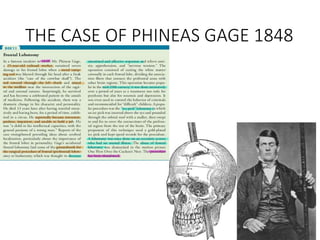
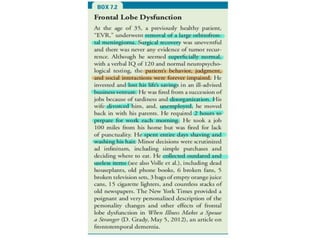
THE CASE OF PHINEAS GAGE 1848
FRONTAL LOBE
Dr. Pavithra Arunachaleeswaran
JR & PG, Department of Psychiatry,
SSIMS & RC.
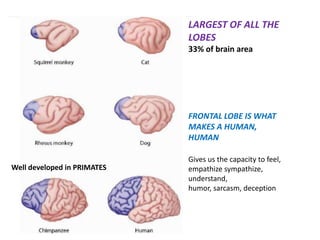
LARGEST OF ALL THE
LOBES
33% of brain area
Well developed in PRIMATES
FRONTAL LOBE IS WHAT
MAKES A HUMAN,
HUMAN
Gives us the capacity to feel,
empathize sympathize,
understand,
humor, sarcasm, deception
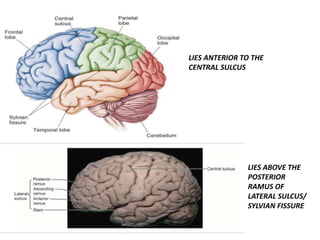
LIES ANTERIOR TO THE
CENTRAL SULCUS
LIES ABOVE THE
POSTERIOR
RAMUS OF
LATERAL SULCUS/
SYLVIAN FISSURE
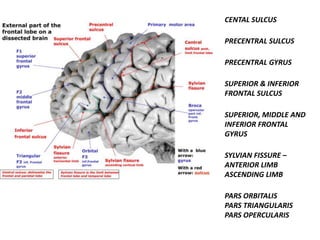
PRECENTRAL SULCUS
PRECENTRAL GYRUS
SUPERIOR & INFERIOR
FRONTAL SULCUS
SUPERIOR, MIDDLE AND
INFERIOR FRONTAL
GYRUS
SYLVIAN FISSURE –
ANTERIOR LIMB
ASCENDING LIMB
PARS ORBITALIS
PARS TRIANGULARIS
PARS OPERCULARIS
CENTAL SULCUS
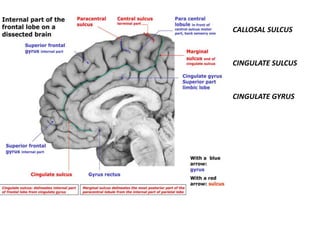
CALLOSAL SULCUS
CINGULATE SULCUS
CINGULATE GYRUS
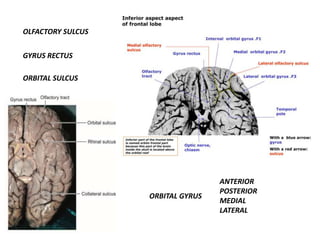
OLFACTORY SULCUS
GYRUS RECTUS
ORBITAL SULCUS
ANTERIOR
POSTERIOR
MEDIAL
LATERAL
ORBITAL GYRUS
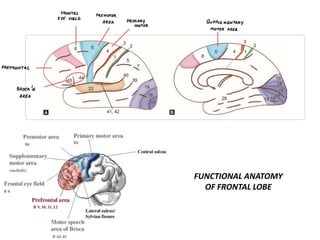
FUNCTIONAL ANATOMY
OF FRONTAL LOBE
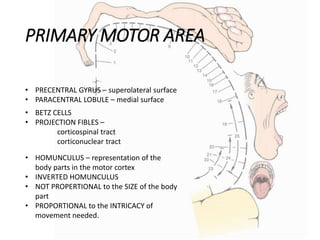
PRIMARY MOTOR AREA
• PRECENTRAL GYRUS – superolateral surface
• PARACENTRAL LOBULE – medial surface
• BETZ CELLS
• PROJECTION FIBLES –
corticospinal tract
corticonuclear tract
• HOMUNCULUS – representation of the
body parts in the motor cortex
• INVERTED HOMUNCULUS
• NOT PROPERTIONAL to the SIZE of the body
part
• PROPORTIONAL to the INTRICACY of
movement needed.
PREMOTOR AREA
• Anterior to motor area
• Posterior parts of SUPERIOR, MIDDLE, INFERIOR Frontal Gyri
PROGRAMMING & PLANNING INTENDED MOVEMENTS & CONTROL OF MOVEMENTS IN
PROGRESS
SUPPLEMENTARY MOTOR AREA
• Area 4, 6, 8 – medial surface
• Movements of contralateral limbs. – when stronger stimulus +
• COORDINATED MOVEMENTS between hands  ALIEN HAND SYNDROME
• PLANNING MOTOR MOVEMENTS
• TEMPORAL ORGANIZATION OF MULTIPLE MOVEMENTS
• (-)  Impair memory based sequencing of movements
FRONTAL EYE FIELD
MOTOR SPEECH AREA
• AREA 8
• In the MIDDLE FRONTAL GYRUS
• CONJUGATE EYE MOVEMENTS – movement of eyes in
opposite direction
• GAZE DEVIATION - IPSILATERALLY
• AREA 44, 45
• In the INFERIOR FRONTAL GYRUS of DOMINANT
HEMISPHERE
• INJURY - APHASIA
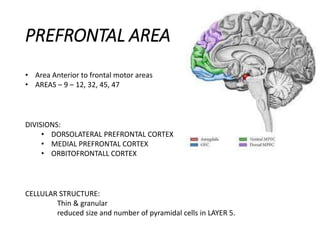
PREFRONTAL AREA
• Area Anterior to frontal motor areas
• AREAS – 9 – 12, 32, 45, 47
DIVISIONS:
• DORSOLATERAL PREFRONTAL CORTEX
• MEDIAL PREFRONTAL CORTEX
• ORBITOFRONTALL CORTEX
CELLULAR STRUCTURE:
Thin & granular
reduced size and number of pyramidal cells in LAYER 5.
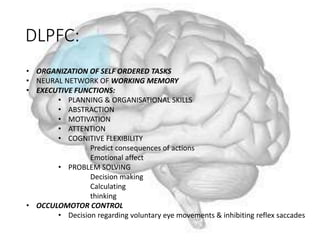
DLPFC:
• ORGANIZATION OF SELF ORDERED TASKS
• NEURAL NETWORK OF WORKING MEMORY
• EXECUTIVE FUNCTIONS:
• PLANNING & ORGANISATIONAL SKILLS
• ABSTRACTION
• MOTIVATION
• ATTENTION
• COGNITIVE FLEXIBILITY
Predict consequences of actions
Emotional affect
• PROBLEM SOLVING
Decision making
Calculating
thinking
• OCCULOMOTOR CONTROL
• Decision regarding voluntary eye movements & inhibiting reflex saccades
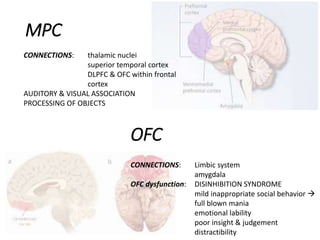
OFC
CONNECTIONS: thalamic nuclei
superior temporal cortex
DLPFC & OFC within frontal
cortex
AUDITORY & VISUAL ASSOCIATION
PROCESSING OF OBJECTS
MPC
CONNECTIONS: Limbic system
amygdala
OFC dysfunction: DISINHIBITION SYNDROME
mild inappropriate social behavior 
full blown mania
emotional lability
poor insight & judgement
distractibility
VASCULAR SUPPLY
FRONTAL CIRCUIT SYSTEM
• FRONTAL – SUBCORTICAL CIRCUITS – organizational
network of the brain  BRAIN BEHAVIOUR
RELATIONSHIP
• 5 CIRCUITS – named according to their function /
cortical site of origin
• MOTOR FUNCTIONS:
• MOTOR CIRCUIT – supplementary motor area
• OCCULOMOTOR CIRCUIT – frontal eye fields
• EXECUTIVE, COGNITIVE, MOTIVATION & PERSONALITY:
• DORSOLATERAL PREFRONTAL
• LATERAL ORBITO FRONTAL
• ANTERIOR CINGULATE
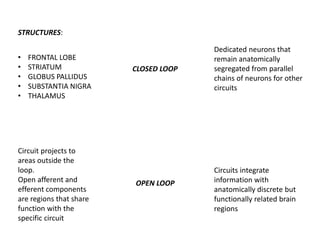
STRUCTURES:
• FRONTAL LOBE
• STRIATUM
• GLOBUS PALLIDUS
• SUBSTANTIA NIGRA
• THALAMUS
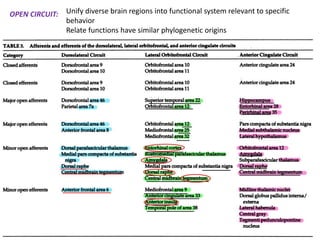
CLOSED LOOP
OPEN LOOP
Circuits integrate
information with
anatomically discrete but
functionally related brain
regions
Dedicated neurons that
remain anatomically
segregated from parallel
chains of neurons for other
circuits
Circuit projects to
areas outside the
loop.
Open afferent and
efferent components
are regions that share
function with the
specific circuit
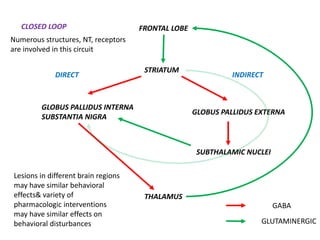
FRONTAL LOBE
STRIATUM
GLOBUS PALLIDUS INTERNA
SUBSTANTIA NIGRA
GLOBUS PALLIDUS EXTERNA
SUBTHALAMIC NUCLEI
THALAMUS
GABA
GLUTAMINERGIC
DIRECT INDIRECT
CLOSED LOOP
Numerous structures, NT, receptors
are involved in this circuit
Lesions in different brain regions
may have similar behavioral
effects& variety of
pharmacologic interventions
may have similar effects on
behavioral disturbances
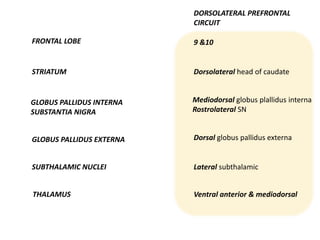
DORSOLATERAL PREFRONTAL
CIRCUIT
FRONTAL LOBE
STRIATUM
GLOBUS PALLIDUS INTERNA
SUBSTANTIA NIGRA
GLOBUS PALLIDUS EXTERNA
SUBTHALAMIC NUCLEI
THALAMUS
9 &10
Dorsolateral head of caudate
Mediodorsal globus plallidus interna
Rostrolateral SN
Dorsal globus pallidus externa
Lateral subthalamic
Ventral anterior & mediodorsal
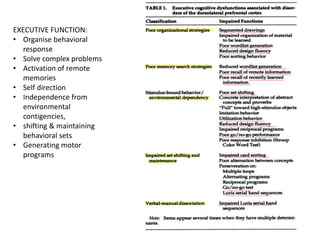
EXECUTIVE FUNCTION:
• Organise behavioral
response
• Solve complex problems
• Activation of remote
memories
• Self direction
• Independence from
environmental
contigencies,
• shifting & maintaining
behavioral sets
• Generating motor
programs
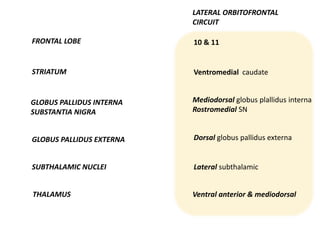
LATERAL ORBITOFRONTAL
CIRCUIT
FRONTAL LOBE
STRIATUM
GLOBUS PALLIDUS INTERNA
SUBSTANTIA NIGRA
GLOBUS PALLIDUS EXTERNA
SUBTHALAMIC NUCLEI
THALAMUS
10 & 11
Ventromedial caudate
Mediodorsal globus plallidus interna
Rostromedial SN
Dorsal globus pallidus externa
Lateral subthalamic
Ventral anterior & mediodorsal
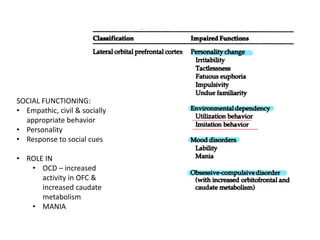
SOCIAL FUNCTIONING:
• Empathic, civil & socially
appropriate behavior
• Personality
• Response to social cues
• ROLE IN
• OCD – increased
activity in OFC &
increased caudate
metabolism
• MANIA
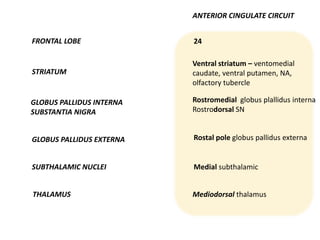
ANTERIOR CINGULATE CIRCUIT
FRONTAL LOBE
STRIATUM
GLOBUS PALLIDUS INTERNA
SUBSTANTIA NIGRA
GLOBUS PALLIDUS EXTERNA
SUBTHALAMIC NUCLEI
THALAMUS
24
Ventral striatum – ventomedial
caudate, ventral putamen, NA,
olfactory tubercle
Rostromedial globus plallidus interna
Rostrodorsal SN
Rostal pole globus pallidus externa
Medial subthalamic
Mediodorsal thalamus
OPEN CIRCUIT: Unify diverse brain regions into functional system relevant to specific
behavior
Relate functions have similar phylogenetic origins
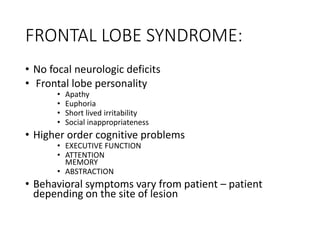
FRONTAL LOBE SYNDROME:
• No focal neurologic deficits
• Frontal lobe personality
• Apathy
• Euphoria
• Short lived irritability
• Social inappropriateness
• Higher order cognitive problems
• EXECUTIVE FUNCTION
• ATTENTION
MEMORY
• ABSTRACTION
• Behavioral symptoms vary from patient – patient
depending on the site of lesion
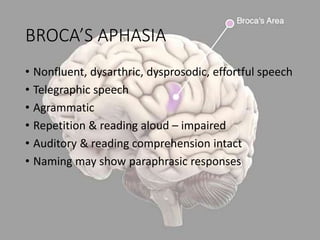
BROCA’S APHASIA
• Nonfluent, dysarthric, dysprosodic, effortful speech
• Telegraphic speech
• Agrammatic
• Repetition & reading aloud – impaired
• Auditory & reading comprehension intact
• Naming may show paraphrasic responses
ASSESSMENTS OF FRONTAL LOBE
FUNCTION
• HISTORY (PMP, change in personality) & MSE
• ATTENTION
• DIGIT SPAN
• SUSTAINED ATTENTION
- indicate A’s as I read out by taping on desk (omission error, commission error,
perseveration error),
- serial subtraction 100 – 7.
• ABSTRACTION
• PROVERBS
• SIMILARITIES
• DISSIMILARITIES
• MEMORY
• IMMEDIATE, RECENT, REMOTE
• JUDGEMENT
• SOCIAL JUDGEMENT
• LANGUAGE
Language
• Handedness – for dominant hemisphere
• Spontaneous speech
• Verbal fluency
• COWA – controlled oral word fluency test
- As many words as possible starting with F, A, S in 1 minute
- Categorical verbal fluency
Observe:
perseveration ( within – task perseveration – same word, between-task perseveration
– previous letter)
intrusion errors(disinhibited association – not starting from any of the letter)
Disinhibitory deficits – socially inappropriate / vulgar words
• Comprehension
• Pointing commands
• questions that can be answered with yes/ no
• Motor commands
• Repetition
• Naming & word finding
• Reading - reading aloud, reading comprehension
• Writing
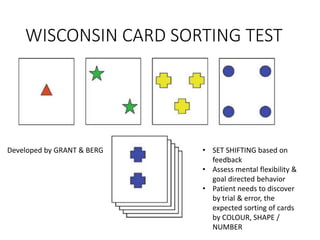
WISCONSIN CARD SORTING TEST
• SET SHIFTING based on
feedback
• Assess mental flexibility &
goal directed behavior
• Patient needs to discover
by trial & error, the
expected sorting of cards
by COLOUR, SHAPE /
NUMBER
Developed by GRANT & BERG
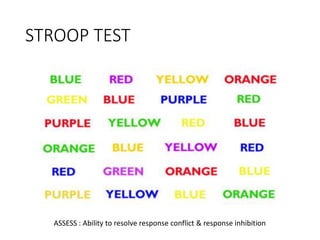
STROOP TEST
ASSESS : Ability to resolve response conflict & response inhibition
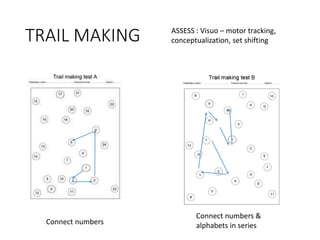
TRAIL MAKING
Connect numbers
Connect numbers &
alphabets in series
ASSESS : Visuo – motor tracking,
conceptualization, set shifting
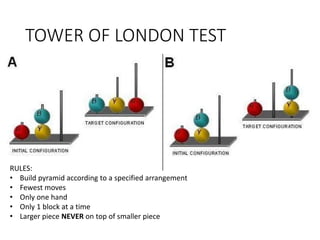
TOWER OF LONDON TEST
RULES:
• Build pyramid according to a specified arrangement
• Fewest moves
• Only one hand
• Only 1 block at a time
• Larger piece NEVER on top of smaller piece
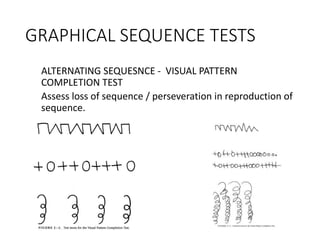
GRAPHICAL SEQUENCE TESTS
ALTERNATING SEQUESNCE - VISUAL PATTERN
COMPLETION TEST
Assess loss of sequence / perseveration in reproduction of
sequence.
FAB
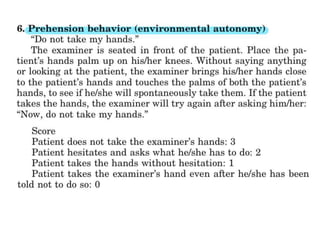
• Devised by Dubois B in 2000.
• Bed side assessment of frontal lobe functions
• SUBTESTS:
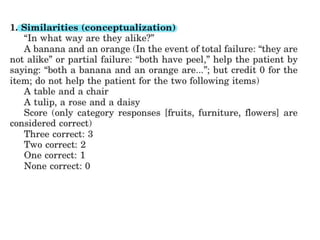
• CONCEPTUALIZATION
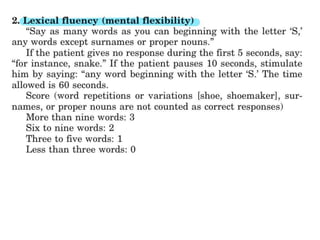
• MENTAL FLEXIBILITY
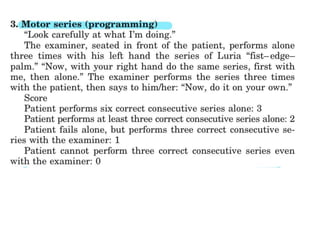
• MOTOR PROGRAMMING
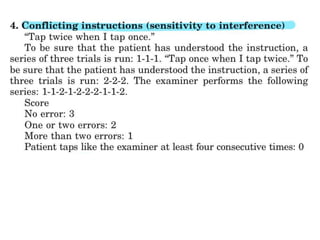
• SENSITIVITY TO INTERFERANCE
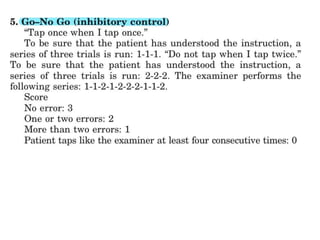
• INHIBITORY CONTROL
• ENVIRONMENTAL AUTONOMY
• TOTAL SCORE = sum of all the scores
• DURATION – 10 mins
CONCLUSION:
• Frontal lobe is what makes us what we are as a
person
• Lesion of the frontal lobe changes our personality
as a whole.
• Executive function & personality is not a unitary
construct and it is impossible to device a single test
to measure it
• The FAB is the most common battery of tests for
bedside assessment of frontal lobe function
THANK YOU
REFERENCES:
• DeJong’s Neurologic Examination
• Inderbir Singh’s Text book of Human Neuroanatomy
• Mental Status Examination in Neurology – Strub & Black
• Goldberg E, Bougakov D. Neuropsychologic assessment of Frontal
Lobe Dysfunction. Psychiatr Clin N Am. 2005;28(3): 567-80.
• Dubois B, Slachevsky A, Litvan I, Pillon B. The FAB: a frontal
assessment batter at bedside
• Cummings JL, Mega MS. Frontal – subcortical circuits &
Neuropsychiatric disorders. J Neuropsychiatry Clin Neurosci.
1994;6(4):358-70.
• Malloy PF, Richardson ED. Assessment of frontal lobe Function. J
Neuropsychiatry Clin Neurosci.1994;6(4):399-410.

The Frontal Lobe

  • 1.
    THE CASE OFPHINEAS GAGE 1848
  • 2.
    FRONTAL LOBE Dr. PavithraArunachaleeswaran JR & PG, Department of Psychiatry, SSIMS & RC.
  • 3.
    LARGEST OF ALLTHE LOBES 33% of brain area Well developed in PRIMATES FRONTAL LOBE IS WHAT MAKES A HUMAN, HUMAN Gives us the capacity to feel, empathize sympathize, understand, humor, sarcasm, deception
  • 4.
    LIES ANTERIOR TOTHE CENTRAL SULCUS LIES ABOVE THE POSTERIOR RAMUS OF LATERAL SULCUS/ SYLVIAN FISSURE
  • 5.
    PRECENTRAL SULCUS PRECENTRAL GYRUS SUPERIOR& INFERIOR FRONTAL SULCUS SUPERIOR, MIDDLE AND INFERIOR FRONTAL GYRUS SYLVIAN FISSURE – ANTERIOR LIMB ASCENDING LIMB PARS ORBITALIS PARS TRIANGULARIS PARS OPERCULARIS CENTAL SULCUS
  • 6.
  • 7.
    OLFACTORY SULCUS GYRUS RECTUS ORBITALSULCUS ANTERIOR POSTERIOR MEDIAL LATERAL ORBITAL GYRUS
  • 8.
  • 9.
    PRIMARY MOTOR AREA •PRECENTRAL GYRUS – superolateral surface • PARACENTRAL LOBULE – medial surface • BETZ CELLS • PROJECTION FIBLES – corticospinal tract corticonuclear tract • HOMUNCULUS – representation of the body parts in the motor cortex • INVERTED HOMUNCULUS • NOT PROPERTIONAL to the SIZE of the body part • PROPORTIONAL to the INTRICACY of movement needed.
  • 10.
    PREMOTOR AREA • Anteriorto motor area • Posterior parts of SUPERIOR, MIDDLE, INFERIOR Frontal Gyri PROGRAMMING & PLANNING INTENDED MOVEMENTS & CONTROL OF MOVEMENTS IN PROGRESS SUPPLEMENTARY MOTOR AREA • Area 4, 6, 8 – medial surface • Movements of contralateral limbs. – when stronger stimulus + • COORDINATED MOVEMENTS between hands  ALIEN HAND SYNDROME • PLANNING MOTOR MOVEMENTS • TEMPORAL ORGANIZATION OF MULTIPLE MOVEMENTS • (-)  Impair memory based sequencing of movements
  • 11.
    FRONTAL EYE FIELD MOTORSPEECH AREA • AREA 8 • In the MIDDLE FRONTAL GYRUS • CONJUGATE EYE MOVEMENTS – movement of eyes in opposite direction • GAZE DEVIATION - IPSILATERALLY • AREA 44, 45 • In the INFERIOR FRONTAL GYRUS of DOMINANT HEMISPHERE • INJURY - APHASIA
  • 12.
    PREFRONTAL AREA • AreaAnterior to frontal motor areas • AREAS – 9 – 12, 32, 45, 47 DIVISIONS: • DORSOLATERAL PREFRONTAL CORTEX • MEDIAL PREFRONTAL CORTEX • ORBITOFRONTALL CORTEX CELLULAR STRUCTURE: Thin & granular reduced size and number of pyramidal cells in LAYER 5.
  • 13.
    DLPFC: • ORGANIZATION OFSELF ORDERED TASKS • NEURAL NETWORK OF WORKING MEMORY • EXECUTIVE FUNCTIONS: • PLANNING & ORGANISATIONAL SKILLS • ABSTRACTION • MOTIVATION • ATTENTION • COGNITIVE FLEXIBILITY Predict consequences of actions Emotional affect • PROBLEM SOLVING Decision making Calculating thinking • OCCULOMOTOR CONTROL • Decision regarding voluntary eye movements & inhibiting reflex saccades
  • 14.
    OFC CONNECTIONS: thalamic nuclei superiortemporal cortex DLPFC & OFC within frontal cortex AUDITORY & VISUAL ASSOCIATION PROCESSING OF OBJECTS MPC CONNECTIONS: Limbic system amygdala OFC dysfunction: DISINHIBITION SYNDROME mild inappropriate social behavior  full blown mania emotional lability poor insight & judgement distractibility
  • 15.
  • 16.
    FRONTAL CIRCUIT SYSTEM •FRONTAL – SUBCORTICAL CIRCUITS – organizational network of the brain  BRAIN BEHAVIOUR RELATIONSHIP • 5 CIRCUITS – named according to their function / cortical site of origin • MOTOR FUNCTIONS: • MOTOR CIRCUIT – supplementary motor area • OCCULOMOTOR CIRCUIT – frontal eye fields • EXECUTIVE, COGNITIVE, MOTIVATION & PERSONALITY: • DORSOLATERAL PREFRONTAL • LATERAL ORBITO FRONTAL • ANTERIOR CINGULATE
  • 17.
    STRUCTURES: • FRONTAL LOBE •STRIATUM • GLOBUS PALLIDUS • SUBSTANTIA NIGRA • THALAMUS CLOSED LOOP OPEN LOOP Circuits integrate information with anatomically discrete but functionally related brain regions Dedicated neurons that remain anatomically segregated from parallel chains of neurons for other circuits Circuit projects to areas outside the loop. Open afferent and efferent components are regions that share function with the specific circuit
  • 18.
    FRONTAL LOBE STRIATUM GLOBUS PALLIDUSINTERNA SUBSTANTIA NIGRA GLOBUS PALLIDUS EXTERNA SUBTHALAMIC NUCLEI THALAMUS GABA GLUTAMINERGIC DIRECT INDIRECT CLOSED LOOP Numerous structures, NT, receptors are involved in this circuit Lesions in different brain regions may have similar behavioral effects& variety of pharmacologic interventions may have similar effects on behavioral disturbances
  • 19.
    DORSOLATERAL PREFRONTAL CIRCUIT FRONTAL LOBE STRIATUM GLOBUSPALLIDUS INTERNA SUBSTANTIA NIGRA GLOBUS PALLIDUS EXTERNA SUBTHALAMIC NUCLEI THALAMUS 9 &10 Dorsolateral head of caudate Mediodorsal globus plallidus interna Rostrolateral SN Dorsal globus pallidus externa Lateral subthalamic Ventral anterior & mediodorsal
  • 20.
    EXECUTIVE FUNCTION: • Organisebehavioral response • Solve complex problems • Activation of remote memories • Self direction • Independence from environmental contigencies, • shifting & maintaining behavioral sets • Generating motor programs
  • 21.
    LATERAL ORBITOFRONTAL CIRCUIT FRONTAL LOBE STRIATUM GLOBUSPALLIDUS INTERNA SUBSTANTIA NIGRA GLOBUS PALLIDUS EXTERNA SUBTHALAMIC NUCLEI THALAMUS 10 & 11 Ventromedial caudate Mediodorsal globus plallidus interna Rostromedial SN Dorsal globus pallidus externa Lateral subthalamic Ventral anterior & mediodorsal
  • 22.
    SOCIAL FUNCTIONING: • Empathic,civil & socially appropriate behavior • Personality • Response to social cues • ROLE IN • OCD – increased activity in OFC & increased caudate metabolism • MANIA
  • 23.
    ANTERIOR CINGULATE CIRCUIT FRONTALLOBE STRIATUM GLOBUS PALLIDUS INTERNA SUBSTANTIA NIGRA GLOBUS PALLIDUS EXTERNA SUBTHALAMIC NUCLEI THALAMUS 24 Ventral striatum – ventomedial caudate, ventral putamen, NA, olfactory tubercle Rostromedial globus plallidus interna Rostrodorsal SN Rostal pole globus pallidus externa Medial subthalamic Mediodorsal thalamus
  • 25.
    OPEN CIRCUIT: Unifydiverse brain regions into functional system relevant to specific behavior Relate functions have similar phylogenetic origins
  • 26.
    FRONTAL LOBE SYNDROME: •No focal neurologic deficits • Frontal lobe personality • Apathy • Euphoria • Short lived irritability • Social inappropriateness • Higher order cognitive problems • EXECUTIVE FUNCTION • ATTENTION MEMORY • ABSTRACTION • Behavioral symptoms vary from patient – patient depending on the site of lesion
  • 27.
    BROCA’S APHASIA • Nonfluent,dysarthric, dysprosodic, effortful speech • Telegraphic speech • Agrammatic • Repetition & reading aloud – impaired • Auditory & reading comprehension intact • Naming may show paraphrasic responses
  • 28.
    ASSESSMENTS OF FRONTALLOBE FUNCTION • HISTORY (PMP, change in personality) & MSE • ATTENTION • DIGIT SPAN • SUSTAINED ATTENTION - indicate A’s as I read out by taping on desk (omission error, commission error, perseveration error), - serial subtraction 100 – 7. • ABSTRACTION • PROVERBS • SIMILARITIES • DISSIMILARITIES • MEMORY • IMMEDIATE, RECENT, REMOTE • JUDGEMENT • SOCIAL JUDGEMENT • LANGUAGE
  • 29.
    Language • Handedness –for dominant hemisphere • Spontaneous speech • Verbal fluency • COWA – controlled oral word fluency test - As many words as possible starting with F, A, S in 1 minute - Categorical verbal fluency Observe: perseveration ( within – task perseveration – same word, between-task perseveration – previous letter) intrusion errors(disinhibited association – not starting from any of the letter) Disinhibitory deficits – socially inappropriate / vulgar words • Comprehension • Pointing commands • questions that can be answered with yes/ no • Motor commands • Repetition • Naming & word finding • Reading - reading aloud, reading comprehension • Writing
  • 31.
    WISCONSIN CARD SORTINGTEST • SET SHIFTING based on feedback • Assess mental flexibility & goal directed behavior • Patient needs to discover by trial & error, the expected sorting of cards by COLOUR, SHAPE / NUMBER Developed by GRANT & BERG
  • 32.
    STROOP TEST ASSESS :Ability to resolve response conflict & response inhibition
  • 33.
    TRAIL MAKING Connect numbers Connectnumbers & alphabets in series ASSESS : Visuo – motor tracking, conceptualization, set shifting
  • 34.
    TOWER OF LONDONTEST RULES: • Build pyramid according to a specified arrangement • Fewest moves • Only one hand • Only 1 block at a time • Larger piece NEVER on top of smaller piece
  • 35.
    GRAPHICAL SEQUENCE TESTS ALTERNATINGSEQUESNCE - VISUAL PATTERN COMPLETION TEST Assess loss of sequence / perseveration in reproduction of sequence.
  • 36.
    FAB • Devised byDubois B in 2000. • Bed side assessment of frontal lobe functions • SUBTESTS: • CONCEPTUALIZATION • MENTAL FLEXIBILITY • MOTOR PROGRAMMING • SENSITIVITY TO INTERFERANCE • INHIBITORY CONTROL • ENVIRONMENTAL AUTONOMY • TOTAL SCORE = sum of all the scores • DURATION – 10 mins
  • 44.
    CONCLUSION: • Frontal lobeis what makes us what we are as a person • Lesion of the frontal lobe changes our personality as a whole. • Executive function & personality is not a unitary construct and it is impossible to device a single test to measure it • The FAB is the most common battery of tests for bedside assessment of frontal lobe function
  • 45.
  • 46.
    REFERENCES: • DeJong’s NeurologicExamination • Inderbir Singh’s Text book of Human Neuroanatomy • Mental Status Examination in Neurology – Strub & Black • Goldberg E, Bougakov D. Neuropsychologic assessment of Frontal Lobe Dysfunction. Psychiatr Clin N Am. 2005;28(3): 567-80. • Dubois B, Slachevsky A, Litvan I, Pillon B. The FAB: a frontal assessment batter at bedside • Cummings JL, Mega MS. Frontal – subcortical circuits & Neuropsychiatric disorders. J Neuropsychiatry Clin Neurosci. 1994;6(4):358-70. • Malloy PF, Richardson ED. Assessment of frontal lobe Function. J Neuropsychiatry Clin Neurosci.1994;6(4):399-410.