17/2/2022
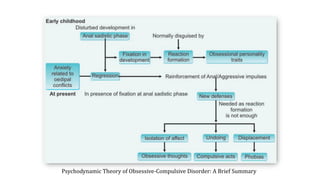
Psychodynamic Theory of Obsessive-Compulsive Disorder: A Brief Summary
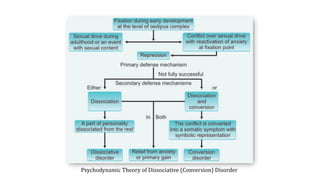
Psychodynamic Theory of Dissociative (Conversion) Disorder
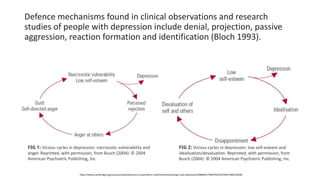
Defence mechanisms found in clinical observations and research
studies of people with depression include denial, projection, passive
aggression, reaction formation and identification (Bloch 1993).
FIG 1: Vicious cycles in depression: narcissistic vulnerability and
anger. Reprinted, with permission, from Busch (2004): © 2004
American Psychiatric Publishing, Inc.
FIG 2: Vicious cycles in depression: low self-esteem and
idealisation/devaluation. Reprinted, with permission, from
Busch (2004): © 2004 American Psychiatric Publishing, Inc.
https://www.cambridge.org/core/journals/advances-in-psychiatric-treatment/article/anger-and-depression/E8606D1796679107A5F3037466C1DDA8
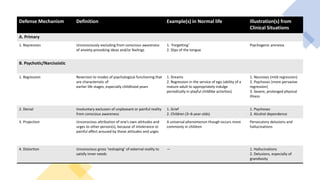
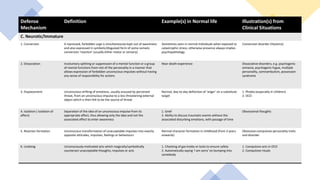
Defense Mechanism Definition Example(s) in Normal life Illustration(s) from
Clinical Situations
A. Primary
1. Repression Unconsciously excluding from conscious awareness
of anxiety-provoking ideas and/or feelings
1. ‘Forgetting’
2. Slips of the tongue
Psychogenic amnesia
B. Psychotic/Narcissistic
1. Regression Reversion to modes of psychological functioning that
are characteristic of
earlier life stages, especially childhood years
1. Dreams
2. Regression in the service of ego (ability of a
mature adult to appropriately indulge
periodically in playful childlike activities)
1. Neuroses (mild regression)
2. Psychoses (more pervasive
regression)
3. Severe, prolonged physical
illness
2. Denial Involuntary exclusion of unpleasant or painful reality
from conscious awareness
1. Grief
2. Children (3–6-year-olds)
1. Psychoses
2. Alcohol dependence
3. Projection Unconscious attribution of one’s own attitudes and
urges to other person(s), because of intolerance or
painful affect aroused by those attitudes and urges
A universal phenomenon though occurs more
commonly in children
Persecutory delusions and
hallucinations
4. Distortion Unconscious gross ‘reshaping’ of external reality to
satisfy inner needs
— 1. Hallucinations
2. Delusions, especially of
grandiosity
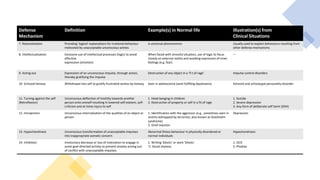
Defense
Mechanism
Definition Example(s) in Normal life Illustration(s) from
Clinical Situations
C. Neurotic/Immature
1. Conversion A repressed, forbidden urge is simultaneously kept out of awareness
and also expressed in symbolic/disguised form of some somatic
conversion ‘reaction’ (usually either motor or sensory)
Sometimes seen in normal individuals when exposed to
catastrophic stress; otherwise presence always implies
psychopathology
Conversion disorder (Hysteria)
2. Dissociation Involuntary splitting or suppression of a mental function or a group
of mental functions from rest of the personality in a manner that
allows expression of forbidden unconscious impulses without having
any sense of responsibility for actions
Near death experience Dissociative disorders, e.g. psychogenic
amnesia, psychogenic fugue, multiple
personality, somnambulism, possession
syndrome
3. Displacement Unconscious shifting of emotions, usually aroused by perceived
threat, from an unconscious impulse to a less threatening external
object which is then felt to be the source of threat
Normal, day-to-day deflection of ‘anger’ on a substitute
target
1. Phobia (especially in children)
2. OCD
4. Isolation ( Isolation of
affect)
Separation of the idea of an unconscious impulse from its
appropriate affect, thus allowing only the idea and not the
associated affect to enter awareness
1. Grief
2. Ability to discuss traumatic events without the
associated disturbing emotions, with passage of time
Obsessional thoughts
5. Reaction formation Unconscious transformation of unacceptable impulses into exactly
opposite attitudes, impulses, feelings or behaviours
Normal character formation in childhood (from 3 years
onwards)
Obsessive-compulsive personality traits
and disorder
6. Undoing Unconsciously motivated acts which magically/symbolically
counteract unacceptable thoughts, impulses or acts
1. Checking of gas knobs or locks to ensure safety
2. Automatically saying ‘I am sorry’ on bumping into
somebody
1. Compulsive acts in OCD
2. Compulsive rituals
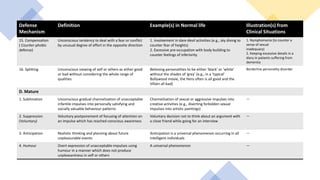
Defense
Mechanism
Definition Example(s) in Normal life Illustration(s) from
Clinical Situations
7. Rationalisation Providing ‘logical’ explanations for irrational behaviour
motivated by unacceptable unconscious wishes
A universal phenomenon Usually used to explain behaviours resulting from
other defense mechanisms
8. Intellectualisation Excessive use of intellectual processes (logic) to avoid
affective
expression (emotion)
When faced with stressful situation, use of logic to focus
closely on external reality and avoiding expression of inner
feelings (e.g. fear)
—
9. Acting out Expression of an unconscious impulse, through action,
thereby gratifying the impulse
Destruction of any object in a ‘fi t of rage’ Impulse control disorders
10. Schizoid fantasy Withdrawal into self to gratify frustrated wishes by fantasy Seen in adolescence (wish fulfilling daydreams) Schizoid and schizotypal personality disorder
11. Turning against the self
(Retroflexion)
Unconscious deflection of hostility towards another
person onto oneself resulting in lowered self-esteem, self-
criticism and at times injury to self
1. Head banging in children
2. Destruction of property or self in a fit of rage
1. Suicide
2. Severe depression
3. Any form of deliberate self harm (DSH)
12. Introjection Unconscious internalisation of the qualities of an object or
person
1. Identification with the aggressor (e.g., sometimes seen in
victims kidnapped by terrorists; also known as Stockholm
syndrome)
2. Grief reaction
Depression
13. Hypochondriasis Unconscious transformation of unacceptable impulses
into inappropriate somatic concern
Abnormal illness behaviour in physically disordered or
normal individuals
Hypochondriasis
14. Inhibition Involuntary decrease or loss of motivation to engage in
some goal-directed activity to prevent anxiety arising out
of conflict with unacceptable impulses
1. Writing ‘blocks’ or work ‘blocks’
’2. Social shyness
1. OCD
2. Phobias
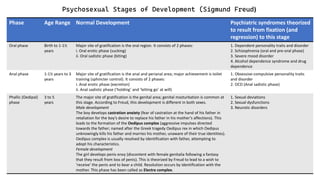
Defense
Mechanism
Definition Example(s) in Normal life Illustration(s) from
Clinical Situations
15. Compensation
( Counter-phobic
defense)
Unconscious tendency to deal with a fear or conflict
by unusual degree of effort in the opposite direction
1. Involvement in dare-devil activities (e.g., sky diving to
counter fear of heights)
2. Excessive pre-occupation with body building to
counter feelings of inferiority
1. Nymphomania (to counter a
sense of sexual
inadequacy)
2. Keeping excessive details in a
diary in patients suffering from
dementia
16. Splitting Unconscious viewing of self or others as either good
or bad without considering the whole range of
qualities
Believing personalities to be either ‘black’ or ‘white’
without the shades of ‘grey’ (e.g., in a ‘typical’
Bollywood movie, the Hero often is all good and the
Villain all bad)
Borderline personality disorder
D. Mature
1. Sublimation Unconscious gradual channelisation of unacceptable
infantile impulses into personally satisfying and
socially valuable behaviour patterns
Channelisation of sexual or aggressive impulses into
creative activities (e.g., diverting forbidden sexual
impulses into artistic paintings)
—
2. Suppression
(Voluntary)
Voluntary postponement of focusing of attention on
an impulse which has reached conscious awareness
Voluntary decision not to think about an argument with
a close friend while going for an interview
—
3. Anticipation Realistic thinking and planning about future
unpleasurable events
Anticipation is a universal phenomenon occurring in all
intelligent individuals
—
4. Humour Overt expression of unacceptable impulses using
humour in a manner which does not produce
unpleasantness in self or others
A universal phenomenon —
Phase Age Range Normal Development Psychiatric syndromes theorized
to result from fixation (and
regression) to this stage
Oral phase Birth to 1-1½
years
Major site of gratification is the oral region. It consists of 2 phases:
i. Oral erotic phase (sucking)
ii. Oral sadistic phase (biting)
1. Dependent personality traits and disorder
2. Schizophrenia (oral and pre-oral phase)
3. Severe mood disorder
4. Alcohol dependence syndrome and drug
dependence
Anal phase 1-1½ years to 3
years
Major site of gratification is the anal and perianal area; major achievement is toilet
training (sphincter control). It consists of 2 phases:
i. Anal erotic phase (excretion)
ii. Anal sadistic phase (‘holding’ and ‘letting go’ at will)
1. Obsessive-compulsive personality traits
and disorder
2. OCD (Anal sadistic phase)
Phallic (Oedipal)
phase
3 to 5
years
The major site of gratification is the genital area; genital masturbation is common at
this stage. According to Freud, this development is different in both sexes.
Male development
The boy develops castration anxiety (fear of castration at the hand of his father in
retaliation for the boy’s desire to replace his father in his mother’s affections). This
leads to the formation of the Oedipus complex (aggressive impulses directed
towards the father; named after the Greek tragedy Oedipus rex in which Oedipus
unknowingly kills his father and marries his mother, unaware of their true identities).
Oedipus complex is usually resolved by identification with father, attempting to
adopt his characteristics.
Female development
The girl develops penis envy (discontent with female genitalia following a fantasy
that they result from loss of penis). This is theorized by Freud to lead to a wish to
‘receive’ the penis and to bear a child. Resolution occurs by identification with the
mother. This phase has been called as Electra complex.
1. Sexual deviations
2. Sexual dysfunctions
3. Neurotic disorders
Psychosexual Stages of Development (Sigmund Freud)
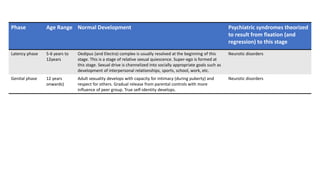
Phase Age Range Normal Development Psychiatric syndromes theorized
to result from fixation (and
regression) to this stage
Latency phase 5-6 years to
12years
Oedipus (and Electra) complex is usually resolved at the beginning of this
stage. This is a stage of relative sexual quiescence. Super-ego is formed at
this stage. Sexual drive is channelized into socially appropriate goals such as
development of interpersonal relationships, sports, school, work, etc.
Neurotic disorders
Genital phase 12 years
onwards)
Adult sexuality develops with capacity for intimacy (during puberty) and
respect for others. Gradual release from parental controls with more
influence of peer group. True self-identity develops.
Neurotic disorders

Psychodynamic Theory

  • 1.
  • 2.
    Psychodynamic Theory ofObsessive-Compulsive Disorder: A Brief Summary
  • 3.
    Psychodynamic Theory ofDissociative (Conversion) Disorder
  • 4.
    Defence mechanisms foundin clinical observations and research studies of people with depression include denial, projection, passive aggression, reaction formation and identification (Bloch 1993). FIG 1: Vicious cycles in depression: narcissistic vulnerability and anger. Reprinted, with permission, from Busch (2004): © 2004 American Psychiatric Publishing, Inc. FIG 2: Vicious cycles in depression: low self-esteem and idealisation/devaluation. Reprinted, with permission, from Busch (2004): © 2004 American Psychiatric Publishing, Inc. https://www.cambridge.org/core/journals/advances-in-psychiatric-treatment/article/anger-and-depression/E8606D1796679107A5F3037466C1DDA8
  • 5.
    Defense Mechanism DefinitionExample(s) in Normal life Illustration(s) from Clinical Situations A. Primary 1. Repression Unconsciously excluding from conscious awareness of anxiety-provoking ideas and/or feelings 1. ‘Forgetting’ 2. Slips of the tongue Psychogenic amnesia B. Psychotic/Narcissistic 1. Regression Reversion to modes of psychological functioning that are characteristic of earlier life stages, especially childhood years 1. Dreams 2. Regression in the service of ego (ability of a mature adult to appropriately indulge periodically in playful childlike activities) 1. Neuroses (mild regression) 2. Psychoses (more pervasive regression) 3. Severe, prolonged physical illness 2. Denial Involuntary exclusion of unpleasant or painful reality from conscious awareness 1. Grief 2. Children (3–6-year-olds) 1. Psychoses 2. Alcohol dependence 3. Projection Unconscious attribution of one’s own attitudes and urges to other person(s), because of intolerance or painful affect aroused by those attitudes and urges A universal phenomenon though occurs more commonly in children Persecutory delusions and hallucinations 4. Distortion Unconscious gross ‘reshaping’ of external reality to satisfy inner needs — 1. Hallucinations 2. Delusions, especially of grandiosity
  • 6.
    Defense Mechanism Definition Example(s) inNormal life Illustration(s) from Clinical Situations C. Neurotic/Immature 1. Conversion A repressed, forbidden urge is simultaneously kept out of awareness and also expressed in symbolic/disguised form of some somatic conversion ‘reaction’ (usually either motor or sensory) Sometimes seen in normal individuals when exposed to catastrophic stress; otherwise presence always implies psychopathology Conversion disorder (Hysteria) 2. Dissociation Involuntary splitting or suppression of a mental function or a group of mental functions from rest of the personality in a manner that allows expression of forbidden unconscious impulses without having any sense of responsibility for actions Near death experience Dissociative disorders, e.g. psychogenic amnesia, psychogenic fugue, multiple personality, somnambulism, possession syndrome 3. Displacement Unconscious shifting of emotions, usually aroused by perceived threat, from an unconscious impulse to a less threatening external object which is then felt to be the source of threat Normal, day-to-day deflection of ‘anger’ on a substitute target 1. Phobia (especially in children) 2. OCD 4. Isolation ( Isolation of affect) Separation of the idea of an unconscious impulse from its appropriate affect, thus allowing only the idea and not the associated affect to enter awareness 1. Grief 2. Ability to discuss traumatic events without the associated disturbing emotions, with passage of time Obsessional thoughts 5. Reaction formation Unconscious transformation of unacceptable impulses into exactly opposite attitudes, impulses, feelings or behaviours Normal character formation in childhood (from 3 years onwards) Obsessive-compulsive personality traits and disorder 6. Undoing Unconsciously motivated acts which magically/symbolically counteract unacceptable thoughts, impulses or acts 1. Checking of gas knobs or locks to ensure safety 2. Automatically saying ‘I am sorry’ on bumping into somebody 1. Compulsive acts in OCD 2. Compulsive rituals
  • 7.
    Defense Mechanism Definition Example(s) inNormal life Illustration(s) from Clinical Situations 7. Rationalisation Providing ‘logical’ explanations for irrational behaviour motivated by unacceptable unconscious wishes A universal phenomenon Usually used to explain behaviours resulting from other defense mechanisms 8. Intellectualisation Excessive use of intellectual processes (logic) to avoid affective expression (emotion) When faced with stressful situation, use of logic to focus closely on external reality and avoiding expression of inner feelings (e.g. fear) — 9. Acting out Expression of an unconscious impulse, through action, thereby gratifying the impulse Destruction of any object in a ‘fi t of rage’ Impulse control disorders 10. Schizoid fantasy Withdrawal into self to gratify frustrated wishes by fantasy Seen in adolescence (wish fulfilling daydreams) Schizoid and schizotypal personality disorder 11. Turning against the self (Retroflexion) Unconscious deflection of hostility towards another person onto oneself resulting in lowered self-esteem, self- criticism and at times injury to self 1. Head banging in children 2. Destruction of property or self in a fit of rage 1. Suicide 2. Severe depression 3. Any form of deliberate self harm (DSH) 12. Introjection Unconscious internalisation of the qualities of an object or person 1. Identification with the aggressor (e.g., sometimes seen in victims kidnapped by terrorists; also known as Stockholm syndrome) 2. Grief reaction Depression 13. Hypochondriasis Unconscious transformation of unacceptable impulses into inappropriate somatic concern Abnormal illness behaviour in physically disordered or normal individuals Hypochondriasis 14. Inhibition Involuntary decrease or loss of motivation to engage in some goal-directed activity to prevent anxiety arising out of conflict with unacceptable impulses 1. Writing ‘blocks’ or work ‘blocks’ ’2. Social shyness 1. OCD 2. Phobias
  • 8.
    Defense Mechanism Definition Example(s) inNormal life Illustration(s) from Clinical Situations 15. Compensation ( Counter-phobic defense) Unconscious tendency to deal with a fear or conflict by unusual degree of effort in the opposite direction 1. Involvement in dare-devil activities (e.g., sky diving to counter fear of heights) 2. Excessive pre-occupation with body building to counter feelings of inferiority 1. Nymphomania (to counter a sense of sexual inadequacy) 2. Keeping excessive details in a diary in patients suffering from dementia 16. Splitting Unconscious viewing of self or others as either good or bad without considering the whole range of qualities Believing personalities to be either ‘black’ or ‘white’ without the shades of ‘grey’ (e.g., in a ‘typical’ Bollywood movie, the Hero often is all good and the Villain all bad) Borderline personality disorder D. Mature 1. Sublimation Unconscious gradual channelisation of unacceptable infantile impulses into personally satisfying and socially valuable behaviour patterns Channelisation of sexual or aggressive impulses into creative activities (e.g., diverting forbidden sexual impulses into artistic paintings) — 2. Suppression (Voluntary) Voluntary postponement of focusing of attention on an impulse which has reached conscious awareness Voluntary decision not to think about an argument with a close friend while going for an interview — 3. Anticipation Realistic thinking and planning about future unpleasurable events Anticipation is a universal phenomenon occurring in all intelligent individuals — 4. Humour Overt expression of unacceptable impulses using humour in a manner which does not produce unpleasantness in self or others A universal phenomenon —
  • 9.
    Phase Age RangeNormal Development Psychiatric syndromes theorized to result from fixation (and regression) to this stage Oral phase Birth to 1-1½ years Major site of gratification is the oral region. It consists of 2 phases: i. Oral erotic phase (sucking) ii. Oral sadistic phase (biting) 1. Dependent personality traits and disorder 2. Schizophrenia (oral and pre-oral phase) 3. Severe mood disorder 4. Alcohol dependence syndrome and drug dependence Anal phase 1-1½ years to 3 years Major site of gratification is the anal and perianal area; major achievement is toilet training (sphincter control). It consists of 2 phases: i. Anal erotic phase (excretion) ii. Anal sadistic phase (‘holding’ and ‘letting go’ at will) 1. Obsessive-compulsive personality traits and disorder 2. OCD (Anal sadistic phase) Phallic (Oedipal) phase 3 to 5 years The major site of gratification is the genital area; genital masturbation is common at this stage. According to Freud, this development is different in both sexes. Male development The boy develops castration anxiety (fear of castration at the hand of his father in retaliation for the boy’s desire to replace his father in his mother’s affections). This leads to the formation of the Oedipus complex (aggressive impulses directed towards the father; named after the Greek tragedy Oedipus rex in which Oedipus unknowingly kills his father and marries his mother, unaware of their true identities). Oedipus complex is usually resolved by identification with father, attempting to adopt his characteristics. Female development The girl develops penis envy (discontent with female genitalia following a fantasy that they result from loss of penis). This is theorized by Freud to lead to a wish to ‘receive’ the penis and to bear a child. Resolution occurs by identification with the mother. This phase has been called as Electra complex. 1. Sexual deviations 2. Sexual dysfunctions 3. Neurotic disorders Psychosexual Stages of Development (Sigmund Freud)
  • 10.
    Phase Age RangeNormal Development Psychiatric syndromes theorized to result from fixation (and regression) to this stage Latency phase 5-6 years to 12years Oedipus (and Electra) complex is usually resolved at the beginning of this stage. This is a stage of relative sexual quiescence. Super-ego is formed at this stage. Sexual drive is channelized into socially appropriate goals such as development of interpersonal relationships, sports, school, work, etc. Neurotic disorders Genital phase 12 years onwards) Adult sexuality develops with capacity for intimacy (during puberty) and respect for others. Gradual release from parental controls with more influence of peer group. True self-identity develops. Neurotic disorders