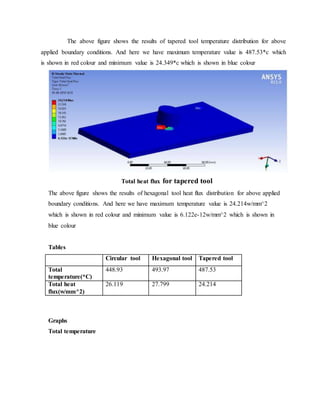
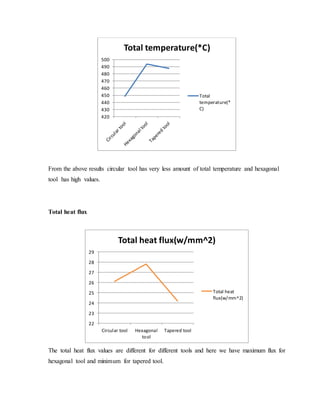
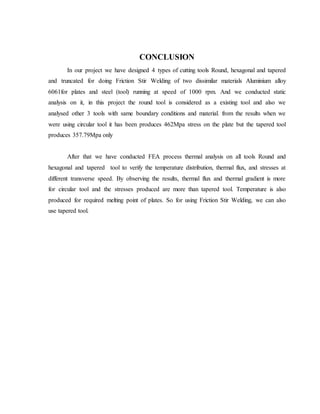
OPTIMISATION OF FRICTION STIR WELDING TOOLS
ABSTRACT
Friction-stir welding (FSW) is a solid-state joining process (the metal is not melted) that uses a
third body tool to join two facing surfaces. Heat is generated between the tool and material
which leads to a very soft region near the FSW tool. It then mechanically intermixes the two
pieces of metal at the place of the joint, then the softened metal (due to the elevated temperature)
can be joined using mechanical pressure (which is applied by the tool), much like joining clay, or
dough.
In this project we have designed circular tool by using creo-2 and then applied static
(tool rotational velocity 1000 rpm) and thermal (temperatures’ and convection on plates and tool
also) boundaries conditions And calculated results like deformation stress and heat flux etc.
Here we also designed 2 more tools hexagonal and tapered, applied same boundary condition
with same material properties and calculated all results from all these results which tool can be
used in the place of circular tool
Software’s were used:
CAD software: creo-2
CAE software: Ansys workbench
INTRODUCCTION
Friction-stir welding (FSW) is a solid-state joining process (the metal is not melted)
that uses a third body tool to join two facing surfaces. Heat is generated between the tool and
material which leads to a very soft region near the FSW tool. It then mechanically intermixes the
two pieces of metal at the place of the joint, then the softened metal (due to the elevated
temperature) can be joined using mechanical pressure (which is applied by the tool), much like
joining clay, or dough. It is primarily used on aluminium, and most often on extruded aluminium
(non-heat treatable alloys), and on structures which need superior weld strength without a post
weld heat treatment.
It was invented and experimentally proven at The Welding Institute UK in December 1991. TWI
holds patents on the process, the first being the most descriptive.
Principle of operation
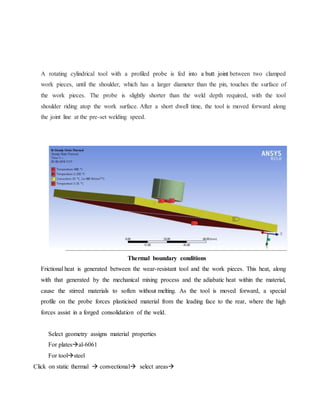
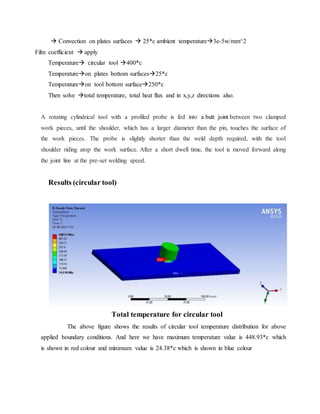
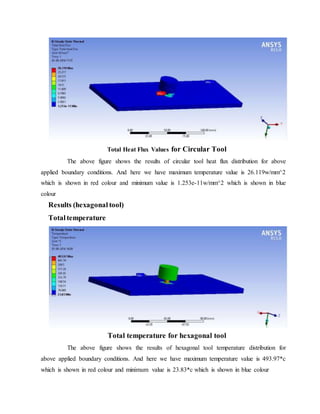
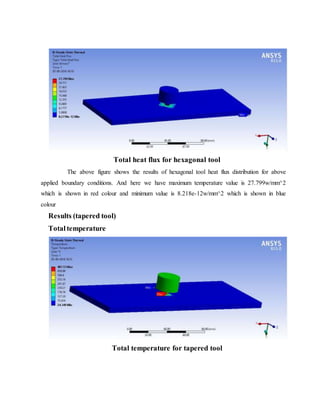
A constantly rotated non-consumable cylindrical-shouldered tool with a profiled probe is
transversely fed at a constant rate into a butt joint between two clamped pieces of butted
material. The probe is slightly shorter than the weld depth required, with the tool shoulder riding
atop the work surface. Frictional heat is generated between the wear-
resistant welding components and the work pieces. This heat, along with that generated by the
mechanical mixing process and the adiabatic heat within the material, cause the stirred materials
to soften without melting. As the pin is moved forward, a special profile on its leading face
forces plasticised material to the rear where clamping force assists in a forged consolidation of
the weld. This process of the tool traversing along the weld line in a plasticised tubular shaft of
metal results in severe solid state deformation involving dynamic re-crystallization of the base
material.
Friction stir welding schematic diagram
Micro structural features
The solid-state nature of the FSW process, combined with its unusual tool and asymmetric
nature, results in a highly characteristic microstructure. The microstructure can be broken up into
the following zones:
 The stir zone (also nugget, dynamically recrystallised zone) is a region of heavily
deformed material that roughly corresponds to the location of the pin during welding.
The grains within the stir zone are roughly equiaxed and often an order of magnitude
smaller than the grains in the parent material. A unique feature of the stir zone is the
common occurrence of several concentric rings which has been referred to as an "onion-
ring" structure. The precise origin of these rings has not been firmly established, although
variations in particle number density, grain size and texture have all been suggested.
 The flow arm zone is on the upper surface of the weld and consists of material that is
dragged by the shoulder from the retreating side of the weld, around the rear of the tool,
and deposited on the advancing side.
 The thermo-mechanically affected zone (TMAZ) occurs on either side of the stir zone. In
this region the strain and temperature are lower and the effect of welding on the
microstructure is correspondingly smaller. Unlike the stir zone the microstructure is
recognizably that of the parent material, albeit significantly deformed and rotated.
Although the term TMAZ technically refers to the entire deformed region it is often used
to describe any region not already covered by the terms stir zone and flow arm.[citation needed]
 The heat-affected zone (HAZ) is common to all welding processes. As indicated by the
name, this region is subjected to a thermal cycle but is not deformed during welding. The
temperatures are lower than those in the TMAZ but may still have a significant effect if
the microstructure is thermally unstable. In fact, in age-hardened aluminium alloys this
region commonly exhibits the poorest mechanical properties.
Advantages and limitations
The solid-state nature of FSW leads to several advantages over fusion welding methods as
problems associated with cooling from the liquid phase are avoided. Issues such as
porosity, solute redistribution, solidification cracking and liquation cracking do not arise
during FSW. In general, FSW has been found to produce a low concentration of defects and is
very tolerant of variations in parameters and materials.
Nevertheless, FSW is associated with a number of unique defects. Insufficient weld
temperatures, due to low rotational speeds or high traverse speeds, for example, mean that the
weld material is unable to accommodate the extensive deformation during welding. This may
result in long, tunnel-like defects running along the weld which may occur on the surface or
subsurface. Low temperatures may also limit the forging action of the tool and so reduce the
continuity of the bond between the material from each side of the weld. The light contact
between the materials has given rise to the name "kissing-bond". This defect is particularly
worrying since it is very difficult to detect using non-destructive methods such as X-
ray or ultrasonic testing. If the pin is not long enough or the tool rises out of the plate then the
interface at the bottom of the weld may not be disrupted and forged by the tool, resulting in a
lack-of-penetration defect. This is essentially a notch in the material which can be a potential
source of fatigue cracks.
A number of potential advantages of FSW over conventional fusion-welding processes have
been identified:
 Good mechanical properties in the as-welded condition
 Improved safety due to the absence of toxic fumes or the spatter of molten material.
 No consumables — A threaded pin made of conventional tool steel, e.g., hardened H13,
can weld over 1 km (0.62 mi) of aluminium, and no filler or gas shield is required for
aluminium.
 Easily automated on simple milling machines — lower setup costs and less training.
 Can operate in all positions (horizontal, vertical, etc.), as there is no weld pool.
 Generally good weld appearance and minimal thickness under/over-matching, thus
reducing the need for expensive machining after welding.
 Can use thinner materials with same joint strength.
 Low environmental impact.
 General performance and cost benefits from switching from fusion to friction.
However, some disadvantages of the process have been identified:
 Exit hole left when tool is withdrawn.
 Large down forces required with heavy-duty clamping necessary to hold the plates
together.
 Less flexible than manual and arc processes (difficulties with thickness variations and
non-linear welds).
 Often slower traverse rate than some fusion welding techniques, although this may be
offset if fewer welding passes are required.
Important welding parameters
Tool design
The design of the tool is a critical factor as a good tool can improve both the quality of the weld
and the maximum possible welding speed.
It is desirable that the tool material be sufficiently strong, tough, and hard wearing at the welding
temperature. Further it should have a good oxidation resistance and a low thermal conductivity to
minimise heat loss and thermal damage to the machinery further up the drive train. Hot-
worked tool steel such as AISI H13 has proven perfectly acceptable for welding aluminium
alloys within thickness ranges of 0.5 – 50 mm but more advanced tool materials are necessary
for more demanding applications such as highly abrasive metal matrix composites or higher
melting point materials such as steel or titanium.
Improvements in tool design have been shown to cause substantial improvements in productivity
and quality. TWI has developed tools specifically designed to increase the penetration depth and
thus increasing the plate thicknesses that can be successfully welded. An example is the "whorl"
design that uses a tapered pin with re-entrant features or a variable pitch thread to improve the
downwards flow of material. Additional designs include the Triflute and Trivex series. The
Triflute design has a complex system of three tapering, threaded re-entrant flutes that appear to
increase material movement around the tool. The Trivex tools use a simpler, non-cylindrical, pin
and have been found to reduce the forces acting on the tool during welding.
The majority of tools have a concave shoulder profile which acts as an escape volume for the
material displaced by the pin, prevents material from extruding out of the sides of the shoulder
and maintains downwards pressure and hence good forging of the material behind the tool. The
Triflute tool uses an alternative system with a series of concentric grooves machined into the
surface which are intended to produce additional movement of material in the upper layers of the
weld.
Widespread commercial applications of friction stir welding process for steels and other hard
alloys such as titanium alloys will require the development of cost-effective and durable
tools. Material selection, design and cost are important considerations in the search for
commercially useful tools for the welding of hard materials. Work is continuing to better
understand the effects of tool material's composition, structure, properties and geometry on their
performance, durability and cost.
Tool rotation and traverse speeds
There are two tool speeds to be considered in friction-stir welding; how fast the tool rotates and
how quickly it traverses the interface. These two parameters have considerable importance and
must be chosen with care to ensure a successful and efficient welding cycle. The relationship
between the welding speeds and the heat input during welding is complex but, in general, it can
be said that increasing the rotation speed or decreasing the traverse speed will result in a hotter
weld. In order to produce a successful weld it is necessary that the material surrounding the tool
is hot enough to enable the extensive plastic flow required and minimize the forces acting on the
tool. If the material is too cold then voids or other flaws may be present in the stir zone and in
extreme cases the tool may break.
Excessively high heat input, on the other hand may be detrimental to the final properties of the
weld. Theoretically, this could even result in defects due to the liquation of low-melting-point
phases (similar to liquation cracking in fusion welds). These competing demands lead onto the
concept of a "processing window": the range of processing parameters viz. tool rotation and
traverse speed that will produce a good quality weld. Within this window the resulting weld will
have a sufficiently high heat input to ensure adequate material plasticity but not so high that the
weld properties are excessively deteriorated.
Tooltilt and plunge depth
The plunge depth is defined as the depth of the lowest point of the shoulder below the surface of
the welded plate and has been found to be a critical parameter for ensuring weld
quality. Plunging the shoulder below the plate surface increases the pressure below the tool and
helps ensure adequate forging of the material at the rear of the tool. Tilting the tool by 2–4
degrees, such that the rear of the tool is lower than the front, has been found to assist this forging
process. The plunge depth needs to be correctly set, both to ensure the necessary downward
pressure is achieved and to ensure that the tool fully penetrates the weld. Given the high loads
required, the welding machine may deflect and so reduce the plunge depth compared to the
nominal setting, which may result in flaws in the weld. On the other hand, an excessive plunge
depth may result in the pin rubbing on the backing plate surface or a significant under match of
the weld thickness compared to the base material. Variable load welders have been developed to
automatically compensate for changes in the tool displacement while TWI have demonstrated a
roller system that maintains the tool position above the weld plate.
Welding forces
During welding a number of forces will act on the tool:
 A downwards force is necessary to maintain the position of the tool at or below the
material surface. Some friction-stir welding machines operate under load control but in
many cases the vertical position of the tool is preset and so the load will vary during
welding.
 The traverse force acts parallel to the tool motion and is positive in the traverse direction.
Since this force arises as a result of the resistance of the material to the motion of the tool
it might be expected that this force will decrease as the temperature of the material around
the tool is increased.
 The lateral force may act perpendicular to the tool traverse direction and is defined here as
positive towards the advancing side of the weld.
 Torque is required to rotate the tool, the amount of which will depend on the down force
and friction coefficient (sliding friction) and/or the flow strength of the material in the
surrounding region (stiction).
In order to prevent tool fracture and to minimize excessive wear and tear on the tool and
associated machinery, the welding cycle is modified so that the forces acting on the tool are as
low as possible and abrupt changes are avoided. In order to find the best combination of
welding parameters, it is likely that a compromise must be reached, since the conditions that
favour low forces (e.g. high heat input, low travel speeds) may be undesirable from the point
of view of productivity and weld properties.
Flow of material
Early work on the mode of material flow around the tool used inserts of a different alloy, which
had a different contrast to the normal material when viewed through a microscope, in an effort to
determine where material was moved as the tool passed. The data was interpreted as representing
a form of in-situ extrusion where the tool, backing plate and cold base material form the
"extrusion chamber" through which the hot, plasticised material is forced. In this model the
rotation of the tool draws little or no material around the front of the pin instead the material
parts in front of the pin and passes down either side. After the material has passed the pin the
side pressure exerted by the "die" forces the material back together and consolidation of the join
occurs as the rear of the tool shoulder passes overhead and the large down force forges the
material.
More recently, an alternative theory has been advanced that advocates considerable material
movement in certain locations. This theory holds that some material does rotate around the pin,
for at least one rotation, and it is this material movement that produces the "onion-ring" structure
in the stir zone. The researchers used a combination of thin copper strip inserts and a "frozen
pin" technique, where the tool is rapidly stopped in place. They suggested that material motion
occurs by two processes:
1. Material on the advancing front side of a weld enters into a zone that rotates and
advances with the pin. This material was very highly deformed and sloughs off behind the pin to
form arc-shaped features when viewed from above (i.e. down the tool axis). It was noted that the
copper entered the rotational zone around the pin, where it was broken up into fragments. These
fragments were only found in the arc shaped features of material behind the tool.
2. The lighter material came from the retreating front side of the pin and was dragged
around to the rear of the tool and filled in the gaps between the arcs of advancing side material.
This material did not rotate around the pin and the lower level of deformation resulted in a larger
grain size.
The primary advantage of this explanation is that it provides a plausible explanation for the
production of the onion-ring structure.
The marker technique for friction stir welding provides data on the initial and final positions of
the marker in the welded material. The flow of material is then reconstructed from these
positions. Detailed material flow field during friction stir welding can also be calculated from
theoretical considerations based on fundamental scientific principles. Material flow calculations
are routinely used in numerous engineering applications. Calculation of material flow fields in
friction stir welding can be undertaken both using comprehensive numerical simulations and
simple but insightful analytical equations. The comprehensive models for the calculation of
material flow fields also provide important information such as geometry of the stir zone and the
torque on the tool. The numerical simulations have shown the ability to correctly predict the
results from marker experiments and the stir zone geometry observed in friction stir welding
experiments.
Generationand flow of heat
For any welding process it is, in general, desirable to increase the travel speed and minimise the
heat input as this will increase productivity and possibly reduce the impact of welding on the
mechanical properties of the weld. At the same time it is necessary to ensure that the temperature
around the tool is sufficiently high to permit adequate material flow and prevent flaws or tool
damage.
When the traverse speed is increased, for a given heat input, there is less time for heat to conduct
ahead of the tool and the thermal gradients are larger. At some point the speed will be so high
that the material ahead of the tool will be too cold, and the flow stress too high, to permit
adequate material movement, resulting in flaws or tool fracture. If the "hot zone" is too large
then there is scope to increase the traverse speed and hence productivity.
The welding cycle can be split into several stages during which the heat flow and thermal profile
will be different:
 Dwell. The material is preheated by a stationary, rotating tool to achieve a sufficient temperature
ahead of the tool to allow the traverse. This period may also include the plunge of the tool into
the workpiece.
 Transient heating. When the tool begins to move there will be a transient period where the heat
production and temperature around the tool will alter in a complex manner until an essentially
steady-state is reached.
 Pseudo steady-state. Although fluctuations in heat generation will occur the thermal field around
the tool remains effectively constant, at least on the macroscopic scale.
 Post steady-state. Near the end of the weld heat may "reflect" from the end of the plate leading
to additional heating around the tool.
Applications
The FSW process is currently patented by TWI in most industrialised countries and licensed for
over 183 users. Friction stir welding and its variants friction stir spot welding and friction are
used for the following industrial applications: shipbuilding and
offshore, aerospace, automotive, rolling stock for railways, general fabrication, robotics, and
computers
Shipbuilding and offshore
Two Scandinavian aluminium extrusion companies were the first to apply FSW commercially to
the manufacture of fish freezer panels atSapa in 1996, as well as deck panels and helicopter
landing platforms at Marine Aluminium Aanensen. Marine Aluminium Aanensen subsequently
merged with Hydro Aluminium Maritime to become Hydro Marine Aluminium. Some of these
freezer panels are now produced by Riftec and Bayards. In 1997 two-dimensional friction stir
welds in the hydro dynamically flared bow section of the hull of the ocean viewer vessel The
Boss were produced at Research Foundation Institute with the first portable FSW machine.
The Super Liner Ogasawara at Mitsui Engineering and Shipbuilding is the largest friction stir
welded ship so far. The Sea Fighter of Nichols Bros and the Freedom Littoral Combat
Ships contain prefabricated panels by the FSW fabricators Advanced Technology and Friction
Stir Link, Inc. respectively. The Houbei class missile boat has friction stir welded rocket launch
containers of China Friction Stir Centre. HMNZSRotoiti in New Zealand has FSW panels made
by Donovans in a converted milling machine. Various companies apply FSW to armor
plating for amphibious assault ships
Aerospace
United Launch Alliance applies FSW to the Delta II, Delta IV, and Atlas V expendable launch
vehicles, and the first of these with a friction stir welded Interstage module was launched in
1999. The process is also used for the Space Shuttle external tank, for Ares I and for the
Orion test article at NASA as well as Falcon 1 and Falcon 9 rockets at SpaceX. The toe nails for
ramp of Boeing C-17 Globemaster III cargo aircraft by Advanced Joining Technologies[39] and
the cargo barrier beams for the Boeing 747 Large Cargo Freighter[39] were the first commercially
produced aircraft parts. FAA approved wings and fuselage panels of the Eclipse 500 aircraft
were made at Eclipse Aviation, and this company delivered 259 friction stir welded business jets,
before they were forced into Chapter 7 liquidation. Floor panels for Airbus A400M military
aircraft are now made by Pfalz Flugzeugwerke and Embraer used FSW for the Legacy 450 and
500 Jets Friction stir welding also is employed for fuselage panels on the Airbus
A380. BRÖTJE-Automation GmbH uses friction stir welding – through the DeltaN FS system –
for gantry production machines developed for the aerospace sector as well as other industrial
applications
Automotive
Aluminium engine cradles and suspension struts for stretched Lincoln Town Car were the first
automotive parts that were friction stir at Tower, who use the process also for the engine tunnel
of the Ford GT. A spin-off of this company is called Friction Stir Link, Inc. and successfully
exploits the FSW process, e.g. for the flatbed trailer "Revolution" of Fontaine Trailers.[43] In
Japan FSW is applied to suspension struts at Showa Denko and for joining of aluminium sheets
to galvanized steel brackets for the boot (trunk) lid of the Mazda MX-5. Friction stir spot
welding is successfully used for the bonnet (hood) and rear doors of the Mazda RX-8 and the
boot lid of the Toyota Prius. Wheels are friction stir welded at Simmons Wheels, UT Alloy
Works and Fundo. Rear seats for the Volvo V70 are friction stir welded at Sapa, HVAC pistons
at Halla Climate Control and exhaust gas recirculation coolers at Pierburg. Tailor welded
blanks are friction stir welded for the Audi R8 at Riftec. The B-column of the Audi R8 Spider is
friction stir welded from two extrusions at Hammerer Aluminium Industries in Austria.
Railways
Since 1997 roof panels were made from aluminium extrusions at Hydro Marine
Aluminium with a bespoke 25m long FSW machine, e.g. for DSB class SA-SD trains of Alstom
LHB Curved side and roof panels for the Victoria line trains of London Underground, side
panels for Bombardier's Electrostar trains at Sapa Group and side panels for Alstom's British
Rail Class 390 Pendolino trains are made at Sapa Group Japanese commuter and express A-
trains, and British Rail Class 395 trains are friction stir welded
byHitachi, while Kawasaki applies friction stir spot welding to roof panels and Sumitomo Light
Metal produces Shinkansen floor panels. Innovative FSW floor panels are made by Hammerer
Aluminium Industries in Austria for the Stadler KISS double decker rail cars, to obtain an
internal height of 2 m on both floors and for the new car bodies of the Wuppertal Suspension
Railway. Heat sinks for cooling high-power electronics of locomotives are made at Sykatek,
EBG, Austerlitz Electronics, Euro Composite, Sapa and Rapid Technic, and are the most
common application of FSW due to the excellent heat transfer
Fabrication
Façade panels and athode sheets are friction stir welded at AMAG and Hammerer Aluminium
Industries including friction stir lap welds of copper to aluminium. Bizerba meat slicers,
Ökolüfter HVAC units and Siemens X-ray vacuum vessels are friction stir welded at Riftec.
Vacuum valves and vessels are made by FSW at Japanese and Swiss companies. FSW is also
used for the encapsulation of nuclear waste at SKB in 50-mm-thick copper canisters. Pressure
vessels from ø1m semi spherical forgings of 38.1mm thick aluminium alloy 2219 at Advanced
Joining Technologies and Lawrence Livermore Nat Lab. Friction stir processing is applied to
ship propellers at Friction Stir Link, Inc. and to hunting knives by Diamond Blade. Bosch uses it
in Worcester for the production of heat exchangers.
Robotics
KUKA Robot Group has adapted its KR500-3MT heavy-duty robot for friction stir welding via
the DeltaN FS tool. The system made its first public appearance at the EuroBLECH show in
November 2012
Personal computers
Apple applied friction stir welding on the 2012 iMac to effectively join the bottom to the back of
the device
2. INTRODUCTION:
CREO
2.1. CAD
Computer aided design (cad) is defined as any activity that involves the
effective use of the computer to create, modify, analyze, or document an engineering design.
CAD is most commonly associated with the use of an interactive computer graphics system,
referred to as cad system. The term CAD/CAM system is also used if it supports manufacturing
as well as design applications
2.2 Introduction to CREO
CREO is a suite of programs that are used in the design, analysis, and manufacturing of a
virtually unlimited range of product.
CREO is a parametric, feature-based solid modelling system, “Feature
based” means that you can create part and assembly by defining feature like pad, rib, slots,
holes, rounds, and so on, instead of specifying low-level geometry like lines, arcs, and circle&
features are specifying by setting values and attributes of element such as reference planes or
surfaces direction of creation, pattern parameters, shape, dimensions and others.
“Parametric” means that the physical shape of the part or assembly is driven by
the values assigned to the attributes (primarily dimensions) of its features. Parametric may define
or modify a feature’s dimensions or other attributes at any time.
For example, if your design intent is such that a hole is centred on a block, you
can relate the dimensional location of the hole to the block dimensions using a numerical
formula; if the block dimensions change, the centred hole position will be recomputed
automatically.
“Solid Modelling” means that the computer model to create it able to contain all the
information that a real solid object would have. The most useful thing about the solid modelling
is that it is impossible to create a computer model that is ambiguous or physically non-realizable.
There are six core CREO concepts. Those are:
 Solid Modelling
 Feature Based
 Parametric
 Parent / Child Relationships
 Associative
 Model Centric
2.3 Capabilities and Benefits:
1. Complete 3D modelling capabilities enable you to exceed quality arid time to arid time to
market goals.
2. Maximum production efficiency through automated generation of associative C tooling
design, assembly instructions, and machine code.
3. Ability to simulate and analysis virtual prototype to improve production performance and
optimized product design.
4. Ability to share digital product data seamlessly among all appropriate team members
5. Compatibility with myriad CAD tools-including associative data exchange and industry
standard data formats.
2.4 Features of CREO
CREO is a one-stop for any manufacturing industry. It offers effective feature,
incorporated for a wide variety of purpose. Some of the important features are as follows:
 Simple and powerful tool
 Parametric design
 Feature-based approach
 Parent child relationship
 Associative and model centric
2.4.1. Simple and Powerful Tool
CREO tools are used friendly. Although the execution of any operation using the tool can
create a highly complex model
2.4.2. Parametric Design
CREO designs are parametric. The term “parametric” means that the design operations that
are captured can be stored as they take place. They can be used effectively in the future for
modifying and editing the design. These types of modeling help in faster and easier
modifications of design
2.4.3. Feature-Based Approach
Features are the basic building blocks required to create an object. CREO wildfire models are
based on the series of feature. Each feature builds upon the previous feature, to create the model
(only one single feature can be modified at a time). Each feature may appear simple,
individually, but collectively forms a complex part and assemblies.
The idea behind feature based modeling is that the designer construct on object, composed of
individual feature that describe the manner in which the geometry supports the object, if its
dimensions change. The first feature is called the base feature.
2.4.4. Parent Child Relationship
The parent child relationship is a powerful way to capture your design intent in a model. This
relationship naturally occurs among features, during the modeling process. When you create a
new feature, the existing feature that are referenced, become parent to the feature.
2.4.5. Associative and Model Centric
CREO drawings are model centric. This means that CREO models that are represented in
assembly or drawings are associative. If changes are made in one module, these will
automatically get updated in the referenced module.
2.5. CREO Basic Design Modes
When a design from conception to completion in CREO, the design information goes through
three basic design steps.
1. Creating the component parts of the design
2. Joining the parts in an assembly that records the relative position of the parts.
3. Creating mechanical drawing based on the information in the parts and the assembly.
2.6 Assembly in CREO:
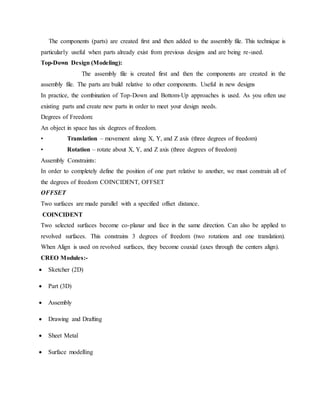
Bottom-Up Design (Modeling):
The components (parts) are created first and then added to the assembly file. This technique is
particularly useful when parts already exist from previous designs and are being re-used.
Top-Down Design (Modeling):
The assembly file is created first and then the components are created in the
assembly file. The parts are build relative to other components. Useful in new designs
In practice, the combination of Top-Down and Bottom-Up approaches is used. As you often use
existing parts and create new parts in order to meet your design needs.
Degrees of Freedom:
An object in space has six degrees of freedom.
• Translation – movement along X, Y, and Z axis (three degrees of freedom)
• Rotation – rotate about X, Y, and Z axis (three degrees of freedom)
Assembly Constraints:
In order to completely define the position of one part relative to another, we must constrain all of
the degrees of freedom COINCIDENT, OFFSET
OFFSET
Two surfaces are made parallel with a specified offset distance.
.
COINCIDENT
Two selected surfaces become co-planar and face in the same direction. Can also be applied to
revolved surfaces. This constrains 3 degrees of freedom (two rotations and one translation).
When Align is used on revolved surfaces, they become coaxial (axes through the centers align).
CREO Modules:-
 Sketcher (2D)
 Part (3D)
 Assembly
 Drawing and Drafting
 Sheet Metal
 Surface modelling
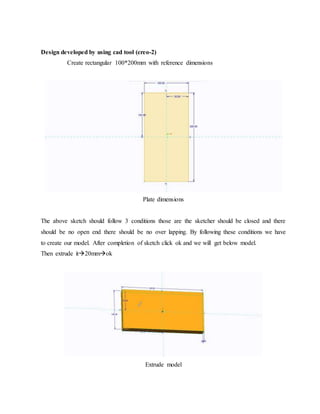
Design developed by using cad tool (creo-2)
Create rectangular 100*200mm with reference dimensions
Plate dimensions
The above sketch should follow 3 conditions those are the sketcher should be closed and there
should be no open end there should be no over lapping. By following these conditions we have
to create our model. After completion of sketch click ok and we will get below model.
Then extrude it20mmok
Extrude model
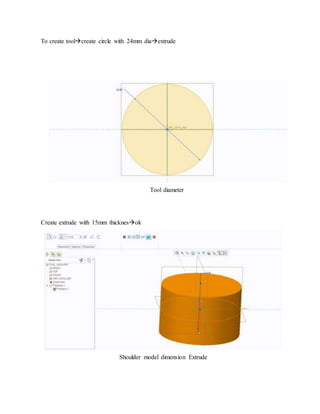
To create toolcreate circle with 24mm diaextrude
Tool diameter
Create extrude with 15mm thicknesok
Shoulder model dimension Extrude
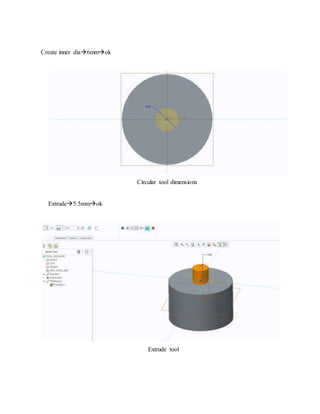
Create inner dia6mmok
Circular tool dimensions
Extrude5.5mmok
Extrude tool
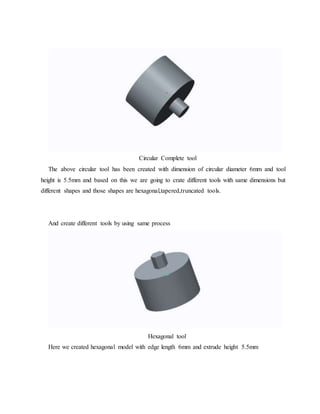
Circular Complete tool
The above circular tool has been created with dimension of circular diameter 6mm and tool
height is 5.5mm and based on this we are going to crate different tools with same dimensions but
different shapes and those shapes are hexagonal,tapered,truncated tools.
And create different tools by using same process
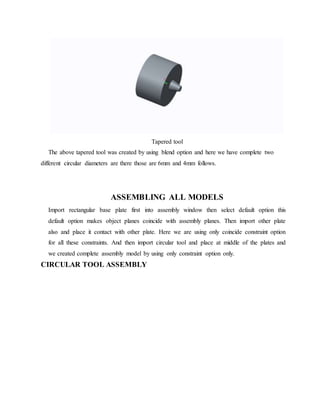
Hexagonal tool
Here we created hexagonal model with edge length 6mm and extrude height 5.5mm
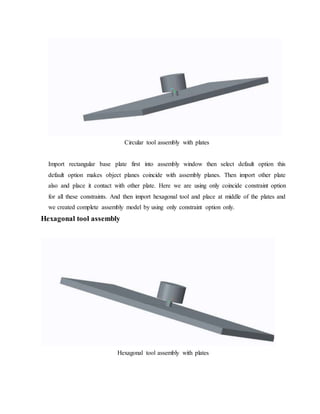
Tapered tool
The above tapered tool was created by using blend option and here we have complete two
different circular diameters are there those are 6mm and 4mm follows.
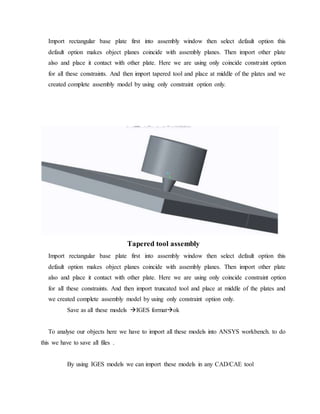
ASSEMBLING ALL MODELS
Import rectangular base plate first into assembly window then select default option this
default option makes object planes coincide with assembly planes. Then import other plate
also and place it contact with other plate. Here we are using only coincide constraint option
for all these constraints. And then import circular tool and place at middle of the plates and
we created complete assembly model by using only constraint option only.
CIRCULAR TOOL ASSEMBLY
Circular tool assembly with plates
Import rectangular base plate first into assembly window then select default option this
default option makes object planes coincide with assembly planes. Then import other plate
also and place it contact with other plate. Here we are using only coincide constraint option
for all these constraints. And then import hexagonal tool and place at middle of the plates and
we created complete assembly model by using only constraint option only.
Hexagonal tool assembly
Hexagonal tool assembly with plates
Import rectangular base plate first into assembly window then select default option this
default option makes object planes coincide with assembly planes. Then import other plate
also and place it contact with other plate. Here we are using only coincide constraint option
for all these constraints. And then import tapered tool and place at middle of the plates and we
created complete assembly model by using only constraint option only.
Tapered tool assembly
Import rectangular base plate first into assembly window then select default option this
default option makes object planes coincide with assembly planes. Then import other plate
also and place it contact with other plate. Here we are using only coincide constraint option
for all these constraints. And then import truncated tool and place at middle of the plates and
we created complete assembly model by using only constraint option only.
Save as all these models IGES formatok
To analyse our objects here we have to import all these models into ANSYS workbench. to do
this we have to save all files .
By using IGES models we can import these models in any CAD/CAE tool
3. INTRODUCTION TO ANSYS
3.1 INTRODUCTION
ANSYS is general-purpose finite element analysis (FEA) software package. Finite Element
Analysis is a numerical method of deconstructing a complex system into very small pieces (of
user-designated size) called elements. The software implements equations that govern the
behaviour of these elements and solves them all; creating a comprehensive explanation of
how the system acts as a whole. These results then can be presented in tabulated, or graphical
forms. This type of analysis is typically used for the design and optimization of a system far
too complex to analyze by hand. Systems that may fit into this category are too complex due
to their geometry, scale, or governing equations.
ANSYS is the standard FEA teaching tool within the Mechanical Engineering Department at
many colleges. ANSYS is also used in Civil and Electrical Engineering, as well as the Physics
and Chemistry departments.
ANSYS provides a cost-effective way to explore the performance of products or processes in
a virtual environment. This type of product development is termed virtual prototyping.
With virtual prototyping techniques, users can iterate various scenarios to optimize the
product long before the manufacturing is started. This enables a reduction in the level of risk,
and in the cost of ineffective designs. The multifaceted nature of ANSYS also provides a
means to ensure that users are able to see the effect of a design on the whole behavior of the
product, be it electromagnetic, thermal, mechanical etc
3.1.1 GENERIC STEPS TO SOLVING ANY PROBLEM IN ANSYS:
Like solving any problem analytically, you need to define (1) your solution domain, (2) the
physical model, (3) boundary conditions and (4) the physical properties. You then solve the
problem and present the results. In numerical methods, the main difference is an extra step
called mesh generation. This is the step that divides the complex model into small elements
that become solvable in an otherwise too complex situation. Below describes the processes in
terminology slightly more attune to the software.
3.1.1.1 BUILD GEOMETRY
Construct a two or three dimensional representation of the object to be modeled and tested
using the work plane coordinate system within ANSYS.
3.1.1.2 DEFINE MATERIAL PROPERTIES
Now that the part exists, define a library of the necessary materials that compose the object
(or project) being modeled. This includes thermal and mechanical properties.
3.1.1.3 GENERATE MESH
At this point ANSYS understands the makeup of the part. Now define how the modeled
system should be broken down into finite pieces.
3.1.1.4 APPLY LOADS
Once the system is fully designed, the last task is to burden the system with constraints, such
as physical loadings or boundary conditions.
3.1.1.5 OBTAIN SOLUTION
This is actually a step, because ANSYS needs to understand within what state (steady state,
transient… etc.) the problem must be solved.
3.1.1.6 PRESENT THE RESULTS
After the solution has been obtained, there are many ways to present ANSYS’ results, choose
from many options such as tables, graphs, and contour plots.
3.2 SPECIFIC CAPABILITIES OF ANSYS:
3.2.1 STRUCTURAL
Structural analysis is probably the most common application of the finite element method as it
implies bridges and buildings, naval, aeronautical, and mechanical structures such as ship
hulls, aircraft bodies, and machine housings, as well as mechanical components such as
pistons, machine parts, and tools.
· Static Analysis - Used to determine displacements, stresses, etc. under static loading
conditions. ANSYS can compute both linear and nonlinear static analyses. Nonlinearities can
include plasticity, stress stiffening, large deflection, large strain, hyper elasticity, contact
surfaces, and creep.
Modal Analysis
A modal analysis is typically used to determine the vibration characteristics (natural
frequencies and mode shapes) of a structure or a machine component while it is being
designed. It can also serve as a starting point for another, more detailed, dynamic analysis,
such as a harmonic response or full transient dynamic analysis.
Modal analyses, while being one of the most basic dynamic analysis types available in
ANSYS, can also be more computationally time consuming than a typical static analysis. A
reduced solver, utilizing automatically or manually selected master degrees of freedom is used
to drastically reduce the problem size and solution time.
Harmonic Analysis - Used extensively by companies who produce rotating machinery,
ANSYS Harmonic analysis is used to predict the sustained dynamic behavior of structures to
consistent cyclic loading. Examples of rotating machines which produced or are subjected to
harmonic loading are:
 Turbines
o Gas Turbines for Aircraft and Power Generation
o Steam Turbines
o Wind Turbine
o Water Turbines
o Turbopumps
 Internal Combustion engines
 Electric motors and generators
 Gas and fluid pumps
 Disc drives
A harmonic analysis can be used to verify whether or not a machine design will successfully
overcome resonance, fatigue, and other harmful effects of forced vibrations.
· Transient Dynamic Analysis - Used to determine the response of a structure to
arbitrarily time-varying loads. All nonlinearities mentioned under Static Analysis above are
allowed.
· Buckling Analysis - Used to calculate the buckling loads and determine the buckling
mode shape. Both linear (eigenvalue) buckling and nonlinear buckling analyses are possible.
In addition to the above analysis types, several special-purpose features are available such as
Fracture mechanics, Composite material analysis, Fatigue, and both p-Method and Beam
analyses.
3.2.2 THERMAL
ANSYS is capable of both steady state and transient analysis of any solid with thermal
boundary conditions.
Steady-state thermal analyses calculate the effects of steady thermal loads on a system or
component. Users often perform a steady-state analysis before doing a transient thermal
analysis, to help establish initial conditions. A steady-state analysis also can be the last step of
a transient thermal analysis; performed after all transient effects have diminished. ANSYS can
be used to determine temperatures, thermal gradients, heat flow rates, and heat fluxes in an
object that are caused by thermal loads that do not vary over time. Such loads include the
following:
· Convection
· Radiation
· Heat flow rates
· Heat fluxes (heat flow per unit area)
· Heat generation rates (heat flow per unit volume)
· Constant temperature boundaries
A steady-state thermal analysis may be either linear, with constant material properties; or
nonlinear, with material properties that depend on temperature. The thermal properties of
most material vary with temperature. This temperature dependency being appreciable, the
analysis becomes nonlinear. Radiation boundary conditions also make the analysis nonlinear.
Transient calculations are time dependent and ANSYS can both solve distributions as well as
create video for time incremental displays of models.
3.2.3 FLUID FLOW
The ANSYS/FLOTRAN CFD (Computational Fluid Dynamics) offers comprehensive tools
for analyzing two-dimensional and three-dimensional fluid flow fields. ANSYS is capable of
modeling a vast range of analysis types such as: airfoils for pressure analysis of airplane
wings (lift and drag), flow in supersonic nozzles, and complex, three-dimensional flow
patterns in a pipe bend. In addition, ANSYS/FLOTRAN could be used to perform tasks
including:
· Calculating the gas pressure and temperature distributions in an engine exhaust
manifold
· Studying the thermal stratification and breakup in piping systems
· Using flow mixing studies to evaluate potential for thermal shock
· Doing natural convection analyses to evaluate the thermal performance of chips in
electronic enclosures
· Conducting heat exchanger studies involving different fluids separated by solid regions
3.2.4 ACOUSTICS / VIBRATION
ANSYS is capable of modelling and analyzing vibrating systems in order to that vibrate in
order to analyze
Acoustics is the study of the generation, propagation, absorption, and reflection of pressure
waves in a fluid medium. Applications for acoustics include the following:
· Sonar - the acoustic counterpart of radar
· Design of concert halls, where an even distribution of sound pressure is desired
· Noise minimization in machine shops
· Noise cancellation in automobiles
· Underwater acoustics
· Design of speakers, speaker housings, acoustic filters, mufflers, and many other similar
devices.
· Geophysical exploration
Within ANSYS, an acoustic analysis usually involves modelling a fluid medium and the
surrounding structure. Characteristics in question include pressure distribution in the fluid at
different frequencies, pressure gradient, and particle velocity, the sound pressure level, as
well as, scattering, diffraction, transmission, radiation, attenuation, and dispersion of
acoustic waves. A coupled acoustic analysis takes the fluid-structure interaction into account.
An uncoupled acoustic analysis models only the fluid and ignores any fluid-structure
interaction.
The ANSYS program assumes that the fluid is compressible, but allows only relatively small
pressure changes with respect to the mean pressure. Also, the fluid is assumed to be non-
flowing and in viscid (that is, viscosity causes no dissipative effects). Uniform mean density
and mean pressure are assumed, with the pressure solution being the deviation from the mean
pressure, not the absolute pressure.
3.2.5 COUPLED FIELDS
A coupled-field analysis is an analysis that takes into account the interaction (coupling)
between two or more disciplines (fields) of engineering. A piezoelectric analysis, for example,
handles the interaction between the structural and electric fields: it solves for the voltage
distribution due to applied displacements, or vice versa. Other examples of coupled-field
analysis are thermal-stress analysis, thermal-electric analysis, and fluid-structure analysis.
Some of the applications in which coupled-field analysis may be required are pressure vessels
(thermal-stress analysis), fluid flow constrictions (fluid-structure analysis), induction heating
(magnetic-thermal analysis), ultrasonic transducers (piezoelectric analysis), magnetic forming
(magneto-structural analysis), and micro-electro mechanical systems (MEMS).
4. Material selection
A material's property is an intensive, often quantitative, property of some material.
Quantitative properties may be used as a metric by which the benefits of one material versus
another can be assessed, thereby aiding in materials selection.
A property may be a constant or may be a function of one or more independent variables,
such as temperature. Materials properties often vary to some degree according to the direction
in the material in which they are measured, a condition referred to as anisotropy. Materials
properties that relate to different physical phenomena often behave linearly (or approximately
so) in a given operating range. Modelling them as linear can significantly simplify
the differential constitutive equations that the property describes.
Some materials properties are used in relevant equations to predict the attributes of a system a
priori. For example, if a material of a known specific heat gains or loses a known amount of
heat, the temperature change of that material can be determined. Materials properties are most
reliably measured by standardized test methods. Many such test methods have been
documented by their respective user communities and published through ASTM International.
Mechanical properties:
Young’s modulus:
Young's modulus, also known as the tensile modulus or elastic modulus, is a mechanical
property of linear elastic solid materials. It measures the force (per unit area) that is needed to
stretch (or compress) a material sample.
Young's modulus is named after the 19th-century British scientist Thomas Young. However,
the concept was developed in 1727 by Leonhard Euler, and the first experiments that used the
concept of Young's modulus in its current form were performed by the Italian
scientist Giordano Riccati in 1782, pre-dating Young's work by 25 years. The term modulus is
the diminutive of the Latin term modus which means measure.
A solid body deforms when a load is applied to it. If the material is elastic, the body returns to
its original shape after the load is removed. The material is linear if the ratio of load to
deformation remains constant during the loading process. Not many materials are linear and
elastic beyond a small amount of deformation. A constant Young's modulus applies only to
linear elastic materials. A rigid material has an infinite Young's modulus because an infinite
force is needed to deform such a material. A material whose Young's modulus is very high
can be approximated as rigid.
A stiff material needs more force to deform compared to a soft material. Therefore, the
Young's modulus is a measure of the stiffness of a solid material. Do not confuse:
 stiffness and strength: the strength of material is the amount of force it can withstand and
still recover its original shape;
 material stiffness and geometric stiffness: the geometric stiffness depends on shape, e.g.
the stiffness of an I beam is much higher than that of a spring made of the same steel thus
having the same rigidity;
 stiffness and hardness: the hardness of a material defines the relative resistance that its
surface imposes against the penetration of a harder body;
 Stiffness and toughness: toughness is the amount of energy that a material can absorb
before fracturing.
Young's modulus is the ratio of stress (which has units of pressure) to strain (which
is dimensionless), and so Young's modulus has units of pressure. Its SI unit is therefore the
Pascal (Pa or N/m2 or m−1·kg·s−2). The practical units used are mega Pascal’s (MPa
or N/mm2) or (GPa or kN/mm2). In United States customary units, it is expressed as pounds
(force) per square inch (psi). The abbreviation ksi refers to "kpsi", or thousands of pounds per
square inch.
The Young's modulus enables the calculation of the change in the dimension of a bar made of
an isotropic elastic material under tensile or compressive loads. For instance, it predicts how
much a material sample extends under tension or shortens under compression. The Young's
modulus directly applies to cases uniaxial stress, that is tensile or compressive stress in one
direction and no stress in the other directions. Young's modulus is also used in order to predict
the deflection that will occur in a statically determinate beam when a load is applied at a point
in between the beam's supports. Other elastic calculations usually require the use of one
additional elastic property, such as the shear modulus, bulk modulus or Poisson's ratio. Any
two of these parameters are sufficient to fully describe elasticity in an isotropic material.
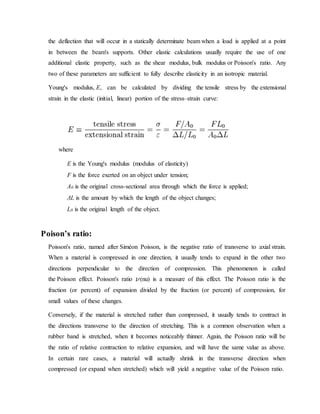
Young's modulus, E, can be calculated by dividing the tensile stress by the extensional
strain in the elastic (initial, linear) portion of the stress–strain curve:
where
E is the Young's modulus (modulus of elasticity)
F is the force exerted on an object under tension;
A0 is the original cross-sectional area through which the force is applied;
ΔL is the amount by which the length of the object changes;
L0 is the original length of the object.
Poison’s ratio:
Poisson's ratio, named after Siméon Poisson, is the negative ratio of transverse to axial strain.
When a material is compressed in one direction, it usually tends to expand in the other two
directions perpendicular to the direction of compression. This phenomenon is called
the Poisson effect. Poisson's ratio (nu) is a measure of this effect. The Poisson ratio is the
fraction (or percent) of expansion divided by the fraction (or percent) of compression, for
small values of these changes.
Conversely, if the material is stretched rather than compressed, it usually tends to contract in
the directions transverse to the direction of stretching. This is a common observation when a
rubber band is stretched, when it becomes noticeably thinner. Again, the Poisson ratio will be
the ratio of relative contraction to relative expansion, and will have the same value as above.
In certain rare cases, a material will actually shrink in the transverse direction when
compressed (or expand when stretched) which will yield a negative value of the Poisson ratio.
The Poisson's ratio of a stable, isotropic, linear elastic material cannot be less than −1.0 nor
greater than 0.5 due to the requirement that Young's modulus, the shear modulus and bulk
modulus have positive values. Most materials have Poisson's ratio values ranging between 0.0
and 0.5. A perfectly incompressible material deformed elastically at small strains would have
a Poisson's ratio of exactly 0.5. Most steels and rigid polymers when used within their design
limits (before yield) exhibit values of about 0.3, increasing to 0.5 for post-yield deformation
(Seismic Performance of Steel-Encased Concrete Piles by RJT Park) (which occurs largely at
constant volume.) Rubber has a Poisson ratio of nearly 0.5. Cork's Poisson ratio is close to 0:
showing very little lateral expansion when compressed. Some materials, mostly polymer
foams, have a negative Poisson's ratio; if these auxetic materials are stretched in one direction,
they become thicker in perpendicular direction. Some anisotropic materials have one or more
Poisson ratios above 0.5 in some directions.
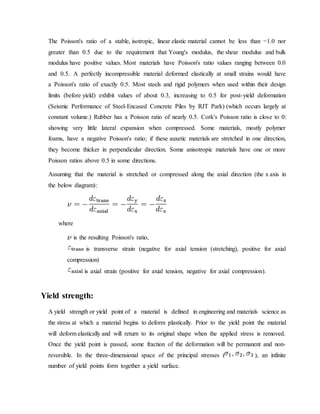
Assuming that the material is stretched or compressed along the axial direction (the x axis in
the below diagram):
where
is the resulting Poisson's ratio,
is transverse strain (negative for axial tension (stretching), positive for axial
compression)
is axial strain (positive for axial tension, negative for axial compression).
Yield strength:
A yield strength or yield point of a material is defined in engineering and materials science as
the stress at which a material begins to deform plastically. Prior to the yield point the material
will deform elastically and will return to its original shape when the applied stress is removed.
Once the yield point is passed, some fraction of the deformation will be permanent and non-
reversible. In the three-dimensional space of the principal stresses ( ), an infinite
number of yield points form together a yield surface.
Knowledge of the yield point is vital when designing a component since it generally
represents an upper limit to the load that can be applied. It is also important for the control of
many materials production techniques such as forging, rolling, or pressing. In structural
engineering, this is a soft failure mode which does not normally cause catastrophic
failure or ultimate failure unless it accelerates buckling.
It is often difficult to precisely define yielding due to the wide variety of stress–strain
curves exhibited by real materials. In addition, there are several possible ways to define
yielding:
True elastic limit
The lowest stress at which dislocations move. This definition is rarely used, since
dislocations move at very low stresses, and detecting such movement is very difficult.
Proportionality limit
Up to this amount of stress, stress is proportional to strain (Hooke's law), so the stress-strain
graph is a straight line, and the gradient will be equal to the elastic modulus of the material.
Elastic limit (yield strength)
Beyond the elastic limit, permanent deformation will occur. The elastic limit is therefore the
lowest stress at which permanent deformation can be measured. This requires a manual load-
unload procedure, and the accuracy is critically dependent on the equipment used and
operator skill. For elastomers, such as rubber, the elastic limit is much larger than the
proportionality limit. Also, precise strain measurements have shown that plastic strain begins
at low stresses.
Yield point
The point in the stress-strain curve at which the curve levels off and plastic deformation
begins to occur.
Offset yield point (proof stress)
When a yield point is not easily defined based on the shape of the stress-strain curve an offset
yield point is arbitrarily defined. The value for this is commonly set at 0.1 or 0.2% plastic
strain.[The offset value is given as a subscript, e.g., Rp0.2=310 MPa. High strength steel and
aluminum alloys do not exhibit a yield point, so this offset yield point is used on these
materials
Upper and lower yield points
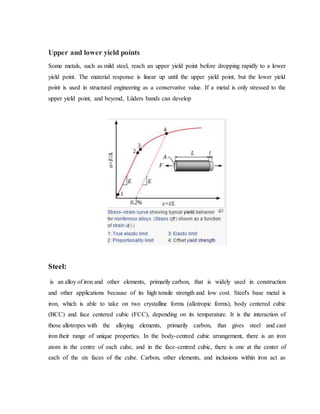
Some metals, such as mild steel, reach an upper yield point before dropping rapidly to a lower
yield point. The material response is linear up until the upper yield point, but the lower yield
point is used in structural engineering as a conservative value. If a metal is only stressed to the
upper yield point, and beyond, Lüders bands can develop
Steel:
is an alloy of iron and other elements, primarily carbon, that is widely used in construction
and other applications because of its high tensile strength and low cost. Steel's base metal is
iron, which is able to take on two crystalline forms (allotropic forms), body centered cubic
(BCC) and face centered cubic (FCC), depending on its temperature. It is the interaction of
those allotropes with the alloying elements, primarily carbon, that gives steel and cast
iron their range of unique properties. In the body-centred cubic arrangement, there is an iron
atom in the centre of each cube, and in the face-centred cubic, there is one at the center of
each of the six faces of the cube. Carbon, other elements, and inclusions within iron act as
hardening agents that prevent the movement of dislocations that otherwise occur in the crystal
lattices of iron atoms.
The carbon in typical steel alloys may contribute up to 2.1% of its weight. Varying the
amount of alloying elements, their presence in the steel either as solute elements, or as
precipitated phases, retards the movement of those dislocations that make iron comparatively
ductile and weak, and thus controls its qualities such as the hardness, ductility, and tensile
strength of the resulting steel. Steel's strength compared to pure iron is only possible at the
expense of iron's ductility, of which iron has an excess.
Steel was produced in bloomery furnaces for thousands of years, but its extensive use began
after more efficient production methods were devised in the 17th century, with the production
of blister steel and then crucible steel. With the invention of the Bessemer process in the mid-
19th century, a new era of mass-produced steel began. This was followed by Siemens-Martin
process and then Gilchrist-Thomas process that refined the quality of steel. With their
introductions, mild steel replaced wrought iron.
Material properties:
Iron is commonly found in the Earth's crust in the form of an ore, usually an iron oxide, such
as magnetite, hematite etc. Iron is extracted from iron ore by removing the oxygen through
combination with a preferred chemical partner such as carbon that is lost to the atmosphere as
carbon dioxide. This process, known as smelting, was first applied to metals with
lower melting points, such as tin, which melts at about 250 °C (482 °F) and copper, which
melts at about 1,100 °C (2,010 °F) and the combination, bronze, which is liquid at less than
1,083 °C (1,981 °F). In comparison, cast iron melts at about 1,375 °C (2,507 °F). Small
quantities of iron were smelted in ancient times, in the solid state, by heating the ore in
a charcoalfire and welding the clumps together with a hammer, squeezing out the impurities.
With care, the carbon content could be controlled by moving it around in the fire.
All of these temperatures could be reached with ancient methods used since the Bronze Age.
Since the oxidation rate of iron increases rapidly beyond 800 °C (1,470 °F), it is important
that smelting take place in a low-oxygen environment. Unlike copper and tin, liquid or solid
iron dissolves carbon quite readily. Smelting, using carbon to reduce iron oxides, results in an
alloy (pig iron) that retains too much carbon to be called steel. The excess carbon and other
impurities are removed in a subsequent step.
Other materials are often added to the iron/carbon mixture to produce steel with desired
properties. Nickeland manganese in steel add to its tensile strength and make
the austenite form of the iron-carbon solution more stable, chromium increases hardness and
melting temperature, and vanadium also increases hardness while making it less prone
to metal fatigue.
To inhibit corrosion, at least 11% chromium is added to steel so that a hard oxide forms on the
metal surface; this is known as stainless steel. Tungsten interferes with the formation
of cementite, allowing martensite to preferentially form at slower quench rates, resulting
in high speed steel. On the other hand, sulfur, nitrogen, and phosphorus make steel more
brittle, so these commonly found elements must be removed from the steel melt during
processing.
The density of steel varies based on the alloying constituents but usually ranges between
7,750 and 8,050 kg/m3 (484 and 503 lb/cu ft), or 7.75 and 8.05 g/cm3 (4.48 and 4.65 oz/cu in).
Even in a narrow range of concentrations of mixtures of carbon and iron that make a steel, a
number of different metallurgical structures, with very different properties can form.
Understanding such properties is essential to making quality steel. At room temperature, the
most stable form of pure iron is the body-centered cubic (BCC) structure called alpha iron or
α-iron. It is a fairly soft metal that can dissolve only a small concentration of carbon, no more
than 0.005% at 0 °C (32 °F) and 0.021 wt% at 723 °C (1,333 °F). The inclusion of carbon in
alpha iron is called ferrite. At 910 °C pure iron transforms into a face-centered cubic (FCC)
structure, called gamma iron or γ-iron. The inclusion of carbon in gamma iron is
called austenite. The FCC structure of austenite can dissolve considerably more carbon, as
much as 2.1% (38 times that of ferrite) carbon at 1,148 °C (2,098 °F), which reflects the upper
carbon content of steel, beyond which is cast iron. When carbon moves out of solution with
iron it forms a very hard, but brittle material called cementite (Fe3C).
When steels with exactly 0.8% carbon (known as a eutectoid steel), are cooled,
the austenitic phase (FCC) of the mixture attempts to revert to the ferrite phase (BCC). The
carbon no longer fits within the FCC austenite structure, resulting in an excess of carbon. One
way for carbon to leave the austenite is for it to precipitate out of solution as cementite,
leaving behind a surrounding phase of BCC iron called ferrite that is able to hold the carbon
in solution. The two, ferrite and cementite, precipitate simultaneously producing a layered
structure called pearlite, named for its resemblance to mother of pearl. In a hypereutectoid
composition (greater than 0.8% carbon), the carbon will first precipitate out as large
inclusions of cementite at the austenite grain boundaries and then when the composition left
behind is eutectoid, the pearlite structure forms. For steels that have less than 0.8% carbon
(hypoeutectoid), ferrite will first form until the remaining composition is 0.8% at which point
the pearlite structure will form. No large inclusions of cementite will form at the
boundaries.[8] The above assumes that the cooling process is very slow, allowing enough time
for the carbon to migrate.
As the rate of cooling is increased the carbon will have less time to migrate to form carbide at
the grain boundaries but will have increasingly large amounts of pearlite of a finer and finer
structure within the grains; hence the carbide is more widely dispersed and acts to prevent slip
of defects within those grains, resulting in hardening of the steel. At the very high cooling
rates produced by quenching, the carbon has no time to migrate but is locked within the face
center austenite and forms martensite. Martensite is highly strained and stressed
supersaturated form of carbon and iron and is exceedingly hard but brittle. Depending on the
carbon content, the martensitic phase takes different forms. Below 0.2% carbon, it takes on a
ferrite BCC crystal form, but at higher carbon content it takes a body-centered
tetragonal (BCT) structure. There is no thermal activation energyfor the transformation from
austenite to martensite. Moreover, there is no compositional change so the atoms generally
retain their same neighbors.
Martensite has a lower density (it expands) than does austenite, so that the transformation
between them results in a change of volume. In this case, expansion occurs. Internal stresses
from this expansion generally take the form of compression on the crystals of martensite
and tension on the remaining ferrite, with a fair amount of shear on both constituents. If
quenching is done improperly, the internal stresses can cause a part to shatter as it cools. At
the very least, they cause internal work hardening and other microscopic imperfections. It is
common for quench cracks to form when steel is water quenched, although they may not
always be visible.
Al-alloy
Aluminium or aluminium (in North American English) is a chemical element in the boron
group with symbol Al and atomic number 13. It is a silvery-white, soft,
nonmagnetic, ductile metal. Aluminium is the third most abundant element in the Earth's
crust (after oxygen and silicon) and its most abundant metal. Aluminium makes up about 8%
of the crust by mass, though it is less common in the mantle below. Aluminium metal is so
chemically reactive that native specimens are rare and limited to
extreme reducing environments. Instead, it is found combined in over 270
different minerals. The chief ore of aluminium is bauxite.
Aluminium is remarkable for the metal's low density and its ability to resist corrosion through
the phenomenon of passivation. Aluminium and its alloys are vital to the aerospace industry
and important in transportation and structures, such as building facades and window
frames. The oxides and sulphates are the most useful compounds of aluminium.
Despite its prevalence in the environment, no known form of life uses
aluminium salts metabolically, but aluminium is well tolerated by plants and
animals. Because of their abundance, the potential for a biological role is of continuing
interest and studies continue.
Generaluse:
Aluminium is the most widely used non-ferrous metal. Global production of aluminium in
2005 was 31.9 million tonnes. It exceeded that of any other metal except iron (837.5 million
tonnes). Forecast for 2012 was 42–45 million tonnes, driven by rising Chinese output.
Aluminium is almost always alloyed, which markedly improves its mechanical properties,
especially when tempered. For example, the common aluminium foils and beverage cans are
alloys of 92% to 99% aluminium. The main alloying agents
are copper, zinc, magnesium, manganese, and silicon (e.g., duralumin) with the levels of other
metals in a few percent by weight.
 Transportation (automobiles, aircraft, trucks, railway cars, marine vessels, bicycles,
spacecraft, etc.) as sheet, tube, and castings.
 Packaging (cans, foil, frame of etc.).
 Food and beverage containers, because of its resistance to corrosion.
 Construction (windows, doors, siding, building wire, sheathing, roofing, etc.).[54]
 A wide range of household items, from cooking utensils to baseball bats and watches.[55]
 Street lighting poles, sailing ship masts, walking poles.
 Outer shells and cases for consumer electronics and photographic equipment.
 Electrical transmission lines for power distribution ("creep" and oxidation are not issues
in this application as the terminations are usually multi-sided "crimps" which enclose all
sides of the conductor with a gas-tight seal).
 MKM steel and Alnico magnets.
 Super purity aluminium (SPA, 99.980% to 99.999% Al), used in electronics and CDs, and
also in wires/cabling.
 Heat sinks for transistors, CPUs, and other components in electronic appliances.
 Substrate material of metal-core copper clad laminates used in high brightness LED
lighting.
 Light reflective surfaces and paint.
 Pyrotechnics, solid rocket fuels, and thermite.
 Production of hydrogen gas by reaction with hydrochloric acid or sodium hydroxide.
 In alloy with magnesium to make aircraft bodies and other transportation components.
 Cooking utensils, because of its resistant to corrosion and light-weight.
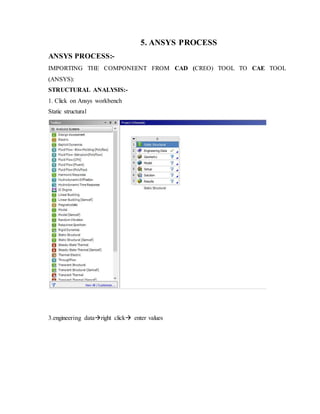
5. ANSYS PROCESS
ANSYS PROCESS:-
IMPORTING THE COMPONEENT FROM CAD (CREO) TOOL TO CAE TOOL
(ANSYS):
STRUCTURAL ANALYSIS:-
1. Click on Ansys workbench
Static structural
3.engineering dataright click enter values
FOR
Steel
Ex: - 2*10^11 Pa
Poison ratio: 0.3
Density: 7850 Kg/m^3
Yield strength: 250 Mpa
Al-6061
Ex: - 68.9*10^9 Pa
Poison ratio: 0.33
Density: 2700 Kg/m^3
Yield strength: 276 Mpa
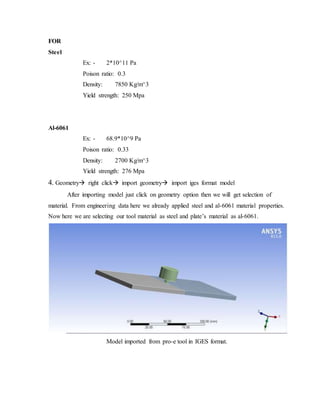
4. Geometry right click import geometry import iges format model
After importing model just click on geometry option then we will get selection of
material. From engineering data here we already applied steel and al-6061 material properties.
Now here we are selecting our tool material as steel and plate’s material as al-6061.
Model imported from pro-e tool in IGES format.
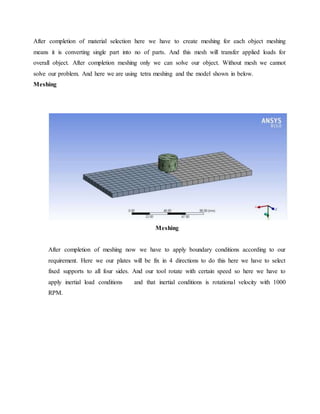
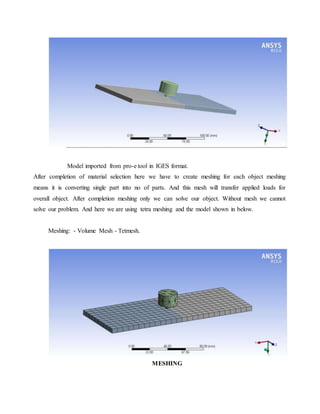
After completion of material selection here we have to create meshing for each object meshing
means it is converting single part into no of parts. And this mesh will transfer applied loads for
overall object. After completion meshing only we can solve our object. Without mesh we cannot
solve our problem. And here we are using tetra meshing and the model shown in below.
Meshing
Meshing
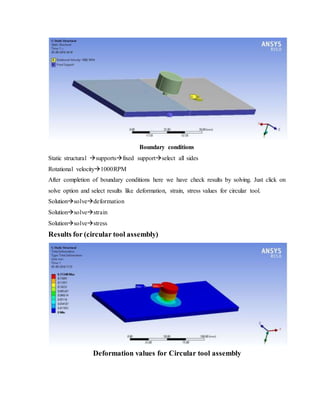
After completion of meshing now we have to apply boundary conditions according to our
requirement. Here we our plates will be fix in 4 directions to do this here we have to select
fixed supports to all four sides. And our tool rotate with certain speed so here we have to
apply inertial load conditions and that inertial conditions is rotational velocity with 1000
RPM.
Boundary conditions
Static structural supportsfixed supportselect all sides
Rotational velocity1000RPM
After completion of boundary conditions here we have check results by solving. Just click on
solve option and select results like deformation, strain, stress values for circular tool.
Solutionsolvedeformation
Solutionsolvestrain
Solutionsolvestress
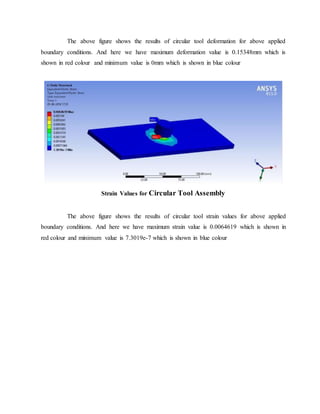
Results for (circular tool assembly)
Deformation values for Circular tool assembly
The above figure shows the results of circular tool deformation for above applied
boundary conditions. And here we have maximum deformation value is 0.15348mm which is
shown in red colour and minimum value is 0mm which is shown in blue colour
Strain Values for Circular Tool Assembly
The above figure shows the results of circular tool strain values for above applied
boundary conditions. And here we have maximum strain value is 0.0064619 which is shown in
red colour and minimum value is 7.3019e-7 which is shown in blue colour
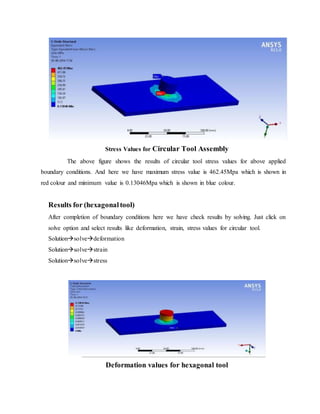
Stress Values for Circular Tool Assembly
The above figure shows the results of circular tool stress values for above applied
boundary conditions. And here we have maximum stress value is 462.45Mpa which is shown in
red colour and minimum value is 0.13046Mpa which is shown in blue colour.
Results for (hexagonaltool)
After completion of boundary conditions here we have check results by solving. Just click on
solve option and select results like deformation, strain, stress values for circular tool.
Solutionsolvedeformation
Solutionsolvestrain
Solutionsolvestress
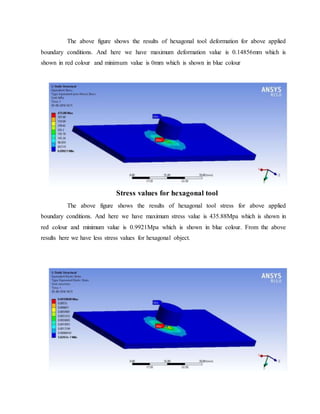
Deformation values for hexagonal tool
The above figure shows the results of hexagonal tool deformation for above applied
boundary conditions. And here we have maximum deformation value is 0.14856mm which is
shown in red colour and minimum value is 0mm which is shown in blue colour
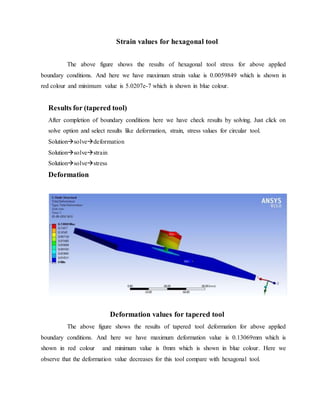
Stress values for hexagonal tool
The above figure shows the results of hexagonal tool stress for above applied
boundary conditions. And here we have maximum stress value is 435.88Mpa which is shown in
red colour and minimum value is 0.9921Mpa which is shown in blue colour. From the above
results here we have less stress values for hexagonal object.
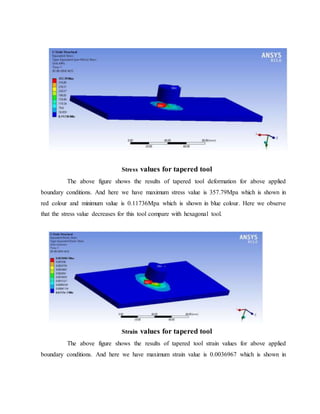
Strain values for hexagonal tool
The above figure shows the results of hexagonal tool stress for above applied
boundary conditions. And here we have maximum strain value is 0.0059849 which is shown in
red colour and minimum value is 5.0207e-7 which is shown in blue colour.
Results for (tapered tool)
After completion of boundary conditions here we have check results by solving. Just click on
solve option and select results like deformation, strain, stress values for circular tool.
Solutionsolvedeformation
Solutionsolvestrain
Solutionsolvestress
Deformation
Deformation values for tapered tool
The above figure shows the results of tapered tool deformation for above applied
boundary conditions. And here we have maximum deformation value is 0.13069mm which is
shown in red colour and minimum value is 0mm which is shown in blue colour. Here we
observe that the deformation value decreases for this tool compare with hexagonal tool.
Stress values for tapered tool
The above figure shows the results of tapered tool deformation for above applied
boundary conditions. And here we have maximum stress value is 357.79Mpa which is shown in
red colour and minimum value is 0.11736Mpa which is shown in blue colour. Here we observe
that the stress value decreases for this tool compare with hexagonal tool.
Strain values for tapered tool
The above figure shows the results of tapered tool strain values for above applied
boundary conditions. And here we have maximum strain value is 0.0036967 which is shown in
red colour and minimum value is 6.6717e-7 which is shown in blue colour. Here we observe that
the stress value decreases for this tool compare with hexagonal tool.
Tables
Circular tool Hexagonal tool Tapered tool
Deformation(mm) 0.15348 0.14856 0.13069
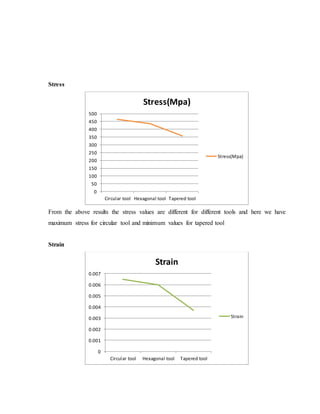
Stress(Mpa) 462.45 435.88 357.79
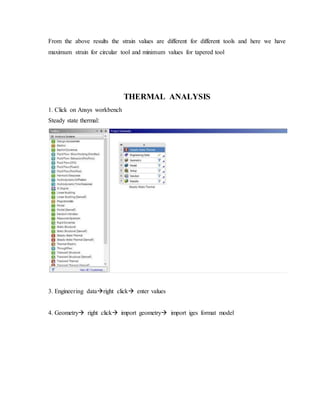
Strain 0.0064619 0.0059849 0.0036967
Graphs
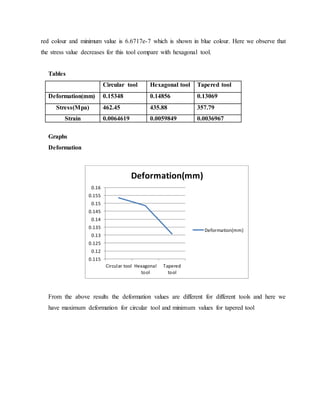
Deformation
From the above results the deformation values are different for different tools and here we
have maximum deformation for circular tool and minimum values for tapered tool
0.115
0.12
0.125
0.13
0.135
0.14
0.145
0.15
0.155
0.16
Circular tool Hexagonal
tool
Tapered
tool
Deformation(mm)
Deformation(mm)
Stress
From the above results the stress values are different for different tools and here we have
maximum stress for circular tool and minimum values for tapered tool
Strain
0
50
100
150
200
250
300
350
400
450
500
Circular tool Hexagonal tool Tapered tool
Stress(Mpa)
Stress(Mpa)
0
0.001
0.002
0.003
0.004
0.005
0.006
0.007
Circular tool Hexagonal tool Tapered tool
Strain
Strain
From the above results the strain values are different for different tools and here we have
maximum strain for circular tool and minimum values for tapered tool
THERMAL ANALYSIS
1. Click on Ansys workbench
Steady state thermal:
3. Engineering dataright click enter values
4. Geometry right click import geometry import iges format model
Model imported from pro-e tool in IGES format.
After completion of material selection here we have to create meshing for each object meshing
means it is converting single part into no of parts. And this mesh will transfer applied loads for
overall object. After completion meshing only we can solve our object. Without mesh we cannot
solve our problem. And here we are using tetra meshing and the model shown in below.
Meshing: - Volume Mesh - Tetmesh.
MESHING
A rotating cylindrical tool with a profiled probe is fed into a butt joint between two clamped
work pieces, until the shoulder, which has a larger diameter than the pin, touches the surface of
the work pieces. The probe is slightly shorter than the weld depth required, with the tool
shoulder riding atop the work surface. After a short dwell time, the tool is moved forward along
the joint line at the pre-set welding speed.
Thermal boundary conditions
Frictional heat is generated between the wear-resistant tool and the work pieces. This heat, along
with that generated by the mechanical mixing process and the adiabatic heat within the material,
cause the stirred materials to soften without melting. As the tool is moved forward, a special
profile on the probe forces plasticised material from the leading face to the rear, where the high
forces assist in a forged consolidation of the weld.
Select geometry assigns material properties
For platesal-6061
For toolsteel
Click on static thermal  convectional select areas
 Convection on plates surfaces  25*c ambient temperature3e-5w/mm^2
Film coefficient  apply
Temperature circular tool 400*c
Temperatureon plates bottom surfaces25*c
Temperatureon tool bottom surface250*c
Then solve total temperature, total heat flux and in x,y,z directions also.
A rotating cylindrical tool with a profiled probe is fed into a butt joint between two clamped
work pieces, until the shoulder, which has a larger diameter than the pin, touches the surface of
the work pieces. The probe is slightly shorter than the weld depth required, with the tool
shoulder riding atop the work surface. After a short dwell time, the tool is moved forward along
the joint line at the pre-set welding speed.
Results (circular tool)
Total temperature for circular tool
The above figure shows the results of circular tool temperature distribution for above
applied boundary conditions. And here we have maximum temperature value is 448.93*c which
is shown in red colour and minimum value is 24.38*c which is shown in blue colour
Total Heat Flux Values for Circular Tool
The above figure shows the results of circular tool heat flux distribution for above
applied boundary conditions. And here we have maximum temperature value is 26.119w/mm^2
which is shown in red colour and minimum value is 1.253e-11w/mm^2 which is shown in blue
colour
Results (hexagonal tool)
Totaltemperature
Total temperature for hexagonal tool
The above figure shows the results of hexagonal tool temperature distribution for
above applied boundary conditions. And here we have maximum temperature value is 493.97*c
which is shown in red colour and minimum value is 23.83*c which is shown in blue colour
Total heat flux for hexagonal tool
The above figure shows the results of hexagonal tool heat flux distribution for above
applied boundary conditions. And here we have maximum temperature value is 27.799w/mm^2
which is shown in red colour and minimum value is 8.218e-12w/mm^2 which is shown in blue
colour
Results (tapered tool)
Totaltemperature
Total temperature for tapered tool
The above figure shows the results of tapered tool temperature distribution for above
applied boundary conditions. And here we have maximum temperature value is 487.53*c which
is shown in red colour and minimum value is 24.349*c which is shown in blue colour
Total heat flux for tapered tool
The above figure shows the results of hexagonal tool heat flux distribution for above applied
boundary conditions. And here we have maximum temperature value is 24.214w/mm^2
which is shown in red colour and minimum value is 6.122e-12w/mm^2 which is shown in
blue colour
Tables
Circular tool Hexagonal tool Tapered tool
Total
temperature(*C)
448.93 493.97 487.53
Total heat
flux(w/mm^2)
26.119 27.799 24.214
Graphs
Total temperature
From the above results circular tool has very less amount of total temperature and hexagonal
tool has high values.
Total heat flux
The total heat flux values are different for different tools and here we have maximum flux for
hexagonal tool and minimum for tapered tool.
420
430
440
450
460
470
480
490
500
Total temperature(*C)
Total
temperature(*
C)
22
23
24
25
26
27
28
29
Circular tool Hexagonal
tool
Tapered tool
Total heat flux(w/mm^2)
Total heat
flux(w/mm^2)
CONCLUSION
In our project we have designed 4 types of cutting tools Round, hexagonal and tapered
and truncated for doing Friction Stir Welding of two dissimilar materials Aluminium alloy
6061for plates and steel (tool) running at speed of 1000 rpm. And we conducted static
analysis on it, in this project the round tool is considered as a existing tool and also we
analysed other 3 tools with same boundary conditions and material. from the results when we
were using circular tool it has been produces 462Mpa stress on the plate but the tapered tool
produces 357.79Mpa only
After that we have conducted FEA process thermal analysis on all tools Round and
hexagonal and tapered tool to verify the temperature distribution, thermal flux, and stresses at
different transverse speed. By observing the results, thermal flux and thermal gradient is more
for circular tool and the stresses produced are more than tapered tool. Temperature is also
produced for required melting point of plates. So for using Friction Stir Welding, we can also
use tapered tool.
References
1. Zhang, W., Kim, C. L., and DebRoy, T. 2004. Journalof Applied Physics, 95(9): 52105219.
2. Rai, R., and DebRoy, T. 2006. Journal of Physics, D:Applied Physics, 39(6): 1257–66.
3. Yang, Z., Sista, S., Elmer, J. W., and De Roy, T. 2000.Acta Materialia, 48(20) 4813–4825.
4. Mishra, S., and DebRoy, T. 2004. Acta Materialia,52(5): 1183–1192.
5. Sista, S., and DebRoy, T. Metallurgical and Materials Transactions, B, 32(6): 1195–1201.
6. Mishra, S., and DebRoy, T. 2004. Journal of Physics D:Applied Physics, 37: 2191–2196.
7. Elmer, J. W., Palmer, T. A., Zhang, W.,Wood, B., and DebRoy, T. 2003. Acta
Materialia,51(12): 3333–3349.
8. Zhang, W., Elmer, J. W., and DebRoy, T.2002. Materials Science and Engineering A,333(1-
2): 320–335.
9. Mundra, K., DebRoy, T., Babu, S. S.,and David, S. A. 1997. Welding Journal, 76(4): 163sto
171-s.
10. Hong, T., Pitscheneder, W., and DebRoy, T. 1998. Science and Technology of Welding.
Volume

Friction stir welding

  • 1.
    OPTIMISATION OF FRICTIONSTIR WELDING TOOLS ABSTRACT Friction-stir welding (FSW) is a solid-state joining process (the metal is not melted) that uses a third body tool to join two facing surfaces. Heat is generated between the tool and material which leads to a very soft region near the FSW tool. It then mechanically intermixes the two pieces of metal at the place of the joint, then the softened metal (due to the elevated temperature) can be joined using mechanical pressure (which is applied by the tool), much like joining clay, or dough. In this project we have designed circular tool by using creo-2 and then applied static (tool rotational velocity 1000 rpm) and thermal (temperatures’ and convection on plates and tool also) boundaries conditions And calculated results like deformation stress and heat flux etc. Here we also designed 2 more tools hexagonal and tapered, applied same boundary condition with same material properties and calculated all results from all these results which tool can be used in the place of circular tool Software’s were used: CAD software: creo-2 CAE software: Ansys workbench
  • 2.
    INTRODUCCTION Friction-stir welding (FSW)is a solid-state joining process (the metal is not melted) that uses a third body tool to join two facing surfaces. Heat is generated between the tool and material which leads to a very soft region near the FSW tool. It then mechanically intermixes the two pieces of metal at the place of the joint, then the softened metal (due to the elevated temperature) can be joined using mechanical pressure (which is applied by the tool), much like joining clay, or dough. It is primarily used on aluminium, and most often on extruded aluminium (non-heat treatable alloys), and on structures which need superior weld strength without a post weld heat treatment. It was invented and experimentally proven at The Welding Institute UK in December 1991. TWI holds patents on the process, the first being the most descriptive. Principle of operation A constantly rotated non-consumable cylindrical-shouldered tool with a profiled probe is transversely fed at a constant rate into a butt joint between two clamped pieces of butted material. The probe is slightly shorter than the weld depth required, with the tool shoulder riding atop the work surface. Frictional heat is generated between the wear- resistant welding components and the work pieces. This heat, along with that generated by the mechanical mixing process and the adiabatic heat within the material, cause the stirred materials to soften without melting. As the pin is moved forward, a special profile on its leading face forces plasticised material to the rear where clamping force assists in a forged consolidation of the weld. This process of the tool traversing along the weld line in a plasticised tubular shaft of metal results in severe solid state deformation involving dynamic re-crystallization of the base material.
  • 3.
    Friction stir weldingschematic diagram Micro structural features The solid-state nature of the FSW process, combined with its unusual tool and asymmetric nature, results in a highly characteristic microstructure. The microstructure can be broken up into the following zones:  The stir zone (also nugget, dynamically recrystallised zone) is a region of heavily deformed material that roughly corresponds to the location of the pin during welding. The grains within the stir zone are roughly equiaxed and often an order of magnitude smaller than the grains in the parent material. A unique feature of the stir zone is the common occurrence of several concentric rings which has been referred to as an "onion- ring" structure. The precise origin of these rings has not been firmly established, although variations in particle number density, grain size and texture have all been suggested.  The flow arm zone is on the upper surface of the weld and consists of material that is dragged by the shoulder from the retreating side of the weld, around the rear of the tool, and deposited on the advancing side.  The thermo-mechanically affected zone (TMAZ) occurs on either side of the stir zone. In this region the strain and temperature are lower and the effect of welding on the microstructure is correspondingly smaller. Unlike the stir zone the microstructure is recognizably that of the parent material, albeit significantly deformed and rotated. Although the term TMAZ technically refers to the entire deformed region it is often used to describe any region not already covered by the terms stir zone and flow arm.[citation needed]
  • 4.
     The heat-affectedzone (HAZ) is common to all welding processes. As indicated by the name, this region is subjected to a thermal cycle but is not deformed during welding. The temperatures are lower than those in the TMAZ but may still have a significant effect if the microstructure is thermally unstable. In fact, in age-hardened aluminium alloys this region commonly exhibits the poorest mechanical properties. Advantages and limitations The solid-state nature of FSW leads to several advantages over fusion welding methods as problems associated with cooling from the liquid phase are avoided. Issues such as porosity, solute redistribution, solidification cracking and liquation cracking do not arise during FSW. In general, FSW has been found to produce a low concentration of defects and is very tolerant of variations in parameters and materials. Nevertheless, FSW is associated with a number of unique defects. Insufficient weld temperatures, due to low rotational speeds or high traverse speeds, for example, mean that the weld material is unable to accommodate the extensive deformation during welding. This may result in long, tunnel-like defects running along the weld which may occur on the surface or subsurface. Low temperatures may also limit the forging action of the tool and so reduce the continuity of the bond between the material from each side of the weld. The light contact between the materials has given rise to the name "kissing-bond". This defect is particularly worrying since it is very difficult to detect using non-destructive methods such as X- ray or ultrasonic testing. If the pin is not long enough or the tool rises out of the plate then the interface at the bottom of the weld may not be disrupted and forged by the tool, resulting in a lack-of-penetration defect. This is essentially a notch in the material which can be a potential source of fatigue cracks. A number of potential advantages of FSW over conventional fusion-welding processes have been identified:  Good mechanical properties in the as-welded condition  Improved safety due to the absence of toxic fumes or the spatter of molten material.
  • 5.
     No consumables— A threaded pin made of conventional tool steel, e.g., hardened H13, can weld over 1 km (0.62 mi) of aluminium, and no filler or gas shield is required for aluminium.  Easily automated on simple milling machines — lower setup costs and less training.  Can operate in all positions (horizontal, vertical, etc.), as there is no weld pool.  Generally good weld appearance and minimal thickness under/over-matching, thus reducing the need for expensive machining after welding.  Can use thinner materials with same joint strength.  Low environmental impact.  General performance and cost benefits from switching from fusion to friction. However, some disadvantages of the process have been identified:  Exit hole left when tool is withdrawn.  Large down forces required with heavy-duty clamping necessary to hold the plates together.  Less flexible than manual and arc processes (difficulties with thickness variations and non-linear welds).  Often slower traverse rate than some fusion welding techniques, although this may be offset if fewer welding passes are required. Important welding parameters Tool design The design of the tool is a critical factor as a good tool can improve both the quality of the weld and the maximum possible welding speed. It is desirable that the tool material be sufficiently strong, tough, and hard wearing at the welding temperature. Further it should have a good oxidation resistance and a low thermal conductivity to minimise heat loss and thermal damage to the machinery further up the drive train. Hot- worked tool steel such as AISI H13 has proven perfectly acceptable for welding aluminium alloys within thickness ranges of 0.5 – 50 mm but more advanced tool materials are necessary
  • 6.
    for more demandingapplications such as highly abrasive metal matrix composites or higher melting point materials such as steel or titanium. Improvements in tool design have been shown to cause substantial improvements in productivity and quality. TWI has developed tools specifically designed to increase the penetration depth and thus increasing the plate thicknesses that can be successfully welded. An example is the "whorl" design that uses a tapered pin with re-entrant features or a variable pitch thread to improve the downwards flow of material. Additional designs include the Triflute and Trivex series. The Triflute design has a complex system of three tapering, threaded re-entrant flutes that appear to increase material movement around the tool. The Trivex tools use a simpler, non-cylindrical, pin and have been found to reduce the forces acting on the tool during welding. The majority of tools have a concave shoulder profile which acts as an escape volume for the material displaced by the pin, prevents material from extruding out of the sides of the shoulder and maintains downwards pressure and hence good forging of the material behind the tool. The Triflute tool uses an alternative system with a series of concentric grooves machined into the surface which are intended to produce additional movement of material in the upper layers of the weld. Widespread commercial applications of friction stir welding process for steels and other hard alloys such as titanium alloys will require the development of cost-effective and durable tools. Material selection, design and cost are important considerations in the search for commercially useful tools for the welding of hard materials. Work is continuing to better understand the effects of tool material's composition, structure, properties and geometry on their performance, durability and cost. Tool rotation and traverse speeds There are two tool speeds to be considered in friction-stir welding; how fast the tool rotates and how quickly it traverses the interface. These two parameters have considerable importance and must be chosen with care to ensure a successful and efficient welding cycle. The relationship between the welding speeds and the heat input during welding is complex but, in general, it can be said that increasing the rotation speed or decreasing the traverse speed will result in a hotter weld. In order to produce a successful weld it is necessary that the material surrounding the tool is hot enough to enable the extensive plastic flow required and minimize the forces acting on the
  • 7.
    tool. If thematerial is too cold then voids or other flaws may be present in the stir zone and in extreme cases the tool may break. Excessively high heat input, on the other hand may be detrimental to the final properties of the weld. Theoretically, this could even result in defects due to the liquation of low-melting-point phases (similar to liquation cracking in fusion welds). These competing demands lead onto the concept of a "processing window": the range of processing parameters viz. tool rotation and traverse speed that will produce a good quality weld. Within this window the resulting weld will have a sufficiently high heat input to ensure adequate material plasticity but not so high that the weld properties are excessively deteriorated. Tooltilt and plunge depth The plunge depth is defined as the depth of the lowest point of the shoulder below the surface of the welded plate and has been found to be a critical parameter for ensuring weld quality. Plunging the shoulder below the plate surface increases the pressure below the tool and helps ensure adequate forging of the material at the rear of the tool. Tilting the tool by 2–4 degrees, such that the rear of the tool is lower than the front, has been found to assist this forging process. The plunge depth needs to be correctly set, both to ensure the necessary downward pressure is achieved and to ensure that the tool fully penetrates the weld. Given the high loads required, the welding machine may deflect and so reduce the plunge depth compared to the nominal setting, which may result in flaws in the weld. On the other hand, an excessive plunge depth may result in the pin rubbing on the backing plate surface or a significant under match of the weld thickness compared to the base material. Variable load welders have been developed to automatically compensate for changes in the tool displacement while TWI have demonstrated a roller system that maintains the tool position above the weld plate. Welding forces During welding a number of forces will act on the tool:  A downwards force is necessary to maintain the position of the tool at or below the material surface. Some friction-stir welding machines operate under load control but in many cases the vertical position of the tool is preset and so the load will vary during welding.
  • 8.
     The traverseforce acts parallel to the tool motion and is positive in the traverse direction. Since this force arises as a result of the resistance of the material to the motion of the tool it might be expected that this force will decrease as the temperature of the material around the tool is increased.  The lateral force may act perpendicular to the tool traverse direction and is defined here as positive towards the advancing side of the weld.  Torque is required to rotate the tool, the amount of which will depend on the down force and friction coefficient (sliding friction) and/or the flow strength of the material in the surrounding region (stiction). In order to prevent tool fracture and to minimize excessive wear and tear on the tool and associated machinery, the welding cycle is modified so that the forces acting on the tool are as low as possible and abrupt changes are avoided. In order to find the best combination of welding parameters, it is likely that a compromise must be reached, since the conditions that favour low forces (e.g. high heat input, low travel speeds) may be undesirable from the point of view of productivity and weld properties. Flow of material Early work on the mode of material flow around the tool used inserts of a different alloy, which had a different contrast to the normal material when viewed through a microscope, in an effort to determine where material was moved as the tool passed. The data was interpreted as representing a form of in-situ extrusion where the tool, backing plate and cold base material form the "extrusion chamber" through which the hot, plasticised material is forced. In this model the rotation of the tool draws little or no material around the front of the pin instead the material parts in front of the pin and passes down either side. After the material has passed the pin the side pressure exerted by the "die" forces the material back together and consolidation of the join occurs as the rear of the tool shoulder passes overhead and the large down force forges the material. More recently, an alternative theory has been advanced that advocates considerable material movement in certain locations. This theory holds that some material does rotate around the pin, for at least one rotation, and it is this material movement that produces the "onion-ring" structure in the stir zone. The researchers used a combination of thin copper strip inserts and a "frozen
  • 9.
    pin" technique, wherethe tool is rapidly stopped in place. They suggested that material motion occurs by two processes: 1. Material on the advancing front side of a weld enters into a zone that rotates and advances with the pin. This material was very highly deformed and sloughs off behind the pin to form arc-shaped features when viewed from above (i.e. down the tool axis). It was noted that the copper entered the rotational zone around the pin, where it was broken up into fragments. These fragments were only found in the arc shaped features of material behind the tool. 2. The lighter material came from the retreating front side of the pin and was dragged around to the rear of the tool and filled in the gaps between the arcs of advancing side material. This material did not rotate around the pin and the lower level of deformation resulted in a larger grain size. The primary advantage of this explanation is that it provides a plausible explanation for the production of the onion-ring structure. The marker technique for friction stir welding provides data on the initial and final positions of the marker in the welded material. The flow of material is then reconstructed from these positions. Detailed material flow field during friction stir welding can also be calculated from theoretical considerations based on fundamental scientific principles. Material flow calculations are routinely used in numerous engineering applications. Calculation of material flow fields in friction stir welding can be undertaken both using comprehensive numerical simulations and simple but insightful analytical equations. The comprehensive models for the calculation of material flow fields also provide important information such as geometry of the stir zone and the torque on the tool. The numerical simulations have shown the ability to correctly predict the results from marker experiments and the stir zone geometry observed in friction stir welding experiments. Generationand flow of heat For any welding process it is, in general, desirable to increase the travel speed and minimise the heat input as this will increase productivity and possibly reduce the impact of welding on the mechanical properties of the weld. At the same time it is necessary to ensure that the temperature
  • 10.
    around the toolis sufficiently high to permit adequate material flow and prevent flaws or tool damage. When the traverse speed is increased, for a given heat input, there is less time for heat to conduct ahead of the tool and the thermal gradients are larger. At some point the speed will be so high that the material ahead of the tool will be too cold, and the flow stress too high, to permit adequate material movement, resulting in flaws or tool fracture. If the "hot zone" is too large then there is scope to increase the traverse speed and hence productivity. The welding cycle can be split into several stages during which the heat flow and thermal profile will be different:  Dwell. The material is preheated by a stationary, rotating tool to achieve a sufficient temperature ahead of the tool to allow the traverse. This period may also include the plunge of the tool into the workpiece.  Transient heating. When the tool begins to move there will be a transient period where the heat production and temperature around the tool will alter in a complex manner until an essentially steady-state is reached.  Pseudo steady-state. Although fluctuations in heat generation will occur the thermal field around the tool remains effectively constant, at least on the macroscopic scale.  Post steady-state. Near the end of the weld heat may "reflect" from the end of the plate leading to additional heating around the tool. Applications The FSW process is currently patented by TWI in most industrialised countries and licensed for over 183 users. Friction stir welding and its variants friction stir spot welding and friction are used for the following industrial applications: shipbuilding and offshore, aerospace, automotive, rolling stock for railways, general fabrication, robotics, and computers Shipbuilding and offshore Two Scandinavian aluminium extrusion companies were the first to apply FSW commercially to the manufacture of fish freezer panels atSapa in 1996, as well as deck panels and helicopter
  • 11.
    landing platforms atMarine Aluminium Aanensen. Marine Aluminium Aanensen subsequently merged with Hydro Aluminium Maritime to become Hydro Marine Aluminium. Some of these freezer panels are now produced by Riftec and Bayards. In 1997 two-dimensional friction stir welds in the hydro dynamically flared bow section of the hull of the ocean viewer vessel The Boss were produced at Research Foundation Institute with the first portable FSW machine. The Super Liner Ogasawara at Mitsui Engineering and Shipbuilding is the largest friction stir welded ship so far. The Sea Fighter of Nichols Bros and the Freedom Littoral Combat Ships contain prefabricated panels by the FSW fabricators Advanced Technology and Friction Stir Link, Inc. respectively. The Houbei class missile boat has friction stir welded rocket launch containers of China Friction Stir Centre. HMNZSRotoiti in New Zealand has FSW panels made by Donovans in a converted milling machine. Various companies apply FSW to armor plating for amphibious assault ships Aerospace United Launch Alliance applies FSW to the Delta II, Delta IV, and Atlas V expendable launch vehicles, and the first of these with a friction stir welded Interstage module was launched in 1999. The process is also used for the Space Shuttle external tank, for Ares I and for the Orion test article at NASA as well as Falcon 1 and Falcon 9 rockets at SpaceX. The toe nails for ramp of Boeing C-17 Globemaster III cargo aircraft by Advanced Joining Technologies[39] and the cargo barrier beams for the Boeing 747 Large Cargo Freighter[39] were the first commercially produced aircraft parts. FAA approved wings and fuselage panels of the Eclipse 500 aircraft were made at Eclipse Aviation, and this company delivered 259 friction stir welded business jets, before they were forced into Chapter 7 liquidation. Floor panels for Airbus A400M military aircraft are now made by Pfalz Flugzeugwerke and Embraer used FSW for the Legacy 450 and 500 Jets Friction stir welding also is employed for fuselage panels on the Airbus A380. BRÖTJE-Automation GmbH uses friction stir welding – through the DeltaN FS system – for gantry production machines developed for the aerospace sector as well as other industrial applications Automotive Aluminium engine cradles and suspension struts for stretched Lincoln Town Car were the first automotive parts that were friction stir at Tower, who use the process also for the engine tunnel
  • 12.
    of the FordGT. A spin-off of this company is called Friction Stir Link, Inc. and successfully exploits the FSW process, e.g. for the flatbed trailer "Revolution" of Fontaine Trailers.[43] In Japan FSW is applied to suspension struts at Showa Denko and for joining of aluminium sheets to galvanized steel brackets for the boot (trunk) lid of the Mazda MX-5. Friction stir spot welding is successfully used for the bonnet (hood) and rear doors of the Mazda RX-8 and the boot lid of the Toyota Prius. Wheels are friction stir welded at Simmons Wheels, UT Alloy Works and Fundo. Rear seats for the Volvo V70 are friction stir welded at Sapa, HVAC pistons at Halla Climate Control and exhaust gas recirculation coolers at Pierburg. Tailor welded blanks are friction stir welded for the Audi R8 at Riftec. The B-column of the Audi R8 Spider is friction stir welded from two extrusions at Hammerer Aluminium Industries in Austria. Railways Since 1997 roof panels were made from aluminium extrusions at Hydro Marine Aluminium with a bespoke 25m long FSW machine, e.g. for DSB class SA-SD trains of Alstom LHB Curved side and roof panels for the Victoria line trains of London Underground, side panels for Bombardier's Electrostar trains at Sapa Group and side panels for Alstom's British Rail Class 390 Pendolino trains are made at Sapa Group Japanese commuter and express A- trains, and British Rail Class 395 trains are friction stir welded byHitachi, while Kawasaki applies friction stir spot welding to roof panels and Sumitomo Light Metal produces Shinkansen floor panels. Innovative FSW floor panels are made by Hammerer Aluminium Industries in Austria for the Stadler KISS double decker rail cars, to obtain an internal height of 2 m on both floors and for the new car bodies of the Wuppertal Suspension Railway. Heat sinks for cooling high-power electronics of locomotives are made at Sykatek, EBG, Austerlitz Electronics, Euro Composite, Sapa and Rapid Technic, and are the most common application of FSW due to the excellent heat transfer Fabrication Façade panels and athode sheets are friction stir welded at AMAG and Hammerer Aluminium Industries including friction stir lap welds of copper to aluminium. Bizerba meat slicers, Ökolüfter HVAC units and Siemens X-ray vacuum vessels are friction stir welded at Riftec. Vacuum valves and vessels are made by FSW at Japanese and Swiss companies. FSW is also used for the encapsulation of nuclear waste at SKB in 50-mm-thick copper canisters. Pressure
  • 13.
    vessels from ø1msemi spherical forgings of 38.1mm thick aluminium alloy 2219 at Advanced Joining Technologies and Lawrence Livermore Nat Lab. Friction stir processing is applied to ship propellers at Friction Stir Link, Inc. and to hunting knives by Diamond Blade. Bosch uses it in Worcester for the production of heat exchangers. Robotics KUKA Robot Group has adapted its KR500-3MT heavy-duty robot for friction stir welding via the DeltaN FS tool. The system made its first public appearance at the EuroBLECH show in November 2012 Personal computers Apple applied friction stir welding on the 2012 iMac to effectively join the bottom to the back of the device
  • 14.
    2. INTRODUCTION: CREO 2.1. CAD Computeraided design (cad) is defined as any activity that involves the effective use of the computer to create, modify, analyze, or document an engineering design. CAD is most commonly associated with the use of an interactive computer graphics system, referred to as cad system. The term CAD/CAM system is also used if it supports manufacturing as well as design applications 2.2 Introduction to CREO CREO is a suite of programs that are used in the design, analysis, and manufacturing of a virtually unlimited range of product. CREO is a parametric, feature-based solid modelling system, “Feature based” means that you can create part and assembly by defining feature like pad, rib, slots, holes, rounds, and so on, instead of specifying low-level geometry like lines, arcs, and circle& features are specifying by setting values and attributes of element such as reference planes or surfaces direction of creation, pattern parameters, shape, dimensions and others. “Parametric” means that the physical shape of the part or assembly is driven by the values assigned to the attributes (primarily dimensions) of its features. Parametric may define or modify a feature’s dimensions or other attributes at any time. For example, if your design intent is such that a hole is centred on a block, you can relate the dimensional location of the hole to the block dimensions using a numerical formula; if the block dimensions change, the centred hole position will be recomputed automatically. “Solid Modelling” means that the computer model to create it able to contain all the information that a real solid object would have. The most useful thing about the solid modelling is that it is impossible to create a computer model that is ambiguous or physically non-realizable. There are six core CREO concepts. Those are:
  • 15.
     Solid Modelling Feature Based  Parametric  Parent / Child Relationships  Associative  Model Centric 2.3 Capabilities and Benefits: 1. Complete 3D modelling capabilities enable you to exceed quality arid time to arid time to market goals. 2. Maximum production efficiency through automated generation of associative C tooling design, assembly instructions, and machine code. 3. Ability to simulate and analysis virtual prototype to improve production performance and optimized product design. 4. Ability to share digital product data seamlessly among all appropriate team members 5. Compatibility with myriad CAD tools-including associative data exchange and industry standard data formats. 2.4 Features of CREO CREO is a one-stop for any manufacturing industry. It offers effective feature, incorporated for a wide variety of purpose. Some of the important features are as follows:  Simple and powerful tool  Parametric design  Feature-based approach  Parent child relationship  Associative and model centric 2.4.1. Simple and Powerful Tool CREO tools are used friendly. Although the execution of any operation using the tool can create a highly complex model 2.4.2. Parametric Design
  • 16.
    CREO designs areparametric. The term “parametric” means that the design operations that are captured can be stored as they take place. They can be used effectively in the future for modifying and editing the design. These types of modeling help in faster and easier modifications of design 2.4.3. Feature-Based Approach Features are the basic building blocks required to create an object. CREO wildfire models are based on the series of feature. Each feature builds upon the previous feature, to create the model (only one single feature can be modified at a time). Each feature may appear simple, individually, but collectively forms a complex part and assemblies. The idea behind feature based modeling is that the designer construct on object, composed of individual feature that describe the manner in which the geometry supports the object, if its dimensions change. The first feature is called the base feature. 2.4.4. Parent Child Relationship The parent child relationship is a powerful way to capture your design intent in a model. This relationship naturally occurs among features, during the modeling process. When you create a new feature, the existing feature that are referenced, become parent to the feature. 2.4.5. Associative and Model Centric CREO drawings are model centric. This means that CREO models that are represented in assembly or drawings are associative. If changes are made in one module, these will automatically get updated in the referenced module. 2.5. CREO Basic Design Modes When a design from conception to completion in CREO, the design information goes through three basic design steps. 1. Creating the component parts of the design 2. Joining the parts in an assembly that records the relative position of the parts. 3. Creating mechanical drawing based on the information in the parts and the assembly. 2.6 Assembly in CREO: Bottom-Up Design (Modeling):
  • 17.
    The components (parts)are created first and then added to the assembly file. This technique is particularly useful when parts already exist from previous designs and are being re-used. Top-Down Design (Modeling): The assembly file is created first and then the components are created in the assembly file. The parts are build relative to other components. Useful in new designs In practice, the combination of Top-Down and Bottom-Up approaches is used. As you often use existing parts and create new parts in order to meet your design needs. Degrees of Freedom: An object in space has six degrees of freedom. • Translation – movement along X, Y, and Z axis (three degrees of freedom) • Rotation – rotate about X, Y, and Z axis (three degrees of freedom) Assembly Constraints: In order to completely define the position of one part relative to another, we must constrain all of the degrees of freedom COINCIDENT, OFFSET OFFSET Two surfaces are made parallel with a specified offset distance. . COINCIDENT Two selected surfaces become co-planar and face in the same direction. Can also be applied to revolved surfaces. This constrains 3 degrees of freedom (two rotations and one translation). When Align is used on revolved surfaces, they become coaxial (axes through the centers align). CREO Modules:-  Sketcher (2D)  Part (3D)  Assembly  Drawing and Drafting  Sheet Metal  Surface modelling
  • 18.
    Design developed byusing cad tool (creo-2) Create rectangular 100*200mm with reference dimensions Plate dimensions The above sketch should follow 3 conditions those are the sketcher should be closed and there should be no open end there should be no over lapping. By following these conditions we have to create our model. After completion of sketch click ok and we will get below model. Then extrude it20mmok Extrude model
  • 19.
    To create toolcreatecircle with 24mm diaextrude Tool diameter Create extrude with 15mm thicknesok Shoulder model dimension Extrude
  • 20.
    Create inner dia6mmok Circulartool dimensions Extrude5.5mmok Extrude tool
  • 21.
    Circular Complete tool Theabove circular tool has been created with dimension of circular diameter 6mm and tool height is 5.5mm and based on this we are going to crate different tools with same dimensions but different shapes and those shapes are hexagonal,tapered,truncated tools. And create different tools by using same process Hexagonal tool Here we created hexagonal model with edge length 6mm and extrude height 5.5mm
  • 22.
    Tapered tool The abovetapered tool was created by using blend option and here we have complete two different circular diameters are there those are 6mm and 4mm follows. ASSEMBLING ALL MODELS Import rectangular base plate first into assembly window then select default option this default option makes object planes coincide with assembly planes. Then import other plate also and place it contact with other plate. Here we are using only coincide constraint option for all these constraints. And then import circular tool and place at middle of the plates and we created complete assembly model by using only constraint option only. CIRCULAR TOOL ASSEMBLY
  • 23.
    Circular tool assemblywith plates Import rectangular base plate first into assembly window then select default option this default option makes object planes coincide with assembly planes. Then import other plate also and place it contact with other plate. Here we are using only coincide constraint option for all these constraints. And then import hexagonal tool and place at middle of the plates and we created complete assembly model by using only constraint option only. Hexagonal tool assembly Hexagonal tool assembly with plates
  • 24.
    Import rectangular baseplate first into assembly window then select default option this default option makes object planes coincide with assembly planes. Then import other plate also and place it contact with other plate. Here we are using only coincide constraint option for all these constraints. And then import tapered tool and place at middle of the plates and we created complete assembly model by using only constraint option only. Tapered tool assembly Import rectangular base plate first into assembly window then select default option this default option makes object planes coincide with assembly planes. Then import other plate also and place it contact with other plate. Here we are using only coincide constraint option for all these constraints. And then import truncated tool and place at middle of the plates and we created complete assembly model by using only constraint option only. Save as all these models IGES formatok To analyse our objects here we have to import all these models into ANSYS workbench. to do this we have to save all files . By using IGES models we can import these models in any CAD/CAE tool
  • 25.
    3. INTRODUCTION TOANSYS 3.1 INTRODUCTION ANSYS is general-purpose finite element analysis (FEA) software package. Finite Element Analysis is a numerical method of deconstructing a complex system into very small pieces (of user-designated size) called elements. The software implements equations that govern the behaviour of these elements and solves them all; creating a comprehensive explanation of how the system acts as a whole. These results then can be presented in tabulated, or graphical forms. This type of analysis is typically used for the design and optimization of a system far too complex to analyze by hand. Systems that may fit into this category are too complex due to their geometry, scale, or governing equations. ANSYS is the standard FEA teaching tool within the Mechanical Engineering Department at many colleges. ANSYS is also used in Civil and Electrical Engineering, as well as the Physics and Chemistry departments. ANSYS provides a cost-effective way to explore the performance of products or processes in a virtual environment. This type of product development is termed virtual prototyping. With virtual prototyping techniques, users can iterate various scenarios to optimize the product long before the manufacturing is started. This enables a reduction in the level of risk, and in the cost of ineffective designs. The multifaceted nature of ANSYS also provides a means to ensure that users are able to see the effect of a design on the whole behavior of the product, be it electromagnetic, thermal, mechanical etc 3.1.1 GENERIC STEPS TO SOLVING ANY PROBLEM IN ANSYS: Like solving any problem analytically, you need to define (1) your solution domain, (2) the physical model, (3) boundary conditions and (4) the physical properties. You then solve the problem and present the results. In numerical methods, the main difference is an extra step called mesh generation. This is the step that divides the complex model into small elements that become solvable in an otherwise too complex situation. Below describes the processes in terminology slightly more attune to the software.
  • 26.
    3.1.1.1 BUILD GEOMETRY Constructa two or three dimensional representation of the object to be modeled and tested using the work plane coordinate system within ANSYS. 3.1.1.2 DEFINE MATERIAL PROPERTIES Now that the part exists, define a library of the necessary materials that compose the object (or project) being modeled. This includes thermal and mechanical properties. 3.1.1.3 GENERATE MESH At this point ANSYS understands the makeup of the part. Now define how the modeled system should be broken down into finite pieces. 3.1.1.4 APPLY LOADS Once the system is fully designed, the last task is to burden the system with constraints, such as physical loadings or boundary conditions. 3.1.1.5 OBTAIN SOLUTION This is actually a step, because ANSYS needs to understand within what state (steady state, transient… etc.) the problem must be solved. 3.1.1.6 PRESENT THE RESULTS After the solution has been obtained, there are many ways to present ANSYS’ results, choose from many options such as tables, graphs, and contour plots. 3.2 SPECIFIC CAPABILITIES OF ANSYS: 3.2.1 STRUCTURAL Structural analysis is probably the most common application of the finite element method as it implies bridges and buildings, naval, aeronautical, and mechanical structures such as ship hulls, aircraft bodies, and machine housings, as well as mechanical components such as pistons, machine parts, and tools. · Static Analysis - Used to determine displacements, stresses, etc. under static loading conditions. ANSYS can compute both linear and nonlinear static analyses. Nonlinearities can include plasticity, stress stiffening, large deflection, large strain, hyper elasticity, contact surfaces, and creep.
  • 27.
    Modal Analysis A modalanalysis is typically used to determine the vibration characteristics (natural frequencies and mode shapes) of a structure or a machine component while it is being designed. It can also serve as a starting point for another, more detailed, dynamic analysis, such as a harmonic response or full transient dynamic analysis. Modal analyses, while being one of the most basic dynamic analysis types available in ANSYS, can also be more computationally time consuming than a typical static analysis. A reduced solver, utilizing automatically or manually selected master degrees of freedom is used to drastically reduce the problem size and solution time. Harmonic Analysis - Used extensively by companies who produce rotating machinery, ANSYS Harmonic analysis is used to predict the sustained dynamic behavior of structures to consistent cyclic loading. Examples of rotating machines which produced or are subjected to harmonic loading are:  Turbines o Gas Turbines for Aircraft and Power Generation o Steam Turbines o Wind Turbine o Water Turbines o Turbopumps  Internal Combustion engines  Electric motors and generators  Gas and fluid pumps  Disc drives
  • 28.
    A harmonic analysiscan be used to verify whether or not a machine design will successfully overcome resonance, fatigue, and other harmful effects of forced vibrations. · Transient Dynamic Analysis - Used to determine the response of a structure to arbitrarily time-varying loads. All nonlinearities mentioned under Static Analysis above are allowed. · Buckling Analysis - Used to calculate the buckling loads and determine the buckling mode shape. Both linear (eigenvalue) buckling and nonlinear buckling analyses are possible. In addition to the above analysis types, several special-purpose features are available such as Fracture mechanics, Composite material analysis, Fatigue, and both p-Method and Beam analyses. 3.2.2 THERMAL ANSYS is capable of both steady state and transient analysis of any solid with thermal boundary conditions. Steady-state thermal analyses calculate the effects of steady thermal loads on a system or component. Users often perform a steady-state analysis before doing a transient thermal analysis, to help establish initial conditions. A steady-state analysis also can be the last step of a transient thermal analysis; performed after all transient effects have diminished. ANSYS can be used to determine temperatures, thermal gradients, heat flow rates, and heat fluxes in an object that are caused by thermal loads that do not vary over time. Such loads include the following: · Convection · Radiation · Heat flow rates · Heat fluxes (heat flow per unit area) · Heat generation rates (heat flow per unit volume) · Constant temperature boundaries A steady-state thermal analysis may be either linear, with constant material properties; or nonlinear, with material properties that depend on temperature. The thermal properties of most material vary with temperature. This temperature dependency being appreciable, the analysis becomes nonlinear. Radiation boundary conditions also make the analysis nonlinear.
  • 29.
    Transient calculations aretime dependent and ANSYS can both solve distributions as well as create video for time incremental displays of models. 3.2.3 FLUID FLOW The ANSYS/FLOTRAN CFD (Computational Fluid Dynamics) offers comprehensive tools for analyzing two-dimensional and three-dimensional fluid flow fields. ANSYS is capable of modeling a vast range of analysis types such as: airfoils for pressure analysis of airplane wings (lift and drag), flow in supersonic nozzles, and complex, three-dimensional flow patterns in a pipe bend. In addition, ANSYS/FLOTRAN could be used to perform tasks including: · Calculating the gas pressure and temperature distributions in an engine exhaust manifold · Studying the thermal stratification and breakup in piping systems · Using flow mixing studies to evaluate potential for thermal shock · Doing natural convection analyses to evaluate the thermal performance of chips in electronic enclosures · Conducting heat exchanger studies involving different fluids separated by solid regions 3.2.4 ACOUSTICS / VIBRATION ANSYS is capable of modelling and analyzing vibrating systems in order to that vibrate in order to analyze Acoustics is the study of the generation, propagation, absorption, and reflection of pressure waves in a fluid medium. Applications for acoustics include the following: · Sonar - the acoustic counterpart of radar · Design of concert halls, where an even distribution of sound pressure is desired · Noise minimization in machine shops · Noise cancellation in automobiles · Underwater acoustics · Design of speakers, speaker housings, acoustic filters, mufflers, and many other similar devices. · Geophysical exploration
  • 30.
    Within ANSYS, anacoustic analysis usually involves modelling a fluid medium and the surrounding structure. Characteristics in question include pressure distribution in the fluid at different frequencies, pressure gradient, and particle velocity, the sound pressure level, as well as, scattering, diffraction, transmission, radiation, attenuation, and dispersion of acoustic waves. A coupled acoustic analysis takes the fluid-structure interaction into account. An uncoupled acoustic analysis models only the fluid and ignores any fluid-structure interaction. The ANSYS program assumes that the fluid is compressible, but allows only relatively small pressure changes with respect to the mean pressure. Also, the fluid is assumed to be non- flowing and in viscid (that is, viscosity causes no dissipative effects). Uniform mean density and mean pressure are assumed, with the pressure solution being the deviation from the mean pressure, not the absolute pressure. 3.2.5 COUPLED FIELDS A coupled-field analysis is an analysis that takes into account the interaction (coupling) between two or more disciplines (fields) of engineering. A piezoelectric analysis, for example, handles the interaction between the structural and electric fields: it solves for the voltage distribution due to applied displacements, or vice versa. Other examples of coupled-field analysis are thermal-stress analysis, thermal-electric analysis, and fluid-structure analysis. Some of the applications in which coupled-field analysis may be required are pressure vessels (thermal-stress analysis), fluid flow constrictions (fluid-structure analysis), induction heating (magnetic-thermal analysis), ultrasonic transducers (piezoelectric analysis), magnetic forming (magneto-structural analysis), and micro-electro mechanical systems (MEMS).
  • 31.
    4. Material selection Amaterial's property is an intensive, often quantitative, property of some material. Quantitative properties may be used as a metric by which the benefits of one material versus another can be assessed, thereby aiding in materials selection. A property may be a constant or may be a function of one or more independent variables, such as temperature. Materials properties often vary to some degree according to the direction in the material in which they are measured, a condition referred to as anisotropy. Materials properties that relate to different physical phenomena often behave linearly (or approximately so) in a given operating range. Modelling them as linear can significantly simplify the differential constitutive equations that the property describes. Some materials properties are used in relevant equations to predict the attributes of a system a priori. For example, if a material of a known specific heat gains or loses a known amount of heat, the temperature change of that material can be determined. Materials properties are most reliably measured by standardized test methods. Many such test methods have been documented by their respective user communities and published through ASTM International. Mechanical properties: Young’s modulus: Young's modulus, also known as the tensile modulus or elastic modulus, is a mechanical property of linear elastic solid materials. It measures the force (per unit area) that is needed to stretch (or compress) a material sample. Young's modulus is named after the 19th-century British scientist Thomas Young. However, the concept was developed in 1727 by Leonhard Euler, and the first experiments that used the concept of Young's modulus in its current form were performed by the Italian scientist Giordano Riccati in 1782, pre-dating Young's work by 25 years. The term modulus is the diminutive of the Latin term modus which means measure.
  • 32.
    A solid bodydeforms when a load is applied to it. If the material is elastic, the body returns to its original shape after the load is removed. The material is linear if the ratio of load to deformation remains constant during the loading process. Not many materials are linear and elastic beyond a small amount of deformation. A constant Young's modulus applies only to linear elastic materials. A rigid material has an infinite Young's modulus because an infinite force is needed to deform such a material. A material whose Young's modulus is very high can be approximated as rigid. A stiff material needs more force to deform compared to a soft material. Therefore, the Young's modulus is a measure of the stiffness of a solid material. Do not confuse:  stiffness and strength: the strength of material is the amount of force it can withstand and still recover its original shape;  material stiffness and geometric stiffness: the geometric stiffness depends on shape, e.g. the stiffness of an I beam is much higher than that of a spring made of the same steel thus having the same rigidity;  stiffness and hardness: the hardness of a material defines the relative resistance that its surface imposes against the penetration of a harder body;  Stiffness and toughness: toughness is the amount of energy that a material can absorb before fracturing. Young's modulus is the ratio of stress (which has units of pressure) to strain (which is dimensionless), and so Young's modulus has units of pressure. Its SI unit is therefore the Pascal (Pa or N/m2 or m−1·kg·s−2). The practical units used are mega Pascal’s (MPa or N/mm2) or (GPa or kN/mm2). In United States customary units, it is expressed as pounds (force) per square inch (psi). The abbreviation ksi refers to "kpsi", or thousands of pounds per square inch. The Young's modulus enables the calculation of the change in the dimension of a bar made of an isotropic elastic material under tensile or compressive loads. For instance, it predicts how much a material sample extends under tension or shortens under compression. The Young's modulus directly applies to cases uniaxial stress, that is tensile or compressive stress in one direction and no stress in the other directions. Young's modulus is also used in order to predict
  • 33.
    the deflection thatwill occur in a statically determinate beam when a load is applied at a point in between the beam's supports. Other elastic calculations usually require the use of one additional elastic property, such as the shear modulus, bulk modulus or Poisson's ratio. Any two of these parameters are sufficient to fully describe elasticity in an isotropic material. Young's modulus, E, can be calculated by dividing the tensile stress by the extensional strain in the elastic (initial, linear) portion of the stress–strain curve: where E is the Young's modulus (modulus of elasticity) F is the force exerted on an object under tension; A0 is the original cross-sectional area through which the force is applied; ΔL is the amount by which the length of the object changes; L0 is the original length of the object. Poison’s ratio: Poisson's ratio, named after Siméon Poisson, is the negative ratio of transverse to axial strain. When a material is compressed in one direction, it usually tends to expand in the other two directions perpendicular to the direction of compression. This phenomenon is called the Poisson effect. Poisson's ratio (nu) is a measure of this effect. The Poisson ratio is the fraction (or percent) of expansion divided by the fraction (or percent) of compression, for small values of these changes. Conversely, if the material is stretched rather than compressed, it usually tends to contract in the directions transverse to the direction of stretching. This is a common observation when a rubber band is stretched, when it becomes noticeably thinner. Again, the Poisson ratio will be the ratio of relative contraction to relative expansion, and will have the same value as above. In certain rare cases, a material will actually shrink in the transverse direction when compressed (or expand when stretched) which will yield a negative value of the Poisson ratio.
  • 34.
    The Poisson's ratioof a stable, isotropic, linear elastic material cannot be less than −1.0 nor greater than 0.5 due to the requirement that Young's modulus, the shear modulus and bulk modulus have positive values. Most materials have Poisson's ratio values ranging between 0.0 and 0.5. A perfectly incompressible material deformed elastically at small strains would have a Poisson's ratio of exactly 0.5. Most steels and rigid polymers when used within their design limits (before yield) exhibit values of about 0.3, increasing to 0.5 for post-yield deformation (Seismic Performance of Steel-Encased Concrete Piles by RJT Park) (which occurs largely at constant volume.) Rubber has a Poisson ratio of nearly 0.5. Cork's Poisson ratio is close to 0: showing very little lateral expansion when compressed. Some materials, mostly polymer foams, have a negative Poisson's ratio; if these auxetic materials are stretched in one direction, they become thicker in perpendicular direction. Some anisotropic materials have one or more Poisson ratios above 0.5 in some directions. Assuming that the material is stretched or compressed along the axial direction (the x axis in the below diagram): where is the resulting Poisson's ratio, is transverse strain (negative for axial tension (stretching), positive for axial compression) is axial strain (positive for axial tension, negative for axial compression). Yield strength: A yield strength or yield point of a material is defined in engineering and materials science as the stress at which a material begins to deform plastically. Prior to the yield point the material will deform elastically and will return to its original shape when the applied stress is removed. Once the yield point is passed, some fraction of the deformation will be permanent and non- reversible. In the three-dimensional space of the principal stresses ( ), an infinite number of yield points form together a yield surface.
  • 35.
    Knowledge of theyield point is vital when designing a component since it generally represents an upper limit to the load that can be applied. It is also important for the control of many materials production techniques such as forging, rolling, or pressing. In structural engineering, this is a soft failure mode which does not normally cause catastrophic failure or ultimate failure unless it accelerates buckling. It is often difficult to precisely define yielding due to the wide variety of stress–strain curves exhibited by real materials. In addition, there are several possible ways to define yielding: True elastic limit The lowest stress at which dislocations move. This definition is rarely used, since dislocations move at very low stresses, and detecting such movement is very difficult. Proportionality limit Up to this amount of stress, stress is proportional to strain (Hooke's law), so the stress-strain graph is a straight line, and the gradient will be equal to the elastic modulus of the material. Elastic limit (yield strength) Beyond the elastic limit, permanent deformation will occur. The elastic limit is therefore the lowest stress at which permanent deformation can be measured. This requires a manual load- unload procedure, and the accuracy is critically dependent on the equipment used and operator skill. For elastomers, such as rubber, the elastic limit is much larger than the proportionality limit. Also, precise strain measurements have shown that plastic strain begins at low stresses. Yield point The point in the stress-strain curve at which the curve levels off and plastic deformation begins to occur. Offset yield point (proof stress) When a yield point is not easily defined based on the shape of the stress-strain curve an offset yield point is arbitrarily defined. The value for this is commonly set at 0.1 or 0.2% plastic strain.[The offset value is given as a subscript, e.g., Rp0.2=310 MPa. High strength steel and aluminum alloys do not exhibit a yield point, so this offset yield point is used on these materials
  • 36.
    Upper and loweryield points Some metals, such as mild steel, reach an upper yield point before dropping rapidly to a lower yield point. The material response is linear up until the upper yield point, but the lower yield point is used in structural engineering as a conservative value. If a metal is only stressed to the upper yield point, and beyond, Lüders bands can develop Steel: is an alloy of iron and other elements, primarily carbon, that is widely used in construction and other applications because of its high tensile strength and low cost. Steel's base metal is iron, which is able to take on two crystalline forms (allotropic forms), body centered cubic (BCC) and face centered cubic (FCC), depending on its temperature. It is the interaction of those allotropes with the alloying elements, primarily carbon, that gives steel and cast iron their range of unique properties. In the body-centred cubic arrangement, there is an iron atom in the centre of each cube, and in the face-centred cubic, there is one at the center of each of the six faces of the cube. Carbon, other elements, and inclusions within iron act as
  • 37.
    hardening agents thatprevent the movement of dislocations that otherwise occur in the crystal lattices of iron atoms. The carbon in typical steel alloys may contribute up to 2.1% of its weight. Varying the amount of alloying elements, their presence in the steel either as solute elements, or as precipitated phases, retards the movement of those dislocations that make iron comparatively ductile and weak, and thus controls its qualities such as the hardness, ductility, and tensile strength of the resulting steel. Steel's strength compared to pure iron is only possible at the expense of iron's ductility, of which iron has an excess. Steel was produced in bloomery furnaces for thousands of years, but its extensive use began after more efficient production methods were devised in the 17th century, with the production of blister steel and then crucible steel. With the invention of the Bessemer process in the mid- 19th century, a new era of mass-produced steel began. This was followed by Siemens-Martin process and then Gilchrist-Thomas process that refined the quality of steel. With their introductions, mild steel replaced wrought iron. Material properties: Iron is commonly found in the Earth's crust in the form of an ore, usually an iron oxide, such as magnetite, hematite etc. Iron is extracted from iron ore by removing the oxygen through combination with a preferred chemical partner such as carbon that is lost to the atmosphere as carbon dioxide. This process, known as smelting, was first applied to metals with lower melting points, such as tin, which melts at about 250 °C (482 °F) and copper, which melts at about 1,100 °C (2,010 °F) and the combination, bronze, which is liquid at less than 1,083 °C (1,981 °F). In comparison, cast iron melts at about 1,375 °C (2,507 °F). Small quantities of iron were smelted in ancient times, in the solid state, by heating the ore in a charcoalfire and welding the clumps together with a hammer, squeezing out the impurities. With care, the carbon content could be controlled by moving it around in the fire. All of these temperatures could be reached with ancient methods used since the Bronze Age. Since the oxidation rate of iron increases rapidly beyond 800 °C (1,470 °F), it is important that smelting take place in a low-oxygen environment. Unlike copper and tin, liquid or solid iron dissolves carbon quite readily. Smelting, using carbon to reduce iron oxides, results in an
  • 38.
    alloy (pig iron)that retains too much carbon to be called steel. The excess carbon and other impurities are removed in a subsequent step. Other materials are often added to the iron/carbon mixture to produce steel with desired properties. Nickeland manganese in steel add to its tensile strength and make the austenite form of the iron-carbon solution more stable, chromium increases hardness and melting temperature, and vanadium also increases hardness while making it less prone to metal fatigue. To inhibit corrosion, at least 11% chromium is added to steel so that a hard oxide forms on the metal surface; this is known as stainless steel. Tungsten interferes with the formation of cementite, allowing martensite to preferentially form at slower quench rates, resulting in high speed steel. On the other hand, sulfur, nitrogen, and phosphorus make steel more brittle, so these commonly found elements must be removed from the steel melt during processing. The density of steel varies based on the alloying constituents but usually ranges between 7,750 and 8,050 kg/m3 (484 and 503 lb/cu ft), or 7.75 and 8.05 g/cm3 (4.48 and 4.65 oz/cu in). Even in a narrow range of concentrations of mixtures of carbon and iron that make a steel, a number of different metallurgical structures, with very different properties can form. Understanding such properties is essential to making quality steel. At room temperature, the most stable form of pure iron is the body-centered cubic (BCC) structure called alpha iron or α-iron. It is a fairly soft metal that can dissolve only a small concentration of carbon, no more than 0.005% at 0 °C (32 °F) and 0.021 wt% at 723 °C (1,333 °F). The inclusion of carbon in alpha iron is called ferrite. At 910 °C pure iron transforms into a face-centered cubic (FCC) structure, called gamma iron or γ-iron. The inclusion of carbon in gamma iron is called austenite. The FCC structure of austenite can dissolve considerably more carbon, as much as 2.1% (38 times that of ferrite) carbon at 1,148 °C (2,098 °F), which reflects the upper carbon content of steel, beyond which is cast iron. When carbon moves out of solution with iron it forms a very hard, but brittle material called cementite (Fe3C). When steels with exactly 0.8% carbon (known as a eutectoid steel), are cooled, the austenitic phase (FCC) of the mixture attempts to revert to the ferrite phase (BCC). The carbon no longer fits within the FCC austenite structure, resulting in an excess of carbon. One
  • 39.
    way for carbonto leave the austenite is for it to precipitate out of solution as cementite, leaving behind a surrounding phase of BCC iron called ferrite that is able to hold the carbon in solution. The two, ferrite and cementite, precipitate simultaneously producing a layered structure called pearlite, named for its resemblance to mother of pearl. In a hypereutectoid composition (greater than 0.8% carbon), the carbon will first precipitate out as large inclusions of cementite at the austenite grain boundaries and then when the composition left behind is eutectoid, the pearlite structure forms. For steels that have less than 0.8% carbon (hypoeutectoid), ferrite will first form until the remaining composition is 0.8% at which point the pearlite structure will form. No large inclusions of cementite will form at the boundaries.[8] The above assumes that the cooling process is very slow, allowing enough time for the carbon to migrate. As the rate of cooling is increased the carbon will have less time to migrate to form carbide at the grain boundaries but will have increasingly large amounts of pearlite of a finer and finer structure within the grains; hence the carbide is more widely dispersed and acts to prevent slip of defects within those grains, resulting in hardening of the steel. At the very high cooling rates produced by quenching, the carbon has no time to migrate but is locked within the face center austenite and forms martensite. Martensite is highly strained and stressed supersaturated form of carbon and iron and is exceedingly hard but brittle. Depending on the carbon content, the martensitic phase takes different forms. Below 0.2% carbon, it takes on a ferrite BCC crystal form, but at higher carbon content it takes a body-centered tetragonal (BCT) structure. There is no thermal activation energyfor the transformation from austenite to martensite. Moreover, there is no compositional change so the atoms generally retain their same neighbors. Martensite has a lower density (it expands) than does austenite, so that the transformation between them results in a change of volume. In this case, expansion occurs. Internal stresses from this expansion generally take the form of compression on the crystals of martensite and tension on the remaining ferrite, with a fair amount of shear on both constituents. If quenching is done improperly, the internal stresses can cause a part to shatter as it cools. At the very least, they cause internal work hardening and other microscopic imperfections. It is common for quench cracks to form when steel is water quenched, although they may not always be visible.
  • 40.
    Al-alloy Aluminium or aluminium(in North American English) is a chemical element in the boron group with symbol Al and atomic number 13. It is a silvery-white, soft, nonmagnetic, ductile metal. Aluminium is the third most abundant element in the Earth's crust (after oxygen and silicon) and its most abundant metal. Aluminium makes up about 8% of the crust by mass, though it is less common in the mantle below. Aluminium metal is so chemically reactive that native specimens are rare and limited to extreme reducing environments. Instead, it is found combined in over 270 different minerals. The chief ore of aluminium is bauxite. Aluminium is remarkable for the metal's low density and its ability to resist corrosion through the phenomenon of passivation. Aluminium and its alloys are vital to the aerospace industry and important in transportation and structures, such as building facades and window frames. The oxides and sulphates are the most useful compounds of aluminium. Despite its prevalence in the environment, no known form of life uses aluminium salts metabolically, but aluminium is well tolerated by plants and animals. Because of their abundance, the potential for a biological role is of continuing interest and studies continue. Generaluse: Aluminium is the most widely used non-ferrous metal. Global production of aluminium in 2005 was 31.9 million tonnes. It exceeded that of any other metal except iron (837.5 million tonnes). Forecast for 2012 was 42–45 million tonnes, driven by rising Chinese output. Aluminium is almost always alloyed, which markedly improves its mechanical properties, especially when tempered. For example, the common aluminium foils and beverage cans are alloys of 92% to 99% aluminium. The main alloying agents are copper, zinc, magnesium, manganese, and silicon (e.g., duralumin) with the levels of other metals in a few percent by weight.
  • 41.
     Transportation (automobiles,aircraft, trucks, railway cars, marine vessels, bicycles, spacecraft, etc.) as sheet, tube, and castings.  Packaging (cans, foil, frame of etc.).  Food and beverage containers, because of its resistance to corrosion.  Construction (windows, doors, siding, building wire, sheathing, roofing, etc.).[54]  A wide range of household items, from cooking utensils to baseball bats and watches.[55]  Street lighting poles, sailing ship masts, walking poles.  Outer shells and cases for consumer electronics and photographic equipment.  Electrical transmission lines for power distribution ("creep" and oxidation are not issues in this application as the terminations are usually multi-sided "crimps" which enclose all sides of the conductor with a gas-tight seal).  MKM steel and Alnico magnets.  Super purity aluminium (SPA, 99.980% to 99.999% Al), used in electronics and CDs, and also in wires/cabling.  Heat sinks for transistors, CPUs, and other components in electronic appliances.  Substrate material of metal-core copper clad laminates used in high brightness LED lighting.  Light reflective surfaces and paint.  Pyrotechnics, solid rocket fuels, and thermite.  Production of hydrogen gas by reaction with hydrochloric acid or sodium hydroxide.  In alloy with magnesium to make aircraft bodies and other transportation components.  Cooking utensils, because of its resistant to corrosion and light-weight.
  • 42.
    5. ANSYS PROCESS ANSYSPROCESS:- IMPORTING THE COMPONEENT FROM CAD (CREO) TOOL TO CAE TOOL (ANSYS): STRUCTURAL ANALYSIS:- 1. Click on Ansys workbench Static structural 3.engineering dataright click enter values
  • 43.
    FOR Steel Ex: - 2*10^11Pa Poison ratio: 0.3 Density: 7850 Kg/m^3 Yield strength: 250 Mpa Al-6061 Ex: - 68.9*10^9 Pa Poison ratio: 0.33 Density: 2700 Kg/m^3 Yield strength: 276 Mpa 4. Geometry right click import geometry import iges format model After importing model just click on geometry option then we will get selection of material. From engineering data here we already applied steel and al-6061 material properties. Now here we are selecting our tool material as steel and plate’s material as al-6061. Model imported from pro-e tool in IGES format.
  • 44.
    After completion ofmaterial selection here we have to create meshing for each object meshing means it is converting single part into no of parts. And this mesh will transfer applied loads for overall object. After completion meshing only we can solve our object. Without mesh we cannot solve our problem. And here we are using tetra meshing and the model shown in below. Meshing Meshing After completion of meshing now we have to apply boundary conditions according to our requirement. Here we our plates will be fix in 4 directions to do this here we have to select fixed supports to all four sides. And our tool rotate with certain speed so here we have to apply inertial load conditions and that inertial conditions is rotational velocity with 1000 RPM.
  • 45.
    Boundary conditions Static structuralsupportsfixed supportselect all sides Rotational velocity1000RPM After completion of boundary conditions here we have check results by solving. Just click on solve option and select results like deformation, strain, stress values for circular tool. Solutionsolvedeformation Solutionsolvestrain Solutionsolvestress Results for (circular tool assembly) Deformation values for Circular tool assembly
  • 46.
    The above figureshows the results of circular tool deformation for above applied boundary conditions. And here we have maximum deformation value is 0.15348mm which is shown in red colour and minimum value is 0mm which is shown in blue colour Strain Values for Circular Tool Assembly The above figure shows the results of circular tool strain values for above applied boundary conditions. And here we have maximum strain value is 0.0064619 which is shown in red colour and minimum value is 7.3019e-7 which is shown in blue colour
  • 47.
    Stress Values forCircular Tool Assembly The above figure shows the results of circular tool stress values for above applied boundary conditions. And here we have maximum stress value is 462.45Mpa which is shown in red colour and minimum value is 0.13046Mpa which is shown in blue colour. Results for (hexagonaltool) After completion of boundary conditions here we have check results by solving. Just click on solve option and select results like deformation, strain, stress values for circular tool. Solutionsolvedeformation Solutionsolvestrain Solutionsolvestress Deformation values for hexagonal tool
  • 48.
    The above figureshows the results of hexagonal tool deformation for above applied boundary conditions. And here we have maximum deformation value is 0.14856mm which is shown in red colour and minimum value is 0mm which is shown in blue colour Stress values for hexagonal tool The above figure shows the results of hexagonal tool stress for above applied boundary conditions. And here we have maximum stress value is 435.88Mpa which is shown in red colour and minimum value is 0.9921Mpa which is shown in blue colour. From the above results here we have less stress values for hexagonal object.
  • 49.
    Strain values forhexagonal tool The above figure shows the results of hexagonal tool stress for above applied boundary conditions. And here we have maximum strain value is 0.0059849 which is shown in red colour and minimum value is 5.0207e-7 which is shown in blue colour. Results for (tapered tool) After completion of boundary conditions here we have check results by solving. Just click on solve option and select results like deformation, strain, stress values for circular tool. Solutionsolvedeformation Solutionsolvestrain Solutionsolvestress Deformation Deformation values for tapered tool The above figure shows the results of tapered tool deformation for above applied boundary conditions. And here we have maximum deformation value is 0.13069mm which is shown in red colour and minimum value is 0mm which is shown in blue colour. Here we observe that the deformation value decreases for this tool compare with hexagonal tool.
  • 50.
    Stress values fortapered tool The above figure shows the results of tapered tool deformation for above applied boundary conditions. And here we have maximum stress value is 357.79Mpa which is shown in red colour and minimum value is 0.11736Mpa which is shown in blue colour. Here we observe that the stress value decreases for this tool compare with hexagonal tool. Strain values for tapered tool The above figure shows the results of tapered tool strain values for above applied boundary conditions. And here we have maximum strain value is 0.0036967 which is shown in
  • 51.
    red colour andminimum value is 6.6717e-7 which is shown in blue colour. Here we observe that the stress value decreases for this tool compare with hexagonal tool. Tables Circular tool Hexagonal tool Tapered tool Deformation(mm) 0.15348 0.14856 0.13069 Stress(Mpa) 462.45 435.88 357.79 Strain 0.0064619 0.0059849 0.0036967 Graphs Deformation From the above results the deformation values are different for different tools and here we have maximum deformation for circular tool and minimum values for tapered tool 0.115 0.12 0.125 0.13 0.135 0.14 0.145 0.15 0.155 0.16 Circular tool Hexagonal tool Tapered tool Deformation(mm) Deformation(mm)
  • 52.
    Stress From the aboveresults the stress values are different for different tools and here we have maximum stress for circular tool and minimum values for tapered tool Strain 0 50 100 150 200 250 300 350 400 450 500 Circular tool Hexagonal tool Tapered tool Stress(Mpa) Stress(Mpa) 0 0.001 0.002 0.003 0.004 0.005 0.006 0.007 Circular tool Hexagonal tool Tapered tool Strain Strain
  • 53.
    From the aboveresults the strain values are different for different tools and here we have maximum strain for circular tool and minimum values for tapered tool THERMAL ANALYSIS 1. Click on Ansys workbench Steady state thermal: 3. Engineering dataright click enter values 4. Geometry right click import geometry import iges format model
  • 54.
    Model imported frompro-e tool in IGES format. After completion of material selection here we have to create meshing for each object meshing means it is converting single part into no of parts. And this mesh will transfer applied loads for overall object. After completion meshing only we can solve our object. Without mesh we cannot solve our problem. And here we are using tetra meshing and the model shown in below. Meshing: - Volume Mesh - Tetmesh. MESHING
  • 55.
    A rotating cylindricaltool with a profiled probe is fed into a butt joint between two clamped work pieces, until the shoulder, which has a larger diameter than the pin, touches the surface of the work pieces. The probe is slightly shorter than the weld depth required, with the tool shoulder riding atop the work surface. After a short dwell time, the tool is moved forward along the joint line at the pre-set welding speed. Thermal boundary conditions Frictional heat is generated between the wear-resistant tool and the work pieces. This heat, along with that generated by the mechanical mixing process and the adiabatic heat within the material, cause the stirred materials to soften without melting. As the tool is moved forward, a special profile on the probe forces plasticised material from the leading face to the rear, where the high forces assist in a forged consolidation of the weld. Select geometry assigns material properties For platesal-6061 For toolsteel Click on static thermal  convectional select areas
  • 56.
     Convection onplates surfaces  25*c ambient temperature3e-5w/mm^2 Film coefficient  apply Temperature circular tool 400*c Temperatureon plates bottom surfaces25*c Temperatureon tool bottom surface250*c Then solve total temperature, total heat flux and in x,y,z directions also. A rotating cylindrical tool with a profiled probe is fed into a butt joint between two clamped work pieces, until the shoulder, which has a larger diameter than the pin, touches the surface of the work pieces. The probe is slightly shorter than the weld depth required, with the tool shoulder riding atop the work surface. After a short dwell time, the tool is moved forward along the joint line at the pre-set welding speed. Results (circular tool) Total temperature for circular tool The above figure shows the results of circular tool temperature distribution for above applied boundary conditions. And here we have maximum temperature value is 448.93*c which is shown in red colour and minimum value is 24.38*c which is shown in blue colour
  • 57.
    Total Heat FluxValues for Circular Tool The above figure shows the results of circular tool heat flux distribution for above applied boundary conditions. And here we have maximum temperature value is 26.119w/mm^2 which is shown in red colour and minimum value is 1.253e-11w/mm^2 which is shown in blue colour Results (hexagonal tool) Totaltemperature Total temperature for hexagonal tool The above figure shows the results of hexagonal tool temperature distribution for above applied boundary conditions. And here we have maximum temperature value is 493.97*c which is shown in red colour and minimum value is 23.83*c which is shown in blue colour
  • 58.
    Total heat fluxfor hexagonal tool The above figure shows the results of hexagonal tool heat flux distribution for above applied boundary conditions. And here we have maximum temperature value is 27.799w/mm^2 which is shown in red colour and minimum value is 8.218e-12w/mm^2 which is shown in blue colour Results (tapered tool) Totaltemperature Total temperature for tapered tool
  • 59.
    The above figureshows the results of tapered tool temperature distribution for above applied boundary conditions. And here we have maximum temperature value is 487.53*c which is shown in red colour and minimum value is 24.349*c which is shown in blue colour Total heat flux for tapered tool The above figure shows the results of hexagonal tool heat flux distribution for above applied boundary conditions. And here we have maximum temperature value is 24.214w/mm^2 which is shown in red colour and minimum value is 6.122e-12w/mm^2 which is shown in blue colour Tables Circular tool Hexagonal tool Tapered tool Total temperature(*C) 448.93 493.97 487.53 Total heat flux(w/mm^2) 26.119 27.799 24.214 Graphs Total temperature
  • 60.
    From the aboveresults circular tool has very less amount of total temperature and hexagonal tool has high values. Total heat flux The total heat flux values are different for different tools and here we have maximum flux for hexagonal tool and minimum for tapered tool. 420 430 440 450 460 470 480 490 500 Total temperature(*C) Total temperature(* C) 22 23 24 25 26 27 28 29 Circular tool Hexagonal tool Tapered tool Total heat flux(w/mm^2) Total heat flux(w/mm^2)
  • 61.
    CONCLUSION In our projectwe have designed 4 types of cutting tools Round, hexagonal and tapered and truncated for doing Friction Stir Welding of two dissimilar materials Aluminium alloy 6061for plates and steel (tool) running at speed of 1000 rpm. And we conducted static analysis on it, in this project the round tool is considered as a existing tool and also we analysed other 3 tools with same boundary conditions and material. from the results when we were using circular tool it has been produces 462Mpa stress on the plate but the tapered tool produces 357.79Mpa only After that we have conducted FEA process thermal analysis on all tools Round and hexagonal and tapered tool to verify the temperature distribution, thermal flux, and stresses at different transverse speed. By observing the results, thermal flux and thermal gradient is more for circular tool and the stresses produced are more than tapered tool. Temperature is also produced for required melting point of plates. So for using Friction Stir Welding, we can also use tapered tool.
  • 62.
    References 1. Zhang, W.,Kim, C. L., and DebRoy, T. 2004. Journalof Applied Physics, 95(9): 52105219. 2. Rai, R., and DebRoy, T. 2006. Journal of Physics, D:Applied Physics, 39(6): 1257–66. 3. Yang, Z., Sista, S., Elmer, J. W., and De Roy, T. 2000.Acta Materialia, 48(20) 4813–4825. 4. Mishra, S., and DebRoy, T. 2004. Acta Materialia,52(5): 1183–1192. 5. Sista, S., and DebRoy, T. Metallurgical and Materials Transactions, B, 32(6): 1195–1201. 6. Mishra, S., and DebRoy, T. 2004. Journal of Physics D:Applied Physics, 37: 2191–2196. 7. Elmer, J. W., Palmer, T. A., Zhang, W.,Wood, B., and DebRoy, T. 2003. Acta Materialia,51(12): 3333–3349. 8. Zhang, W., Elmer, J. W., and DebRoy, T.2002. Materials Science and Engineering A,333(1- 2): 320–335. 9. Mundra, K., DebRoy, T., Babu, S. S.,and David, S. A. 1997. Welding Journal, 76(4): 163sto 171-s. 10. Hong, T., Pitscheneder, W., and DebRoy, T. 1998. Science and Technology of Welding. Volume