PLASMA ARC MACHINING
Presented by
RAJKUMAR S W
1MS15MSE10
MTECH-MSE
25-Apr-16
INTRODUCTION
 Plasma are initially employed to cut metals that are difficult to
machine by conventional methods.
 Later, plasma arc has been sucessfully used for spraying ,surfacing &
welding metals like aluminium, stainless steel, titanium , brass and
copper though other conductive metals may be cut as well.
 Plasma cutting is a process that cuts through electrically conductive
materials by means of an accelerated jet of hot plasma.
25-Apr-16
25-Apr-16
CONT…..
• Plasma cutting is often used in fabrication and welding shops,
automotive repair and restoration, industrial construction, salvage and
scrapping operations.
• Due to the high speed, precision cuts, combined with low cost of
operation, plasma cutting sees a widespread usage from large scale
industrial CNC applications down to small hobbyist shops.
Plasma -WHAT IS PLASMA?
 Gases when heated to elevated temperature, they turn into a
distinctly different type of matter which is called as plasma.
25-Apr-16
REASONS OF PLASMA STATE
 This change takes place when gases are heated to very high temperature
 The number of collisions between the atoms, either elastic or inelastic
increases.
 The gas ionises ,so that a portion of atoms are stripped off from outer
electrons
 The electrons thus produced, in turn colloids with atoms, so that there
thermal kinetic energy increases, and a light is emitted from them ,thus
producing more number of atoms and electrons.
25-Apr-16
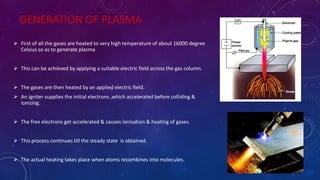
GENERATION OF PLASMA
 First of all the gases are heated to very high temperature of about 16000 degree
Celsius so as to generate plasma
 This can be achieved by applying a suitable electric field across the gas column.
 The gases are then heated by an applied electric field.
 An igniter supplies the initial electrons ,which accelerated before colliding &
ionizing.
 The free electrons get accelerated & causes ionisation & heating of gases.
 This process continues till the steady state is obtained.
 The actual heating takes place when atoms recombines into molecules. 25-Apr-16
PRINCIPLE
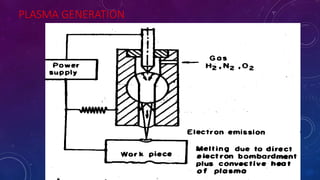
 In this case, the high velocity electrons of are collide with the gas
molecules & metal to form ionisation of beam.
 The plasma gas is forced through nozzle duct & is made to direct on
the work piece to be machined.
 Much of the heating takes place in duct at about 1600 degree celcius
& metal removal is due to electron bombardment & hot plasma.
25-Apr-16
PLASMA GENERATION
25-Apr-16
25-Apr-16
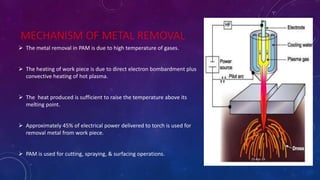
MECHANISM OF METAL REMOVAL
 The metal removal in PAM is due to high temperature of gases.
 The heating of work piece is due to direct electron bombardment plus
convective heating of hot plasma.
 The heat produced is sufficient to raise the temperature above its
melting point.
 Approximately 45% of electrical power delivered to torch is used for
removal metal from work piece.
 PAM is used for cutting, spraying, & surfacing operations.
25-Apr-16
PARAMETERS GOVERNING PAM
 Those associated with design and operation of torch.
 Those associated with physical configuration & setup.
 Environment in which work is performed.
25-Apr-16
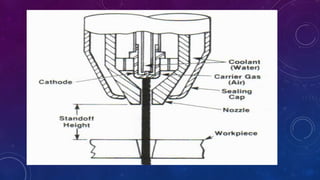
THE TORCH
The plasma is push out of the nozzle with a high velocity jet
Torch consist of non consumable cathode of 2% throiated tungsten.
Converging anode nozzle with a suitable orifice.
Two electrodes are separated by high carbonate resin .
Temperatures of plasma is 10000 degree celcius where as temperature of
oxyacetylene flame is 380 degree celcius.
Velocity of plasma jet is 500m/s.
25-Apr-16
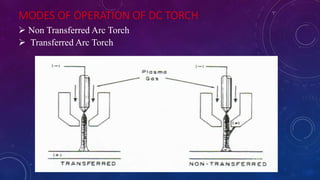
MODES OF OPERATION OF DC TORCH
 Non Transferred Arc Torch
 Transferred Arc Torch
25-Apr-16
Non Transferred Arc Torch
 The DC power source is connected directly across
cathode & anode (nozzle), so that the cathode and
nozzle carry same current.
 Plasma is in the form of flame.
 Useful for spraying ceramic working & chemical
synthesis.
 The hottest portion does not appear outside the
nozzle.
 The electrothermal efficiency is about 65% for sheat
stabilized torches and 75% for vortex stabilized
torches .
Transferred Arc Torch
 Cathode is connected to negative terminal & anode is connected to
positive terminal of DC power source through a suitable resistor to
limit the current through the nozzle to about 50 amp.
 Here arc is struck between tool &work piece.
 Once this arc is struck , the pilot flame circuit is disconnected.
 Useful for welding , cutting and hard surfacing of metals.
 Argon or nitrogen can be used during the operation.
 Electrothermal efficiency is increased to 85-90% , the only loss
being at the cathode and the unconnected nozzle.
25-Apr-16
OPERATION OF TORCHES
 Torches can be operated in two modes.
• Laminar mode
• Turbulent mode
25-Apr-16
LAMINAR MODE
 Long flame . . When low velocity or long flames are required, this mode of torch operation is used.
 Low gas flow rate . Low gas flow rates are maintained in long nozzles to obtain a laminar flame.


 Velocity of flame is with velocities 50m/s and length~ up to 900 mm can be achieved.
 This is used wherever the processed material is not to be sputtered out or when the disintegration of
molten drops into fine droplets is undesirable.
25-Apr-16
TURBULENT MODE
 High velocity flame. When high velocity flames are required for material removal
by melt blasting or spraying,
 High gas flow rate.- high gas flow rates, which give rise to turbulent jets, are used.
 These flames are short in length and are cold outside the nozzle.
 Used for cutting, welding,& spraying.
25-Apr-16
DESIGN OF DC PLASMA TORCHES
• The plasma torch is designed to obtain maximum thermal output.
• The increase in efficiency not only helps in achieving better heating of the gas but also in reducing electrode
losses and thereby increasing the life of electrode.
• The design also ensures that the erosion rates of the electrodes are kept to a minimum.
25-Apr-16
PARAMETERS AFFECTING THE PERFORMANCE OF
TORCH
 Cathode size.
 Annode(nozzle) convergence.
 Nozzle orifice diameter.
 Orifice length.
 Electrode gap.
 Cooling of electrodes.
25-Apr-16
CATHODE
The diameter & bluntness of cathode determines erosion rate.
Tapered rod with slightly blunt tips are used for non transferred application.
For cutting operation flat disk shaped electrode is used.
For welding operation blunt electrode is used.
For spraying and cutting 10mm diameter & cathode is used.
For welding 6mm diameter cathode is used.
Cathode is press fitted into water cooled copper holder & brazed.
25-Apr-16
ANODE
 Anode nozzle has a convergence so as to match the cathode taper.
 Nozzle orifice is designed on the basis of the development of a stabilized plasma column.
 There are two zones of plasma
• Undeveloped zone
• Fully developed zone
25-Apr-16
FULLY DEVELOPED ZONE
 In fully developed zone electrode loss is more
 Thus it is necessary to calculate
• Nozzle orifice diameter
• Nozzle orifice length
• Electrode gap
• Cooling of electrode
25-Apr-16
NECESSARY FACTORS FOR CUTTING &SPRAYING
 For cutting operation
• Nozzle diameter is kept minimum
 For spraying operation
• Nozzle diameter is varied
25-Apr-16
TYPES OF TORCH
1. Non transferred arc torch
2. Transferred arc torch
25-Apr-16
NON TRANSFERRED ARC TORCH
 Turbulent mode flame torches
 Laminar mode flame torches
 High power torches
25-Apr-16
TURBULENT MODE FLAME TORCHES
Flame obtained is
• short in length (about 15cm at 400amps in nitrogen)
• High velocity
• Uses rod type cathodes and nearly 25mm nozzle
• Throat lengths and orifice diameters can be varied over a wide range
• Used for spraying , insulator working and chemical synthesis.
• Has a characteristics “Shrek” or “hiss” sound.
25-Apr-16
LAMINAR MODE FLAME TORCHES
• Such flames have low velocities, length as long as 1meter.
• Flame is emitted with soothing hum .
• The cathode diameters are small and the nozzle throats are large(upto 125mm)
• Used for spherodizing and melting ceramics.
25-Apr-16
HIGH POWER TORCHES
• These torches are made for high temperature arc tunnels and are operated at very high currents(2000amps or
higher).
• To avoid electrode erosion , special magnetic confining fields are used at the nozzle.
25-Apr-16
TRANSFERRED ARC TORCHES
1) Cutting torch
• Single flow torch
• Dual flow torch
• Multiport nozzle torch
• Oxygen plasma cutting torch
2) Welding torches
3) Micro or needle torches
25-Apr-16
SINGLE FLOW TORCH
 Consists of disk shaped ,tapering cathode .
 Throat length of nozzle is 3mm to 5mm.
 High flow rates of gas.
 High velocity of flame.
 Suitable for cutting steels ,aluminium & copper.
25-Apr-16
DUAL FLOW TORCH
 An additional gas flow surrounding the main
arc is provided.
 In carbon steel cutting, the dual gas flow steam
is of oxygen, so that the plasma cutting is
agumented by oxygen cutting to achieve very
high cutting speed.
 Gas flow shields workpiece.
25-Apr-16
MULTIPORT NOZZLE TORCH
 The dual flow concept is used in a different form by
providing part of the plasma gas as shielding flow
through small ports surrounding the main orifice of the
nozzle.
 This flow constricts the arc and also shields the work
piece.
 It has the nozzle with multiport , the Gas flow shields the
gap.
25-Apr-16
OXYGEN PLASMA CUTTING TORCH
 With zirconium as cathode , torches can be used with oxygen plasma for short duration electrode life.
25-Apr-16
WELDING TORCHES
 Cathodes are of small diameter.
 Nozzles are longer.
 Torches operate at low velocity & minimum
turbulence so that the molten metal is not thrown
away.
25-Apr-16
MICRO OR NEEDLE TORCHES
 These are similar to welding torches.
 Operates at low power rate (1kw).
 Used for welding , cutting of foils & wire
25-Apr-16
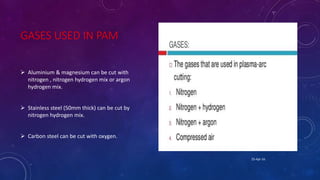
GASES USED IN PAM
 Aluminium & magnesium can be cut with
nitrogen , nitrogen hydrogen mix or argon
hydrogen mix.
 Stainless steel (50mm thick) can be cut by
nitrogen hydrogen mix.
 Carbon steel can be cut with oxygen.
25-Apr-16
THANK YOU
25-Apr-16
APPLICATIONS OF PLASMA JETS
• Plasma arc process for cutting aluminum and other nonferrous materials was first introduced in 1955.
• Due to the remarkable results, the process has now been widely accepted by industries for varied applications.
• The major areas of industrial production where plasma jets have successfully been employed are:
• Welding of material like titanium, stainless steel, etc. which are other-wise difficult to weld.
• Plasma arc surfacing.
• Plasma arc spraying.
• Sufficient literature on plasma arc welding is available but little information regarding plasma arc surfacing and
spraying exist.
25-Apr-16
PLASMA ARC SURFACING
• Surfacing is defined as the deposition of filler metal on metal surface to obtain desired properties or
dimensions.
• It is usually employed to extend the life of a part which may otherwise have all the properties
necessary for an engineering application, or to replace metal which has worn out or corroded away.
25-Apr-16
PLASMA ARC SPRAYING
• Spray coating is a process in which a surface of arbitrary thickness is obtained by spraying the previously
prepared surface of the base material with droplets of a molten material.
• Plasma spraying is a recent development in the filed of metalizing and has been gaining wider use as a method
for producing surface coating of refractory materials and for fabrication of free standing shapes.
• The utilization of plasma torches for spraying protective layers has brought about a rapid progress in coating
techniques.
• A higher operating temperature and the possible use of inert atmosphere are the main advantages derived from
this innovation
25-Apr-16
SPRAY COATING WITH PLASMA
• The technique is similar to that of coating with oxy-fuel or electric arc metallizers.
• The process consists of two basic operations, the preparation of the surface to be coated and spraying proper.
• The surface preparation is of the parent material. The surface of the parent metal is cleaned by degreasing and
appropriately roughened by grit blasting.
• Degreasing in a hot alkaline bath of trichloetrylene is indispensable if a part has been contaminated with oil.
• In spraying with plasma guns, grit blasting will usually be sufficient because plasma produces coating with very
good adhesion.
25-Apr-16
THANK YOU
25-Apr-16

Plasma arc machining

  • 1.
    PLASMA ARC MACHINING Presentedby RAJKUMAR S W 1MS15MSE10 MTECH-MSE 25-Apr-16
  • 2.
    INTRODUCTION  Plasma areinitially employed to cut metals that are difficult to machine by conventional methods.  Later, plasma arc has been sucessfully used for spraying ,surfacing & welding metals like aluminium, stainless steel, titanium , brass and copper though other conductive metals may be cut as well.  Plasma cutting is a process that cuts through electrically conductive materials by means of an accelerated jet of hot plasma. 25-Apr-16
  • 3.
  • 4.
    CONT….. • Plasma cuttingis often used in fabrication and welding shops, automotive repair and restoration, industrial construction, salvage and scrapping operations. • Due to the high speed, precision cuts, combined with low cost of operation, plasma cutting sees a widespread usage from large scale industrial CNC applications down to small hobbyist shops. Plasma -WHAT IS PLASMA?  Gases when heated to elevated temperature, they turn into a distinctly different type of matter which is called as plasma. 25-Apr-16
  • 5.
    REASONS OF PLASMASTATE  This change takes place when gases are heated to very high temperature  The number of collisions between the atoms, either elastic or inelastic increases.  The gas ionises ,so that a portion of atoms are stripped off from outer electrons  The electrons thus produced, in turn colloids with atoms, so that there thermal kinetic energy increases, and a light is emitted from them ,thus producing more number of atoms and electrons. 25-Apr-16
  • 6.
    GENERATION OF PLASMA First of all the gases are heated to very high temperature of about 16000 degree Celsius so as to generate plasma  This can be achieved by applying a suitable electric field across the gas column.  The gases are then heated by an applied electric field.  An igniter supplies the initial electrons ,which accelerated before colliding & ionizing.  The free electrons get accelerated & causes ionisation & heating of gases.  This process continues till the steady state is obtained.  The actual heating takes place when atoms recombines into molecules. 25-Apr-16
  • 7.
    PRINCIPLE  In thiscase, the high velocity electrons of are collide with the gas molecules & metal to form ionisation of beam.  The plasma gas is forced through nozzle duct & is made to direct on the work piece to be machined.  Much of the heating takes place in duct at about 1600 degree celcius & metal removal is due to electron bombardment & hot plasma. 25-Apr-16
  • 8.
  • 9.
  • 10.
    MECHANISM OF METALREMOVAL  The metal removal in PAM is due to high temperature of gases.  The heating of work piece is due to direct electron bombardment plus convective heating of hot plasma.  The heat produced is sufficient to raise the temperature above its melting point.  Approximately 45% of electrical power delivered to torch is used for removal metal from work piece.  PAM is used for cutting, spraying, & surfacing operations. 25-Apr-16
  • 11.
    PARAMETERS GOVERNING PAM Those associated with design and operation of torch.  Those associated with physical configuration & setup.  Environment in which work is performed. 25-Apr-16
  • 12.
    THE TORCH The plasmais push out of the nozzle with a high velocity jet Torch consist of non consumable cathode of 2% throiated tungsten. Converging anode nozzle with a suitable orifice. Two electrodes are separated by high carbonate resin . Temperatures of plasma is 10000 degree celcius where as temperature of oxyacetylene flame is 380 degree celcius. Velocity of plasma jet is 500m/s. 25-Apr-16
  • 13.
    MODES OF OPERATIONOF DC TORCH  Non Transferred Arc Torch  Transferred Arc Torch 25-Apr-16
  • 14.
    Non Transferred ArcTorch  The DC power source is connected directly across cathode & anode (nozzle), so that the cathode and nozzle carry same current.  Plasma is in the form of flame.  Useful for spraying ceramic working & chemical synthesis.  The hottest portion does not appear outside the nozzle.  The electrothermal efficiency is about 65% for sheat stabilized torches and 75% for vortex stabilized torches . Transferred Arc Torch  Cathode is connected to negative terminal & anode is connected to positive terminal of DC power source through a suitable resistor to limit the current through the nozzle to about 50 amp.  Here arc is struck between tool &work piece.  Once this arc is struck , the pilot flame circuit is disconnected.  Useful for welding , cutting and hard surfacing of metals.  Argon or nitrogen can be used during the operation.  Electrothermal efficiency is increased to 85-90% , the only loss being at the cathode and the unconnected nozzle. 25-Apr-16
  • 15.
    OPERATION OF TORCHES Torches can be operated in two modes. • Laminar mode • Turbulent mode 25-Apr-16
  • 16.
    LAMINAR MODE  Longflame . . When low velocity or long flames are required, this mode of torch operation is used.  Low gas flow rate . Low gas flow rates are maintained in long nozzles to obtain a laminar flame.  Velocity of flame is with velocities 50m/s and length~ up to 900 mm can be achieved.  This is used wherever the processed material is not to be sputtered out or when the disintegration of molten drops into fine droplets is undesirable. 25-Apr-16
  • 17.
    TURBULENT MODE  Highvelocity flame. When high velocity flames are required for material removal by melt blasting or spraying,  High gas flow rate.- high gas flow rates, which give rise to turbulent jets, are used.  These flames are short in length and are cold outside the nozzle.  Used for cutting, welding,& spraying. 25-Apr-16
  • 18.
    DESIGN OF DCPLASMA TORCHES • The plasma torch is designed to obtain maximum thermal output. • The increase in efficiency not only helps in achieving better heating of the gas but also in reducing electrode losses and thereby increasing the life of electrode. • The design also ensures that the erosion rates of the electrodes are kept to a minimum. 25-Apr-16
  • 19.
    PARAMETERS AFFECTING THEPERFORMANCE OF TORCH  Cathode size.  Annode(nozzle) convergence.  Nozzle orifice diameter.  Orifice length.  Electrode gap.  Cooling of electrodes. 25-Apr-16
  • 20.
    CATHODE The diameter &bluntness of cathode determines erosion rate. Tapered rod with slightly blunt tips are used for non transferred application. For cutting operation flat disk shaped electrode is used. For welding operation blunt electrode is used. For spraying and cutting 10mm diameter & cathode is used. For welding 6mm diameter cathode is used. Cathode is press fitted into water cooled copper holder & brazed. 25-Apr-16
  • 21.
    ANODE  Anode nozzlehas a convergence so as to match the cathode taper.  Nozzle orifice is designed on the basis of the development of a stabilized plasma column.  There are two zones of plasma • Undeveloped zone • Fully developed zone 25-Apr-16
  • 22.
    FULLY DEVELOPED ZONE In fully developed zone electrode loss is more  Thus it is necessary to calculate • Nozzle orifice diameter • Nozzle orifice length • Electrode gap • Cooling of electrode 25-Apr-16
  • 23.
    NECESSARY FACTORS FORCUTTING &SPRAYING  For cutting operation • Nozzle diameter is kept minimum  For spraying operation • Nozzle diameter is varied 25-Apr-16
  • 24.
    TYPES OF TORCH 1.Non transferred arc torch 2. Transferred arc torch 25-Apr-16
  • 25.
    NON TRANSFERRED ARCTORCH  Turbulent mode flame torches  Laminar mode flame torches  High power torches 25-Apr-16
  • 26.
    TURBULENT MODE FLAMETORCHES Flame obtained is • short in length (about 15cm at 400amps in nitrogen) • High velocity • Uses rod type cathodes and nearly 25mm nozzle • Throat lengths and orifice diameters can be varied over a wide range • Used for spraying , insulator working and chemical synthesis. • Has a characteristics “Shrek” or “hiss” sound. 25-Apr-16
  • 27.
    LAMINAR MODE FLAMETORCHES • Such flames have low velocities, length as long as 1meter. • Flame is emitted with soothing hum . • The cathode diameters are small and the nozzle throats are large(upto 125mm) • Used for spherodizing and melting ceramics. 25-Apr-16
  • 28.
    HIGH POWER TORCHES •These torches are made for high temperature arc tunnels and are operated at very high currents(2000amps or higher). • To avoid electrode erosion , special magnetic confining fields are used at the nozzle. 25-Apr-16
  • 29.
    TRANSFERRED ARC TORCHES 1)Cutting torch • Single flow torch • Dual flow torch • Multiport nozzle torch • Oxygen plasma cutting torch 2) Welding torches 3) Micro or needle torches 25-Apr-16
  • 30.
    SINGLE FLOW TORCH Consists of disk shaped ,tapering cathode .  Throat length of nozzle is 3mm to 5mm.  High flow rates of gas.  High velocity of flame.  Suitable for cutting steels ,aluminium & copper. 25-Apr-16
  • 31.
    DUAL FLOW TORCH An additional gas flow surrounding the main arc is provided.  In carbon steel cutting, the dual gas flow steam is of oxygen, so that the plasma cutting is agumented by oxygen cutting to achieve very high cutting speed.  Gas flow shields workpiece. 25-Apr-16
  • 32.
    MULTIPORT NOZZLE TORCH The dual flow concept is used in a different form by providing part of the plasma gas as shielding flow through small ports surrounding the main orifice of the nozzle.  This flow constricts the arc and also shields the work piece.  It has the nozzle with multiport , the Gas flow shields the gap. 25-Apr-16
  • 33.
    OXYGEN PLASMA CUTTINGTORCH  With zirconium as cathode , torches can be used with oxygen plasma for short duration electrode life. 25-Apr-16
  • 34.
    WELDING TORCHES  Cathodesare of small diameter.  Nozzles are longer.  Torches operate at low velocity & minimum turbulence so that the molten metal is not thrown away. 25-Apr-16
  • 35.
    MICRO OR NEEDLETORCHES  These are similar to welding torches.  Operates at low power rate (1kw).  Used for welding , cutting of foils & wire 25-Apr-16
  • 36.
    GASES USED INPAM  Aluminium & magnesium can be cut with nitrogen , nitrogen hydrogen mix or argon hydrogen mix.  Stainless steel (50mm thick) can be cut by nitrogen hydrogen mix.  Carbon steel can be cut with oxygen. 25-Apr-16
  • 37.
  • 38.
    APPLICATIONS OF PLASMAJETS • Plasma arc process for cutting aluminum and other nonferrous materials was first introduced in 1955. • Due to the remarkable results, the process has now been widely accepted by industries for varied applications. • The major areas of industrial production where plasma jets have successfully been employed are: • Welding of material like titanium, stainless steel, etc. which are other-wise difficult to weld. • Plasma arc surfacing. • Plasma arc spraying. • Sufficient literature on plasma arc welding is available but little information regarding plasma arc surfacing and spraying exist. 25-Apr-16
  • 39.
    PLASMA ARC SURFACING •Surfacing is defined as the deposition of filler metal on metal surface to obtain desired properties or dimensions. • It is usually employed to extend the life of a part which may otherwise have all the properties necessary for an engineering application, or to replace metal which has worn out or corroded away. 25-Apr-16
  • 40.
    PLASMA ARC SPRAYING •Spray coating is a process in which a surface of arbitrary thickness is obtained by spraying the previously prepared surface of the base material with droplets of a molten material. • Plasma spraying is a recent development in the filed of metalizing and has been gaining wider use as a method for producing surface coating of refractory materials and for fabrication of free standing shapes. • The utilization of plasma torches for spraying protective layers has brought about a rapid progress in coating techniques. • A higher operating temperature and the possible use of inert atmosphere are the main advantages derived from this innovation 25-Apr-16
  • 41.
    SPRAY COATING WITHPLASMA • The technique is similar to that of coating with oxy-fuel or electric arc metallizers. • The process consists of two basic operations, the preparation of the surface to be coated and spraying proper. • The surface preparation is of the parent material. The surface of the parent metal is cleaned by degreasing and appropriately roughened by grit blasting. • Degreasing in a hot alkaline bath of trichloetrylene is indispensable if a part has been contaminated with oil. • In spraying with plasma guns, grit blasting will usually be sufficient because plasma produces coating with very good adhesion. 25-Apr-16
  • 42.