Friction Stir Welding
Group:2
Hafiz Bilal Abid (E14-300)
Abdullah Mir (E14-325)
Hafiz Rizwan Razzaq (E14-335)
Farooq Yousaf (E14-344)
COLLEGE OF ENGINEERING & EMERGING TECHNOLOGIES
UNIVERSITY OF THE PUNJAB
Contents
 Introduction
 Equipment and Design
 Working Principle
 Welding parameters
 Merits & De-merits
 Applications
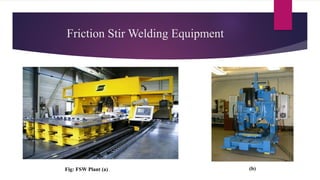
Friction Stir Welding Equipment
Fig: FSW Plant (a) (b)
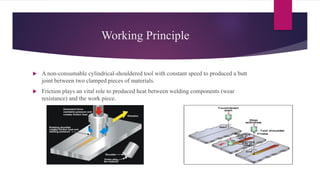
Working Principle
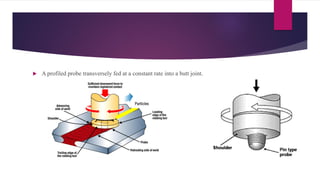
 A non-consumable cylindrical-shouldered tool with constant speed to produced a butt
joint between two clamped pieces of materials.
 Friction plays an vital role to produced heat between welding components (wear
resistance) and the work piece.
 A profiled probe transversely fed at a constant rate into a butt joint.
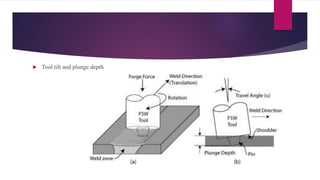
 Tool tilt and plunge depth
Effected Zones
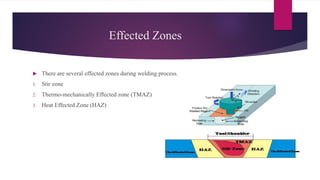
 There are several effected zones during welding process.
1. Stir zone
2. Thermo-mechanically Effected zone (TMAZ)
3. Heat Effected Zone (HAZ)
Benefits
 No hot cracks, no gas pores.
 No shielding gases or consumables.
 Possibility of joining dissimilar allay materials.
 Few softening or deformation.
 Good mechanical properties in the as-welded condition.
 Easily automated on simple milling machines — lower setup costs and
less training.
 Can operate in all positions (horizontal, vertical, etc.), as there is no weld
pool.
 Generally good weld appearance and minimal thickness under/over-
matching, thus reducing the need for expensive machining after welding.
 Low environmental impact.
 This technique can be used to join eyeglass frames to the pins in their
hinges.
Drawbacks
 Exit hole left when tool is withdrawn.
 Large down forces required with heavy-duty clamping necessary to hold the plates
together.
 Less flexible than manual and arc processes (difficulties with thickness variations
and non-linear welds).
 Often slower traverse rate than some fusion welding techniques.
Applications
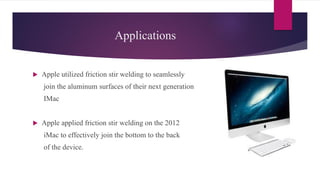
 Apple utilized friction stir welding to seamlessly
join the aluminum surfaces of their next generation
IMac
 Apple applied friction stir welding on the 2012
iMac to effectively join the bottom to the back
of the device.
Automotive
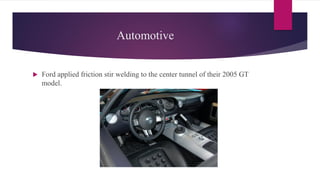
 Ford applied friction stir welding to the center tunnel of their 2005 GT
model.
Railways
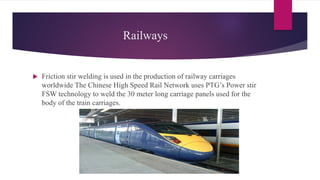
 Friction stir welding is used in the production of railway carriages
worldwide The Chinese High Speed Rail Network uses PTG’s Power stir
FSW technology to weld the 30 meter long carriage panels used for the
body of the train carriages.
Fabrication
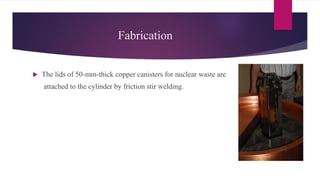
 The lids of 50-mm-thick copper canisters for nuclear waste are
attached to the cylinder by friction stir welding.
Shipbuilding
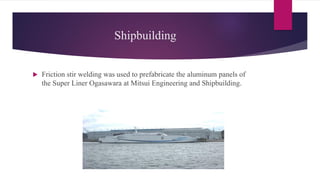
 Friction stir welding was used to prefabricate the aluminum panels of
the Super Liner Ogasawara at Mitsui Engineering and Shipbuilding.
Ammunitions
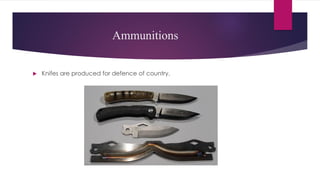
 Knifes are produced for defence of country.
References
 Friction stir welding and processing by Rajiv S. Mishra and Murray W.
Mahoney (2007).
 Friction stir welding; From Basics to Applications by Daniela Lohwasser
and Zhan Chen (2009)
 https://en.wikipedia.org/wiki/Friction_stir_welding

Friction stir welding

  • 1.
    Friction Stir Welding Group:2 HafizBilal Abid (E14-300) Abdullah Mir (E14-325) Hafiz Rizwan Razzaq (E14-335) Farooq Yousaf (E14-344) COLLEGE OF ENGINEERING & EMERGING TECHNOLOGIES UNIVERSITY OF THE PUNJAB
  • 2.
    Contents  Introduction  Equipmentand Design  Working Principle  Welding parameters  Merits & De-merits  Applications
  • 3.
    Friction Stir WeldingEquipment Fig: FSW Plant (a) (b)
  • 4.
    Working Principle  Anon-consumable cylindrical-shouldered tool with constant speed to produced a butt joint between two clamped pieces of materials.  Friction plays an vital role to produced heat between welding components (wear resistance) and the work piece.
  • 5.
     A profiledprobe transversely fed at a constant rate into a butt joint.
  • 7.
     Tool tiltand plunge depth
  • 8.
    Effected Zones  Thereare several effected zones during welding process. 1. Stir zone 2. Thermo-mechanically Effected zone (TMAZ) 3. Heat Effected Zone (HAZ)
  • 9.
    Benefits  No hotcracks, no gas pores.  No shielding gases or consumables.  Possibility of joining dissimilar allay materials.  Few softening or deformation.  Good mechanical properties in the as-welded condition.
  • 10.
     Easily automatedon simple milling machines — lower setup costs and less training.  Can operate in all positions (horizontal, vertical, etc.), as there is no weld pool.  Generally good weld appearance and minimal thickness under/over- matching, thus reducing the need for expensive machining after welding.  Low environmental impact.  This technique can be used to join eyeglass frames to the pins in their hinges.
  • 11.
    Drawbacks  Exit holeleft when tool is withdrawn.  Large down forces required with heavy-duty clamping necessary to hold the plates together.  Less flexible than manual and arc processes (difficulties with thickness variations and non-linear welds).  Often slower traverse rate than some fusion welding techniques.
  • 12.
    Applications  Apple utilizedfriction stir welding to seamlessly join the aluminum surfaces of their next generation IMac  Apple applied friction stir welding on the 2012 iMac to effectively join the bottom to the back of the device.
  • 13.
    Automotive  Ford appliedfriction stir welding to the center tunnel of their 2005 GT model.
  • 14.
    Railways  Friction stirwelding is used in the production of railway carriages worldwide The Chinese High Speed Rail Network uses PTG’s Power stir FSW technology to weld the 30 meter long carriage panels used for the body of the train carriages.
  • 15.
    Fabrication  The lidsof 50-mm-thick copper canisters for nuclear waste are attached to the cylinder by friction stir welding.
  • 16.
    Shipbuilding  Friction stirwelding was used to prefabricate the aluminum panels of the Super Liner Ogasawara at Mitsui Engineering and Shipbuilding.
  • 17.
    Ammunitions  Knifes areproduced for defence of country.
  • 18.
    References  Friction stirwelding and processing by Rajiv S. Mishra and Murray W. Mahoney (2007).  Friction stir welding; From Basics to Applications by Daniela Lohwasser and Zhan Chen (2009)  https://en.wikipedia.org/wiki/Friction_stir_welding