FRICTION STIR
WELDING
(F.S.W)
CH.KRISHNAMA RAJU
315277133002
CONTENTS
• INTRODUCTION
• PRINCIPLES OF FSW WELDING
• FSW SET UP
• MATERIALS USED
• ADVANTAGES
• DISADVANTAGES
• APPLICATIONS
• FUTURE DEVELOPMENTS
INTRODUCTION :
• FSW was invented by Wayne Thomas at TWI(The Welding
Institute) Ltd in 1991.
• It overcomes many of the problems associated with conventional
joining techniques.
• FSW is low energy input, capable of producing very high strength
welds in wide range of materials at lower cost.
• FSW process takes place in the solid phase below the melting
point of the materials to be joined.
WELDING :
• Welding is a joining process.
• Application of heat.
• With / without application of pressure& electrode.
• Making permanent joints.
CLASSIFICATION OF WELDING :
• Main two classifications are
• Fusion welding :
1. heated to molten state
2. no pressure required
Ex: Gas welding, Arc welding
• Plastic welding :
1. heated to plastic state
2. pressure required
Ex: friction Welding, forge welding
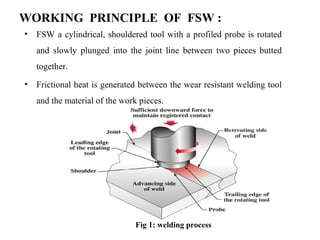
WORKING PRINCIPLE OF FSW :
• FSW a cylindrical, shouldered tool with a profiled probe is rotated
and slowly plunged into the joint line between two pieces butted
together.
• Frictional heat is generated between the wear resistant welding tool
and the material of the work pieces.
Fig 1: welding process
WORKING PRINCIPLE OF FSW
• The plasticized material is transferred the front edge of the
tool to back edge of the tool probe and it’s forged by the
intimate contact of the tool shoulder and pin profile.
• This heat is without reaching the melting point and allows
traversing of the tool along the weld line.
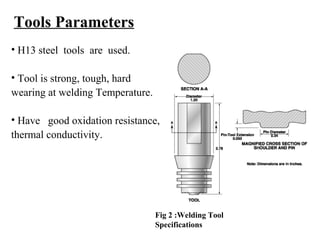
Tools Parameters
• H13 steel tools are used.
• Tool is strong, tough, hard
wearing at welding Temperature.
• Have good oxidation resistance,
thermal conductivity.
Fig 2 :Welding Tool
Specifications
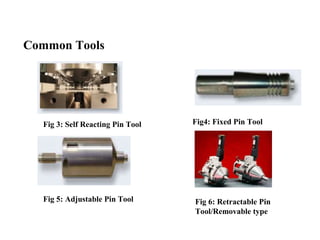
Common Tools
Fig4: Fixed Pin ToolFig 3: Self Reacting Pin Tool
Fig 5: Adjustable Pin Tool Fig 6: Retractable Pin
Tool/Removable type
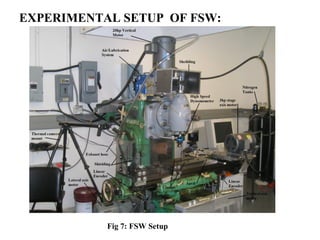
EXPERIMENTAL SETUP OF FSW:
Fig 7: FSW Setup
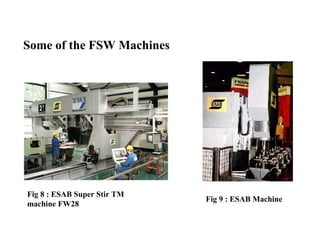
Some of the FSW Machines
Fig 8 : ESAB Super Stir TM
machine FW28
Fig 9 : ESAB Machine
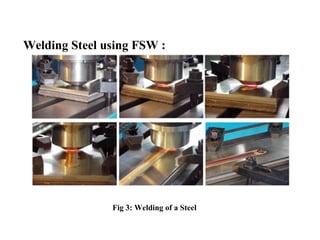
Welding Steel using FSW :
Fig 3: Welding of a Steel
IMPORTANT WELDING ZONES :
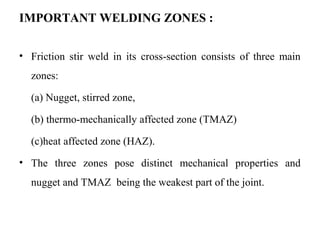
• Friction stir weld in its cross-section consists of three main
zones:
(a) Nugget, stirred zone,
(b) thermo-mechanically affected zone (TMAZ)
(c)heat affected zone (HAZ).
• The three zones pose distinct mechanical properties and
nugget and TMAZ being the weakest part of the joint.
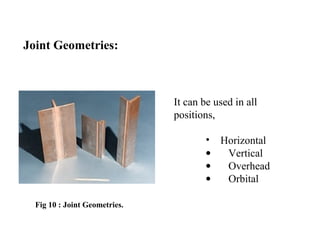
Joint Geometries:
It can be used in all
positions,
• Horizontal
• Vertical
• Overhead
• Orbital
Fig 10 : Joint Geometries.
Material Suitability:
 Copper and its alloys
 Lead
 Titanium and its alloys
 Magnesium alloys
 Zinc
 Plastics
 Mild steel
 Stainless steel
 Nickel alloys
Advantages
 Good mechanical properties as in weld condition
 Improved safety due to absence of toxic fumes
 No consumables
 Easily automated on simple milling machines
 Can operate on all positions (vertical, horizontal) etc.
 Low environment impact
 High superior weld strength
Disadvantages
 Work pieces must be rigidly clamped
 Slower traverse rate than fusion welding
APPLICATIONS
• AEROSPACE
• SHIP BUILDING & OFFSHORE
• AUTOMOTIVE
• FABRICATIONS
• RAILWAYS
Future Developments
 Laser-assisted friction stir welding
 Possible use of induction coil and other mechanism
THANK YOU

315277133002

  • 1.
  • 2.
    CONTENTS • INTRODUCTION • PRINCIPLESOF FSW WELDING • FSW SET UP • MATERIALS USED • ADVANTAGES • DISADVANTAGES • APPLICATIONS • FUTURE DEVELOPMENTS
  • 3.
    INTRODUCTION : • FSWwas invented by Wayne Thomas at TWI(The Welding Institute) Ltd in 1991. • It overcomes many of the problems associated with conventional joining techniques. • FSW is low energy input, capable of producing very high strength welds in wide range of materials at lower cost. • FSW process takes place in the solid phase below the melting point of the materials to be joined.
  • 4.
    WELDING : • Weldingis a joining process. • Application of heat. • With / without application of pressure& electrode. • Making permanent joints.
  • 5.
    CLASSIFICATION OF WELDING: • Main two classifications are • Fusion welding : 1. heated to molten state 2. no pressure required Ex: Gas welding, Arc welding • Plastic welding : 1. heated to plastic state 2. pressure required Ex: friction Welding, forge welding
  • 6.
    WORKING PRINCIPLE OFFSW : • FSW a cylindrical, shouldered tool with a profiled probe is rotated and slowly plunged into the joint line between two pieces butted together. • Frictional heat is generated between the wear resistant welding tool and the material of the work pieces. Fig 1: welding process
  • 7.
    WORKING PRINCIPLE OFFSW • The plasticized material is transferred the front edge of the tool to back edge of the tool probe and it’s forged by the intimate contact of the tool shoulder and pin profile. • This heat is without reaching the melting point and allows traversing of the tool along the weld line.
  • 8.
    Tools Parameters • H13steel tools are used. • Tool is strong, tough, hard wearing at welding Temperature. • Have good oxidation resistance, thermal conductivity. Fig 2 :Welding Tool Specifications
  • 9.
    Common Tools Fig4: FixedPin ToolFig 3: Self Reacting Pin Tool Fig 5: Adjustable Pin Tool Fig 6: Retractable Pin Tool/Removable type
  • 10.
    EXPERIMENTAL SETUP OFFSW: Fig 7: FSW Setup
  • 11.
    Some of theFSW Machines Fig 8 : ESAB Super Stir TM machine FW28 Fig 9 : ESAB Machine
  • 12.
    Welding Steel usingFSW : Fig 3: Welding of a Steel
  • 13.
    IMPORTANT WELDING ZONES: • Friction stir weld in its cross-section consists of three main zones: (a) Nugget, stirred zone, (b) thermo-mechanically affected zone (TMAZ) (c)heat affected zone (HAZ). • The three zones pose distinct mechanical properties and nugget and TMAZ being the weakest part of the joint.
  • 14.
    Joint Geometries: It canbe used in all positions, • Horizontal • Vertical • Overhead • Orbital Fig 10 : Joint Geometries.
  • 15.
    Material Suitability:  Copperand its alloys  Lead  Titanium and its alloys  Magnesium alloys  Zinc  Plastics  Mild steel  Stainless steel  Nickel alloys
  • 16.
    Advantages  Good mechanicalproperties as in weld condition  Improved safety due to absence of toxic fumes  No consumables  Easily automated on simple milling machines  Can operate on all positions (vertical, horizontal) etc.  Low environment impact  High superior weld strength
  • 17.
    Disadvantages  Work piecesmust be rigidly clamped  Slower traverse rate than fusion welding
  • 18.
    APPLICATIONS • AEROSPACE • SHIPBUILDING & OFFSHORE • AUTOMOTIVE • FABRICATIONS • RAILWAYS
  • 19.
    Future Developments  Laser-assistedfriction stir welding  Possible use of induction coil and other mechanism
  • 20.