NAME : K.JOTHI KARTHICK
DEPT. : WELDING METALLUGY
REG NO : 1763009
Weldability of stainless steels
• There are four types such as
•Austenitic stainless steel
•Ferritic stainless steel
•Martensitic stainless steel
WELDABILITY OF AUTENITIC STAINLESS STEEL
• It has the following composition
• C 0.03 to 0.25% Mn 2 to 10%
• Si 1 to 2% Cr 16 to26%
• Ni 3.5 to 22% P and S 0.008% Cb and Ta
• Mo and Ti in somecase fe balance
• They posses high corrosion resistance of all the Stainless
steels.
• They posses great strength and ductility and non magnetic
and so on.
• Application
• Aircraft industry
• Austenitic – process plants, cryogenics, medium corrosive
applications, used over wide temperature range
• Chemical processing (heat exchanger)
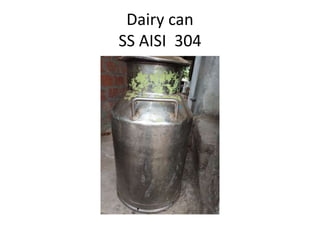
• Dairy industry( milk cans)
Dairy can
SS AISI 304
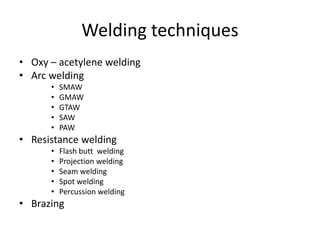
Welding techniques
• Oxy – acetylene welding
• Arc welding
• SMAW
• GMAW
• GTAW
• SAW
• PAW
• Resistance welding
• Flash butt welding
• Projection welding
• Seam welding
• Spot welding
• Percussion welding
• Brazing
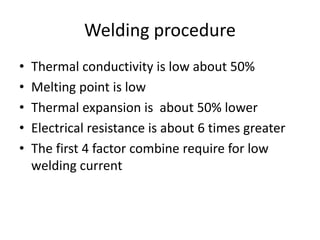
Welding procedure
• Thermal conductivity is low about 50%
• Melting point is low
• Thermal expansion is about 50% lower
• Electrical resistance is about 6 times greater
• The first 4 factor combine require for low
welding current
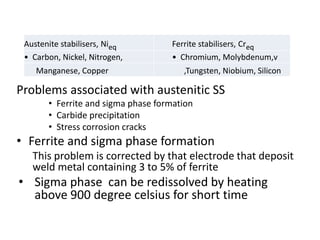
Problems associated with austenitic SS
• Ferrite and sigma phase formation
• Carbide precipitation
• Stress corrosion cracks
• Ferrite and sigma phase formation
This problem is corrected by that electrode that deposit
weld metal containing 3 to 5% of ferrite
• Sigma phase can be redissolved by heating
above 900 degree celsius for short time
Austenite stabilisers, Nieq Ferrite stabilisers, Creq
• Carbon, Nickel, Nitrogen, • Chromium, Molybdenum,v
Manganese, Copper ,Tungsten, Niobium, Silicon
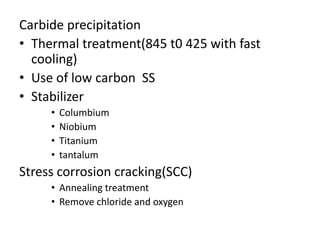
Carbide precipitation
• Thermal treatment(845 t0 425 with fast
cooling)
• Use of low carbon SS
• Stabilizer
• Columbium
• Niobium
• Titanium
• tantalum
Stress corrosion cracking(SCC)
• Annealing treatment
• Remove chloride and oxygen
Weldability of Ferritic stainless steels
• It has following composition
• C 0.08 to 1.5% Si 1%
• Mn 1 to 2% Cr 11 to 27%
• S 0.04% P 0.04%
• Fe balance
• They possess magnetic and good ductility
• It is more corrosion resist than martensitic steels.
• Application
• Lining petroleum industry
• Heating element for furnace
• Screws and fitting
Ferritic SS
• Sensitive to grain growth
– loss of toughness, embrittlement
– limited to 250°C service temperature
– can lead to cracking in weld or HAZ of highly
restrained joints and thick section material.
• Hydrogen cracking
• Filler metals:
• – matching, austenitic or nickel alloy
Welding techniques
• GMAW
• SAW
• GTAW
• SMAW
• Resistance welding
• Flash butt welding
• Projection welding
• Seam welding
• Spot welding
• Percussion welding
• The welding quality of ferritic Stainless steels
is poorest of AISI types
• Welding heat a zone in the base metal above
critical temp 955 and cause rapid grain
growth of ferrite
• Excess grain growth avoid by lower heat
inputs
• Adding Al,V,Zr to suppress the grain growth
during welding
• Intergranular corrosion avoided by annaling
650 to 815 about 10 min to 60mine
Preheating
• A preheating 150 or higher to minimize
residual stress
• Thin section not require
• Thick section require for preheating
PWHT(post weld heat treatment)
• Reduce harness and residual stress
Weldability of martensitic Stainless
steels
• It has following composition
• C 0.15 to 3% Si 1.8%
• Mn 3.5% Cr 11 to 18%
• Fe balance Ni 1.25%
• They possess hardness and ductility and magnetic
and so on.
• It is best thermal conductivity of SS.
• It uses of martensitic Stainless steels
• Pump and valve
• Surgical instrument
• Rules an tape
Welding techniques
• SMAW
• GTAW
• GMAW
• SAW
• SPOT Welding
• Flash welding
• Friction welding
• EBW
• Welding Problems
• Hydrogen cracking
• Normally matching consumables.
• High hardness in the HAZ makes this type of stainless steel
very prone to hydrogen cracking .
• The risk of cracking increasing with the carbon content.
• Above C .15 to 3% not suitable for welding.
• Underbead crack
• Take precautions to minimize
• Preheating
• PWHT
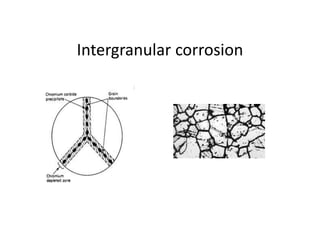
Sensitization
• Sensitization refers to the precipitation of
carbides at grain boundaries in a stainless
steel or alloy, causing the alloy to be susceptible
to intergranular corrosion.
• This results in susceptibility to intergranular
corrosion.
• austentitic stainless steel may become sensitised
if they are heat treated or used at temperature in
range 500-800c. the heat affected zones of welds
may also be sensitised in some circumstance
Intergranular corrosion
CAUSES
• More amount of carbon content
• Slow rate of cooling from 425 to 845 so it is
also called sensitising temperature range.
• Time ,temperature , chemical composition
play a vital role in sensitisation.
Prevention
• Fast cooling requires because the carbon does
not react with chromium.
• Stabilizer
• Columbium
• Niobium
• Titanium
• Tantalum
• Both base materials and fill rod have low
carbon content.
Sigma embrittlement
• Sigma phase is a non-magnetic composed mainly of
iron and chromium which forms in ferritic and
austenitic stainless steels during exposure at 560º-
980ºC .
• Many stainless steels and other iron-chromium alloys
are susceptible grain boundary phenomenon known
as sigma-phase embrittlement.
• Alloy elements such as molybdenum, titanium and
silicon promote the formation of sigma phase
• Molybdenum promotes sigma-phase formation much
more effectively than chromium, particularly at
temperatures around 900°C (1650°C)
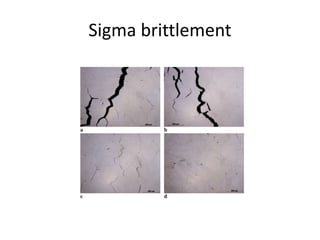
Sigma brittlement
causes
• Loss of ductility and toughness
• Corrosion resistance resulting in cracking
• Failure of components
• Especially those subjected to impact loads or
excessive stress
PREVENTION
• Nitrogen and carbon reduce as it tendency to
form.
• Annealing treatment.
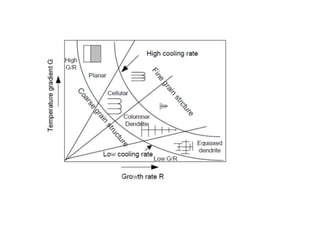
Mode of solidification
• Solidification
solidification, also known as freezing, is a phase
change of matter that results in the production of a
solid. Generally, this occurs when the temperature of
a liquid is lowered below its freezing point
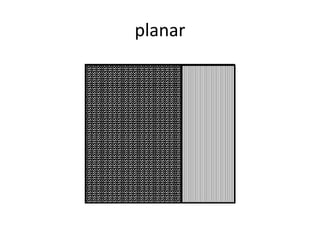
• There are four modes
• Planar
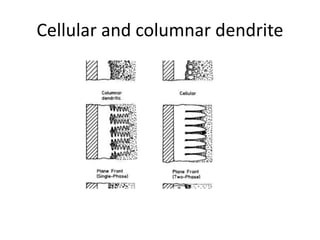
• Cellular
• Columnar Dendrite
• Equiaxed dendrite
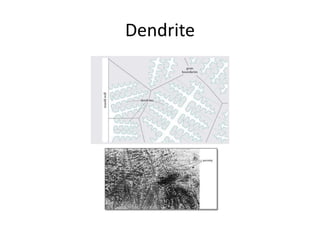
Dendrite
Cellular and columnar dendrite
planar
THANK YOU

Weldability of stainless steels

  • 1.
    NAME : K.JOTHIKARTHICK DEPT. : WELDING METALLUGY REG NO : 1763009
  • 2.
    Weldability of stainlesssteels • There are four types such as •Austenitic stainless steel •Ferritic stainless steel •Martensitic stainless steel
  • 3.
    WELDABILITY OF AUTENITICSTAINLESS STEEL • It has the following composition • C 0.03 to 0.25% Mn 2 to 10% • Si 1 to 2% Cr 16 to26% • Ni 3.5 to 22% P and S 0.008% Cb and Ta • Mo and Ti in somecase fe balance • They posses high corrosion resistance of all the Stainless steels. • They posses great strength and ductility and non magnetic and so on. • Application • Aircraft industry • Austenitic – process plants, cryogenics, medium corrosive applications, used over wide temperature range • Chemical processing (heat exchanger) • Dairy industry( milk cans)
  • 4.
  • 5.
    Welding techniques • Oxy– acetylene welding • Arc welding • SMAW • GMAW • GTAW • SAW • PAW • Resistance welding • Flash butt welding • Projection welding • Seam welding • Spot welding • Percussion welding • Brazing
  • 6.
    Welding procedure • Thermalconductivity is low about 50% • Melting point is low • Thermal expansion is about 50% lower • Electrical resistance is about 6 times greater • The first 4 factor combine require for low welding current
  • 7.
    Problems associated withaustenitic SS • Ferrite and sigma phase formation • Carbide precipitation • Stress corrosion cracks • Ferrite and sigma phase formation This problem is corrected by that electrode that deposit weld metal containing 3 to 5% of ferrite • Sigma phase can be redissolved by heating above 900 degree celsius for short time Austenite stabilisers, Nieq Ferrite stabilisers, Creq • Carbon, Nickel, Nitrogen, • Chromium, Molybdenum,v Manganese, Copper ,Tungsten, Niobium, Silicon
  • 8.
    Carbide precipitation • Thermaltreatment(845 t0 425 with fast cooling) • Use of low carbon SS • Stabilizer • Columbium • Niobium • Titanium • tantalum Stress corrosion cracking(SCC) • Annealing treatment • Remove chloride and oxygen
  • 9.
    Weldability of Ferriticstainless steels • It has following composition • C 0.08 to 1.5% Si 1% • Mn 1 to 2% Cr 11 to 27% • S 0.04% P 0.04% • Fe balance • They possess magnetic and good ductility • It is more corrosion resist than martensitic steels. • Application • Lining petroleum industry • Heating element for furnace • Screws and fitting
  • 10.
    Ferritic SS • Sensitiveto grain growth – loss of toughness, embrittlement – limited to 250°C service temperature – can lead to cracking in weld or HAZ of highly restrained joints and thick section material. • Hydrogen cracking • Filler metals: • – matching, austenitic or nickel alloy
  • 11.
    Welding techniques • GMAW •SAW • GTAW • SMAW • Resistance welding • Flash butt welding • Projection welding • Seam welding • Spot welding • Percussion welding
  • 12.
    • The weldingquality of ferritic Stainless steels is poorest of AISI types • Welding heat a zone in the base metal above critical temp 955 and cause rapid grain growth of ferrite • Excess grain growth avoid by lower heat inputs • Adding Al,V,Zr to suppress the grain growth during welding • Intergranular corrosion avoided by annaling 650 to 815 about 10 min to 60mine
  • 13.
    Preheating • A preheating150 or higher to minimize residual stress • Thin section not require • Thick section require for preheating PWHT(post weld heat treatment) • Reduce harness and residual stress
  • 14.
    Weldability of martensiticStainless steels • It has following composition • C 0.15 to 3% Si 1.8% • Mn 3.5% Cr 11 to 18% • Fe balance Ni 1.25% • They possess hardness and ductility and magnetic and so on. • It is best thermal conductivity of SS. • It uses of martensitic Stainless steels • Pump and valve • Surgical instrument • Rules an tape
  • 15.
    Welding techniques • SMAW •GTAW • GMAW • SAW • SPOT Welding • Flash welding • Friction welding • EBW
  • 16.
    • Welding Problems •Hydrogen cracking • Normally matching consumables. • High hardness in the HAZ makes this type of stainless steel very prone to hydrogen cracking . • The risk of cracking increasing with the carbon content. • Above C .15 to 3% not suitable for welding. • Underbead crack • Take precautions to minimize • Preheating • PWHT
  • 17.
    Sensitization • Sensitization refersto the precipitation of carbides at grain boundaries in a stainless steel or alloy, causing the alloy to be susceptible to intergranular corrosion. • This results in susceptibility to intergranular corrosion. • austentitic stainless steel may become sensitised if they are heat treated or used at temperature in range 500-800c. the heat affected zones of welds may also be sensitised in some circumstance
  • 18.
  • 19.
    CAUSES • More amountof carbon content • Slow rate of cooling from 425 to 845 so it is also called sensitising temperature range. • Time ,temperature , chemical composition play a vital role in sensitisation.
  • 20.
    Prevention • Fast coolingrequires because the carbon does not react with chromium. • Stabilizer • Columbium • Niobium • Titanium • Tantalum • Both base materials and fill rod have low carbon content.
  • 21.
    Sigma embrittlement • Sigmaphase is a non-magnetic composed mainly of iron and chromium which forms in ferritic and austenitic stainless steels during exposure at 560º- 980ºC . • Many stainless steels and other iron-chromium alloys are susceptible grain boundary phenomenon known as sigma-phase embrittlement. • Alloy elements such as molybdenum, titanium and silicon promote the formation of sigma phase • Molybdenum promotes sigma-phase formation much more effectively than chromium, particularly at temperatures around 900°C (1650°C)
  • 22.
  • 23.
    causes • Loss ofductility and toughness • Corrosion resistance resulting in cracking • Failure of components • Especially those subjected to impact loads or excessive stress
  • 24.
    PREVENTION • Nitrogen andcarbon reduce as it tendency to form. • Annealing treatment.
  • 25.
    Mode of solidification •Solidification solidification, also known as freezing, is a phase change of matter that results in the production of a solid. Generally, this occurs when the temperature of a liquid is lowered below its freezing point • There are four modes • Planar • Cellular • Columnar Dendrite • Equiaxed dendrite
  • 27.
  • 28.
  • 29.
  • 30.