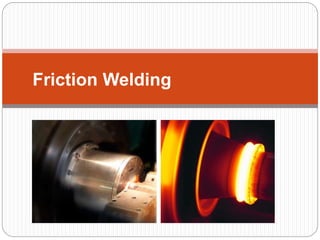
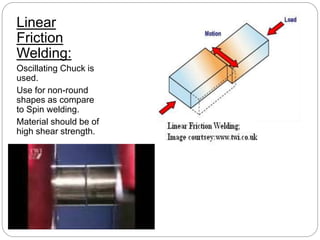
Friction Welding
Friction welding is a solid state
joining process that produces
coalescence by the heat
developed between two surfaces
by mechanically induced surface
motion.
•It is solid state joining process.
•Mechanical friction between a
moving work piece and a stationary
component.
•Lateral force (upset) is applied to
plastically displace and fuse the
materials
Introduction
Types of Friction Welding
Spin
Welding:
A rotating chuck
along with flywheel.
After reaching to
required speed motor
is removed from
flywheel.
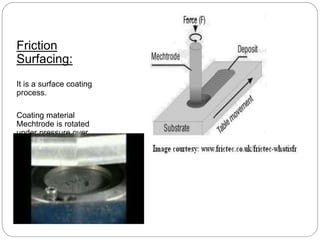
Linear
Friction
Welding:
Oscillating Chuck is
used.
Use for non-round
shapes as compare
to Spin welding.
Material should be of
high shear strength.
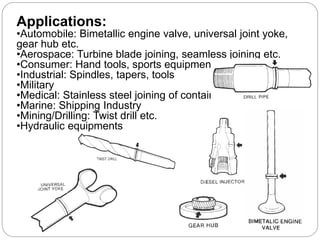
Friction
Surfacing:
It is a surface coating
process.
Coating material
Mechtrode is rotated
under pressure over
substrate.
Friction Stir
Welding:
A cylindrical shouldered tool,
with a profiled probe (nib or
pin) is used.
Friction is between tool
shoulder, nib and work metal.
Advantages of Friction Welding
•Simplicity of operation and simple equipment.
•Less time requirement.
•Low Surface impurities and oxide films.
•Compare to resistance butt welding produces improved welds at higher
speed and lower cost, less electric current is required.
•Heat affected zone is small as compare to conventional flash welding.
•Less shortening of the component, as compared to that in flash or butt
welding.
•There is no flux, gas, filler metal or slag present to cause imperfections in
welds.
Disadvantages of Friction
Welding
•Process is restricted to flat and
angular butt welds.
•Use only for joining small parts.
•In case of tube welding process
becomes complicated.
•In case of high carbon steels it is
difficult to remove flash.
•It require heavy rigid machine due to
high Thrust pressure.
Friction Welding Machine
Applications:
•Automobile: Bimetallic engine valve, universal joint yoke,
gear hub etc.
•Aerospace: Turbine blade joining, seamless joining etc.
•Consumer: Hand tools, sports equipment
•Industrial: Spindles, tapers, tools
•Military
•Medical: Stainless steel joining of containers
•Marine: Shipping Industry
•Mining/Drilling: Twist drill etc.
•Hydraulic equipments
Thank You
Preeti Joddabge

Friction welding

  • 1.
  • 2.
    Friction welding isa solid state joining process that produces coalescence by the heat developed between two surfaces by mechanically induced surface motion. •It is solid state joining process. •Mechanical friction between a moving work piece and a stationary component. •Lateral force (upset) is applied to plastically displace and fuse the materials Introduction
  • 3.
    Types of FrictionWelding Spin Welding: A rotating chuck along with flywheel. After reaching to required speed motor is removed from flywheel.
  • 4.
    Linear Friction Welding: Oscillating Chuck is used. Usefor non-round shapes as compare to Spin welding. Material should be of high shear strength.
  • 5.
    Friction Surfacing: It is asurface coating process. Coating material Mechtrode is rotated under pressure over substrate.
  • 6.
    Friction Stir Welding: A cylindricalshouldered tool, with a profiled probe (nib or pin) is used. Friction is between tool shoulder, nib and work metal.
  • 7.
    Advantages of FrictionWelding •Simplicity of operation and simple equipment. •Less time requirement. •Low Surface impurities and oxide films. •Compare to resistance butt welding produces improved welds at higher speed and lower cost, less electric current is required. •Heat affected zone is small as compare to conventional flash welding. •Less shortening of the component, as compared to that in flash or butt welding. •There is no flux, gas, filler metal or slag present to cause imperfections in welds. Disadvantages of Friction Welding •Process is restricted to flat and angular butt welds. •Use only for joining small parts. •In case of tube welding process becomes complicated. •In case of high carbon steels it is difficult to remove flash. •It require heavy rigid machine due to high Thrust pressure. Friction Welding Machine
  • 8.
    Applications: •Automobile: Bimetallic enginevalve, universal joint yoke, gear hub etc. •Aerospace: Turbine blade joining, seamless joining etc. •Consumer: Hand tools, sports equipment •Industrial: Spindles, tapers, tools •Military •Medical: Stainless steel joining of containers •Marine: Shipping Industry •Mining/Drilling: Twist drill etc. •Hydraulic equipments
  • 9.