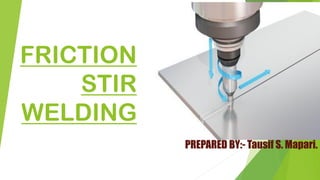
FRICTION
STIR
WELDING
PREPARED BY:- Tausif S. Mapari.
INTRODUCTION
 Welding is a process of joining of different or similar
material.
 Advantages
economical
considerable freedom in designing
large no. of dissimilar or similar materials
joined
weld as strong as the parent metal
OBJECTIVES:
1.A comprehensive literature survey of friction stir welding
affordable for joining aluminum sheet.
2.To development of FSW tool.
3.To investigations of mechanical and metallurgical behavior
during FSW of Aluminum.
4.To Measure tensile strength on weld specimen.
CLASSIFICATION OF WELDING
 Mainly welding is classified into two categories. They are:
a)Fusion welding :
* heated to molten state
* no pressure required
* Example: Gas welding, Arc welding
b) Plastic welding:
*heated to plastic state
*pressure required
*Example: friction welding, forge welding
FRICTION STIR WELDING
 Friction is the force resisting the relative motion of solid
surfaces, fluid layers, and material elements sliding against
each other
 Welding using friction as the major resource is called
friction stir welding.
Welds created by,
a) Frictional heating
b) Mechanical deformation
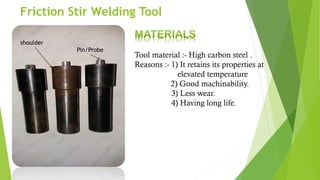
Friction Stir Welding Tool
Tool material :- High carbon steel .
Reasons :- 1) It retains its properties at
elevated temperature
2) Good machinability.
3) Less wear.
4) Having long life.
Pin/Probe
shoulder
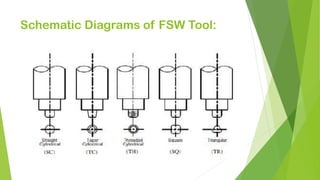
Schematic Diagrams of FSW Tool:
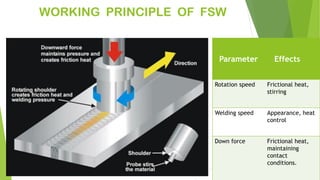
WORKING PRINCIPLE OF FSW
Parameter Effects
Rotation speed Frictional heat,
stirring
Welding speed Appearance, heat
control
Down force Frictional heat,
maintaining
contact
conditions.
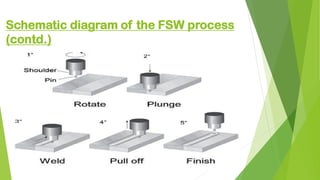
Schematic diagram of the FSW process
(contd.)
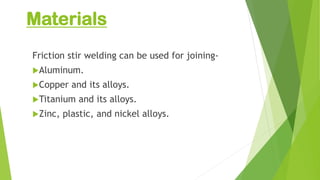
Materials
Friction stir welding can be used for joining-
Aluminum.
Copper and its alloys.
Titanium and its alloys.
Zinc, plastic, and nickel alloys.
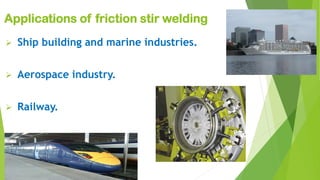
Applications of friction stir welding
➢ Ship building and marine industries.
➢ Aerospace industry.
➢ Railway.
`
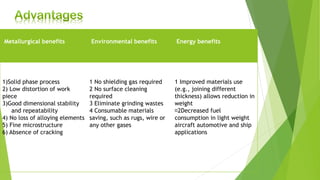
Metallurgical benefits Environmental benefits Energy benefits
1)Solid phase process
2) Low distortion of work
piece
3)Good dimensional stability
and repeatability
4) No loss of alloying elements
5) Fine microstructure
6) Absence of cracking
1 No shielding gas required
2 No surface cleaning
required
3 Eliminate grinding wastes
4 Consumable materials
saving, such as rugs, wire or
any other gases
1 Improved materials use
(e.g., joining different
thickness) allows reduction in
weight
2Decreased fuel
consumption in light weight
aircraft automotive and ship
applications
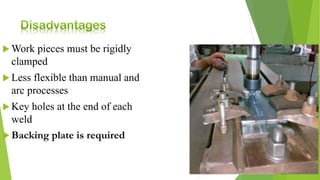
 Work pieces must be rigidly
clamped
 Less flexible than manual and
arc processes
 Key holes at the end of each
weld
 Backing plate is required
Conclusion
✓ New technology with vital application in
aerospace and marine
✓ Presently limited to aluminum ,its alloys and
related metals
✓ FSW of steel and titanium alloys are
developed and they are in the nascent stage
✓ Will emerge as a better welding technology
Thank You

Friction stir welding

  • 1.
  • 2.
    INTRODUCTION  Welding isa process of joining of different or similar material.  Advantages economical considerable freedom in designing large no. of dissimilar or similar materials joined weld as strong as the parent metal
  • 3.
    OBJECTIVES: 1.A comprehensive literaturesurvey of friction stir welding affordable for joining aluminum sheet. 2.To development of FSW tool. 3.To investigations of mechanical and metallurgical behavior during FSW of Aluminum. 4.To Measure tensile strength on weld specimen.
  • 4.
    CLASSIFICATION OF WELDING Mainly welding is classified into two categories. They are: a)Fusion welding : * heated to molten state * no pressure required * Example: Gas welding, Arc welding b) Plastic welding: *heated to plastic state *pressure required *Example: friction welding, forge welding
  • 5.
    FRICTION STIR WELDING Friction is the force resisting the relative motion of solid surfaces, fluid layers, and material elements sliding against each other  Welding using friction as the major resource is called friction stir welding. Welds created by, a) Frictional heating b) Mechanical deformation
  • 6.
    Friction Stir WeldingTool Tool material :- High carbon steel . Reasons :- 1) It retains its properties at elevated temperature 2) Good machinability. 3) Less wear. 4) Having long life. Pin/Probe shoulder
  • 7.
  • 8.
    WORKING PRINCIPLE OFFSW Parameter Effects Rotation speed Frictional heat, stirring Welding speed Appearance, heat control Down force Frictional heat, maintaining contact conditions.
  • 9.
    Schematic diagram ofthe FSW process (contd.)
  • 10.
    Materials Friction stir weldingcan be used for joining- Aluminum. Copper and its alloys. Titanium and its alloys. Zinc, plastic, and nickel alloys.
  • 11.
    Applications of frictionstir welding ➢ Ship building and marine industries. ➢ Aerospace industry. ➢ Railway.
  • 12.
    ` Metallurgical benefits Environmentalbenefits Energy benefits 1)Solid phase process 2) Low distortion of work piece 3)Good dimensional stability and repeatability 4) No loss of alloying elements 5) Fine microstructure 6) Absence of cracking 1 No shielding gas required 2 No surface cleaning required 3 Eliminate grinding wastes 4 Consumable materials saving, such as rugs, wire or any other gases 1 Improved materials use (e.g., joining different thickness) allows reduction in weight 2Decreased fuel consumption in light weight aircraft automotive and ship applications
  • 13.
     Work piecesmust be rigidly clamped  Less flexible than manual and arc processes  Key holes at the end of each weld  Backing plate is required
  • 14.
    Conclusion ✓ New technologywith vital application in aerospace and marine ✓ Presently limited to aluminum ,its alloys and related metals ✓ FSW of steel and titanium alloys are developed and they are in the nascent stage ✓ Will emerge as a better welding technology
  • 15.