Dr. Shailesh Kumar Dewangan
Assistant Professor
Department of Production Engineering,
BIT Mesra Ranchi
Metal Forming Process
Hot Working and Cold Working
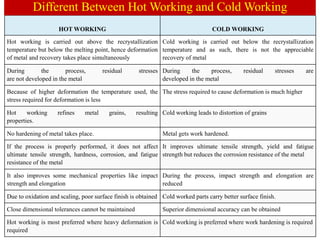
HOT WORKING COLD WORKING
Hot working is carried out above the recrystallization
temperature but below the melting point, hence deformation
of metal and recovery takes place simultaneously
Cold working is carried out below the recrystallization
temperature and as such, there is not the appreciable
recovery of metal
During the process, residual stresses
are not developed in the metal
During the process, residual stresses are
developed in the metal
Because of higher deformation the temperature used, the
stress required for deformation is less
The stress required to cause deformation is much higher
Hot working refines metal grains, resulting
properties.
Cold working leads to distortion of grains
No hardening of metal takes place. Metal gets work hardened.
If the process is properly performed, it does not affect
ultimate tensile strength, hardness, corrosion, and fatigue
resistance of the metal
It improves ultimate tensile strength, yield and fatigue
strength but reduces the corrosion resistance of the metal
It also improves some mechanical properties like impact
strength and elongation
During the process, impact strength and elongation are
reduced
Due to oxidation and scaling, poor surface finish is obtained Cold worked parts carry better surface finish.
Close dimensional tolerances cannot be maintained Superior dimensional accuracy can be obtained
Hot working is most preferred where heavy deformation is
required
Cold working is preferred where work hardening is required
Different Between Hot Working and Cold Working
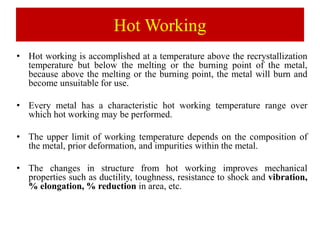
Hot Working
• Hot working is accomplished at a temperature above the recrystallization
temperature but below the melting or the burning point of the metal,
because above the melting or the burning point, the metal will burn and
become unsuitable for use.
• Every metal has a characteristic hot working temperature range over
which hot working may be performed.
• The upper limit of working temperature depends on the composition of
the metal, prior deformation, and impurities within the metal.
• The changes in structure from hot working improves mechanical
properties such as ductility, toughness, resistance to shock and vibration,
% elongation, % reduction in area, etc.
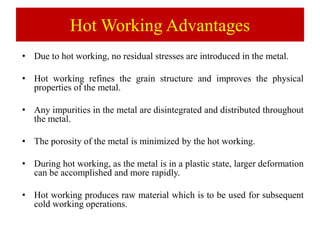
Hot Working Advantages
• Due to hot working, no residual stresses are introduced in the metal.
• Hot working refines the grain structure and improves the physical
properties of the metal.
• Any impurities in the metal are disintegrated and distributed throughout
the metal.
• The porosity of the metal is minimized by the hot working.
• During hot working, as the metal is in a plastic state, larger deformation
can be accomplished and more rapidly.
• Hot working produces raw material which is to be used for subsequent
cold working operations.
Hot Working Disadvantages
• Due to the loss of carbon from the surface of the
steel piece being worked, the surface layer loses its
strength.
• This weakening of the surface layer may give rise
to fatigue crack which results in failure of the part.
• Close tolerances cannot be obtained.
• Hot working involves excessive expenditure on
account of high tooling costs.
Cold Working
• The working of metals at temperatures below their recrystallization
temperature is called as cold working.
• Most of the cold working processes are performed at room
temperature.
• Unlike hot working, it distorts the grain structure and does not
provide an appreciable reduction in size.
• Cold working requires much higher pressure than hot working.
• If the material is more ductile, it can be more cold worked.
• Cold Working results in Strain Hardening, distortion of grains and
the crystallographic structure.
Cold Working Advantages
• Better dimensional control is possible because there is not
much reduction in size.
• The surface finish of the component is better because no
oxidation takes place during the process.
• Strength and hardness of metal are increased.
• It is an ideal method for increasing the hardness of those
metals which do not respond to heat treatment.
Cold Working Disadvantages
• The ductility of the metal is decreased during the process.
• Only ductile metals can be shaped through cold working.
• Over-working of metal results in brittleness and it has to be
annealed to remove this brittleness.
• To remove the residual stresses set up during the process,
subsequent heat treatment is mostly required.
Hot Working and Cold working Operation.pptx

Hot Working and Cold working Operation.pptx

  • 1.
    Dr. Shailesh KumarDewangan Assistant Professor Department of Production Engineering, BIT Mesra Ranchi Metal Forming Process Hot Working and Cold Working
  • 2.
    HOT WORKING COLDWORKING Hot working is carried out above the recrystallization temperature but below the melting point, hence deformation of metal and recovery takes place simultaneously Cold working is carried out below the recrystallization temperature and as such, there is not the appreciable recovery of metal During the process, residual stresses are not developed in the metal During the process, residual stresses are developed in the metal Because of higher deformation the temperature used, the stress required for deformation is less The stress required to cause deformation is much higher Hot working refines metal grains, resulting properties. Cold working leads to distortion of grains No hardening of metal takes place. Metal gets work hardened. If the process is properly performed, it does not affect ultimate tensile strength, hardness, corrosion, and fatigue resistance of the metal It improves ultimate tensile strength, yield and fatigue strength but reduces the corrosion resistance of the metal It also improves some mechanical properties like impact strength and elongation During the process, impact strength and elongation are reduced Due to oxidation and scaling, poor surface finish is obtained Cold worked parts carry better surface finish. Close dimensional tolerances cannot be maintained Superior dimensional accuracy can be obtained Hot working is most preferred where heavy deformation is required Cold working is preferred where work hardening is required Different Between Hot Working and Cold Working
  • 3.
    Hot Working • Hotworking is accomplished at a temperature above the recrystallization temperature but below the melting or the burning point of the metal, because above the melting or the burning point, the metal will burn and become unsuitable for use. • Every metal has a characteristic hot working temperature range over which hot working may be performed. • The upper limit of working temperature depends on the composition of the metal, prior deformation, and impurities within the metal. • The changes in structure from hot working improves mechanical properties such as ductility, toughness, resistance to shock and vibration, % elongation, % reduction in area, etc.
  • 4.
    Hot Working Advantages •Due to hot working, no residual stresses are introduced in the metal. • Hot working refines the grain structure and improves the physical properties of the metal. • Any impurities in the metal are disintegrated and distributed throughout the metal. • The porosity of the metal is minimized by the hot working. • During hot working, as the metal is in a plastic state, larger deformation can be accomplished and more rapidly. • Hot working produces raw material which is to be used for subsequent cold working operations.
  • 5.
    Hot Working Disadvantages •Due to the loss of carbon from the surface of the steel piece being worked, the surface layer loses its strength. • This weakening of the surface layer may give rise to fatigue crack which results in failure of the part. • Close tolerances cannot be obtained. • Hot working involves excessive expenditure on account of high tooling costs.
  • 6.
    Cold Working • Theworking of metals at temperatures below their recrystallization temperature is called as cold working. • Most of the cold working processes are performed at room temperature. • Unlike hot working, it distorts the grain structure and does not provide an appreciable reduction in size. • Cold working requires much higher pressure than hot working. • If the material is more ductile, it can be more cold worked. • Cold Working results in Strain Hardening, distortion of grains and the crystallographic structure.
  • 7.
    Cold Working Advantages •Better dimensional control is possible because there is not much reduction in size. • The surface finish of the component is better because no oxidation takes place during the process. • Strength and hardness of metal are increased. • It is an ideal method for increasing the hardness of those metals which do not respond to heat treatment.
  • 8.
    Cold Working Disadvantages •The ductility of the metal is decreased during the process. • Only ductile metals can be shaped through cold working. • Over-working of metal results in brittleness and it has to be annealed to remove this brittleness. • To remove the residual stresses set up during the process, subsequent heat treatment is mostly required.