2
FREEZING
• There are different methods of commercial freezing
available, but they are all based on two concepts.
• Very low temperatures inhibit growth of micro-organisms
and limit enzyme and chemical activity.
• The formation of ice crystals draws available water from
the food, also preventing growth of micro-organisms.
Treatment prior to freezing
-
• Blanching of some fruits and most vegetables to
inactivate peroxidase, catalase and brown enzymes, reduce
cellular oxygen, reduce microbial numbers and improve
color
-• Addition of or dipping into ascorbic acid or sulphur dioxide
solutions to retain color and reduce browning.
Methods of Freezing
The freezing methods are classified as two methods
FAST FREEZING
 Quick or fast freezing occurs
at –25ºC or less.Ice crystals
are small and do not damage
food cells.
SLOW FREEZING
 Slow freezing occurs at -24ºC or
above.Ice crystals are big and
damage the food cells causing
loss of texture, nutrients, color
& flavour on thawing.
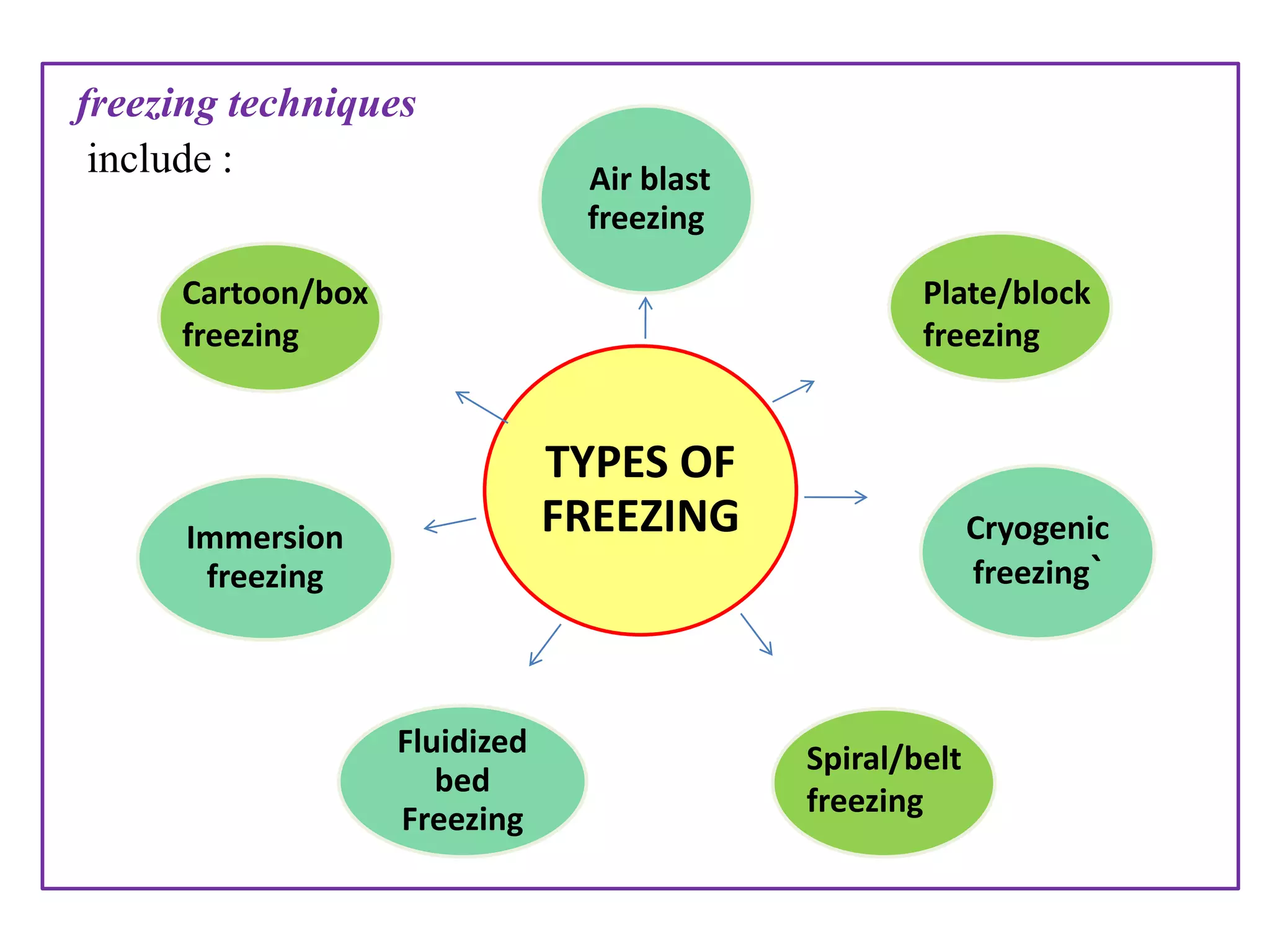
TYPES OF
FREEZING
Air blast
freezing
Cryogenic
freezing`
Fluidized
bed
Freezing
Immersion
freezing
freezing techniques
include :
Cartoon/box
freezing
Plate/block
freezing
Spiral/belt
freezing
SELECTION OF FREEZING METHOD
Freezing method chosen for each product will depend on :
a. Product quality and freezing rate desired
b. Type and shape of product, package, etc.
c. Flexibility required in freezing operations.
d. Costs of freezing
AIR BLAST FREEZING
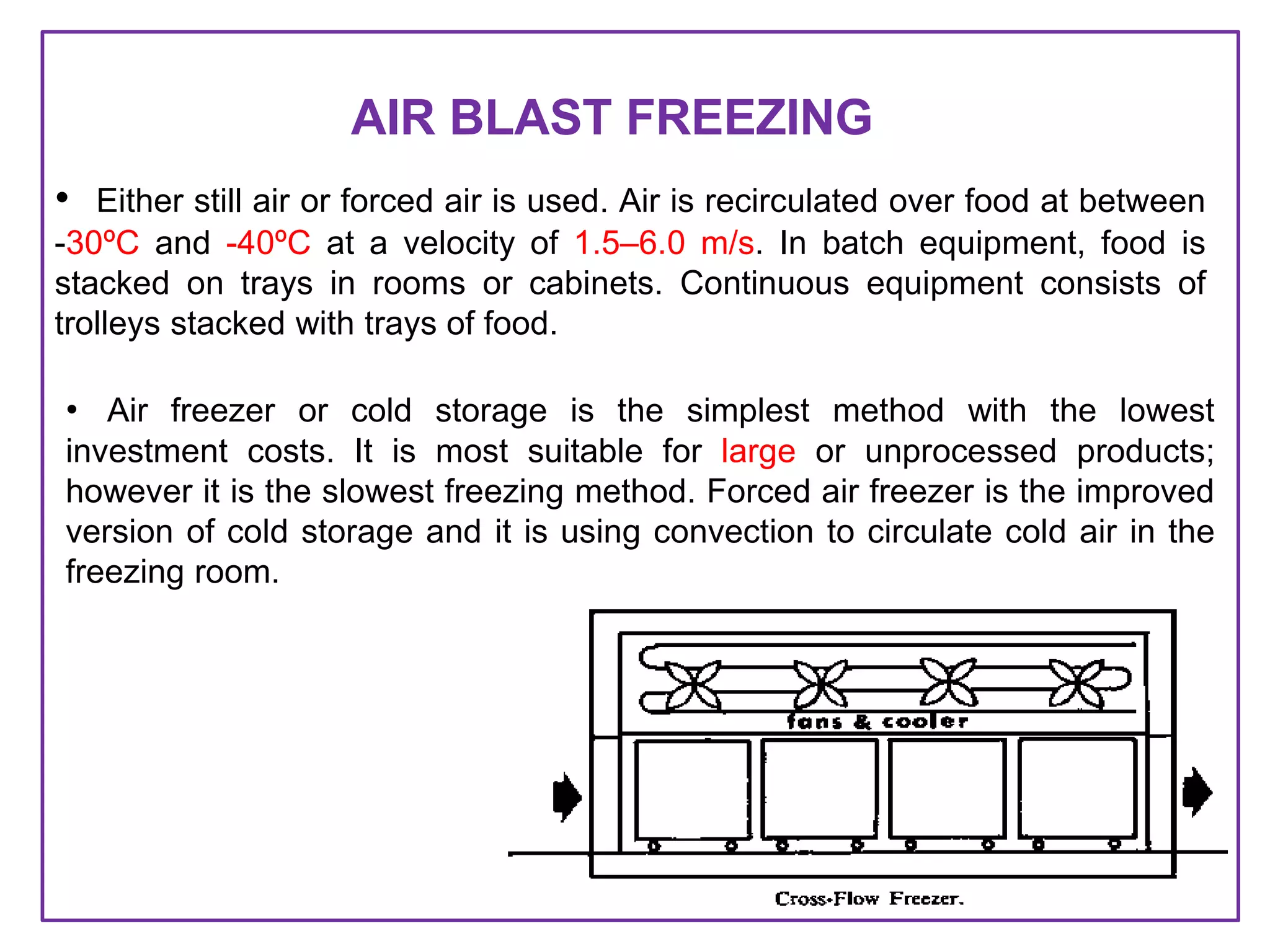
• Either still air or forced air is used. Air is recirculated over food at between
-30ºC and -40ºC at a velocity of 1.5–6.0 m/s. In batch equipment, food is
stacked on trays in rooms or cabinets. Continuous equipment consists of
trolleys stacked with trays of food.
• Air freezer or cold storage is the simplest method with the lowest
investment costs. It is most suitable for large or unprocessed products;
however it is the slowest freezing method. Forced air freezer is the improved
version of cold storage and it is using convection to circulate cold air in the
freezing room.
ADVANTAGES
• It can be suitable for any types of products.
• This process can freeze irregular shaped foods, including those
which have already been packaged, e.g. battered fish pieces.
• It is the cheapest freezing method, air blast freezers are used on a
wide range of products.
DISADVANTAGES
• High manpower needed
for operation
• Slow freezing.
CARTOON/BOX FREEZING
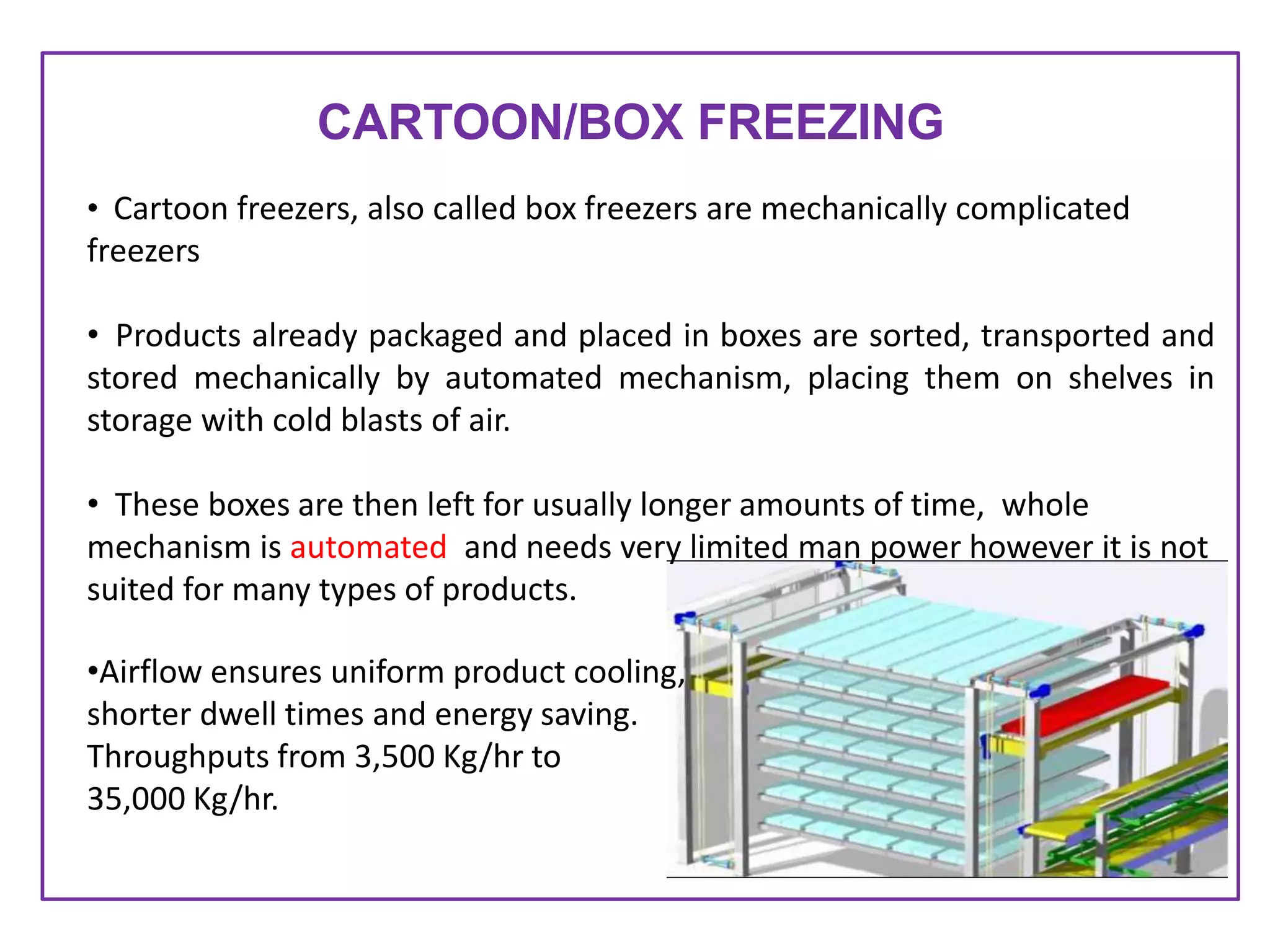
• Cartoon freezers, also called box freezers are mechanically complicated
freezers
• Products already packaged and placed in boxes are sorted, transported and
stored mechanically by automated mechanism, placing them on shelves in
storage with cold blasts of air.
• These boxes are then left for usually longer amounts of time, whole
mechanism is automated and needs very limited man power however it is not
suited for many types of products.
•Airflow ensures uniform product cooling,
shorter dwell times and energy saving.
Throughputs from 3,500 Kg/hr to
35,000 Kg/hr.
```
ADVANTAGES
• Needs very limited man power
• Using belts is the extremely accurate control of transportation process
DISADVANTAGES
• Maintenance requirement, difficulty of cleaning or belt marks left on the
product
• Immersion method is the fastest freezing method
• It is commonly used as a pre-treatment of large products in order to
create a frozen layer before the product is exposed to longer freezing
time, in order to avoid dehydration.
• Traditionally foods were immersed in solutions of salt and ice for
several hours, e.g. brine, freezing of fish at sea. However, modern
methods of freezing have meant that this process is rarely used.
Refrigerants are now sprayed directly onto the food.
• Direct immersion in refrigerants [(glycols, glycerol, sodium chloride,
calcium chloride, and mixtures of salt and sugars)].
• The challenge with this method is that the solution becomes quickly
diluted with the product which can change the process speed and
efficiency.
IMMERSION FREEZING
PLATE FREEZING
• The food is prepared as normal, then packed between flat,
hollow, refrigerated metal plates.
• These are adjusted to press tightly on the food and reduce
any air gaps.
• The plates may be horizontal or vertical, the latter being
used for many bulky products, such as blocks of fish for fish
fingers.
• This system is ideal for freezing large blocks of product,
but cannot easily freeze irregular shaped items.
FLUIDISED BED FREEZING
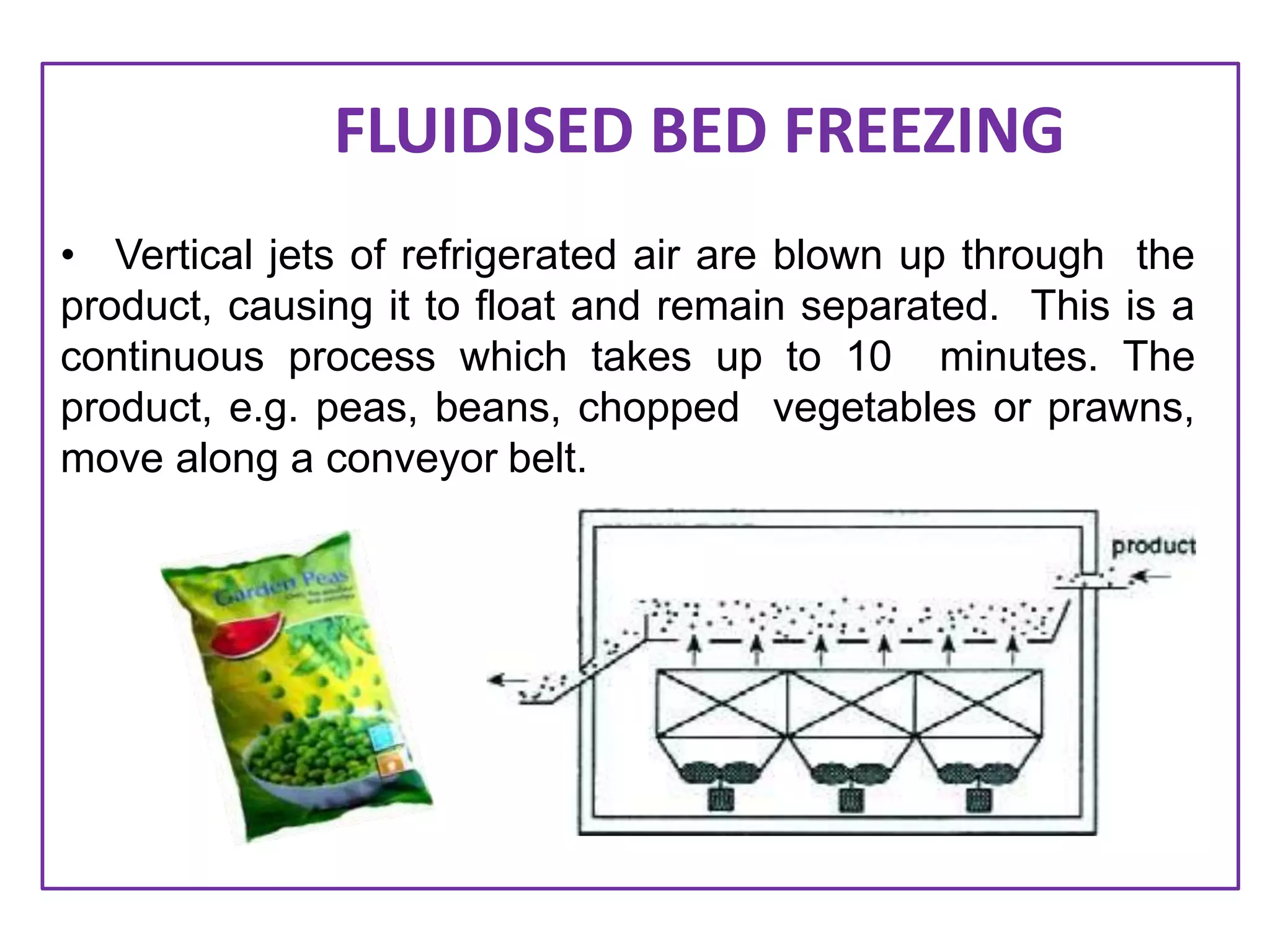
• Vertical jets of refrigerated air are blown up through the
product, causing it to float and remain separated. This is a
continuous process which takes up to 10 minutes. The
product, e.g. peas, beans, chopped vegetables or prawns,
move along a conveyor belt.
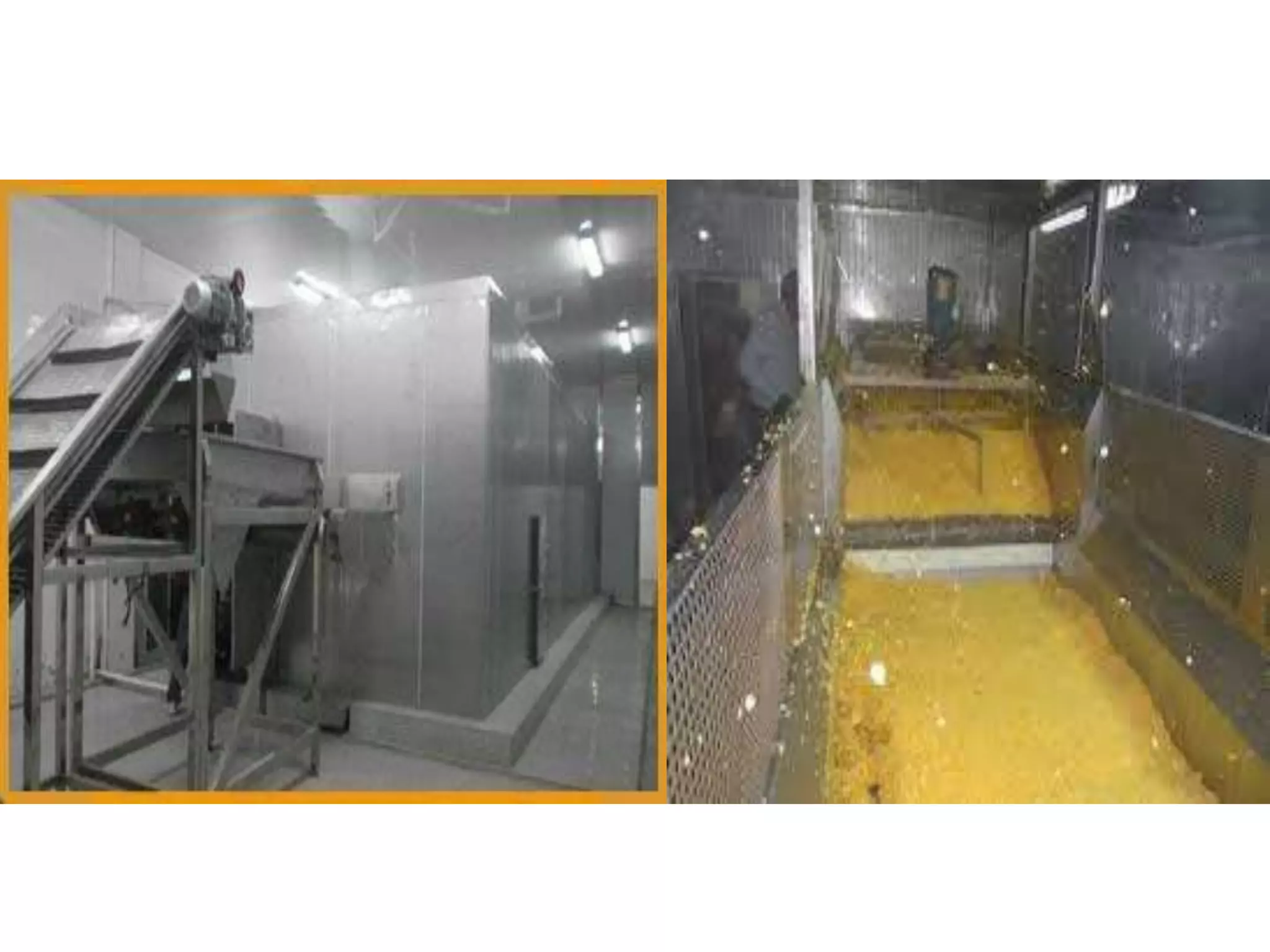
CRYOGENIC FREEZING
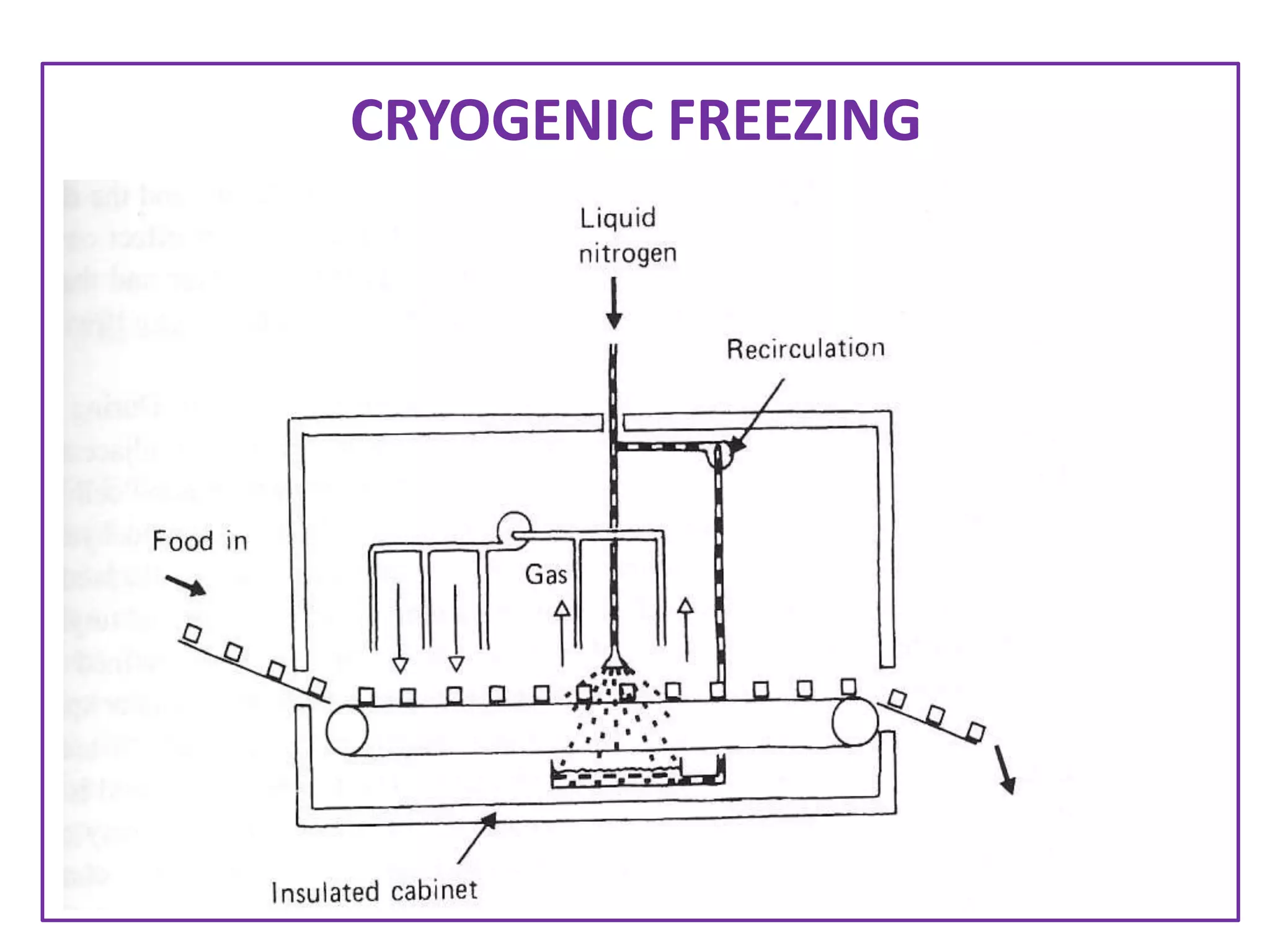
• Liquid nitrogen or carbon dioxide is sprayed directly onto
small food items such as soft fruit and prawns.
• Due to the liquids’ extremely low temperatures (-196ºC)
and -78ºC respectively) freezing is almost instant. The
nitrogen gas is removed by fans.
• Liquid carbon dioxide is used for larger products.
CRYOGENIC FREEZING
LIQUID CARBONDIOXIDE FREEZING
• When the CO2 gas is released to the atmosphere
at -70 °C, half of the gas becomes dry-ice snow and
the other half stays in the form of vapor.
• This unusual property of liquid carbon dioxide is
used in a variety of freezing systems, one of
which is a pre-freezing treatment before the
product is exposed to nitrogen spray
SPIRAL BELT FREEZER
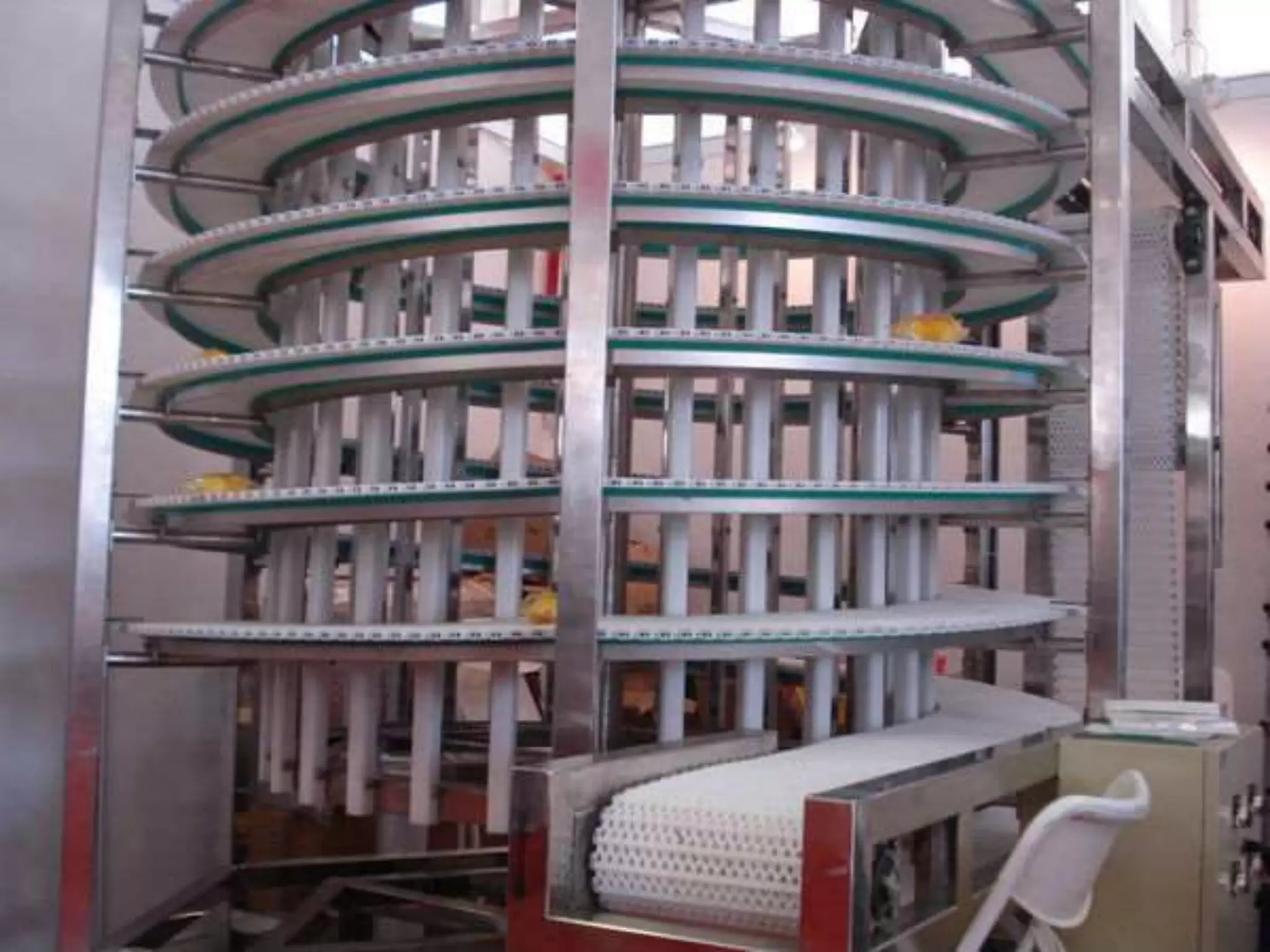
• In this case, the belt is bent around a central
supporting structure, maximizing the belt surface in a
limited space.
• The spiral belt freezer can be a good solution for
gentle products as it minimizes product damage at
transfer points.
• This technology also presents the advantage of very
large amount of square metres on a limited footprint
allowing high capacity and continuous production with
limited man power.
• However the spiral belt freezer still presents the
disadvantages of the belt.
Commercially Frozen Foods
Fruits - strawberries, oranges, raspberries,
blackcurrants), whole or pureed, or juice
concentrates
Vegetables - peas, green beans, sweet corn,
spinach, sprouts & potatoes
Fish fillets & sea foods - cod, plaice, shrimps
and crab meat incl. fish fingers, fish cakes or
prepared dishes with sauce
Meats - beef, lamb, poultry as carcasses,
boxed joints or cubes,& meat products -
sausages, beef burgers, reformed steaks.
Baked goods - bread, cakes, fruit & meat pies
Prepared foods - pizzas, desserts, ice cream,
complete meals & cook–freeze dishes
ADVANTAGES OF FREEZING
Many foods can be frozen.
Natural color, flavor, and nutritive value retained.
Texture usually better than other methods of food
preservation.
Foods can be frozen in less time than they can be
dried or canned.
Simple procedures.
Adds convenience to food preparation.
Proportions can be adapted to needs unlike other
home preservation methods.
Kitchen remains cool and comfortable.
DISADVANTAGES OF FREEZING
 Changes in colour (loss of natural colour constituents,
chlorophyll pigments, development of off colour)
Changes in texture (loss of cloud destruction of gels,
denaturation, toughening)
Changes in flavour (loss of natural flavour, development of off -
flavour, rancidity)
Changes in nutrients, such as ascorbic acid in fruits and
vegetables, unsaturated lipids, essential amino acids.
Initial investment and cost of maintaining freezer is high.
Storage space limited by capacity of freezer.
Freezing Time Estimation Methods
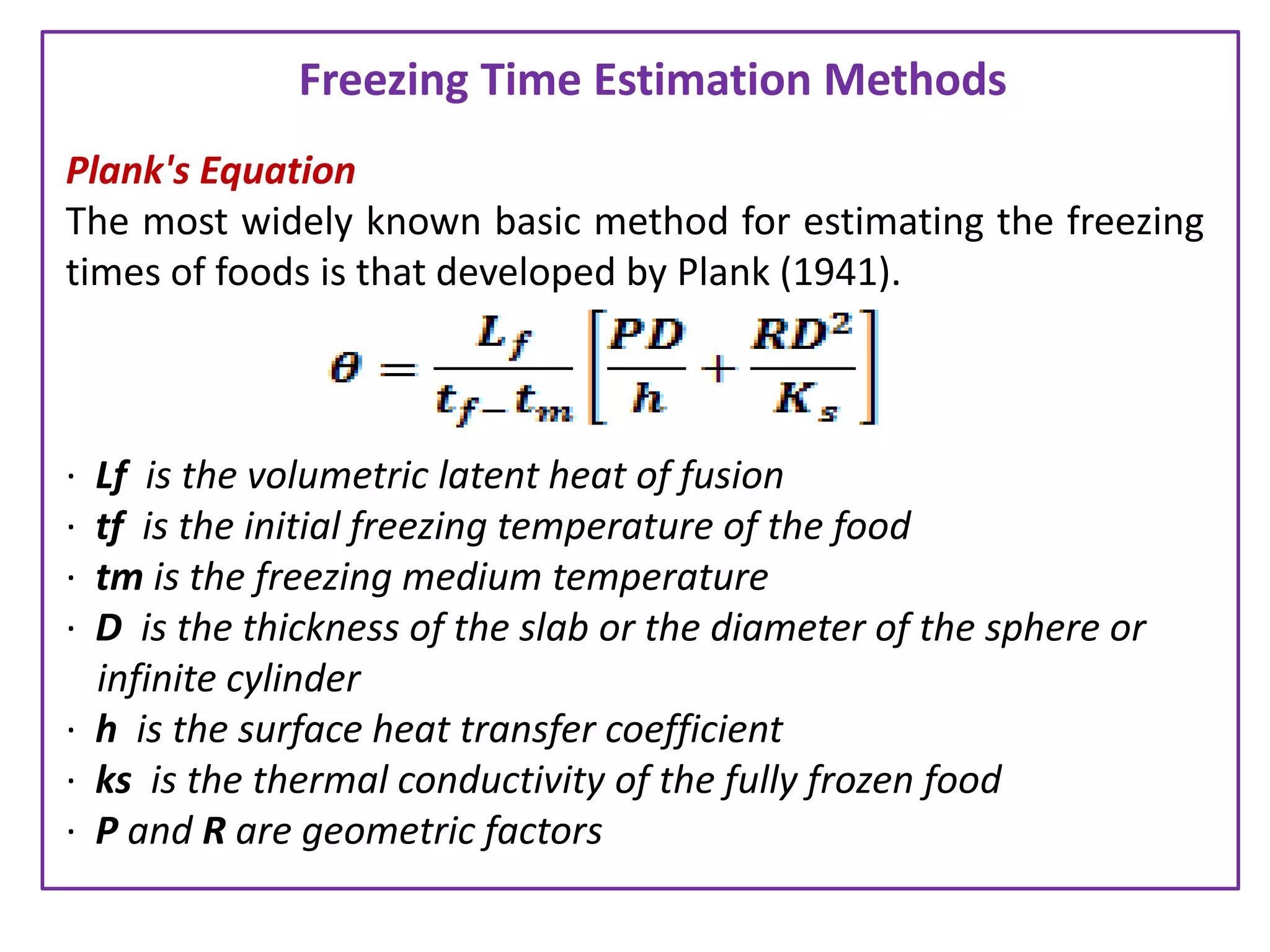
Plank's Equation
The most widely known basic method for estimating the freezing
times of foods is that developed by Plank (1941).
· Lf is the volumetric latent heat of fusion
· tf is the initial freezing temperature of the food
· tm is the freezing medium temperature
· D is the thickness of the slab or the diameter of the sphere or
infinite cylinder
· h is the surface heat transfer coefficient
· ks is the thermal conductivity of the fully frozen food
· P and R are geometric factors
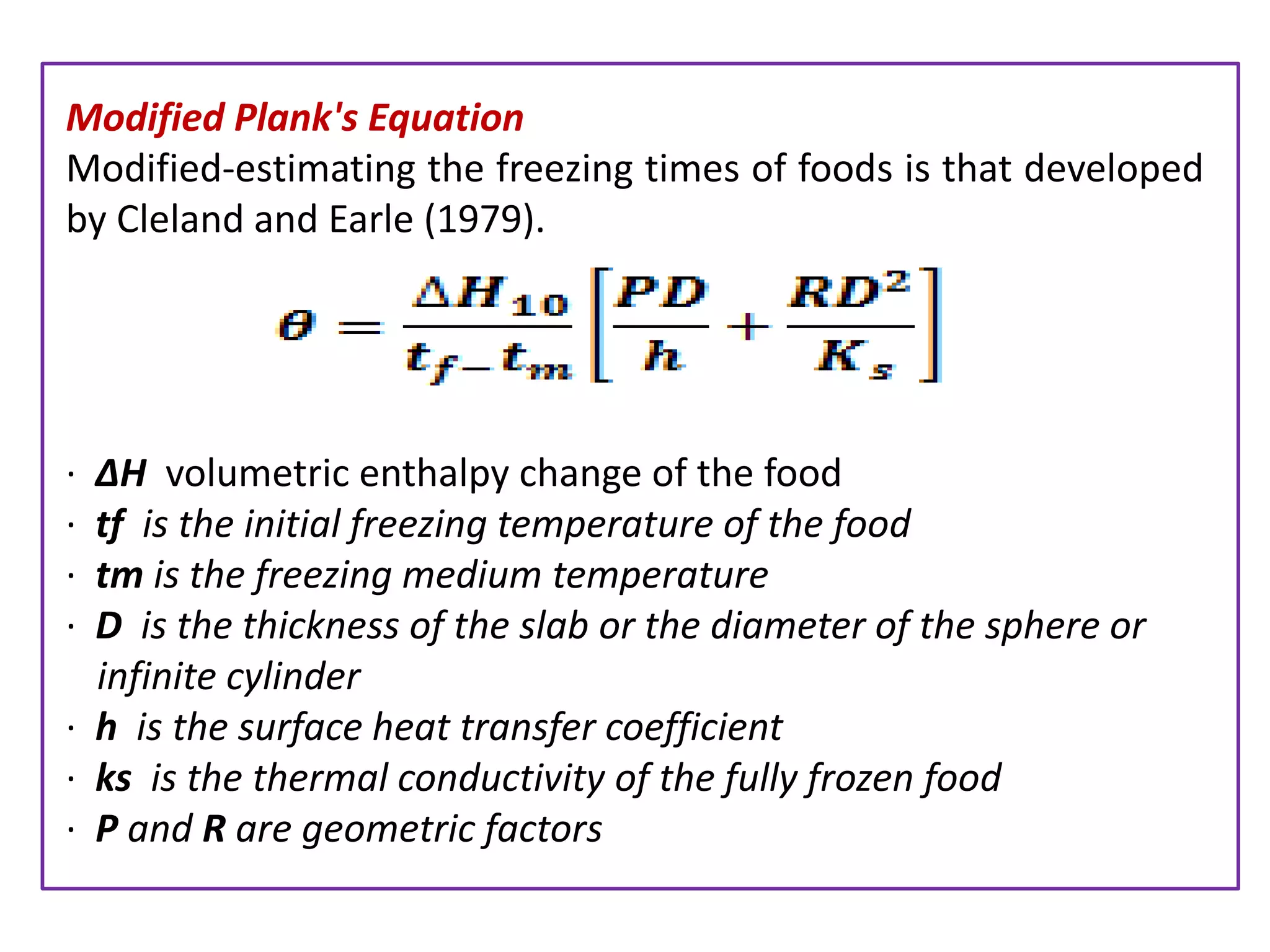
Modified Plank's Equation
Modified-estimating the freezing times of foods is that developed
by Cleland and Earle (1979).
· ΔH volumetric enthalpy change of the food
· tf is the initial freezing temperature of the food
· tm is the freezing medium temperature
· D is the thickness of the slab or the diameter of the sphere or
infinite cylinder
· h is the surface heat transfer coefficient
· ks is the thermal conductivity of the fully frozen food
· P and R are geometric factors
calculation of food freezing times using the prediction methods described above requires
the
convection heat transfer coefficient.
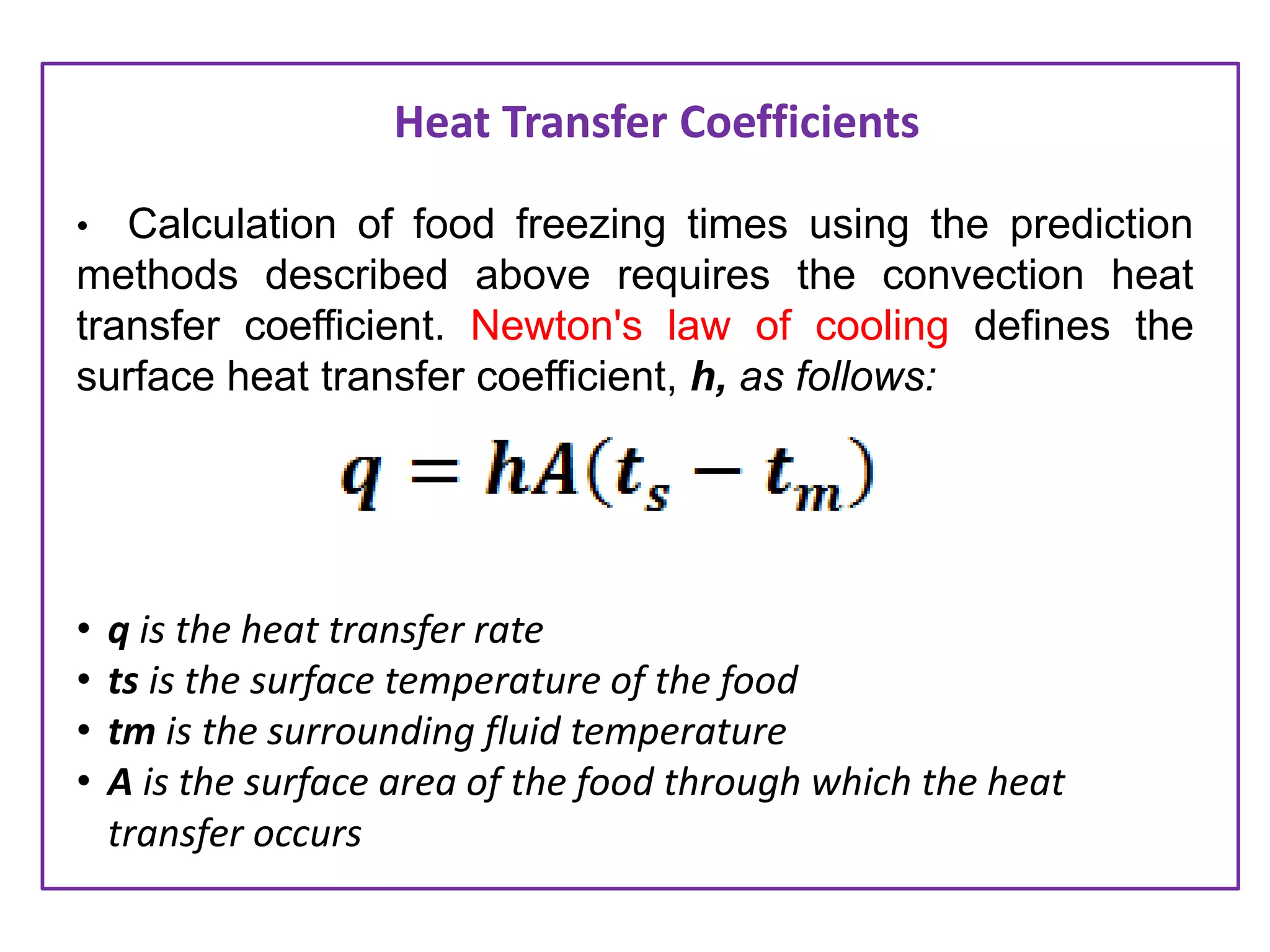
Newton's law of cooling defines the surface heat transfer coefficient, h, as follows:
Heat Transfer Coefficients
• Calculation of food freezing times using the prediction
methods described above requires the convection heat
transfer coefficient. Newton's law of cooling defines the
surface heat transfer coefficient, h, as follows:
• q is the heat transfer rate
• ts is the surface temperature of the food
• tm is the surrounding fluid temperature
• A is the surface area of the food through which the heat
transfer occurs
Freezing ppt  p.divya

Freezing ppt p.divya

  • 2.
    2 FREEZING • There aredifferent methods of commercial freezing available, but they are all based on two concepts. • Very low temperatures inhibit growth of micro-organisms and limit enzyme and chemical activity. • The formation of ice crystals draws available water from the food, also preventing growth of micro-organisms.
  • 3.
    Treatment prior tofreezing - • Blanching of some fruits and most vegetables to inactivate peroxidase, catalase and brown enzymes, reduce cellular oxygen, reduce microbial numbers and improve color -• Addition of or dipping into ascorbic acid or sulphur dioxide solutions to retain color and reduce browning.
  • 4.
    Methods of Freezing Thefreezing methods are classified as two methods FAST FREEZING  Quick or fast freezing occurs at –25ºC or less.Ice crystals are small and do not damage food cells. SLOW FREEZING  Slow freezing occurs at -24ºC or above.Ice crystals are big and damage the food cells causing loss of texture, nutrients, color & flavour on thawing.
  • 5.
    TYPES OF FREEZING Air blast freezing Cryogenic freezing` Fluidized bed Freezing Immersion freezing freezingtechniques include : Cartoon/box freezing Plate/block freezing Spiral/belt freezing
  • 6.
    SELECTION OF FREEZINGMETHOD Freezing method chosen for each product will depend on : a. Product quality and freezing rate desired b. Type and shape of product, package, etc. c. Flexibility required in freezing operations. d. Costs of freezing
  • 7.
    AIR BLAST FREEZING •Either still air or forced air is used. Air is recirculated over food at between -30ºC and -40ºC at a velocity of 1.5–6.0 m/s. In batch equipment, food is stacked on trays in rooms or cabinets. Continuous equipment consists of trolleys stacked with trays of food. • Air freezer or cold storage is the simplest method with the lowest investment costs. It is most suitable for large or unprocessed products; however it is the slowest freezing method. Forced air freezer is the improved version of cold storage and it is using convection to circulate cold air in the freezing room.
  • 8.
    ADVANTAGES • It canbe suitable for any types of products. • This process can freeze irregular shaped foods, including those which have already been packaged, e.g. battered fish pieces. • It is the cheapest freezing method, air blast freezers are used on a wide range of products. DISADVANTAGES • High manpower needed for operation • Slow freezing.
  • 9.
    CARTOON/BOX FREEZING • Cartoonfreezers, also called box freezers are mechanically complicated freezers • Products already packaged and placed in boxes are sorted, transported and stored mechanically by automated mechanism, placing them on shelves in storage with cold blasts of air. • These boxes are then left for usually longer amounts of time, whole mechanism is automated and needs very limited man power however it is not suited for many types of products. •Airflow ensures uniform product cooling, shorter dwell times and energy saving. Throughputs from 3,500 Kg/hr to 35,000 Kg/hr.
  • 10.
    ``` ADVANTAGES • Needs verylimited man power • Using belts is the extremely accurate control of transportation process DISADVANTAGES • Maintenance requirement, difficulty of cleaning or belt marks left on the product
  • 11.
    • Immersion methodis the fastest freezing method • It is commonly used as a pre-treatment of large products in order to create a frozen layer before the product is exposed to longer freezing time, in order to avoid dehydration. • Traditionally foods were immersed in solutions of salt and ice for several hours, e.g. brine, freezing of fish at sea. However, modern methods of freezing have meant that this process is rarely used. Refrigerants are now sprayed directly onto the food. • Direct immersion in refrigerants [(glycols, glycerol, sodium chloride, calcium chloride, and mixtures of salt and sugars)]. • The challenge with this method is that the solution becomes quickly diluted with the product which can change the process speed and efficiency. IMMERSION FREEZING
  • 13.
    PLATE FREEZING • Thefood is prepared as normal, then packed between flat, hollow, refrigerated metal plates. • These are adjusted to press tightly on the food and reduce any air gaps. • The plates may be horizontal or vertical, the latter being used for many bulky products, such as blocks of fish for fish fingers. • This system is ideal for freezing large blocks of product, but cannot easily freeze irregular shaped items.
  • 14.
    FLUIDISED BED FREEZING •Vertical jets of refrigerated air are blown up through the product, causing it to float and remain separated. This is a continuous process which takes up to 10 minutes. The product, e.g. peas, beans, chopped vegetables or prawns, move along a conveyor belt.
  • 16.
    CRYOGENIC FREEZING • Liquidnitrogen or carbon dioxide is sprayed directly onto small food items such as soft fruit and prawns. • Due to the liquids’ extremely low temperatures (-196ºC) and -78ºC respectively) freezing is almost instant. The nitrogen gas is removed by fans. • Liquid carbon dioxide is used for larger products.
  • 17.
  • 18.
    LIQUID CARBONDIOXIDE FREEZING •When the CO2 gas is released to the atmosphere at -70 °C, half of the gas becomes dry-ice snow and the other half stays in the form of vapor. • This unusual property of liquid carbon dioxide is used in a variety of freezing systems, one of which is a pre-freezing treatment before the product is exposed to nitrogen spray
  • 19.
    SPIRAL BELT FREEZER •In this case, the belt is bent around a central supporting structure, maximizing the belt surface in a limited space. • The spiral belt freezer can be a good solution for gentle products as it minimizes product damage at transfer points. • This technology also presents the advantage of very large amount of square metres on a limited footprint allowing high capacity and continuous production with limited man power. • However the spiral belt freezer still presents the disadvantages of the belt.
  • 22.
    Commercially Frozen Foods Fruits- strawberries, oranges, raspberries, blackcurrants), whole or pureed, or juice concentrates Vegetables - peas, green beans, sweet corn, spinach, sprouts & potatoes Fish fillets & sea foods - cod, plaice, shrimps and crab meat incl. fish fingers, fish cakes or prepared dishes with sauce Meats - beef, lamb, poultry as carcasses, boxed joints or cubes,& meat products - sausages, beef burgers, reformed steaks. Baked goods - bread, cakes, fruit & meat pies Prepared foods - pizzas, desserts, ice cream, complete meals & cook–freeze dishes
  • 23.
    ADVANTAGES OF FREEZING Manyfoods can be frozen. Natural color, flavor, and nutritive value retained. Texture usually better than other methods of food preservation. Foods can be frozen in less time than they can be dried or canned. Simple procedures. Adds convenience to food preparation. Proportions can be adapted to needs unlike other home preservation methods. Kitchen remains cool and comfortable.
  • 24.
    DISADVANTAGES OF FREEZING Changes in colour (loss of natural colour constituents, chlorophyll pigments, development of off colour) Changes in texture (loss of cloud destruction of gels, denaturation, toughening) Changes in flavour (loss of natural flavour, development of off - flavour, rancidity) Changes in nutrients, such as ascorbic acid in fruits and vegetables, unsaturated lipids, essential amino acids. Initial investment and cost of maintaining freezer is high. Storage space limited by capacity of freezer.
  • 25.
    Freezing Time EstimationMethods Plank's Equation The most widely known basic method for estimating the freezing times of foods is that developed by Plank (1941). · Lf is the volumetric latent heat of fusion · tf is the initial freezing temperature of the food · tm is the freezing medium temperature · D is the thickness of the slab or the diameter of the sphere or infinite cylinder · h is the surface heat transfer coefficient · ks is the thermal conductivity of the fully frozen food · P and R are geometric factors
  • 26.
    Modified Plank's Equation Modified-estimatingthe freezing times of foods is that developed by Cleland and Earle (1979). · ΔH volumetric enthalpy change of the food · tf is the initial freezing temperature of the food · tm is the freezing medium temperature · D is the thickness of the slab or the diameter of the sphere or infinite cylinder · h is the surface heat transfer coefficient · ks is the thermal conductivity of the fully frozen food · P and R are geometric factors
  • 27.
    calculation of foodfreezing times using the prediction methods described above requires the convection heat transfer coefficient. Newton's law of cooling defines the surface heat transfer coefficient, h, as follows: Heat Transfer Coefficients • Calculation of food freezing times using the prediction methods described above requires the convection heat transfer coefficient. Newton's law of cooling defines the surface heat transfer coefficient, h, as follows: • q is the heat transfer rate • ts is the surface temperature of the food • tm is the surrounding fluid temperature • A is the surface area of the food through which the heat transfer occurs