Chilling
• Chilling is the unit operation in which the temperature of
a food is reduced to between 1ºC and 8ºC. It is used to
reduce the rate of biochemical and microbiological
changes, and hence to extend the shelf life of fresh and
processed foods. It causes minimal changes to sensory
characteristics and nutritional properties of foods and, as
a result, chilled foods are perceived by consumers as
being convenient, easy to prepare, high quality and
‘healthy’, ‘natural’ and ‘fresh’.
• Chilling is often used in combination with other
unit operations (for example fermentation or
pasteurization) to extend the shelf life of mildly
processed foods. There is a greater preservative
effect when chilling is combined with control of
the composition of the storage atmosphere than
that found using either unit operation alone.
Chilled foods are grouped into three categories according
to their storage temperature range as follows:
1. -1ºC to +1ºC (fresh fish, meats, sausages and ground
meats, smoked meats and breaded fish).
2. 0ºC to +5ºC (pasteurised canned meat, milk, cream,
yoghurt, prepared salads, sandwiches, baked goods,
fresh pasta, fresh soups and sauces, pizzas, pastries
and unbaked dough).
3. 0ºC to +8ºC (fully cooked meats and fish pies, cooked
or uncooked cured meats, butter, margarine, hard
cheese, cooked rice, fruit juices and soft fruits).
Theory
1. Fresh foods
• The rate of biochemical changes caused by either micro-
organisms or naturally occurring enzymes increases
logarithmically with temperature. Chilling therefore
reduces the rate of enzymic and microbiological change
and retards respiration of fresh foods.
The factors that control the shelf life of fresh crops in chill
storage include:
the type of food and variety or cultivar
the part of the crop selected (the fastest growing parts
have the highest metabolic rates and the shortest
storage lives )
the condition of the food at harvest (for example the
presence of mechanical damage or microbial
contamination, and the degree of maturity)
the temperature of harvest, storage, distribution and
retail display
the relative humidity of the storage atmosphere, which
influences dehydration losses.
Botanical function related to respiration rate and
storage life for selected products
• To chill fresh foods it is necessary to remove both
sensible heat (also known as field heat) and heat
generated by respiratory activity. The production of
respiratory heat at 20ºC and atmospheric pressure is
given by equation
Optimum storage conditions for some fruits and
vegetables
2. Processed foods
• There are four broad categories of micro-organism,
based on the temperature range for growth
1. thermophilic (minimum: 30–40ºC, optimum: 55–65ºC)
2. mesophilic (minimum: 5–10ºC, optimum: 30–40ºC)
3. psychrotrophic (minimum: 0–5ºC, optimum: 20–30ºC)
4. psychrophilic (minimum: 0–5ºC, optimum: 12–18ºC).
• Chilling prevents the growth of thermophilic and many
mesophilic micro-organisms. The main microbiological
concerns with chilled foods are a number of pathogens
that can grow during extended refrigerated storage
below 5ºC, or as a result of any increase in temperature
(temperature abuse) and thus cause food poisoning.
• Examples of these pathogens that survive chilling
conditions are Aeromonas hydrophilia, Listeria spp,
Yersinia enterocolitica, some strains of Bacillus cereus,
Vibrio parahaemolyticus and enteropathogenic
Escherichia coli (Marth, 1998). An example of the last
(E.coli 0157:H7) may cause hemorrhagic colitis after
ingestion of as little as ten cell.
The shelf life of chilled processed foods is
determined by:
• the type of food
• the degree of microbial destruction or enzyme
inactivation achieved by the process
• control of hygiene during processing and packaging
• the barrier properties of the package
• temperatures during processing, distribution and storage.
Cook–chill systems
• Individual foods (for example sliced roast meats) or
complete meals are produced by cook–chill or cook–
pasteurise–chill processes
• These products, which include complete meals or
components such as sauces, were developed for
institutional catering to replace warm-holding, which
reduces losses in nutritional and eating quality and is
less expensive
The range of chilled foods can be characterised by the
class of microbial risk that they pose to consumers as
follows:
Class 1 foods containing raw or uncooked ingredients,
such as salad or cheese as ready-to-eat (RTE) foods
(also includes chill-stable raw foods, such as meat, fish,
etc.)
Class 2 products made from a mixture of cooked and low
risk raw ingredients
Class 3 cooked products that are then packaged
Class 4 products that are cooked after packaging,
including ready-to-eat-products for- extended-durability
(REPFEDs) having a shelf life of 40+ days (the acronym
is also used to mean refrigerated-pasteurised-foods-for-
extended durability).
Freezing
• Freezing is the unit operation in which the temperature
of a food is reduced below its freezing point and a
proportion of the water undergoes a change in state to
form ice crystals. The immobilisation of water to ice and
the resulting concentration of dissolved solutes in
unfrozen water lower the water activity (aw) of the food
• Preservation is achieved by a combination of low
temperatures, reduced water activity and, in some
foods, pre-treatment by blanching.
The major groups of commercially frozen
foods are as follows:
• fruits (strawberries, oranges, raspberries) either whole or
pureed, or as juice concentrates
• vegetables (peas, green beans, sweet corn, spinach, and
potatoes)
• fish fillets and sea foods (cod, plaice, shrimps and crab
meat) including fish fingers, fish cakes or prepared
dishes with an accompanying sauce
• meats (beef, lamb, poultry) as carcasses, boxed joints or
cubes, and meat products (sausages, beefburgers,
reformed steaks)
• baked goods (bread, cakes, fruit and meat pies)
• prepared foods (pizzas, desserts, ice cream, complete
meals and cook–freeze dishes).
8.1 Theory
• During freezing, sensible heat is first removed to lower
the temperature of a food to the freezing point. In fresh
foods, heat produced by respiration is also removed.
This is termed the heat load, and is important in
determining the correct size of freezing equipment for a
particular production rate.
• Latent and sensible heat are types of energy released
or absorbed in the atmosphere. Latent heat is related to
changes in phase between liquids, gases, and
solids. Sensible heat is related to changes in
temperature of a gas or object with no change in phase.
• A substantial amount of energy is therefore needed to
remove latent heat, form ice crystals and hence to
freeze foods.
• The latent heat of other components of the food (for
example fats) must also be removed before they can
solidify but in most foods these other components are
present in smaller amounts and removal of a relatively
small amount of heat is needed for crystallisation to take
place
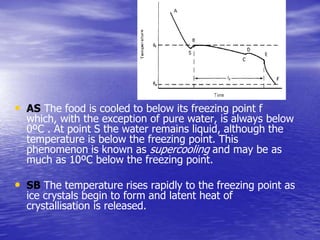
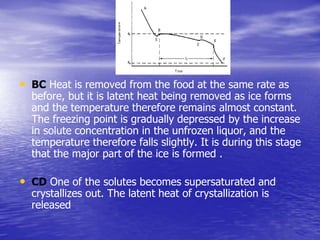
Time–temperature data during freezing.
• AS The food is cooled to below its freezing point f
which, with the exception of pure water, is always below
0ºC . At point S the water remains liquid, although the
temperature is below the freezing point. This
phenomenon is known as supercooling and may be as
much as 10ºC below the freezing point.
• SB The temperature rises rapidly to the freezing point as
ice crystals begin to form and latent heat of
crystallisation is released.
• BC Heat is removed from the food at the same rate as
before, but it is latent heat being removed as ice forms
and the temperature therefore remains almost constant.
The freezing point is gradually depressed by the increase
in solute concentration in the unfrozen liquor, and the
temperature therefore falls slightly. It is during this stage
that the major part of the ice is formed .
• CD One of the solutes becomes supersaturated and
crystallizes out. The latent heat of crystallization is
released
• DE Crystallization of water and solutes continues. The
total time tf taken (the freezing plateau) is
determined by the rate at which heat is removed.
• EF The temperature of the ice–water mixture falls to the
temperature of the freezer. A proportion of the water
remains unfrozen at the temperatures used in
commercial freezing; the amount depends on the type
and composition of the food and the temperature of
storage. For example at a storage temperature of -20ºC
the percentage of water frozen is 88% in lamb, 91% in
fish and 93% in egg albumin.
Equipment
Freezers are broadly categorized into:
• mechanical refrigerators, which evaporate and
compress a refrigerant in a continuous cycle and
use cooled air, cooled liquid or cooled surfaces
to remove heat from foods
• cryogenic freezers, which use solid or liquid
carbon dioxide, liquid nitrogen (or until
recently, liquid Freon) directly in contact with the
food.
Cooled-air freezers
• chest freezers food is frozen in stationary (natural-
circulation) air at between -20ºC and -30ºC. Chest
freezers are not used for commercial freezing owing to
low freezing rates (3–72 h).
• A major problem with cold stores is ice formation on
floors, walls and evaporator coils, caused by moisture
from the air or from unpackaged products in the store.
blast freezers:
• air is recirculated over food at between -30ºC and -40ºC
at a velocity of 1.5–6.0 m s1. The high air velocity
reduces the thickness of boundary films surrounding the
food and thus increases the surface heat transfer
coefficient
• In batch equipment, food is stacked on trays in rooms or
cabinets. Continuous equipment consists of trolleys
stacked with trays of food or on conveyor belts which
carry the food through an insulated tunnel. The trolleys
should be fully loaded to prevent air from bypassing the
food through spaces between the trays
• Belt freezers (spiral freezers) have a continuous
flexible mesh belt which is formed into spiral tiers and
carries food up through a refrigerated chamber. In some
designs each tier rests on the vertical sides of the tier
beneath and the belt is therefore ‘selfstacking’. This
eliminates the need for support rails and improves the
capacity by up to 50% for a given stack height.
• Fluidised-bed freezers are modified blast freezers in
which air at between -25ºC and -35ºC is passed at a
high velocity (2–6 m s1) through a 2–13 cm bed of food,
contained on a perforated tray or conveyor belt. In some
designs there are two stages; after initial rapid freezing
in a shallow bed to produce an ice glaze on the surface
of the food, freezing is completed on a second belt in
beds 10–15 cm deep.
Cooled-liquid freezers
• In immersion freezers, packaged food is passed
through a bath of refrigerated propylene glycol, brine,
glycerol or calcium chloride solution on a submerged
mesh conveyor
Cooled-surface freezers
• Plate freezers consist of a vertical or horizontal stack of
hollow plates, through which refrigerant is pumped at ---
-40ºC . They may be batch, semi-continuous or
continuous in operation. Flat, relatively thin foods (for
example filleted fish, fish fingers or beef burgers) are
placed in single layers between the plates and a slight
pressure is applied by moving the plates together.
Plate freezer
• Scraped-surface freezers are used for liquid or semi-
solid foods (for example ice cream). They are similar in
design to equipment used for evaporation and heat
sterilization but are refrigerated with ammonia, brine, or
other refrigerants. In ice cream manufacture, the rotor
scrapes frozen food from the wall of the freezer barrel
and simultaneously incorporates air. Alternatively, air
can be injected into the product. The increase in volume
of the product due to the air is expressed as overrun
Cryogenic freezers
• Freezers of this type are characterised by a change of
state in the refrigerant (or cryogen) as heat is absorbed
from the freezing food. The heat from the food therefore
provides the latent heat of vaporisation or sublimation of
the cryogen. The cryogen is in intimate contact with the
food and rapidly removes heat from all surfaces of the
food to produce high heat transfer coefficients and rapid
freezing. The two most common refrigerants are liquid
nitrogen and solid or liquid carbon dioxide.
Liquid-nitrogen freezer
Changes in foods
Effect of freezing
• The main effect of freezing on food quality is damage
caused to cells by ice crystal growth. Freezing causes
negligible changes to pigments, flavours or nutritionally
important components, although these may be lost in
preparation procedures or deteriorate later during frozen
storage.
Effect of freezing on plant tissues: (a) slow
freezing; (b) fast freezing.
The main changes to frozen foods during
storage are as follows:
• Degradation of pigments. Chloroplasts and chromoplasts
are broken down and chlorophyll is slowly degraded to
brown pheophytin even in blanched vegetables. In fruits,
changes in pH due to precipitation of salts in
concentrated solutions change the colour of
anthocyanins.
• Loss of vitamins. Water-soluble vitamins (for example
vitamin C and pantothenic acid) are lost at sub-freezing
temperatures .
• Vitamin C losses are highly temperature dependent; a
10ºC increase in temperature causes a sixfold to
twentyfold increase in the rate of vitamin C degradation
in vegetables and a thirtyfold to seventyfold increase in
fruits. Losses of other vitamins are mainly due to drip
losses, particularly in meat and fish (if the drip loss is not
consumed).
• Residual enzyme activity. In vegetables which are
inadequately blanched or in fruits, the most important
loss of quality is due to polyphenoloxidase activity which
causes browning, and lipoxygenases activity which
produces off-flavours and off-odours from lipids and
causes degradation of carotene. Proteolytic and lipolytic
activity in meats may alter the texture and flavour over
long storage periods.
• Oxidation of lipids. This reaction takes place slowly at -
18ºC and causes off-odors and off-flavors.

Freezing

  • 1.
    Chilling • Chilling isthe unit operation in which the temperature of a food is reduced to between 1ºC and 8ºC. It is used to reduce the rate of biochemical and microbiological changes, and hence to extend the shelf life of fresh and processed foods. It causes minimal changes to sensory characteristics and nutritional properties of foods and, as a result, chilled foods are perceived by consumers as being convenient, easy to prepare, high quality and ‘healthy’, ‘natural’ and ‘fresh’.
  • 2.
    • Chilling isoften used in combination with other unit operations (for example fermentation or pasteurization) to extend the shelf life of mildly processed foods. There is a greater preservative effect when chilling is combined with control of the composition of the storage atmosphere than that found using either unit operation alone.
  • 3.
    Chilled foods aregrouped into three categories according to their storage temperature range as follows: 1. -1ºC to +1ºC (fresh fish, meats, sausages and ground meats, smoked meats and breaded fish). 2. 0ºC to +5ºC (pasteurised canned meat, milk, cream, yoghurt, prepared salads, sandwiches, baked goods, fresh pasta, fresh soups and sauces, pizzas, pastries and unbaked dough). 3. 0ºC to +8ºC (fully cooked meats and fish pies, cooked or uncooked cured meats, butter, margarine, hard cheese, cooked rice, fruit juices and soft fruits).
  • 4.
    Theory 1. Fresh foods •The rate of biochemical changes caused by either micro- organisms or naturally occurring enzymes increases logarithmically with temperature. Chilling therefore reduces the rate of enzymic and microbiological change and retards respiration of fresh foods.
  • 5.
    The factors thatcontrol the shelf life of fresh crops in chill storage include: the type of food and variety or cultivar the part of the crop selected (the fastest growing parts have the highest metabolic rates and the shortest storage lives ) the condition of the food at harvest (for example the presence of mechanical damage or microbial contamination, and the degree of maturity) the temperature of harvest, storage, distribution and retail display the relative humidity of the storage atmosphere, which influences dehydration losses.
  • 6.
    Botanical function relatedto respiration rate and storage life for selected products
  • 7.
    • To chillfresh foods it is necessary to remove both sensible heat (also known as field heat) and heat generated by respiratory activity. The production of respiratory heat at 20ºC and atmospheric pressure is given by equation
  • 8.
    Optimum storage conditionsfor some fruits and vegetables
  • 9.
    2. Processed foods •There are four broad categories of micro-organism, based on the temperature range for growth 1. thermophilic (minimum: 30–40ºC, optimum: 55–65ºC) 2. mesophilic (minimum: 5–10ºC, optimum: 30–40ºC) 3. psychrotrophic (minimum: 0–5ºC, optimum: 20–30ºC) 4. psychrophilic (minimum: 0–5ºC, optimum: 12–18ºC).
  • 10.
    • Chilling preventsthe growth of thermophilic and many mesophilic micro-organisms. The main microbiological concerns with chilled foods are a number of pathogens that can grow during extended refrigerated storage below 5ºC, or as a result of any increase in temperature (temperature abuse) and thus cause food poisoning. • Examples of these pathogens that survive chilling conditions are Aeromonas hydrophilia, Listeria spp, Yersinia enterocolitica, some strains of Bacillus cereus, Vibrio parahaemolyticus and enteropathogenic Escherichia coli (Marth, 1998). An example of the last (E.coli 0157:H7) may cause hemorrhagic colitis after ingestion of as little as ten cell.
  • 11.
    The shelf lifeof chilled processed foods is determined by: • the type of food • the degree of microbial destruction or enzyme inactivation achieved by the process • control of hygiene during processing and packaging • the barrier properties of the package • temperatures during processing, distribution and storage.
  • 12.
    Cook–chill systems • Individualfoods (for example sliced roast meats) or complete meals are produced by cook–chill or cook– pasteurise–chill processes • These products, which include complete meals or components such as sauces, were developed for institutional catering to replace warm-holding, which reduces losses in nutritional and eating quality and is less expensive
  • 13.
    The range ofchilled foods can be characterised by the class of microbial risk that they pose to consumers as follows: Class 1 foods containing raw or uncooked ingredients, such as salad or cheese as ready-to-eat (RTE) foods (also includes chill-stable raw foods, such as meat, fish, etc.) Class 2 products made from a mixture of cooked and low risk raw ingredients Class 3 cooked products that are then packaged Class 4 products that are cooked after packaging, including ready-to-eat-products for- extended-durability (REPFEDs) having a shelf life of 40+ days (the acronym is also used to mean refrigerated-pasteurised-foods-for- extended durability).
  • 14.
    Freezing • Freezing isthe unit operation in which the temperature of a food is reduced below its freezing point and a proportion of the water undergoes a change in state to form ice crystals. The immobilisation of water to ice and the resulting concentration of dissolved solutes in unfrozen water lower the water activity (aw) of the food • Preservation is achieved by a combination of low temperatures, reduced water activity and, in some foods, pre-treatment by blanching.
  • 15.
    The major groupsof commercially frozen foods are as follows: • fruits (strawberries, oranges, raspberries) either whole or pureed, or as juice concentrates • vegetables (peas, green beans, sweet corn, spinach, and potatoes) • fish fillets and sea foods (cod, plaice, shrimps and crab meat) including fish fingers, fish cakes or prepared dishes with an accompanying sauce • meats (beef, lamb, poultry) as carcasses, boxed joints or cubes, and meat products (sausages, beefburgers, reformed steaks) • baked goods (bread, cakes, fruit and meat pies) • prepared foods (pizzas, desserts, ice cream, complete meals and cook–freeze dishes).
  • 16.
    8.1 Theory • Duringfreezing, sensible heat is first removed to lower the temperature of a food to the freezing point. In fresh foods, heat produced by respiration is also removed. This is termed the heat load, and is important in determining the correct size of freezing equipment for a particular production rate. • Latent and sensible heat are types of energy released or absorbed in the atmosphere. Latent heat is related to changes in phase between liquids, gases, and solids. Sensible heat is related to changes in temperature of a gas or object with no change in phase.
  • 17.
    • A substantialamount of energy is therefore needed to remove latent heat, form ice crystals and hence to freeze foods. • The latent heat of other components of the food (for example fats) must also be removed before they can solidify but in most foods these other components are present in smaller amounts and removal of a relatively small amount of heat is needed for crystallisation to take place
  • 18.
  • 19.
    • AS Thefood is cooled to below its freezing point f which, with the exception of pure water, is always below 0ºC . At point S the water remains liquid, although the temperature is below the freezing point. This phenomenon is known as supercooling and may be as much as 10ºC below the freezing point. • SB The temperature rises rapidly to the freezing point as ice crystals begin to form and latent heat of crystallisation is released.
  • 20.
    • BC Heatis removed from the food at the same rate as before, but it is latent heat being removed as ice forms and the temperature therefore remains almost constant. The freezing point is gradually depressed by the increase in solute concentration in the unfrozen liquor, and the temperature therefore falls slightly. It is during this stage that the major part of the ice is formed . • CD One of the solutes becomes supersaturated and crystallizes out. The latent heat of crystallization is released
  • 21.
    • DE Crystallizationof water and solutes continues. The total time tf taken (the freezing plateau) is determined by the rate at which heat is removed. • EF The temperature of the ice–water mixture falls to the temperature of the freezer. A proportion of the water remains unfrozen at the temperatures used in commercial freezing; the amount depends on the type and composition of the food and the temperature of storage. For example at a storage temperature of -20ºC the percentage of water frozen is 88% in lamb, 91% in fish and 93% in egg albumin.
  • 22.
    Equipment Freezers are broadlycategorized into: • mechanical refrigerators, which evaporate and compress a refrigerant in a continuous cycle and use cooled air, cooled liquid or cooled surfaces to remove heat from foods • cryogenic freezers, which use solid or liquid carbon dioxide, liquid nitrogen (or until recently, liquid Freon) directly in contact with the food.
  • 23.
    Cooled-air freezers • chestfreezers food is frozen in stationary (natural- circulation) air at between -20ºC and -30ºC. Chest freezers are not used for commercial freezing owing to low freezing rates (3–72 h). • A major problem with cold stores is ice formation on floors, walls and evaporator coils, caused by moisture from the air or from unpackaged products in the store.
  • 24.
    blast freezers: • airis recirculated over food at between -30ºC and -40ºC at a velocity of 1.5–6.0 m s1. The high air velocity reduces the thickness of boundary films surrounding the food and thus increases the surface heat transfer coefficient • In batch equipment, food is stacked on trays in rooms or cabinets. Continuous equipment consists of trolleys stacked with trays of food or on conveyor belts which carry the food through an insulated tunnel. The trolleys should be fully loaded to prevent air from bypassing the food through spaces between the trays
  • 25.
    • Belt freezers(spiral freezers) have a continuous flexible mesh belt which is formed into spiral tiers and carries food up through a refrigerated chamber. In some designs each tier rests on the vertical sides of the tier beneath and the belt is therefore ‘selfstacking’. This eliminates the need for support rails and improves the capacity by up to 50% for a given stack height.
  • 27.
    • Fluidised-bed freezersare modified blast freezers in which air at between -25ºC and -35ºC is passed at a high velocity (2–6 m s1) through a 2–13 cm bed of food, contained on a perforated tray or conveyor belt. In some designs there are two stages; after initial rapid freezing in a shallow bed to produce an ice glaze on the surface of the food, freezing is completed on a second belt in beds 10–15 cm deep.
  • 28.
    Cooled-liquid freezers • Inimmersion freezers, packaged food is passed through a bath of refrigerated propylene glycol, brine, glycerol or calcium chloride solution on a submerged mesh conveyor
  • 29.
    Cooled-surface freezers • Platefreezers consist of a vertical or horizontal stack of hollow plates, through which refrigerant is pumped at --- -40ºC . They may be batch, semi-continuous or continuous in operation. Flat, relatively thin foods (for example filleted fish, fish fingers or beef burgers) are placed in single layers between the plates and a slight pressure is applied by moving the plates together.
  • 30.
  • 31.
    • Scraped-surface freezersare used for liquid or semi- solid foods (for example ice cream). They are similar in design to equipment used for evaporation and heat sterilization but are refrigerated with ammonia, brine, or other refrigerants. In ice cream manufacture, the rotor scrapes frozen food from the wall of the freezer barrel and simultaneously incorporates air. Alternatively, air can be injected into the product. The increase in volume of the product due to the air is expressed as overrun
  • 32.
    Cryogenic freezers • Freezersof this type are characterised by a change of state in the refrigerant (or cryogen) as heat is absorbed from the freezing food. The heat from the food therefore provides the latent heat of vaporisation or sublimation of the cryogen. The cryogen is in intimate contact with the food and rapidly removes heat from all surfaces of the food to produce high heat transfer coefficients and rapid freezing. The two most common refrigerants are liquid nitrogen and solid or liquid carbon dioxide.
  • 33.
  • 34.
    Changes in foods Effectof freezing • The main effect of freezing on food quality is damage caused to cells by ice crystal growth. Freezing causes negligible changes to pigments, flavours or nutritionally important components, although these may be lost in preparation procedures or deteriorate later during frozen storage.
  • 35.
    Effect of freezingon plant tissues: (a) slow freezing; (b) fast freezing.
  • 36.
    The main changesto frozen foods during storage are as follows: • Degradation of pigments. Chloroplasts and chromoplasts are broken down and chlorophyll is slowly degraded to brown pheophytin even in blanched vegetables. In fruits, changes in pH due to precipitation of salts in concentrated solutions change the colour of anthocyanins.
  • 37.
    • Loss ofvitamins. Water-soluble vitamins (for example vitamin C and pantothenic acid) are lost at sub-freezing temperatures . • Vitamin C losses are highly temperature dependent; a 10ºC increase in temperature causes a sixfold to twentyfold increase in the rate of vitamin C degradation in vegetables and a thirtyfold to seventyfold increase in fruits. Losses of other vitamins are mainly due to drip losses, particularly in meat and fish (if the drip loss is not consumed).
  • 38.
    • Residual enzymeactivity. In vegetables which are inadequately blanched or in fruits, the most important loss of quality is due to polyphenoloxidase activity which causes browning, and lipoxygenases activity which produces off-flavours and off-odours from lipids and causes degradation of carotene. Proteolytic and lipolytic activity in meats may alter the texture and flavour over long storage periods. • Oxidation of lipids. This reaction takes place slowly at - 18ºC and causes off-odors and off-flavors.