Freezing
Submitted To. Mr. shubham Rohilla
Submitted By. Rahul
Roll No. 2124667
B.S.C Food Science And Tech.
4th sem.
2
What is freezing ?
A method of food preservation whereby:
• The heat is removed .
• where a portion of liquid turns into a solid.
• Temperature of the food is reduced below its freezing point (T<Tf).
• Generally -18°C.
Principle : Freezing is a phase transition phenomenon in which a substance transforms
its state from liquid to solid below its freezing point. Principle of Freezing: When a
substance changes its state from liquid to solid, the evolution of heat takes place from
the body to its surroundings.
4/20/2023 Designed by Rahul
3
Goals of Preservation
The basic goal is to :
• Preserve the taste, texture, and nutritional value in foods.
• Reducing water activity.
• Provide a significant extended shelf life.
• Retards growth of microorganisms.
• To lower temperature enough to slow down chemical reactions – (every
10°C decrease in temperature that lead to half the reaction rate).
4/20/2023 Designed by Rahul
Important terminologies
• Sensible heat: The increase/decrease in temperature on addition/removal
of heat in object.
• Latent heat : The heat is given out during the solidification of a unit
crystallization mass of a liquid.
• Supercoiling: Going below the freezing temperature without formation of
crystals.
• Nucleation. Nucleation is simply defined as the first random formation of
a distinct thermodynamic new phase (daughter phase) that
have the ability to irreversibly grow into larger sized nucleus
within the body of a metastable parent phase
Or the first appearance of ice crystals.
4/20/2023 Designed by Rahul 4
Latent heat of
crystallization
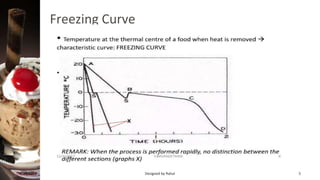
Freezing Curve
4/20/2023 Designed by Rahul 5
Freezing curve:
Section AS
• The food is cooled to below its freezing point (=sensible heat).
• At point S the water remains liquid, although the temperature is
below the freezing point.
• Phenomenon is called supercooling and partly determines the
crystal size.
• Section SB
• The temperature rises rapidly to the freezing point as ice crystals
begin to form and latent heat of crystallization is released.
• Crystallization occurs at point B of freezing curve.
4/20/2023 Designed by Rahul 6
• Section BC
• Heat is removed from the food at the same rate as before
• Latent heat is removed and ice forms, but temperature almost
constant.
• The freezing point is depressed by the increase in solute concentrations
in the unfrozen liquor.
• Major part of the ice is formed.
• Section CD
• The temperature of the ice-water mixture decreases to the temperature
of the freeze.
4/20/2023 Designed by Rahul 7
Freezing temperature of selected foods
4/20/2023 Designed by Rahul 8
Advantages of freezing
• No nutrient loss
• Retain freshness of commodity.
• Retain color and flavor constituents.
• No microbial contamination.
• No respiration, hence longer shelf-life.
4/20/2023 9
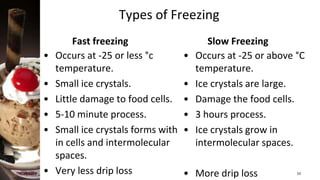
Types of Freezing
Slow Freezing
• Occurs at -25 or above °C
temperature.
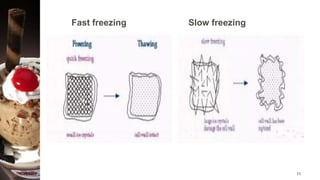
• Ice crystals are large.
• Damage the food cells.
• 3 hours process.
• Ice crystals grow in
intermolecular spaces.
• More drip loss
Fast freezing
• Occurs at -25 or less °c
temperature.
• Small ice crystals.
• Little damage to food cells.
• 5-10 minute process.
• Small ice crystals forms with
in cells and intermolecular
spaces.
• Very less drip loss
4/20/2023 10
4/20/2023 11
Fast freezing Slow freezing
Advantages of quick freezing over slow freezing
• Smaller and less sharp ice crystals are formed, hence there is less
mechanical destruction of intact cells of the food.
• There is more prevention of microbial growth.
• There is more rapid slowing of enzyme action.
4/20/2023 12
Disadvantages of quick freezing
• Higher investment in deep freezer of freezing equipment or frozen stores.
• Need for refrigerated display cabinets for retail marketing.
• Freezing technology at present suitable for upper and middle class
• Products are more prone to dehydration because of large exposed
surface.
• Improper thawing can cause drip loss
4/20/2023 13
Types of freezer
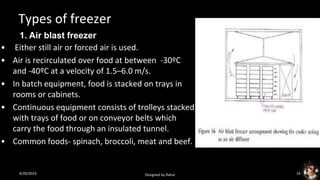
• Either still air or forced air is used.
• Air is recirculated over food at between -30ºC
and -40ºC at a velocity of 1.5–6.0 m/s.
• In batch equipment, food is stacked on trays in
rooms or cabinets.
• Continuous equipment consists of trolleys stacked
with trays of food or on conveyor belts which
carry the food through an insulated tunnel.
• Common foods- spinach, broccoli, meat and beef.
4/20/2023 Designed by Rahul 14
1. Air blast freezer
Air freezing may result in:
• Excessive drying
• Costly
But it is
• More efficient & more rapid heat transfer
• Less product dehydration & less frequent requirement of frosting.
• Short freezing time so less moisture loss.
4/20/2023 15
2. BELT FREEZER
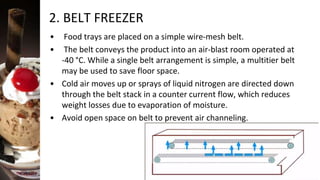
• Food trays are placed on a simple wire-mesh belt.
• The belt conveys the product into an air-blast room operated at
-40 °C. While a single belt arrangement is simple, a multitier belt
may be used to save floor space.
• Cold air moves up or sprays of liquid nitrogen are directed down
through the belt stack in a counter current flow, which reduces
weight losses due to evaporation of moisture.
• Avoid open space on belt to prevent air channeling.
4/20/2023 16
3. Cryogenic food freezing
 Uses liquid nitrogen and solid carbon dioxide as cryogen to effectively
freeze the food products.
 The cryogen is in intimate contact with the food and rapidly removes heat
from all surfaces to produce high heat transfer coefficients and rapid
freezing
 This helps to maximise production efficiencies while minimising costs.
 The use of cryogenic gas at very low operating temperatures of -80ºC
provides a high heat transfer rate that ensures quick freezing times.
4/20/2023 Designed by rahul 17
4/20/2023
The main advantages of cryogenic freezing are as follows:
• Short freezing time due to high heat transfer
• Reduction in flavor loss
• Reduction in drip loss
• Reduction in oxidative changes
• Improved texture of the product
• Suitable for freeze sensitive products
The main disadvantage of cryogenic freezing is relatively high cost of
cryogens.
4/20/2023 19
4. PLATE FREEZER
• It consist of a vertical or horizontal
stack of hollow plates, through which
refrigerant is pumped at -40ºC.
• This method is used for bricked shaped
packaged materials.
• Slight pressure is applied to improves
the contact between surfaces of the
food and the plates and thereby
increases the rate of heat transfer.
• No dehydration takes place as there is
no air is used. So, no weight loss takes
will place.
4/20/2023 Designed by rahul 20
Changes Associated With Ice Formation
1. Volume changes
• when water is transformed into ice at 0°C, and hence upon freezing there
is expansion of foods.
The degree of expansion depends upon:
 Moisture: High moisture contents in foods produce greater changes in
volume.
 Concentration of solutes: High concentrations reduce the freezing point
and foods do not freeze or expand at commercial freezing temperatures.
4/20/2023 Designed by PoweredTemplate.com 21
2. Concentration of non-aqueous system
 During freezing water freezes first. So nearly all the dissolved substances
are therefore concentrated in the diminished quantity of water.
 Dissolved gases will be removed/expelled from the space.
 As freezing progresses, concentration of a particular solute increases.
4/20/2023 Designed by PoweredTemplate.com 22
Effect of freezing
• Causes of quality loss:
– Chemical causes
– Biochemical causes
– Microbiological causes
– Physical causes
4/20/2023 Designed by rahul 23
Quality loss:
chemical causes
• Denaturation of proteins
–Due to ice-liquid interface formation, protein gets exposes to this interface
and start getting denature.
– fish gets a stringy structure, red meat and poultry become firmer
• Lipids:
– taste rancid because of oxidation
• Color changes in meat:
– oxymyoglobine (red) is converted to metmyoglobine (brown)
4/20/2023 Designed by rahul 24
Quality loss: biochemical causes
• Color changes in vegetables:
–chances of moderate decrease of chlorophyll.
• Loss of vitamins:
–vit C & pantothenic acid lost at subfreezing Temp.
• Other vitamin lost due to drip losses in meat & fish,
4/20/2023 Designed by rahul 25
Microbiological causes
• During freezing:
–Microorganisms can grow as growth of microorganisms is temperature
dependent.
– No microorganisms growth <-5°C.
– limited amount of micro-organisms are destroyed
• During storage:
– Generally G+ bacteria more resistant for freezing than G- bacteria.
– Bacillus, Clostridium, Lactobacillus, Staphylococcus, Micrococcus, Streptococcus.
– G- bacteria, • Echerichia, Pseudomonas, Alcaligenes, Vibrio, Salmonella
– Pathogenic parasites are killed
4/20/2023 Designed by rahul 26
Physical causes:
• loss of moisture from food to storage environment
• characterized by: lighter colour
• minimized by special packaging methods.
4/20/2023 Designed by rahul 27
4/20/2023 Designed by rahul 28

Freezing pptx everything

  • 1.
    Freezing Submitted To. Mr.shubham Rohilla Submitted By. Rahul Roll No. 2124667 B.S.C Food Science And Tech. 4th sem.
  • 2.
    2 What is freezing? A method of food preservation whereby: • The heat is removed . • where a portion of liquid turns into a solid. • Temperature of the food is reduced below its freezing point (T<Tf). • Generally -18°C. Principle : Freezing is a phase transition phenomenon in which a substance transforms its state from liquid to solid below its freezing point. Principle of Freezing: When a substance changes its state from liquid to solid, the evolution of heat takes place from the body to its surroundings. 4/20/2023 Designed by Rahul
  • 3.
    3 Goals of Preservation Thebasic goal is to : • Preserve the taste, texture, and nutritional value in foods. • Reducing water activity. • Provide a significant extended shelf life. • Retards growth of microorganisms. • To lower temperature enough to slow down chemical reactions – (every 10°C decrease in temperature that lead to half the reaction rate). 4/20/2023 Designed by Rahul
  • 4.
    Important terminologies • Sensibleheat: The increase/decrease in temperature on addition/removal of heat in object. • Latent heat : The heat is given out during the solidification of a unit crystallization mass of a liquid. • Supercoiling: Going below the freezing temperature without formation of crystals. • Nucleation. Nucleation is simply defined as the first random formation of a distinct thermodynamic new phase (daughter phase) that have the ability to irreversibly grow into larger sized nucleus within the body of a metastable parent phase Or the first appearance of ice crystals. 4/20/2023 Designed by Rahul 4 Latent heat of crystallization
  • 5.
  • 6.
    Freezing curve: Section AS •The food is cooled to below its freezing point (=sensible heat). • At point S the water remains liquid, although the temperature is below the freezing point. • Phenomenon is called supercooling and partly determines the crystal size. • Section SB • The temperature rises rapidly to the freezing point as ice crystals begin to form and latent heat of crystallization is released. • Crystallization occurs at point B of freezing curve. 4/20/2023 Designed by Rahul 6
  • 7.
    • Section BC •Heat is removed from the food at the same rate as before • Latent heat is removed and ice forms, but temperature almost constant. • The freezing point is depressed by the increase in solute concentrations in the unfrozen liquor. • Major part of the ice is formed. • Section CD • The temperature of the ice-water mixture decreases to the temperature of the freeze. 4/20/2023 Designed by Rahul 7
  • 8.
    Freezing temperature ofselected foods 4/20/2023 Designed by Rahul 8
  • 9.
    Advantages of freezing •No nutrient loss • Retain freshness of commodity. • Retain color and flavor constituents. • No microbial contamination. • No respiration, hence longer shelf-life. 4/20/2023 9
  • 10.
    Types of Freezing SlowFreezing • Occurs at -25 or above °C temperature. • Ice crystals are large. • Damage the food cells. • 3 hours process. • Ice crystals grow in intermolecular spaces. • More drip loss Fast freezing • Occurs at -25 or less °c temperature. • Small ice crystals. • Little damage to food cells. • 5-10 minute process. • Small ice crystals forms with in cells and intermolecular spaces. • Very less drip loss 4/20/2023 10
  • 11.
  • 12.
    Advantages of quickfreezing over slow freezing • Smaller and less sharp ice crystals are formed, hence there is less mechanical destruction of intact cells of the food. • There is more prevention of microbial growth. • There is more rapid slowing of enzyme action. 4/20/2023 12
  • 13.
    Disadvantages of quickfreezing • Higher investment in deep freezer of freezing equipment or frozen stores. • Need for refrigerated display cabinets for retail marketing. • Freezing technology at present suitable for upper and middle class • Products are more prone to dehydration because of large exposed surface. • Improper thawing can cause drip loss 4/20/2023 13
  • 14.
    Types of freezer •Either still air or forced air is used. • Air is recirculated over food at between -30ºC and -40ºC at a velocity of 1.5–6.0 m/s. • In batch equipment, food is stacked on trays in rooms or cabinets. • Continuous equipment consists of trolleys stacked with trays of food or on conveyor belts which carry the food through an insulated tunnel. • Common foods- spinach, broccoli, meat and beef. 4/20/2023 Designed by Rahul 14 1. Air blast freezer
  • 15.
    Air freezing mayresult in: • Excessive drying • Costly But it is • More efficient & more rapid heat transfer • Less product dehydration & less frequent requirement of frosting. • Short freezing time so less moisture loss. 4/20/2023 15
  • 16.
    2. BELT FREEZER •Food trays are placed on a simple wire-mesh belt. • The belt conveys the product into an air-blast room operated at -40 °C. While a single belt arrangement is simple, a multitier belt may be used to save floor space. • Cold air moves up or sprays of liquid nitrogen are directed down through the belt stack in a counter current flow, which reduces weight losses due to evaporation of moisture. • Avoid open space on belt to prevent air channeling. 4/20/2023 16
  • 17.
    3. Cryogenic foodfreezing  Uses liquid nitrogen and solid carbon dioxide as cryogen to effectively freeze the food products.  The cryogen is in intimate contact with the food and rapidly removes heat from all surfaces to produce high heat transfer coefficients and rapid freezing  This helps to maximise production efficiencies while minimising costs.  The use of cryogenic gas at very low operating temperatures of -80ºC provides a high heat transfer rate that ensures quick freezing times. 4/20/2023 Designed by rahul 17
  • 18.
  • 19.
    The main advantagesof cryogenic freezing are as follows: • Short freezing time due to high heat transfer • Reduction in flavor loss • Reduction in drip loss • Reduction in oxidative changes • Improved texture of the product • Suitable for freeze sensitive products The main disadvantage of cryogenic freezing is relatively high cost of cryogens. 4/20/2023 19
  • 20.
    4. PLATE FREEZER •It consist of a vertical or horizontal stack of hollow plates, through which refrigerant is pumped at -40ºC. • This method is used for bricked shaped packaged materials. • Slight pressure is applied to improves the contact between surfaces of the food and the plates and thereby increases the rate of heat transfer. • No dehydration takes place as there is no air is used. So, no weight loss takes will place. 4/20/2023 Designed by rahul 20
  • 21.
    Changes Associated WithIce Formation 1. Volume changes • when water is transformed into ice at 0°C, and hence upon freezing there is expansion of foods. The degree of expansion depends upon:  Moisture: High moisture contents in foods produce greater changes in volume.  Concentration of solutes: High concentrations reduce the freezing point and foods do not freeze or expand at commercial freezing temperatures. 4/20/2023 Designed by PoweredTemplate.com 21
  • 22.
    2. Concentration ofnon-aqueous system  During freezing water freezes first. So nearly all the dissolved substances are therefore concentrated in the diminished quantity of water.  Dissolved gases will be removed/expelled from the space.  As freezing progresses, concentration of a particular solute increases. 4/20/2023 Designed by PoweredTemplate.com 22
  • 23.
    Effect of freezing •Causes of quality loss: – Chemical causes – Biochemical causes – Microbiological causes – Physical causes 4/20/2023 Designed by rahul 23
  • 24.
    Quality loss: chemical causes •Denaturation of proteins –Due to ice-liquid interface formation, protein gets exposes to this interface and start getting denature. – fish gets a stringy structure, red meat and poultry become firmer • Lipids: – taste rancid because of oxidation • Color changes in meat: – oxymyoglobine (red) is converted to metmyoglobine (brown) 4/20/2023 Designed by rahul 24
  • 25.
    Quality loss: biochemicalcauses • Color changes in vegetables: –chances of moderate decrease of chlorophyll. • Loss of vitamins: –vit C & pantothenic acid lost at subfreezing Temp. • Other vitamin lost due to drip losses in meat & fish, 4/20/2023 Designed by rahul 25
  • 26.
    Microbiological causes • Duringfreezing: –Microorganisms can grow as growth of microorganisms is temperature dependent. – No microorganisms growth <-5°C. – limited amount of micro-organisms are destroyed • During storage: – Generally G+ bacteria more resistant for freezing than G- bacteria. – Bacillus, Clostridium, Lactobacillus, Staphylococcus, Micrococcus, Streptococcus. – G- bacteria, • Echerichia, Pseudomonas, Alcaligenes, Vibrio, Salmonella – Pathogenic parasites are killed 4/20/2023 Designed by rahul 26
  • 27.
    Physical causes: • lossof moisture from food to storage environment • characterized by: lighter colour • minimized by special packaging methods. 4/20/2023 Designed by rahul 27
  • 28.