FOOD FREEZING & FREEZING
SYSTEMS
PRESENTED BY : BINYAMIN BUTT (2015-DT-009)
PRESENTED TO: SIR. ENGINEER SAQIB MANZOOR
WHAT SHALL WE LEARN IN THIS
PRESENTATION?
 FREEZING
Planck's equation for predicting freezing times
PHAM’S Equation modification
Types of Freezing systems
Direct & Indirect freezing systems
Important terms used in freezing
Cold storage
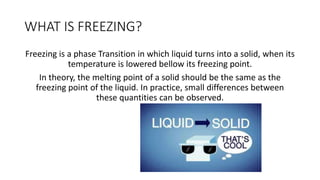
WHAT IS FREEZING?
Freezing is a phase Transition in which liquid turns into a solid, when its
temperature is lowered bellow its freezing point.
In theory, the melting point of a solid should be the same as the
freezing point of the liquid. In practice, small differences between
these quantities can be observed.
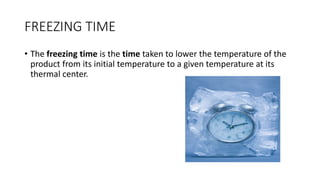
FREEZING TIME
• The freezing time is the time taken to lower the temperature of the
product from its initial temperature to a given temperature at its
thermal center.
NO exact mathematical model exists for predicting
the freezing of foods due to:
• Foods, undergoing freezing, release latent heat over a range of
temperatures.
• Freezing does not occur at a unique temperature.
• foods do not have constant thermal properties during freezing.
It is important to accurately predict the
freezing times of foods to assess the
• Quality,
• Processing requirements
• Economical aspects of food freezing
HOW TO DETERMINE FREEZING TIME ??
ONE OF THE WAY TO ESIIMATE FREEZING TIME IS THROUGH
PLANCK’S EQUATION.
THIS APPROCCH WAS DEVELPOED BY PLANCKS IN 1913.
Plank’s equation was derived based on energy balance principle.He
developed the equation to find out the freezing point of water.
Although this equation has many limitations but it enables to find out
freezing point with those limitations with spreadsheet or Calculator.
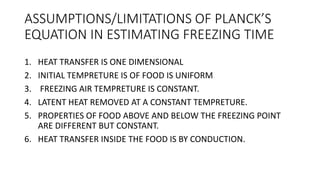
ASSUMPTIONS/LIMITATIONS OF PLANCK’S
EQUATION IN ESTIMATING FREEZING TIME
1. HEAT TRANSFER IS ONE DIMENSIONAL
2. INITIAL TEMPRETURE IS OF FOOD IS UNIFORM
3. FREEZING AIR TEMPRETURE IS CONSTANT.
4. LATENT HEAT REMOVED AT A CONSTANT TEMPRETURE.
5. PROPERTIES OF FOOD ABOVE AND BELOW THE FREEZING POINT
ARE DIFFERENT BUT CONSTANT.
6. HEAT TRANSFER INSIDE THE FOOD IS BY CONDUCTION.
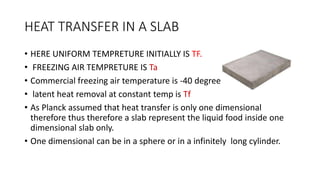
HEAT TRANSFER IN A SLAB
• HERE UNIFORM TEMPRETURE INITIALLY IS TF.
• FREEZING AIR TEMPRETURE IS Ta
• Commercial freezing air temperature is -40 degree
• latent heat removal at constant temp is Tf
• As Planck assumed that heat transfer is only one dimensional
therefore thus therefore a slab represent the liquid food inside one
dimensional slab only.
• One dimensional can be in a sphere or in a infinitely long cylinder.
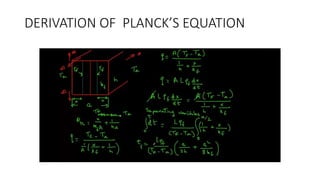
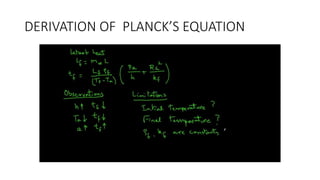
DERIVATION OF PLANCK’S EQUATION
Professor Duc
Truong Pham
Estimate freezing time using Pham's Method
• PLANKCKS EQUATION HAD SEVERAL DEFICINIES IN ESTIMATING
FREEZING TIME
• SOME OF ITS DEFECTS WERE OVERCOME BY A METHOD DEVELPOED
BY PROFESSOR PHAM IN 2001.
• THIS PROCEDURE IS MORE RELEASTIC THAN PLANCKS.
• SPECIALLY PHAMS PROCEDURE ACCOUNTS FOR THE SENSIBLE HEAT
REMOVAL DURING THE PRE-FREEZING AND POST-FREEZING PERIODS.
• IT ALLOWS TO CONSIDER SOME IRREGULAR SHAPES
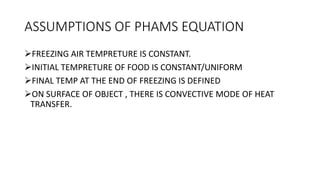
ASSUMPTIONS OF PHAMS EQUATION
FREEZING AIR TEMPRETURE IS CONSTANT.
INITIAL TEMPRETURE OF FOOD IS CONSTANT/UNIFORM
FINAL TEMP AT THE END OF FREEZING IS DEFINED
ON SURFACE OF OBJECT , THERE IS CONVECTIVE MODE OF HEAT
TRANSFER.
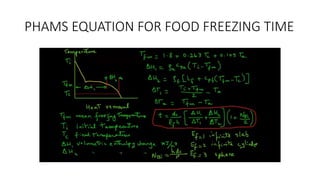
PHAMS EQUATION FOR FOOD FREEZING TIME
IMPORTANT POINTS TO KNOW
1. Freezing point is defined as the temperature at which the first
ice crystal appears and the liquid at that temperature is in
equilibrium with the solid.
2. Freezing time is defined as time required to lower product
temperature from its initial temperature to a given temperature at
its thermal center.
3. Freezing rate is defined as the ratio of difference between initial
and final temperature of product to freezing time.
TYPES OF FREEZING
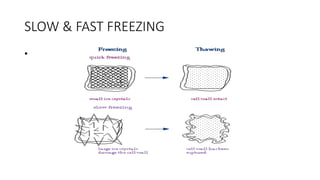
• SLOW FREEZING: Slow freezing occurs at -24 ºC or above. Ice
crystals are big and damage the food cells causing loss of texture,
nutrients, colour & flavour on thawing.
• FAST FREEZING: Quick or fast freezing occurs at –25ºC or less. Ice
crystals are small and do not damage food cells
SLOW & FAST FREEZING
•
TYPES OF FREEZING
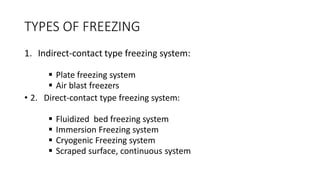
1. Indirect-contact type freezing system:
 Plate freezing system
 Air blast freezers
• 2. Direct-contact type freezing system:
 Fluidized bed freezing system
 Immersion Freezing system
 Cryogenic Freezing system
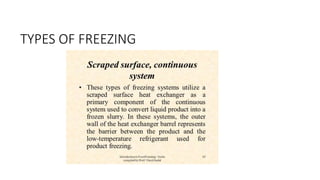
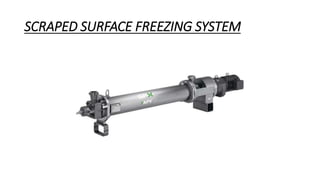
 Scraped surface, continuous system
TYPES OF FREEZING
• INDIRECT CONTACT FREEZING
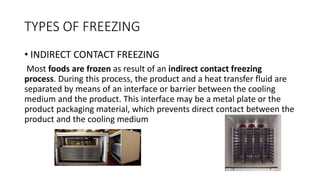
Most foods are frozen as result of an indirect contact freezing
process. During this process, the product and a heat transfer fluid are
separated by means of an interface or barrier between the cooling
medium and the product. This interface may be a metal plate or the
product packaging material, which prevents direct contact between the
product and the cooling medium
BLAST FREEZERS
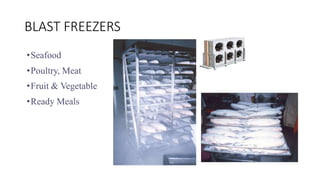
•Seafood
•Poultry, Meat
•Fruit & Vegetable
•Ready Meals
TYPES OF FREEZING
• TYPE OF DIRECT FREEZING
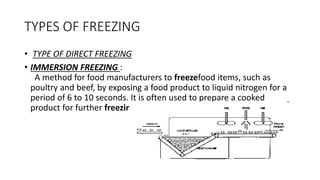
• IMMERSION FREEZING :
A method for food manufacturers to freezefood items, such as
poultry and beef, by exposing a food product to liquid nitrogen for a
period of 6 to 10 seconds. It is often used to prepare a cooked
product for further freezing.
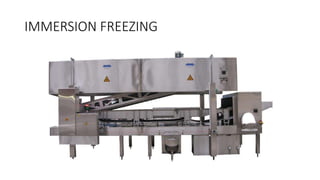
IMMERSION FREEZING
TYPES OF FREEZING
• TYPE OF DIRECT FREEZING
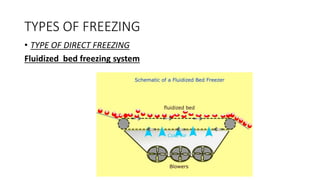
Fluidized bed freezing system
TYPES OF FREEZING
• TYPE OF DIRECT FREEZING
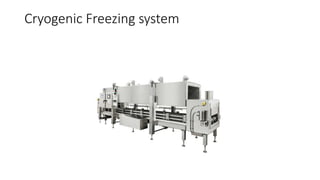
• Cryogenic Freezing system
Liquid nitrogen or liquid carbon dioxide is purchased and kept in a
pressurized storage vessel. The cryogen is piped as a liquid into the
freezer unit and applied directly to the product in a variety of modes
depending on the cryogen, freezer type or food product. However, the
cryogen is a consumable product and except in very unusual
circumstances, can only be used once.
Cryogenic Freezing system
TYPES OF FREEZING
SCRAPED SURFACE FREEZING SYSTEM
Cold stores
 To store food products after processing
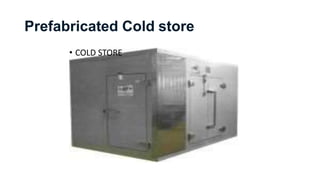
 Prefabricated insulated panels
 Air tight door in sandwich construction
 Safety anti-locking arrangement
 Temperatures – positive or sub-zero
 Layout – air lock, sorting-cum-intermediate storage area,
store compartments
 Important points – temperature, RH, air motion,
product mix, duration
Prefabricated Cold store
• COLD STORE
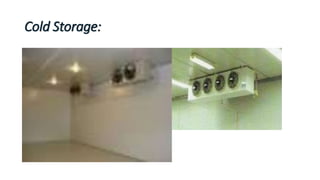
Cold Storage:
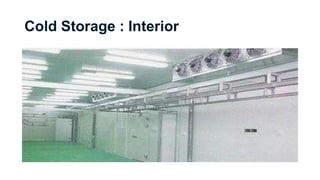
Cold Storage : Interior
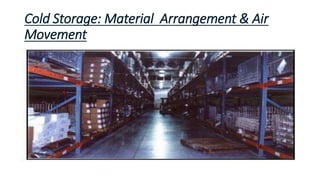
Cold Storage: Material Arrangement & Air
Movement
Food freezing & freezing systems

Food freezing & freezing systems

  • 1.
    FOOD FREEZING &FREEZING SYSTEMS PRESENTED BY : BINYAMIN BUTT (2015-DT-009) PRESENTED TO: SIR. ENGINEER SAQIB MANZOOR
  • 2.
    WHAT SHALL WELEARN IN THIS PRESENTATION?  FREEZING Planck's equation for predicting freezing times PHAM’S Equation modification Types of Freezing systems Direct & Indirect freezing systems Important terms used in freezing Cold storage
  • 3.
    WHAT IS FREEZING? Freezingis a phase Transition in which liquid turns into a solid, when its temperature is lowered bellow its freezing point. In theory, the melting point of a solid should be the same as the freezing point of the liquid. In practice, small differences between these quantities can be observed.
  • 4.
    FREEZING TIME • Thefreezing time is the time taken to lower the temperature of the product from its initial temperature to a given temperature at its thermal center.
  • 5.
    NO exact mathematicalmodel exists for predicting the freezing of foods due to: • Foods, undergoing freezing, release latent heat over a range of temperatures. • Freezing does not occur at a unique temperature. • foods do not have constant thermal properties during freezing.
  • 6.
    It is importantto accurately predict the freezing times of foods to assess the • Quality, • Processing requirements • Economical aspects of food freezing
  • 7.
    HOW TO DETERMINEFREEZING TIME ?? ONE OF THE WAY TO ESIIMATE FREEZING TIME IS THROUGH PLANCK’S EQUATION. THIS APPROCCH WAS DEVELPOED BY PLANCKS IN 1913. Plank’s equation was derived based on energy balance principle.He developed the equation to find out the freezing point of water. Although this equation has many limitations but it enables to find out freezing point with those limitations with spreadsheet or Calculator.
  • 8.
    ASSUMPTIONS/LIMITATIONS OF PLANCK’S EQUATIONIN ESTIMATING FREEZING TIME 1. HEAT TRANSFER IS ONE DIMENSIONAL 2. INITIAL TEMPRETURE IS OF FOOD IS UNIFORM 3. FREEZING AIR TEMPRETURE IS CONSTANT. 4. LATENT HEAT REMOVED AT A CONSTANT TEMPRETURE. 5. PROPERTIES OF FOOD ABOVE AND BELOW THE FREEZING POINT ARE DIFFERENT BUT CONSTANT. 6. HEAT TRANSFER INSIDE THE FOOD IS BY CONDUCTION.
  • 9.
    HEAT TRANSFER INA SLAB • HERE UNIFORM TEMPRETURE INITIALLY IS TF. • FREEZING AIR TEMPRETURE IS Ta • Commercial freezing air temperature is -40 degree • latent heat removal at constant temp is Tf • As Planck assumed that heat transfer is only one dimensional therefore thus therefore a slab represent the liquid food inside one dimensional slab only. • One dimensional can be in a sphere or in a infinitely long cylinder.
  • 10.
  • 11.
  • 12.
  • 13.
    Estimate freezing timeusing Pham's Method • PLANKCKS EQUATION HAD SEVERAL DEFICINIES IN ESTIMATING FREEZING TIME • SOME OF ITS DEFECTS WERE OVERCOME BY A METHOD DEVELPOED BY PROFESSOR PHAM IN 2001. • THIS PROCEDURE IS MORE RELEASTIC THAN PLANCKS. • SPECIALLY PHAMS PROCEDURE ACCOUNTS FOR THE SENSIBLE HEAT REMOVAL DURING THE PRE-FREEZING AND POST-FREEZING PERIODS. • IT ALLOWS TO CONSIDER SOME IRREGULAR SHAPES
  • 14.
    ASSUMPTIONS OF PHAMSEQUATION FREEZING AIR TEMPRETURE IS CONSTANT. INITIAL TEMPRETURE OF FOOD IS CONSTANT/UNIFORM FINAL TEMP AT THE END OF FREEZING IS DEFINED ON SURFACE OF OBJECT , THERE IS CONVECTIVE MODE OF HEAT TRANSFER.
  • 15.
    PHAMS EQUATION FORFOOD FREEZING TIME
  • 16.
    IMPORTANT POINTS TOKNOW 1. Freezing point is defined as the temperature at which the first ice crystal appears and the liquid at that temperature is in equilibrium with the solid. 2. Freezing time is defined as time required to lower product temperature from its initial temperature to a given temperature at its thermal center. 3. Freezing rate is defined as the ratio of difference between initial and final temperature of product to freezing time.
  • 17.
    TYPES OF FREEZING •SLOW FREEZING: Slow freezing occurs at -24 ºC or above. Ice crystals are big and damage the food cells causing loss of texture, nutrients, colour & flavour on thawing. • FAST FREEZING: Quick or fast freezing occurs at –25ºC or less. Ice crystals are small and do not damage food cells
  • 18.
    SLOW & FASTFREEZING •
  • 19.
    TYPES OF FREEZING 1.Indirect-contact type freezing system:  Plate freezing system  Air blast freezers • 2. Direct-contact type freezing system:  Fluidized bed freezing system  Immersion Freezing system  Cryogenic Freezing system  Scraped surface, continuous system
  • 20.
    TYPES OF FREEZING •INDIRECT CONTACT FREEZING Most foods are frozen as result of an indirect contact freezing process. During this process, the product and a heat transfer fluid are separated by means of an interface or barrier between the cooling medium and the product. This interface may be a metal plate or the product packaging material, which prevents direct contact between the product and the cooling medium
  • 21.
  • 22.
    TYPES OF FREEZING •TYPE OF DIRECT FREEZING • IMMERSION FREEZING : A method for food manufacturers to freezefood items, such as poultry and beef, by exposing a food product to liquid nitrogen for a period of 6 to 10 seconds. It is often used to prepare a cooked product for further freezing.
  • 23.
  • 24.
    TYPES OF FREEZING •TYPE OF DIRECT FREEZING Fluidized bed freezing system
  • 25.
    TYPES OF FREEZING •TYPE OF DIRECT FREEZING • Cryogenic Freezing system Liquid nitrogen or liquid carbon dioxide is purchased and kept in a pressurized storage vessel. The cryogen is piped as a liquid into the freezer unit and applied directly to the product in a variety of modes depending on the cryogen, freezer type or food product. However, the cryogen is a consumable product and except in very unusual circumstances, can only be used once.
  • 26.
  • 27.
  • 28.
  • 29.
    Cold stores  Tostore food products after processing  Prefabricated insulated panels  Air tight door in sandwich construction  Safety anti-locking arrangement  Temperatures – positive or sub-zero  Layout – air lock, sorting-cum-intermediate storage area, store compartments  Important points – temperature, RH, air motion, product mix, duration
  • 30.
  • 31.
  • 32.
  • 33.
    Cold Storage: MaterialArrangement & Air Movement