Batul Hussain
Roll no. 13FET1008
What is Freeze Drying (Lyophilization)?
•Freeze drying also known as lyophilization is an important process for the
preservation and storage of biologicals, pharmaceuticals and foods.
•The basic idea of freeze-drying is to completely remove water from some material,
such as food, while leaving the basic structure and composition of the material
intact.
•Freeze drying is a process whereby water or other solvent is removed from frozen
material by converting the frozen water directly into vapor without the
intermediate formation of liquid water.
PRINCIPLE
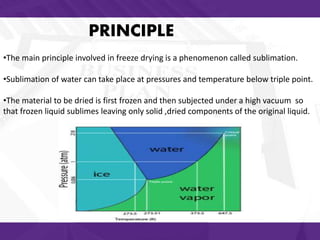
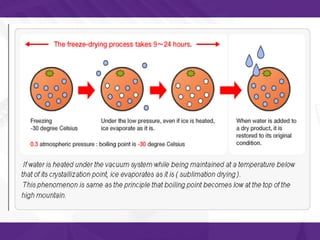
•The main principle involved in freeze drying is a phenomenon called sublimation.
•Sublimation of water can take place at pressures and temperature below triple point.
•The material to be dried is first frozen and then subjected under a high vacuum so
that frozen liquid sublimes leaving only solid ,dried components of the original liquid.
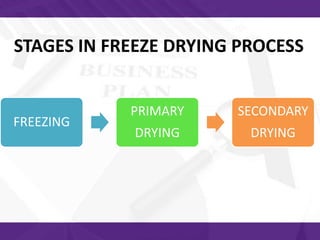
FREEZING
PRIMARY
DRYING
SECONDARY
DRYING
STAGES IN FREEZE DRYING PROCESS
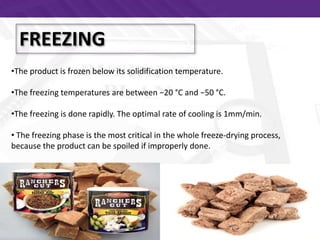
FREEZING
•The product is frozen below its solidification temperature.
•The freezing temperatures are between −20 °C and −50 °C.
•The freezing is done rapidly. The optimal rate of cooling is 1mm/min.
• The freezing phase is the most critical in the whole freeze-drying process,
because the product can be spoiled if improperly done.
Air Freezing : Foods can be frozen in air at temperatures ranging from –18° to – 40 °.
Air Blast Freezing :
•Circulation of cold air enables freezing to proceed at a moderately rapid rate.
•Products are placed on trays, either loose or in packages and the trays are placed on
freezing coils in a low temperature room with cold air blowing over the product
Liquid Immersion Freezing :
•A food product is frozen by immersion in or by spraying with a freezant that remains
liquid throughout the process.
•Freezants: propylene glycol, glycerol, sodium chloride, and mixtures of salt and sugar.
Cryogenic freezing :
Liquid nitrogen (LN), liquid “freon” freezant (LFF) is used for food freezing.
FREEZING METHODS
PRIMARY DRYING
• The removal of the frozen free moisture by a
process of sublimation.
•During the primary drying phase, the pressure
is lowered , and enough heat is supplied to the
material for the ice to sublime (latent heat of
sublimation).
•In this initial drying phase, about 95% of the
water in the material is sublimated. This phase
may be slow because, if too much heat is
added, the material’s structure could be altered.
•The heat is brought mainly by conduction,
convection or radiation.
SECONDARY DRYING
•Eliminating the final traces of water which remain due to absorption.
•The temperature is raised higher than in the primary drying phase, and can even be
above 0 °C, to break any physico-chemical interactions that have formed between the
water molecules and the frozen material.
•At the end of the operation, the final residual water content in the product is extremely
low, around 1% to 4%.
•After the freeze-drying process is complete, the vacuum is usually broken with an inert
gas, such as nitrogen, before the material is sealed.
 Place the material to be preserved onto the
shelves.
Machine runs the compressors to lower the
temperature in the chamber.
 The machine turns on the vacuum pump to force
air out of the chamber, lowering the atmospheric
pressure below .06 ATM.
The heating units apply a small amount of heat to
the shelves, causing the ice to change phase.
This continues for many hours (even days) while
the material gradually dries out.
Once the material is dried sufficiently, it's sealed in
a moisture-free package
PROCESS
PROPERTIES OF FREEZE DRIED MEAT
taste
texture
nutrients
•Reconstitutes to original state when placed in water
•Retains original characteristics of the product, including: color, form, size, taste, texture,
nutrients.
•Reconstitutes to original state when placed in water
•Shelf stable at room temperature - cold storage not required
•The weight of the freeze-dried products is reduced by 70 to 90 percent, with no change in
volume
•The product is light weight and easy to handle
•Shipping costs are reduced because of the light weight and lack of refrigeration
•Low water activity virtually eliminates microbiological concerns
•Offers highest quality in a dry product compared to other drying methods
Quality Changes In Freeze Dried Meat
• Changes in protein structure and water binding caused by
1. Aggregation or cross linking of undenatured protein.
2. Denaturation of protein followed by aggregation.
3. Interaction of denatured protein with lipids or
carbohydrates.
• Non-enzymatic browning reactions due to interaction
between protein groups and carbonyl compounds fron
auto-oxidising lipids.
• Degradation of myoglobin pigment, responsible for the red
colour .
• It is also found that degraded heme pigments may catalyse
lipid oxidation.
STABILITY OF FREEZE DRIED MEAT
•MOISTURE AND OXYGEN are the two most important factors which affect the
stability
•The detrimental effects of moisture and oxygen are temperature dependent.
•Packaging used must be impermeable to atmospheric moisture.
•Freeze-dried foods are packed in airtight NITROGEN PACK. This process uses both
vacuum oxygen removal and nitrogen flushing.
•Shelf life is from 5 to 8 years and if stored properly can last upto 20 years .
ADVANTAGES
Chemical decomposition is
minimized.
Removal of water without
excessive heating.
Enhanced product stability in a
dry state.
DISADVANTAGES
Increased handling and processing
time.
Volatile compounds can be removed
by vacuum.
Freeze drying requires large,
expensive equipments
Pharmaceutical
and
Biotechnology
Technological
Industry
Food
Industry
APPLICATIONS
Freeze drying

Freeze drying

  • 1.
  • 2.
    What is FreezeDrying (Lyophilization)? •Freeze drying also known as lyophilization is an important process for the preservation and storage of biologicals, pharmaceuticals and foods. •The basic idea of freeze-drying is to completely remove water from some material, such as food, while leaving the basic structure and composition of the material intact. •Freeze drying is a process whereby water or other solvent is removed from frozen material by converting the frozen water directly into vapor without the intermediate formation of liquid water.
  • 3.
    PRINCIPLE •The main principleinvolved in freeze drying is a phenomenon called sublimation. •Sublimation of water can take place at pressures and temperature below triple point. •The material to be dried is first frozen and then subjected under a high vacuum so that frozen liquid sublimes leaving only solid ,dried components of the original liquid.
  • 4.
  • 5.
    FREEZING •The product isfrozen below its solidification temperature. •The freezing temperatures are between −20 °C and −50 °C. •The freezing is done rapidly. The optimal rate of cooling is 1mm/min. • The freezing phase is the most critical in the whole freeze-drying process, because the product can be spoiled if improperly done.
  • 6.
    Air Freezing :Foods can be frozen in air at temperatures ranging from –18° to – 40 °. Air Blast Freezing : •Circulation of cold air enables freezing to proceed at a moderately rapid rate. •Products are placed on trays, either loose or in packages and the trays are placed on freezing coils in a low temperature room with cold air blowing over the product Liquid Immersion Freezing : •A food product is frozen by immersion in or by spraying with a freezant that remains liquid throughout the process. •Freezants: propylene glycol, glycerol, sodium chloride, and mixtures of salt and sugar. Cryogenic freezing : Liquid nitrogen (LN), liquid “freon” freezant (LFF) is used for food freezing. FREEZING METHODS
  • 7.
    PRIMARY DRYING • Theremoval of the frozen free moisture by a process of sublimation. •During the primary drying phase, the pressure is lowered , and enough heat is supplied to the material for the ice to sublime (latent heat of sublimation). •In this initial drying phase, about 95% of the water in the material is sublimated. This phase may be slow because, if too much heat is added, the material’s structure could be altered. •The heat is brought mainly by conduction, convection or radiation.
  • 8.
    SECONDARY DRYING •Eliminating thefinal traces of water which remain due to absorption. •The temperature is raised higher than in the primary drying phase, and can even be above 0 °C, to break any physico-chemical interactions that have formed between the water molecules and the frozen material. •At the end of the operation, the final residual water content in the product is extremely low, around 1% to 4%. •After the freeze-drying process is complete, the vacuum is usually broken with an inert gas, such as nitrogen, before the material is sealed.
  • 11.
     Place thematerial to be preserved onto the shelves. Machine runs the compressors to lower the temperature in the chamber.  The machine turns on the vacuum pump to force air out of the chamber, lowering the atmospheric pressure below .06 ATM. The heating units apply a small amount of heat to the shelves, causing the ice to change phase. This continues for many hours (even days) while the material gradually dries out. Once the material is dried sufficiently, it's sealed in a moisture-free package PROCESS
  • 12.
    PROPERTIES OF FREEZEDRIED MEAT taste texture nutrients •Reconstitutes to original state when placed in water •Retains original characteristics of the product, including: color, form, size, taste, texture, nutrients. •Reconstitutes to original state when placed in water •Shelf stable at room temperature - cold storage not required •The weight of the freeze-dried products is reduced by 70 to 90 percent, with no change in volume •The product is light weight and easy to handle •Shipping costs are reduced because of the light weight and lack of refrigeration •Low water activity virtually eliminates microbiological concerns •Offers highest quality in a dry product compared to other drying methods
  • 13.
    Quality Changes InFreeze Dried Meat • Changes in protein structure and water binding caused by 1. Aggregation or cross linking of undenatured protein. 2. Denaturation of protein followed by aggregation. 3. Interaction of denatured protein with lipids or carbohydrates. • Non-enzymatic browning reactions due to interaction between protein groups and carbonyl compounds fron auto-oxidising lipids. • Degradation of myoglobin pigment, responsible for the red colour . • It is also found that degraded heme pigments may catalyse lipid oxidation.
  • 14.
    STABILITY OF FREEZEDRIED MEAT •MOISTURE AND OXYGEN are the two most important factors which affect the stability •The detrimental effects of moisture and oxygen are temperature dependent. •Packaging used must be impermeable to atmospheric moisture. •Freeze-dried foods are packed in airtight NITROGEN PACK. This process uses both vacuum oxygen removal and nitrogen flushing. •Shelf life is from 5 to 8 years and if stored properly can last upto 20 years .
  • 15.
    ADVANTAGES Chemical decomposition is minimized. Removalof water without excessive heating. Enhanced product stability in a dry state. DISADVANTAGES Increased handling and processing time. Volatile compounds can be removed by vacuum. Freeze drying requires large, expensive equipments
  • 16.