
Presented by
Pallavi B.S
B.Tech food science and technology
INDIVIDUAL QUICK
FREEZING OF HERBS
PROCESS
 FREEZING is the methods of food preservation,
 It allows preservation of taste, texture, and nutritional value in
foods.
 The freezing process is a combination of the beneficial effects
of low temperatures at which microorganisms cannot grow,
chemical reactions are reduced and cellular metabolic
reactions are delayed.
 For preservation of foods for longer periods.
 The way foods are frozen in the IQF method involves sending
the individual food items on sort of conveyor belt in to a blast-
freezer the item freeze very quickly. Because the food items
separate when they go in, they stay separate after they’ve been
frozen
 Products are individually frozen
.
The material to be
frozen first cools
down to the
temperature at
which
Nucleation starts
@ pre –cooling
Before ice can
form, a nucleus, is
required upon
which the crystal
can grow; the
process of
producing this is
defined as
Nucleation
@ freezing .
Once the first
crystal appears in
the
solution, a phase
change occurs
from
liquid to solid
with further
crystal
growth
HOW ???
Figure 3. Practical definition of the freezing process for foods (Mallet, 1993).
 To retard the microbial growth
 For long shelf life
 Good natural color, flavor and
nutritive value can be retained.
 Texture usually better than other
methods of food preservation.
 Foods can be frozen in less time than
they can be dried or canned.
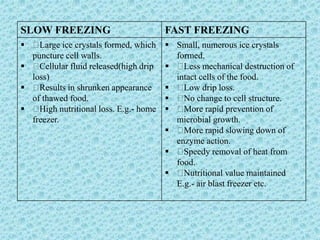
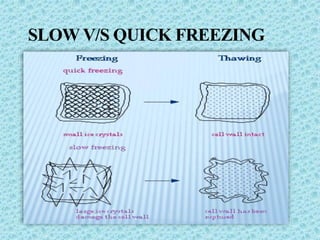
SLOW FREEZING FAST FREEZING
 Large ice crystals formed, which
puncture cell walls.
 Cellular fluid released(high drip
loss)
 Results in shrunken appearance
of thawed food.
 High nutritional loss. E.g.- home
freezer.
 Small, numerous ice crystals
formed.
 Less mechanical destruction of
intact cells of the food.
 Low drip loss.
 No change to cell structure.
 More rapid prevention of
microbial growth.
 More rapid slowing down of
enzyme action.
 Speedy removal of heat from
food.
 Nutritional value maintained
E.g.- air blast freezer etc.
 Chives
 Dill
 Lemon grass
Dill
Chives
Lemon grass
 Line clearance is required:
 washing and sanitization of equipment, processing area with
food grade chemicals (sodium hypochlorite, per acetic acid)
 Clean the floor (with soap oil)
 Ensure the personnel hygiene (jewellery policy )
 Ensure Good Hygiene Practice, Good Manufacturing Practice
 Raw material are received and checked against raw material
specification provided by either customer or in-house as per
sampling plan
 Material is either accepted(A) , rejected(R) or accepted
under deviation (AUD)
NOTE:
a. Material is accepted if it conforms to the specification
b. Material is rejected if doesn’t meets specification
c. Material is accepted under deviation after discussion and
joint agreement between production and quality team.
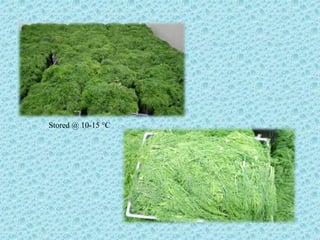
Stored @ 10-15 °C
SN RAW MATERIAL PARAMETER SPECIFICATION
1 chives
Colour Green to dark green leaves lighter at base.
shape Stem length > 200-300mm, Long, cylindrical leaves
Foreign taints / smells 5%
Extraneous matter <2%
Dehydration
Max 5%Yellow coloured leaves
Spoiled leaves
2 Dill leaves
Colour Deep green color leaves, green stems.
Bunch size
Bunch length 250 - 350 mm;
Shape
Fine leaves, arranged along thin, round, slightly grooved
stems.
Foreign taints / smells Max 2 %
Diseased Max 5 %
Spoiled leaves
Max 5%Yellow leaves /withering
Sun burn
3 Lemon grass Colour Dark green to light green in colour with woodier stalks
Length 450-550 mm
Dehydration / Shrivel / Wrinkles Max 10%
Diseased nil
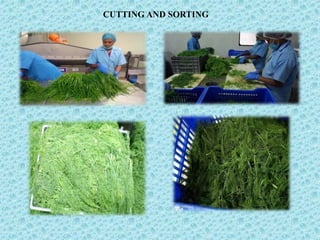
GRADING AND SORTING: The herbs are given for
cutting of roots and removal of stem part (dill),
extraneous matter, spoiled part, yellow leaves, infestation
and foreign particles.
NOTE: Where the unwanted materials are removed
CUTTING AND SORTING
Yellow leaves Thread/
Rubber bands
Extraneous matters Dehydrated
/Withered/
Shrinked
Spoiled
1.WASHING
Received raw material are then transferred into clean plastic crates and
arranged properly
Washing is done to remove the dirt, dust adhered to the raw material and
to reduce the microbial load.
 Herbs (Dill, lemon grass, chives) are washed with max. 0.03% per
acetic acid as per food safety standards which helps in reducing the
microbial load
 The level of per acetic acid is verified by per acetic acid strips and
cross checked by titration method
 Tub washing
It’s a manual method of washing where the raw materials in
crates are dipped in tub which contain 100L of water with
incorporation of 200ml PAA.
 Changing of water once in hour or once after every 5 to 6
number of crates and top up of per acetic acid based on the
suggestion from quality executive
Tub
washing
Herbs
Dipping time 2-3 min
Per acetic acid level
Max 0.03% ( 300
ppm)
Plain water washing
Washing with per acetic acid
incorporated water 2-3 min
 Slicing is the process carrying out as per the customer /specific
requirement
 Slicing size :
After slicing, following parameters are checked:
Chives 5-8mm
Lemon grass 5-8mm
Dill leaves 5-8mm
Chives Long
Fines
Large
Extra large
Lemon grass
Dill leaves
Feeding to the slicer
Slices
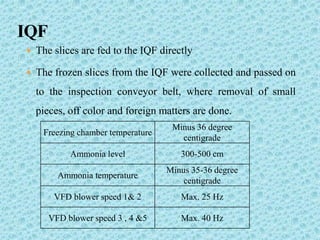
 The slices are fed to the IQF directly
 The frozen slices from the IQF were collected and passed on
to the inspection conveyor belt, where removal of small
pieces, off color and foreign matters are done.
Freezing chamber temperature
Minus 36 degree
centigrade
Ammonia level 300-500 cm
Ammonia temperature
Minus 35-36 degree
centigrade
VFD blower speed 1& 2 Max. 25 Hz
VFD blower speed 3 , 4 &5 Max. 40 Hz
IQF chamber
Product from the IQF
Finished good
 From the conveyor slices were collected in white LDPE bag and packing
in HDPE bag and weighed on weighing scale as per the plan
 Sealing
 Following quality parameters are checked in FG:
 Product Temperature
 Name of the product
 Batch code
 Date of manufacturing
 Total quantity
 Bag number
Collection to the bag
Stitching
Final temperature monitoring
Weighing
 After packing the bag is passed trough the metal detector
 Before passing checked against the standard test pieces are
• Ferrous : 2mm
• Non ferrous : 2.5 mm
• Stainless steel : 3mm
After packing the product is hand over to freezer room and stored at -18
to -22°C till dispatch .
 Issue the frozen slice bag from freezer room (-18°C)as per FIFO
 Before the dispatch, following parameters are checked:
 Temperature of product
 Temperature of vehicle
 Product Condition
 Vehicle Condition
 Slicer
 IQF chamber
 Weighing balance
 Hand Stitching machine
 Metal detector
 Automatic Leafy / Root Vegetables Cutting Machine
 Variable Speed with Conveyor
 Multi Function Machine for Different Products
 Easy to Adjust size
 Stainless Steel Body
Specification
 Voltage: 220v
 Power: 1.1 KW
 Horsepower: 1.5 HP(corn vegetable 1 HP, leaf vegetable 0.5 HP)
 Production: leaf vegetable 400-600 kg/ hour
 Root vegetable 300-500 kg/ hour
 Ideal for Cut Fruits, Vegetable & herbs
 Food grade MOC gives high standard of hygiene
 Inbuilt VFD for variable belt speed which gives freedom in
handling variety of products
 Complete ease of defrost and high degree of sanitation
 Very quick freezing time ensure minimal water loss and high
product quality
IQF CHAMBER
TWO STAGE BELT FREEZER which
consists of two mesh conveyor belts in
series.
 The first belt initially precools.
 Second belt for freezing and sensible
cooling (-18 Deg C of below).
Generally operated at -32 to -36°C in
side the chamber with freezing times
from 5 to 7 min.
 vertical blowing principle.
 which blows the air through an evaporator generating an air
temperature of below -30°C. A quick freezing with a product
temperature down to -18°C is achieved.
 consists of bare tubes or coils over which the metal plates or
fins are fastened.
 The shape, size or spacing of the fins can be adapted to
provide best rate of heat transfer
 it will defrost itself on the off cycle when the temperature of
the
 coil is near 0°C. A finned coil should never be allowed to
frost because the accumulation
 of frost between the fins reduces the capacity
Ammonia is one of the oldest and most widely used refrigerant .
 It is colorless gas
 It is highly toxic
 Its boiling point at atmospheric pressure is -33.3ºC
and its melting point from solid is
-78ºC ammonia.
 It is extensively found in cold storage,
ware house plant, food freezing plant
etc.
 It is a poisonous gas if inhaled in large quantities.
 In lesser quantities, it is irritating to the, nose and throat. This
refrigerant is somewhat flammable when mixed with air in the
ratio of 16% to 25% of gas by volume, will form an explosive
mixture.
 The leaks of this refrigerant may quickly and easily detected by
the use of burning sulphur candle which in the presence of
ammonia forms white fumes of ammonium sulphite.
 This refrigerant attacks copper and bronze in the presence of a
little moisture but does not corrode iron or steel..
 designed to detect minute Metal contamination in
products and give accurate results,
Freezing pdf

Freezing pdf

  • 1.
    Presented by Pallavi B.S B.Techfood science and technology INDIVIDUAL QUICK FREEZING OF HERBS PROCESS
  • 2.
     FREEZING isthe methods of food preservation,  It allows preservation of taste, texture, and nutritional value in foods.  The freezing process is a combination of the beneficial effects of low temperatures at which microorganisms cannot grow, chemical reactions are reduced and cellular metabolic reactions are delayed.  For preservation of foods for longer periods.
  • 3.
     The wayfoods are frozen in the IQF method involves sending the individual food items on sort of conveyor belt in to a blast- freezer the item freeze very quickly. Because the food items separate when they go in, they stay separate after they’ve been frozen  Products are individually frozen
  • 4.
    . The material tobe frozen first cools down to the temperature at which Nucleation starts @ pre –cooling Before ice can form, a nucleus, is required upon which the crystal can grow; the process of producing this is defined as Nucleation @ freezing . Once the first crystal appears in the solution, a phase change occurs from liquid to solid with further crystal growth HOW ???
  • 5.
    Figure 3. Practicaldefinition of the freezing process for foods (Mallet, 1993).
  • 6.
     To retardthe microbial growth  For long shelf life  Good natural color, flavor and nutritive value can be retained.  Texture usually better than other methods of food preservation.  Foods can be frozen in less time than they can be dried or canned.
  • 7.
    SLOW FREEZING FASTFREEZING  Large ice crystals formed, which puncture cell walls.  Cellular fluid released(high drip loss)  Results in shrunken appearance of thawed food.  High nutritional loss. E.g.- home freezer.  Small, numerous ice crystals formed.  Less mechanical destruction of intact cells of the food.  Low drip loss.  No change to cell structure.  More rapid prevention of microbial growth.  More rapid slowing down of enzyme action.  Speedy removal of heat from food.  Nutritional value maintained E.g.- air blast freezer etc.
  • 9.
     Chives  Dill Lemon grass Dill Chives Lemon grass
  • 10.
     Line clearanceis required:  washing and sanitization of equipment, processing area with food grade chemicals (sodium hypochlorite, per acetic acid)  Clean the floor (with soap oil)  Ensure the personnel hygiene (jewellery policy )  Ensure Good Hygiene Practice, Good Manufacturing Practice
  • 11.
     Raw materialare received and checked against raw material specification provided by either customer or in-house as per sampling plan  Material is either accepted(A) , rejected(R) or accepted under deviation (AUD) NOTE: a. Material is accepted if it conforms to the specification b. Material is rejected if doesn’t meets specification c. Material is accepted under deviation after discussion and joint agreement between production and quality team.
  • 12.
  • 13.
    SN RAW MATERIALPARAMETER SPECIFICATION 1 chives Colour Green to dark green leaves lighter at base. shape Stem length > 200-300mm, Long, cylindrical leaves Foreign taints / smells 5% Extraneous matter <2% Dehydration Max 5%Yellow coloured leaves Spoiled leaves 2 Dill leaves Colour Deep green color leaves, green stems. Bunch size Bunch length 250 - 350 mm; Shape Fine leaves, arranged along thin, round, slightly grooved stems. Foreign taints / smells Max 2 % Diseased Max 5 % Spoiled leaves Max 5%Yellow leaves /withering Sun burn 3 Lemon grass Colour Dark green to light green in colour with woodier stalks Length 450-550 mm Dehydration / Shrivel / Wrinkles Max 10% Diseased nil
  • 14.
    GRADING AND SORTING:The herbs are given for cutting of roots and removal of stem part (dill), extraneous matter, spoiled part, yellow leaves, infestation and foreign particles. NOTE: Where the unwanted materials are removed
  • 15.
  • 16.
    Yellow leaves Thread/ Rubberbands Extraneous matters Dehydrated /Withered/ Shrinked Spoiled
  • 17.
    1.WASHING Received raw materialare then transferred into clean plastic crates and arranged properly Washing is done to remove the dirt, dust adhered to the raw material and to reduce the microbial load.  Herbs (Dill, lemon grass, chives) are washed with max. 0.03% per acetic acid as per food safety standards which helps in reducing the microbial load  The level of per acetic acid is verified by per acetic acid strips and cross checked by titration method
  • 18.
     Tub washing It’sa manual method of washing where the raw materials in crates are dipped in tub which contain 100L of water with incorporation of 200ml PAA.  Changing of water once in hour or once after every 5 to 6 number of crates and top up of per acetic acid based on the suggestion from quality executive Tub washing Herbs Dipping time 2-3 min Per acetic acid level Max 0.03% ( 300 ppm)
  • 19.
    Plain water washing Washingwith per acetic acid incorporated water 2-3 min
  • 20.
     Slicing isthe process carrying out as per the customer /specific requirement  Slicing size : After slicing, following parameters are checked: Chives 5-8mm Lemon grass 5-8mm Dill leaves 5-8mm Chives Long Fines Large Extra large Lemon grass Dill leaves
  • 21.
    Feeding to theslicer Slices
  • 22.
     The slicesare fed to the IQF directly  The frozen slices from the IQF were collected and passed on to the inspection conveyor belt, where removal of small pieces, off color and foreign matters are done. Freezing chamber temperature Minus 36 degree centigrade Ammonia level 300-500 cm Ammonia temperature Minus 35-36 degree centigrade VFD blower speed 1& 2 Max. 25 Hz VFD blower speed 3 , 4 &5 Max. 40 Hz
  • 23.
    IQF chamber Product fromthe IQF Finished good
  • 24.
     From theconveyor slices were collected in white LDPE bag and packing in HDPE bag and weighed on weighing scale as per the plan  Sealing  Following quality parameters are checked in FG:  Product Temperature  Name of the product  Batch code  Date of manufacturing  Total quantity  Bag number
  • 25.
    Collection to thebag Stitching Final temperature monitoring Weighing
  • 26.
     After packingthe bag is passed trough the metal detector  Before passing checked against the standard test pieces are • Ferrous : 2mm • Non ferrous : 2.5 mm • Stainless steel : 3mm
  • 27.
    After packing theproduct is hand over to freezer room and stored at -18 to -22°C till dispatch .  Issue the frozen slice bag from freezer room (-18°C)as per FIFO  Before the dispatch, following parameters are checked:  Temperature of product  Temperature of vehicle  Product Condition  Vehicle Condition
  • 28.
     Slicer  IQFchamber  Weighing balance  Hand Stitching machine  Metal detector
  • 29.
     Automatic Leafy/ Root Vegetables Cutting Machine  Variable Speed with Conveyor  Multi Function Machine for Different Products  Easy to Adjust size  Stainless Steel Body Specification  Voltage: 220v  Power: 1.1 KW  Horsepower: 1.5 HP(corn vegetable 1 HP, leaf vegetable 0.5 HP)  Production: leaf vegetable 400-600 kg/ hour  Root vegetable 300-500 kg/ hour
  • 30.
     Ideal forCut Fruits, Vegetable & herbs  Food grade MOC gives high standard of hygiene  Inbuilt VFD for variable belt speed which gives freedom in handling variety of products  Complete ease of defrost and high degree of sanitation  Very quick freezing time ensure minimal water loss and high product quality IQF CHAMBER
  • 31.
    TWO STAGE BELTFREEZER which consists of two mesh conveyor belts in series.  The first belt initially precools.  Second belt for freezing and sensible cooling (-18 Deg C of below). Generally operated at -32 to -36°C in side the chamber with freezing times from 5 to 7 min.
  • 32.
     vertical blowingprinciple.  which blows the air through an evaporator generating an air temperature of below -30°C. A quick freezing with a product temperature down to -18°C is achieved.
  • 33.
     consists ofbare tubes or coils over which the metal plates or fins are fastened.  The shape, size or spacing of the fins can be adapted to provide best rate of heat transfer  it will defrost itself on the off cycle when the temperature of the  coil is near 0°C. A finned coil should never be allowed to frost because the accumulation  of frost between the fins reduces the capacity
  • 34.
    Ammonia is oneof the oldest and most widely used refrigerant .  It is colorless gas  It is highly toxic  Its boiling point at atmospheric pressure is -33.3ºC and its melting point from solid is -78ºC ammonia.  It is extensively found in cold storage, ware house plant, food freezing plant etc.
  • 35.
     It isa poisonous gas if inhaled in large quantities.  In lesser quantities, it is irritating to the, nose and throat. This refrigerant is somewhat flammable when mixed with air in the ratio of 16% to 25% of gas by volume, will form an explosive mixture.  The leaks of this refrigerant may quickly and easily detected by the use of burning sulphur candle which in the presence of ammonia forms white fumes of ammonium sulphite.  This refrigerant attacks copper and bronze in the presence of a little moisture but does not corrode iron or steel..
  • 36.
     designed todetect minute Metal contamination in products and give accurate results,