Applied Physics
Single Slit
Diffraction
Content
● Introduction
● Huygens’s Principle
● How interference creates pattern?
● Minima(Dark Fringes)
● Conditions for minima
● Central Maxima
● Why central maxima is special?
● Intensity Distribution
● Complete Diffraction Pattern Description
● Factors that control the pattern
● Real life Applications
● Summary
Name
01 Roll no
02 Roll no
03 Roll no
Name
Name
Group Members
Introduction
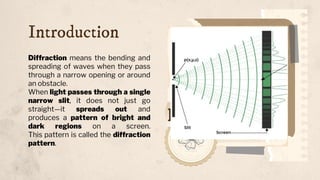
Diffraction means the bending and
spreading of waves when they pass
through a narrow opening or around
an obstacle.
When light passes through a single
narrow slit, it does not just go
straight—it spreads out and
produces a pattern of bright and
dark regions on a screen.
This pattern is called the diffraction
pattern.
Huygens’ Principle says:
Every point on a wavefront acts as a source of tiny
secondary wavelets.
These wavelets spread forward and interfere with each
other.
So when light hits a slit:
• The slit is not just one opening.
• Instead, every point across the slit width acts like
a source of secondary waves.
This turns a single slit into many tiny sources of light
waves all across the slit.
These tiny waves combine on the screen →
interference
occurs → diffraction pattern appears.
Why Diffraction Happens? —
Huygens’ Principle
How Interference Creates
the Pattern?
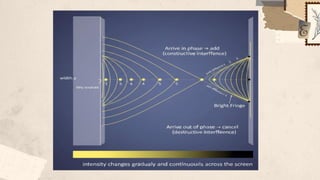
Inside the slit of width a, imagine dividing it
into many segments as shown in fig:
All these tiny sources send waves to a point
on the screen.
The waves may:
• Arrive in phase → add (constructive
interference → bright fringe)
• Arrive out of phase → cancel
(destructive interference → dark fringe)
Different screen positions correspond to
different path differences.
This is why the intensity changes gradually
and continuously across the screen.
Minima
Minima are the positions on the diffraction
pattern where destructive interference of
light waves occurs, resulting in very low or
zero intensity.
Simple meaning:
Minima = dark fringes = zero intensity
points due to complete cancellation of
light waves.
Conditions for Minima
(Dark Fringes) — Derivation
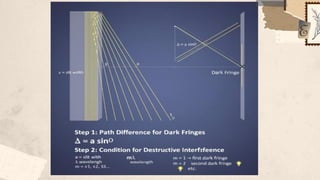
Step 1: Consider light going at angle θ.
For the top and bottom of the slit, the path difference
is:
Δ = a sinθ
Step 2: Condition for destructive
interference
For a dark fringe, waves from the top half of the slit
cancel waves from the bottom half.
This requires:
Δ = mλ
→ a sinθ = mλ
Where
● a = slit width
● m = ±1, ±2, ±3…
● λ = wavelength
So:
● m = 1 → first dark fringe
● m = 2 → second dark fringe
● etc.
Central Maximum
“The central maximum is the bright central region in a
diffraction pattern where all the light waves from the
slit arrive in phase and interfere constructively,
producing maximum intensity.”
Key Points:
🔸 Brightest Fringe
It has the highest intensity because there is no path
difference between waves from different parts of the
slit.
🔸 Occurs at θ = 0
This is the exact center of the screen—straight ahead of
the slit.
🔸 Widest Bright Band
The central maximum is twice as wide as the other
bright fringes.
🔸 Formed by Constructive Interference
Since all waves travel the same distance at the center,
they add up perfectly.
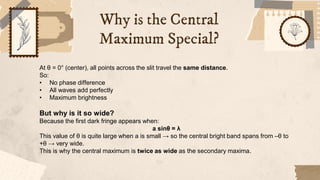
Why is the Central
Maximum Special?
At θ = 0° (center), all points across the slit travel the same distance.
So:
• No phase difference
• All waves add perfectly
• Maximum brightness
But why is it so wide?
Because the first dark fringe appears when:
a sinθ = λ
This value of θ is quite large when a is small → so the central bright band spans from –θ to
+θ → very wide.
This is why the central maximum is twice as wide as the secondary maxima.
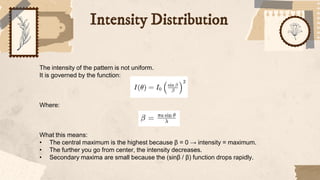
Intensity Distribution
The intensity of the pattern is not uniform.
It is governed by the function:
Where:
What this means:
• The central maximum is the highest because β = 0 → intensity = maximum.
• The further you go from center, the intensity decreases.
• Secondary maxima are small because the (sinβ / β) function drops rapidly.
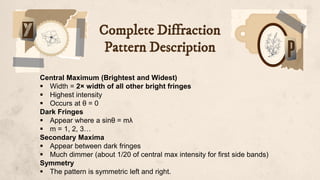
Complete Diffraction
Pattern Description
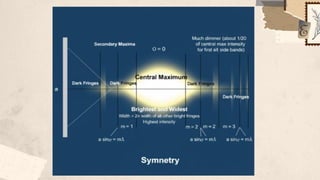
Central Maximum (Brightest and Widest)
 Width = 2× width of all other bright fringes
 Highest intensity
 Occurs at θ = 0
Dark Fringes
 Appear where a sinθ = mλ
 m = 1, 2, 3…
Secondary Maxima
 Appear between dark fringes
 Much dimmer (about 1/20 of central max intensity for first side bands)
Symmetry
 The pattern is symmetric left and right.
Factors That Control the Pattern
Distance to screen (D)
Slit Width (a)
• Smaller slit → more
Diffraction
Because λ/a increases →
large θ for first minimum
• Larger slit → less
spreading
Diffraction ∝ 1/a
• Longer wavelength (red)
→ more spread
• Shorter wavelength
(blue) → less spread
Diffraction ∝ λ
Does not affect angles but
spreads physically:
y = D tanθ ≈ D sinθ
→ larger D → wider
pattern on screen
Wavelength (λ)
Real-Life Applications
🔹 Optical Instruments
Diffraction limits resolution:
A microscope cannot see very small objects because small
apertures cause spreading.
🔹 Astronomy (Telescope Resolution)
Stars appear as diffraction disks (Airy pattern).
🔹 CD and DVD patterns
Grooves act like slits and diffract light.
🔹 Sound Diffraction
Sound heard around corners due to long wavelengths.
🔹 Human eye pupil diffraction
Limits the sharpness of vision.
Summary
• Single slit acts as many sources of
secondary waves.
• Interference of these waves
produces a central bright band and
alternating dark and bright fringes.
• Dark fringes follow: asinθ=m
• Bright fringes are in between but
not equally intense.
• Central maximum is the brightest
and widest due to perfect
constructive interference.
• Pattern depends on slit width and
wavelength.
Thank
You!

Introduction to Single slit Diffraction.pdf

  • 1.
  • 2.
    Content ● Introduction ● Huygens’sPrinciple ● How interference creates pattern? ● Minima(Dark Fringes) ● Conditions for minima ● Central Maxima ● Why central maxima is special? ● Intensity Distribution ● Complete Diffraction Pattern Description ● Factors that control the pattern ● Real life Applications ● Summary
  • 3.
    Name 01 Roll no 02Roll no 03 Roll no Name Name Group Members
  • 4.
    Introduction Diffraction means thebending and spreading of waves when they pass through a narrow opening or around an obstacle. When light passes through a single narrow slit, it does not just go straight—it spreads out and produces a pattern of bright and dark regions on a screen. This pattern is called the diffraction pattern.
  • 5.
    Huygens’ Principle says: Everypoint on a wavefront acts as a source of tiny secondary wavelets. These wavelets spread forward and interfere with each other. So when light hits a slit: • The slit is not just one opening. • Instead, every point across the slit width acts like a source of secondary waves. This turns a single slit into many tiny sources of light waves all across the slit. These tiny waves combine on the screen → interference occurs → diffraction pattern appears. Why Diffraction Happens? — Huygens’ Principle
  • 6.
    How Interference Creates thePattern? Inside the slit of width a, imagine dividing it into many segments as shown in fig: All these tiny sources send waves to a point on the screen. The waves may: • Arrive in phase → add (constructive interference → bright fringe) • Arrive out of phase → cancel (destructive interference → dark fringe) Different screen positions correspond to different path differences. This is why the intensity changes gradually and continuously across the screen.
  • 8.
    Minima Minima are thepositions on the diffraction pattern where destructive interference of light waves occurs, resulting in very low or zero intensity. Simple meaning: Minima = dark fringes = zero intensity points due to complete cancellation of light waves.
  • 9.
    Conditions for Minima (DarkFringes) — Derivation
  • 10.
    Step 1: Considerlight going at angle θ. For the top and bottom of the slit, the path difference is: Δ = a sinθ Step 2: Condition for destructive interference For a dark fringe, waves from the top half of the slit cancel waves from the bottom half. This requires: Δ = mλ → a sinθ = mλ Where ● a = slit width ● m = ±1, ±2, ±3… ● λ = wavelength So: ● m = 1 → first dark fringe ● m = 2 → second dark fringe ● etc.
  • 12.
    Central Maximum “The centralmaximum is the bright central region in a diffraction pattern where all the light waves from the slit arrive in phase and interfere constructively, producing maximum intensity.” Key Points: 🔸 Brightest Fringe It has the highest intensity because there is no path difference between waves from different parts of the slit. 🔸 Occurs at θ = 0 This is the exact center of the screen—straight ahead of the slit. 🔸 Widest Bright Band The central maximum is twice as wide as the other bright fringes. 🔸 Formed by Constructive Interference Since all waves travel the same distance at the center, they add up perfectly.
  • 13.
    Why is theCentral Maximum Special? At θ = 0° (center), all points across the slit travel the same distance. So: • No phase difference • All waves add perfectly • Maximum brightness But why is it so wide? Because the first dark fringe appears when: a sinθ = λ This value of θ is quite large when a is small → so the central bright band spans from –θ to +θ → very wide. This is why the central maximum is twice as wide as the secondary maxima.
  • 14.
    Intensity Distribution The intensityof the pattern is not uniform. It is governed by the function: Where: What this means: • The central maximum is the highest because β = 0 → intensity = maximum. • The further you go from center, the intensity decreases. • Secondary maxima are small because the (sinβ / β) function drops rapidly.
  • 15.
    Complete Diffraction Pattern Description CentralMaximum (Brightest and Widest)  Width = 2× width of all other bright fringes  Highest intensity  Occurs at θ = 0 Dark Fringes  Appear where a sinθ = mλ  m = 1, 2, 3… Secondary Maxima  Appear between dark fringes  Much dimmer (about 1/20 of central max intensity for first side bands) Symmetry  The pattern is symmetric left and right.
  • 17.
    Factors That Controlthe Pattern Distance to screen (D) Slit Width (a) • Smaller slit → more Diffraction Because λ/a increases → large θ for first minimum • Larger slit → less spreading Diffraction ∝ 1/a • Longer wavelength (red) → more spread • Shorter wavelength (blue) → less spread Diffraction ∝ λ Does not affect angles but spreads physically: y = D tanθ ≈ D sinθ → larger D → wider pattern on screen Wavelength (λ)
  • 18.
    Real-Life Applications 🔹 OpticalInstruments Diffraction limits resolution: A microscope cannot see very small objects because small apertures cause spreading. 🔹 Astronomy (Telescope Resolution) Stars appear as diffraction disks (Airy pattern). 🔹 CD and DVD patterns Grooves act like slits and diffract light. 🔹 Sound Diffraction Sound heard around corners due to long wavelengths. 🔹 Human eye pupil diffraction Limits the sharpness of vision.
  • 19.
    Summary • Single slitacts as many sources of secondary waves. • Interference of these waves produces a central bright band and alternating dark and bright fringes. • Dark fringes follow: asinθ=m • Bright fringes are in between but not equally intense. • Central maximum is the brightest and widest due to perfect constructive interference. • Pattern depends on slit width and wavelength.

  • 20.