International Refereed Journal of Engineering and Science (IRJES)
ISSN (Online) 2319-183X, (Print) 2319-1821
Volume 2, Issue 5(May 2013), PP.08-15
www.irjes.com
www.irjes.com 8 | Page
On A Class Of 𝒑 −Valent Functions Involving Generalized
Hypergeometric Function
Chena Ram And Saroj Solanki
Department of Mathematics and Statistics, Jai Narain Vyas University Jodhpur, (Rajasthan), India.
Abstract: Invoking the Hadamard product (or convolution), a class of p-valent functions has been introduced.
The coefficient bounds, extreme points, radii of close-to-convex, starlikeness and convexity are obtained for the
same class of functions. Distortion theorem and fractional differ-integral operators are also obtained.
Key words: 𝑝-valent function; Analytic function; Hadamard product; Generalized hyper-geometric functions;
Linear operator; Starlike function; Convex function; Fractional differential and integral operator.
I. Introduction
Let 𝐴(𝑛, 𝑝) denote the class of functions 𝑓(𝑧) of the form
𝑓 𝑧 = 𝑧 𝑝
+ 𝑎 𝑛+𝑝
∞
𝑛=1
𝑧 𝑛+𝑝
, 𝑝, 𝑛 ∈ N = 1,2, … … , (1.1)
which are analytic and 𝑝 −valent in the unit disk 𝕌 = { 𝑧 ∶ 𝑧 < 1}.
A function 𝑓(𝑧) ∈ 𝐴 (𝑛, 𝑝) is said to be 𝑝 −valent starlike of order 𝛿 (0 ≤ 𝛿 < 𝑝) if and only
if
Re
𝑧𝑓′(𝑧)
𝑓(𝑧)
> 𝛿 , 𝑧 ∈ 𝕌; 0 ≤ 𝛿 < 𝑝 . (1.2)
We denote by 𝑆𝑛 𝑝, 𝛿 the subclass of 𝐴(𝑛, 𝑝) consisting of functions which are 𝑝 −valent starlike of order 𝛿.
Also a function 𝑓 𝑧 ∈ 𝐴(𝑛, 𝑝) is said to be in the class 𝐾𝑛 𝑝, 𝛿 if and only if
Re 1 +
𝑧𝑓′′(𝑧)
𝑓′(𝑧)
> 𝛿 , (𝑧 ∈ 𝕌;0 ≤ 𝛿 < 𝑝). (1.3)
A function 𝑓 𝑧 ∈ 𝐾𝑛 𝑝, 𝛿 is called 𝑝 -valent convex function of order 𝛿 (0≤ 𝛿 < 𝑝), if
𝑓 𝑧 ∈ 𝐾𝑛 𝑝, 𝛿  𝑧𝑓′
(𝑧) ∈ 𝑆𝑛 𝑝, 𝛿 , ∀ 𝑛 ∈ 𝑁. (1.4)
For a function 𝑓(𝑧) is given by (1.1) and 𝑔(𝑧) ∈ 𝐴 𝑛, 𝑝 is given by
𝑔 𝑧 = 𝑧 𝑝
+ 𝑏 𝑛+𝑝
∞
𝑛=1
𝑧 𝑛+𝑝
, 𝑝 , 𝑛 ∈ N , (1.5)
we define the Hadamard product of 𝑓 𝑧 and 𝑔 𝑧 as
𝑓 ∗ 𝑔 𝑧 = 𝑧 𝑝
+ 𝑎 𝑛+𝑝 𝑏 𝑛+𝑝
∞
𝑛=1
𝑧 𝑛+𝑝
, 𝑧 ∈ 𝕌. (1.6)
Let the subclass A 𝑛, 𝑝 is denoted by 𝜑 consisting of functions of the form
𝑓 𝑧 = 𝑧 𝑝
− 𝑎 𝑛+𝑝
∞
𝑛=1
𝑧 𝑛+𝑝
, 𝑝 , 𝑛 ∈ N; 𝑎 𝑛 ≥ 0 . (1.7)
Invoking the Hadamard product, a linear operator 𝐿 𝑝
𝑘
𝑎, 𝑏, 𝑐 𝑓(𝑧) is defined as
𝐿 𝑝
𝑘
𝑎, 𝑏, 𝑐 𝑓 𝑧 = (𝑧 𝑝
𝑅12 𝑎, 𝑏; 𝑐; 𝑘; 𝑧 ) ∗ 𝑓 𝑧
= 𝑧 𝑝
−
Γ 𝑐
Γ 𝑏
(𝑎) 𝑛 Γ 𝑏 + 𝑘𝑛
Γ 𝑐 + 𝑘𝑛
∞
𝑛=1
𝑎 𝑛+𝑝 𝑧 𝑛+𝑝
𝑛 !
(1.8)
= 𝑧 𝑝
− 𝑎 𝑛+𝑝
∞
𝑛=1
𝐵 𝑛 𝑧 𝑛+𝑝
, (1.9)
where 2 𝑅1 𝑎, 𝑏; 𝑐; 𝑧 is generalized hypergeomertric function defined by Virchenko, Kalla and Al-Zamel [6]
as,
𝑅12 𝑎, 𝑏; 𝑐; 𝑘; 𝑧 =
Γ 𝑐
Γ 𝑏
(𝑎) 𝑛 Γ 𝑏 + 𝑘𝑛
Γ 𝑐 + 𝑘𝑛
𝑧 𝑛
𝑛 !
, 𝑘 ∈ 𝑅, 𝑘 > 0, 𝑧 < 1, (1.10)
∞
𝑛=0
where (𝑎) 𝑛 is the pochhammer symbol defined as
On A Class Of 𝑝 −Valent Functions Involving Generalized Hypergeometric Function
www.irjes.com 9 | Page
(𝑎) 𝑛 =
Γ 𝑎+𝑛
Γ 𝑎
=
1, 𝑛 = 0
𝑎 𝑎 + 1 … … 𝑎 + 𝑛 − 1 ; 𝑛 ∈ 𝑁
and
𝐵 𝑛 =
Γ 𝑐
Γ 𝑏
(𝑎) 𝑛 Γ 𝑏+𝑘𝑛
Γ 𝑐+𝑘𝑛 𝑛 !
. (1.11)
If we set 𝑘 = 1 in (1.8), then the linear operator 𝐿 𝑝
𝑘
𝑎, 𝑏, 𝑐 𝑓 𝑧 reduces to the linear operator 𝐿 𝑝 𝑎, 𝑏, 𝑐 𝑓 𝑧
defined (cf. [5]) as
𝐿 𝑝 𝑎, 𝑏, 𝑐 𝑓 𝑧 = 𝑧 𝑝
−
(𝑎) 𝑛 (𝑏) 𝑛 𝑎 𝑛+𝑝 𝑧 𝑛+𝑝
(𝑐) 𝑛 𝑛 !
= 𝑧 𝑝
𝐹12 𝑎, 𝑏; 𝑐; 𝑧 ∗ 𝑓 𝑧 .
∞
𝑛=1
(1.12)
In particular, if we set 𝑏 = 1, then linear operator 𝐿 𝑝 𝑎, 𝑏, 𝑐 𝑓 𝑧 reduces to Carlson-Shaffer
operator 𝐿 𝑎, 𝑐 𝑓 𝑧 defined as
𝐿 𝑝 𝑎, 1, 𝑐 𝑓 𝑧 = 𝐿 𝑝 𝑎, 𝑐 𝑓 𝑧 = 𝑧 𝑝
−
(𝑎) 𝑛 𝑎 𝑛+𝑝 𝑧 𝑛+𝑝
(𝑐) 𝑛
∞
𝑛=1
= 𝑧 𝑝
𝜙 𝑎, 𝑐; 𝑧 ∗ 𝑓 𝑧 , (1.13)
where 𝜙 𝑎; 𝑐; 𝑧 is incomplete beta function defined as
𝜙 𝑎, 𝑐; 𝑧 =2 𝐹1 𝑎, 1; 𝑐; 𝑧 = 

0n
(𝑎) 𝑛 𝑧 𝑛
(𝑐) 𝑛
.
For detail, one can see [1, 4].
A function 𝑓 𝑧 ∈ 𝜑, for 𝛼 ≥ 0 and 0 ≤ 𝛽 < 𝑝 is said to be in the class 𝐴 𝑝
𝑘
(𝛼, 𝛽) if it satisfies the following
relation
Re
𝑧 𝐿 𝑝
𝑘 𝑎,𝑏,𝑐 𝑓 𝑧
′
𝐿 𝑝
𝑘 𝑎,𝑏,𝑐 𝑓(𝑧)
> 𝛼
𝑧 𝐿 𝑝
𝑘 𝑎,𝑏,𝑐 𝑓 𝑧
′
𝐿 𝑝
𝑘 𝑎,𝑏,𝑐 𝑓 𝑧
− 𝑝 +𝛽. (1.14)
For detail, one can see [7].
II. Coefficient Bounds for Function 𝒇(𝒛) in 𝑨 𝒑
𝒌
(𝜶, 𝜷)
Theorem 2.1. Let the function 𝑓(𝑧) defined by (1.7) be in the class 𝐴 𝑝
𝑘
(𝛼, 𝛽) if and only if
𝑛 1 + 𝛼 + 𝑝 − 𝛽
𝑝 − 𝛽
𝑎 𝑛+𝑝
∞
𝑛=1
𝐵 𝑛 < 1, (2.1)
where 0 ≤ 𝛽 < 𝑝 , 𝛼 ≥ 0 and 𝐵 𝑛 is defined by (1.11).
Proof. Let 𝑓 ∈ 𝐴 𝑝
𝑘
(𝛼, 𝛽). By using Re 𝑤 > 𝛼 𝑤 − 𝑝 + 𝛽, if and only if, Re 𝑤 1 + 𝛼 𝑒 𝑖𝛾
− 𝑝𝛼 𝑒 𝑖𝛾
> 𝛽
for real 𝛾 and letting
𝑤 =
𝑧 𝐿 𝑝
𝑘 𝑎,𝑏,𝑐 𝑓 𝑧
′
𝐿 𝑝
𝑘 𝑎,𝑏,𝑐 𝑓 𝑧
,
(1.14) reduces to
Re
𝑧 𝐿 𝑝
𝑘
𝑎, 𝑏, 𝑐 𝑓 𝑧
′
𝐿 𝑝
𝑘 𝑎, 𝑏, 𝑐 𝑓 𝑧
(1 + 𝛼 𝑒 𝑖𝛾
) − pα𝑒 𝑖𝛾
> 𝛽,
or, equivalently,
Re
𝑝−𝛽 − 

1n
𝐵 𝑛 𝑛+𝑝−𝛽 𝑎 𝑛+𝑝 𝑧 𝑛 −𝛼𝑒 𝑖𝛾


1n
𝑛 𝐵 𝑛 𝑎 𝑛+𝑝 𝑧 𝑛
1− 

1n
𝐵 𝑛 𝑎 𝑛+𝑝 𝑧 𝑛
> 0. (2.2)
The inequality (2.2) must hold for all 𝑧 in 𝕌.By letting 𝑧 → 1−
, we have
On A Class Of 𝑝 −Valent Functions Involving Generalized Hypergeometric Function
www.irjes.com 10 | Page
Re
𝑝−𝛽 − 

1n
𝐵 𝑛 𝑛+𝑝−𝛽 𝑎 𝑛+𝑝 −𝛼𝑒 𝑖𝛾


1n
𝑛 𝐵 𝑛 𝑎 𝑛+𝑝
1− 

1n
𝐵 𝑛 𝑎 𝑛+𝑝
> 0,
by means of mean value theorem, we get
𝑝 − 𝛽 − 𝑎 𝑛+𝑝
∞
𝑛=1
𝐵 𝑛 𝑛 + 𝑝 − 𝛽 − 𝛼 𝑛 𝑎 𝑛+𝑝
∞
𝑛=1
𝐵 𝑛 ≥ 0.
Therefore,
𝑛 1 + 𝛼 + 𝑝 − 𝛽 𝑎 𝑛+𝑝 𝐵 𝑛
∞
𝑛=1
≤ 𝑝 − 𝛽 . (2.3)
Conversely, we assume that (2.1) hold. We are to show that (1.14) is satisfied and so
𝑓 ∈ 𝐴 𝑝
𝑘
(𝛼, 𝛽). By using Re 𝑤 > 𝛼 if and only if 𝑤 − 𝑝 + 𝛼 < 𝑤 + 𝑝 − 𝛼 , it is sufficient to show
that
𝑧 𝐿 𝑝
𝑘
𝑎, 𝑏, 𝑐 𝑓 𝑧
′
𝐿 𝑝
𝑘 𝑎, 𝑏, 𝑐 𝑓 𝑧
− 𝑝 + 𝛼
𝑧 𝐿 𝑝
𝑘
𝑎, 𝑏, 𝑐 𝑓 𝑧
′
𝐿 𝑝
𝑘 𝑎, 𝑏, 𝑐 𝑓 𝑧
− 𝑝 + 𝛽
<
𝑧 𝐿 𝑝
𝑘
𝑎, 𝑏, 𝑐 𝑓 𝑧
’
𝐿 𝑝
𝑘 𝑎, 𝑏, 𝑐 𝑓 𝑧
+ 𝑝 − 𝛼
𝑧 𝐿 𝑝
𝑘
𝑎, 𝑏, 𝑐 𝑓 𝑧
’
𝐿 𝑝
𝑘 𝑎, 𝑏, 𝑐 𝑓 𝑧
− 𝑝 − 𝛽 .
Let
𝑒 𝑖∅
=
𝐿 𝑝
𝑘 𝑎,𝑏,𝑐 𝑓 𝑧
𝐿 𝑝
𝑘 𝑎,𝑏,𝑐 𝑓 𝑧
then,
E =
𝑧 𝐿 𝑝
𝑘 𝑎,𝑏,𝑐 𝑓 𝑧
′
𝐿 𝑝
𝑘 𝑎,𝑏,𝑐 𝑓 𝑧
+ 𝑝 − 𝛼
𝑧 𝐿 𝑝
𝑘 𝑎,𝑏,𝑐 𝑓 𝑧
′
𝐿 𝑝
𝑘 𝑎,𝑏,𝑐 𝑓 𝑧
− 𝑝 − 𝛽
=
𝑧 𝐿 𝑝
𝑘 𝑎,𝑏,𝑐 𝑓 𝑧
′
+ 𝑝−𝛽 𝐿 𝑝
𝑘 𝑎,𝑏,𝑐 𝑓 𝑧 −𝛼𝑒 𝑖∅ 𝑧 𝐿 𝑝
𝑘 𝑎,𝑏,𝑐 𝑓 𝑧
′
− 𝑝( 𝐿 𝑝
𝑘 𝑎,𝑏,𝑐 𝑓 𝑧 )
𝐿 𝑝
𝑘 𝑎,𝑏,𝑐 𝑓 𝑧
>
𝑧 𝑝 2𝑝−𝛽− 

1n
2𝑝−𝛽+𝑛(1−𝛼) 𝐵(𝑛) 𝑎 𝑛+𝑝 𝑧 𝑛
𝐿 𝑝
𝑘 𝑎,𝑏,𝑐 𝑓 𝑧
. (2.4)
and
F =
𝑧 𝐿 𝑝
𝑘 𝑎,𝑏,𝑐 𝑓 𝑧
′
𝐿 𝑝
𝑘 𝑎,𝑏,𝑐 𝑓 𝑧
− 𝑝 + 𝛼
𝑧 𝐿 𝑝
𝑘 𝑎,𝑏,𝑐 𝑓 𝑧
′
𝐿 𝑝
𝑘 𝑎,𝑏,𝑐 𝑓 𝑧
− 𝑝 + 𝛽
=
𝑧 𝐿 𝑝
𝑘 𝑎,𝑏,𝑐 𝑓 𝑧
′
− 𝑝+𝛽 𝐿 𝑝
𝑘 𝑎,𝑏,𝑐 𝑓 𝑧 − 𝛼𝑒 𝑖∅ 𝑧 𝐿 𝑝
𝑘 𝑎,𝑏,𝑐 𝑓 𝑧
′
− 𝑝 𝐿 𝑝
𝑘 𝑎,𝑏,𝑐 𝑓 𝑧
𝐿 𝑝
𝑘 𝑎,𝑏,𝑐 𝑓 𝑧
>
𝑧 𝑝 𝛽+ 

1n
[𝑛(1+𝛼)−𝛽] 𝑎 𝑛+𝑝 𝐵(𝑛) 𝑧 𝑛
𝐿 𝑝
𝑘 𝑎,𝑏,𝑐 𝑓 𝑧
(2.5)
if (2.1) holds, then it is easy to show that E – F > 0. So the proof is completed.
III. Extreme Points for the class 𝑨 𝒑
𝒌
(𝜶, 𝜷)
Theorem 3.1. Let 𝑓1 𝑧 = 𝑧 𝑝
(3.1)
On A Class Of 𝑝 −Valent Functions Involving Generalized Hypergeometric Function
www.irjes.com 11 | Page
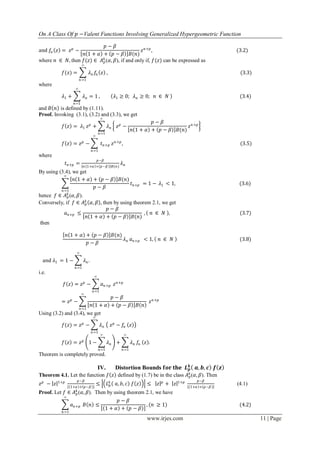
and 𝑓𝑛 𝑧 = 𝑧 𝑝
−
𝑝 − 𝛽
𝑛 1 + 𝛼 + 𝑝 − 𝛽 𝐵(𝑛)
𝑧 𝑛+𝑝
, (3.2)
where 𝑛 ∈ 𝑁, then 𝑓(𝑧) ∈ 𝐴 𝑝
𝑘
(𝛼, 𝛽), if and only if, 𝑓(𝑧) can be expressed as
𝑓(𝑧) = 𝜆 𝑛 𝑓𝑛 𝑧 , (3.3)
∞
𝑛=1
where
𝜆1 + 𝜆 𝑛 = 1 , 𝜆1 ≥ 0; 𝜆 𝑛 ≥ 0; 𝑛 ∈ 𝑁 (3.4)
∞
𝑛=1
and 𝐵 𝑛 is defined by (1.11).
Proof. Invoking (3.1), (3.2) and (3.3), we get
𝑓 𝑧 = 𝜆1 𝑧 𝑝
+ 𝜆 𝑛 𝑧 𝑝
−
𝑝 − 𝛽
𝑛 1 + 𝛼 + 𝑝 − 𝛽 𝐵(𝑛)
𝑧 𝑛+𝑝
∞
𝑛=1
𝑓 𝑧 = 𝑧 𝑝
− 𝑡 𝑛+𝑝
∞
𝑛=1
𝑧 𝑛+𝑝
, (3.5)
where
𝑡 𝑛+𝑝 =
𝑝−𝛽
𝑛 1+𝛼 + 𝑝−𝛽 𝐵(𝑛)
𝜆 𝑛
By using (3.4), we get
𝑛 1 + 𝛼 + 𝑝 − 𝛽 𝐵(𝑛)
𝑝 − 𝛽
𝑡 𝑛+𝑝 = 1 −
∞
𝑛=1
𝜆1 < 1, (3.6)
hence 𝑓 ∈ 𝐴 𝑝
𝑘
(𝛼, 𝛽).
Conversely, if 𝑓 ∈ 𝐴 𝑝
𝑘
𝛼, 𝛽 , then by using theorem 2.1, we get
𝑎 𝑛+𝑝 ≤
𝑝 − 𝛽
𝑛 1 + 𝛼 + 𝑝 − 𝛽 𝐵(𝑛)
, 𝑛 ∈ 𝑁 , (3.7)
then
𝑛 1 + 𝛼 + 𝑝 − 𝛽 𝐵(𝑛)
𝑝 − 𝛽
𝜆 𝑛 𝑎 𝑛+𝑝 < 1, 𝑛 ∈ 𝑁 (3.8)
and 𝜆1 = 1 − 𝜆 𝑛
∞
𝑛=1
.
i.e.
𝑓 𝑧 = 𝑧 𝑝
− 𝑎 𝑛+𝑝
∞
𝑛=1
𝑧 𝑛+𝑝
= 𝑧 𝑝
−
𝑝 − 𝛽
𝑛 1 + 𝛼 + 𝑝 − 𝛽 𝐵 𝑛
𝑧 𝑛+𝑝
∞
𝑛=1
Using (3.2) and (3.4), we get
𝑓(𝑧) = 𝑧 𝑝
− 𝜆 𝑛 𝑧 𝑝
− 𝑓𝑛 𝑧
∞
𝑛=1
𝑓 𝑧 = 𝑧 𝑝
1 − 𝜆 𝑛
∞
𝑛=1
+ 𝜆 𝑛
∞
𝑛=1
𝑓𝑛 𝑧 .
Theorem is completely proved.
IV. Distortion Bounds 𝐟𝐨𝐫 𝐭𝐡𝐞 𝑳 𝒑
𝒌
𝒂, 𝒃, 𝒄 𝒇 𝒛
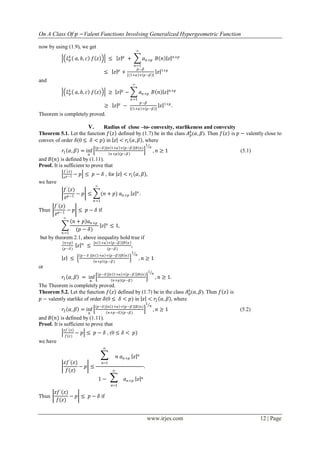
Theorem 4.1. Let the function 𝑓 𝑧 defined by (1.7) be in the class 𝐴 𝑝
𝑘
(𝛼, 𝛽). Then
𝑧 𝑝
− 𝑧 1+𝑝 𝑝−𝛽
1+𝛼 + 𝑝−𝛽
≤ 𝐿 𝑝
𝑘
𝑎, 𝑏, 𝑐 𝑓 𝑧 ≤ 𝑧 𝑝
+ 𝑧 1+𝑝 𝑝−𝛽
1+𝛼 + 𝑝−𝛽
(4.1)
Proof. Let 𝑓 ∈ 𝐴 𝑝
𝑘
(𝛼, 𝛽). Then by using theorem 2.1, we have
𝑎 𝑛+𝑝
∞
𝑛=1
𝐵 𝑛 ≤
𝑝 − 𝛽
1 + 𝛼 + 𝑝 − 𝛽
, (𝑛 ≥ 1) (4.2)
On A Class Of 𝑝 −Valent Functions Involving Generalized Hypergeometric Function
www.irjes.com 12 | Page
now by using (1.9), we get
𝐿 𝑝
𝑘
𝑎, 𝑏, 𝑐 𝑓 𝑧 ≤ 𝑧 𝑝
+ 𝑎 𝑛+𝑝
∞
𝑛=1
𝐵 𝑛 𝑧 𝑛+𝑝
≤ 𝑧 𝑝
+
𝑝−𝛽
1+𝛼 + 𝑝−𝛽
𝑧 1+𝑝
and
𝐿 𝑝
𝑘
𝑎, 𝑏, 𝑐 𝑓 𝑧 ≥ 𝑧 𝑝
− 𝑎 𝑛+𝑝
∞
𝑛=1
𝐵 𝑛 𝑧 𝑛+𝑝
≥ 𝑧 𝑝
−
𝑝−𝛽
1+𝛼 + 𝑝−𝛽
𝑧 1+𝑝
.
Theorem is completely proved.
V. Radius of close –to- convexity, starlikeness and convexity
Theorem 5.1. Let the function 𝑓 𝑧 defined by (1.7) be in the class 𝐴 𝑝
𝑘
(𝛼, 𝛽). Then 𝑓 𝑧 is 𝑝 − valently close to
convex of order 𝛿(0 ≤ 𝛿 < 𝑝) in 𝑧 < 𝑟1 𝛼, 𝛽 , where
𝑟1 𝛼, 𝛽 = inf
𝑛
(𝑝−𝛿) 𝑛 1+𝛼 + 𝑝−𝛽 𝐵(𝑛)
𝑛+𝑝 (𝑝−𝛽)
1
𝑛
, 𝑛 ≥ 1 (5.1)
and 𝐵(𝑛) is defined by (1.11).
Proof. It is sufficient to prove that
𝑓′(𝑧)
𝑧 𝑝−1 − 𝑝 ≤ 𝑝 − 𝛿 , for 𝑧 < 𝑟1 𝛼, 𝛽 ,
we have
𝑓′
(𝑧)
𝑧 𝑝−1
− 𝑝 ≤ (𝑛 + 𝑝) 𝑎 𝑛+𝑝 𝑧 𝑛
∞
𝑛=1
.
Thus
𝑓′
(𝑧)
𝑧 𝑝−1
− 𝑝 ≤ 𝑝 − 𝛿 if
𝑛 + 𝑝 𝑎 𝑛+𝑝
(𝑝 − 𝛿)
∞
𝑛=1
𝑧 𝑛
≤ 1,
but by theorem 2.1, above inequality hold true if
𝑛+𝑝
(𝑝−𝛿)
𝑧 𝑛
≤
𝑛 1+𝛼 + 𝑝−𝛽 𝐵 𝑛
(𝑝−𝛽)
,
𝑧 ≤
(𝑝− 𝛿 ) 𝑛 1+𝛼 + 𝑝−𝛽 𝐵 𝑛
𝑛+𝑝 (𝑝−𝛽)
1
𝑛
, 𝑛 ≥ 1
or
𝑟1 𝛼, 𝛽 = inf
𝑛
(𝑝−𝛿) 𝑛 1+𝛼 + 𝑝−𝛽 𝐵(𝑛)
𝑛+𝑝 (𝑝−𝛽)
1
𝑛
, 𝑛 ≥ 1.
The Theorem is completely proved.
Theorem 5.2. Let the function 𝑓 𝑧 defined by (1.7) be in the class 𝐴 𝑝
𝑘
(𝛼, 𝛽). Then 𝑓 𝑧 is
𝑝 − valently starlike of order 𝛿(0 ≤ 𝛿 < 𝑝) in 𝑧 < 𝑟2 𝛼, 𝛽 , where
𝑟2 𝛼, 𝛽 = inf
𝑛
(𝑝−𝛿) 𝑛 1+𝛼 + 𝑝−𝛽 𝐵(𝑛)
𝑛+𝑝−𝛿 (𝑝−𝛽)
1
𝑛
, 𝑛 ≥ 1 (5.2)
and 𝐵(𝑛) is defined by (1.11).
Proof. It is sufficient to prove that
𝑧𝑓′(𝑧)
𝑓(𝑧)
− 𝑝 ≤ 𝑝 − 𝛿 , (0 ≤ 𝛿 < 𝑝)
we have
𝑧𝑓′
(𝑧)
𝑓(𝑧)
− 𝑝 ≤


1n
𝑛 𝑎 𝑛+𝑝 𝑧 𝑛
1 − 

1n
𝑎 𝑛+𝑝 𝑧 𝑛
.
Thus
𝑧𝑓′
(𝑧)
𝑓(𝑧)
− 𝑝 ≤ 𝑝 − 𝛿 if
On A Class Of 𝑝 −Valent Functions Involving Generalized Hypergeometric Function
www.irjes.com 13 | Page
𝑛 + 𝑝 − 𝛿 𝑎 𝑛+𝑝
(𝑝 − 𝛿)
∞
𝑛=1
𝑧 𝑛
≤ 1,
but by theorem 2.1, above inequality hold true if
𝑧 ≤
(𝑝− 𝛿 ) 𝑛 1+𝛼 + 𝑝−𝛽 𝐵 𝑛
𝑛+𝑝− 𝛿 (𝑝−𝛽)
1
𝑛
, 𝑛 ≥ 1
or
𝑟2 𝛼, 𝛽 = inf
𝑛
(𝑝 − 𝛿) 𝑛 1 + 𝛼 + 𝑝 − 𝛽 𝐵(𝑛)
𝑛 + 𝑝 − 𝛿 (𝑝 − 𝛽)
1
𝑛
, 𝑛 ≥ 1.
The Theorem is completely proved.
Corollary 1. Let the function 𝑓 𝑧 defined by (1.7) be in the class 𝐴 𝑝
𝑘
(𝛼, 𝛽). Then 𝑓 𝑧 is
𝑝 − valently convex of order 𝛿(0 ≤ 𝛿 < 𝑝) in 𝑧 < 𝑟3 𝛼, 𝛽 , where
𝑟3 𝛼, 𝛽 = inf
𝑛
𝑝 (𝑝− 𝛿) 𝑛 1+𝛼 + 𝑝−𝛽 𝐵(𝑛)
𝑛+𝑝 𝑛+𝑝−𝛿 (𝑝−𝛽)
1
𝑛
, 𝑛 ≥ 1 (5.3)
and 𝐵(𝑛) is defined by (1.11).
VI. Fractional integral operator
The following definition given by Srivastava and Owa [2] are required to prove the results in this section:
Definition 1. The fractional derivative of order 𝛼 for a function 𝑓 𝑧 is defined by
𝐷𝑧
𝛼
𝑓 𝑧 =
1
Γ(1−α)
𝑑
𝑑𝑧
𝑓(𝑡)
𝑧−𝑡 𝛼 𝑑𝑡
𝑧
0
; 0≤ 𝛼 < 1, (6.1)
where the function 𝑓 𝑧 is analytic in simply-connected region of the 𝑧 -plane containing the origin and
multiplicity of 𝑧 − 𝑡 −𝛼
is removed by requiring log(𝑧 − 𝑡) to be real when (𝑧 − 𝑡) > 0.
Definition 2. The fractional integral of order 𝛼 is defined , for a analytic function 𝑓 𝑧 by
𝐷𝑧
−𝛼
𝑓 𝑧 =
1
Γ(α)
𝑓(𝑡)
𝑧−𝑡 1−𝛼 𝑑𝑡
𝑧
0
; 𝛼 > 0 , (6.2)
where the analytic function 𝑓 𝑧 is in a simply-connected region of the 𝑧 -plane containing the origin and
multiplicity of 𝑧 − 𝑡 𝛼−1
is removed by requiring log(𝑧 − 𝑡) to be real when (𝑧 − 𝑡) >0.
Definition 3. By the hypothesis of definition 1, the fractional derivative of function 𝑓 𝑧 for order 𝑘 + 𝛼
is defined by
𝐷𝑧
𝑘+𝛼
𝑓 𝑧 =
𝑑 𝑘
𝑑𝑧 𝑘 𝐷𝑧
𝛼
𝑓 𝑧 , (0 ≤ 𝛼 < 1; 𝑘 ∈ 𝑁0). (6.3)
We also need the following definition of fractional integral operator given by Srivastava, Saigo and Owa [3]
defined as
Definition 4. The fractional operator 𝐼0,𝑧
𝛼,𝜂,𝛿
for real numbers > 0 , 𝜂 𝑎𝑛𝑑 𝛿 is defined by
𝐼0,𝑧
𝛼,𝜂,𝛿
𝑓 𝑧 =
𝑧−𝛼−𝜂
Γ(α)
𝑧 − 𝑡 𝐹12 𝛼 + 𝜂, −𝛿; 𝛼 ; 1 −
𝑡
𝑧
𝑓 𝑡 𝑑𝑡,
𝑧
0
(6.4)
where the function 𝑓 𝑧 is analytic in simply-connected region of the 𝑧 -plane containing the origin with order
𝑓 𝑧 = O 𝑧 𝜀
, 𝑧 → 0 and 𝜀 > max 0, 𝜂 − 𝛿 − 1,
𝐹12 𝑎, 𝑏; 𝑐; 𝑧 =
(𝑎) 𝑛 (𝑏) 𝑛
(𝑐) 𝑛
𝑧 𝑛
𝑛!
∞
𝑛=0
,
where (𝑎) 𝑛 is the Pochhammer symbol and multiplicity of 𝑧 − 𝑡 𝛼−1
is removed by requiring log(𝑧 − 𝑡) to be
real when (𝑧 − 𝑡) > 0.
Lemma 1. If 𝛼 > 0 and 𝑛 > 𝜂 − 𝛿 − 1, then
𝐼0,𝑧
𝛼,𝜂,𝛿
𝑧 𝑛
=
Γ 𝑛+1 Γ 𝑛−𝜂+𝛿+1
Γ 𝑛−𝜂+1 Γ 𝑛+𝛼+𝛿+1
𝑧 𝑛−𝜂
. (6.5)
Theorem 6.1. Let 𝑓 𝑧 defined by (1.7) be in the class 𝐴 𝑝
𝑘
(𝛼, 𝛽) for 𝛼 > 0, 𝜂 < 2, then
𝐼0,𝑧
𝛼,𝜂,𝛿
𝑓 𝑧 ≥
Γ 𝑝+1 Γ 𝑝−𝜂+𝛿+1
Γ 𝑝−𝜂+1 Γ 𝑝+𝛼+𝛿+1
𝑧 𝑝−𝜂
1 −
𝑝+1 𝑝−𝛽 𝑝+1−𝜂+𝛿
𝑝+1−𝜂 𝑝+1+𝛼+𝛿 𝑝+1+𝛼−𝛽 𝑎
Γ 𝑐+𝑘
Γ 𝑏+𝑘
Γ 𝑏
Γ c
𝑧 (6.6)
and
𝐼0,𝑧
𝛼,𝜂,𝛿
𝑓 𝑧 ≤
Γ 𝑝+1 Γ 𝑝−𝜂+𝛿+1
Γ 𝑝−𝜂+1 Γ 𝑝+𝛼+𝛿+1
𝑧 𝑝−𝜂
1 +
𝑝+1 𝑝−𝛽 𝑝+1−𝜂+𝛿
𝑝+1−𝜂 𝑝+1+𝛼+𝛿 𝑝+1+𝛼−𝛽
Γ 𝑐+𝑘
𝑎Γ 𝑏+𝑘
Γ 𝑏
Γ c
𝑧 . (6.7)
Proof. By using lemma 1, we get
𝐼0,𝑧
𝛼,𝜂,𝛿
𝑓 𝑧 =
Γ 𝑝+1 Γ 𝑝−𝜂+𝛿+1
Γ 𝑝−𝜂+1 Γ 𝑝+𝛼+𝛿+1
𝑧 𝑝−𝜂
− 

1n
Γ 𝑛+𝑝+1 Γ 𝑛+𝑝−𝜂+𝛿+1
Γ 𝑛+𝑝−𝜂+1 Γ 𝑛+𝑝+𝛼+𝛿+1
𝑎 𝑛+𝑝 𝑧 𝑛+𝑝−𝜂
6.8
On A Class Of 𝑝 −Valent Functions Involving Generalized Hypergeometric Function
www.irjes.com 14 | Page
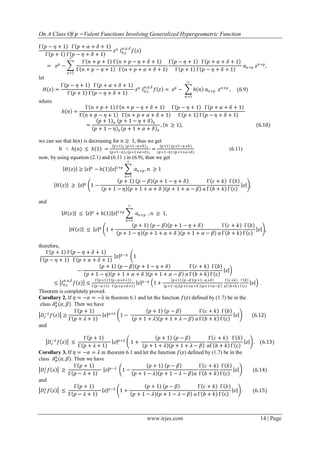
Γ 𝑝 − 𝜂 + 1 Γ 𝑝 + 𝛼 + 𝛿 + 1
Γ 𝑝 + 1 Γ 𝑝 − 𝜂 + 𝛿 + 1
𝑧 𝜂
𝐼0,𝑧
𝛼,𝜂,𝛿
𝑓 𝑧
= 𝑧 𝑝
−
Γ 𝑛 + 𝑝 + 1 Γ 𝑛 + 𝑝 − 𝜂 + 𝛿 + 1
Γ 𝑛 + 𝑝 − 𝜂 + 1 Γ 𝑛 + 𝑝 + 𝛼 + 𝛿 + 1
Γ 𝑝 − 𝜂 + 1 Γ 𝑝 + 𝛼 + 𝛿 + 1
Γ 𝑝 + 1 Γ 𝑝 − 𝜂 + 𝛿 + 1
𝑎 𝑛+𝑝 𝑧 𝑛+𝑝
,
∞
𝑛=1
let
𝐻(𝑧) =
Γ 𝑝 − 𝜂 + 1 Γ 𝑝 + 𝛼 + 𝛿 + 1
Γ 𝑝 + 1 Γ 𝑝 − 𝜂 + 𝛿 + 1
𝑧 𝜂
𝐼0,𝑧
𝛼,𝜂,𝛿
𝑓 𝑧 = 𝑧 𝑝
− 𝑕 𝑛 𝑎 𝑛+𝑝 𝑧 𝑛+𝑝
, (6.9)
∞
𝑛=1
where
𝑕 𝑛 =
Γ 𝑛 + 𝑝 + 1 Γ 𝑛 + 𝑝 − 𝜂 + 𝛿 + 1
Γ 𝑛 + 𝑝 − 𝜂 + 1 Γ 𝑛 + 𝑝 + 𝛼 + 𝛿 + 1
Γ 𝑝 − 𝜂 + 1 Γ 𝑝 + 𝛼 + 𝛿 + 1
Γ 𝑝 + 1 Γ 𝑝 − 𝜂 + 𝛿 + 1
=
𝑝 + 1 𝑛 𝑝 + 1 − 𝜂 + 𝛿 𝑛
𝑝 + 1 − 𝜂 𝑛 𝑝 + 1 + 𝛼 + 𝛿 𝑛
, 𝑛 ≥ 1 , 6.10
we can see that h(𝑛) is decreasing for 𝑛 ≥ 1, thus we get
0 < 𝑕(𝑛) ≤ 𝑕 1 =
𝑝+1 1 𝑝+1−𝜂+𝛿 1
𝑝+1−𝜂 1 𝑝+1+𝛼+𝛿 1
=
𝑝+1 (𝑝+1−𝜂+𝛿)
𝑝+1−𝜂 (𝑝+1+𝛼+𝛿)
(6.11)
now, by using equation (2.1) and (6.11 ) in (6.9), then we get
𝐻(𝑧) ≥ 𝑧 𝑝
− 𝑕(1) 𝑧 1+𝑝
𝑎 𝑛+𝑝 , 𝑛 ≥ 1
∞
𝑛=1
𝐻 𝑧 ≥ 𝑧 𝑝
1 −
𝑝 + 1 𝑝 − 𝛽 𝑝 + 1 − 𝜂 + 𝛿
𝑝 + 1 − 𝜂 𝑝 + 1 + 𝛼 + 𝛿 𝑝 + 1 + 𝛼 − 𝛽 𝑎
Γ 𝑐 + 𝑘
Γ 𝑏 + 𝑘
Γ 𝑏
Γ c
𝑧 ,
and
𝐻(𝑧) ≤ 𝑧 𝑝
+ 𝑕 1 𝑧 1+𝑝
𝑎 𝑛+𝑝
∞
𝑛=1
, 𝑛 ≥ 1,
𝐻 𝑧 ≤ 𝑧 𝑝
1 +
𝑝 + 1 𝑝 − 𝛽 𝑝 + 1 − 𝜂 + 𝛿
𝑝 + 1 − 𝜂 𝑝 + 1 + 𝛼 + 𝛿 𝑝 + 1 + 𝛼 − 𝛽 𝑎
Γ 𝑐 + 𝑘
Γ 𝑏 + 𝑘
Γ 𝑏
Γ c
𝑧 ,
therefore,
Γ 𝑝 + 1 Γ 𝑝 − 𝜂 + 𝛿 + 1
Γ 𝑝 − 𝜂 + 1 Γ 𝑝 + 𝛼 + 𝛿 + 1
𝑧 𝑝−𝜂
1
−
𝑝 + 1 𝑝 − 𝛽 𝑝 + 1 − 𝜂 + 𝛿
𝑝 + 1 − 𝜂 𝑝 + 1 + 𝛼 + 𝛿 𝑝 + 1 + 𝛼 − 𝛽 𝑎
Γ 𝑐 + 𝑘
Γ 𝑏 + 𝑘
Γ 𝑏
Γ c
𝑧
≤ 𝐼0,𝑧
𝛼,𝜂,𝛿
𝑓 𝑧 ≤
Γ 𝑝+1 Γ 𝑝−𝜂+𝛿+1
Γ 𝑝−𝜂+1 Γ 𝑝+𝛼+𝛿+1
𝑧 𝑝−𝜂
1 +
𝑝+1 𝑝−𝛽 𝑝+1−𝜂+𝛿
𝑝+1−𝜂 𝑝+1+𝛼+𝛿 𝑝+1+𝛼−𝛽
Γ 𝑐+𝑘
𝑎Γ 𝑏+𝑘
Γ 𝑏
Γ c
𝑧 .
Theorem is completely proved.
Corollary 2. If 𝜂 = −𝛼 = −𝜆 in theorem 6.1 and let the function 𝑓(𝑧) defined by (1.7) be in the
class 𝐴 𝑝
𝑘
(𝛼, 𝛽). Then we have
𝐷𝑧
−𝜆
𝑓 𝑧 ≥
Γ 𝑝 + 1
Γ 𝑝 + 𝜆 + 1
𝑧 𝑝+𝜆
1 −
𝑝 + 1 𝑝 − 𝛽
𝑝 + 1 + 𝜆 𝑝 + 1 + 𝜆 − 𝛽 𝑎
Γ 𝑐 + 𝑘
Γ 𝑏 + 𝑘
Γ 𝑏
Γ c
𝑧 (6.12)
and
𝐷𝑧
−𝜆
𝑓 𝑧 ≤
Γ 𝑝 + 1
Γ 𝑝 + 𝜆 + 1
𝑧 𝑝+𝜆
1 +
𝑝 + 1 𝑝 − 𝛽
𝑝 + 1 + 𝜆 𝑝 + 1 + 𝜆 − 𝛽
Γ 𝑐 + 𝑘
𝑎Γ 𝑏 + 𝑘
Γ 𝑏
Γ c
𝑧 . (6.13)
Corollary 3. If 𝜂 = −𝛼 = 𝜆 in theorem 6.1 and let the function 𝑓(𝑧) defined by (1.7) be in the
class 𝐴 𝑝
𝑘
(𝛼, 𝛽). Then we have
𝐷𝑧
𝜆
𝑓 𝑧 ≥
Γ 𝑝 + 1
Γ 𝑝 − 𝜆 + 1
𝑧 𝑝−𝜆
1 −
𝑝 + 1 𝑝 − 𝛽
𝑝 + 1 − 𝜆 𝑝 + 1 − 𝜆 − 𝛽 𝑎
Γ 𝑐 + 𝑘
Γ 𝑏 + 𝑘
Γ 𝑏
Γ c
𝑧 (6.14)
and
𝐷𝑧
𝜆
𝑓 𝑧 ≤
Γ 𝑝 + 1
Γ 𝑝 − 𝜆 + 1
𝑧 𝑝−𝜆
1 +
𝑝 + 1 𝑝 − 𝛽
𝑝 + 1 − 𝜆 𝑝 + 1 − 𝜆 − 𝛽 𝑎
Γ 𝑐 + 𝑘
Γ 𝑏 + 𝑘
Γ 𝑏
Γ c
𝑧 . (6.15)
On A Class Of 𝑝 −Valent Functions Involving Generalized Hypergeometric Function
www.irjes.com 15 | Page
References
[1] B. C. Carlson and S. B. Shaffer (2002): Starlike and prestarlike hypergeometric functions, SIAM J. Math. Anal., 15, 737-
745.
[2] H.M. Srivastava and S. Owa (1984): An application of the fractional derivative, Math. Japonica, 29, 383-389.
[3] H.M. Srivastava, M. Saigo and S.Owa (1988): A class of distortion theorem of fractional calculus, J. Math. Anal. Appl.,
131, 412-420.
[4] J.L. Liu and H.M. Srivastava (2001): A linear operator and associated families of meromorphically multivalent functions, J.
Math. Anal. Appl., 259, 566-581.
[5] J.L. Liu and H.M. Srivastava (2004): Classes of meromorphically multivalent functions associated with generalized
hypergeometric functions, Maths. Comput. Modelling, 39, 21-34.
[6] N. Virchenko, S.L. Kalla and A. Al-Zamel (2001): Some results on generalized hypergeometric function, Integral
Transforms and Special Functions, 12 (1), 89-100.
[7] S.P. Goyal and R. Goyal (2005): On a class of multivalent functions defined by generalized Ruscheweyh derivatives
involving a general fractional derivative operators, J. Indian Acad. Math., 27(2), 439-456.

International Refereed Journal of Engineering and Science (IRJES)

  • 1.
    International Refereed Journalof Engineering and Science (IRJES) ISSN (Online) 2319-183X, (Print) 2319-1821 Volume 2, Issue 5(May 2013), PP.08-15 www.irjes.com www.irjes.com 8 | Page On A Class Of 𝒑 −Valent Functions Involving Generalized Hypergeometric Function Chena Ram And Saroj Solanki Department of Mathematics and Statistics, Jai Narain Vyas University Jodhpur, (Rajasthan), India. Abstract: Invoking the Hadamard product (or convolution), a class of p-valent functions has been introduced. The coefficient bounds, extreme points, radii of close-to-convex, starlikeness and convexity are obtained for the same class of functions. Distortion theorem and fractional differ-integral operators are also obtained. Key words: 𝑝-valent function; Analytic function; Hadamard product; Generalized hyper-geometric functions; Linear operator; Starlike function; Convex function; Fractional differential and integral operator. I. Introduction Let 𝐴(𝑛, 𝑝) denote the class of functions 𝑓(𝑧) of the form 𝑓 𝑧 = 𝑧 𝑝 + 𝑎 𝑛+𝑝 ∞ 𝑛=1 𝑧 𝑛+𝑝 , 𝑝, 𝑛 ∈ N = 1,2, … … , (1.1) which are analytic and 𝑝 −valent in the unit disk 𝕌 = { 𝑧 ∶ 𝑧 < 1}. A function 𝑓(𝑧) ∈ 𝐴 (𝑛, 𝑝) is said to be 𝑝 −valent starlike of order 𝛿 (0 ≤ 𝛿 < 𝑝) if and only if Re 𝑧𝑓′(𝑧) 𝑓(𝑧) > 𝛿 , 𝑧 ∈ 𝕌; 0 ≤ 𝛿 < 𝑝 . (1.2) We denote by 𝑆𝑛 𝑝, 𝛿 the subclass of 𝐴(𝑛, 𝑝) consisting of functions which are 𝑝 −valent starlike of order 𝛿. Also a function 𝑓 𝑧 ∈ 𝐴(𝑛, 𝑝) is said to be in the class 𝐾𝑛 𝑝, 𝛿 if and only if Re 1 + 𝑧𝑓′′(𝑧) 𝑓′(𝑧) > 𝛿 , (𝑧 ∈ 𝕌;0 ≤ 𝛿 < 𝑝). (1.3) A function 𝑓 𝑧 ∈ 𝐾𝑛 𝑝, 𝛿 is called 𝑝 -valent convex function of order 𝛿 (0≤ 𝛿 < 𝑝), if 𝑓 𝑧 ∈ 𝐾𝑛 𝑝, 𝛿  𝑧𝑓′ (𝑧) ∈ 𝑆𝑛 𝑝, 𝛿 , ∀ 𝑛 ∈ 𝑁. (1.4) For a function 𝑓(𝑧) is given by (1.1) and 𝑔(𝑧) ∈ 𝐴 𝑛, 𝑝 is given by 𝑔 𝑧 = 𝑧 𝑝 + 𝑏 𝑛+𝑝 ∞ 𝑛=1 𝑧 𝑛+𝑝 , 𝑝 , 𝑛 ∈ N , (1.5) we define the Hadamard product of 𝑓 𝑧 and 𝑔 𝑧 as 𝑓 ∗ 𝑔 𝑧 = 𝑧 𝑝 + 𝑎 𝑛+𝑝 𝑏 𝑛+𝑝 ∞ 𝑛=1 𝑧 𝑛+𝑝 , 𝑧 ∈ 𝕌. (1.6) Let the subclass A 𝑛, 𝑝 is denoted by 𝜑 consisting of functions of the form 𝑓 𝑧 = 𝑧 𝑝 − 𝑎 𝑛+𝑝 ∞ 𝑛=1 𝑧 𝑛+𝑝 , 𝑝 , 𝑛 ∈ N; 𝑎 𝑛 ≥ 0 . (1.7) Invoking the Hadamard product, a linear operator 𝐿 𝑝 𝑘 𝑎, 𝑏, 𝑐 𝑓(𝑧) is defined as 𝐿 𝑝 𝑘 𝑎, 𝑏, 𝑐 𝑓 𝑧 = (𝑧 𝑝 𝑅12 𝑎, 𝑏; 𝑐; 𝑘; 𝑧 ) ∗ 𝑓 𝑧 = 𝑧 𝑝 − Γ 𝑐 Γ 𝑏 (𝑎) 𝑛 Γ 𝑏 + 𝑘𝑛 Γ 𝑐 + 𝑘𝑛 ∞ 𝑛=1 𝑎 𝑛+𝑝 𝑧 𝑛+𝑝 𝑛 ! (1.8) = 𝑧 𝑝 − 𝑎 𝑛+𝑝 ∞ 𝑛=1 𝐵 𝑛 𝑧 𝑛+𝑝 , (1.9) where 2 𝑅1 𝑎, 𝑏; 𝑐; 𝑧 is generalized hypergeomertric function defined by Virchenko, Kalla and Al-Zamel [6] as, 𝑅12 𝑎, 𝑏; 𝑐; 𝑘; 𝑧 = Γ 𝑐 Γ 𝑏 (𝑎) 𝑛 Γ 𝑏 + 𝑘𝑛 Γ 𝑐 + 𝑘𝑛 𝑧 𝑛 𝑛 ! , 𝑘 ∈ 𝑅, 𝑘 > 0, 𝑧 < 1, (1.10) ∞ 𝑛=0 where (𝑎) 𝑛 is the pochhammer symbol defined as
  • 2.
    On A ClassOf 𝑝 −Valent Functions Involving Generalized Hypergeometric Function www.irjes.com 9 | Page (𝑎) 𝑛 = Γ 𝑎+𝑛 Γ 𝑎 = 1, 𝑛 = 0 𝑎 𝑎 + 1 … … 𝑎 + 𝑛 − 1 ; 𝑛 ∈ 𝑁 and 𝐵 𝑛 = Γ 𝑐 Γ 𝑏 (𝑎) 𝑛 Γ 𝑏+𝑘𝑛 Γ 𝑐+𝑘𝑛 𝑛 ! . (1.11) If we set 𝑘 = 1 in (1.8), then the linear operator 𝐿 𝑝 𝑘 𝑎, 𝑏, 𝑐 𝑓 𝑧 reduces to the linear operator 𝐿 𝑝 𝑎, 𝑏, 𝑐 𝑓 𝑧 defined (cf. [5]) as 𝐿 𝑝 𝑎, 𝑏, 𝑐 𝑓 𝑧 = 𝑧 𝑝 − (𝑎) 𝑛 (𝑏) 𝑛 𝑎 𝑛+𝑝 𝑧 𝑛+𝑝 (𝑐) 𝑛 𝑛 ! = 𝑧 𝑝 𝐹12 𝑎, 𝑏; 𝑐; 𝑧 ∗ 𝑓 𝑧 . ∞ 𝑛=1 (1.12) In particular, if we set 𝑏 = 1, then linear operator 𝐿 𝑝 𝑎, 𝑏, 𝑐 𝑓 𝑧 reduces to Carlson-Shaffer operator 𝐿 𝑎, 𝑐 𝑓 𝑧 defined as 𝐿 𝑝 𝑎, 1, 𝑐 𝑓 𝑧 = 𝐿 𝑝 𝑎, 𝑐 𝑓 𝑧 = 𝑧 𝑝 − (𝑎) 𝑛 𝑎 𝑛+𝑝 𝑧 𝑛+𝑝 (𝑐) 𝑛 ∞ 𝑛=1 = 𝑧 𝑝 𝜙 𝑎, 𝑐; 𝑧 ∗ 𝑓 𝑧 , (1.13) where 𝜙 𝑎; 𝑐; 𝑧 is incomplete beta function defined as 𝜙 𝑎, 𝑐; 𝑧 =2 𝐹1 𝑎, 1; 𝑐; 𝑧 =   0n (𝑎) 𝑛 𝑧 𝑛 (𝑐) 𝑛 . For detail, one can see [1, 4]. A function 𝑓 𝑧 ∈ 𝜑, for 𝛼 ≥ 0 and 0 ≤ 𝛽 < 𝑝 is said to be in the class 𝐴 𝑝 𝑘 (𝛼, 𝛽) if it satisfies the following relation Re 𝑧 𝐿 𝑝 𝑘 𝑎,𝑏,𝑐 𝑓 𝑧 ′ 𝐿 𝑝 𝑘 𝑎,𝑏,𝑐 𝑓(𝑧) > 𝛼 𝑧 𝐿 𝑝 𝑘 𝑎,𝑏,𝑐 𝑓 𝑧 ′ 𝐿 𝑝 𝑘 𝑎,𝑏,𝑐 𝑓 𝑧 − 𝑝 +𝛽. (1.14) For detail, one can see [7]. II. Coefficient Bounds for Function 𝒇(𝒛) in 𝑨 𝒑 𝒌 (𝜶, 𝜷) Theorem 2.1. Let the function 𝑓(𝑧) defined by (1.7) be in the class 𝐴 𝑝 𝑘 (𝛼, 𝛽) if and only if 𝑛 1 + 𝛼 + 𝑝 − 𝛽 𝑝 − 𝛽 𝑎 𝑛+𝑝 ∞ 𝑛=1 𝐵 𝑛 < 1, (2.1) where 0 ≤ 𝛽 < 𝑝 , 𝛼 ≥ 0 and 𝐵 𝑛 is defined by (1.11). Proof. Let 𝑓 ∈ 𝐴 𝑝 𝑘 (𝛼, 𝛽). By using Re 𝑤 > 𝛼 𝑤 − 𝑝 + 𝛽, if and only if, Re 𝑤 1 + 𝛼 𝑒 𝑖𝛾 − 𝑝𝛼 𝑒 𝑖𝛾 > 𝛽 for real 𝛾 and letting 𝑤 = 𝑧 𝐿 𝑝 𝑘 𝑎,𝑏,𝑐 𝑓 𝑧 ′ 𝐿 𝑝 𝑘 𝑎,𝑏,𝑐 𝑓 𝑧 , (1.14) reduces to Re 𝑧 𝐿 𝑝 𝑘 𝑎, 𝑏, 𝑐 𝑓 𝑧 ′ 𝐿 𝑝 𝑘 𝑎, 𝑏, 𝑐 𝑓 𝑧 (1 + 𝛼 𝑒 𝑖𝛾 ) − pα𝑒 𝑖𝛾 > 𝛽, or, equivalently, Re 𝑝−𝛽 −   1n 𝐵 𝑛 𝑛+𝑝−𝛽 𝑎 𝑛+𝑝 𝑧 𝑛 −𝛼𝑒 𝑖𝛾   1n 𝑛 𝐵 𝑛 𝑎 𝑛+𝑝 𝑧 𝑛 1−   1n 𝐵 𝑛 𝑎 𝑛+𝑝 𝑧 𝑛 > 0. (2.2) The inequality (2.2) must hold for all 𝑧 in 𝕌.By letting 𝑧 → 1− , we have
  • 3.
    On A ClassOf 𝑝 −Valent Functions Involving Generalized Hypergeometric Function www.irjes.com 10 | Page Re 𝑝−𝛽 −   1n 𝐵 𝑛 𝑛+𝑝−𝛽 𝑎 𝑛+𝑝 −𝛼𝑒 𝑖𝛾   1n 𝑛 𝐵 𝑛 𝑎 𝑛+𝑝 1−   1n 𝐵 𝑛 𝑎 𝑛+𝑝 > 0, by means of mean value theorem, we get 𝑝 − 𝛽 − 𝑎 𝑛+𝑝 ∞ 𝑛=1 𝐵 𝑛 𝑛 + 𝑝 − 𝛽 − 𝛼 𝑛 𝑎 𝑛+𝑝 ∞ 𝑛=1 𝐵 𝑛 ≥ 0. Therefore, 𝑛 1 + 𝛼 + 𝑝 − 𝛽 𝑎 𝑛+𝑝 𝐵 𝑛 ∞ 𝑛=1 ≤ 𝑝 − 𝛽 . (2.3) Conversely, we assume that (2.1) hold. We are to show that (1.14) is satisfied and so 𝑓 ∈ 𝐴 𝑝 𝑘 (𝛼, 𝛽). By using Re 𝑤 > 𝛼 if and only if 𝑤 − 𝑝 + 𝛼 < 𝑤 + 𝑝 − 𝛼 , it is sufficient to show that 𝑧 𝐿 𝑝 𝑘 𝑎, 𝑏, 𝑐 𝑓 𝑧 ′ 𝐿 𝑝 𝑘 𝑎, 𝑏, 𝑐 𝑓 𝑧 − 𝑝 + 𝛼 𝑧 𝐿 𝑝 𝑘 𝑎, 𝑏, 𝑐 𝑓 𝑧 ′ 𝐿 𝑝 𝑘 𝑎, 𝑏, 𝑐 𝑓 𝑧 − 𝑝 + 𝛽 < 𝑧 𝐿 𝑝 𝑘 𝑎, 𝑏, 𝑐 𝑓 𝑧 ’ 𝐿 𝑝 𝑘 𝑎, 𝑏, 𝑐 𝑓 𝑧 + 𝑝 − 𝛼 𝑧 𝐿 𝑝 𝑘 𝑎, 𝑏, 𝑐 𝑓 𝑧 ’ 𝐿 𝑝 𝑘 𝑎, 𝑏, 𝑐 𝑓 𝑧 − 𝑝 − 𝛽 . Let 𝑒 𝑖∅ = 𝐿 𝑝 𝑘 𝑎,𝑏,𝑐 𝑓 𝑧 𝐿 𝑝 𝑘 𝑎,𝑏,𝑐 𝑓 𝑧 then, E = 𝑧 𝐿 𝑝 𝑘 𝑎,𝑏,𝑐 𝑓 𝑧 ′ 𝐿 𝑝 𝑘 𝑎,𝑏,𝑐 𝑓 𝑧 + 𝑝 − 𝛼 𝑧 𝐿 𝑝 𝑘 𝑎,𝑏,𝑐 𝑓 𝑧 ′ 𝐿 𝑝 𝑘 𝑎,𝑏,𝑐 𝑓 𝑧 − 𝑝 − 𝛽 = 𝑧 𝐿 𝑝 𝑘 𝑎,𝑏,𝑐 𝑓 𝑧 ′ + 𝑝−𝛽 𝐿 𝑝 𝑘 𝑎,𝑏,𝑐 𝑓 𝑧 −𝛼𝑒 𝑖∅ 𝑧 𝐿 𝑝 𝑘 𝑎,𝑏,𝑐 𝑓 𝑧 ′ − 𝑝( 𝐿 𝑝 𝑘 𝑎,𝑏,𝑐 𝑓 𝑧 ) 𝐿 𝑝 𝑘 𝑎,𝑏,𝑐 𝑓 𝑧 > 𝑧 𝑝 2𝑝−𝛽−   1n 2𝑝−𝛽+𝑛(1−𝛼) 𝐵(𝑛) 𝑎 𝑛+𝑝 𝑧 𝑛 𝐿 𝑝 𝑘 𝑎,𝑏,𝑐 𝑓 𝑧 . (2.4) and F = 𝑧 𝐿 𝑝 𝑘 𝑎,𝑏,𝑐 𝑓 𝑧 ′ 𝐿 𝑝 𝑘 𝑎,𝑏,𝑐 𝑓 𝑧 − 𝑝 + 𝛼 𝑧 𝐿 𝑝 𝑘 𝑎,𝑏,𝑐 𝑓 𝑧 ′ 𝐿 𝑝 𝑘 𝑎,𝑏,𝑐 𝑓 𝑧 − 𝑝 + 𝛽 = 𝑧 𝐿 𝑝 𝑘 𝑎,𝑏,𝑐 𝑓 𝑧 ′ − 𝑝+𝛽 𝐿 𝑝 𝑘 𝑎,𝑏,𝑐 𝑓 𝑧 − 𝛼𝑒 𝑖∅ 𝑧 𝐿 𝑝 𝑘 𝑎,𝑏,𝑐 𝑓 𝑧 ′ − 𝑝 𝐿 𝑝 𝑘 𝑎,𝑏,𝑐 𝑓 𝑧 𝐿 𝑝 𝑘 𝑎,𝑏,𝑐 𝑓 𝑧 > 𝑧 𝑝 𝛽+   1n [𝑛(1+𝛼)−𝛽] 𝑎 𝑛+𝑝 𝐵(𝑛) 𝑧 𝑛 𝐿 𝑝 𝑘 𝑎,𝑏,𝑐 𝑓 𝑧 (2.5) if (2.1) holds, then it is easy to show that E – F > 0. So the proof is completed. III. Extreme Points for the class 𝑨 𝒑 𝒌 (𝜶, 𝜷) Theorem 3.1. Let 𝑓1 𝑧 = 𝑧 𝑝 (3.1)
  • 4.
    On A ClassOf 𝑝 −Valent Functions Involving Generalized Hypergeometric Function www.irjes.com 11 | Page and 𝑓𝑛 𝑧 = 𝑧 𝑝 − 𝑝 − 𝛽 𝑛 1 + 𝛼 + 𝑝 − 𝛽 𝐵(𝑛) 𝑧 𝑛+𝑝 , (3.2) where 𝑛 ∈ 𝑁, then 𝑓(𝑧) ∈ 𝐴 𝑝 𝑘 (𝛼, 𝛽), if and only if, 𝑓(𝑧) can be expressed as 𝑓(𝑧) = 𝜆 𝑛 𝑓𝑛 𝑧 , (3.3) ∞ 𝑛=1 where 𝜆1 + 𝜆 𝑛 = 1 , 𝜆1 ≥ 0; 𝜆 𝑛 ≥ 0; 𝑛 ∈ 𝑁 (3.4) ∞ 𝑛=1 and 𝐵 𝑛 is defined by (1.11). Proof. Invoking (3.1), (3.2) and (3.3), we get 𝑓 𝑧 = 𝜆1 𝑧 𝑝 + 𝜆 𝑛 𝑧 𝑝 − 𝑝 − 𝛽 𝑛 1 + 𝛼 + 𝑝 − 𝛽 𝐵(𝑛) 𝑧 𝑛+𝑝 ∞ 𝑛=1 𝑓 𝑧 = 𝑧 𝑝 − 𝑡 𝑛+𝑝 ∞ 𝑛=1 𝑧 𝑛+𝑝 , (3.5) where 𝑡 𝑛+𝑝 = 𝑝−𝛽 𝑛 1+𝛼 + 𝑝−𝛽 𝐵(𝑛) 𝜆 𝑛 By using (3.4), we get 𝑛 1 + 𝛼 + 𝑝 − 𝛽 𝐵(𝑛) 𝑝 − 𝛽 𝑡 𝑛+𝑝 = 1 − ∞ 𝑛=1 𝜆1 < 1, (3.6) hence 𝑓 ∈ 𝐴 𝑝 𝑘 (𝛼, 𝛽). Conversely, if 𝑓 ∈ 𝐴 𝑝 𝑘 𝛼, 𝛽 , then by using theorem 2.1, we get 𝑎 𝑛+𝑝 ≤ 𝑝 − 𝛽 𝑛 1 + 𝛼 + 𝑝 − 𝛽 𝐵(𝑛) , 𝑛 ∈ 𝑁 , (3.7) then 𝑛 1 + 𝛼 + 𝑝 − 𝛽 𝐵(𝑛) 𝑝 − 𝛽 𝜆 𝑛 𝑎 𝑛+𝑝 < 1, 𝑛 ∈ 𝑁 (3.8) and 𝜆1 = 1 − 𝜆 𝑛 ∞ 𝑛=1 . i.e. 𝑓 𝑧 = 𝑧 𝑝 − 𝑎 𝑛+𝑝 ∞ 𝑛=1 𝑧 𝑛+𝑝 = 𝑧 𝑝 − 𝑝 − 𝛽 𝑛 1 + 𝛼 + 𝑝 − 𝛽 𝐵 𝑛 𝑧 𝑛+𝑝 ∞ 𝑛=1 Using (3.2) and (3.4), we get 𝑓(𝑧) = 𝑧 𝑝 − 𝜆 𝑛 𝑧 𝑝 − 𝑓𝑛 𝑧 ∞ 𝑛=1 𝑓 𝑧 = 𝑧 𝑝 1 − 𝜆 𝑛 ∞ 𝑛=1 + 𝜆 𝑛 ∞ 𝑛=1 𝑓𝑛 𝑧 . Theorem is completely proved. IV. Distortion Bounds 𝐟𝐨𝐫 𝐭𝐡𝐞 𝑳 𝒑 𝒌 𝒂, 𝒃, 𝒄 𝒇 𝒛 Theorem 4.1. Let the function 𝑓 𝑧 defined by (1.7) be in the class 𝐴 𝑝 𝑘 (𝛼, 𝛽). Then 𝑧 𝑝 − 𝑧 1+𝑝 𝑝−𝛽 1+𝛼 + 𝑝−𝛽 ≤ 𝐿 𝑝 𝑘 𝑎, 𝑏, 𝑐 𝑓 𝑧 ≤ 𝑧 𝑝 + 𝑧 1+𝑝 𝑝−𝛽 1+𝛼 + 𝑝−𝛽 (4.1) Proof. Let 𝑓 ∈ 𝐴 𝑝 𝑘 (𝛼, 𝛽). Then by using theorem 2.1, we have 𝑎 𝑛+𝑝 ∞ 𝑛=1 𝐵 𝑛 ≤ 𝑝 − 𝛽 1 + 𝛼 + 𝑝 − 𝛽 , (𝑛 ≥ 1) (4.2)
  • 5.
    On A ClassOf 𝑝 −Valent Functions Involving Generalized Hypergeometric Function www.irjes.com 12 | Page now by using (1.9), we get 𝐿 𝑝 𝑘 𝑎, 𝑏, 𝑐 𝑓 𝑧 ≤ 𝑧 𝑝 + 𝑎 𝑛+𝑝 ∞ 𝑛=1 𝐵 𝑛 𝑧 𝑛+𝑝 ≤ 𝑧 𝑝 + 𝑝−𝛽 1+𝛼 + 𝑝−𝛽 𝑧 1+𝑝 and 𝐿 𝑝 𝑘 𝑎, 𝑏, 𝑐 𝑓 𝑧 ≥ 𝑧 𝑝 − 𝑎 𝑛+𝑝 ∞ 𝑛=1 𝐵 𝑛 𝑧 𝑛+𝑝 ≥ 𝑧 𝑝 − 𝑝−𝛽 1+𝛼 + 𝑝−𝛽 𝑧 1+𝑝 . Theorem is completely proved. V. Radius of close –to- convexity, starlikeness and convexity Theorem 5.1. Let the function 𝑓 𝑧 defined by (1.7) be in the class 𝐴 𝑝 𝑘 (𝛼, 𝛽). Then 𝑓 𝑧 is 𝑝 − valently close to convex of order 𝛿(0 ≤ 𝛿 < 𝑝) in 𝑧 < 𝑟1 𝛼, 𝛽 , where 𝑟1 𝛼, 𝛽 = inf 𝑛 (𝑝−𝛿) 𝑛 1+𝛼 + 𝑝−𝛽 𝐵(𝑛) 𝑛+𝑝 (𝑝−𝛽) 1 𝑛 , 𝑛 ≥ 1 (5.1) and 𝐵(𝑛) is defined by (1.11). Proof. It is sufficient to prove that 𝑓′(𝑧) 𝑧 𝑝−1 − 𝑝 ≤ 𝑝 − 𝛿 , for 𝑧 < 𝑟1 𝛼, 𝛽 , we have 𝑓′ (𝑧) 𝑧 𝑝−1 − 𝑝 ≤ (𝑛 + 𝑝) 𝑎 𝑛+𝑝 𝑧 𝑛 ∞ 𝑛=1 . Thus 𝑓′ (𝑧) 𝑧 𝑝−1 − 𝑝 ≤ 𝑝 − 𝛿 if 𝑛 + 𝑝 𝑎 𝑛+𝑝 (𝑝 − 𝛿) ∞ 𝑛=1 𝑧 𝑛 ≤ 1, but by theorem 2.1, above inequality hold true if 𝑛+𝑝 (𝑝−𝛿) 𝑧 𝑛 ≤ 𝑛 1+𝛼 + 𝑝−𝛽 𝐵 𝑛 (𝑝−𝛽) , 𝑧 ≤ (𝑝− 𝛿 ) 𝑛 1+𝛼 + 𝑝−𝛽 𝐵 𝑛 𝑛+𝑝 (𝑝−𝛽) 1 𝑛 , 𝑛 ≥ 1 or 𝑟1 𝛼, 𝛽 = inf 𝑛 (𝑝−𝛿) 𝑛 1+𝛼 + 𝑝−𝛽 𝐵(𝑛) 𝑛+𝑝 (𝑝−𝛽) 1 𝑛 , 𝑛 ≥ 1. The Theorem is completely proved. Theorem 5.2. Let the function 𝑓 𝑧 defined by (1.7) be in the class 𝐴 𝑝 𝑘 (𝛼, 𝛽). Then 𝑓 𝑧 is 𝑝 − valently starlike of order 𝛿(0 ≤ 𝛿 < 𝑝) in 𝑧 < 𝑟2 𝛼, 𝛽 , where 𝑟2 𝛼, 𝛽 = inf 𝑛 (𝑝−𝛿) 𝑛 1+𝛼 + 𝑝−𝛽 𝐵(𝑛) 𝑛+𝑝−𝛿 (𝑝−𝛽) 1 𝑛 , 𝑛 ≥ 1 (5.2) and 𝐵(𝑛) is defined by (1.11). Proof. It is sufficient to prove that 𝑧𝑓′(𝑧) 𝑓(𝑧) − 𝑝 ≤ 𝑝 − 𝛿 , (0 ≤ 𝛿 < 𝑝) we have 𝑧𝑓′ (𝑧) 𝑓(𝑧) − 𝑝 ≤   1n 𝑛 𝑎 𝑛+𝑝 𝑧 𝑛 1 −   1n 𝑎 𝑛+𝑝 𝑧 𝑛 . Thus 𝑧𝑓′ (𝑧) 𝑓(𝑧) − 𝑝 ≤ 𝑝 − 𝛿 if
  • 6.
    On A ClassOf 𝑝 −Valent Functions Involving Generalized Hypergeometric Function www.irjes.com 13 | Page 𝑛 + 𝑝 − 𝛿 𝑎 𝑛+𝑝 (𝑝 − 𝛿) ∞ 𝑛=1 𝑧 𝑛 ≤ 1, but by theorem 2.1, above inequality hold true if 𝑧 ≤ (𝑝− 𝛿 ) 𝑛 1+𝛼 + 𝑝−𝛽 𝐵 𝑛 𝑛+𝑝− 𝛿 (𝑝−𝛽) 1 𝑛 , 𝑛 ≥ 1 or 𝑟2 𝛼, 𝛽 = inf 𝑛 (𝑝 − 𝛿) 𝑛 1 + 𝛼 + 𝑝 − 𝛽 𝐵(𝑛) 𝑛 + 𝑝 − 𝛿 (𝑝 − 𝛽) 1 𝑛 , 𝑛 ≥ 1. The Theorem is completely proved. Corollary 1. Let the function 𝑓 𝑧 defined by (1.7) be in the class 𝐴 𝑝 𝑘 (𝛼, 𝛽). Then 𝑓 𝑧 is 𝑝 − valently convex of order 𝛿(0 ≤ 𝛿 < 𝑝) in 𝑧 < 𝑟3 𝛼, 𝛽 , where 𝑟3 𝛼, 𝛽 = inf 𝑛 𝑝 (𝑝− 𝛿) 𝑛 1+𝛼 + 𝑝−𝛽 𝐵(𝑛) 𝑛+𝑝 𝑛+𝑝−𝛿 (𝑝−𝛽) 1 𝑛 , 𝑛 ≥ 1 (5.3) and 𝐵(𝑛) is defined by (1.11). VI. Fractional integral operator The following definition given by Srivastava and Owa [2] are required to prove the results in this section: Definition 1. The fractional derivative of order 𝛼 for a function 𝑓 𝑧 is defined by 𝐷𝑧 𝛼 𝑓 𝑧 = 1 Γ(1−α) 𝑑 𝑑𝑧 𝑓(𝑡) 𝑧−𝑡 𝛼 𝑑𝑡 𝑧 0 ; 0≤ 𝛼 < 1, (6.1) where the function 𝑓 𝑧 is analytic in simply-connected region of the 𝑧 -plane containing the origin and multiplicity of 𝑧 − 𝑡 −𝛼 is removed by requiring log(𝑧 − 𝑡) to be real when (𝑧 − 𝑡) > 0. Definition 2. The fractional integral of order 𝛼 is defined , for a analytic function 𝑓 𝑧 by 𝐷𝑧 −𝛼 𝑓 𝑧 = 1 Γ(α) 𝑓(𝑡) 𝑧−𝑡 1−𝛼 𝑑𝑡 𝑧 0 ; 𝛼 > 0 , (6.2) where the analytic function 𝑓 𝑧 is in a simply-connected region of the 𝑧 -plane containing the origin and multiplicity of 𝑧 − 𝑡 𝛼−1 is removed by requiring log(𝑧 − 𝑡) to be real when (𝑧 − 𝑡) >0. Definition 3. By the hypothesis of definition 1, the fractional derivative of function 𝑓 𝑧 for order 𝑘 + 𝛼 is defined by 𝐷𝑧 𝑘+𝛼 𝑓 𝑧 = 𝑑 𝑘 𝑑𝑧 𝑘 𝐷𝑧 𝛼 𝑓 𝑧 , (0 ≤ 𝛼 < 1; 𝑘 ∈ 𝑁0). (6.3) We also need the following definition of fractional integral operator given by Srivastava, Saigo and Owa [3] defined as Definition 4. The fractional operator 𝐼0,𝑧 𝛼,𝜂,𝛿 for real numbers > 0 , 𝜂 𝑎𝑛𝑑 𝛿 is defined by 𝐼0,𝑧 𝛼,𝜂,𝛿 𝑓 𝑧 = 𝑧−𝛼−𝜂 Γ(α) 𝑧 − 𝑡 𝐹12 𝛼 + 𝜂, −𝛿; 𝛼 ; 1 − 𝑡 𝑧 𝑓 𝑡 𝑑𝑡, 𝑧 0 (6.4) where the function 𝑓 𝑧 is analytic in simply-connected region of the 𝑧 -plane containing the origin with order 𝑓 𝑧 = O 𝑧 𝜀 , 𝑧 → 0 and 𝜀 > max 0, 𝜂 − 𝛿 − 1, 𝐹12 𝑎, 𝑏; 𝑐; 𝑧 = (𝑎) 𝑛 (𝑏) 𝑛 (𝑐) 𝑛 𝑧 𝑛 𝑛! ∞ 𝑛=0 , where (𝑎) 𝑛 is the Pochhammer symbol and multiplicity of 𝑧 − 𝑡 𝛼−1 is removed by requiring log(𝑧 − 𝑡) to be real when (𝑧 − 𝑡) > 0. Lemma 1. If 𝛼 > 0 and 𝑛 > 𝜂 − 𝛿 − 1, then 𝐼0,𝑧 𝛼,𝜂,𝛿 𝑧 𝑛 = Γ 𝑛+1 Γ 𝑛−𝜂+𝛿+1 Γ 𝑛−𝜂+1 Γ 𝑛+𝛼+𝛿+1 𝑧 𝑛−𝜂 . (6.5) Theorem 6.1. Let 𝑓 𝑧 defined by (1.7) be in the class 𝐴 𝑝 𝑘 (𝛼, 𝛽) for 𝛼 > 0, 𝜂 < 2, then 𝐼0,𝑧 𝛼,𝜂,𝛿 𝑓 𝑧 ≥ Γ 𝑝+1 Γ 𝑝−𝜂+𝛿+1 Γ 𝑝−𝜂+1 Γ 𝑝+𝛼+𝛿+1 𝑧 𝑝−𝜂 1 − 𝑝+1 𝑝−𝛽 𝑝+1−𝜂+𝛿 𝑝+1−𝜂 𝑝+1+𝛼+𝛿 𝑝+1+𝛼−𝛽 𝑎 Γ 𝑐+𝑘 Γ 𝑏+𝑘 Γ 𝑏 Γ c 𝑧 (6.6) and 𝐼0,𝑧 𝛼,𝜂,𝛿 𝑓 𝑧 ≤ Γ 𝑝+1 Γ 𝑝−𝜂+𝛿+1 Γ 𝑝−𝜂+1 Γ 𝑝+𝛼+𝛿+1 𝑧 𝑝−𝜂 1 + 𝑝+1 𝑝−𝛽 𝑝+1−𝜂+𝛿 𝑝+1−𝜂 𝑝+1+𝛼+𝛿 𝑝+1+𝛼−𝛽 Γ 𝑐+𝑘 𝑎Γ 𝑏+𝑘 Γ 𝑏 Γ c 𝑧 . (6.7) Proof. By using lemma 1, we get 𝐼0,𝑧 𝛼,𝜂,𝛿 𝑓 𝑧 = Γ 𝑝+1 Γ 𝑝−𝜂+𝛿+1 Γ 𝑝−𝜂+1 Γ 𝑝+𝛼+𝛿+1 𝑧 𝑝−𝜂 −   1n Γ 𝑛+𝑝+1 Γ 𝑛+𝑝−𝜂+𝛿+1 Γ 𝑛+𝑝−𝜂+1 Γ 𝑛+𝑝+𝛼+𝛿+1 𝑎 𝑛+𝑝 𝑧 𝑛+𝑝−𝜂 6.8
  • 7.
    On A ClassOf 𝑝 −Valent Functions Involving Generalized Hypergeometric Function www.irjes.com 14 | Page Γ 𝑝 − 𝜂 + 1 Γ 𝑝 + 𝛼 + 𝛿 + 1 Γ 𝑝 + 1 Γ 𝑝 − 𝜂 + 𝛿 + 1 𝑧 𝜂 𝐼0,𝑧 𝛼,𝜂,𝛿 𝑓 𝑧 = 𝑧 𝑝 − Γ 𝑛 + 𝑝 + 1 Γ 𝑛 + 𝑝 − 𝜂 + 𝛿 + 1 Γ 𝑛 + 𝑝 − 𝜂 + 1 Γ 𝑛 + 𝑝 + 𝛼 + 𝛿 + 1 Γ 𝑝 − 𝜂 + 1 Γ 𝑝 + 𝛼 + 𝛿 + 1 Γ 𝑝 + 1 Γ 𝑝 − 𝜂 + 𝛿 + 1 𝑎 𝑛+𝑝 𝑧 𝑛+𝑝 , ∞ 𝑛=1 let 𝐻(𝑧) = Γ 𝑝 − 𝜂 + 1 Γ 𝑝 + 𝛼 + 𝛿 + 1 Γ 𝑝 + 1 Γ 𝑝 − 𝜂 + 𝛿 + 1 𝑧 𝜂 𝐼0,𝑧 𝛼,𝜂,𝛿 𝑓 𝑧 = 𝑧 𝑝 − 𝑕 𝑛 𝑎 𝑛+𝑝 𝑧 𝑛+𝑝 , (6.9) ∞ 𝑛=1 where 𝑕 𝑛 = Γ 𝑛 + 𝑝 + 1 Γ 𝑛 + 𝑝 − 𝜂 + 𝛿 + 1 Γ 𝑛 + 𝑝 − 𝜂 + 1 Γ 𝑛 + 𝑝 + 𝛼 + 𝛿 + 1 Γ 𝑝 − 𝜂 + 1 Γ 𝑝 + 𝛼 + 𝛿 + 1 Γ 𝑝 + 1 Γ 𝑝 − 𝜂 + 𝛿 + 1 = 𝑝 + 1 𝑛 𝑝 + 1 − 𝜂 + 𝛿 𝑛 𝑝 + 1 − 𝜂 𝑛 𝑝 + 1 + 𝛼 + 𝛿 𝑛 , 𝑛 ≥ 1 , 6.10 we can see that h(𝑛) is decreasing for 𝑛 ≥ 1, thus we get 0 < 𝑕(𝑛) ≤ 𝑕 1 = 𝑝+1 1 𝑝+1−𝜂+𝛿 1 𝑝+1−𝜂 1 𝑝+1+𝛼+𝛿 1 = 𝑝+1 (𝑝+1−𝜂+𝛿) 𝑝+1−𝜂 (𝑝+1+𝛼+𝛿) (6.11) now, by using equation (2.1) and (6.11 ) in (6.9), then we get 𝐻(𝑧) ≥ 𝑧 𝑝 − 𝑕(1) 𝑧 1+𝑝 𝑎 𝑛+𝑝 , 𝑛 ≥ 1 ∞ 𝑛=1 𝐻 𝑧 ≥ 𝑧 𝑝 1 − 𝑝 + 1 𝑝 − 𝛽 𝑝 + 1 − 𝜂 + 𝛿 𝑝 + 1 − 𝜂 𝑝 + 1 + 𝛼 + 𝛿 𝑝 + 1 + 𝛼 − 𝛽 𝑎 Γ 𝑐 + 𝑘 Γ 𝑏 + 𝑘 Γ 𝑏 Γ c 𝑧 , and 𝐻(𝑧) ≤ 𝑧 𝑝 + 𝑕 1 𝑧 1+𝑝 𝑎 𝑛+𝑝 ∞ 𝑛=1 , 𝑛 ≥ 1, 𝐻 𝑧 ≤ 𝑧 𝑝 1 + 𝑝 + 1 𝑝 − 𝛽 𝑝 + 1 − 𝜂 + 𝛿 𝑝 + 1 − 𝜂 𝑝 + 1 + 𝛼 + 𝛿 𝑝 + 1 + 𝛼 − 𝛽 𝑎 Γ 𝑐 + 𝑘 Γ 𝑏 + 𝑘 Γ 𝑏 Γ c 𝑧 , therefore, Γ 𝑝 + 1 Γ 𝑝 − 𝜂 + 𝛿 + 1 Γ 𝑝 − 𝜂 + 1 Γ 𝑝 + 𝛼 + 𝛿 + 1 𝑧 𝑝−𝜂 1 − 𝑝 + 1 𝑝 − 𝛽 𝑝 + 1 − 𝜂 + 𝛿 𝑝 + 1 − 𝜂 𝑝 + 1 + 𝛼 + 𝛿 𝑝 + 1 + 𝛼 − 𝛽 𝑎 Γ 𝑐 + 𝑘 Γ 𝑏 + 𝑘 Γ 𝑏 Γ c 𝑧 ≤ 𝐼0,𝑧 𝛼,𝜂,𝛿 𝑓 𝑧 ≤ Γ 𝑝+1 Γ 𝑝−𝜂+𝛿+1 Γ 𝑝−𝜂+1 Γ 𝑝+𝛼+𝛿+1 𝑧 𝑝−𝜂 1 + 𝑝+1 𝑝−𝛽 𝑝+1−𝜂+𝛿 𝑝+1−𝜂 𝑝+1+𝛼+𝛿 𝑝+1+𝛼−𝛽 Γ 𝑐+𝑘 𝑎Γ 𝑏+𝑘 Γ 𝑏 Γ c 𝑧 . Theorem is completely proved. Corollary 2. If 𝜂 = −𝛼 = −𝜆 in theorem 6.1 and let the function 𝑓(𝑧) defined by (1.7) be in the class 𝐴 𝑝 𝑘 (𝛼, 𝛽). Then we have 𝐷𝑧 −𝜆 𝑓 𝑧 ≥ Γ 𝑝 + 1 Γ 𝑝 + 𝜆 + 1 𝑧 𝑝+𝜆 1 − 𝑝 + 1 𝑝 − 𝛽 𝑝 + 1 + 𝜆 𝑝 + 1 + 𝜆 − 𝛽 𝑎 Γ 𝑐 + 𝑘 Γ 𝑏 + 𝑘 Γ 𝑏 Γ c 𝑧 (6.12) and 𝐷𝑧 −𝜆 𝑓 𝑧 ≤ Γ 𝑝 + 1 Γ 𝑝 + 𝜆 + 1 𝑧 𝑝+𝜆 1 + 𝑝 + 1 𝑝 − 𝛽 𝑝 + 1 + 𝜆 𝑝 + 1 + 𝜆 − 𝛽 Γ 𝑐 + 𝑘 𝑎Γ 𝑏 + 𝑘 Γ 𝑏 Γ c 𝑧 . (6.13) Corollary 3. If 𝜂 = −𝛼 = 𝜆 in theorem 6.1 and let the function 𝑓(𝑧) defined by (1.7) be in the class 𝐴 𝑝 𝑘 (𝛼, 𝛽). Then we have 𝐷𝑧 𝜆 𝑓 𝑧 ≥ Γ 𝑝 + 1 Γ 𝑝 − 𝜆 + 1 𝑧 𝑝−𝜆 1 − 𝑝 + 1 𝑝 − 𝛽 𝑝 + 1 − 𝜆 𝑝 + 1 − 𝜆 − 𝛽 𝑎 Γ 𝑐 + 𝑘 Γ 𝑏 + 𝑘 Γ 𝑏 Γ c 𝑧 (6.14) and 𝐷𝑧 𝜆 𝑓 𝑧 ≤ Γ 𝑝 + 1 Γ 𝑝 − 𝜆 + 1 𝑧 𝑝−𝜆 1 + 𝑝 + 1 𝑝 − 𝛽 𝑝 + 1 − 𝜆 𝑝 + 1 − 𝜆 − 𝛽 𝑎 Γ 𝑐 + 𝑘 Γ 𝑏 + 𝑘 Γ 𝑏 Γ c 𝑧 . (6.15)
  • 8.
    On A ClassOf 𝑝 −Valent Functions Involving Generalized Hypergeometric Function www.irjes.com 15 | Page References [1] B. C. Carlson and S. B. Shaffer (2002): Starlike and prestarlike hypergeometric functions, SIAM J. Math. Anal., 15, 737- 745. [2] H.M. Srivastava and S. Owa (1984): An application of the fractional derivative, Math. Japonica, 29, 383-389. [3] H.M. Srivastava, M. Saigo and S.Owa (1988): A class of distortion theorem of fractional calculus, J. Math. Anal. Appl., 131, 412-420. [4] J.L. Liu and H.M. Srivastava (2001): A linear operator and associated families of meromorphically multivalent functions, J. Math. Anal. Appl., 259, 566-581. [5] J.L. Liu and H.M. Srivastava (2004): Classes of meromorphically multivalent functions associated with generalized hypergeometric functions, Maths. Comput. Modelling, 39, 21-34. [6] N. Virchenko, S.L. Kalla and A. Al-Zamel (2001): Some results on generalized hypergeometric function, Integral Transforms and Special Functions, 12 (1), 89-100. [7] S.P. Goyal and R. Goyal (2005): On a class of multivalent functions defined by generalized Ruscheweyh derivatives involving a general fractional derivative operators, J. Indian Acad. Math., 27(2), 439-456.