
English For Mathematics
Education
Forth Lecture
http://www.slideshare.net/QuKumeng
Polynomials
• A polynomial is an expression that is the sum of a finite number of non-zero terms,
each term consisting of the product of a constant and a finite number of variables
raised to whole number powers. For example, 𝑥2 + 2𝑥 − 3 is a polynomial in the
single variable 𝑥.
• A polynomial expression is an expression that may be rewritten as a polynomial,
by using commutativity, associativity and distributivity of addition and
multiplication. For example, (𝑥 − 1)(𝑥 + 3) is a polynomial expression, that,
properly speaking, is not a polynomial.
• A polynomial function is a function that is defined by a polynomial, or,
equivalently, by a polynomial expression. The two preceding examples define the
same polynomial function.
• Two important and related problems in algebra are the factorization of
polynomials, that is, expressing a given polynomial as a product of other
polynomials that can not be factored any further, and the computation of
polynomial greatest common divisors. The example polynomial above can be
factored as (𝑥 − 1)(𝑥 + 3). A related class of problems is finding algebraic
expressions for the roots of a polynomial in a single variable.
Abstract algebra
• Abstract algebra extends the familiar concepts found in elementary algebra and
arithmetic of numbers to more general concepts. Here are listed fundamental
concepts in abstract algebra :
• Sets: Rather than just considering the different types of numbers, abstract algebra
deals with the more general concept of sets: a collection of all objects (called
elements) selected by property specific for the set. All collections of the familiar
types of numbers are sets. Other examples of sets include the set of all two-by-two
matrices, the set of all second-degree polynomials (ax2 + bx + c), the set of all two
dimensional vectors in the plane, and the various finite groups such as the cyclic
groups, which are the groups of integers modulo n. Set theory is a branch of logic
and not technically a branch of algebra.
• Binary operations: The notion of addition (+) is abstracted to give a binary
operation, ∗ say. The notion of binary operation is meaningless without the set on
which the operation is defined. For two elements a and b in a set S, a ∗ b is
another element in the set; this condition is called closure. Addition (+),
subtraction (-), multiplication (×), and division (÷) can be binary operations when
defined on different sets, as are addition and multiplication of matrices, vectors,
and polynomials.
Abstract algebra
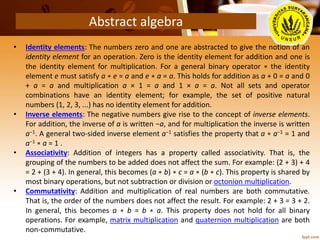
• Identity elements: The numbers zero and one are abstracted to give the notion of an
identity element for an operation. Zero is the identity element for addition and one is
the identity element for multiplication. For a general binary operator ∗ the identity
element e must satisfy a ∗ e = a and e ∗ a = a. This holds for addition as a + 0 = a and 0
+ a = a and multiplication a × 1 = a and 1 × a = a. Not all sets and operator
combinations have an identity element; for example, the set of positive natural
numbers (1, 2, 3, ...) has no identity element for addition.
• Inverse elements: The negative numbers give rise to the concept of inverse elements.
For addition, the inverse of a is written −a, and for multiplication the inverse is written
a−1. A general two-sided inverse element a−1 satisfies the property that a ∗ a−1 = 1 and
a−1 ∗ a = 1 .
• Associativity: Addition of integers has a property called associativity. That is, the
grouping of the numbers to be added does not affect the sum. For example: (2 + 3) + 4
= 2 + (3 + 4). In general, this becomes (a ∗ b) ∗ c = a ∗ (b ∗ c). This property is shared by
most binary operations, but not subtraction or division or octonion multiplication.
• Commutativity: Addition and multiplication of real numbers are both commutative.
That is, the order of the numbers does not affect the result. For example: 2 + 3 = 3 + 2.
In general, this becomes a ∗ b = b ∗ a. This property does not hold for all binary
operations. For example, matrix multiplication and quaternion multiplication are both
non-commutative.
Groups
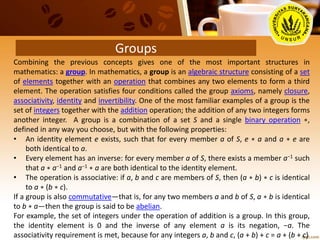
Combining the previous concepts gives one of the most important structures in
mathematics: a group. In mathematics, a group is an algebraic structure consisting of a set
of elements together with an operation that combines any two elements to form a third
element. The operation satisfies four conditions called the group axioms, namely closure,
associativity, identity and invertibility. One of the most familiar examples of a group is the
set of integers together with the addition operation; the addition of any two integers forms
another integer. A group is a combination of a set S and a single binary operation ∗,
defined in any way you choose, but with the following properties:
• An identity element e exists, such that for every member a of S, e ∗ a and a ∗ e are
both identical to a.
• Every element has an inverse: for every member a of S, there exists a member a−1 such
that a ∗ a−1 and a−1 ∗ a are both identical to the identity element.
• The operation is associative: if a, b and c are members of S, then (a ∗ b) ∗ c is identical
to a ∗ (b ∗ c).
If a group is also commutative—that is, for any two members a and b of S, a ∗ b is identical
to b ∗ a—then the group is said to be abelian.
For example, the set of integers under the operation of addition is a group. In this group,
the identity element is 0 and the inverse of any element a is its negation, −a. The
associativity requirement is met, because for any integers a, b and c, (a + b) + c = a + (b + c)
Groups
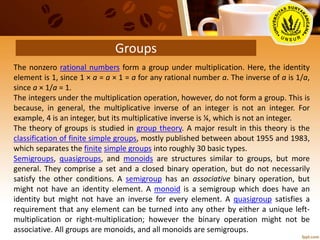
The nonzero rational numbers form a group under multiplication. Here, the identity
element is 1, since 1 × a = a × 1 = a for any rational number a. The inverse of a is 1/a,
since a × 1/a = 1.
The integers under the multiplication operation, however, do not form a group. This is
because, in general, the multiplicative inverse of an integer is not an integer. For
example, 4 is an integer, but its multiplicative inverse is ¼, which is not an integer.
The theory of groups is studied in group theory. A major result in this theory is the
classification of finite simple groups, mostly published between about 1955 and 1983,
which separates the finite simple groups into roughly 30 basic types.
Semigroups, quasigroups, and monoids are structures similar to groups, but more
general. They comprise a set and a closed binary operation, but do not necessarily
satisfy the other conditions. A semigroup has an associative binary operation, but
might not have an identity element. A monoid is a semigroup which does have an
identity but might not have an inverse for every element. A quasigroup satisfies a
requirement that any element can be turned into any other by either a unique left-
multiplication or right-multiplication; however the binary operation might not be
associative. All groups are monoids, and all monoids are semigroups.
Example
 Algebraic properties satisfied by the natural numbers
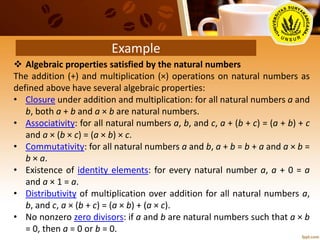
The addition (+) and multiplication (×) operations on natural numbers as
defined above have several algebraic properties:
• Closure under addition and multiplication: for all natural numbers a and
b, both a + b and a × b are natural numbers.
• Associativity: for all natural numbers a, b, and c, a + (b + c) = (a + b) + c
and a × (b × c) = (a × b) × c.
• Commutativity: for all natural numbers a and b, a + b = b + a and a × b =
b × a.
• Existence of identity elements: for every natural number a, a + 0 = a
and a × 1 = a.
• Distributivity of multiplication over addition for all natural numbers a,
b, and c, a × (b + c) = (a × b) + (a × c).
• No nonzero zero divisors: if a and b are natural numbers such that a × b
= 0, then a = 0 or b = 0.
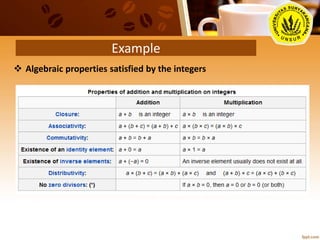
Example
 Algebraic properties satisfied by the integers
Rings and fields
Groups just have one binary operation. To fully explain the behaviour of the different
types of numbers, structures with two operators need to be studied. The most
important of these are rings, and fields.
A ring has two binary operations (+) and (×), with × distributive over +. Under the first
operator (+) it forms an abelian group. Under the second operator (×) it is associative,
but it does not need to have identity, or inverse, so division is not required. The
additive (+) identity element is written as 0 and the additive inverse of a is written as
−a.
Distributivity generalises the distributive law for numbers. For the integers (a + b) × c
= a × c + b × c and c × (a + b) = c × a + c × b, and × is said to be distributive over +.
The integers are an example of a ring. The integers have additional properties which
make it an integral domain.
A field is a ring with the additional property that all the elements excluding 0 form an
abelian group under ×. The multiplicative (×) identity is written as 1 and the
multiplicative inverse of a is written as a−1.
The rational numbers, the real numbers and the complex numbers are all examples of
fields.
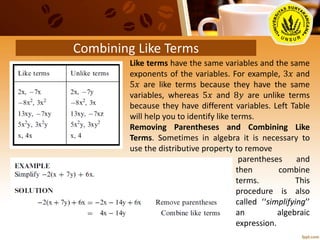
Combining Like Terms
Like terms have the same variables and the same
exponents of the variables. For example, 3𝑥 and
5𝑥 are like terms because they have the same
variables, whereas 5𝑥 and 8𝑦 are unlike terms
because they have different variables. Left Table
will help you to identify like terms.
Removing Parentheses and Combining Like
Terms. Sometimes in algebra it is necessary to
use the distributive property to remove
parentheses and
then combine
terms. This
procedure is also
called ‘‘simplifying’’
an algebraic
expression.
Ratio and Proportion
A ratio is a comparison of two numbers. For example, consider the statement,
‘‘About 14 out of every 100 people in the United States do not have health
insurance.’’
A ratio can be expressed by a fraction or by using a colon. In the preceding
example, the ratio
14
100
is the same as 14 to 100 or 14 : 100. Fractions are usually
reduced to lowest terms, so the ratio becomes
7
50
or 7 : 50.
It is important to understand that whatever number comes first in the ratio
statement is placed in the numerator of the fraction and whatever number comes
second in the ratio statement is placed in the denominator of the fraction. In
general, the ratio of a to b is written as
𝑎
𝑏
.
A proportion is a statement of equality of two ratios. For example,
3
4
=
6
8
is a
proportion. Proportions can also be expressed using a colon, as 3 : 4 ¼ 6 : 8. A
proportion consists of 4 terms. Usually it is necessary to find the value of one
term given the other three terms. For example,
5
8
=
𝑥
24
.
THANK YOU FOR YOUR
ATTENTION
Individual Task :
Download Allan G. Bluman, pre-Algebra
Demystified, McRaw-Hill, New York, 2004.

Forth Lecture

  • 1.
    English For Mathematics Education ForthLecture http://www.slideshare.net/QuKumeng
  • 2.
    Polynomials • A polynomialis an expression that is the sum of a finite number of non-zero terms, each term consisting of the product of a constant and a finite number of variables raised to whole number powers. For example, 𝑥2 + 2𝑥 − 3 is a polynomial in the single variable 𝑥. • A polynomial expression is an expression that may be rewritten as a polynomial, by using commutativity, associativity and distributivity of addition and multiplication. For example, (𝑥 − 1)(𝑥 + 3) is a polynomial expression, that, properly speaking, is not a polynomial. • A polynomial function is a function that is defined by a polynomial, or, equivalently, by a polynomial expression. The two preceding examples define the same polynomial function. • Two important and related problems in algebra are the factorization of polynomials, that is, expressing a given polynomial as a product of other polynomials that can not be factored any further, and the computation of polynomial greatest common divisors. The example polynomial above can be factored as (𝑥 − 1)(𝑥 + 3). A related class of problems is finding algebraic expressions for the roots of a polynomial in a single variable.
  • 3.
    Abstract algebra • Abstractalgebra extends the familiar concepts found in elementary algebra and arithmetic of numbers to more general concepts. Here are listed fundamental concepts in abstract algebra : • Sets: Rather than just considering the different types of numbers, abstract algebra deals with the more general concept of sets: a collection of all objects (called elements) selected by property specific for the set. All collections of the familiar types of numbers are sets. Other examples of sets include the set of all two-by-two matrices, the set of all second-degree polynomials (ax2 + bx + c), the set of all two dimensional vectors in the plane, and the various finite groups such as the cyclic groups, which are the groups of integers modulo n. Set theory is a branch of logic and not technically a branch of algebra. • Binary operations: The notion of addition (+) is abstracted to give a binary operation, ∗ say. The notion of binary operation is meaningless without the set on which the operation is defined. For two elements a and b in a set S, a ∗ b is another element in the set; this condition is called closure. Addition (+), subtraction (-), multiplication (×), and division (÷) can be binary operations when defined on different sets, as are addition and multiplication of matrices, vectors, and polynomials.
  • 4.
    Abstract algebra • Identityelements: The numbers zero and one are abstracted to give the notion of an identity element for an operation. Zero is the identity element for addition and one is the identity element for multiplication. For a general binary operator ∗ the identity element e must satisfy a ∗ e = a and e ∗ a = a. This holds for addition as a + 0 = a and 0 + a = a and multiplication a × 1 = a and 1 × a = a. Not all sets and operator combinations have an identity element; for example, the set of positive natural numbers (1, 2, 3, ...) has no identity element for addition. • Inverse elements: The negative numbers give rise to the concept of inverse elements. For addition, the inverse of a is written −a, and for multiplication the inverse is written a−1. A general two-sided inverse element a−1 satisfies the property that a ∗ a−1 = 1 and a−1 ∗ a = 1 . • Associativity: Addition of integers has a property called associativity. That is, the grouping of the numbers to be added does not affect the sum. For example: (2 + 3) + 4 = 2 + (3 + 4). In general, this becomes (a ∗ b) ∗ c = a ∗ (b ∗ c). This property is shared by most binary operations, but not subtraction or division or octonion multiplication. • Commutativity: Addition and multiplication of real numbers are both commutative. That is, the order of the numbers does not affect the result. For example: 2 + 3 = 3 + 2. In general, this becomes a ∗ b = b ∗ a. This property does not hold for all binary operations. For example, matrix multiplication and quaternion multiplication are both non-commutative.
  • 5.
    Groups Combining the previousconcepts gives one of the most important structures in mathematics: a group. In mathematics, a group is an algebraic structure consisting of a set of elements together with an operation that combines any two elements to form a third element. The operation satisfies four conditions called the group axioms, namely closure, associativity, identity and invertibility. One of the most familiar examples of a group is the set of integers together with the addition operation; the addition of any two integers forms another integer. A group is a combination of a set S and a single binary operation ∗, defined in any way you choose, but with the following properties: • An identity element e exists, such that for every member a of S, e ∗ a and a ∗ e are both identical to a. • Every element has an inverse: for every member a of S, there exists a member a−1 such that a ∗ a−1 and a−1 ∗ a are both identical to the identity element. • The operation is associative: if a, b and c are members of S, then (a ∗ b) ∗ c is identical to a ∗ (b ∗ c). If a group is also commutative—that is, for any two members a and b of S, a ∗ b is identical to b ∗ a—then the group is said to be abelian. For example, the set of integers under the operation of addition is a group. In this group, the identity element is 0 and the inverse of any element a is its negation, −a. The associativity requirement is met, because for any integers a, b and c, (a + b) + c = a + (b + c)
  • 6.
    Groups The nonzero rationalnumbers form a group under multiplication. Here, the identity element is 1, since 1 × a = a × 1 = a for any rational number a. The inverse of a is 1/a, since a × 1/a = 1. The integers under the multiplication operation, however, do not form a group. This is because, in general, the multiplicative inverse of an integer is not an integer. For example, 4 is an integer, but its multiplicative inverse is ¼, which is not an integer. The theory of groups is studied in group theory. A major result in this theory is the classification of finite simple groups, mostly published between about 1955 and 1983, which separates the finite simple groups into roughly 30 basic types. Semigroups, quasigroups, and monoids are structures similar to groups, but more general. They comprise a set and a closed binary operation, but do not necessarily satisfy the other conditions. A semigroup has an associative binary operation, but might not have an identity element. A monoid is a semigroup which does have an identity but might not have an inverse for every element. A quasigroup satisfies a requirement that any element can be turned into any other by either a unique left- multiplication or right-multiplication; however the binary operation might not be associative. All groups are monoids, and all monoids are semigroups.
  • 7.
    Example  Algebraic propertiessatisfied by the natural numbers The addition (+) and multiplication (×) operations on natural numbers as defined above have several algebraic properties: • Closure under addition and multiplication: for all natural numbers a and b, both a + b and a × b are natural numbers. • Associativity: for all natural numbers a, b, and c, a + (b + c) = (a + b) + c and a × (b × c) = (a × b) × c. • Commutativity: for all natural numbers a and b, a + b = b + a and a × b = b × a. • Existence of identity elements: for every natural number a, a + 0 = a and a × 1 = a. • Distributivity of multiplication over addition for all natural numbers a, b, and c, a × (b + c) = (a × b) + (a × c). • No nonzero zero divisors: if a and b are natural numbers such that a × b = 0, then a = 0 or b = 0.
  • 8.
    Example  Algebraic propertiessatisfied by the integers
  • 9.
    Rings and fields Groupsjust have one binary operation. To fully explain the behaviour of the different types of numbers, structures with two operators need to be studied. The most important of these are rings, and fields. A ring has two binary operations (+) and (×), with × distributive over +. Under the first operator (+) it forms an abelian group. Under the second operator (×) it is associative, but it does not need to have identity, or inverse, so division is not required. The additive (+) identity element is written as 0 and the additive inverse of a is written as −a. Distributivity generalises the distributive law for numbers. For the integers (a + b) × c = a × c + b × c and c × (a + b) = c × a + c × b, and × is said to be distributive over +. The integers are an example of a ring. The integers have additional properties which make it an integral domain. A field is a ring with the additional property that all the elements excluding 0 form an abelian group under ×. The multiplicative (×) identity is written as 1 and the multiplicative inverse of a is written as a−1. The rational numbers, the real numbers and the complex numbers are all examples of fields.
  • 10.
    Combining Like Terms Liketerms have the same variables and the same exponents of the variables. For example, 3𝑥 and 5𝑥 are like terms because they have the same variables, whereas 5𝑥 and 8𝑦 are unlike terms because they have different variables. Left Table will help you to identify like terms. Removing Parentheses and Combining Like Terms. Sometimes in algebra it is necessary to use the distributive property to remove parentheses and then combine terms. This procedure is also called ‘‘simplifying’’ an algebraic expression.
  • 11.
    Ratio and Proportion Aratio is a comparison of two numbers. For example, consider the statement, ‘‘About 14 out of every 100 people in the United States do not have health insurance.’’ A ratio can be expressed by a fraction or by using a colon. In the preceding example, the ratio 14 100 is the same as 14 to 100 or 14 : 100. Fractions are usually reduced to lowest terms, so the ratio becomes 7 50 or 7 : 50. It is important to understand that whatever number comes first in the ratio statement is placed in the numerator of the fraction and whatever number comes second in the ratio statement is placed in the denominator of the fraction. In general, the ratio of a to b is written as 𝑎 𝑏 . A proportion is a statement of equality of two ratios. For example, 3 4 = 6 8 is a proportion. Proportions can also be expressed using a colon, as 3 : 4 ¼ 6 : 8. A proportion consists of 4 terms. Usually it is necessary to find the value of one term given the other three terms. For example, 5 8 = 𝑥 24 .
  • 12.
    THANK YOU FORYOUR ATTENTION Individual Task : Download Allan G. Bluman, pre-Algebra Demystified, McRaw-Hill, New York, 2004.