Module 4
Algebraic Structures
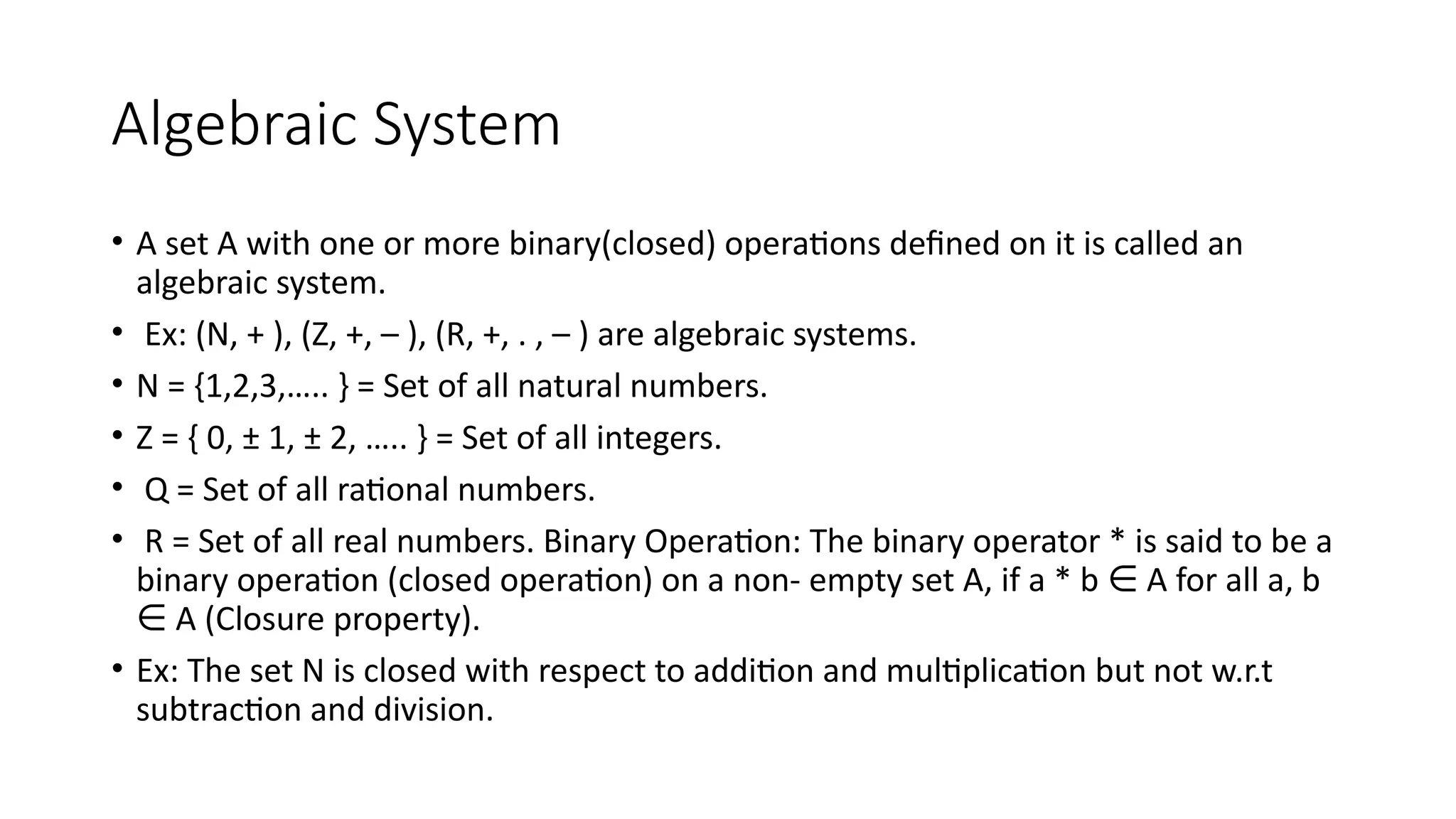
Algebraic System
• A set A with one or more binary(closed) operations defined on it is called an
algebraic system.
• Ex: (N, + ), (Z, +, – ), (R, +, . , – ) are algebraic systems.
• N = {1,2,3,….. } = Set of all natural numbers.
• Z = { 0, ± 1, ± 2, ….. } = Set of all integers.
• Q = Set of all rational numbers.
• R = Set of all real numbers. Binary Operation: The binary operator * is said to be a
binary operation (closed operation) on a non- empty set A, if a * b A for all a, b
∈
A (Closure property).
∈
• Ex: The set N is closed with respect to addition and multiplication but not w.r.t
subtraction and division.
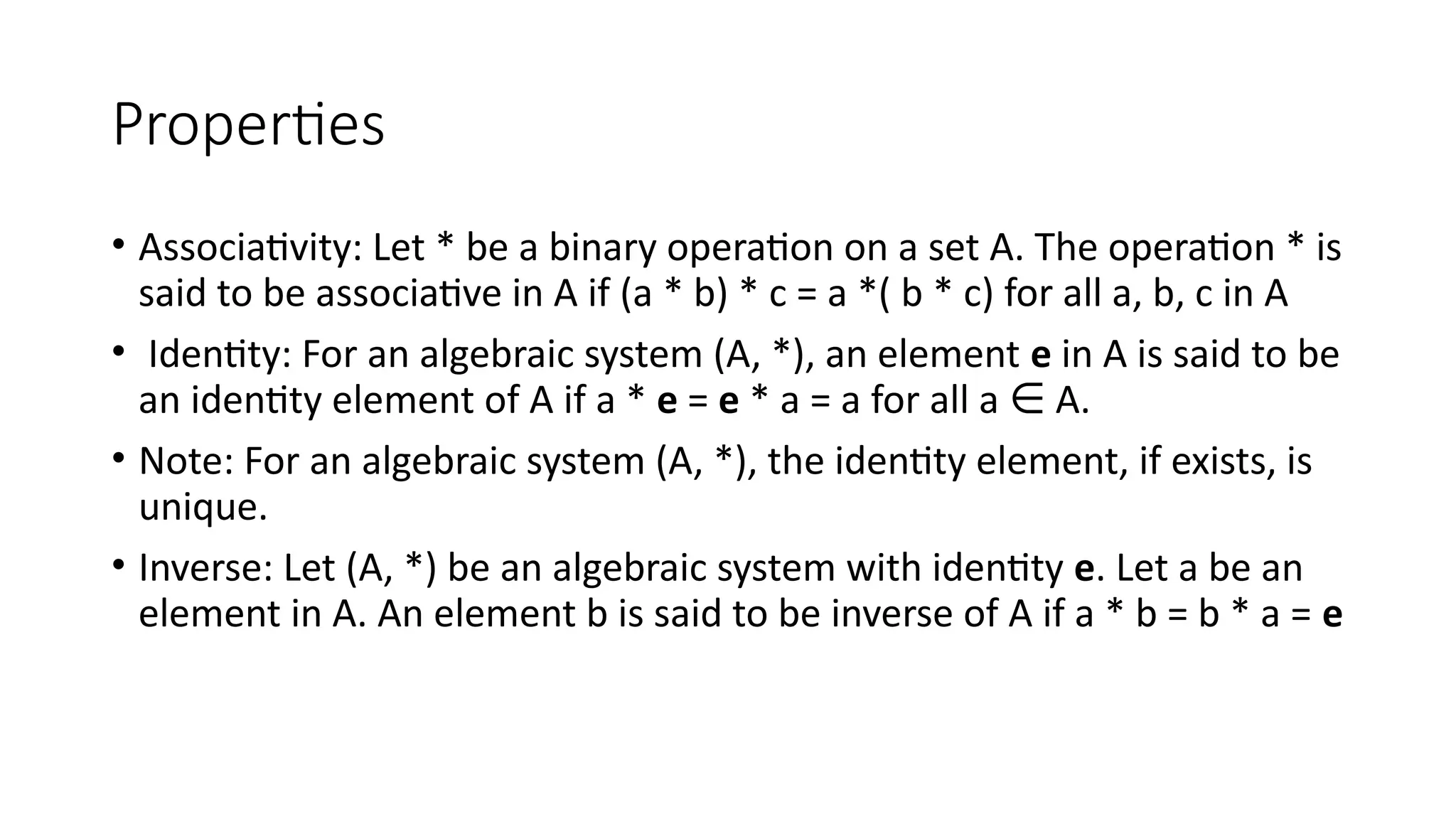
Properties
• Associativity: Let * be a binary operation on a set A. The operation * is
said to be associative in A if (a * b) * c = a *( b * c) for all a, b, c in A
• Identity: For an algebraic system (A, *), an element e in A is said to be
an identity element of A if a * e = e * a = a for all a A.
∈
• Note: For an algebraic system (A, *), the identity element, if exists, is
unique.
• Inverse: Let (A, *) be an algebraic system with identity e. Let a be an
element in A. An element b is said to be inverse of A if a * b = b * a = e
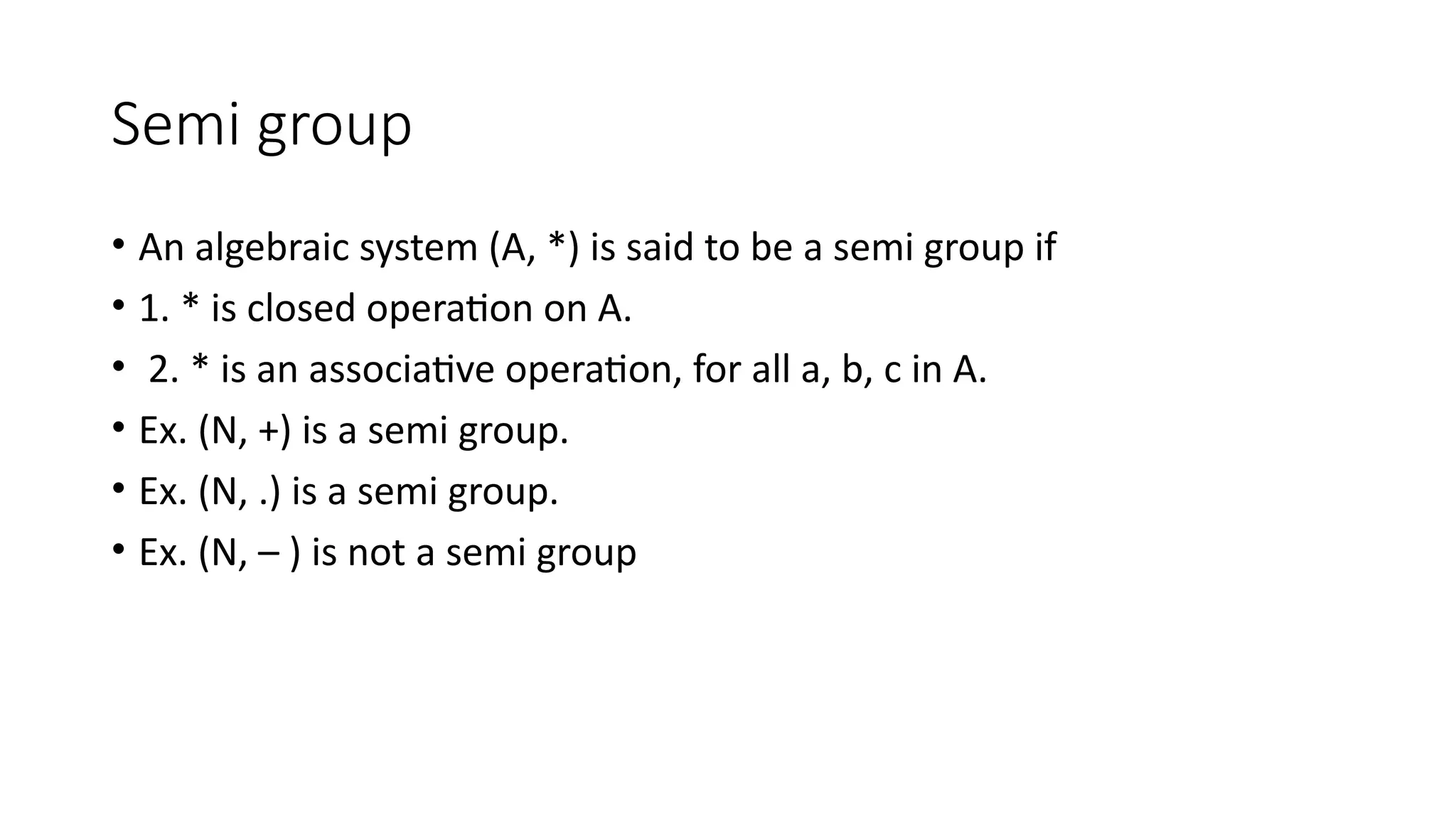
Semi group
• An algebraic system (A, *) is said to be a semi group if
• 1. * is closed operation on A.
• 2. * is an associative operation, for all a, b, c in A.
• Ex. (N, +) is a semi group.
• Ex. (N, .) is a semi group.
• Ex. (N, – ) is not a semi group
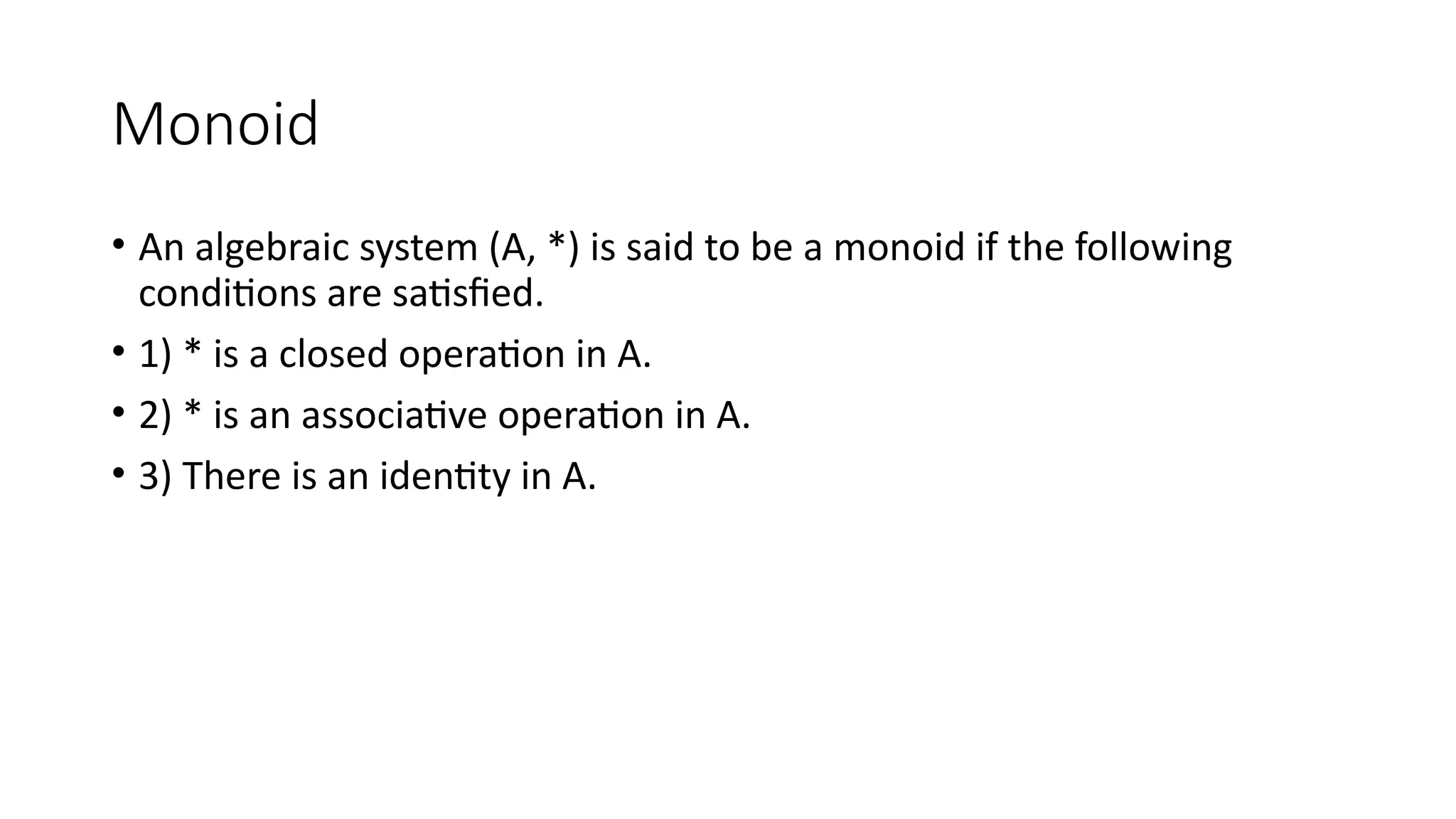
Monoid
• An algebraic system (A, *) is said to be a monoid if the following
conditions are satisfied.
• 1) * is a closed operation in A.
• 2) * is an associative operation in A.
• 3) There is an identity in A.
Subsemigroup & submonoid
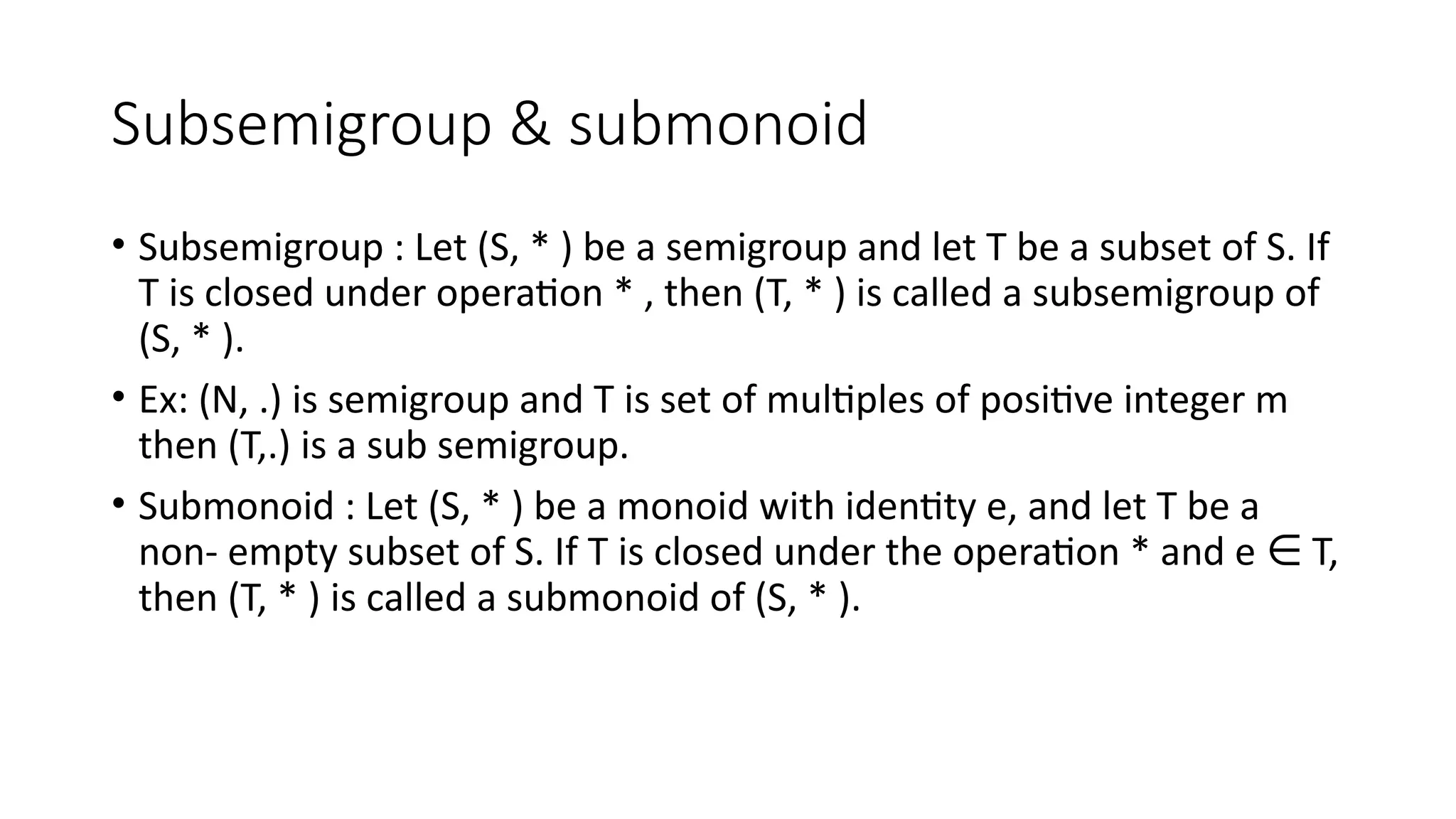
• Subsemigroup : Let (S, * ) be a semigroup and let T be a subset of S. If
T is closed under operation * , then (T, * ) is called a subsemigroup of
(S, * ).
• Ex: (N, .) is semigroup and T is set of multiples of positive integer m
then (T,.) is a sub semigroup.
• Submonoid : Let (S, * ) be a monoid with identity e, and let T be a
non- empty subset of S. If T is closed under the operation * and e T,
∈
then (T, * ) is called a submonoid of (S, * ).
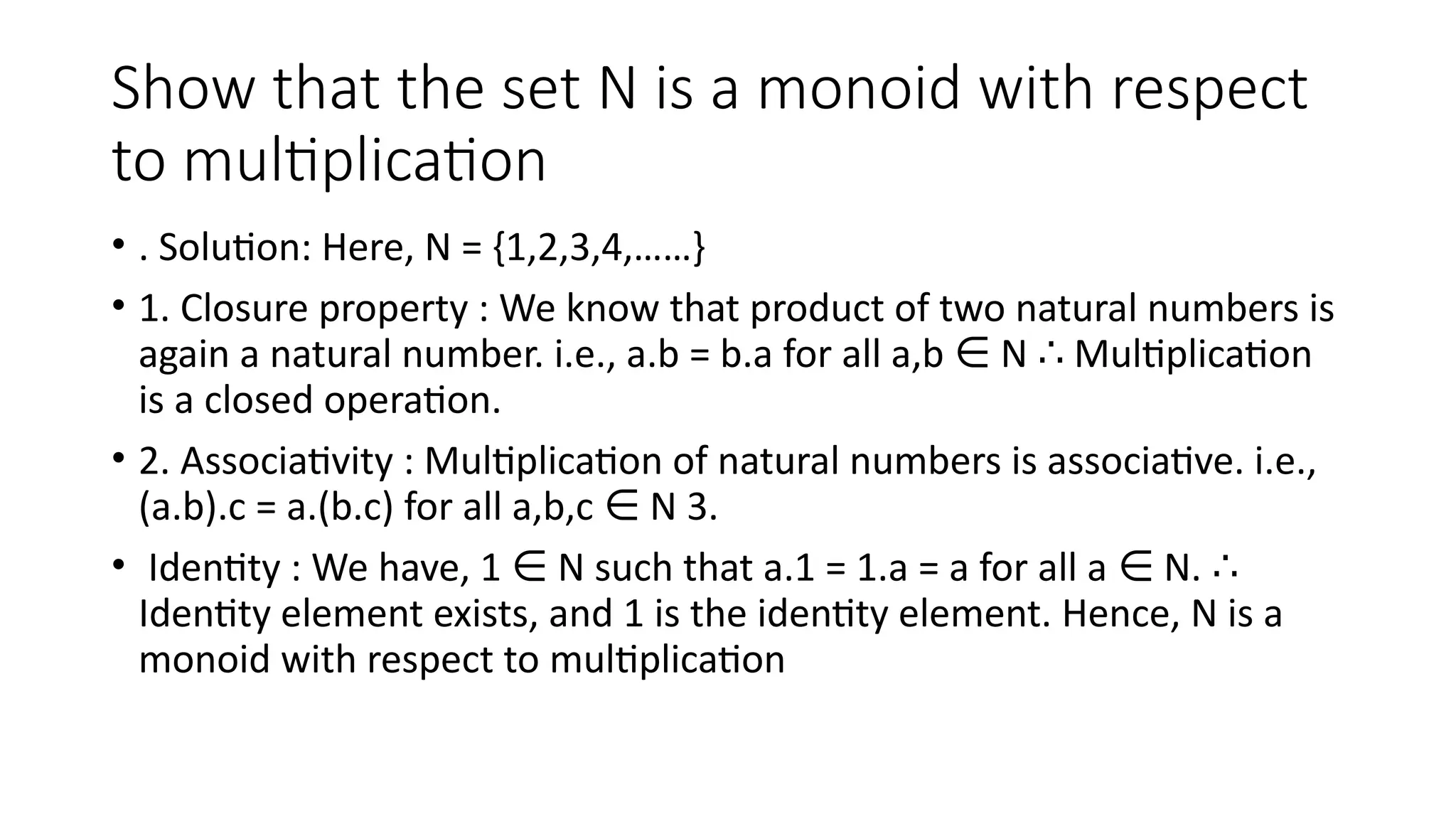
Show that the set N is a monoid with respect
to multiplication
• . Solution: Here, N = {1,2,3,4,……}
• 1. Closure property : We know that product of two natural numbers is
again a natural number. i.e., a.b = b.a for all a,b N Multiplication
∈ ∴
is a closed operation.
• 2. Associativity : Multiplication of natural numbers is associative. i.e.,
(a.b).c = a.(b.c) for all a,b,c N 3.
∈
• Identity : We have, 1 N such that a.1 = 1.a = a for all a N.
∈ ∈ ∴
Identity element exists, and 1 is the identity element. Hence, N is a
monoid with respect to multiplication
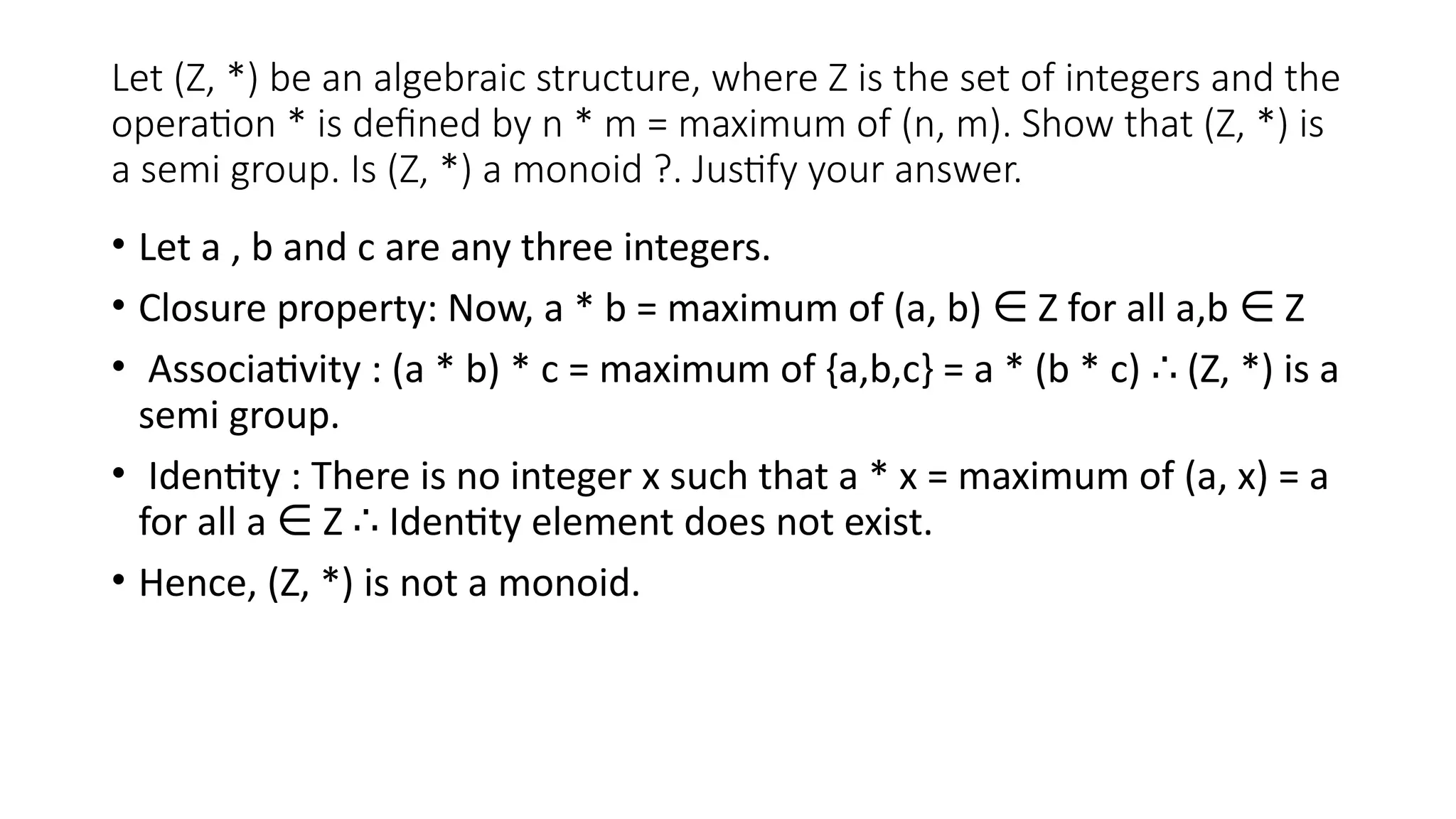
Let (Z, *) be an algebraic structure, where Z is the set of integers and the
operation * is defined by n * m = maximum of (n, m). Show that (Z, *) is
a semi group. Is (Z, *) a monoid ?. Justify your answer.
• Let a , b and c are any three integers.
• Closure property: Now, a * b = maximum of (a, b) Z for all a,b Z
∈ ∈
• Associativity : (a * b) * c = maximum of {a,b,c} = a * (b * c) (Z, *) is a
∴
semi group.
• Identity : There is no integer x such that a * x = maximum of (a, x) = a
for all a Z Identity element does not exist.
∈ ∴
• Hence, (Z, *) is not a monoid.
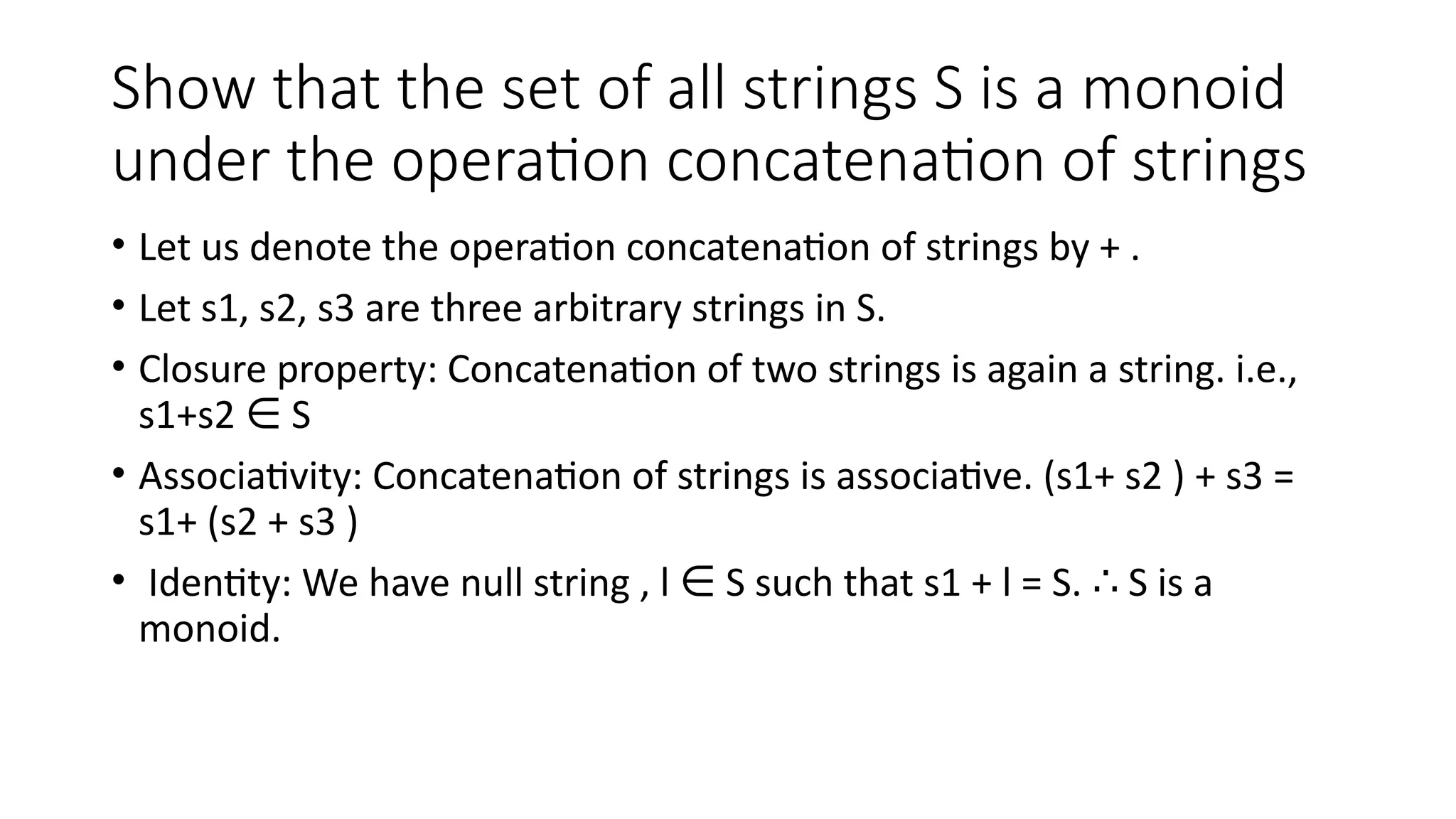
Show that the set of all strings S is a monoid
under the operation concatenation of strings
• Let us denote the operation concatenation of strings by + .
• Let s1, s2, s3 are three arbitrary strings in S.
• Closure property: Concatenation of two strings is again a string. i.e.,
s1+s2 S
∈
• Associativity: Concatenation of strings is associative. (s1+ s2 ) + s3 =
s1+ (s2 + s3 )
• Identity: We have null string , l S such that s1 + l = S. S is a
∈ ∴
monoid.
Groups
• An algebraic system (G, *) is said to be a group if the following
conditions are satisfied.
• 1) * is a closed operation.
• 2) * is an associative operation.
• 3) There is an identity in G.
• 4) Every element in G has inverse in G.
• Abelian group (Commutative group): A group (G, *) is said to be
abelian (or commutative) if a * b = b * a "a, b G.
∈
Properties
• In a Group (G, * ) the following properties hold good
• 1. Identity element is unique.
• 2. Inverse of an element is unique.
• 3. Cancellation laws hold good a * b = a * c => b = c (left cancellation law) a * c
= b * c => a = b (Right cancellation law)
• 4. (a * b) -1
= b-1
* a-1
• In a group, the identity element is its own inverse.
• Order of a group : The number of elements in a group is called order of the
group.
• Finite group: If the order of a group G is finite, then G is called a finite group.
Show that, the set of all integers is an abelian
group with respect to addition.
• Let Z = set of all integers. Let a, b, c are any three elements of Z.
• 1. Closure property : We know that, Sum of two integers is again an integer. i.e.,
a + b Z for all a,b Z
∈ ∈
• 2. Associativity: We know that addition of integers is associative. i.e., (a+b)+c =
a+(b+c) for all a,b,c Z.
∈
• 3. Identity : We have 0 Z and a + 0 = a for all a Z . Identity element exists,
∈ ∈ ∴
and 0 is the identity element.
• 4. Inverse: To each a Z , we have – a Z such that a + ( – a ) = 0 Each element
∈ ∈
in Z has an inverse.
• 5. Commutativity: We know that addition of integers is commutative. i.e., a + b =
b +a for all a,b Z. Hence, ( Z , + ) is an abelian group.
∈
Show that set of all non zero real numbers is a
group with respect to multiplication .
• : Let R* = set of all non zero real numbers. Let a, b, c are any three elements of R* .
• 1. Closure property : We know that, product of two nonzero real numbers is again
a nonzero real number . i.e., a . b R* for all a,b R* .
∈ ∈
• 2. Associativity: We know that multiplication of real numbers is associative. i.e.,
(a.b).c = a.(b.c) for all a,b,c R* .
∈
• 3. Identity : We have 1 R* and a .1 = a for all a R* . Identity element exists,
∈ ∈ ∴
and ͚1͛ is the identity element.
• 4. Inverse: To each a R* , we have 1/a R* such that a .(1/a) = 1 i.e., Each
∈ ∈
element in R* has an inverse.
• 5.Commutativity: We know that multiplication of real numbers is commutative.
i.e., a . b = b . a for all a,b R* . Hence, ( R* , . ) is an abelian group.
∈
In a group (G, *) , Prove that the identity
element is unique
• .Proof : a) Let e1 and e2 are two identity elements in G.
• Now, e1 * e2 = e1 since e2 is the identity) (1)
• Again, e1 * e2 = e2 since e1 is the identity) (2)
• From (1) and (2), we have e1 = e2
• ∴ Identity element in a group is unique.
In a group (G, *) , Prove that the inverse of
any element is unique.
• Let a ,b,c G and e is the identity in G.
∈
• Let us suppose, Both b and c are inverse elements of a .
• Now, a * b = e (1) Since b is the inverse of a
• Again a*c=e (2) Since c is the inverse of a
• From (1) and (2), we have a * b = a * c
• b = c (By left cancellation law) In a group, the inverse of any element
is unique.
In a group (G, *) , Prove that (a * b)-1
= b-1
* a-1
for
all a,b G.
∈
• Proof : Consider, (a * b)-1
* ( b-1
* a-1
) = (a * ( b * b-1
) * a-1
) (By
associative property).
• = (a * e * a-1
) ( By inverse property)
• = ( a * a-1
) ( Since, e is identity) = e ( By inverse property)
• Similarly, we can show that ( b-1
* a-1
) * (a * b)-1
= e
• Hence, ((a * b)-1
= b-1
* a-1
.
• If (G, *) is a group and a G such that a * a = a , then show that a =
∈
e , where e is identity element in G.
• Proof: Given that, a * a = a
• a * a = a * e ( Since, e is identity in G)
• a = e ( By left cancellation law) Hence, the result follows.
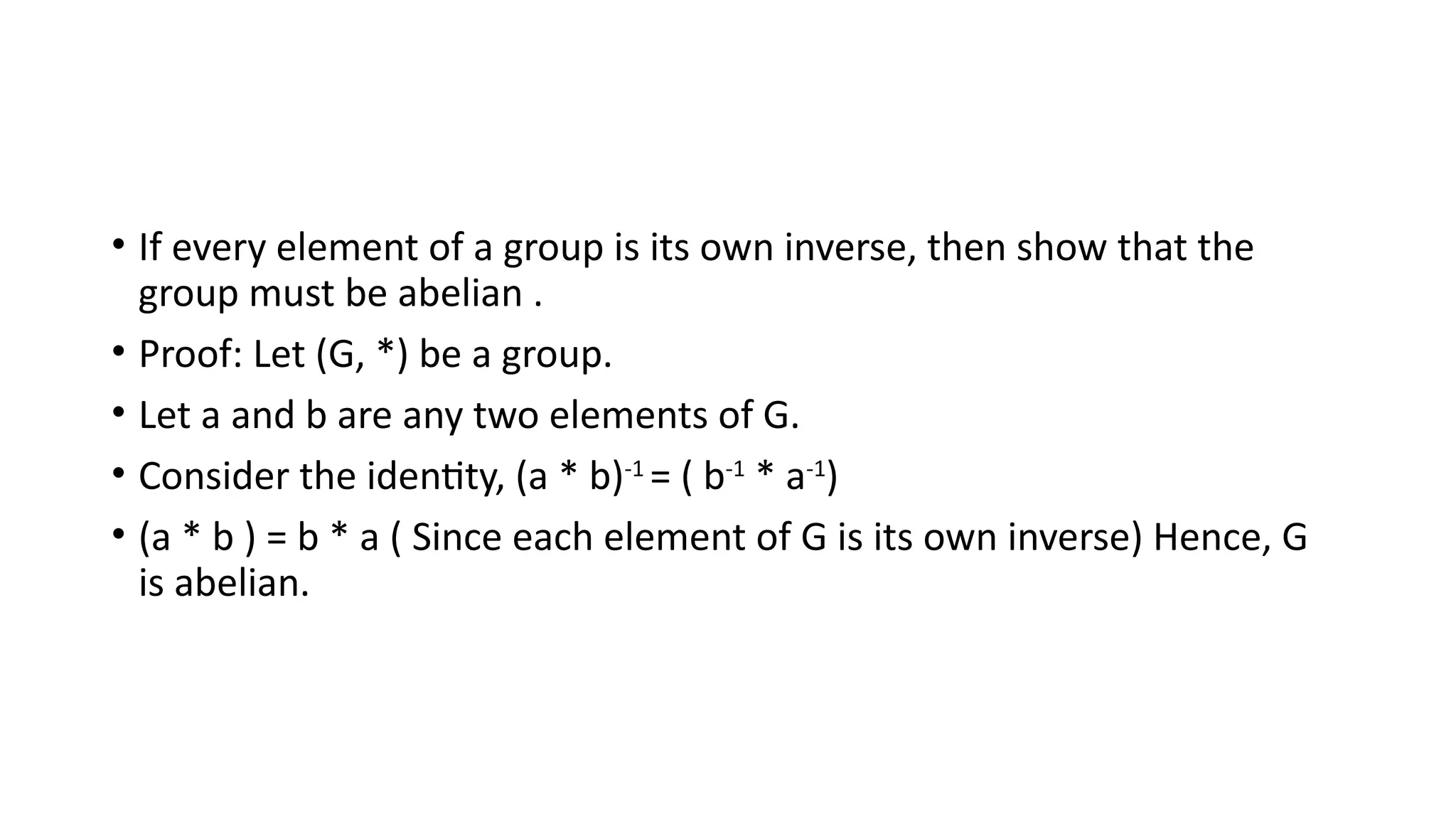
• If every element of a group is its own inverse, then show that the
group must be abelian .
• Proof: Let (G, *) be a group.
• Let a and b are any two elements of G.
• Consider the identity, (a * b)-1
= ( b-1
* a-1
)
• (a * b ) = b * a ( Since each element of G is its own inverse) Hence, G
is abelian.
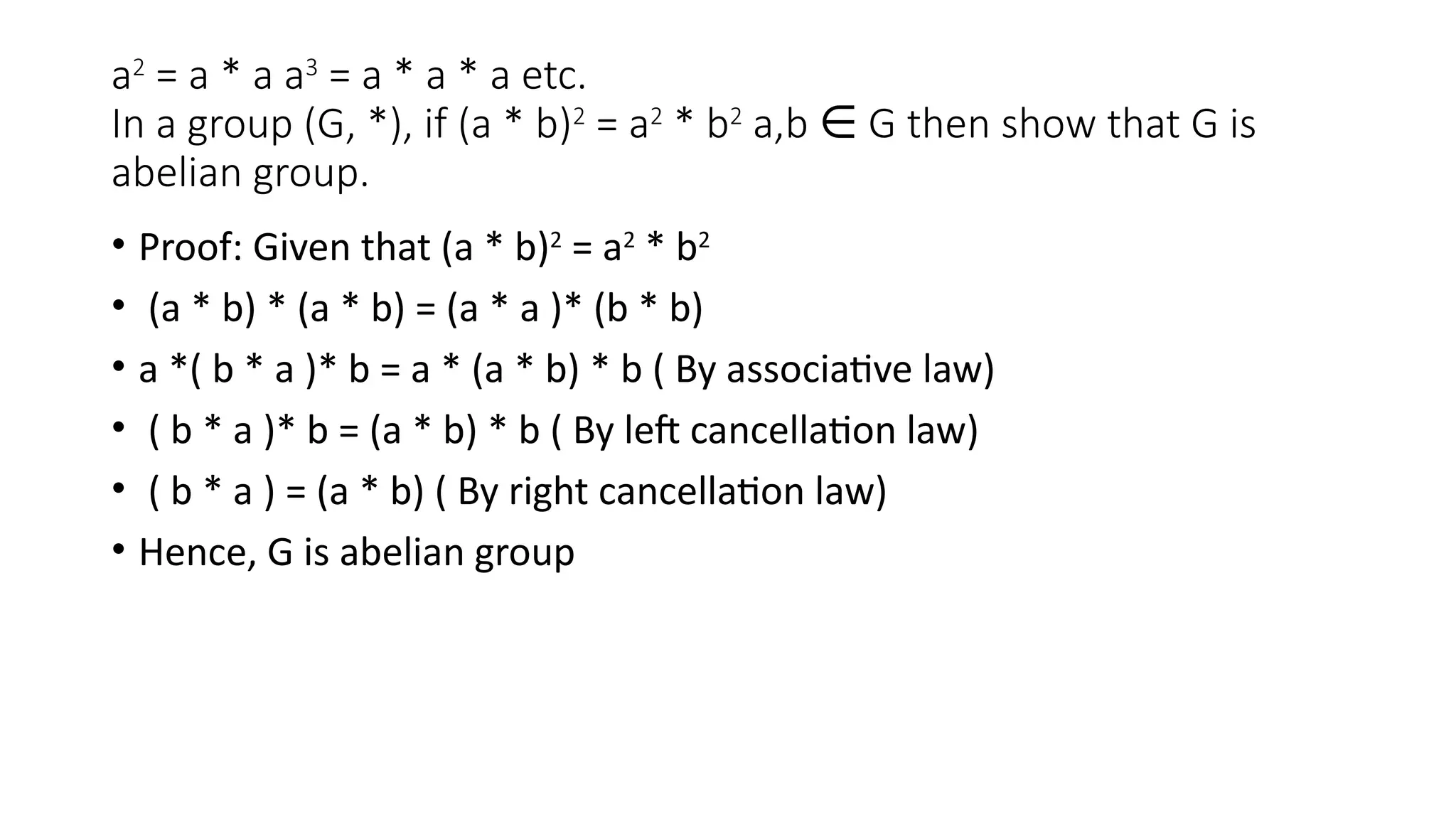
a2
= a * a a3
= a * a * a etc.
In a group (G, *), if (a * b)2
= a2
* b2
a,b G then show that G is
∈
abelian group.
• Proof: Given that (a * b)2
= a2
* b2
• (a * b) * (a * b) = (a * a )* (b * b)
• a *( b * a )* b = a * (a * b) * b ( By associative law)
• ( b * a )* b = (a * b) * b ( By left cancellation law)
• ( b * a ) = (a * b) ( By right cancellation law)
• Hence, G is abelian group
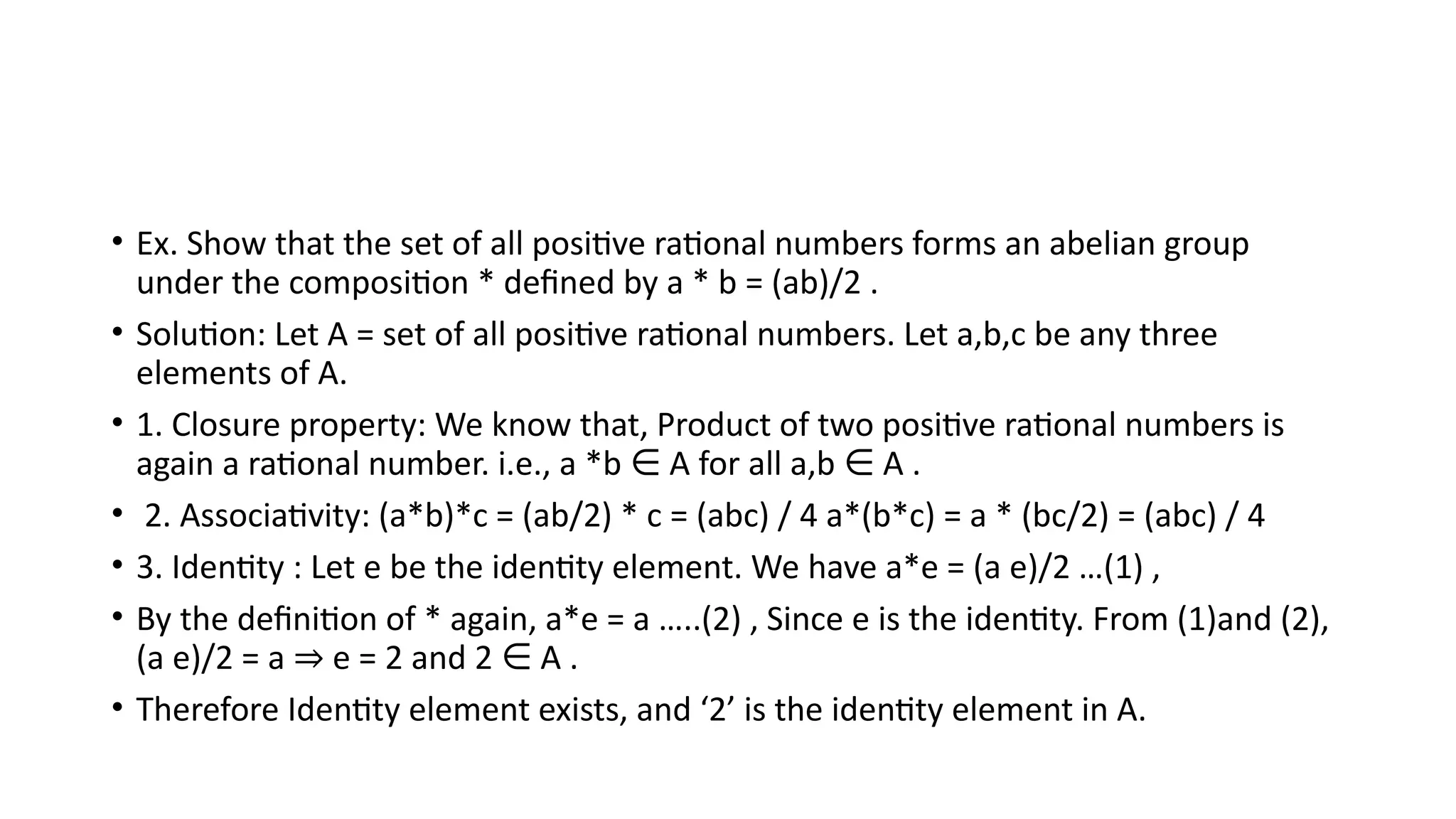
• Ex. Show that the set of all positive rational numbers forms an abelian group
under the composition * defined by a * b = (ab)/2 .
• Solution: Let A = set of all positive rational numbers. Let a,b,c be any three
elements of A.
• 1. Closure property: We know that, Product of two positive rational numbers is
again a rational number. i.e., a *b A for all a,b A .
∈ ∈
• 2. Associativity: (a*b)*c = (ab/2) * c = (abc) / 4 a*(b*c) = a * (bc/2) = (abc) / 4
• 3. Identity : Let e be the identity element. We have a*e = (a e)/2 …(1) ,
• By the definition of * again, a*e = a …..(2) , Since e is the identity. From (1)and (2),
(a e)/2 = a ⇒ e = 2 and 2 A .
∈
• Therefore Identity element exists, and ‘2’ is the identity element in A.
Ring
• Let addition (+) and Multiplication (.) be two binary operations
defined on a non empty set R. Then R is said to form a ring w.r.t
addition (+) and multiplication (.) if the following conditions are
satisfied:
• (R, +) is an abelian group ( i.e commutative group)
• (R, .) is a semigroup
• For any three elements a, b, c ∈R the left distributive law a.(b+c) =a.b
+ a.c and the right distributive property (b + c).a =b.a + c.a holds.
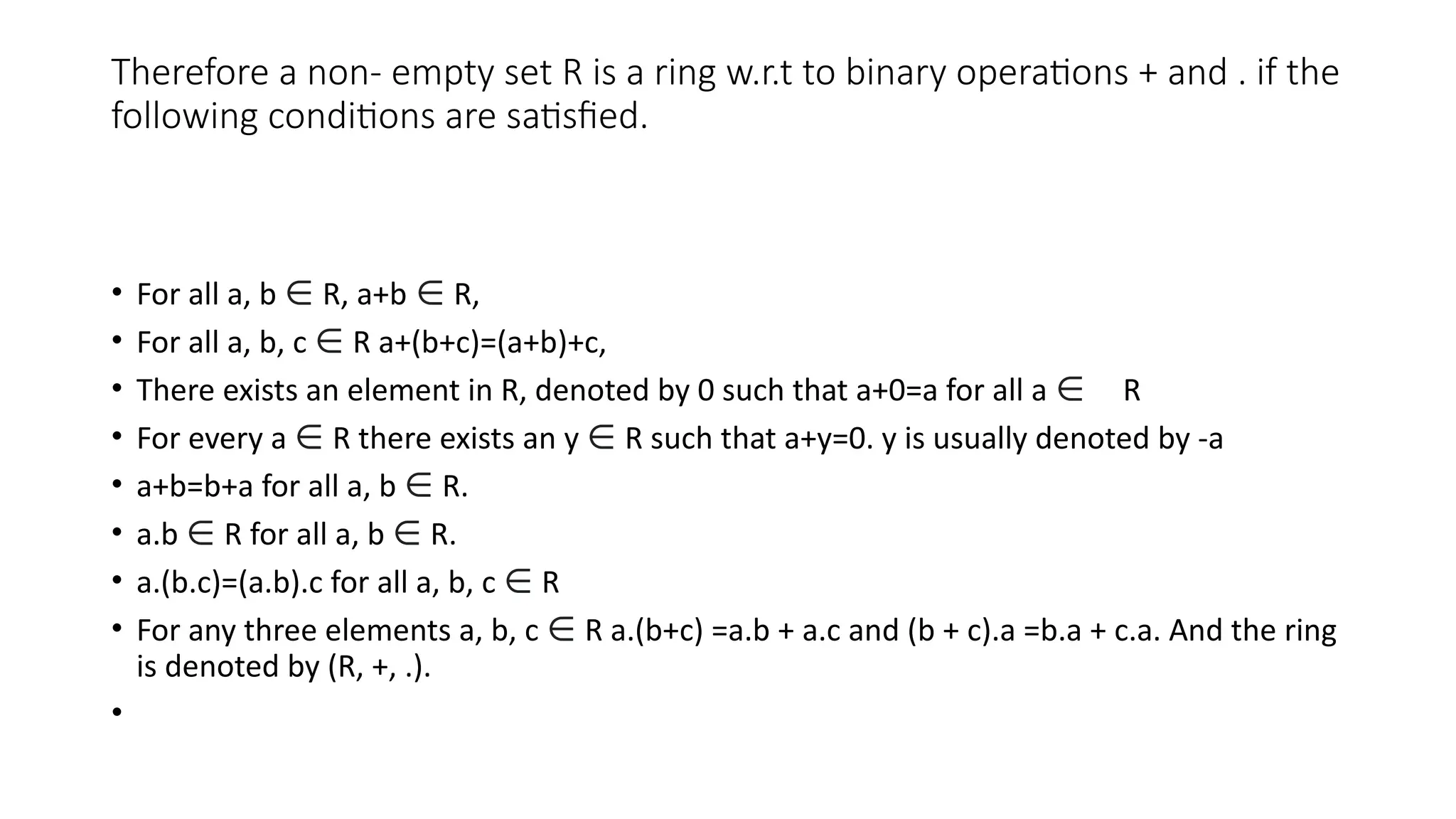
Therefore a non- empty set R is a ring w.r.t to binary operations + and . if the
following conditions are satisfied.
• For all a, b ∈ R, a+b ∈ R,
• For all a, b, c ∈ R a+(b+c)=(a+b)+c,
• There exists an element in R, denoted by 0 such that a+0=a for all a ∈ R
• For every a ∈ R there exists an y ∈ R such that a+y=0. y is usually denoted by -a
• a+b=b+a for all a, b ∈ R.
• a.b ∈ R for all a, b ∈ R.
• a.(b.c)=(a.b).c for all a, b, c ∈ R
• For any three elements a, b, c ∈ R a.(b+c) =a.b + a.c and (b + c).a =b.a + c.a. And the ring
is denoted by (R, +, .).
•
Examples
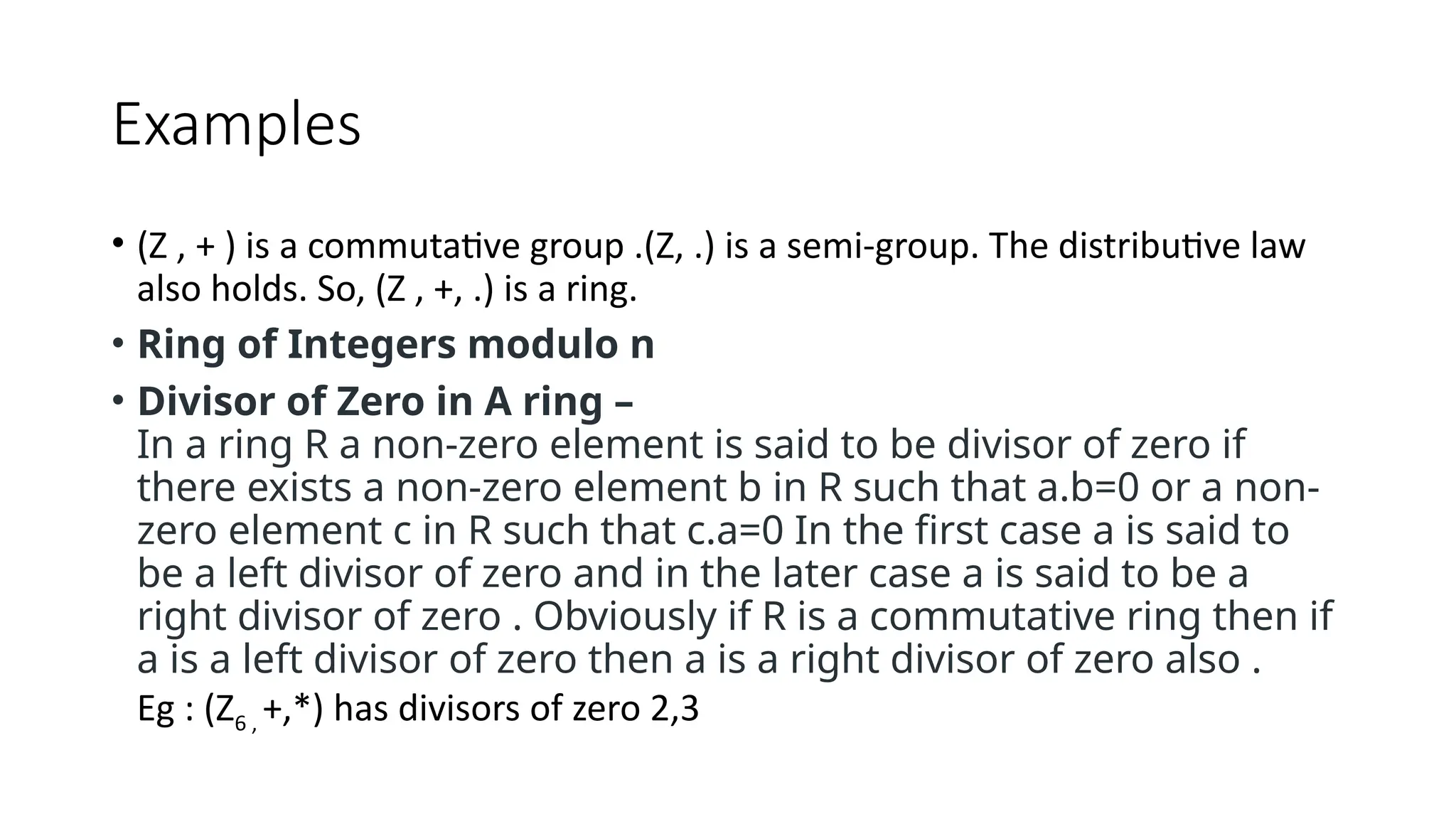
• (Z , + ) is a commutative group .(Z, .) is a semi-group. The distributive law
also holds. So, (Z , +, .) is a ring.
• Ring of Integers modulo n
• Divisor of Zero in A ring –
In a ring R a non-zero element is said to be divisor of zero if
there exists a non-zero element b in R such that a.b=0 or a non-
zero element c in R such that c.a=0 In the first case a is said to
be a left divisor of zero and in the later case a is said to be a
right divisor of zero . Obviously if R is a commutative ring then if
a is a left divisor of zero then a is a right divisor of zero also .
Eg : (Z6 , +,*) has divisors of zero 2,3
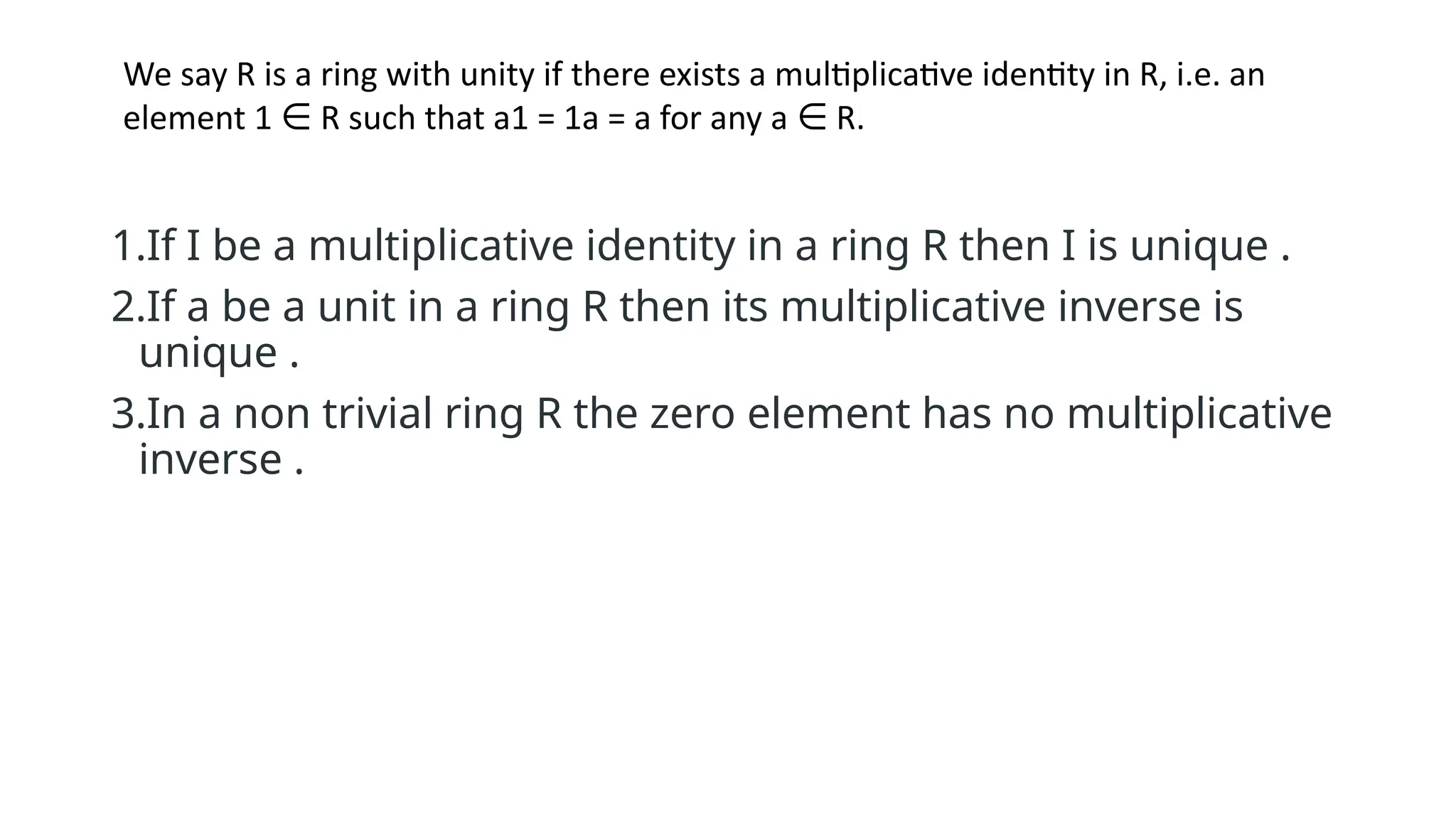
1.If I be a multiplicative identity in a ring R then I is unique .
2.If a be a unit in a ring R then its multiplicative inverse is
unique .
3.In a non trivial ring R the zero element has no multiplicative
inverse .
We say R is a ring with unity if there exists a multiplicative identity in R, i.e. an
element 1 R such that a1 = 1a = a for any a R.
∈ ∈
Integral Domain
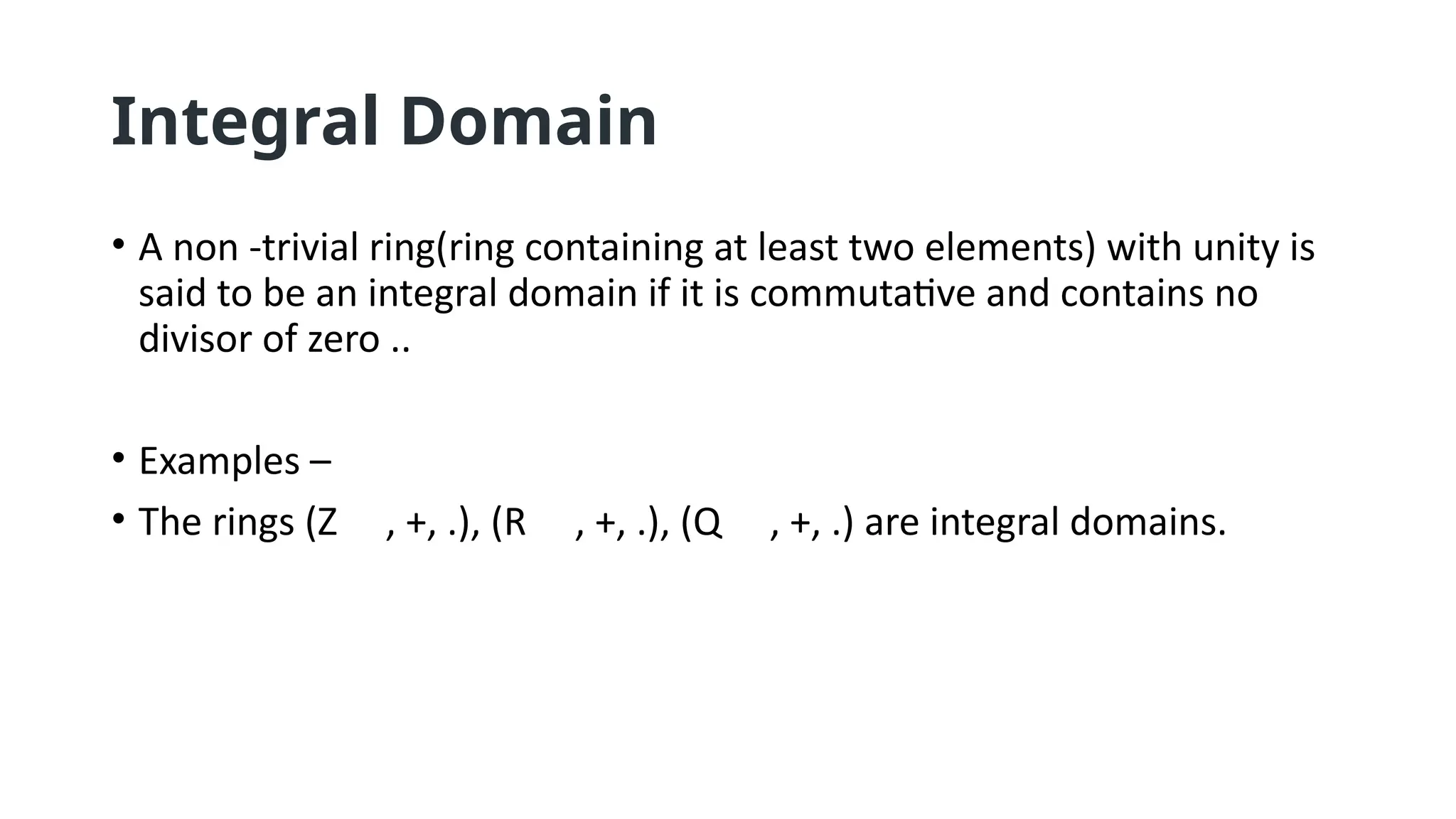
• A non -trivial ring(ring containing at least two elements) with unity is
said to be an integral domain if it is commutative and contains no
divisor of zero ..
• Examples –
• The rings (Z , +, .), (R , +, .), (Q , +, .) are integral domains.
Field
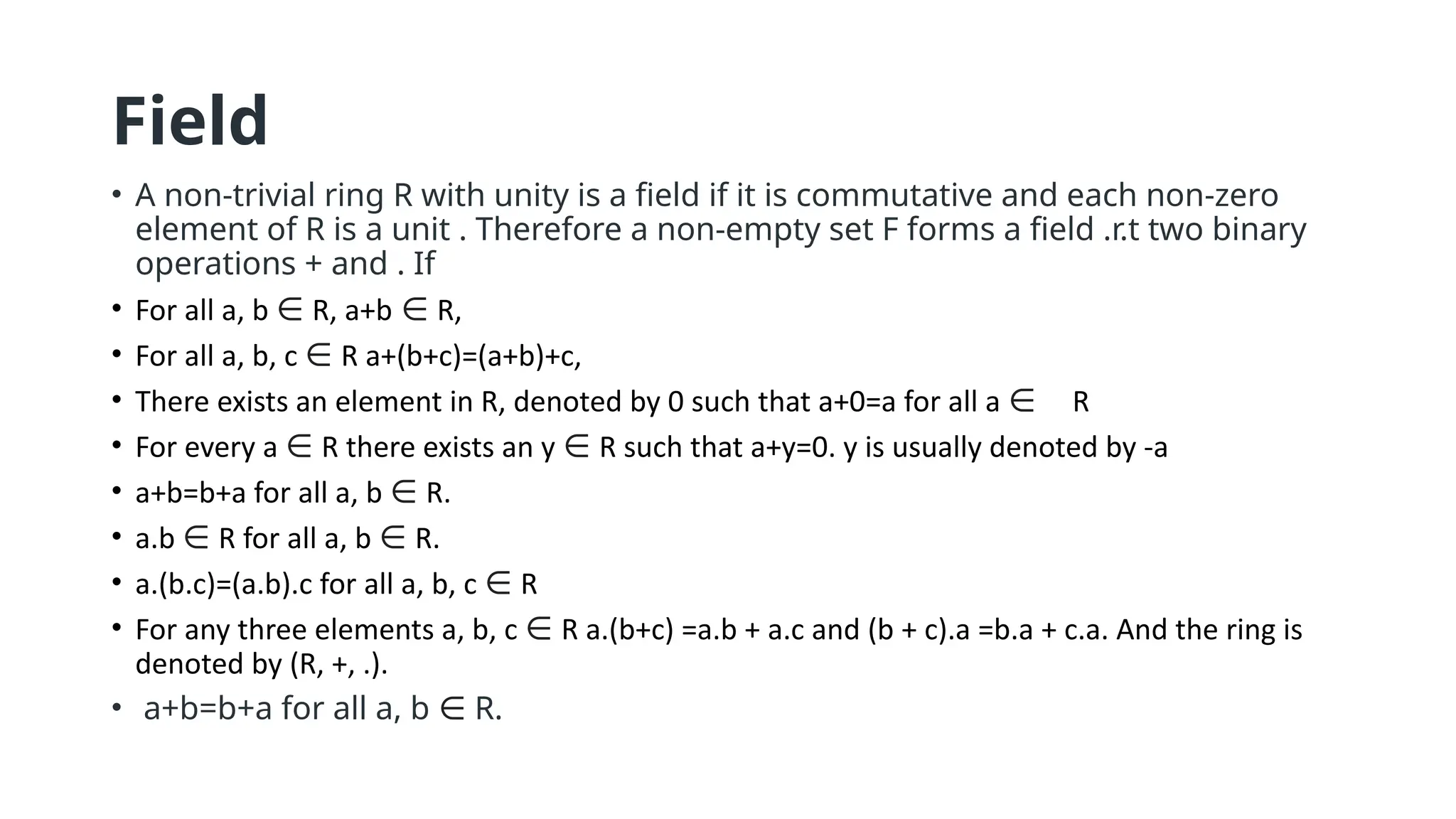
• A non-trivial ring R with unity is a field if it is commutative and each non-zero
element of R is a unit . Therefore a non-empty set F forms a field .r.t two binary
operations + and . If
• For all a, b ∈ R, a+b ∈ R,
• For all a, b, c ∈ R a+(b+c)=(a+b)+c,
• There exists an element in R, denoted by 0 such that a+0=a for all a ∈ R
• For every a ∈ R there exists an y ∈ R such that a+y=0. y is usually denoted by -a
• a+b=b+a for all a, b ∈ R.
• a.b ∈ R for all a, b ∈ R.
• a.(b.c)=(a.b).c for all a, b, c ∈ R
• For any three elements a, b, c ∈ R a.(b+c) =a.b + a.c and (b + c).a =b.a + c.a. And the ring is
denoted by (R, +, .).
• a+b=b+a for all a, b ∈ R.
• a.b ∈ F for all a.b ∈ F.
• a.(b.c)=(a.b).c for all a, b ∈ F
• There exists an element I in F, called the identity element such that a.I=a for all a in F
• For each non-zero element a in F there exists an element, denoted by a-1
in F such that a a-1
=I.
• a.b =b.a for all a, b in F .
• a.(b+c) =a.b + a.c for all a, b, c in F
•
• Examples – The rings (Q , +, .), (R , + . .) are familiar examples of fields.
• Some important results:
• A field is an integral domain.
• A finite integral domain is a field.
• A non trivial finite commutative ring containing no divisor of zero is an integral domain
algebraic structuresalgebraic structures.pptxalgebraic structures.pptx.pptx

algebraic structuresalgebraic structures.pptxalgebraic structures.pptx.pptx

  • 1.
  • 2.
    Algebraic System • Aset A with one or more binary(closed) operations defined on it is called an algebraic system. • Ex: (N, + ), (Z, +, – ), (R, +, . , – ) are algebraic systems. • N = {1,2,3,….. } = Set of all natural numbers. • Z = { 0, ± 1, ± 2, ….. } = Set of all integers. • Q = Set of all rational numbers. • R = Set of all real numbers. Binary Operation: The binary operator * is said to be a binary operation (closed operation) on a non- empty set A, if a * b A for all a, b ∈ A (Closure property). ∈ • Ex: The set N is closed with respect to addition and multiplication but not w.r.t subtraction and division.
  • 3.
    Properties • Associativity: Let* be a binary operation on a set A. The operation * is said to be associative in A if (a * b) * c = a *( b * c) for all a, b, c in A • Identity: For an algebraic system (A, *), an element e in A is said to be an identity element of A if a * e = e * a = a for all a A. ∈ • Note: For an algebraic system (A, *), the identity element, if exists, is unique. • Inverse: Let (A, *) be an algebraic system with identity e. Let a be an element in A. An element b is said to be inverse of A if a * b = b * a = e
  • 4.
    Semi group • Analgebraic system (A, *) is said to be a semi group if • 1. * is closed operation on A. • 2. * is an associative operation, for all a, b, c in A. • Ex. (N, +) is a semi group. • Ex. (N, .) is a semi group. • Ex. (N, – ) is not a semi group
  • 5.
    Monoid • An algebraicsystem (A, *) is said to be a monoid if the following conditions are satisfied. • 1) * is a closed operation in A. • 2) * is an associative operation in A. • 3) There is an identity in A.
  • 6.
    Subsemigroup & submonoid •Subsemigroup : Let (S, * ) be a semigroup and let T be a subset of S. If T is closed under operation * , then (T, * ) is called a subsemigroup of (S, * ). • Ex: (N, .) is semigroup and T is set of multiples of positive integer m then (T,.) is a sub semigroup. • Submonoid : Let (S, * ) be a monoid with identity e, and let T be a non- empty subset of S. If T is closed under the operation * and e T, ∈ then (T, * ) is called a submonoid of (S, * ).
  • 7.
    Show that theset N is a monoid with respect to multiplication • . Solution: Here, N = {1,2,3,4,……} • 1. Closure property : We know that product of two natural numbers is again a natural number. i.e., a.b = b.a for all a,b N Multiplication ∈ ∴ is a closed operation. • 2. Associativity : Multiplication of natural numbers is associative. i.e., (a.b).c = a.(b.c) for all a,b,c N 3. ∈ • Identity : We have, 1 N such that a.1 = 1.a = a for all a N. ∈ ∈ ∴ Identity element exists, and 1 is the identity element. Hence, N is a monoid with respect to multiplication
  • 8.
    Let (Z, *)be an algebraic structure, where Z is the set of integers and the operation * is defined by n * m = maximum of (n, m). Show that (Z, *) is a semi group. Is (Z, *) a monoid ?. Justify your answer. • Let a , b and c are any three integers. • Closure property: Now, a * b = maximum of (a, b) Z for all a,b Z ∈ ∈ • Associativity : (a * b) * c = maximum of {a,b,c} = a * (b * c) (Z, *) is a ∴ semi group. • Identity : There is no integer x such that a * x = maximum of (a, x) = a for all a Z Identity element does not exist. ∈ ∴ • Hence, (Z, *) is not a monoid.
  • 9.
    Show that theset of all strings S is a monoid under the operation concatenation of strings • Let us denote the operation concatenation of strings by + . • Let s1, s2, s3 are three arbitrary strings in S. • Closure property: Concatenation of two strings is again a string. i.e., s1+s2 S ∈ • Associativity: Concatenation of strings is associative. (s1+ s2 ) + s3 = s1+ (s2 + s3 ) • Identity: We have null string , l S such that s1 + l = S. S is a ∈ ∴ monoid.
  • 10.
    Groups • An algebraicsystem (G, *) is said to be a group if the following conditions are satisfied. • 1) * is a closed operation. • 2) * is an associative operation. • 3) There is an identity in G. • 4) Every element in G has inverse in G. • Abelian group (Commutative group): A group (G, *) is said to be abelian (or commutative) if a * b = b * a "a, b G. ∈
  • 11.
    Properties • In aGroup (G, * ) the following properties hold good • 1. Identity element is unique. • 2. Inverse of an element is unique. • 3. Cancellation laws hold good a * b = a * c => b = c (left cancellation law) a * c = b * c => a = b (Right cancellation law) • 4. (a * b) -1 = b-1 * a-1 • In a group, the identity element is its own inverse. • Order of a group : The number of elements in a group is called order of the group. • Finite group: If the order of a group G is finite, then G is called a finite group.
  • 12.
    Show that, theset of all integers is an abelian group with respect to addition. • Let Z = set of all integers. Let a, b, c are any three elements of Z. • 1. Closure property : We know that, Sum of two integers is again an integer. i.e., a + b Z for all a,b Z ∈ ∈ • 2. Associativity: We know that addition of integers is associative. i.e., (a+b)+c = a+(b+c) for all a,b,c Z. ∈ • 3. Identity : We have 0 Z and a + 0 = a for all a Z . Identity element exists, ∈ ∈ ∴ and 0 is the identity element. • 4. Inverse: To each a Z , we have – a Z such that a + ( – a ) = 0 Each element ∈ ∈ in Z has an inverse. • 5. Commutativity: We know that addition of integers is commutative. i.e., a + b = b +a for all a,b Z. Hence, ( Z , + ) is an abelian group. ∈
  • 13.
    Show that setof all non zero real numbers is a group with respect to multiplication . • : Let R* = set of all non zero real numbers. Let a, b, c are any three elements of R* . • 1. Closure property : We know that, product of two nonzero real numbers is again a nonzero real number . i.e., a . b R* for all a,b R* . ∈ ∈ • 2. Associativity: We know that multiplication of real numbers is associative. i.e., (a.b).c = a.(b.c) for all a,b,c R* . ∈ • 3. Identity : We have 1 R* and a .1 = a for all a R* . Identity element exists, ∈ ∈ ∴ and ͚1͛ is the identity element. • 4. Inverse: To each a R* , we have 1/a R* such that a .(1/a) = 1 i.e., Each ∈ ∈ element in R* has an inverse. • 5.Commutativity: We know that multiplication of real numbers is commutative. i.e., a . b = b . a for all a,b R* . Hence, ( R* , . ) is an abelian group. ∈
  • 14.
    In a group(G, *) , Prove that the identity element is unique • .Proof : a) Let e1 and e2 are two identity elements in G. • Now, e1 * e2 = e1 since e2 is the identity) (1) • Again, e1 * e2 = e2 since e1 is the identity) (2) • From (1) and (2), we have e1 = e2 • ∴ Identity element in a group is unique.
  • 15.
    In a group(G, *) , Prove that the inverse of any element is unique. • Let a ,b,c G and e is the identity in G. ∈ • Let us suppose, Both b and c are inverse elements of a . • Now, a * b = e (1) Since b is the inverse of a • Again a*c=e (2) Since c is the inverse of a • From (1) and (2), we have a * b = a * c • b = c (By left cancellation law) In a group, the inverse of any element is unique.
  • 16.
    In a group(G, *) , Prove that (a * b)-1 = b-1 * a-1 for all a,b G. ∈ • Proof : Consider, (a * b)-1 * ( b-1 * a-1 ) = (a * ( b * b-1 ) * a-1 ) (By associative property). • = (a * e * a-1 ) ( By inverse property) • = ( a * a-1 ) ( Since, e is identity) = e ( By inverse property) • Similarly, we can show that ( b-1 * a-1 ) * (a * b)-1 = e • Hence, ((a * b)-1 = b-1 * a-1 .
  • 17.
    • If (G,*) is a group and a G such that a * a = a , then show that a = ∈ e , where e is identity element in G. • Proof: Given that, a * a = a • a * a = a * e ( Since, e is identity in G) • a = e ( By left cancellation law) Hence, the result follows.
  • 18.
    • If everyelement of a group is its own inverse, then show that the group must be abelian . • Proof: Let (G, *) be a group. • Let a and b are any two elements of G. • Consider the identity, (a * b)-1 = ( b-1 * a-1 ) • (a * b ) = b * a ( Since each element of G is its own inverse) Hence, G is abelian.
  • 19.
    a2 = a *a a3 = a * a * a etc. In a group (G, *), if (a * b)2 = a2 * b2 a,b G then show that G is ∈ abelian group. • Proof: Given that (a * b)2 = a2 * b2 • (a * b) * (a * b) = (a * a )* (b * b) • a *( b * a )* b = a * (a * b) * b ( By associative law) • ( b * a )* b = (a * b) * b ( By left cancellation law) • ( b * a ) = (a * b) ( By right cancellation law) • Hence, G is abelian group
  • 20.
    • Ex. Showthat the set of all positive rational numbers forms an abelian group under the composition * defined by a * b = (ab)/2 . • Solution: Let A = set of all positive rational numbers. Let a,b,c be any three elements of A. • 1. Closure property: We know that, Product of two positive rational numbers is again a rational number. i.e., a *b A for all a,b A . ∈ ∈ • 2. Associativity: (a*b)*c = (ab/2) * c = (abc) / 4 a*(b*c) = a * (bc/2) = (abc) / 4 • 3. Identity : Let e be the identity element. We have a*e = (a e)/2 …(1) , • By the definition of * again, a*e = a …..(2) , Since e is the identity. From (1)and (2), (a e)/2 = a ⇒ e = 2 and 2 A . ∈ • Therefore Identity element exists, and ‘2’ is the identity element in A.
  • 21.
    Ring • Let addition(+) and Multiplication (.) be two binary operations defined on a non empty set R. Then R is said to form a ring w.r.t addition (+) and multiplication (.) if the following conditions are satisfied: • (R, +) is an abelian group ( i.e commutative group) • (R, .) is a semigroup • For any three elements a, b, c ∈R the left distributive law a.(b+c) =a.b + a.c and the right distributive property (b + c).a =b.a + c.a holds.
  • 22.
    Therefore a non-empty set R is a ring w.r.t to binary operations + and . if the following conditions are satisfied. • For all a, b ∈ R, a+b ∈ R, • For all a, b, c ∈ R a+(b+c)=(a+b)+c, • There exists an element in R, denoted by 0 such that a+0=a for all a ∈ R • For every a ∈ R there exists an y ∈ R such that a+y=0. y is usually denoted by -a • a+b=b+a for all a, b ∈ R. • a.b ∈ R for all a, b ∈ R. • a.(b.c)=(a.b).c for all a, b, c ∈ R • For any three elements a, b, c ∈ R a.(b+c) =a.b + a.c and (b + c).a =b.a + c.a. And the ring is denoted by (R, +, .). •
  • 23.
    Examples • (Z ,+ ) is a commutative group .(Z, .) is a semi-group. The distributive law also holds. So, (Z , +, .) is a ring. • Ring of Integers modulo n • Divisor of Zero in A ring – In a ring R a non-zero element is said to be divisor of zero if there exists a non-zero element b in R such that a.b=0 or a non- zero element c in R such that c.a=0 In the first case a is said to be a left divisor of zero and in the later case a is said to be a right divisor of zero . Obviously if R is a commutative ring then if a is a left divisor of zero then a is a right divisor of zero also . Eg : (Z6 , +,*) has divisors of zero 2,3
  • 24.
    1.If I bea multiplicative identity in a ring R then I is unique . 2.If a be a unit in a ring R then its multiplicative inverse is unique . 3.In a non trivial ring R the zero element has no multiplicative inverse . We say R is a ring with unity if there exists a multiplicative identity in R, i.e. an element 1 R such that a1 = 1a = a for any a R. ∈ ∈
  • 25.
    Integral Domain • Anon -trivial ring(ring containing at least two elements) with unity is said to be an integral domain if it is commutative and contains no divisor of zero .. • Examples – • The rings (Z , +, .), (R , +, .), (Q , +, .) are integral domains.
  • 26.
    Field • A non-trivialring R with unity is a field if it is commutative and each non-zero element of R is a unit . Therefore a non-empty set F forms a field .r.t two binary operations + and . If • For all a, b ∈ R, a+b ∈ R, • For all a, b, c ∈ R a+(b+c)=(a+b)+c, • There exists an element in R, denoted by 0 such that a+0=a for all a ∈ R • For every a ∈ R there exists an y ∈ R such that a+y=0. y is usually denoted by -a • a+b=b+a for all a, b ∈ R. • a.b ∈ R for all a, b ∈ R. • a.(b.c)=(a.b).c for all a, b, c ∈ R • For any three elements a, b, c ∈ R a.(b+c) =a.b + a.c and (b + c).a =b.a + c.a. And the ring is denoted by (R, +, .). • a+b=b+a for all a, b ∈ R.
  • 27.
    • a.b ∈F for all a.b ∈ F. • a.(b.c)=(a.b).c for all a, b ∈ F • There exists an element I in F, called the identity element such that a.I=a for all a in F • For each non-zero element a in F there exists an element, denoted by a-1 in F such that a a-1 =I. • a.b =b.a for all a, b in F . • a.(b+c) =a.b + a.c for all a, b, c in F • • Examples – The rings (Q , +, .), (R , + . .) are familiar examples of fields. • Some important results: • A field is an integral domain. • A finite integral domain is a field. • A non trivial finite commutative ring containing no divisor of zero is an integral domain