Literal Equations
Given an equation with many variables, to solve for a particular
variable means to isolate that variable to one side of the
equation.
Literal Equations
Given an equation with many variables, to solve for a particular
variable means to isolate that variable to one side of the
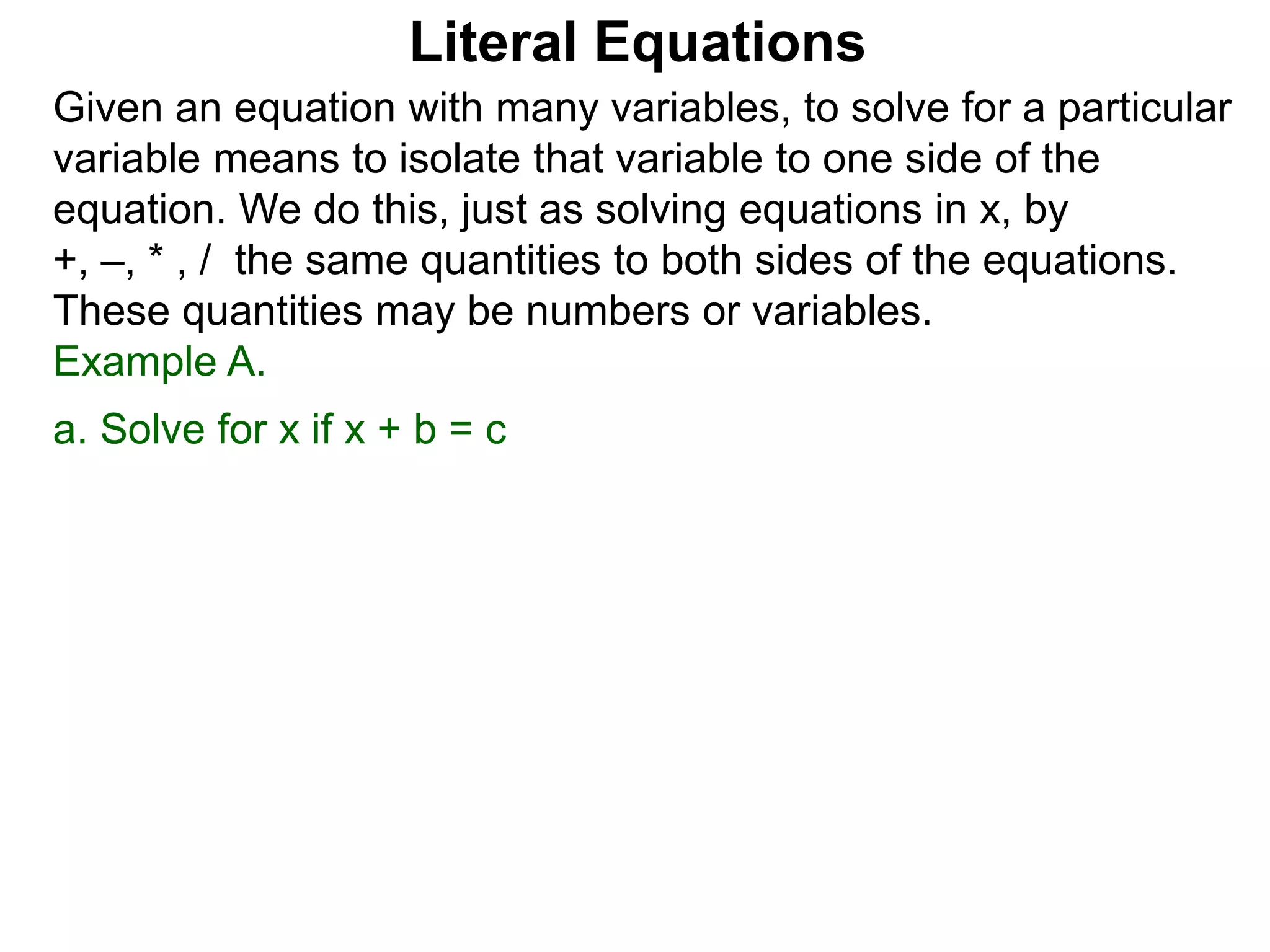
equation. We do this, just as solving equations in x,
Literal Equations
Given an equation with many variables, to solve for a particular
variable means to isolate that variable to one side of the
equation. We do this, just as solving equations in x, by
+, –, * , / the same quantities to both sides of the equations.
Literal Equations
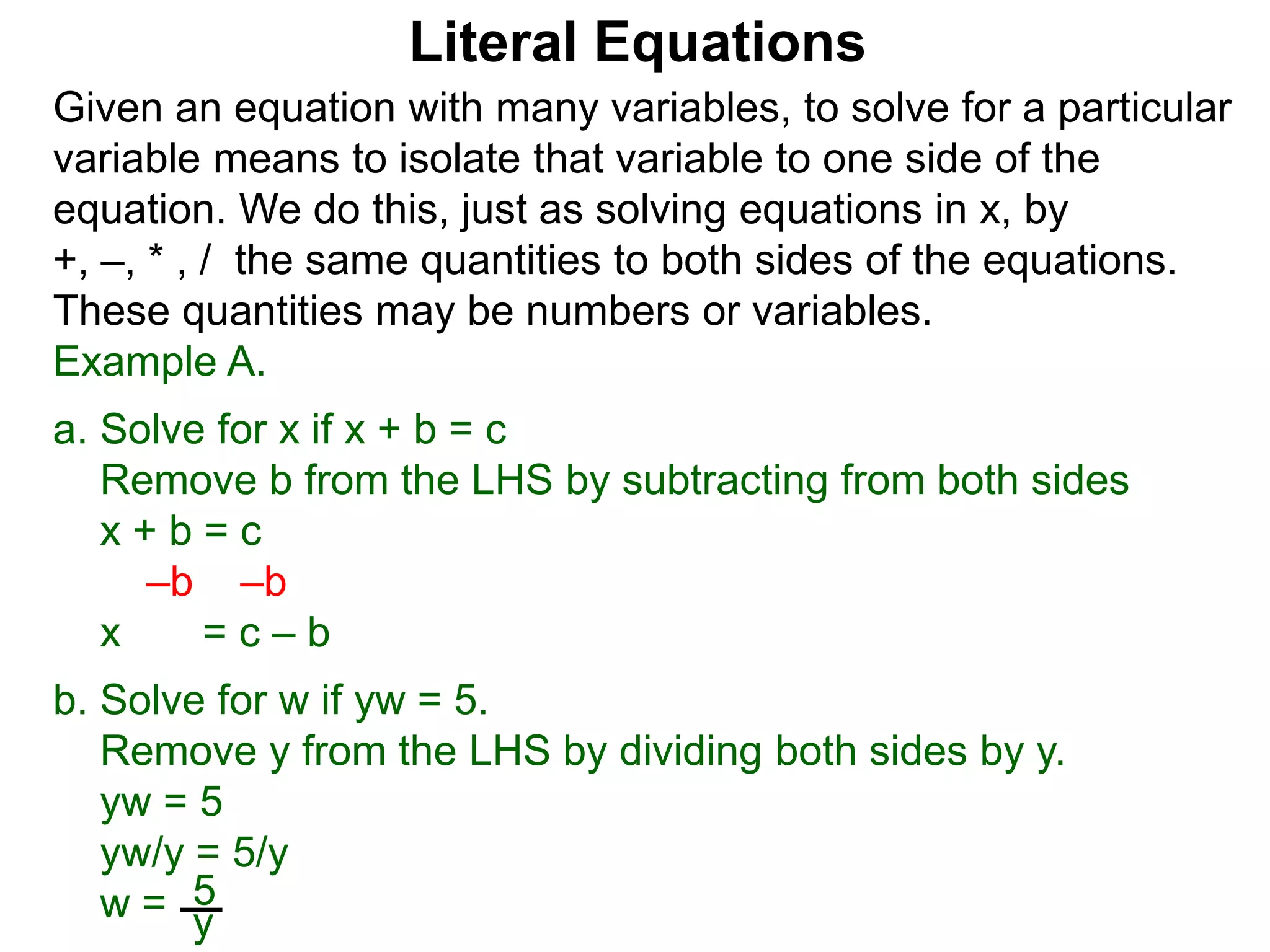
Given an equation with many variables, to solve for a particular
variable means to isolate that variable to one side of the
equation. We do this, just as solving equations in x, by
+, –, * , / the same quantities to both sides of the equations.
These quantities may be numbers or variables.
Literal Equations
Given an equation with many variables, to solve for a particular
variable means to isolate that variable to one side of the
equation. We do this, just as solving equations in x, by
+, –, * , / the same quantities to both sides of the equations.
These quantities may be numbers or variables.
Example A.
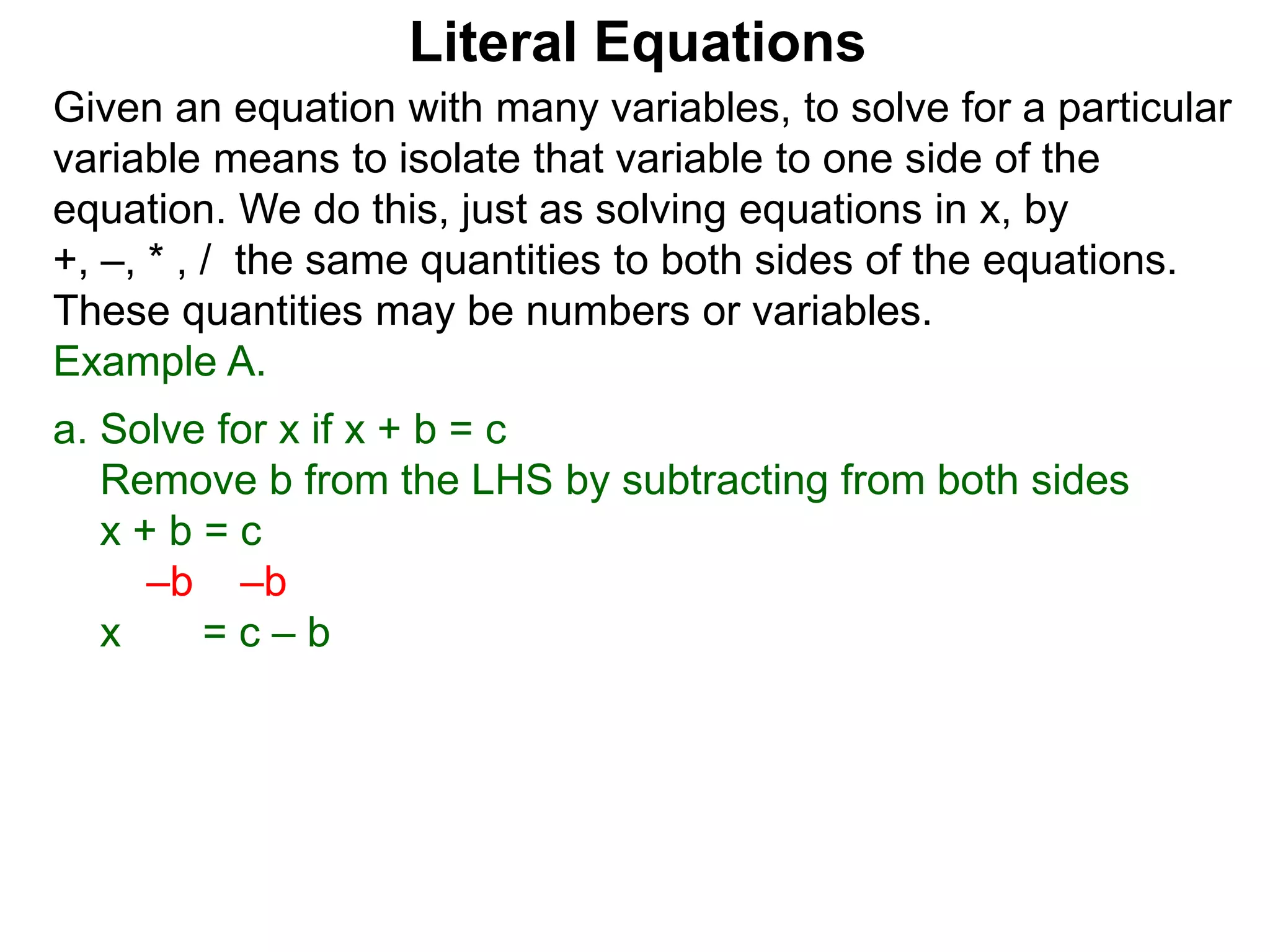
a. Solve for x if x + b = c
Literal Equations
Given an equation with many variables, to solve for a particular
variable means to isolate that variable to one side of the
equation. We do this, just as solving equations in x, by
+, –, * , / the same quantities to both sides of the equations.
These quantities may be numbers or variables.
Example A.
a. Solve for x if x + b = c
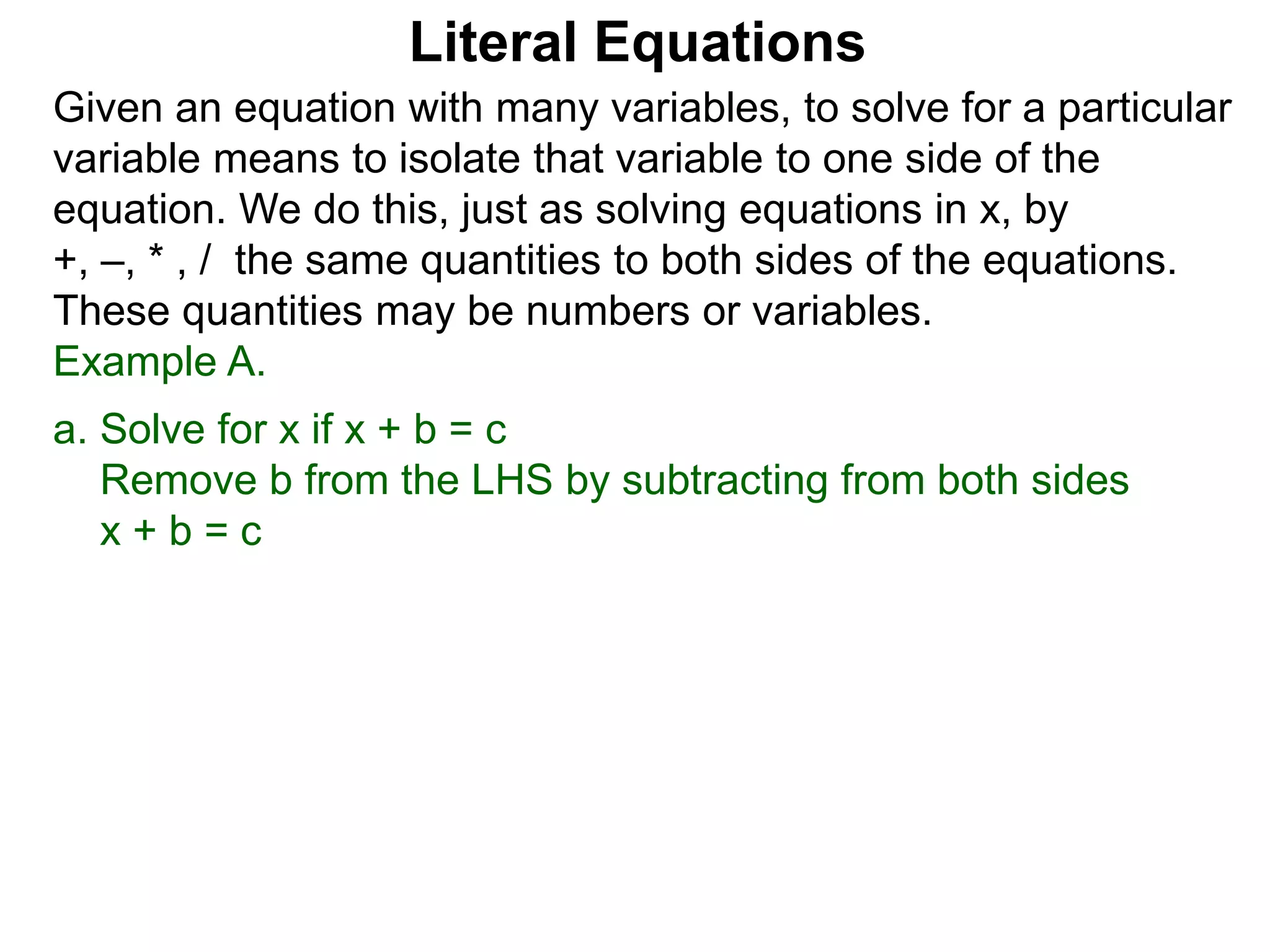
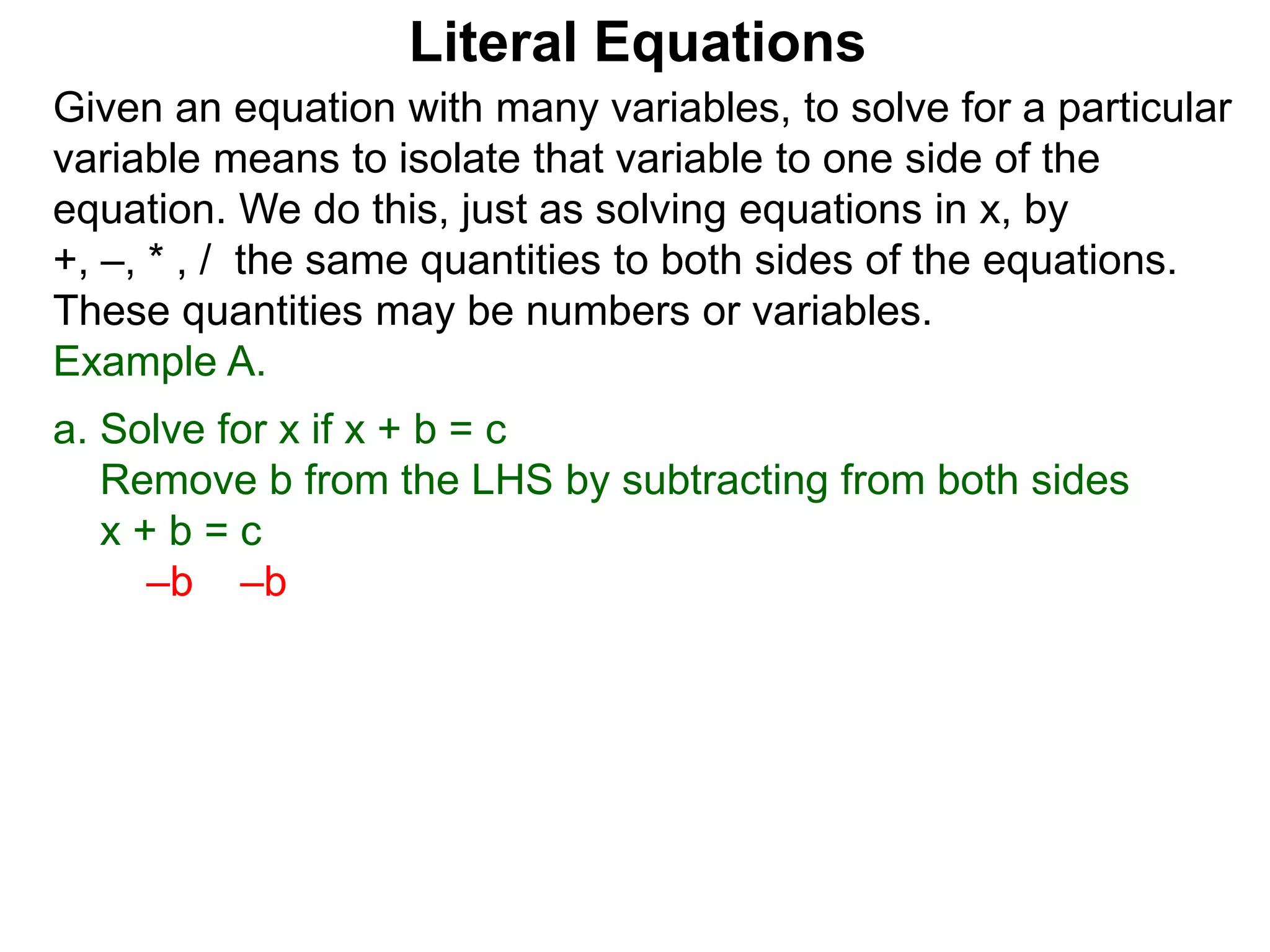
Remove b from the LHS by subtracting from both sides
x + b = c
Literal Equations
Given an equation with many variables, to solve for a particular
variable means to isolate that variable to one side of the
equation. We do this, just as solving equations in x, by
+, –, * , / the same quantities to both sides of the equations.
These quantities may be numbers or variables.
Example A.
a. Solve for x if x + b = c
Remove b from the LHS by subtracting from both sides
x + b = c
–b –b
Literal Equations
Given an equation with many variables, to solve for a particular
variable means to isolate that variable to one side of the
equation. We do this, just as solving equations in x, by
+, –, * , / the same quantities to both sides of the equations.
These quantities may be numbers or variables.
Example A.
a. Solve for x if x + b = c
Remove b from the LHS by subtracting from both sides
x + b = c
–b –b
x = c – b
Literal Equations
Given an equation with many variables, to solve for a particular
variable means to isolate that variable to one side of the
equation. We do this, just as solving equations in x, by
+, –, * , / the same quantities to both sides of the equations.
These quantities may be numbers or variables.
Example A.
a. Solve for x if x + b = c
Remove b from the LHS by subtracting from both sides
x + b = c
–b –b
x = c – b
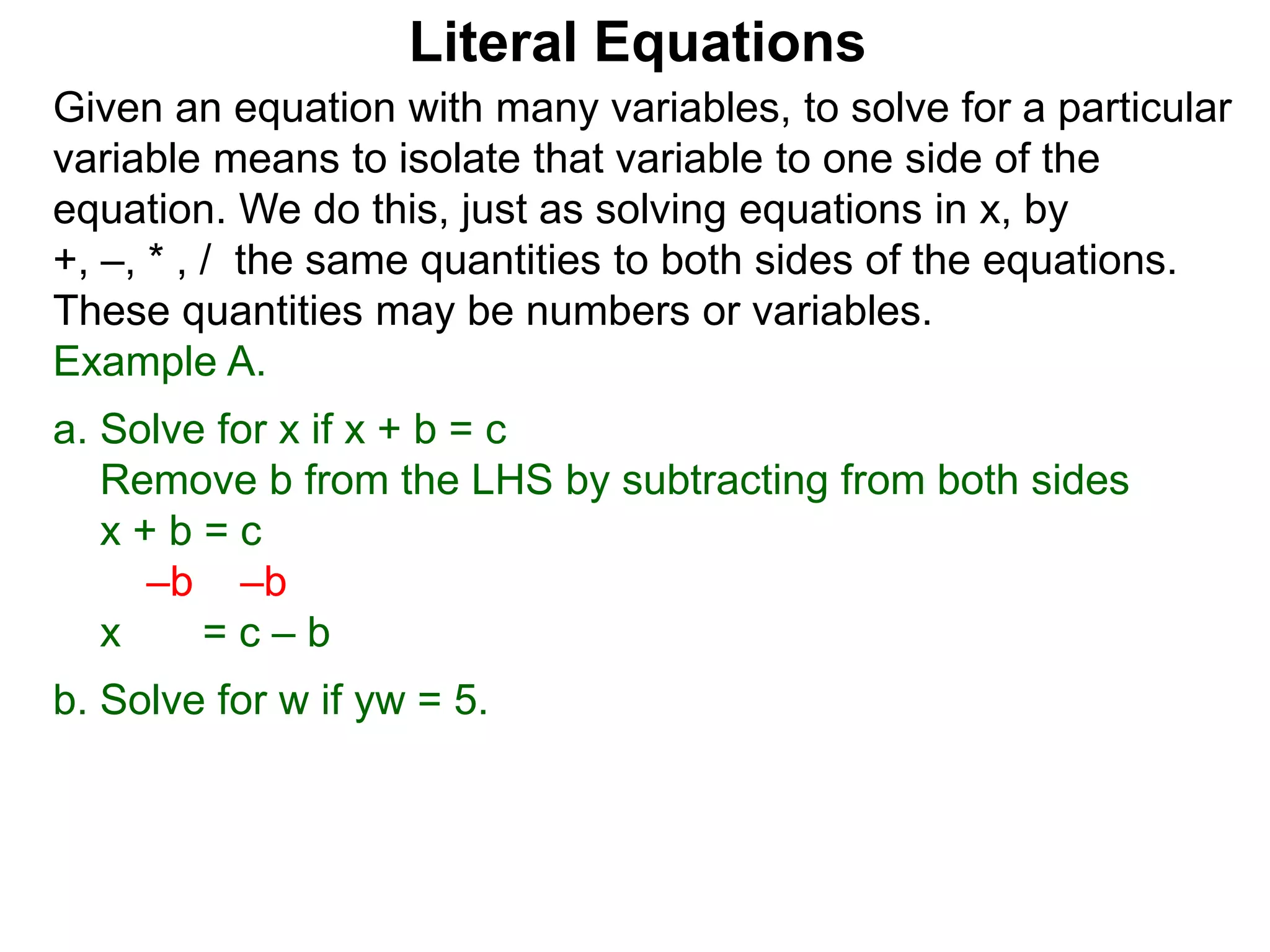
b. Solve for w if yw = 5.
Literal Equations
Given an equation with many variables, to solve for a particular
variable means to isolate that variable to one side of the
equation. We do this, just as solving equations in x, by
+, –, * , / the same quantities to both sides of the equations.
These quantities may be numbers or variables.
Example A.
a. Solve for x if x + b = c
Remove b from the LHS by subtracting from both sides
x + b = c
–b –b
x = c – b
b. Solve for w if yw = 5.
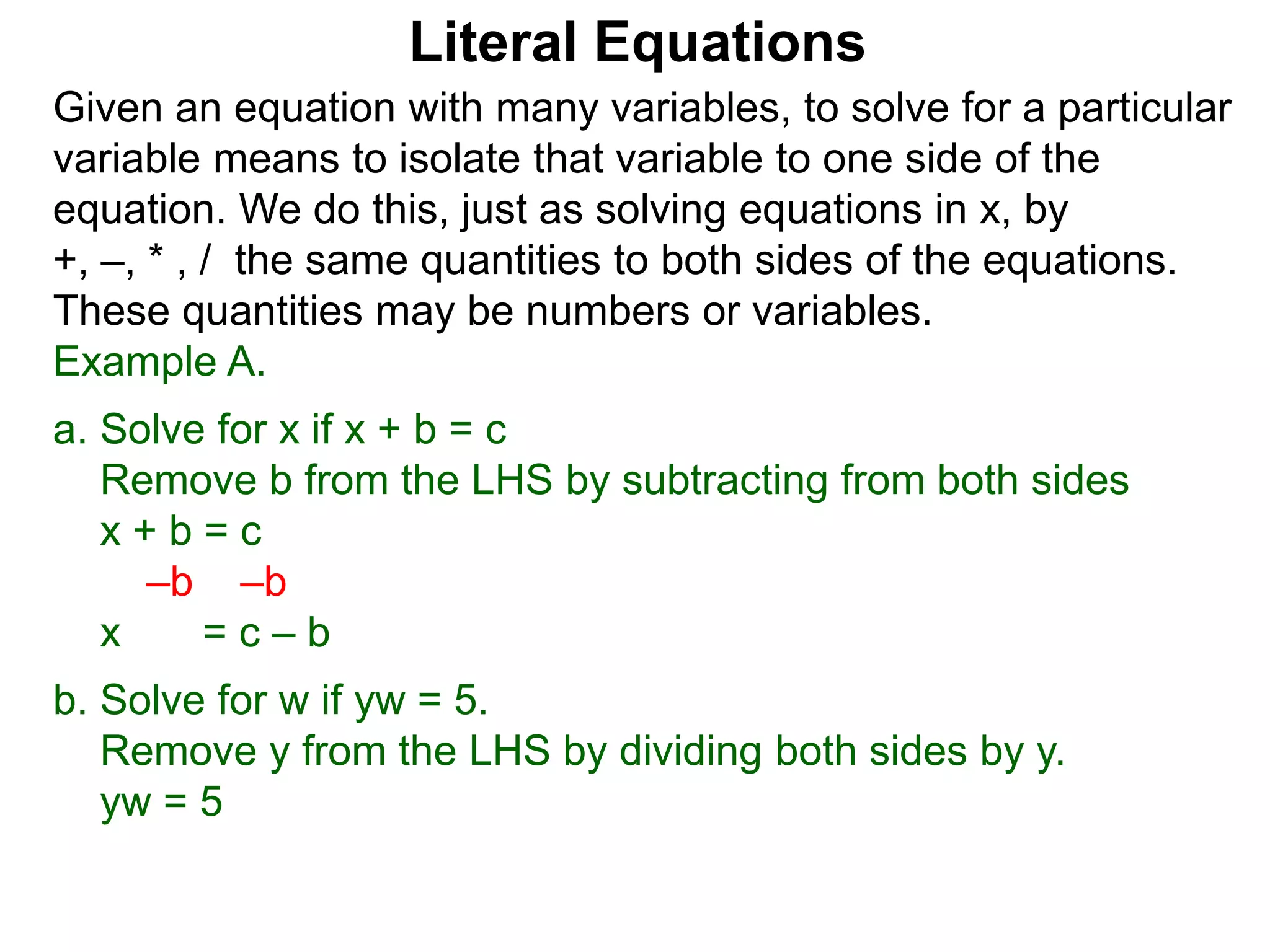
Remove y from the LHS by dividing both sides by y.
yw = 5
Literal Equations
Given an equation with many variables, to solve for a particular
variable means to isolate that variable to one side of the
equation. We do this, just as solving equations in x, by
+, –, * , / the same quantities to both sides of the equations.
These quantities may be numbers or variables.
Example A.
a. Solve for x if x + b = c
Remove b from the LHS by subtracting from both sides
x + b = c
–b –b
x = c – b
b. Solve for w if yw = 5.
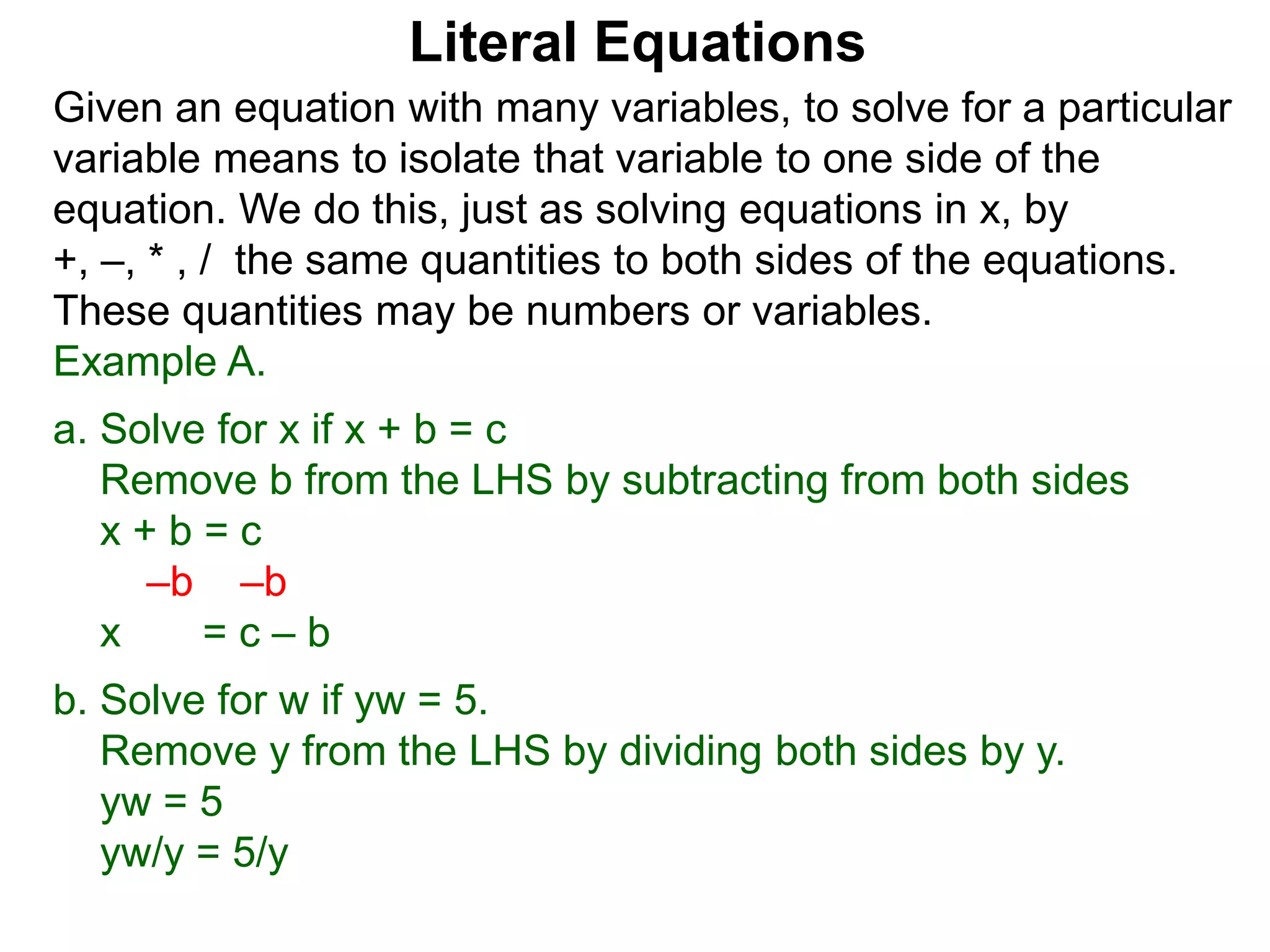
Remove y from the LHS by dividing both sides by y.
yw = 5
yw/y = 5/y
Literal Equations
Given an equation with many variables, to solve for a particular
variable means to isolate that variable to one side of the
equation. We do this, just as solving equations in x, by
+, –, * , / the same quantities to both sides of the equations.
These quantities may be numbers or variables.
Example A.
a. Solve for x if x + b = c
Remove b from the LHS by subtracting from both sides
x + b = c
–b –b
x = c – b
b. Solve for w if yw = 5.
Remove y from the LHS by dividing both sides by y.
yw = 5
yw/y = 5/y
w = 5
y
Literal Equations
Literal Equations
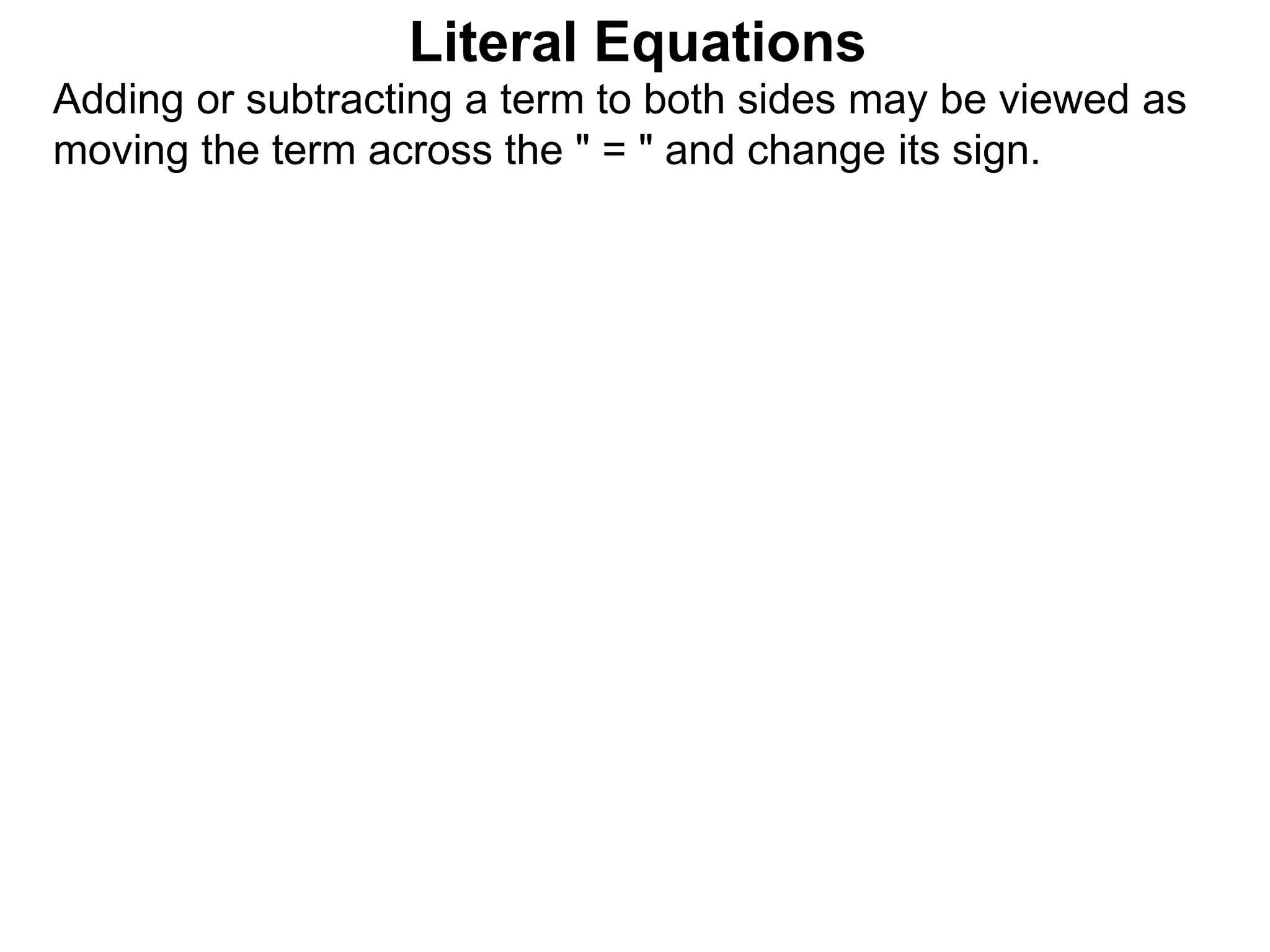
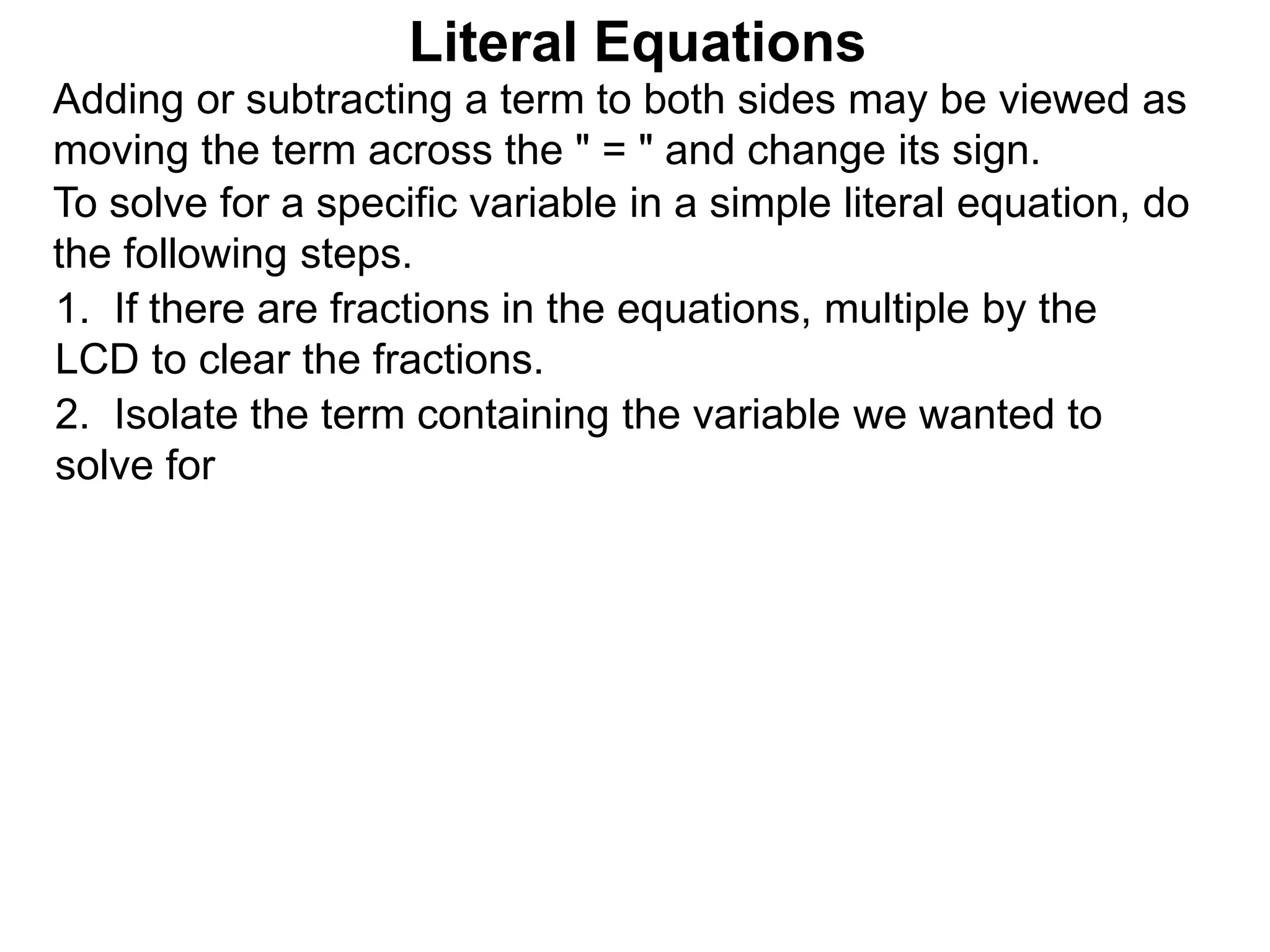
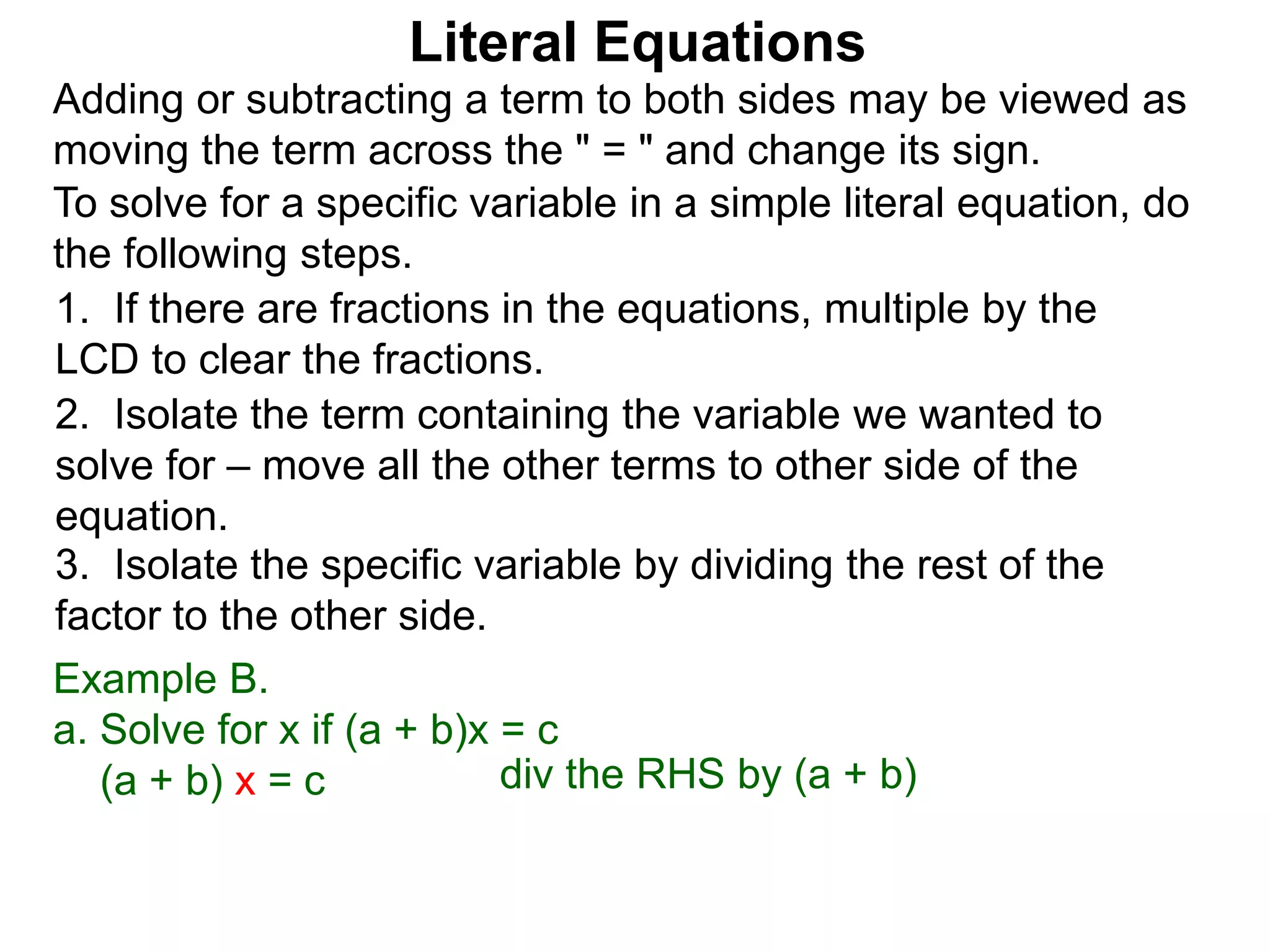
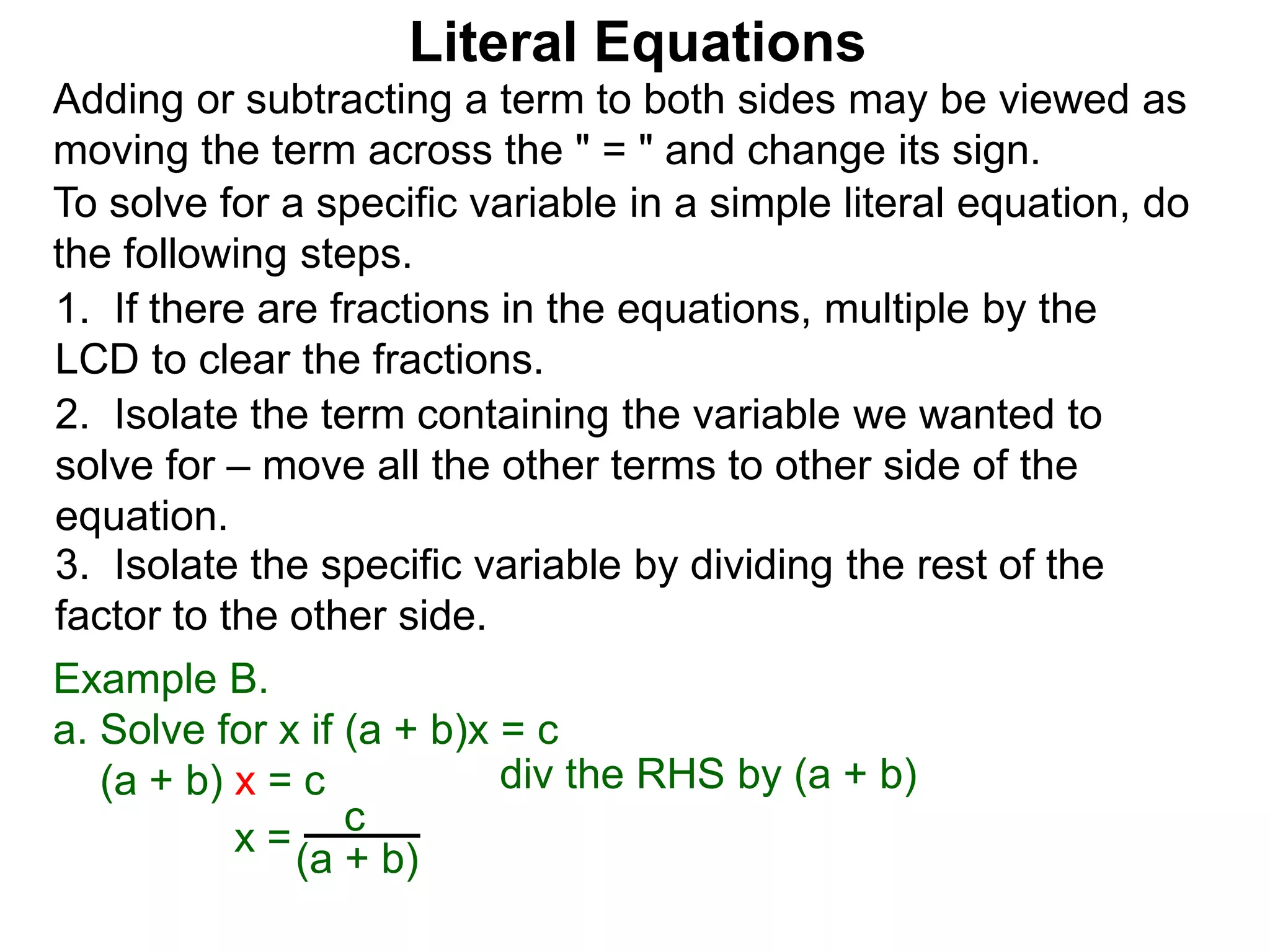
Adding or subtracting a term to both sides may be viewed as
moving the term across the " = " and change its sign.
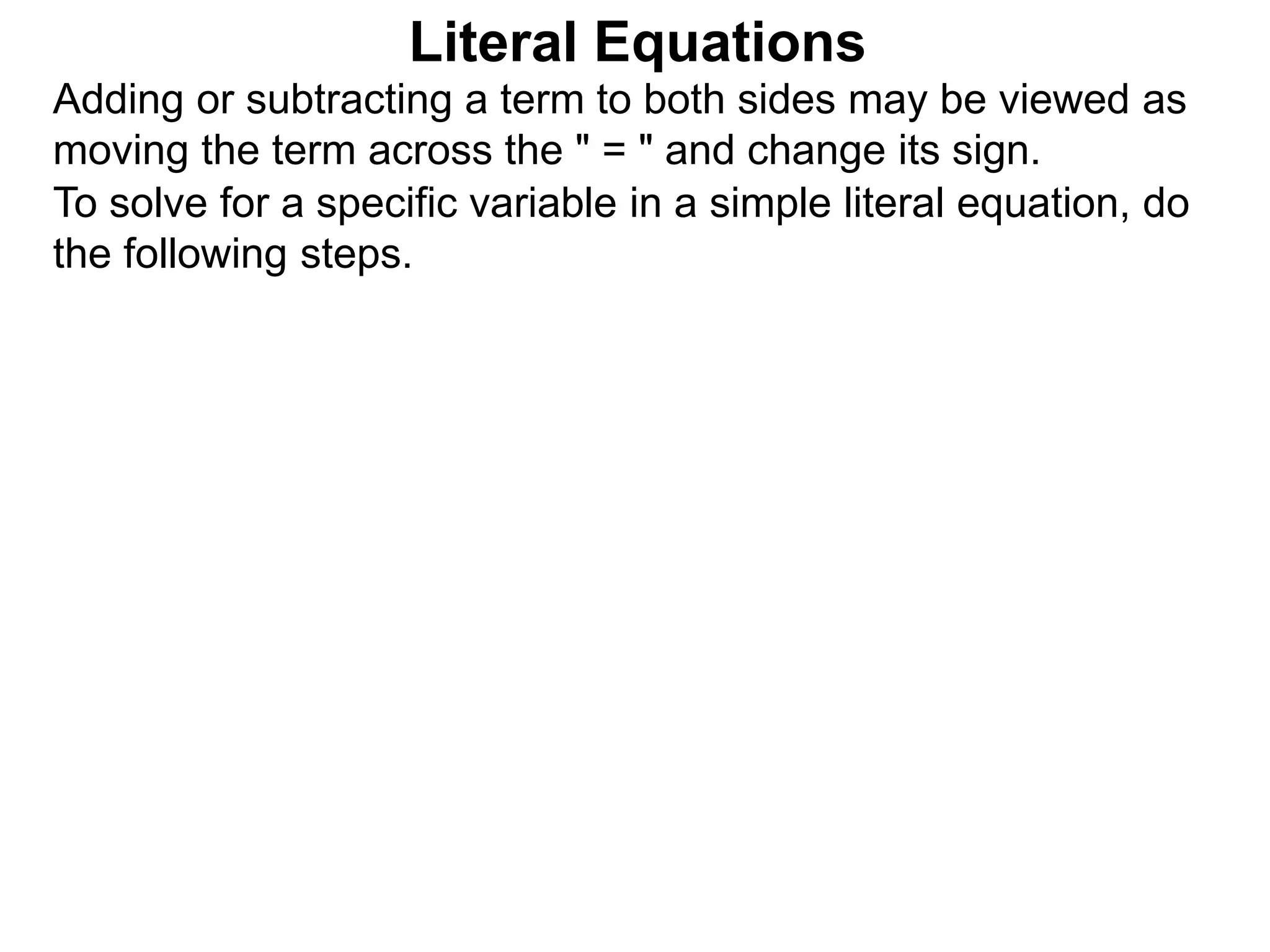
To solve for a specific variable in a simple literal equation, do
the following steps.
Literal Equations
Adding or subtracting a term to both sides may be viewed as
moving the term across the " = " and change its sign.
To solve for a specific variable in a simple literal equation, do
the following steps.
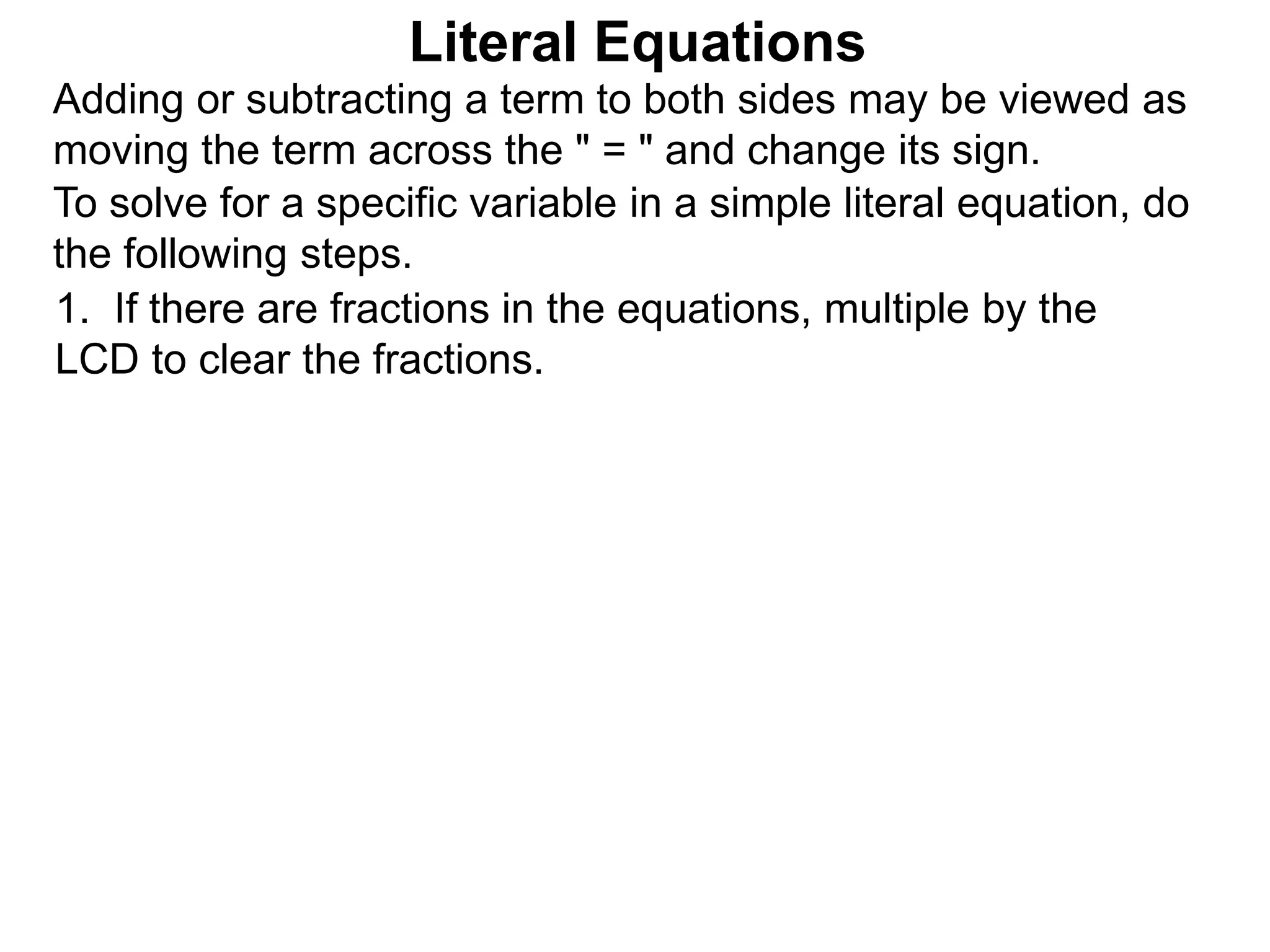
1. If there are fractions in the equations, multiple by the
LCD to clear the fractions.
Literal Equations
Adding or subtracting a term to both sides may be viewed as
moving the term across the " = " and change its sign.
To solve for a specific variable in a simple literal equation, do
the following steps.
1. If there are fractions in the equations, multiple by the
LCD to clear the fractions.
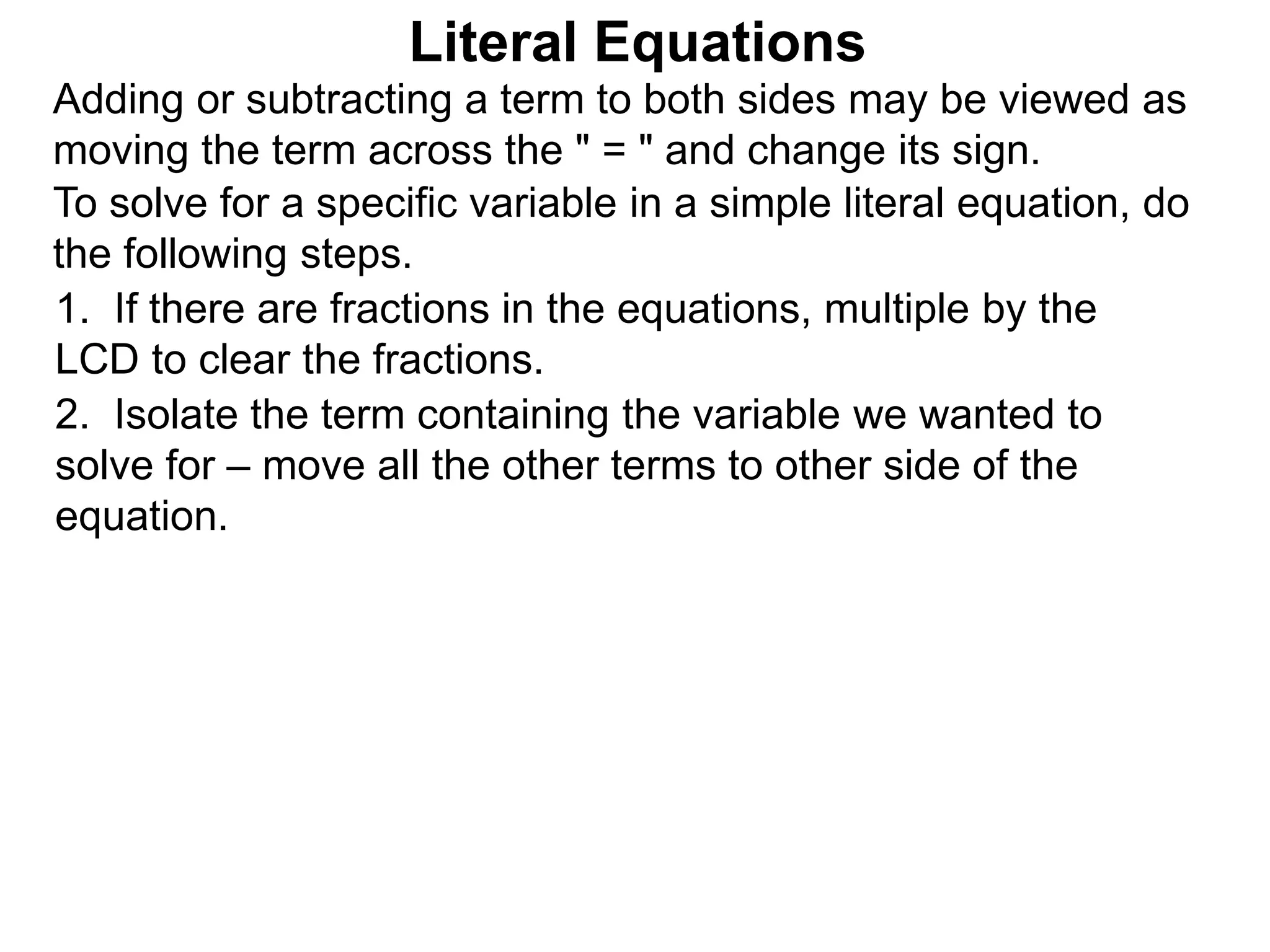
2. Isolate the term containing the variable we wanted to
solve for
Literal Equations
Adding or subtracting a term to both sides may be viewed as
moving the term across the " = " and change its sign.
To solve for a specific variable in a simple literal equation, do
the following steps.
1. If there are fractions in the equations, multiple by the
LCD to clear the fractions.
2. Isolate the term containing the variable we wanted to
solve for – move all the other terms to other side of the
equation.
Literal Equations
Adding or subtracting a term to both sides may be viewed as
moving the term across the " = " and change its sign.
To solve for a specific variable in a simple literal equation, do
the following steps.
1. If there are fractions in the equations, multiple by the
LCD to clear the fractions.
2. Isolate the term containing the variable we wanted to
solve for – move all the other terms to other side of the
equation.
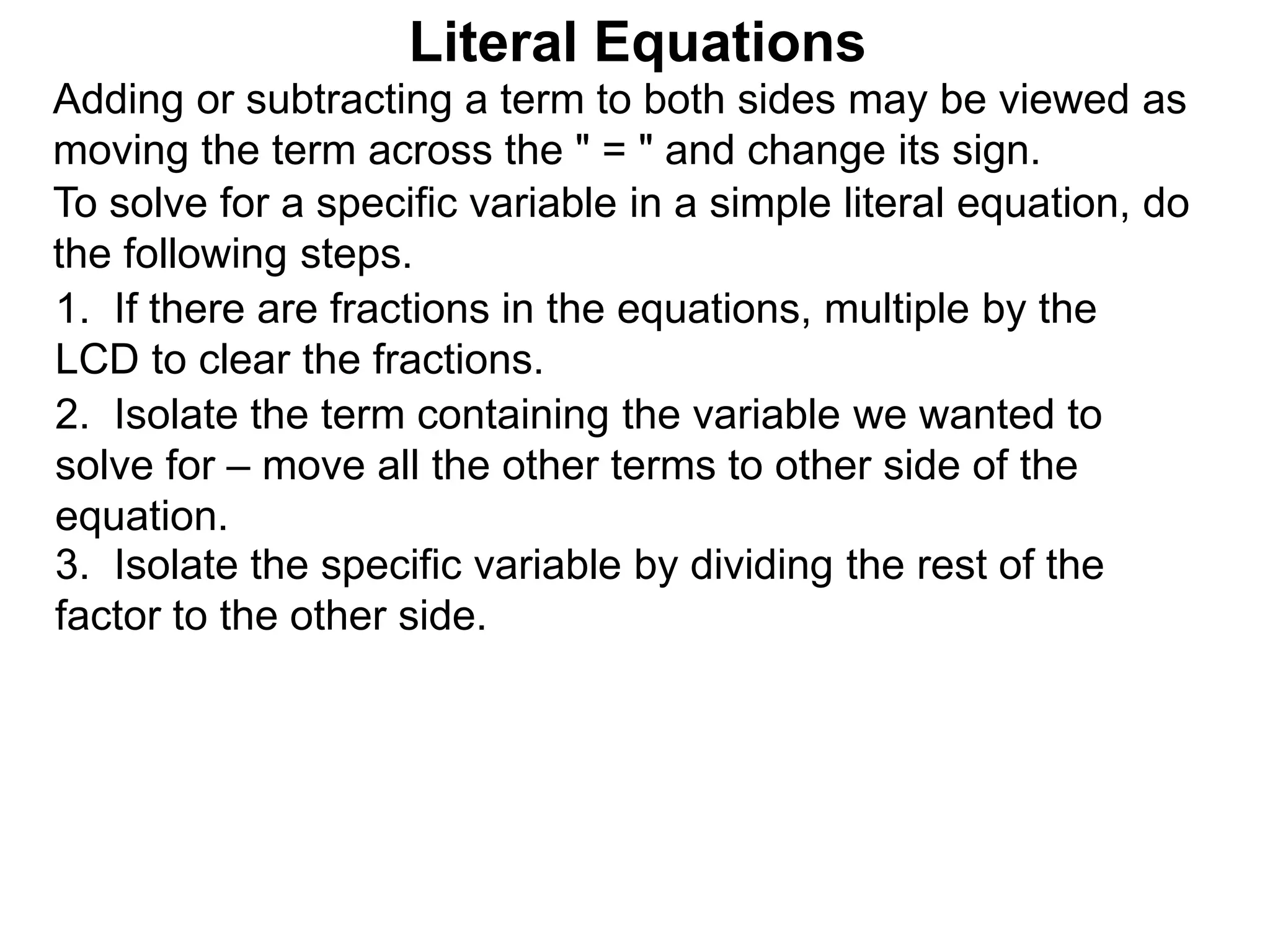
3. Isolate the specific variable by dividing the rest of the
factor to the other side.
Literal Equations
Adding or subtracting a term to both sides may be viewed as
moving the term across the " = " and change its sign.
To solve for a specific variable in a simple literal equation, do
the following steps.
1. If there are fractions in the equations, multiple by the
LCD to clear the fractions.
2. Isolate the term containing the variable we wanted to
solve for – move all the other terms to other side of the
equation.
3. Isolate the specific variable by dividing the rest of the
factor to the other side.
Literal Equations
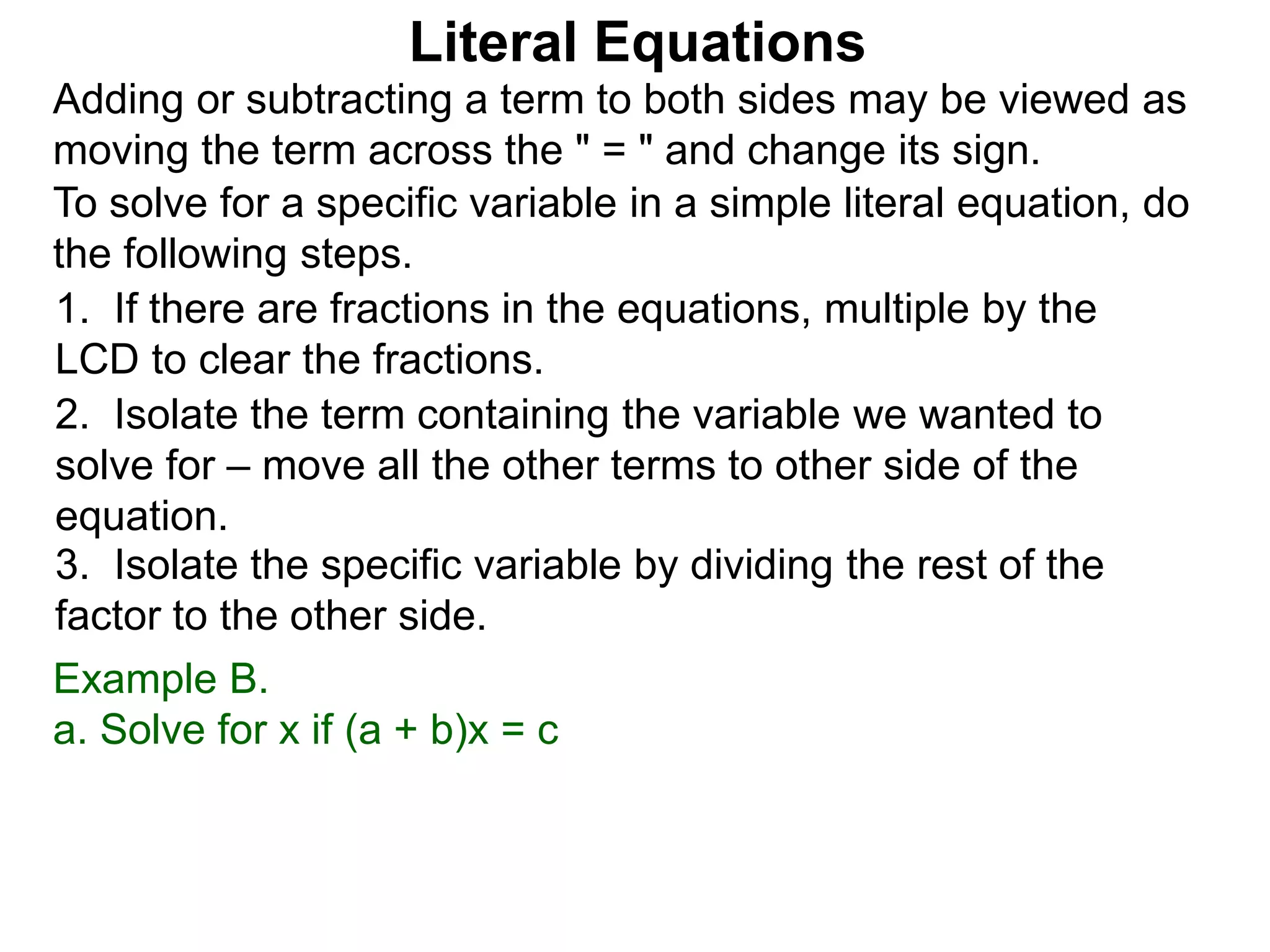
Example B.
a. Solve for x if (a + b)x = c
Adding or subtracting a term to both sides may be viewed as
moving the term across the " = " and change its sign.
To solve for a specific variable in a simple literal equation, do
the following steps.
1. If there are fractions in the equations, multiple by the
LCD to clear the fractions.
2. Isolate the term containing the variable we wanted to
solve for – move all the other terms to other side of the
equation.
3. Isolate the specific variable by dividing the rest of the
factor to the other side.
Literal Equations
Example B.
a. Solve for x if (a + b)x = c
(a + b) x = c div the RHS by (a + b)
Adding or subtracting a term to both sides may be viewed as
moving the term across the " = " and change its sign.
To solve for a specific variable in a simple literal equation, do
the following steps.
1. If there are fractions in the equations, multiple by the
LCD to clear the fractions.
2. Isolate the term containing the variable we wanted to
solve for – move all the other terms to other side of the
equation.
3. Isolate the specific variable by dividing the rest of the
factor to the other side.
Literal Equations
Example B.
a. Solve for x if (a + b)x = c
(a + b) x = c
x =
c
(a + b)
div the RHS by (a + b)
Adding or subtracting a term to both sides may be viewed as
moving the term across the " = " and change its sign.
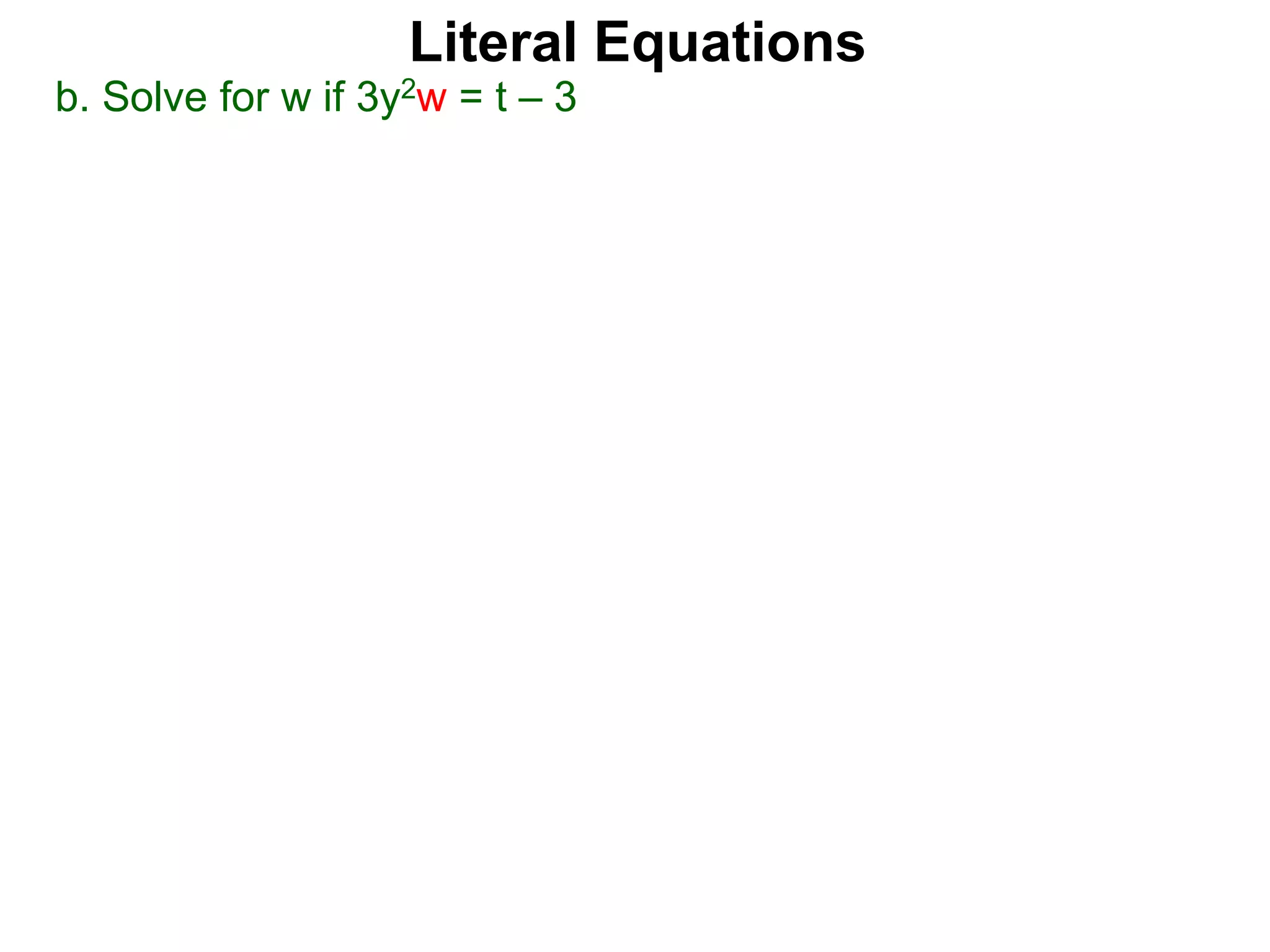
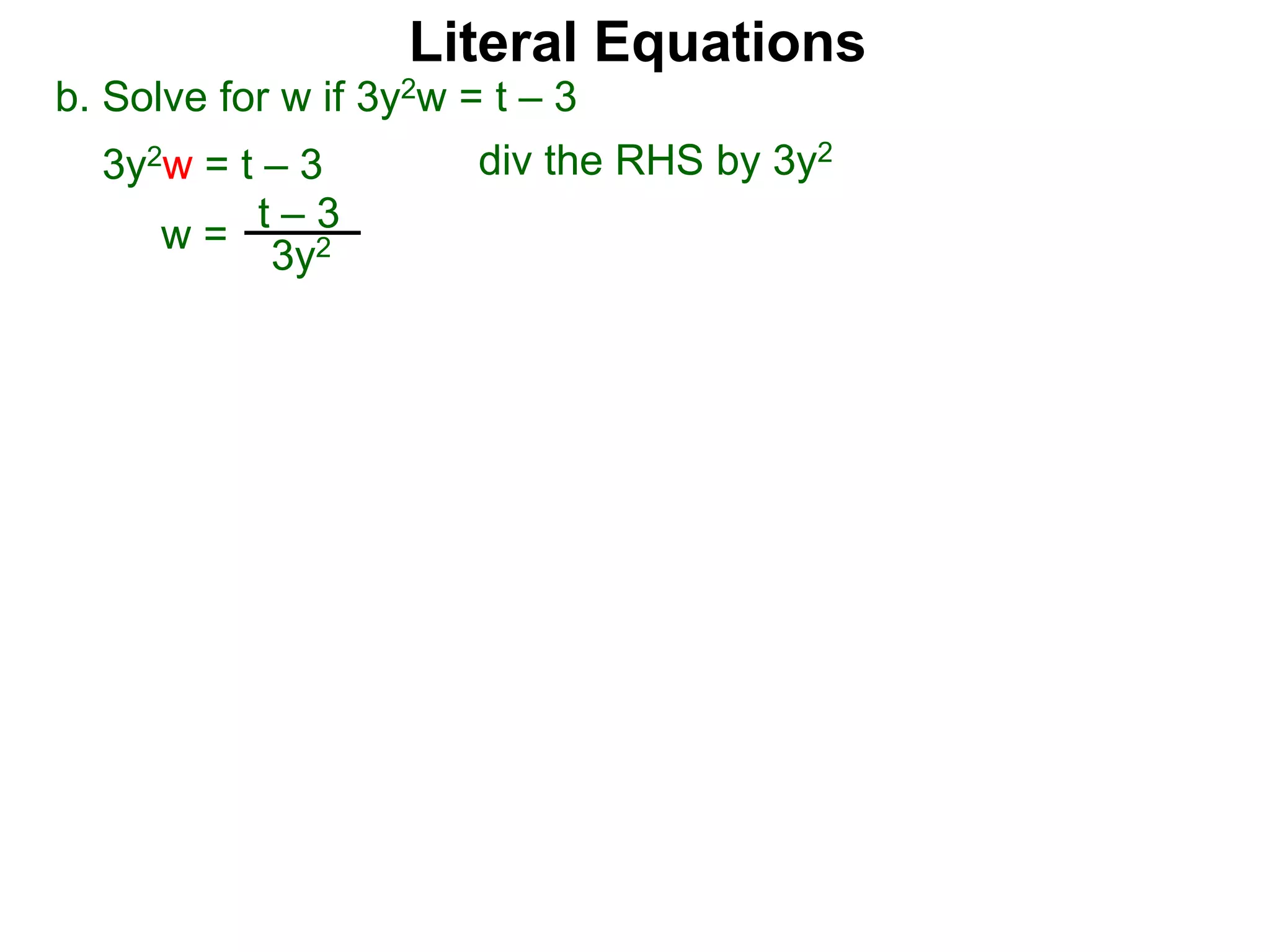
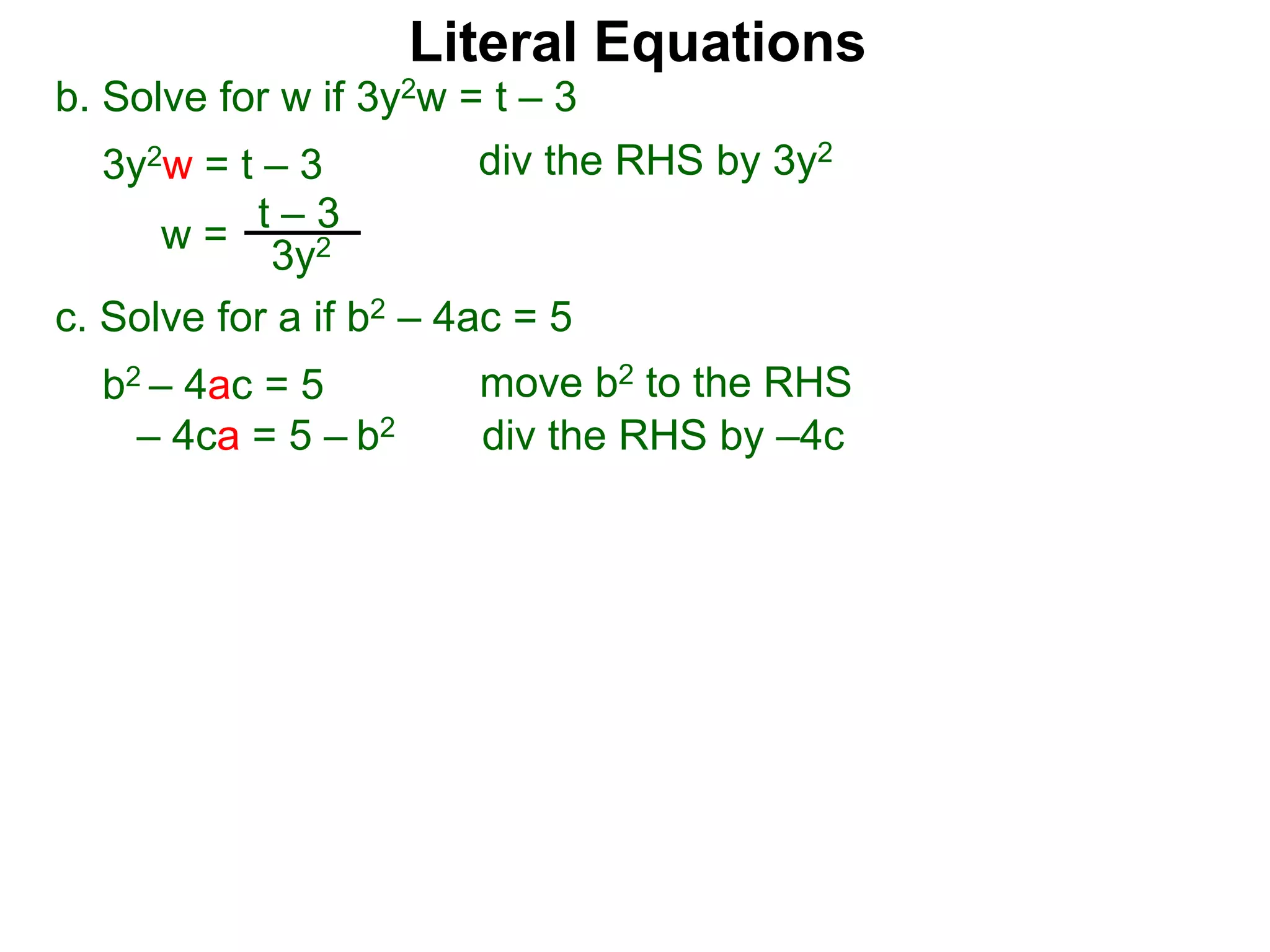
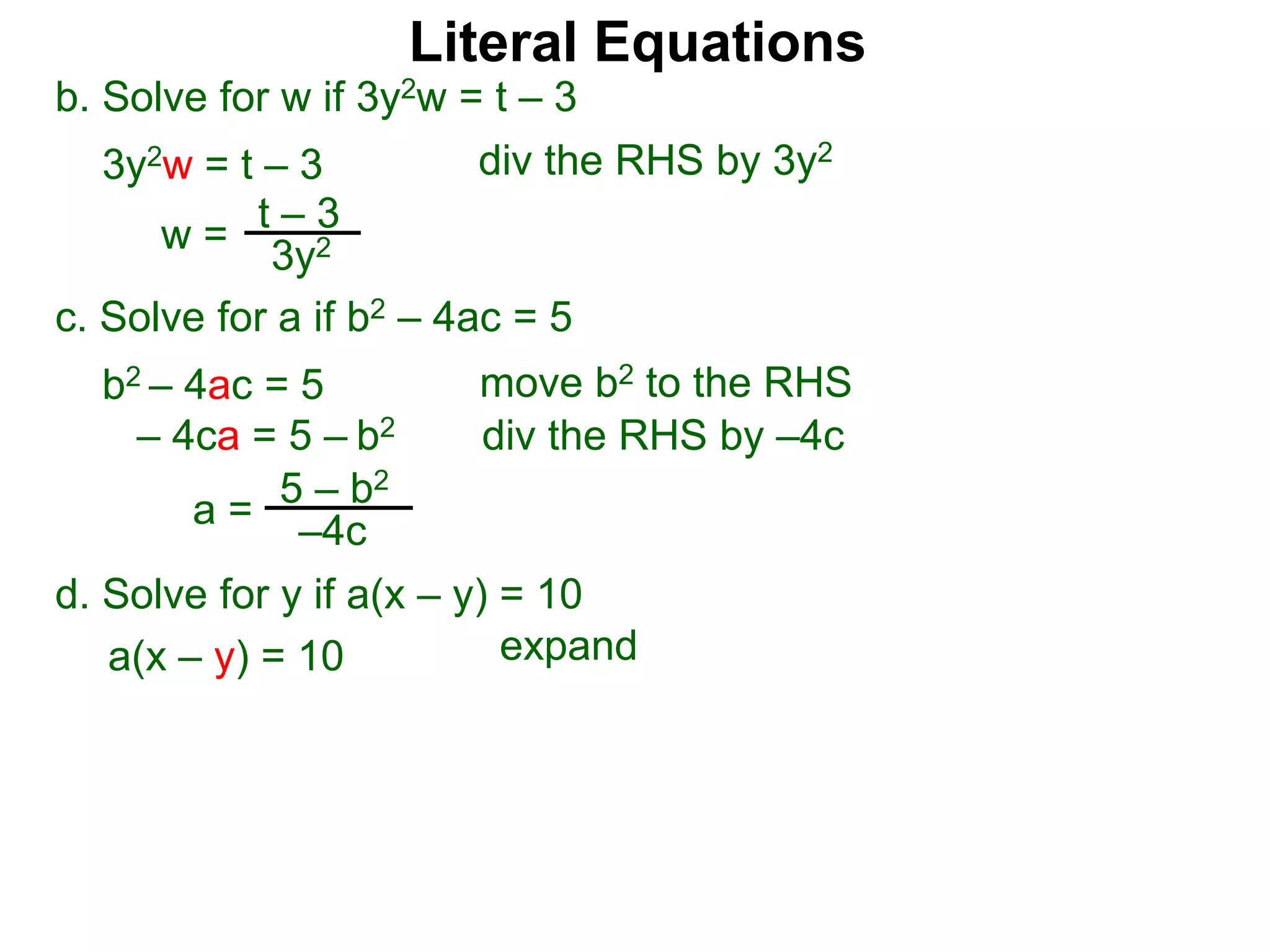
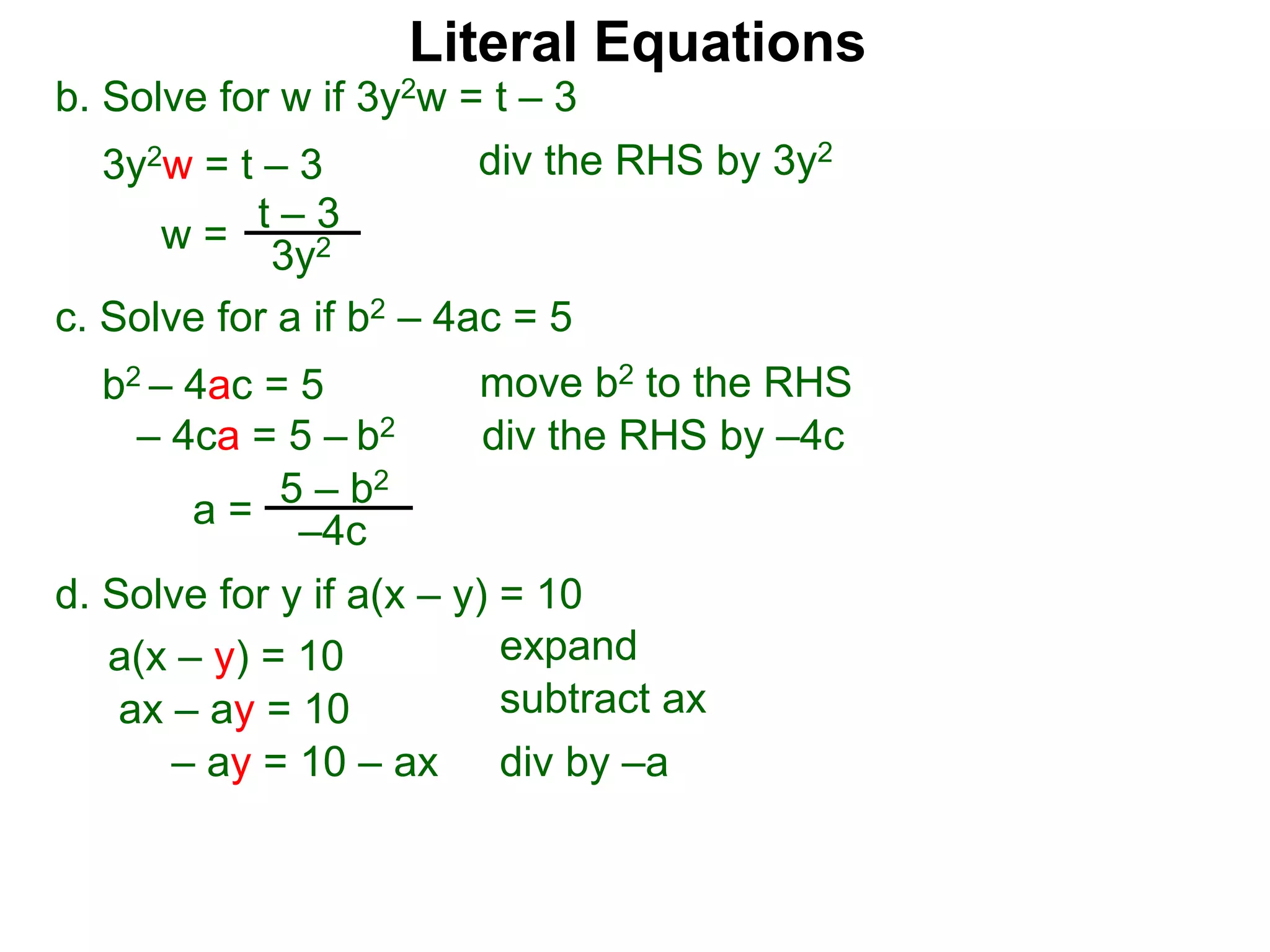
b. Solve for w if 3y2w = t – 3
Literal Equations
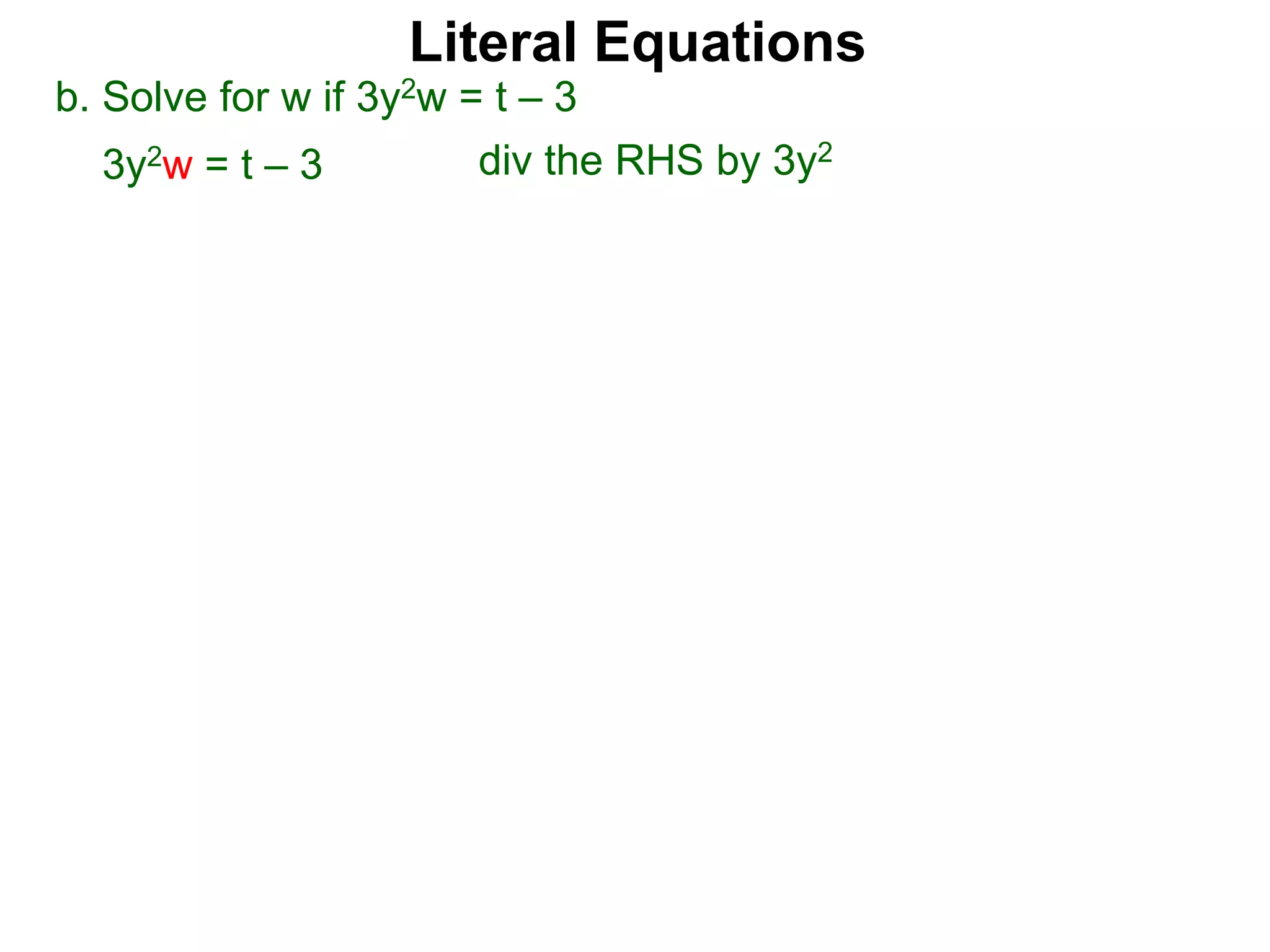
b. Solve for w if 3y2w = t – 3
3y2w = t – 3 div the RHS by 3y2
Literal Equations
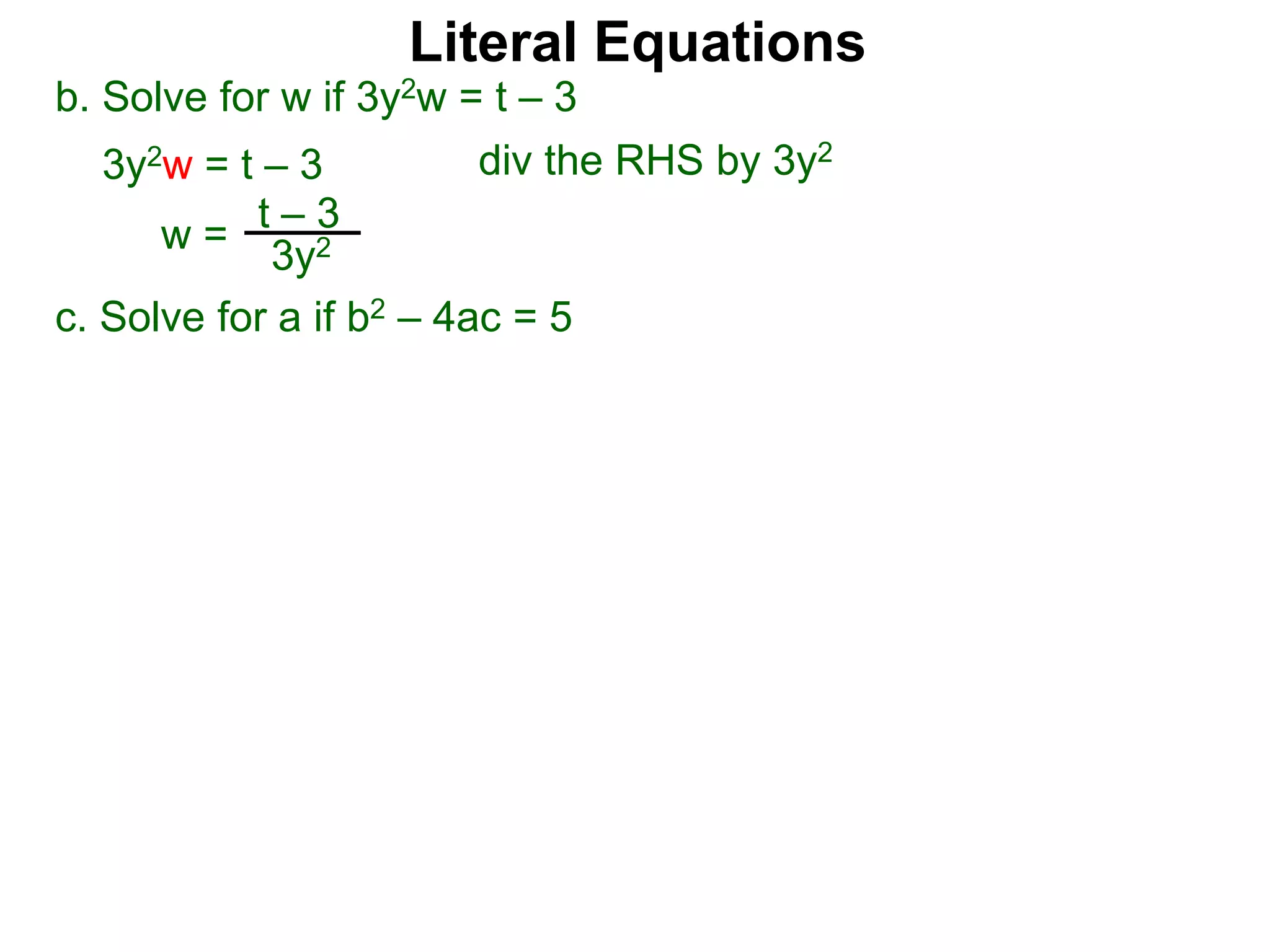
b. Solve for w if 3y2w = t – 3
3y2w = t – 3
w =
t – 3
3y2
div the RHS by 3y2
Literal Equations
b. Solve for w if 3y2w = t – 3
3y2w = t – 3
c. Solve for a if b2 – 4ac = 5
w =
t – 3
3y2
div the RHS by 3y2
Literal Equations
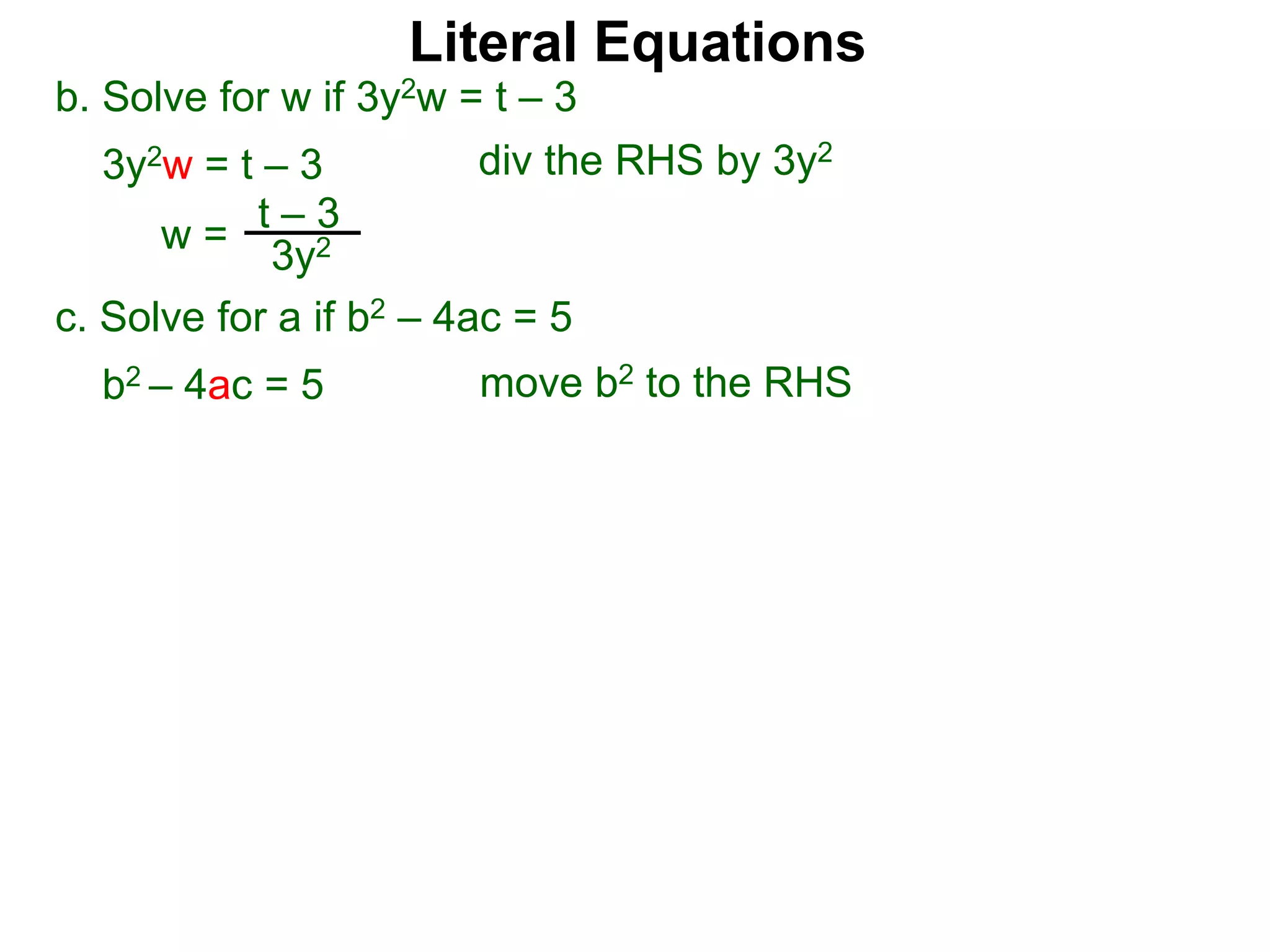
b. Solve for w if 3y2w = t – 3
3y2w = t – 3
c. Solve for a if b2 – 4ac = 5
b2 – 4ac = 5
w =
t – 3
3y2
div the RHS by 3y2
move b2 to the RHS
Literal Equations
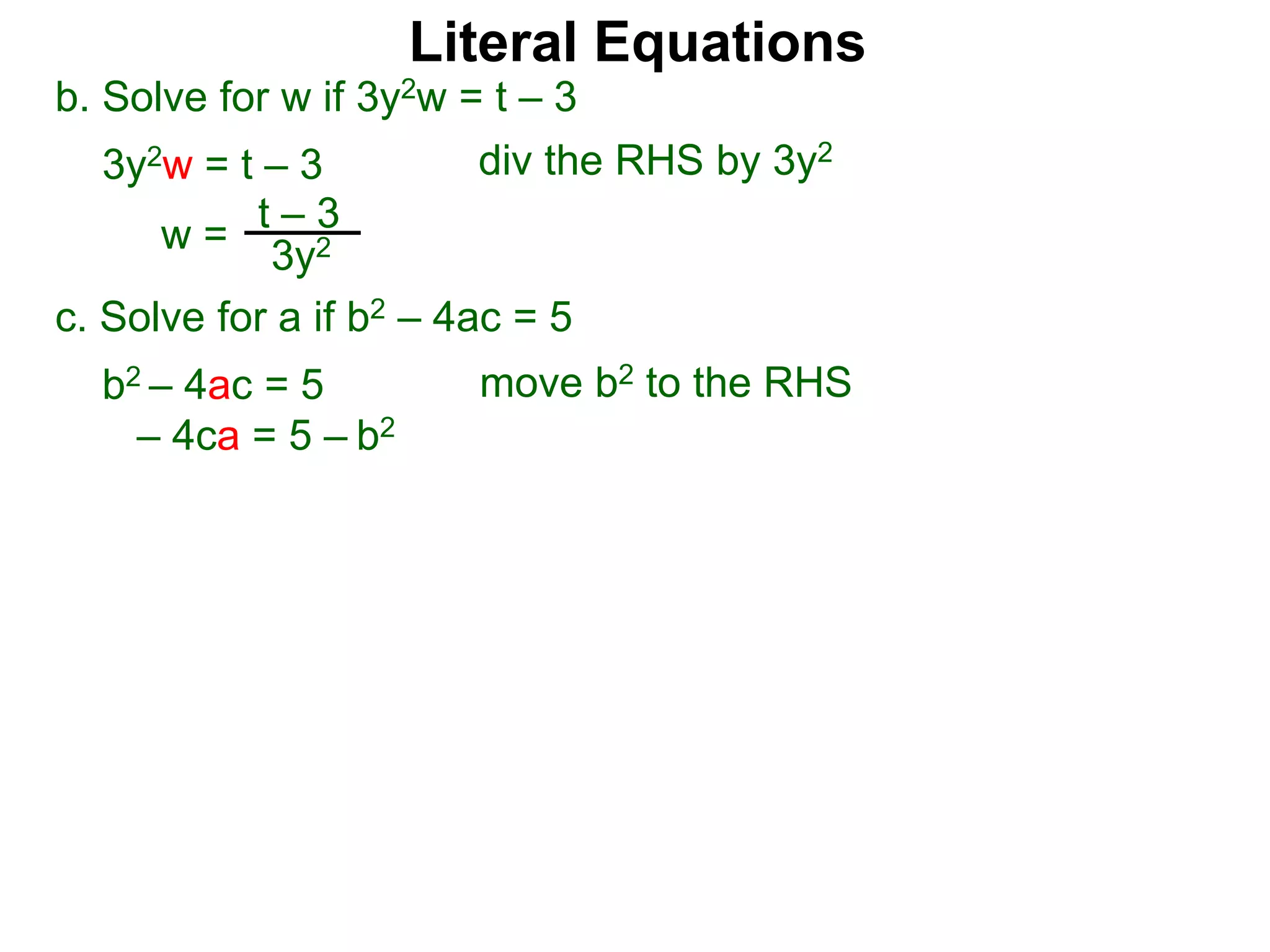
b. Solve for w if 3y2w = t – 3
3y2w = t – 3
c. Solve for a if b2 – 4ac = 5
b2 – 4ac = 5
– 4ca = 5 – b2
w =
t – 3
3y2
div the RHS by 3y2
move b2 to the RHS
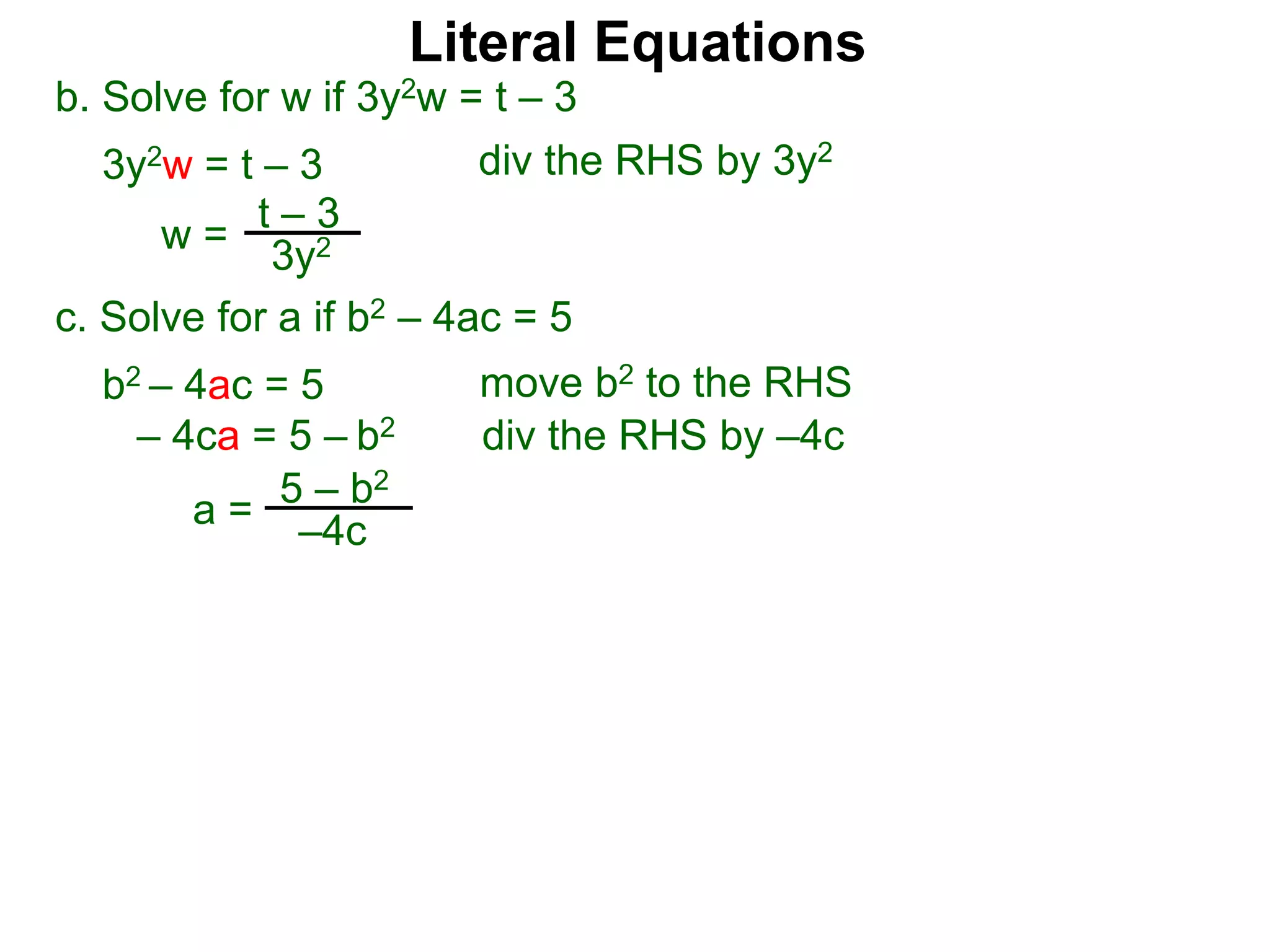
Literal Equations
b. Solve for w if 3y2w = t – 3
3y2w = t – 3
c. Solve for a if b2 – 4ac = 5
b2 – 4ac = 5
– 4ca = 5 – b2
w =
t – 3
3y2
div the RHS by 3y2
move b2 to the RHS
div the RHS by –4c
Literal Equations
b. Solve for w if 3y2w = t – 3
3y2w = t – 3
c. Solve for a if b2 – 4ac = 5
b2 – 4ac = 5
– 4ca = 5 – b2
w =
t – 3
3y2
a = 5 – b2
–4c
div the RHS by 3y2
move b2 to the RHS
div the RHS by –4c
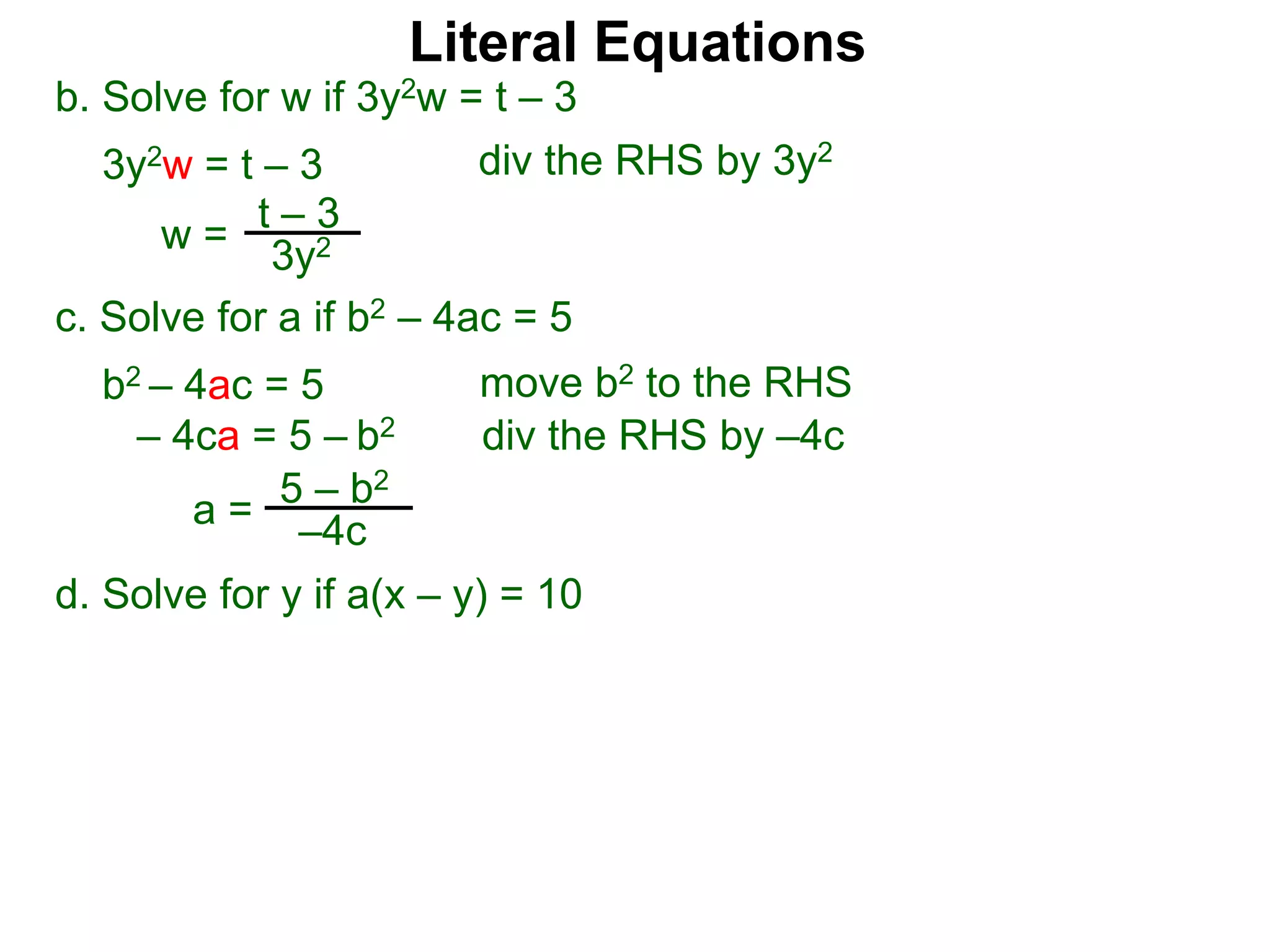
Literal Equations
b. Solve for w if 3y2w = t – 3
3y2w = t – 3
c. Solve for a if b2 – 4ac = 5
b2 – 4ac = 5
– 4ca = 5 – b2
w =
t – 3
3y2
a = 5 – b2
–4c
div the RHS by 3y2
move b2 to the RHS
div the RHS by –4c
Literal Equations
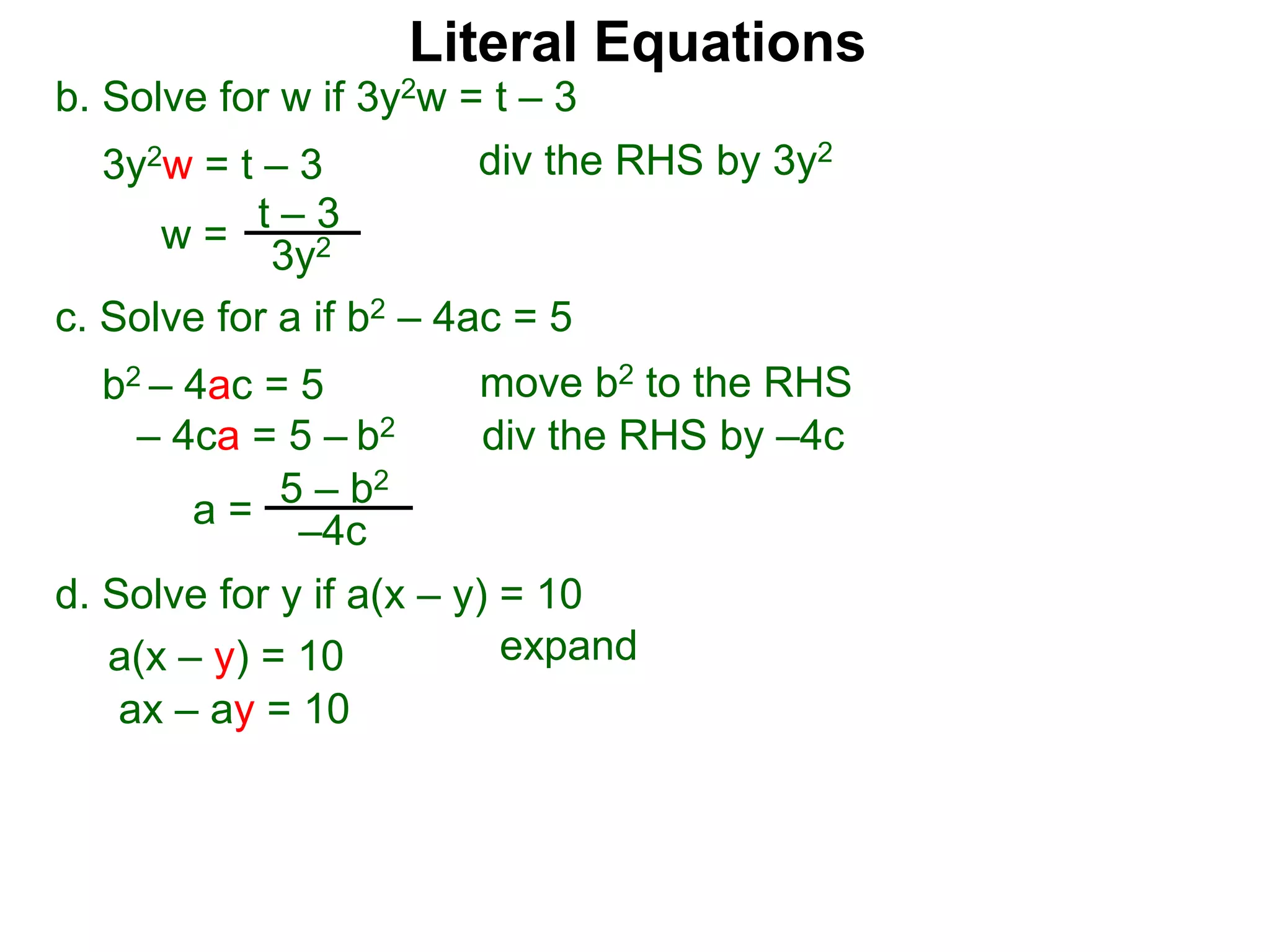
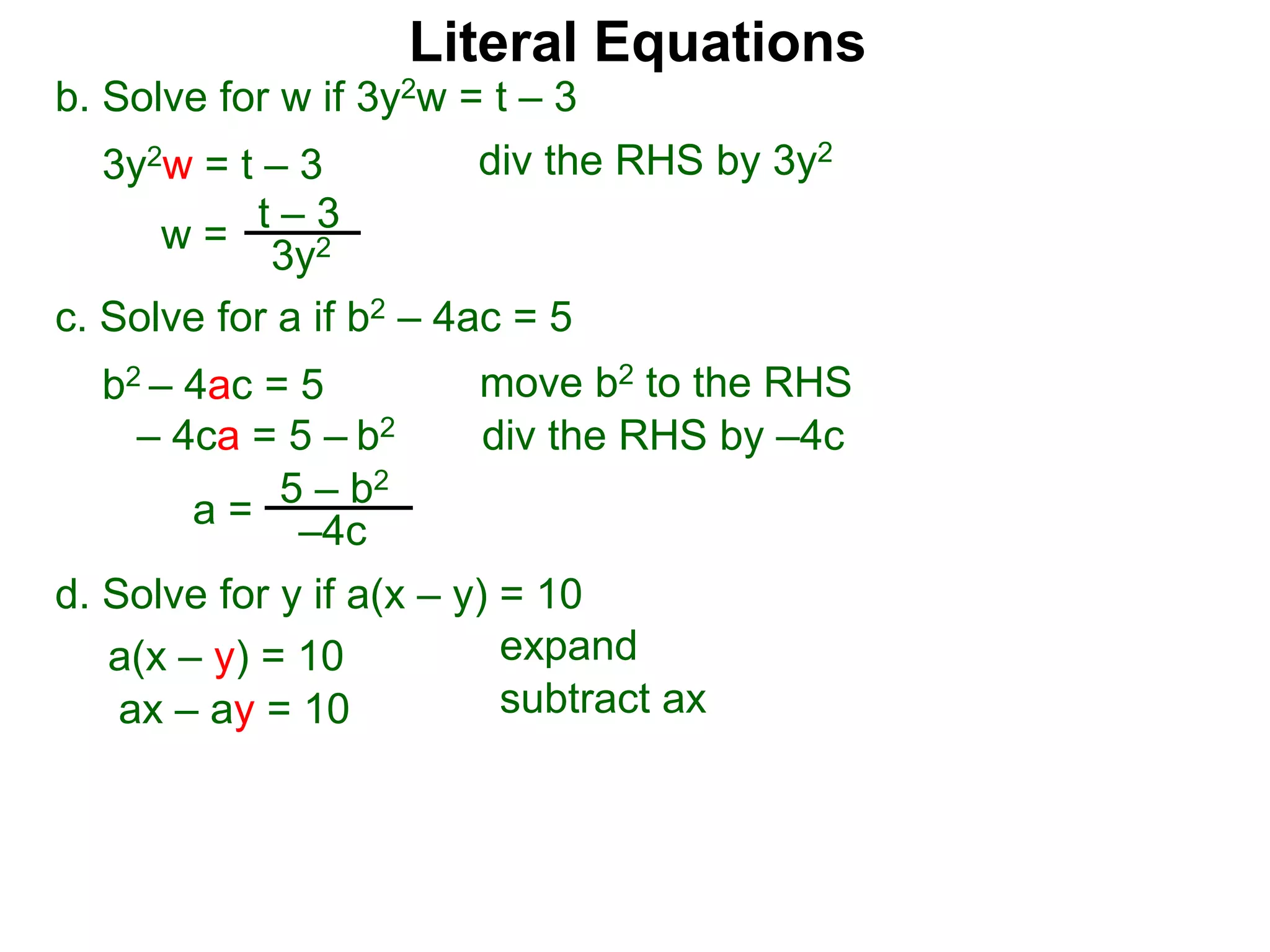
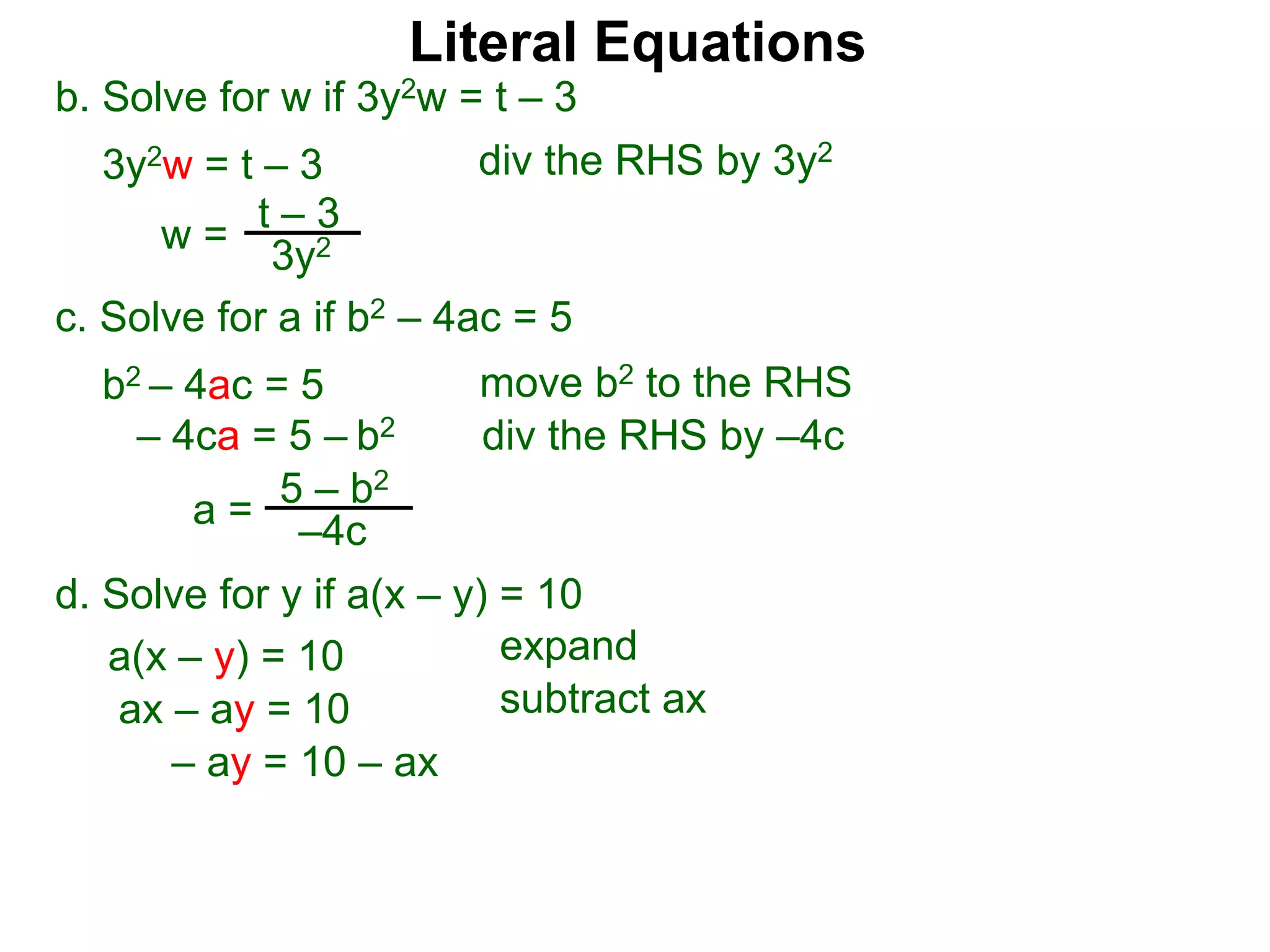
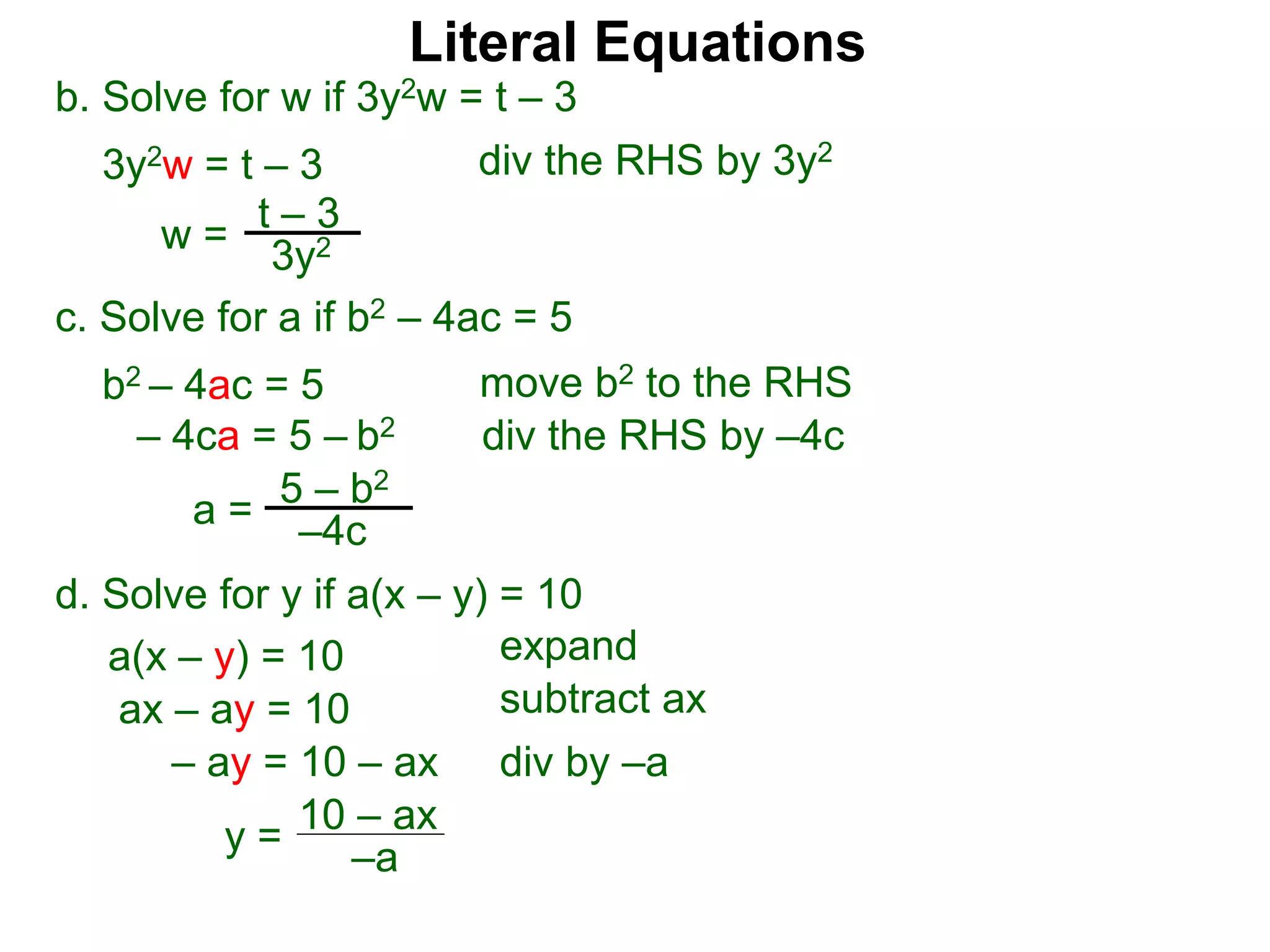
d. Solve for y if a(x – y) = 10
b. Solve for w if 3y2w = t – 3
3y2w = t – 3
c. Solve for a if b2 – 4ac = 5
b2 – 4ac = 5
– 4ca = 5 – b2
w =
t – 3
3y2
a = 5 – b2
–4c
div the RHS by 3y2
move b2 to the RHS
div the RHS by –4c
Literal Equations
d. Solve for y if a(x – y) = 10
a(x – y) = 10 expand
b. Solve for w if 3y2w = t – 3
3y2w = t – 3
c. Solve for a if b2 – 4ac = 5
b2 – 4ac = 5
– 4ca = 5 – b2
w =
t – 3
3y2
a = 5 – b2
–4c
div the RHS by 3y2
move b2 to the RHS
div the RHS by –4c
Literal Equations
d. Solve for y if a(x – y) = 10
a(x – y) = 10 expand
ax – ay = 10
b. Solve for w if 3y2w = t – 3
3y2w = t – 3
c. Solve for a if b2 – 4ac = 5
b2 – 4ac = 5
– 4ca = 5 – b2
w =
t – 3
3y2
a = 5 – b2
–4c
div the RHS by 3y2
move b2 to the RHS
div the RHS by –4c
Literal Equations
d. Solve for y if a(x – y) = 10
a(x – y) = 10 expand
ax – ay = 10 subtract ax
b. Solve for w if 3y2w = t – 3
3y2w = t – 3
c. Solve for a if b2 – 4ac = 5
b2 – 4ac = 5
– 4ca = 5 – b2
w =
t – 3
3y2
a = 5 – b2
–4c
div the RHS by 3y2
move b2 to the RHS
div the RHS by –4c
Literal Equations
d. Solve for y if a(x – y) = 10
a(x – y) = 10 expand
ax – ay = 10 subtract ax
– ay = 10 – ax
b. Solve for w if 3y2w = t – 3
3y2w = t – 3
c. Solve for a if b2 – 4ac = 5
b2 – 4ac = 5
– 4ca = 5 – b2
w =
t – 3
3y2
a = 5 – b2
–4c
div the RHS by 3y2
move b2 to the RHS
div the RHS by –4c
Literal Equations
d. Solve for y if a(x – y) = 10
a(x – y) = 10 expand
ax – ay = 10 subtract ax
– ay = 10 – ax div by –a
b. Solve for w if 3y2w = t – 3
3y2w = t – 3
c. Solve for a if b2 – 4ac = 5
b2 – 4ac = 5
– 4ca = 5 – b2
w =
t – 3
3y2
a = 5 – b2
–4c
div the RHS by 3y2
move b2 to the RHS
div the RHS by –4c
Literal Equations
d. Solve for y if a(x – y) = 10
a(x – y) = 10 expand
ax – ay = 10 subtract ax
– ay = 10 – ax div by –a
y =
10 – ax
–a
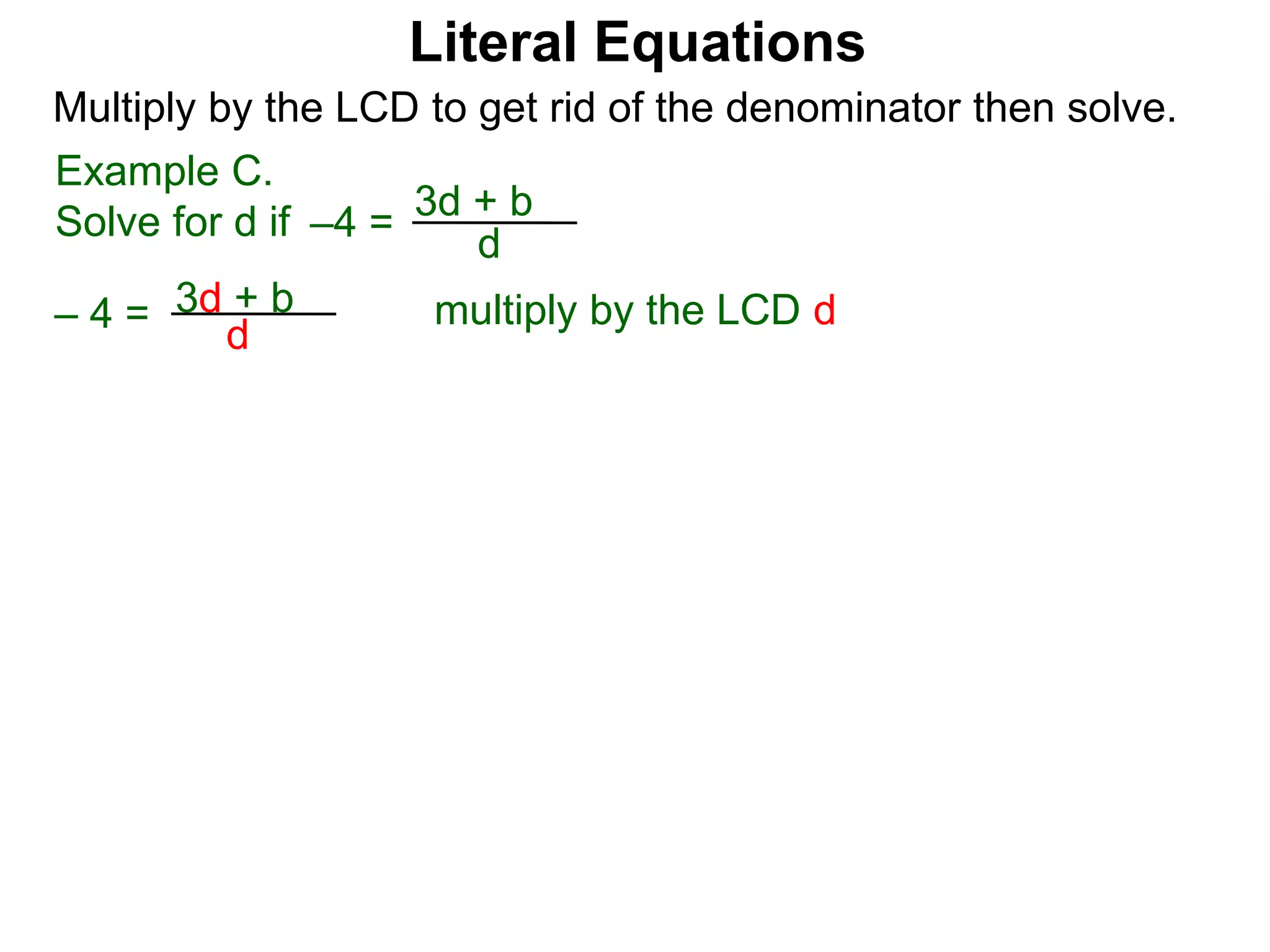
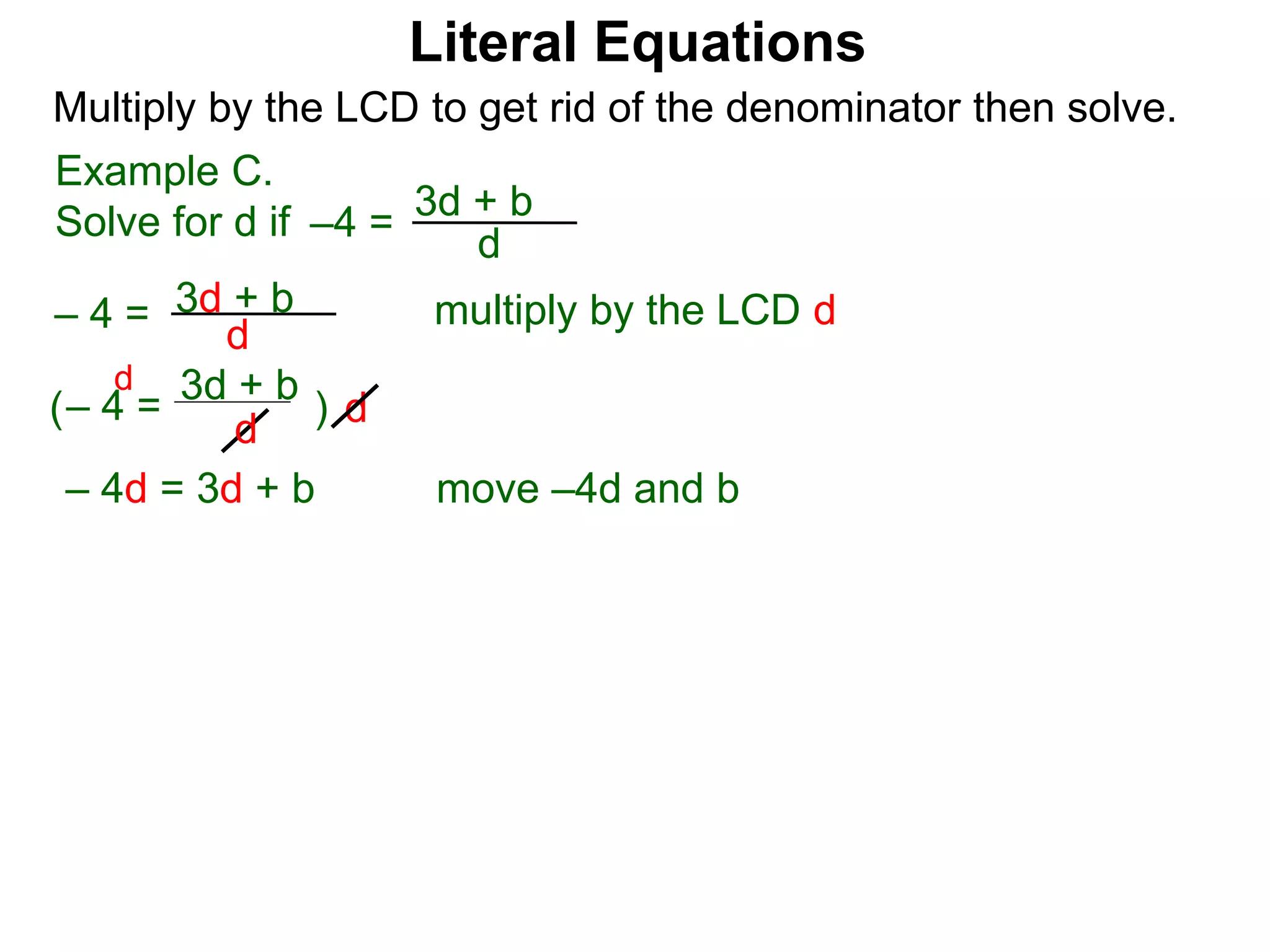
Multiply by the LCD to get rid of the denominator then solve.
Literal Equations
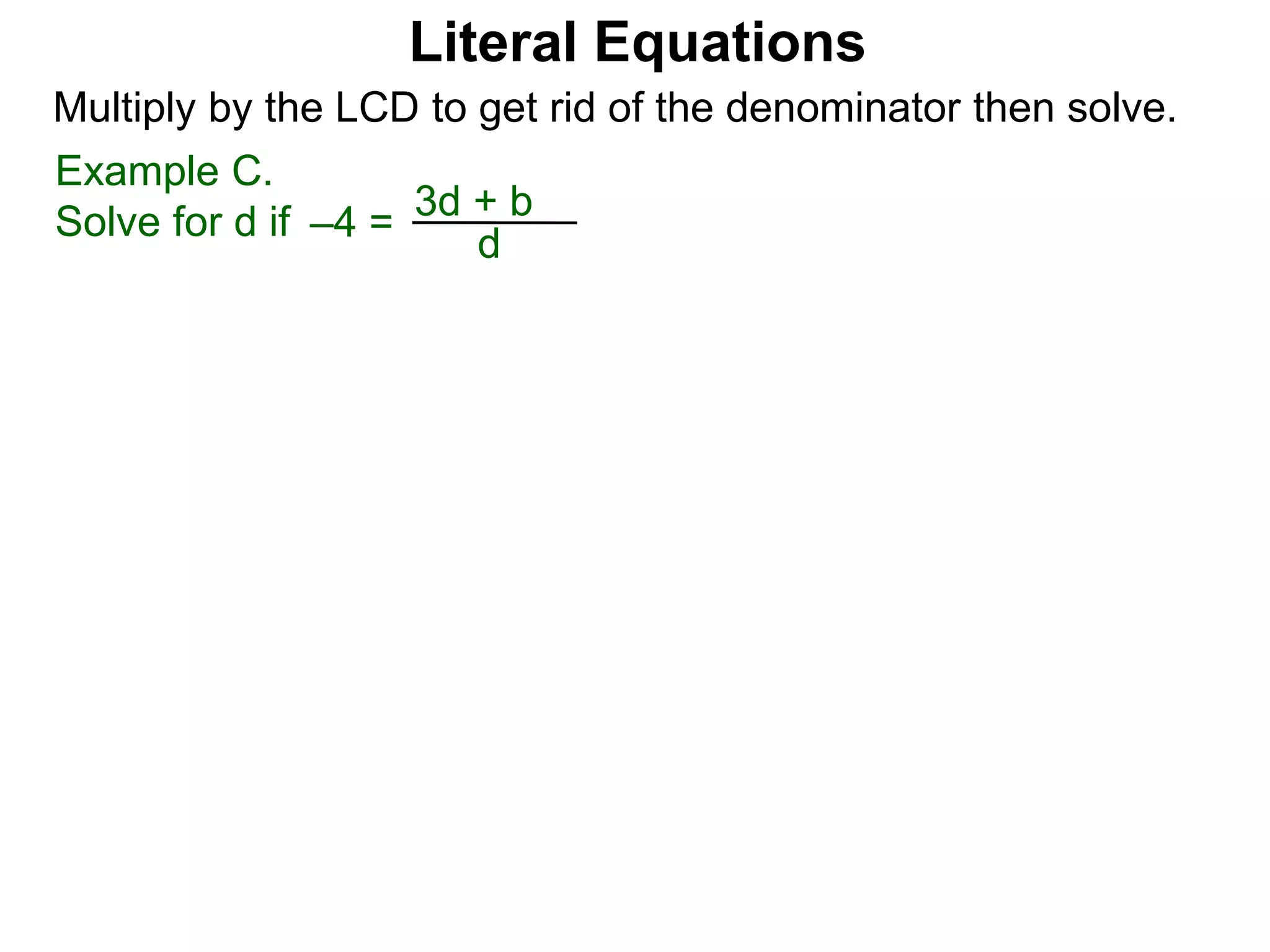
–4 =
d
3d + b
Multiply by the LCD to get rid of the denominator then solve.
Example C.
Solve for d if
Literal Equations
–4 =
d
3d + b
Multiply by the LCD to get rid of the denominator then solve.
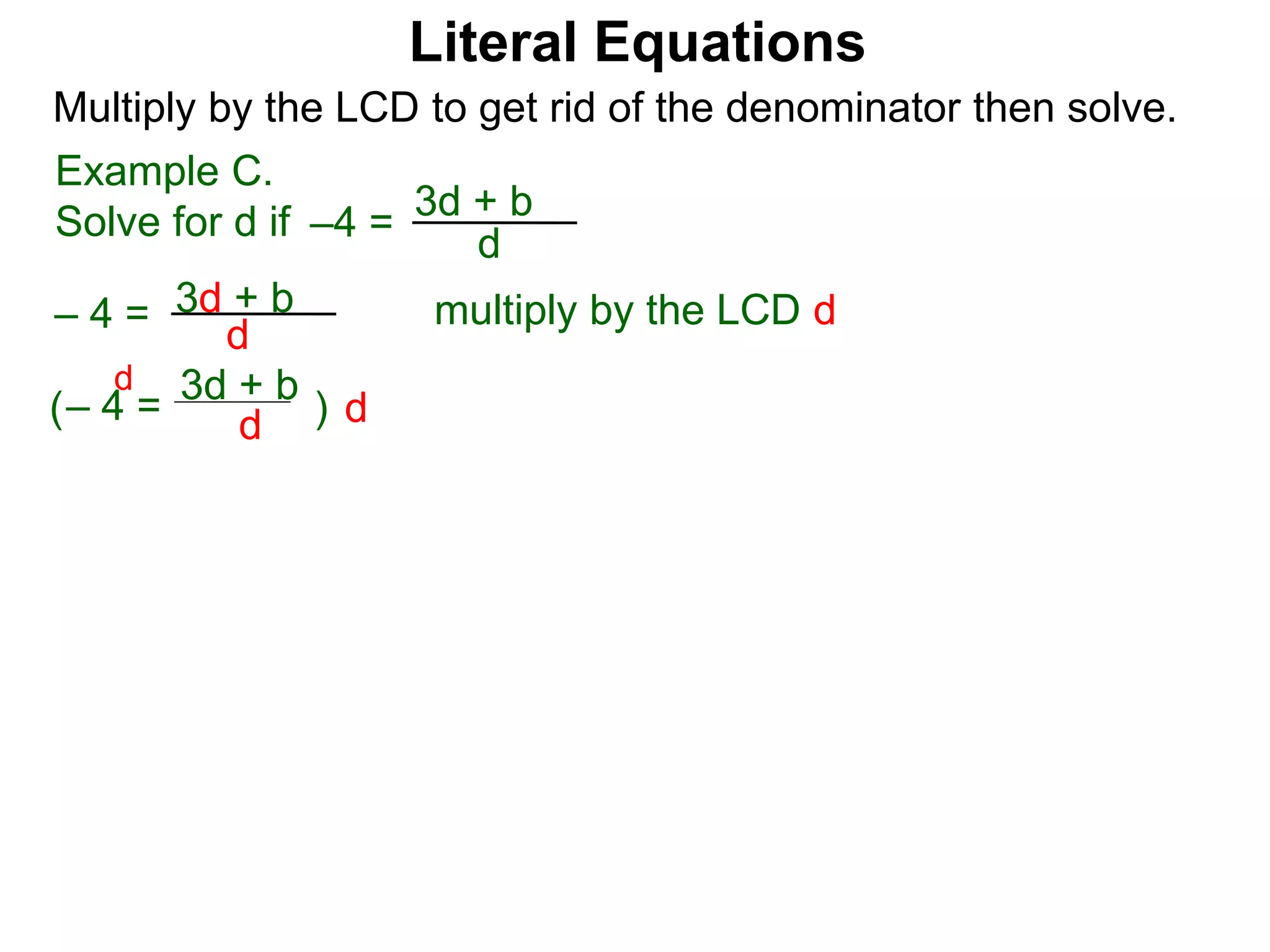
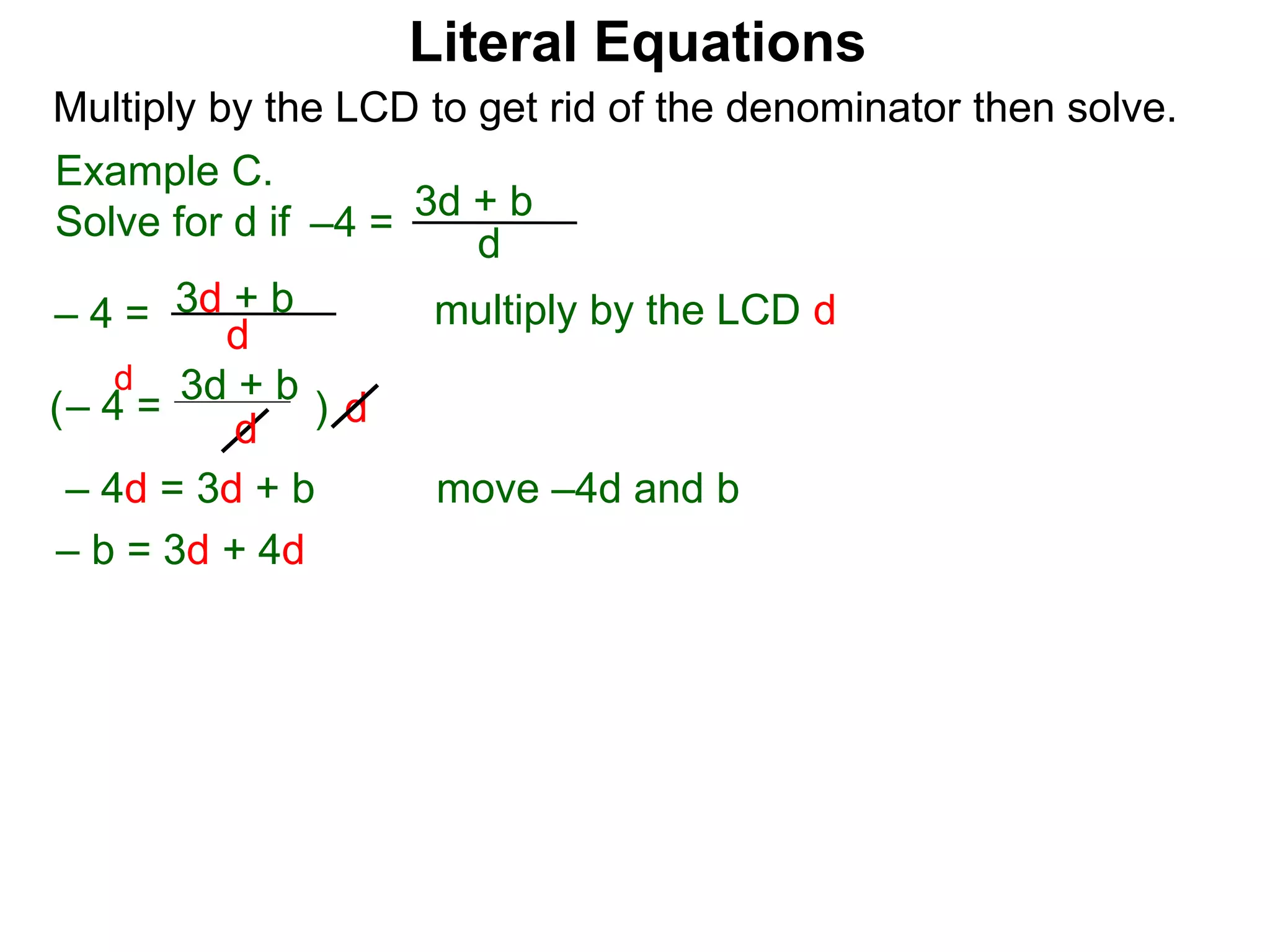
multiply by the LCD d– 4 = d
3d + b
Example C.
Solve for d if
Literal Equations
–4 =
d
3d + b
Multiply by the LCD to get rid of the denominator then solve.
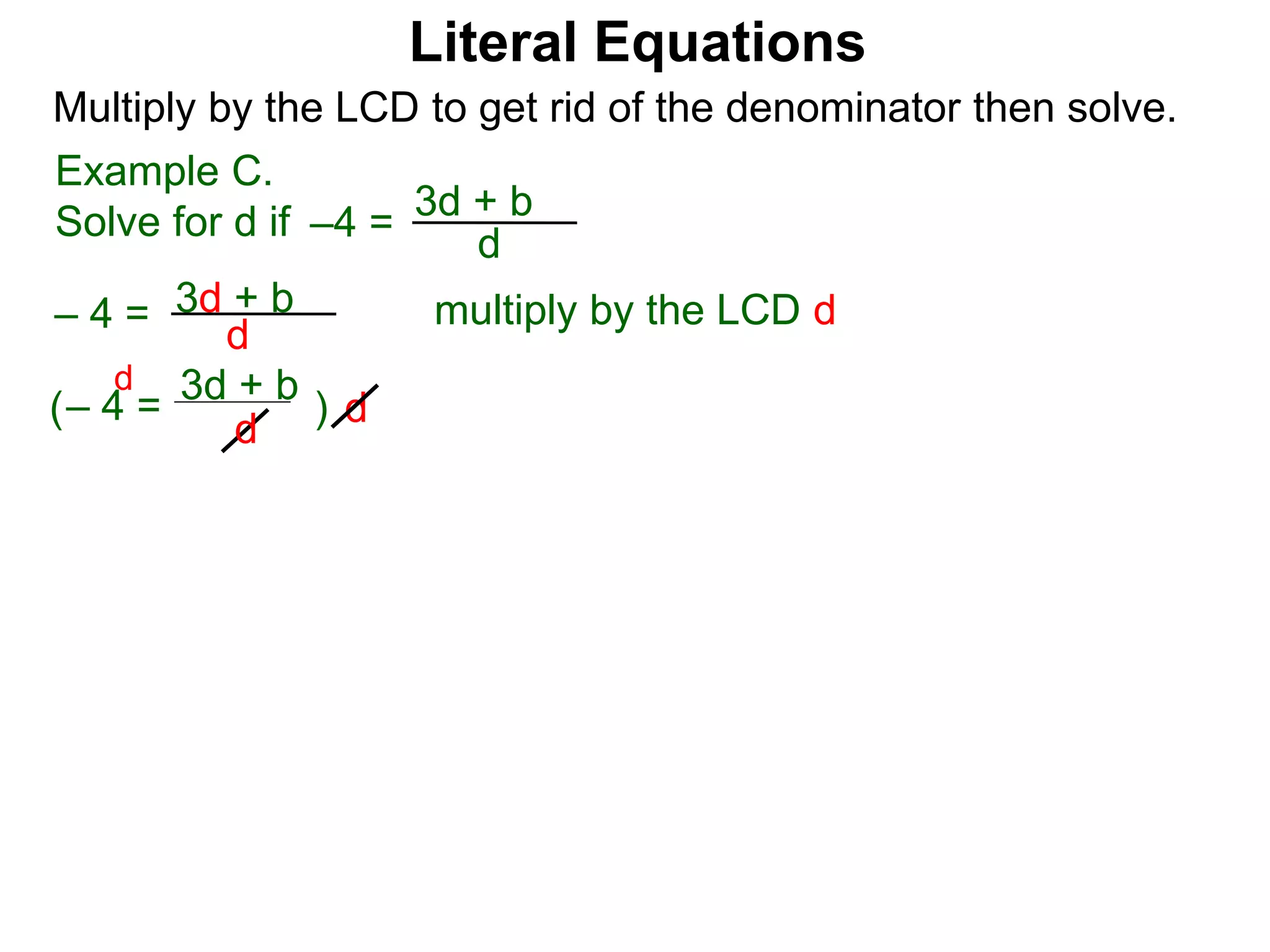
multiply by the LCD d
d
– 4 = d
3d + b
– 4 = d
3d + b
( )
d
Example C.
Solve for d if
Literal Equations
–4 =
d
3d + b
Multiply by the LCD to get rid of the denominator then solve.
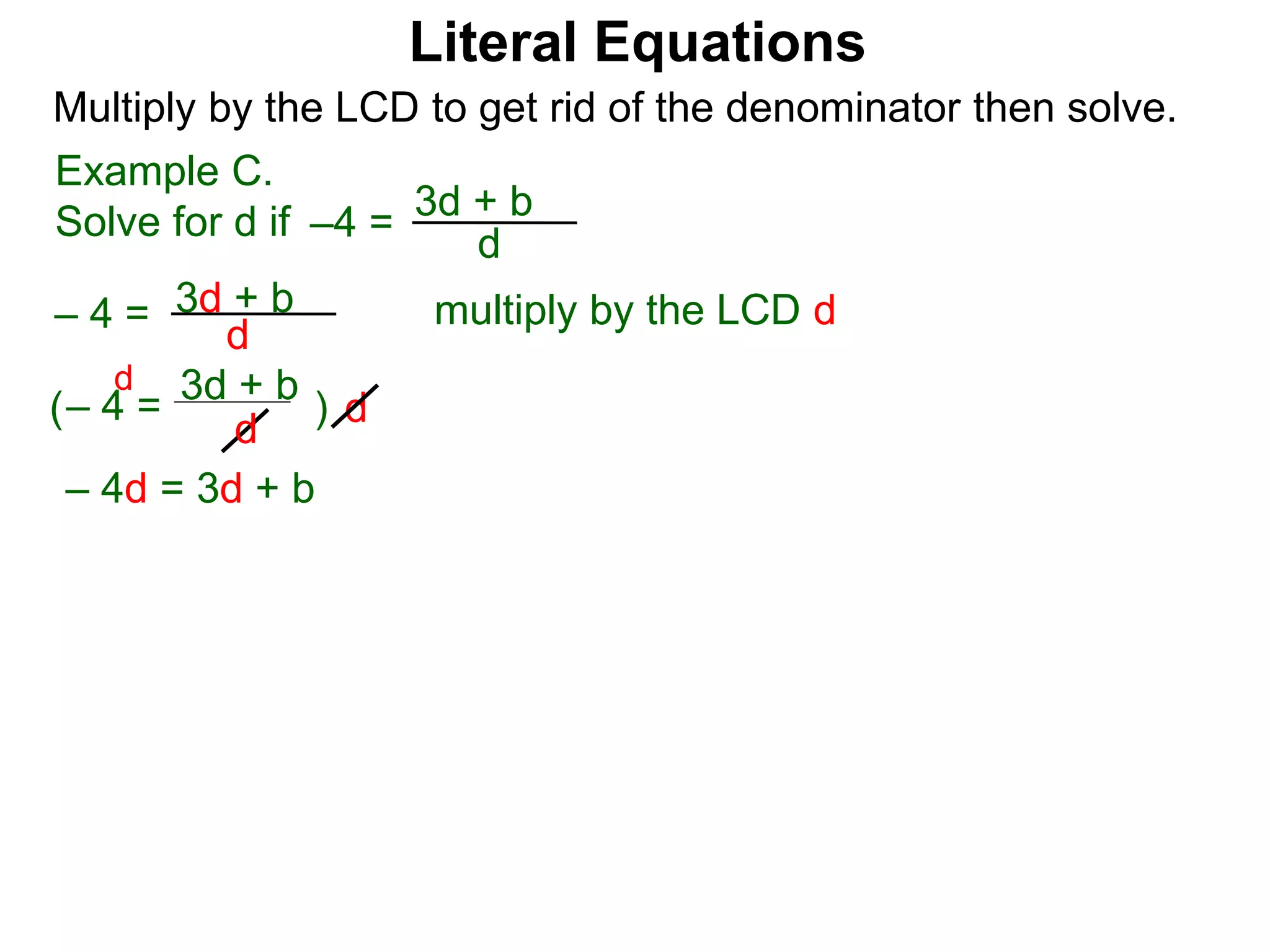
multiply by the LCD d
d
– 4 = d
3d + b
– 4 =
d
3d + b
( )
d
Example C.
Solve for d if
Literal Equations
–4 =
d
3d + b
Multiply by the LCD to get rid of the denominator then solve.
multiply by the LCD d
d
– 4 = d
3d + b
– 4 =
d
3d + b
( )
d
– 4d = 3d + b
Example C.
Solve for d if
Literal Equations
–4 =
d
3d + b
Multiply by the LCD to get rid of the denominator then solve.
multiply by the LCD d
d
– 4 = d
3d + b
– 4 =
d
3d + b
( )
d
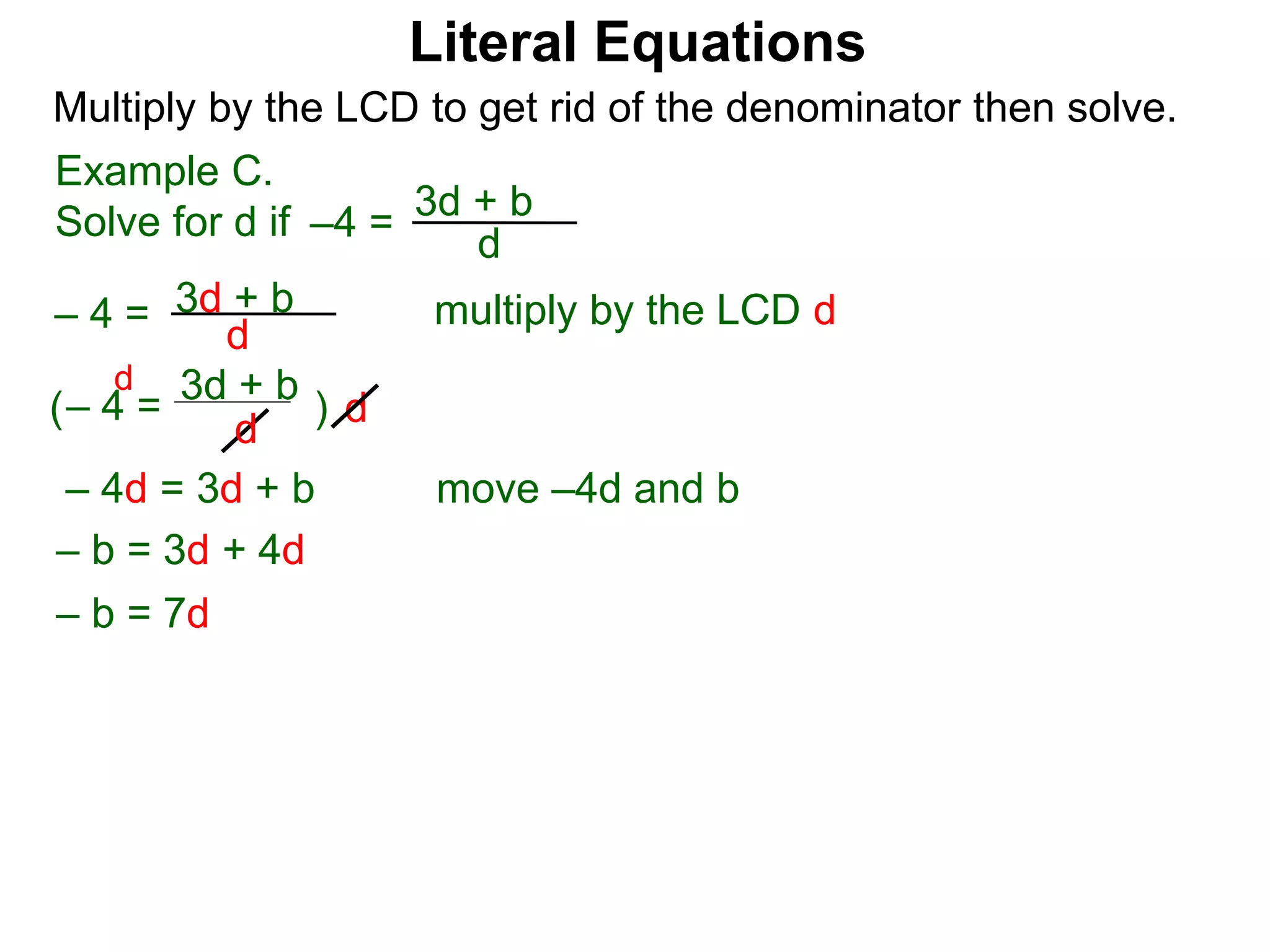
– 4d = 3d + b move –4d and b
Example C.
Solve for d if
Literal Equations
–4 =
d
3d + b
Multiply by the LCD to get rid of the denominator then solve.
multiply by the LCD d
d
– 4 = d
3d + b
– 4 =
d
3d + b
( )
d
– 4d = 3d + b
– b = 3d + 4d
move –4d and b
Example C.
Solve for d if
Literal Equations
–4 =
d
3d + b
Multiply by the LCD to get rid of the denominator then solve.
multiply by the LCD d
d
– 4 = d
3d + b
– 4 =
d
3d + b
( )
d
– 4d = 3d + b
– b = 3d + 4d
move –4d and b
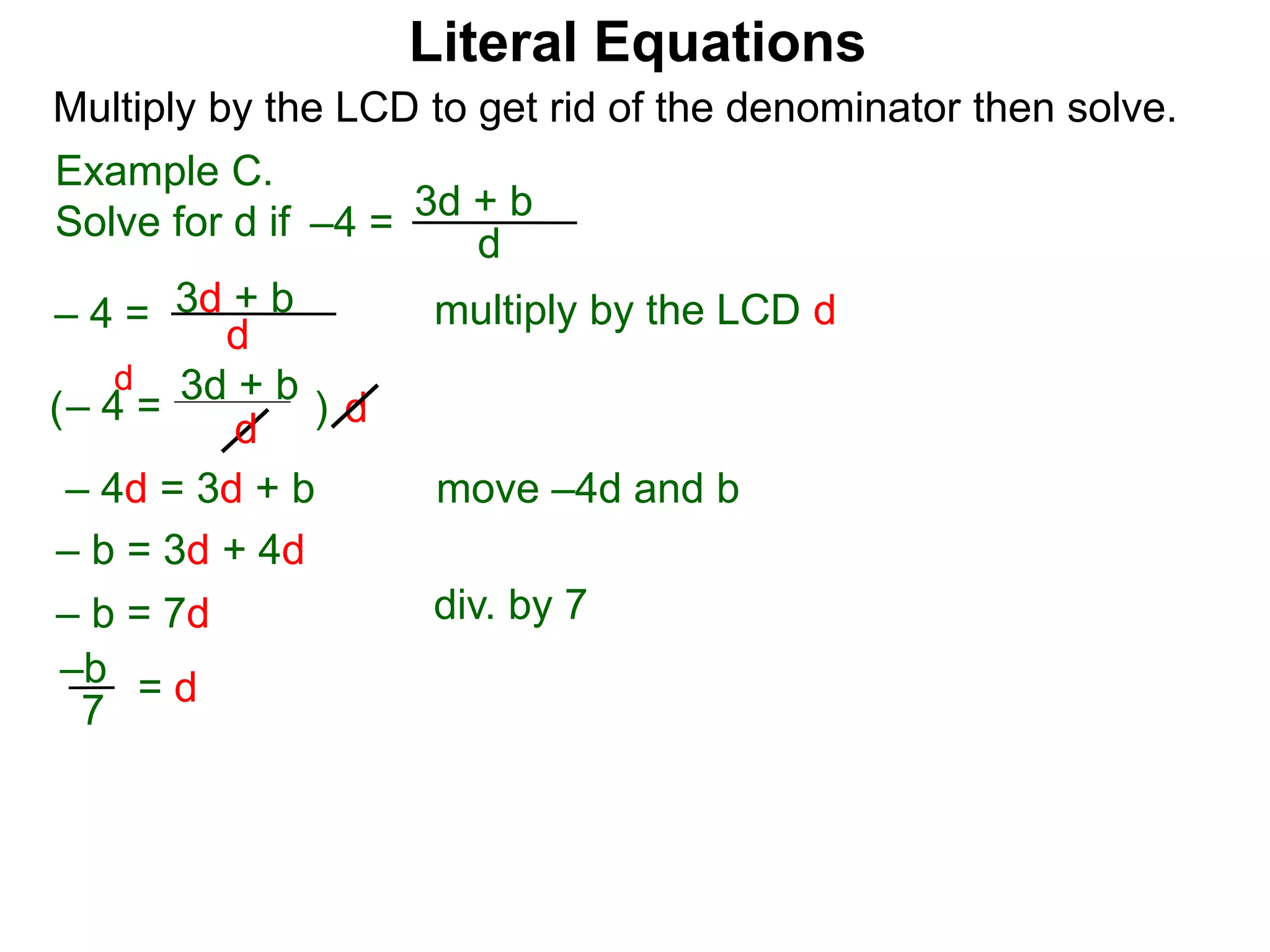
– b = 7d
Example C.
Solve for d if
Literal Equations
–4 =
d
3d + b
Multiply by the LCD to get rid of the denominator then solve.
multiply by the LCD d
d
– 4 = d
3d + b
– 4 =
d
3d + b
( )
d
– 4d = 3d + b
– b = 3d + 4d
move –4d and b
– b = 7d
= d
7
–b
Example C.
Solve for d if
Literal Equations
div. by 7
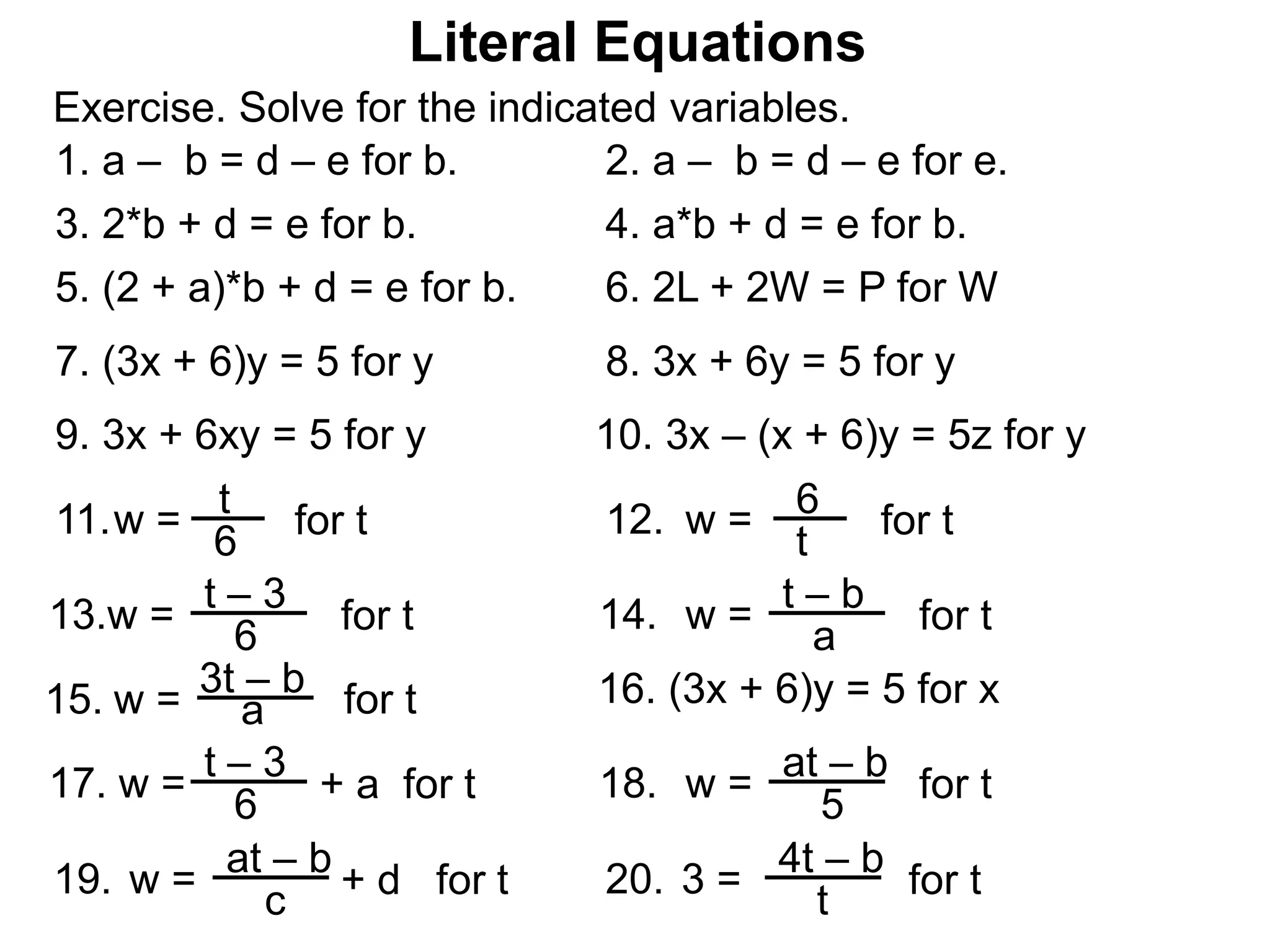
Exercise. Solve for the indicated variables.
Literal Equations
1. a – b = d – e for b. 2. a – b = d – e for e.
3. 2*b + d = e for b. 4. a*b + d = e for b.
5. (2 + a)*b + d = e for b. 6. 2L + 2W = P for W
7. (3x + 6)y = 5 for y 8. 3x + 6y = 5 for y
w = t – 3
613. for t w = t – b
a14. for t
w =11. for t w =12. for t
t
6
6
t
w =
3t – b
a15. for t 16. (3x + 6)y = 5 for x
w = t – 3
6
17. + a for t w = at – b
5
18. for t
w =
at – b
c
19. + d for t 3 =
4t – b
t
20. for t
9. 3x + 6xy = 5 for y 10. 3x – (x + 6)y = 5z for y

2 5literal equations

  • 1.
  • 2.
    Given an equationwith many variables, to solve for a particular variable means to isolate that variable to one side of the equation. Literal Equations
  • 3.
    Given an equationwith many variables, to solve for a particular variable means to isolate that variable to one side of the equation. We do this, just as solving equations in x, Literal Equations
  • 4.
    Given an equationwith many variables, to solve for a particular variable means to isolate that variable to one side of the equation. We do this, just as solving equations in x, by +, –, * , / the same quantities to both sides of the equations. Literal Equations
  • 5.
    Given an equationwith many variables, to solve for a particular variable means to isolate that variable to one side of the equation. We do this, just as solving equations in x, by +, –, * , / the same quantities to both sides of the equations. These quantities may be numbers or variables. Literal Equations
  • 6.
    Given an equationwith many variables, to solve for a particular variable means to isolate that variable to one side of the equation. We do this, just as solving equations in x, by +, –, * , / the same quantities to both sides of the equations. These quantities may be numbers or variables. Example A. a. Solve for x if x + b = c Literal Equations
  • 7.
    Given an equationwith many variables, to solve for a particular variable means to isolate that variable to one side of the equation. We do this, just as solving equations in x, by +, –, * , / the same quantities to both sides of the equations. These quantities may be numbers or variables. Example A. a. Solve for x if x + b = c Remove b from the LHS by subtracting from both sides x + b = c Literal Equations
  • 8.
    Given an equationwith many variables, to solve for a particular variable means to isolate that variable to one side of the equation. We do this, just as solving equations in x, by +, –, * , / the same quantities to both sides of the equations. These quantities may be numbers or variables. Example A. a. Solve for x if x + b = c Remove b from the LHS by subtracting from both sides x + b = c –b –b Literal Equations
  • 9.
    Given an equationwith many variables, to solve for a particular variable means to isolate that variable to one side of the equation. We do this, just as solving equations in x, by +, –, * , / the same quantities to both sides of the equations. These quantities may be numbers or variables. Example A. a. Solve for x if x + b = c Remove b from the LHS by subtracting from both sides x + b = c –b –b x = c – b Literal Equations
  • 10.
    Given an equationwith many variables, to solve for a particular variable means to isolate that variable to one side of the equation. We do this, just as solving equations in x, by +, –, * , / the same quantities to both sides of the equations. These quantities may be numbers or variables. Example A. a. Solve for x if x + b = c Remove b from the LHS by subtracting from both sides x + b = c –b –b x = c – b b. Solve for w if yw = 5. Literal Equations
  • 11.
    Given an equationwith many variables, to solve for a particular variable means to isolate that variable to one side of the equation. We do this, just as solving equations in x, by +, –, * , / the same quantities to both sides of the equations. These quantities may be numbers or variables. Example A. a. Solve for x if x + b = c Remove b from the LHS by subtracting from both sides x + b = c –b –b x = c – b b. Solve for w if yw = 5. Remove y from the LHS by dividing both sides by y. yw = 5 Literal Equations
  • 12.
    Given an equationwith many variables, to solve for a particular variable means to isolate that variable to one side of the equation. We do this, just as solving equations in x, by +, –, * , / the same quantities to both sides of the equations. These quantities may be numbers or variables. Example A. a. Solve for x if x + b = c Remove b from the LHS by subtracting from both sides x + b = c –b –b x = c – b b. Solve for w if yw = 5. Remove y from the LHS by dividing both sides by y. yw = 5 yw/y = 5/y Literal Equations
  • 13.
    Given an equationwith many variables, to solve for a particular variable means to isolate that variable to one side of the equation. We do this, just as solving equations in x, by +, –, * , / the same quantities to both sides of the equations. These quantities may be numbers or variables. Example A. a. Solve for x if x + b = c Remove b from the LHS by subtracting from both sides x + b = c –b –b x = c – b b. Solve for w if yw = 5. Remove y from the LHS by dividing both sides by y. yw = 5 yw/y = 5/y w = 5 y Literal Equations
  • 14.
    Literal Equations Adding orsubtracting a term to both sides may be viewed as moving the term across the " = " and change its sign.
  • 15.
    To solve fora specific variable in a simple literal equation, do the following steps. Literal Equations Adding or subtracting a term to both sides may be viewed as moving the term across the " = " and change its sign.
  • 16.
    To solve fora specific variable in a simple literal equation, do the following steps. 1. If there are fractions in the equations, multiple by the LCD to clear the fractions. Literal Equations Adding or subtracting a term to both sides may be viewed as moving the term across the " = " and change its sign.
  • 17.
    To solve fora specific variable in a simple literal equation, do the following steps. 1. If there are fractions in the equations, multiple by the LCD to clear the fractions. 2. Isolate the term containing the variable we wanted to solve for Literal Equations Adding or subtracting a term to both sides may be viewed as moving the term across the " = " and change its sign.
  • 18.
    To solve fora specific variable in a simple literal equation, do the following steps. 1. If there are fractions in the equations, multiple by the LCD to clear the fractions. 2. Isolate the term containing the variable we wanted to solve for – move all the other terms to other side of the equation. Literal Equations Adding or subtracting a term to both sides may be viewed as moving the term across the " = " and change its sign.
  • 19.
    To solve fora specific variable in a simple literal equation, do the following steps. 1. If there are fractions in the equations, multiple by the LCD to clear the fractions. 2. Isolate the term containing the variable we wanted to solve for – move all the other terms to other side of the equation. 3. Isolate the specific variable by dividing the rest of the factor to the other side. Literal Equations Adding or subtracting a term to both sides may be viewed as moving the term across the " = " and change its sign.
  • 20.
    To solve fora specific variable in a simple literal equation, do the following steps. 1. If there are fractions in the equations, multiple by the LCD to clear the fractions. 2. Isolate the term containing the variable we wanted to solve for – move all the other terms to other side of the equation. 3. Isolate the specific variable by dividing the rest of the factor to the other side. Literal Equations Example B. a. Solve for x if (a + b)x = c Adding or subtracting a term to both sides may be viewed as moving the term across the " = " and change its sign.
  • 21.
    To solve fora specific variable in a simple literal equation, do the following steps. 1. If there are fractions in the equations, multiple by the LCD to clear the fractions. 2. Isolate the term containing the variable we wanted to solve for – move all the other terms to other side of the equation. 3. Isolate the specific variable by dividing the rest of the factor to the other side. Literal Equations Example B. a. Solve for x if (a + b)x = c (a + b) x = c div the RHS by (a + b) Adding or subtracting a term to both sides may be viewed as moving the term across the " = " and change its sign.
  • 22.
    To solve fora specific variable in a simple literal equation, do the following steps. 1. If there are fractions in the equations, multiple by the LCD to clear the fractions. 2. Isolate the term containing the variable we wanted to solve for – move all the other terms to other side of the equation. 3. Isolate the specific variable by dividing the rest of the factor to the other side. Literal Equations Example B. a. Solve for x if (a + b)x = c (a + b) x = c x = c (a + b) div the RHS by (a + b) Adding or subtracting a term to both sides may be viewed as moving the term across the " = " and change its sign.
  • 23.
    b. Solve forw if 3y2w = t – 3 Literal Equations
  • 24.
    b. Solve forw if 3y2w = t – 3 3y2w = t – 3 div the RHS by 3y2 Literal Equations
  • 25.
    b. Solve forw if 3y2w = t – 3 3y2w = t – 3 w = t – 3 3y2 div the RHS by 3y2 Literal Equations
  • 26.
    b. Solve forw if 3y2w = t – 3 3y2w = t – 3 c. Solve for a if b2 – 4ac = 5 w = t – 3 3y2 div the RHS by 3y2 Literal Equations
  • 27.
    b. Solve forw if 3y2w = t – 3 3y2w = t – 3 c. Solve for a if b2 – 4ac = 5 b2 – 4ac = 5 w = t – 3 3y2 div the RHS by 3y2 move b2 to the RHS Literal Equations
  • 28.
    b. Solve forw if 3y2w = t – 3 3y2w = t – 3 c. Solve for a if b2 – 4ac = 5 b2 – 4ac = 5 – 4ca = 5 – b2 w = t – 3 3y2 div the RHS by 3y2 move b2 to the RHS Literal Equations
  • 29.
    b. Solve forw if 3y2w = t – 3 3y2w = t – 3 c. Solve for a if b2 – 4ac = 5 b2 – 4ac = 5 – 4ca = 5 – b2 w = t – 3 3y2 div the RHS by 3y2 move b2 to the RHS div the RHS by –4c Literal Equations
  • 30.
    b. Solve forw if 3y2w = t – 3 3y2w = t – 3 c. Solve for a if b2 – 4ac = 5 b2 – 4ac = 5 – 4ca = 5 – b2 w = t – 3 3y2 a = 5 – b2 –4c div the RHS by 3y2 move b2 to the RHS div the RHS by –4c Literal Equations
  • 31.
    b. Solve forw if 3y2w = t – 3 3y2w = t – 3 c. Solve for a if b2 – 4ac = 5 b2 – 4ac = 5 – 4ca = 5 – b2 w = t – 3 3y2 a = 5 – b2 –4c div the RHS by 3y2 move b2 to the RHS div the RHS by –4c Literal Equations d. Solve for y if a(x – y) = 10
  • 32.
    b. Solve forw if 3y2w = t – 3 3y2w = t – 3 c. Solve for a if b2 – 4ac = 5 b2 – 4ac = 5 – 4ca = 5 – b2 w = t – 3 3y2 a = 5 – b2 –4c div the RHS by 3y2 move b2 to the RHS div the RHS by –4c Literal Equations d. Solve for y if a(x – y) = 10 a(x – y) = 10 expand
  • 33.
    b. Solve forw if 3y2w = t – 3 3y2w = t – 3 c. Solve for a if b2 – 4ac = 5 b2 – 4ac = 5 – 4ca = 5 – b2 w = t – 3 3y2 a = 5 – b2 –4c div the RHS by 3y2 move b2 to the RHS div the RHS by –4c Literal Equations d. Solve for y if a(x – y) = 10 a(x – y) = 10 expand ax – ay = 10
  • 34.
    b. Solve forw if 3y2w = t – 3 3y2w = t – 3 c. Solve for a if b2 – 4ac = 5 b2 – 4ac = 5 – 4ca = 5 – b2 w = t – 3 3y2 a = 5 – b2 –4c div the RHS by 3y2 move b2 to the RHS div the RHS by –4c Literal Equations d. Solve for y if a(x – y) = 10 a(x – y) = 10 expand ax – ay = 10 subtract ax
  • 35.
    b. Solve forw if 3y2w = t – 3 3y2w = t – 3 c. Solve for a if b2 – 4ac = 5 b2 – 4ac = 5 – 4ca = 5 – b2 w = t – 3 3y2 a = 5 – b2 –4c div the RHS by 3y2 move b2 to the RHS div the RHS by –4c Literal Equations d. Solve for y if a(x – y) = 10 a(x – y) = 10 expand ax – ay = 10 subtract ax – ay = 10 – ax
  • 36.
    b. Solve forw if 3y2w = t – 3 3y2w = t – 3 c. Solve for a if b2 – 4ac = 5 b2 – 4ac = 5 – 4ca = 5 – b2 w = t – 3 3y2 a = 5 – b2 –4c div the RHS by 3y2 move b2 to the RHS div the RHS by –4c Literal Equations d. Solve for y if a(x – y) = 10 a(x – y) = 10 expand ax – ay = 10 subtract ax – ay = 10 – ax div by –a
  • 37.
    b. Solve forw if 3y2w = t – 3 3y2w = t – 3 c. Solve for a if b2 – 4ac = 5 b2 – 4ac = 5 – 4ca = 5 – b2 w = t – 3 3y2 a = 5 – b2 –4c div the RHS by 3y2 move b2 to the RHS div the RHS by –4c Literal Equations d. Solve for y if a(x – y) = 10 a(x – y) = 10 expand ax – ay = 10 subtract ax – ay = 10 – ax div by –a y = 10 – ax –a
  • 38.
    Multiply by theLCD to get rid of the denominator then solve. Literal Equations
  • 39.
    –4 = d 3d +b Multiply by the LCD to get rid of the denominator then solve. Example C. Solve for d if Literal Equations
  • 40.
    –4 = d 3d +b Multiply by the LCD to get rid of the denominator then solve. multiply by the LCD d– 4 = d 3d + b Example C. Solve for d if Literal Equations
  • 41.
    –4 = d 3d +b Multiply by the LCD to get rid of the denominator then solve. multiply by the LCD d d – 4 = d 3d + b – 4 = d 3d + b ( ) d Example C. Solve for d if Literal Equations
  • 42.
    –4 = d 3d +b Multiply by the LCD to get rid of the denominator then solve. multiply by the LCD d d – 4 = d 3d + b – 4 = d 3d + b ( ) d Example C. Solve for d if Literal Equations
  • 43.
    –4 = d 3d +b Multiply by the LCD to get rid of the denominator then solve. multiply by the LCD d d – 4 = d 3d + b – 4 = d 3d + b ( ) d – 4d = 3d + b Example C. Solve for d if Literal Equations
  • 44.
    –4 = d 3d +b Multiply by the LCD to get rid of the denominator then solve. multiply by the LCD d d – 4 = d 3d + b – 4 = d 3d + b ( ) d – 4d = 3d + b move –4d and b Example C. Solve for d if Literal Equations
  • 45.
    –4 = d 3d +b Multiply by the LCD to get rid of the denominator then solve. multiply by the LCD d d – 4 = d 3d + b – 4 = d 3d + b ( ) d – 4d = 3d + b – b = 3d + 4d move –4d and b Example C. Solve for d if Literal Equations
  • 46.
    –4 = d 3d +b Multiply by the LCD to get rid of the denominator then solve. multiply by the LCD d d – 4 = d 3d + b – 4 = d 3d + b ( ) d – 4d = 3d + b – b = 3d + 4d move –4d and b – b = 7d Example C. Solve for d if Literal Equations
  • 47.
    –4 = d 3d +b Multiply by the LCD to get rid of the denominator then solve. multiply by the LCD d d – 4 = d 3d + b – 4 = d 3d + b ( ) d – 4d = 3d + b – b = 3d + 4d move –4d and b – b = 7d = d 7 –b Example C. Solve for d if Literal Equations div. by 7
  • 48.
    Exercise. Solve forthe indicated variables. Literal Equations 1. a – b = d – e for b. 2. a – b = d – e for e. 3. 2*b + d = e for b. 4. a*b + d = e for b. 5. (2 + a)*b + d = e for b. 6. 2L + 2W = P for W 7. (3x + 6)y = 5 for y 8. 3x + 6y = 5 for y w = t – 3 613. for t w = t – b a14. for t w =11. for t w =12. for t t 6 6 t w = 3t – b a15. for t 16. (3x + 6)y = 5 for x w = t – 3 6 17. + a for t w = at – b 5 18. for t w = at – b c 19. + d for t 3 = 4t – b t 20. for t 9. 3x + 6xy = 5 for y 10. 3x – (x + 6)y = 5z for y