BLACKBOX
      TAF 3023:
MATHEMATICS DISCRET
  TASK 2:CONCEPT OF SET
DEFINITIONS OF SETS
• A set is any well-defined collection of
  objects
• The elements or members of a set are the
  objects contained in the set
• Well-defined means that it is possible to
   decide if a given object belongs to the
   collection or not.
1)WAY OF LISTING THE ELEMENTS
 OF SETS

A. Roster Method
 -listing the elements in any order and enclosing
  them with braces.
Example:
     A= {January, February, March…December}
     B={1,3,5…}
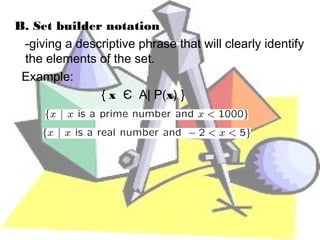
B. Set builder notation
 -giving a descriptive phrase that will clearly identify
 the elements of the set.
 Example:
               { x Є A| P(x) }
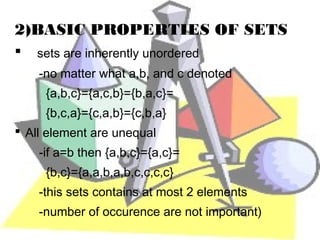
2)BASIC PROPERTIES OF SETS
   sets are inherently unordered
    -no matter what a,b, and c denoted
     {a,b,c}={a,c,b}={b,a,c}=
     {b,c,a}={c,a,b}={c,b,a}
 All element are unequal
    -if a=b then {a,b,c}={a,c}=
     {b,c}={a,a,b,a,b,c,c,c,c}
    -this sets contains at most 2 elements
    -number of occurence are not important)
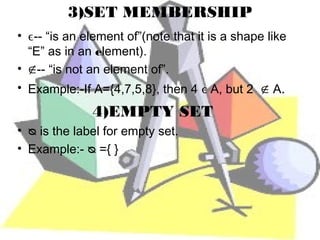
3)SET MEMBERSHIP
• ϵ-- “is an element of”(note that it is a shape like
  “E” as in an element).
• ∉-- “is not an element of”.
• Example:-If A={4,7,5,8}, then 4 ϵ A, but 2 ∉ A.
              4)EMPTY SET
• ᴓ is the label for empty set.
• Example:- ᴓ ={ }
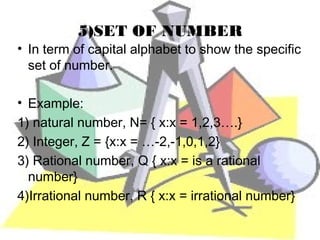
5)SET OF NUMBER
• In term of capital alphabet to show the specific
  set of number.

• Example:
1) natural number, N= { x:x = 1,2,3….}
2) Integer, Z = {x:x = …-2,-1,0,1,2}
3) Rational number, Q { x:x = is a rational
  number}
4)Irrational number, R { x:x = irrational number}
6)SET OF EQUALITY
• Set which has same or equal element in term on
  it’s declaration in the content.
• Note that set have a same element
• In some of case, it does not matter if the
  arrangement is correct order or not
                   How to understand
                    ( if the set is equal)
• Let’s assume that set P is defined same set of Q.
• So, if the set have same element and although
  not in correct order it can be considered the both
  set is equal.
How to understand
                    (if it is not equal)
• If the set P does not have same element with set
  Q , so it is not equal.
• Eventhough the least one element either set P or
  set Q not in both set, it consider as not equal
  laaa…
• Example :
P = {a, b, c, d}
Q = {d, c, b, a}  
P=Q
   each elements of set P that is a, b, c, d is same
  with  element of set Q that is 8, 4, 2, 6. rearrange
  the elements of the set it still be same.
7)VENN DIAGRAM
 also known as set diagram. which known as a diagram indicates all of the
  possible logical relations between sets of finite collection (aggregation).
  Venn diagrams are alternatives to solve problems in market research, in
                        science, in social science, etc.

where often overlapping information is obtained and needs to be organized.

                      history facts on Venn Diagram:

the Venn Diagram were formulated by John Venn on 1880. Nowadays, The
 Venn Diagram can be use to illustrate simple set relationship in probability,
            logic, statistics, linguistics, and computer science.
examples
       1. From a survey of 100 workers, a marketing
       research company found that 75 workers owned
       stereos, 45 owned cars, and 35 owned cars and
       stereos.

a) How many students owned either a car or a stereo?
b) How many students did not own either a car or a stereo?
METHOD?
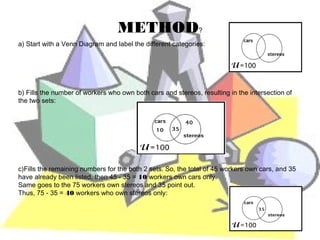
a) Start with a Venn Diagram and label the different categories:


b) Fills the number of workers who own both cars and stereos, resulting in the intersection of
the two sets:


c)Fills the remaining numbers for the both 2 sets. So, the total of 45 workers own cars, and 35
have already been listed, then 45 - 35 = 10 workers own cars only.
Same goes to the 75 workers own stereos and 35 point out.
Thus, 75 - 35 = 40 workers who own stereos only:
answers!
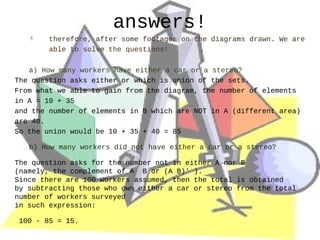
        therefore, after some footages on the diagrams drawn. We are
        able to solve the questions!

   a) How many workers have either a car or a stereo?
The question asks either or which is union of the sets.
From what we able to gain from the diagram, the number of elements
in A = 10 + 35
and the number of elements in B which are NOT in A (different area)
are 40.
So the union would be 10 + 35 + 40 = 85

   b) How many workers did not have either a car or a stereo?

The question asks for the number not in either A nor B
(namely, the complement of A B or (A B)' ).
Since there are 100 workers assumed, then the total is obtained
by subtracting those who own either a car or stereo from the total
number of workers surveyed
in such expression:

100 - 85 = 15.
8)SUBSET
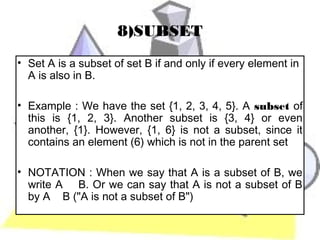
• Set A is a subset of set B if and only if every element in
  A is also in B.

• Example : We have the set {1, 2, 3, 4, 5}. A subset of
  this is {1, 2, 3}. Another subset is {3, 4} or even
  another, {1}. However, {1, 6} is not a subset, since it
  contains an element (6) which is not in the parent set

• NOTATION : When we say that A is a subset of B, we
  write A B. Or we can say that A is not a subset of B
  by A B ("A is not a subset of B")
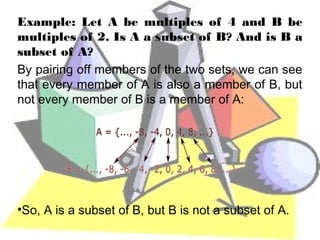
Example: Let A be multiples of 4 and B be
multiples of 2. Is A a subset of B? And is B a
subset of A?
By pairing off members of the two sets, we can see
that every member of A is also a member of B, but
not every member of B is a member of A:


•So, A is a subset of B, but B is not a subset of A.
Proper Subsets
•A is a proper subset of B if and only if every
element in A is also in B, and there exists at least
one element in B that is not in A.
•Example: {1, 2, 3} is a subset of {1, 2, 3}, but is
not a proper subset of {1, 2, 3}.
•Example: {1, 2, 3} is a proper subset of {1, 2, 3,
4} because the element 4 is not in the first set.
•You should notice that if A is a proper subset of B,
then it is also a subset of B.
9)POWER SET

• 
• 
10)SET OPERATION
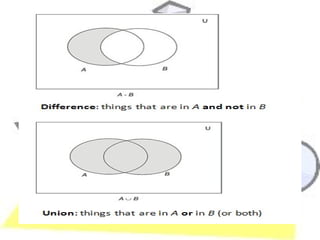
A)UNION
union of the sets A and B, denoted by A ∪ B
elements that are either in A or in B, or in both.
A ∪ B = {x | x ∈ A ∨ x ∈ B}.

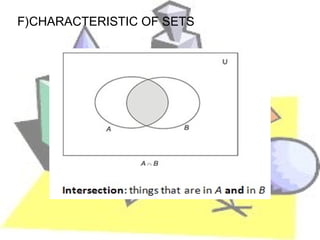
 B)INTERSECTION
• intersection of the sets A and B, denoted by A ∩
  B
• set
• containing those elements in both A and B
A ∩ B = {x | x ∈ A ∧ x ∈ B}.
C)DISJOINT SET
• Two sets are called disjoint if their intersection is
  the empty set.
• Meaning that two sets has nothing in common

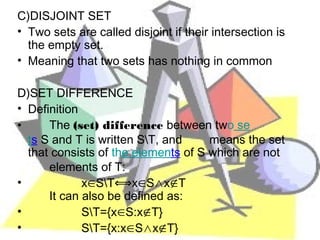
D)SET DIFFERENCE
• Definition
•     The (set) difference between two se
  ts S and T is written S∖T, and     means the set
  that consists of the elements of S which are not
      elements of T:
•            x∈S∖T⟺x∈S∧x∉T
      It can also be defined as:
•            S∖T={x∈S:x∉T}
•            S∖T={x:x∈S∧x∉T}
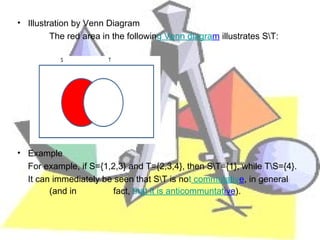
• Illustration by Venn Diagram
         The red area in the following Venn diagram illustrates S∖T:


• Example
  For example, if S={1,2,3} and T={2,3,4}, then S∖T={1}, while T∖S={4}.
  It can immediately be seen that S∖T is not commutative, in general
        (and in         fact, that it is anticommuntative).
E)SET COMPLEMENTARY
 So far, we have considered operations in which two sets combine to
      form a third: binary operations. Now we look at
 a unary operation - one that involves just one set.
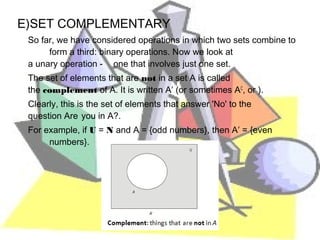
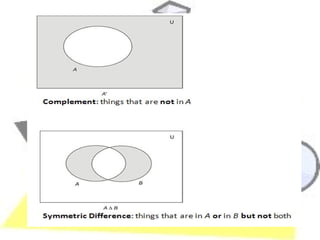
 The set of elements that are not in a set A is called
 the complement of A. It is written A′ (or sometimes AC, or ).
 Clearly, this is the set of elements that answer 'No' to the
 question Are you in A?.
 For example, if U = N and A = {odd numbers}, then A′ = {even
      numbers}.
F)CHARACTERISTIC OF SETS
11)GENERALISED UNION AND INTERSECTION

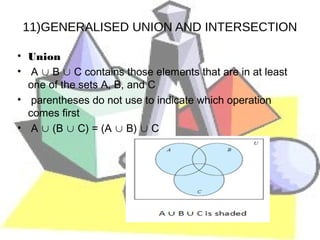
• Union
• A ∪ B ∪ C contains those elements that are in at least
  one of the sets A, B, and C
• parentheses do not use to indicate which operation
  comes first
• A ∪ (B ∪ C) = (A ∪ B) ∪ C
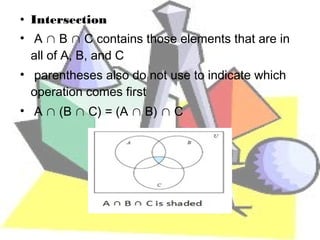
• Intersection
• A ∩ B ∩ C contains those elements that are in
  all of A, B, and C
• parentheses also do not use to indicate which
  operation comes first
• A ∩ (B ∩ C) = (A ∩ B) ∩ C
• Example:


• Let A = {0, 2, 4, 6, 8}, B = {0, 1, 3, 5, 7} and C = {0, 1, 2, 3}. What
  are A ∪ B ∪ C and A ∩ B ∩ C ?


• Solution:


 The set A ∪ B ∪ C contains those elements in at least one of A,
 B, and C.
• A ∪ B ∪ C = {0, 1, 2, 3, 4, 5, 6, 7}


 The set A ∩ B ∩ C contains those elements in all three of A, B,
 and C.
• A ∩ B ∩ C = {0}
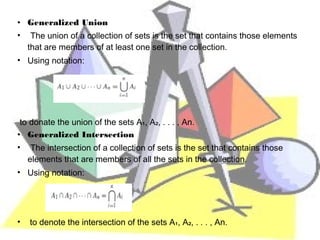
• Generalized Union
•    The union of a collection of sets is the set that contains those elements
    that are members of at least one set in the collection.
• Using notation:


 to donate the union of the sets A₁, A₂, . . . , An.
• Generalized Intersection
•    The intersection of a collection of sets is the set that contains those
    elements that are members of all the sets in the collection.
• Using notation:


•   to denote the intersection of the sets A₁, A₂, . . . , An.
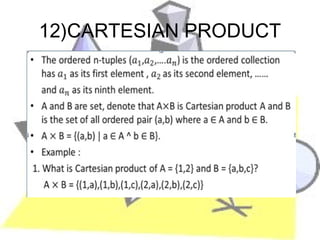
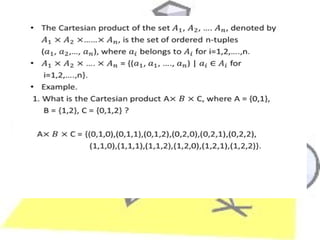
12)CARTESIAN PRODUCT
Blackbox task 2

Blackbox task 2

  • 1.
    BLACKBOX TAF 3023: MATHEMATICS DISCRET TASK 2:CONCEPT OF SET
  • 2.
    DEFINITIONS OF SETS •A set is any well-defined collection of objects • The elements or members of a set are the objects contained in the set • Well-defined means that it is possible to decide if a given object belongs to the collection or not.
  • 3.
    1)WAY OF LISTINGTHE ELEMENTS OF SETS A. Roster Method -listing the elements in any order and enclosing them with braces. Example: A= {January, February, March…December} B={1,3,5…}
  • 4.
    B. Set buildernotation -giving a descriptive phrase that will clearly identify the elements of the set. Example: { x Є A| P(x) }
  • 5.
    2)BASIC PROPERTIES OFSETS  sets are inherently unordered -no matter what a,b, and c denoted {a,b,c}={a,c,b}={b,a,c}= {b,c,a}={c,a,b}={c,b,a}  All element are unequal -if a=b then {a,b,c}={a,c}= {b,c}={a,a,b,a,b,c,c,c,c} -this sets contains at most 2 elements -number of occurence are not important)
  • 6.
    3)SET MEMBERSHIP • ϵ--“is an element of”(note that it is a shape like “E” as in an element). • ∉-- “is not an element of”. • Example:-If A={4,7,5,8}, then 4 ϵ A, but 2 ∉ A. 4)EMPTY SET • ᴓ is the label for empty set. • Example:- ᴓ ={ }
  • 7.
    5)SET OF NUMBER •In term of capital alphabet to show the specific set of number. • Example: 1) natural number, N= { x:x = 1,2,3….} 2) Integer, Z = {x:x = …-2,-1,0,1,2} 3) Rational number, Q { x:x = is a rational number} 4)Irrational number, R { x:x = irrational number}
  • 8.
    6)SET OF EQUALITY •Set which has same or equal element in term on it’s declaration in the content. • Note that set have a same element • In some of case, it does not matter if the arrangement is correct order or not How to understand ( if the set is equal) • Let’s assume that set P is defined same set of Q. • So, if the set have same element and although not in correct order it can be considered the both set is equal.
  • 9.
    How to understand (if it is not equal) • If the set P does not have same element with set Q , so it is not equal. • Eventhough the least one element either set P or set Q not in both set, it consider as not equal laaa… • Example : P = {a, b, c, d} Q = {d, c, b, a}   P=Q each elements of set P that is a, b, c, d is same with  element of set Q that is 8, 4, 2, 6. rearrange the elements of the set it still be same.
  • 10.
    7)VENN DIAGRAM alsoknown as set diagram. which known as a diagram indicates all of the possible logical relations between sets of finite collection (aggregation). Venn diagrams are alternatives to solve problems in market research, in science, in social science, etc. where often overlapping information is obtained and needs to be organized. history facts on Venn Diagram: the Venn Diagram were formulated by John Venn on 1880. Nowadays, The Venn Diagram can be use to illustrate simple set relationship in probability, logic, statistics, linguistics, and computer science.
  • 11.
    examples 1. From a survey of 100 workers, a marketing research company found that 75 workers owned stereos, 45 owned cars, and 35 owned cars and stereos. a) How many students owned either a car or a stereo? b) How many students did not own either a car or a stereo?
  • 12.
    METHOD? a) Start witha Venn Diagram and label the different categories: b) Fills the number of workers who own both cars and stereos, resulting in the intersection of the two sets: c)Fills the remaining numbers for the both 2 sets. So, the total of 45 workers own cars, and 35 have already been listed, then 45 - 35 = 10 workers own cars only. Same goes to the 75 workers own stereos and 35 point out. Thus, 75 - 35 = 40 workers who own stereos only:
  • 13.
    answers! therefore, after some footages on the diagrams drawn. We are able to solve the questions! a) How many workers have either a car or a stereo? The question asks either or which is union of the sets. From what we able to gain from the diagram, the number of elements in A = 10 + 35 and the number of elements in B which are NOT in A (different area) are 40. So the union would be 10 + 35 + 40 = 85 b) How many workers did not have either a car or a stereo? The question asks for the number not in either A nor B (namely, the complement of A B or (A B)' ). Since there are 100 workers assumed, then the total is obtained by subtracting those who own either a car or stereo from the total number of workers surveyed in such expression: 100 - 85 = 15.
  • 14.
    8)SUBSET • Set Ais a subset of set B if and only if every element in A is also in B. • Example : We have the set {1, 2, 3, 4, 5}. A subset of this is {1, 2, 3}. Another subset is {3, 4} or even another, {1}. However, {1, 6} is not a subset, since it contains an element (6) which is not in the parent set • NOTATION : When we say that A is a subset of B, we write A B. Or we can say that A is not a subset of B by A B ("A is not a subset of B")
  • 15.
    Example: Let Abe multiples of 4 and B be multiples of 2. Is A a subset of B? And is B a subset of A? By pairing off members of the two sets, we can see that every member of A is also a member of B, but not every member of B is a member of A: •So, A is a subset of B, but B is not a subset of A.
  • 16.
    Proper Subsets •A isa proper subset of B if and only if every element in A is also in B, and there exists at least one element in B that is not in A. •Example: {1, 2, 3} is a subset of {1, 2, 3}, but is not a proper subset of {1, 2, 3}. •Example: {1, 2, 3} is a proper subset of {1, 2, 3, 4} because the element 4 is not in the first set. •You should notice that if A is a proper subset of B, then it is also a subset of B.
  • 17.
  • 18.
  • 19.
    10)SET OPERATION A)UNION union ofthe sets A and B, denoted by A ∪ B elements that are either in A or in B, or in both. A ∪ B = {x | x ∈ A ∨ x ∈ B}. B)INTERSECTION • intersection of the sets A and B, denoted by A ∩ B • set • containing those elements in both A and B A ∩ B = {x | x ∈ A ∧ x ∈ B}.
  • 20.
    C)DISJOINT SET • Twosets are called disjoint if their intersection is the empty set. • Meaning that two sets has nothing in common D)SET DIFFERENCE • Definition • The (set) difference between two se ts S and T is written S∖T, and means the set that consists of the elements of S which are not elements of T: • x∈S∖T⟺x∈S∧x∉T It can also be defined as: • S∖T={x∈S:x∉T} • S∖T={x:x∈S∧x∉T}
  • 21.
    • Illustration byVenn Diagram The red area in the following Venn diagram illustrates S∖T: • Example For example, if S={1,2,3} and T={2,3,4}, then S∖T={1}, while T∖S={4}. It can immediately be seen that S∖T is not commutative, in general (and in fact, that it is anticommuntative).
  • 22.
    E)SET COMPLEMENTARY Sofar, we have considered operations in which two sets combine to form a third: binary operations. Now we look at a unary operation - one that involves just one set. The set of elements that are not in a set A is called the complement of A. It is written A′ (or sometimes AC, or ). Clearly, this is the set of elements that answer 'No' to the question Are you in A?. For example, if U = N and A = {odd numbers}, then A′ = {even numbers}.
  • 23.
  • 26.
    11)GENERALISED UNION ANDINTERSECTION • Union • A ∪ B ∪ C contains those elements that are in at least one of the sets A, B, and C • parentheses do not use to indicate which operation comes first • A ∪ (B ∪ C) = (A ∪ B) ∪ C
  • 27.
    • Intersection • A∩ B ∩ C contains those elements that are in all of A, B, and C • parentheses also do not use to indicate which operation comes first • A ∩ (B ∩ C) = (A ∩ B) ∩ C
  • 28.
    • Example: • LetA = {0, 2, 4, 6, 8}, B = {0, 1, 3, 5, 7} and C = {0, 1, 2, 3}. What are A ∪ B ∪ C and A ∩ B ∩ C ? • Solution:  The set A ∪ B ∪ C contains those elements in at least one of A, B, and C. • A ∪ B ∪ C = {0, 1, 2, 3, 4, 5, 6, 7}  The set A ∩ B ∩ C contains those elements in all three of A, B, and C. • A ∩ B ∩ C = {0}
  • 29.
    • Generalized Union • The union of a collection of sets is the set that contains those elements that are members of at least one set in the collection. • Using notation: to donate the union of the sets A₁, A₂, . . . , An. • Generalized Intersection • The intersection of a collection of sets is the set that contains those elements that are members of all the sets in the collection. • Using notation: • to denote the intersection of the sets A₁, A₂, . . . , An.
  • 30.