MATH BASICSCHAPTER 10
Look at the following problem:	How many even prime numbers are there between 0 and 100.A.  0B. 1C. 2D. 3E. 4
The answer is (B)If you know what the terms even and prime mean, then this problem is a snap.  Without knowledge of the problem is impossible. We will begin our math review by going over all the basic terms and operations covered on the ACT.
MATH TERMINOLOGYMake sure that you are familiar with math terminology.  Many partial answers rely on the misinterpretation of key terms; don’t be a vicitm!
Basic Terms: Real numbersReal numbers are all the number you think of when you think of numbers.  5, ¼, 7.9, √2, are all real numbersThey include everything except imaginary numbers, which appear only occasionally on the ACT.
Basic terms: rational numbersAny number that can be written as a whole number, a fraction, or a repeating decimal is a rational number.  5, 1/5, and .333 are rational numbersMost of the numbers you’ll see on th ACT are rational numbers
Basic terms: irrational numbersAn irrational number cannot be written as an integer over another integer.  ∏ is irrational and like other irrational numbers it goes on forever.Other irrational numbers include any square root of a number that does not have a perfect square root.√3 and √2 are irrational, but √4, which simplifies to 2 is rational
Basic terms: integersIntegers include everything except what we normally think of as fractions or decimals.2, 134, -56, 0 and 7 are all integers
Basic terms: positive and negativePositive numbers are to the right of the 0 on a number line and negative numbers are to the left of the 0 on the number line.Zero itself is neither positive or negativeThere are 3 rules for positive and negative multiplication	positive   x   positive  =   positive	positive   x    negative =  negative    negative  x  negative  = positive
Basic terms: even and odd numbersEven numbers are numbers that can be divided by 2 ( with no remainder)Odd numbers are integers that cannot be divided evenly by 2 NOTE that 0 is even
Basic terms: digitsThere are ten digits: 0,1,2,3,4,5,6,7,8,9The number 364 has three digits – 3 ,6 and 4.  4 is called the ones digit, 6 is the tens digit, and 3 is the hundreds digit.Other digits include tenths, digit, hundredths digit, and thousandths digit
Basic terms: prime numbersA prime number can be divided evenly by two and only two distinct factors – 1 and itself.  Thus 2,3,5,7,11,13 are all prime numbersThe number 2 is the only even prime numberNeither 0 nor 1 are prime numbersThere are no negative prime numbers
Basic terms: Absolute valueThe absolute value of a number is the distance between that number and 0 on the number line.
Basic terms: variables and coefficientsIn the expression 3x + 4y, the x and y are called variables because we don’t know what they are.3 and 4 are called coefficients because you multiply the variables by them.
BASIC OPERATIONSKnowing the rules of divisibility can be very useful on the ACT.The rules are as follows:1. A number is divisible by 2 if its ones digit can be divided evenly by 2.  In other words it is an even number.2. A number is divisible by 3 if the sum of its digits can be divided evenly by 3.
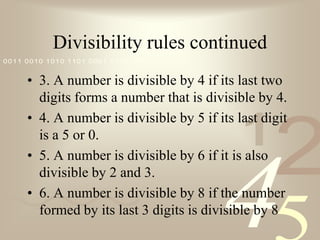
Divisibility rules continued3. A number is divisible by 4 if its last two digits forms a number that is divisible by 4.4. A number is divisible by 5 if its last digit is a 5 or 0.5. A number is divisible by 6 if it is also divisible by 2 and 3.6. A number is divisible by 8 if the number formed by its last 3 digits is divisible by 8
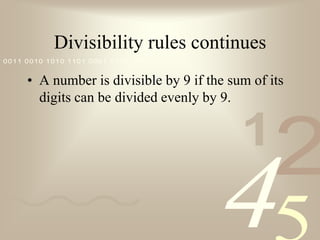
Divisibility rules continuesA number is divisible by 9 if the sum of its digits can be divided evenly by 9.
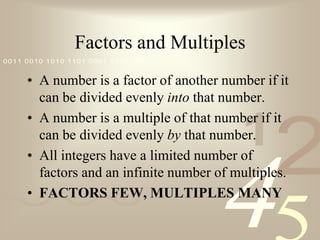
Factors and MultiplesA number is a factor of another number if it can be divided evenly into that number.A number is a multiple of that number if it can be divided evenly by that number.All integers have a limited number of factors and an infinite number of multiples.FACTORS FEW, MULTIPLES MANY
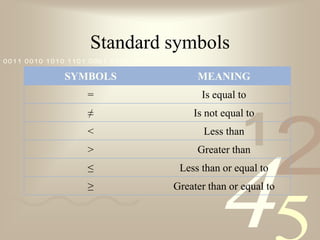
Standard symbols
ExponentsAn exponent is a short hand way of writing the value of a number multiplied several times by itself.The larger number is called the base and the upper number is called the exponent.
Multiplying numbers with the same baseWhen you multiply numbers that have the same base, you simply add the exponents
Dividing numbers with the same baseWhen dividing exponents with the same base, you simple subtract the bottom exponent from the top exponent.
Negative powersA negative power is simply the reciprocal of a positive power.
Fractional powersWhen a number is raised to a fractional power, the numerator functions like a real exponent, and the denominator functions as the index.
Raising a power to a powerWhen you raise a power to a power you simply multiply the exponents
The Zero PowerANYTHING to the zero power is 1
The First PowerANYTHING to the power of 1 is itself
Distributing exponentsWhen several numbers are inside parenthesis, the exponent outside the parenthesis must be distributed to all of the numbers within.
But watch out for…Exponents are shorthand for multiplication, so the rules apply only when you multiply or divide the same base.
RadicalsThe square root of a positive number x is the number that when squared, equals x.On the ACT you will not have to worry about negative exponents.The cubed root of a positive number x is the number that, when cubed, equals x.
RadicalsBe sure that you know how to use you calculator more than just the square root and simple exponents.  The ACT is going to have fractional exponents, negative exponents, and all sorts of weird roots.

Chapter 10 Math Basics

  • 1.
  • 2.
    Look at thefollowing problem: How many even prime numbers are there between 0 and 100.A. 0B. 1C. 2D. 3E. 4
  • 3.
    The answer is(B)If you know what the terms even and prime mean, then this problem is a snap. Without knowledge of the problem is impossible. We will begin our math review by going over all the basic terms and operations covered on the ACT.
  • 4.
    MATH TERMINOLOGYMake surethat you are familiar with math terminology. Many partial answers rely on the misinterpretation of key terms; don’t be a vicitm!
  • 5.
    Basic Terms: RealnumbersReal numbers are all the number you think of when you think of numbers. 5, ¼, 7.9, √2, are all real numbersThey include everything except imaginary numbers, which appear only occasionally on the ACT.
  • 6.
    Basic terms: rationalnumbersAny number that can be written as a whole number, a fraction, or a repeating decimal is a rational number. 5, 1/5, and .333 are rational numbersMost of the numbers you’ll see on th ACT are rational numbers
  • 7.
    Basic terms: irrationalnumbersAn irrational number cannot be written as an integer over another integer. ∏ is irrational and like other irrational numbers it goes on forever.Other irrational numbers include any square root of a number that does not have a perfect square root.√3 and √2 are irrational, but √4, which simplifies to 2 is rational
  • 8.
    Basic terms: integersIntegersinclude everything except what we normally think of as fractions or decimals.2, 134, -56, 0 and 7 are all integers
  • 9.
    Basic terms: positiveand negativePositive numbers are to the right of the 0 on a number line and negative numbers are to the left of the 0 on the number line.Zero itself is neither positive or negativeThere are 3 rules for positive and negative multiplication positive x positive = positive positive x negative = negative negative x negative = positive
  • 10.
    Basic terms: evenand odd numbersEven numbers are numbers that can be divided by 2 ( with no remainder)Odd numbers are integers that cannot be divided evenly by 2 NOTE that 0 is even
  • 11.
    Basic terms: digitsThereare ten digits: 0,1,2,3,4,5,6,7,8,9The number 364 has three digits – 3 ,6 and 4. 4 is called the ones digit, 6 is the tens digit, and 3 is the hundreds digit.Other digits include tenths, digit, hundredths digit, and thousandths digit
  • 12.
    Basic terms: primenumbersA prime number can be divided evenly by two and only two distinct factors – 1 and itself. Thus 2,3,5,7,11,13 are all prime numbersThe number 2 is the only even prime numberNeither 0 nor 1 are prime numbersThere are no negative prime numbers
  • 13.
    Basic terms: AbsolutevalueThe absolute value of a number is the distance between that number and 0 on the number line.
  • 14.
    Basic terms: variablesand coefficientsIn the expression 3x + 4y, the x and y are called variables because we don’t know what they are.3 and 4 are called coefficients because you multiply the variables by them.
  • 15.
    BASIC OPERATIONSKnowing therules of divisibility can be very useful on the ACT.The rules are as follows:1. A number is divisible by 2 if its ones digit can be divided evenly by 2. In other words it is an even number.2. A number is divisible by 3 if the sum of its digits can be divided evenly by 3.
  • 16.
    Divisibility rules continued3.A number is divisible by 4 if its last two digits forms a number that is divisible by 4.4. A number is divisible by 5 if its last digit is a 5 or 0.5. A number is divisible by 6 if it is also divisible by 2 and 3.6. A number is divisible by 8 if the number formed by its last 3 digits is divisible by 8
  • 17.
    Divisibility rules continuesAnumber is divisible by 9 if the sum of its digits can be divided evenly by 9.
  • 18.
    Factors and MultiplesAnumber is a factor of another number if it can be divided evenly into that number.A number is a multiple of that number if it can be divided evenly by that number.All integers have a limited number of factors and an infinite number of multiples.FACTORS FEW, MULTIPLES MANY
  • 19.
  • 20.
    ExponentsAn exponent isa short hand way of writing the value of a number multiplied several times by itself.The larger number is called the base and the upper number is called the exponent.
  • 21.
    Multiplying numbers withthe same baseWhen you multiply numbers that have the same base, you simply add the exponents
  • 22.
    Dividing numbers withthe same baseWhen dividing exponents with the same base, you simple subtract the bottom exponent from the top exponent.
  • 23.
    Negative powersA negativepower is simply the reciprocal of a positive power.
  • 24.
    Fractional powersWhen anumber is raised to a fractional power, the numerator functions like a real exponent, and the denominator functions as the index.
  • 25.
    Raising a powerto a powerWhen you raise a power to a power you simply multiply the exponents
  • 26.
    The Zero PowerANYTHINGto the zero power is 1
  • 27.
    The First PowerANYTHINGto the power of 1 is itself
  • 28.
    Distributing exponentsWhen severalnumbers are inside parenthesis, the exponent outside the parenthesis must be distributed to all of the numbers within.
  • 29.
    But watch outfor…Exponents are shorthand for multiplication, so the rules apply only when you multiply or divide the same base.
  • 30.
    RadicalsThe square rootof a positive number x is the number that when squared, equals x.On the ACT you will not have to worry about negative exponents.The cubed root of a positive number x is the number that, when cubed, equals x.
  • 31.
    RadicalsBe sure thatyou know how to use you calculator more than just the square root and simple exponents. The ACT is going to have fractional exponents, negative exponents, and all sorts of weird roots.