

CHAPTER FIVE The Open Economy
Chapter objectives accounting identities for the open economy small open economy model what makes it “small” how the trade balance and exchange rate are determined how policies affect trade balance & exchange rate
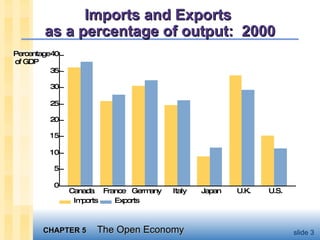
Imports and Exports  as a percentage of output:  2000 Percentage of GDP 40 35 30 25 20 15 10 5 0 Canada France Germany Italy Japan U.K. U.S. Imports Exports
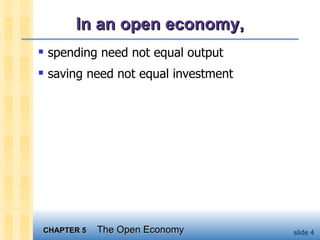
In an open economy, spending need not equal output saving need not equal investment
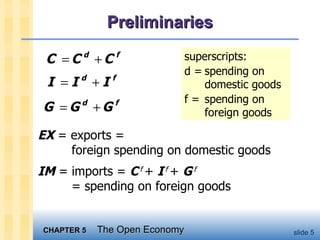
Preliminaries EX  = exports =  foreign spending on domestic goods IM  = imports =  C   f   +  I   f   +  G   f   = spending on foreign goods superscripts: d = spending on domestic goods f = spending on foreign goods
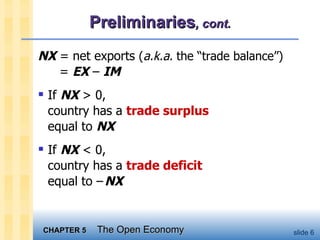
Preliminaries , cont. NX  = net exports  ( a.k.a.  the “trade balance”)     =  EX  –  IM If  NX  > 0,  country has a  trade surplus   equal to  NX If  NX  < 0, country has a  trade deficit   equal to –   NX
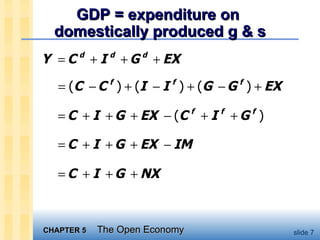
GDP = expenditure on  domestically produced g & s
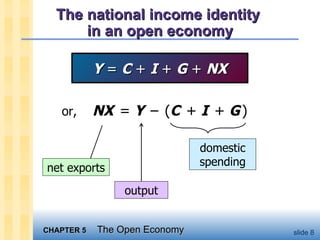
The national income identity  in an open economy Y  =  C  +  I  +  G  +  NX or,  NX   =  Y   –  ( C   +  I   +  G   ) net exports domestic spending output
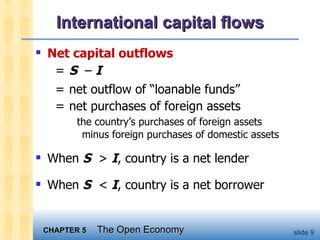
International capital flows Net capital outflows S   –  I net outflow of “loanable funds” net purchases of foreign assets   the country’s purchases of foreign assets    minus foreign purchases of domestic assets When  S   >  I , country is a net lender When  S   <  I , country is a net borrower
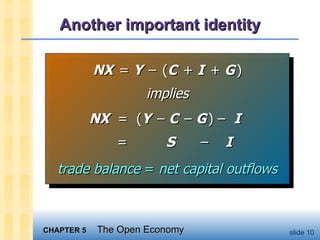
Another important identity NX   =  Y   –  ( C   +  I   +  G   ) implies NX   =  ( Y   –  C   –  G   ) –  I   =  S   –  I trade balance  =  net capital outflows
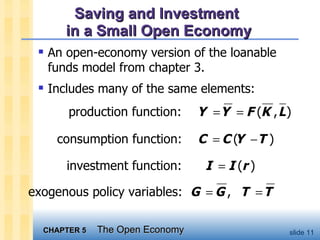
Saving and Investment  in a Small Open Economy An open-economy version of the loanable funds model from chapter 3. Includes many of the same elements:
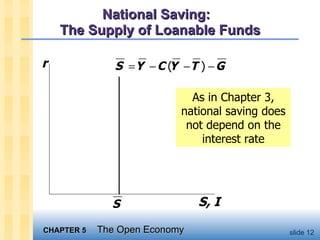
National Saving:  The Supply of Loanable Funds As in Chapter 3, national saving does not depend on the interest rate r S, I
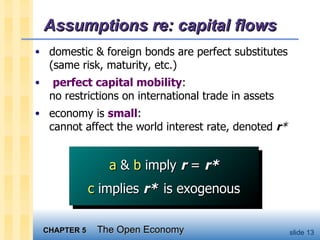
Assumptions re: capital flows domestic & foreign bonds are perfect substitutes (same risk, maturity, etc.) perfect capital mobility : no restrictions on international trade in assets economy is  small : cannot affect the world interest rate, denoted  r * a  &  b  imply  r  =  r* c  implies  r*   is exogenous
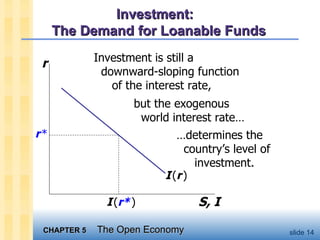
Investment:  The Demand for Loanable Funds Investment is still a    downward-sloping function   of the interest rate, r   * but the exogenous    world interest rate… … determines the   country’s level of   investment. I   ( r*   ) r S, I I   ( r   )
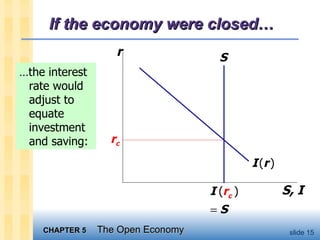
If the economy were closed… … the interest rate would adjust to  equate  investment  and saving: r S, I I   ( r   ) r c
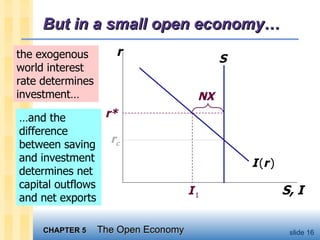
But in a small open economy… the exogenous world interest rate determines investment… … and the difference between saving and investment determines net capital outflows and net exports NX r S, I I   ( r   ) r c r* I   1
Three experiments 1. Fiscal policy at home 2. Fiscal policy abroad 3.  An increase in investment demand
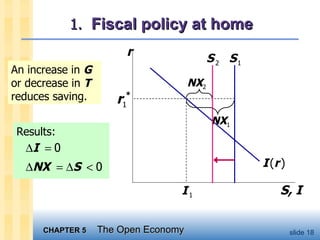
1.  Fiscal policy at home An increase in  G  or decrease in  T  reduces saving. r S, I I   ( r   ) I   1 NX 1 NX 2 Results:
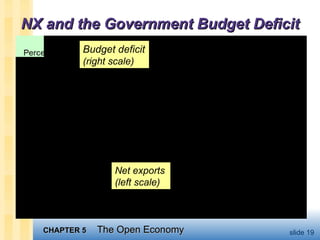
NX and the Government Budget Deficit Budget deficit (right scale) Net exports (left scale)
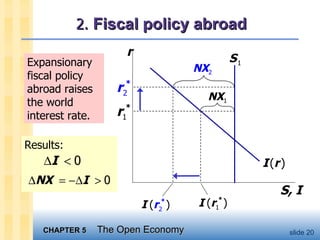
2.  Fiscal policy abroad Expansionary fiscal policy abroad raises the world interest rate. Results:  r S, I I   ( r   ) NX 1 NX 2
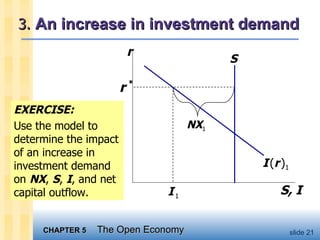
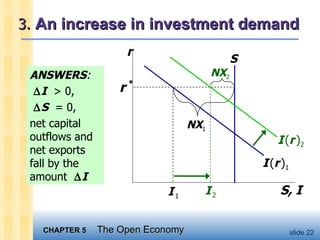
3.  An increase in investment demand EXERCISE: Use the model to determine the impact of an increase in investment demand on  NX ,  S ,  I , and net capital outflow. r S, I I   ( r   ) 1 NX 1 I   1 S
3.  An increase in investment demand ANSWERS :  I   > 0,  S   = 0, net capital outflows and net exports  fall by the amount   I   r S, I I   ( r   ) 1 NX 2 NX 1 I   1 I   2 S I   ( r   ) 2
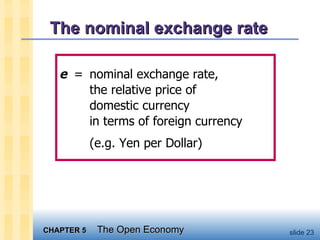
The nominal exchange rate e  =  nominal exchange rate,  the relative price of  domestic currency  in terms of foreign currency  (e.g. Yen per Dollar)
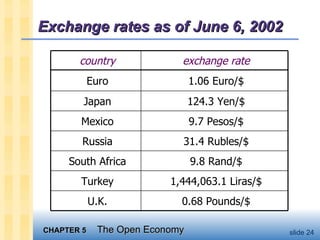
Exchange rates as of June 6, 2002 9.7 Pesos/$ Mexico 1,444,063.1 Liras/$ Turkey 0.68 Pounds/$ U.K. 31.4 Rubles/$ Russia 1.06 Euro/$ Euro exchange rate country 9.8 Rand/$ South Africa 124.3 Yen/$ Japan
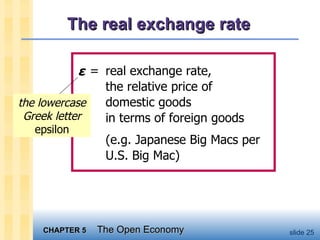
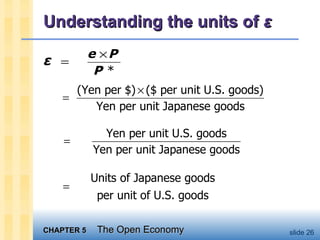
The real exchange rate =  real exchange rate,  the relative price of  domestic goods  in terms of foreign goods  (e.g. Japanese Big Macs per U.S. Big Mac) ε the lowercase Greek letter  epsilon
Understanding the units of  ε ε
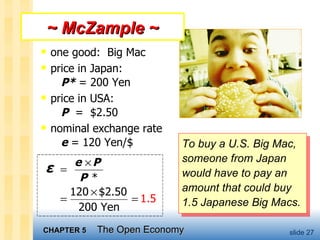
one good:  Big Mac price in Japan:    P*  = 200 Yen price in USA:    P   =  $2.50 nominal exchange rate    e  = 120 Yen/$ ~ McZample ~ To buy a U.S. Big Mac, someone from Japan  would have to pay an amount that could buy  1.5 Japanese Big Macs. ε
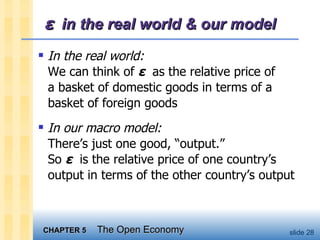
ε   in the real world & our model In the real world: We can think of  ε   as the relative price of  a basket of domestic goods in terms of a basket of foreign goods In our macro model: There’s just one good, “output.” So  ε   is the relative price of one country’s output in terms of the other country’s output
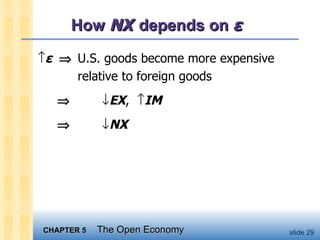
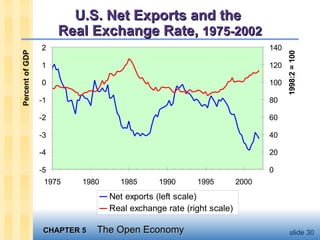
How  NX   depends on  ε    ε     U.S. goods become more expensive relative to foreign goods      EX ,   IM     NX
U.S. Net Exports and the  Real Exchange Rate,  1975-2002
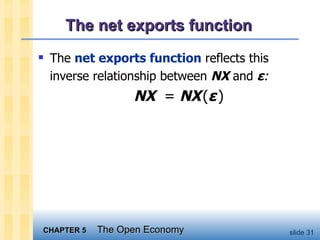
The net exports function The  net exports function  reflects this inverse relationship between  NX  and  ε : NX   =  NX   ( ε   )
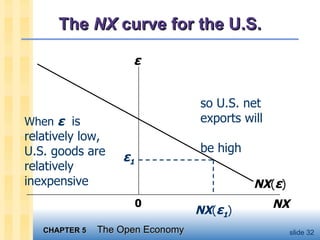
The  NX  curve for the U.S. 0 NX ε NX ( ε ) ε 1 When  ε   is relatively low,  U.S. goods are relatively inexpensive NX ( ε 1 ) so U.S. net exports will  be high
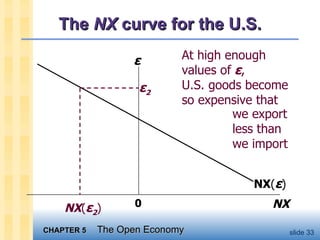
The  NX  curve for the U.S. 0 NX ε NX ( ε ) ε 2 At high enough values of   ε ,  U.S. goods become so expensive that  NX ( ε 2 ) we export less than we import
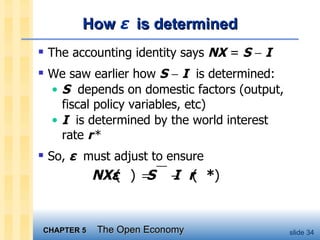
How  ε   is determined The accounting identity says  NX  =  S      I We saw earlier how  S      I   is determined: S   depends on domestic factors (output, fiscal policy variables, etc) I   is determined by the world interest  rate  r   * So,  ε   must adjust to ensure
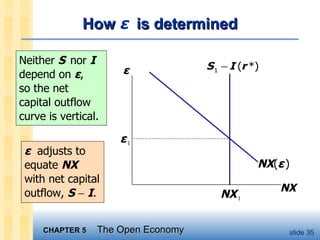
How  ε   is determined Neither  S   nor  I  depend on  ε ,  so the net capital outflow curve is vertical.  ε   adjusts to equate  NX   with net capital outflow,  S      I . ε   1 NX   1 ε NX NX ( ε   )
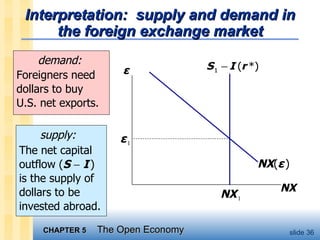
Interpretation:  supply and demand in the foreign exchange market demand:  Foreigners need dollars to buy U.S. net exports. supply:  The net capital outflow ( S      I   )  is the supply of dollars to be invested abroad. ε   1 NX   1 ε NX NX ( ε   )
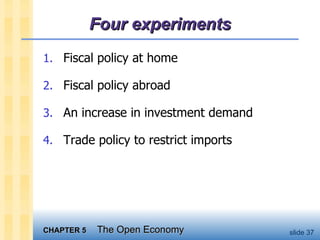
Four experiments 1. Fiscal policy at home 2. Fiscal policy abroad 3.  An increase in investment demand 4.  Trade policy to restrict imports
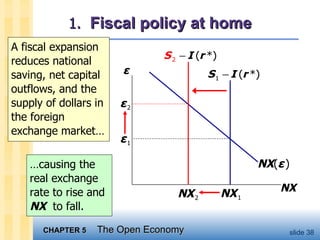
1.  Fiscal policy at home A fiscal expansion reduces national saving, net capital outflows, and the supply of dollars in the foreign exchange market…  … causing the real exchange rate to rise and  NX   to fall. ε NX NX ( ε   ) ε   1 NX   1 NX   2 ε   2
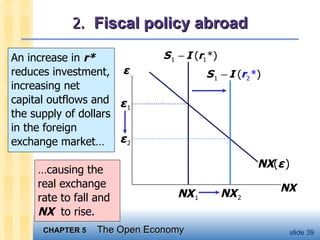
2.  Fiscal policy abroad An increase in  r*  reduces investment, increasing net capital outflows and the supply of dollars in the foreign exchange market…  … causing the real exchange rate to fall and  NX   to rise. ε NX NX ( ε   ) NX   1 ε   1 ε   2 NX   2
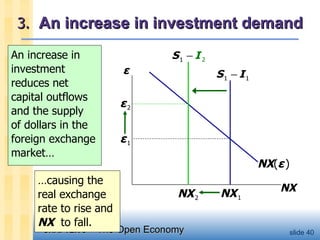
3.  An increase in investment demand An increase in investment reduces net capital outflows and the supply  of dollars in the foreign exchange market…  … causing the real exchange rate to rise and  NX   to fall. ε NX NX ( ε   ) ε   1 NX   1 NX   2 ε   2
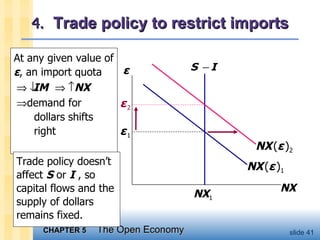
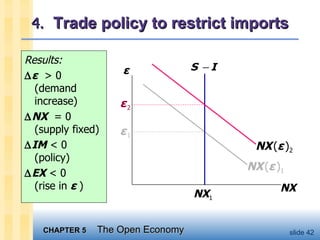
4.  Trade policy to restrict imports At any given value of  ε , an import quota   IM    NX  demand for  dollars shifts  right Trade policy doesn’t affect  S  or  I  , so capital flows and the supply of dollars remains fixed. ε NX NX   ( ε   ) 1 NX 1 ε   1 NX   ( ε   ) 2 ε   2
4.  Trade policy to restrict imports Results:  ε   > 0  (demand increase)  NX   = 0 (supply fixed)   IM  < 0  (policy)  EX  < 0 (rise in  ε  ) ε NX NX   ( ε   ) 1 NX 1 ε   1 NX   ( ε   ) 2 ε   2
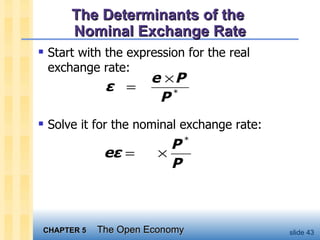
The Determinants of the  Nominal Exchange Rate Start with the expression for the real exchange rate: Solve it for the nominal exchange rate:
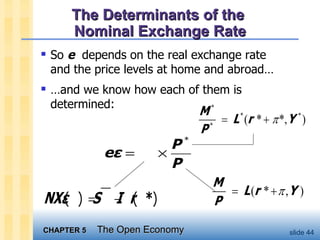
The Determinants of the  Nominal Exchange Rate So  e   depends on the real exchange rate and the price levels at home and abroad… … and we know how each of them is determined:
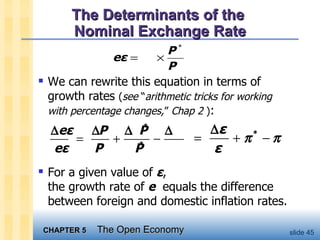
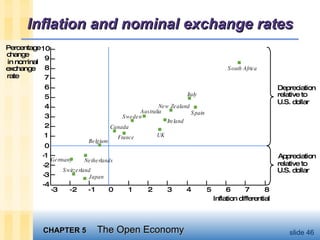
The Determinants of the  Nominal Exchange Rate We can rewrite this equation in terms of growth rates  ( see  “ arithmetic tricks for working with percentage changes, ”  Chap 2  ) : For a given value of  ε ,  the growth rate of  e   equals the difference between foreign and domestic inflation rates.
Inflation and nominal exchange rates Percentage  change in nominal exchange  rate 10  9  8  7  6  5  4  3  2  1  0  - 1  - 2  - 3  - 4 Inflation differential Depreciation relative to  U.S. dollar Appreciation relative to  U.S. dollar - 1 - 2 - 3 1 0 2 3 4 5 6 8 7 France Canada Sweden Australia UK Ireland Spain South Africa Italy New Zealand Netherlands Germany Japan Belgium Switzerland
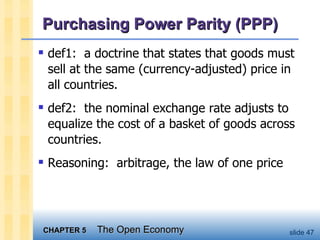
Purchasing Power Parity (PPP) def1:  a doctrine that states that goods must sell at the same (currency-adjusted) price in all countries. def2:  the nominal exchange rate adjusts to equalize the cost of a basket of goods across countries.  Reasoning:  arbitrage, the law of one price
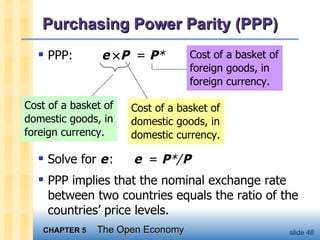
Purchasing Power Parity (PPP) PPP:  e   P   =  P *   Solve for  e   :  e  =  P */   P   PPP implies that the nominal exchange rate between two countries equals the ratio of the countries’ price levels.  Cost of a basket of domestic goods, in foreign currency. Cost of a basket of domestic goods, in domestic currency. Cost of a basket of foreign goods, in foreign currency.
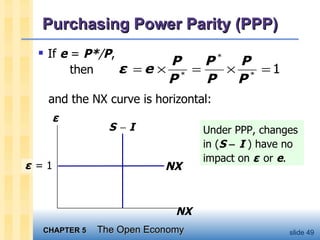
Purchasing Power Parity (PPP) If  e  =  P* / P ,  then  and the NX curve is horizontal: Under PPP, changes in ( S   I  ) have no impact on  ε   or  e .  ε NX NX ε   = 1 S     I
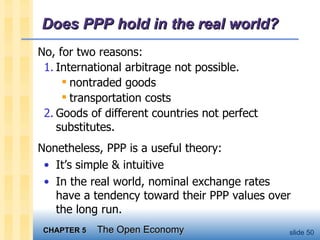
Does PPP hold in the real world? No, for two reasons: 1. International arbitrage not possible. nontraded goods transportation costs 2. Goods of different countries not perfect substitutes. Nonetheless, PPP is a useful theory: It’s simple & intuitive In the real world, nominal exchange rates have a tendency toward their PPP values over the long run.
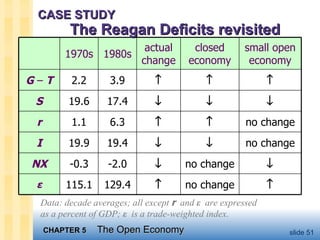
CASE STUDY The Reagan Deficits revisited Data: decade averages; all except  r   and  ε   are expressed  as a percent of GDP;  ε   is a trade-weighted index.  no change no change       no change no change         129.4 -2.0 19.4 6.3 17.4 3.9 115.1 -0.3 19.9 1.1 19.6 2.2 closed economy small open economy actual change ε NX I r S G  –  T 1980s 1970s
The U.S. as a large open economy So far, we’ve learned long-run models for  two extreme cases: closed economy (chapter 3) small open economy (chapter 5) A large open economy---like the U.S.---is in between these two extremes.  The analysis of policies or other exogenous changes in a large open economy is a mixture of the results for the closed & small open economy cases.  For example…
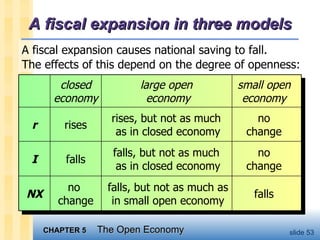
A fiscal expansion in three models falls, but not as much as in small open economy falls no  change falls, but not as much  as in closed economy no change falls rises, but not as much  as in closed economy no change rises A fiscal expansion causes national saving to fall. The effects of this depend on the degree of openness: NX I r large open  economy small open economy closed economy
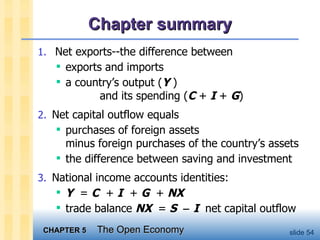
Chapter summary 1.   Net exports--the difference between  exports and imports a country’s output ( Y  )    and its spending ( C  +  I  +  G ) 2. Net capital outflow equals purchases of foreign assets  minus foreign purchases of the country’s assets the difference between saving and investment 3. National income accounts identities: Y   =  C   +  I   +  G  +  NX trade balance  NX  =  S    I  net capital outflow
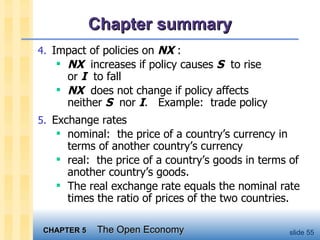
Chapter summary 4. Impact of policies on  NX  : NX   increases if policy causes  S   to rise  or  I   to fall NX   does not change if policy affects  neither  S   nor  I .  Example:  trade policy 5. Exchange rates nominal:  the price of a country’s currency in terms of another country’s currency real:  the price of a country’s goods in terms of another country’s goods. The real exchange rate equals the nominal rate times the ratio of prices of the two countries.
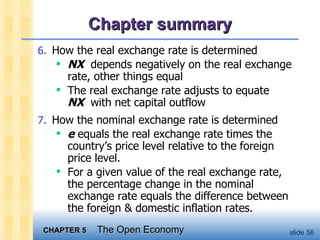
Chapter summary 6. How the real exchange rate is determined NX   depends negatively on the real exchange rate, other things equal The real exchange rate adjusts to equate  NX   with net capital outflow 7. How the nominal exchange rate is determined e  equals the real exchange rate times the country’s price level relative to the foreign price level.  For a given value of the real exchange rate, the percentage change in the nominal exchange rate equals the difference between the foreign & domestic inflation rates.
 

MACROECONOMICS-CH5

  • 1.
    CHAPTER FIVE TheOpen Economy
  • 2.
    Chapter objectives accountingidentities for the open economy small open economy model what makes it “small” how the trade balance and exchange rate are determined how policies affect trade balance & exchange rate
  • 3.
    Imports and Exports as a percentage of output: 2000 Percentage of GDP 40 35 30 25 20 15 10 5 0 Canada France Germany Italy Japan U.K. U.S. Imports Exports
  • 4.
    In an openeconomy, spending need not equal output saving need not equal investment
  • 5.
    Preliminaries EX = exports = foreign spending on domestic goods IM = imports = C f + I f + G f = spending on foreign goods superscripts: d = spending on domestic goods f = spending on foreign goods
  • 6.
    Preliminaries , cont.NX = net exports ( a.k.a. the “trade balance”) = EX – IM If NX > 0, country has a trade surplus equal to NX If NX < 0, country has a trade deficit equal to – NX
  • 7.
    GDP = expenditureon domestically produced g & s
  • 8.
    The national incomeidentity in an open economy Y = C + I + G + NX or, NX = Y – ( C + I + G ) net exports domestic spending output
  • 9.
    International capital flowsNet capital outflows S – I net outflow of “loanable funds” net purchases of foreign assets the country’s purchases of foreign assets minus foreign purchases of domestic assets When S > I , country is a net lender When S < I , country is a net borrower
  • 10.
    Another important identityNX = Y – ( C + I + G ) implies NX = ( Y – C – G ) – I = S – I trade balance = net capital outflows
  • 11.
    Saving and Investment in a Small Open Economy An open-economy version of the loanable funds model from chapter 3. Includes many of the same elements:
  • 12.
    National Saving: The Supply of Loanable Funds As in Chapter 3, national saving does not depend on the interest rate r S, I
  • 13.
    Assumptions re: capitalflows domestic & foreign bonds are perfect substitutes (same risk, maturity, etc.) perfect capital mobility : no restrictions on international trade in assets economy is small : cannot affect the world interest rate, denoted r * a & b imply r = r* c implies r* is exogenous
  • 14.
    Investment: TheDemand for Loanable Funds Investment is still a downward-sloping function of the interest rate, r * but the exogenous world interest rate… … determines the country’s level of investment. I ( r* ) r S, I I ( r )
  • 15.
    If the economywere closed… … the interest rate would adjust to equate investment and saving: r S, I I ( r ) r c
  • 16.
    But in asmall open economy… the exogenous world interest rate determines investment… … and the difference between saving and investment determines net capital outflows and net exports NX r S, I I ( r ) r c r* I 1
  • 17.
    Three experiments 1.Fiscal policy at home 2. Fiscal policy abroad 3. An increase in investment demand
  • 18.
    1. Fiscalpolicy at home An increase in G or decrease in T reduces saving. r S, I I ( r ) I 1 NX 1 NX 2 Results:
  • 19.
    NX and theGovernment Budget Deficit Budget deficit (right scale) Net exports (left scale)
  • 20.
    2. Fiscalpolicy abroad Expansionary fiscal policy abroad raises the world interest rate. Results: r S, I I ( r ) NX 1 NX 2
  • 21.
    3. Anincrease in investment demand EXERCISE: Use the model to determine the impact of an increase in investment demand on NX , S , I , and net capital outflow. r S, I I ( r ) 1 NX 1 I 1 S
  • 22.
    3. Anincrease in investment demand ANSWERS :  I > 0,  S = 0, net capital outflows and net exports fall by the amount  I r S, I I ( r ) 1 NX 2 NX 1 I 1 I 2 S I ( r ) 2
  • 23.
    The nominal exchangerate e = nominal exchange rate, the relative price of domestic currency in terms of foreign currency (e.g. Yen per Dollar)
  • 24.
    Exchange rates asof June 6, 2002 9.7 Pesos/$ Mexico 1,444,063.1 Liras/$ Turkey 0.68 Pounds/$ U.K. 31.4 Rubles/$ Russia 1.06 Euro/$ Euro exchange rate country 9.8 Rand/$ South Africa 124.3 Yen/$ Japan
  • 25.
    The real exchangerate = real exchange rate, the relative price of domestic goods in terms of foreign goods (e.g. Japanese Big Macs per U.S. Big Mac) ε the lowercase Greek letter epsilon
  • 26.
  • 27.
    one good: Big Mac price in Japan: P* = 200 Yen price in USA: P = $2.50 nominal exchange rate e = 120 Yen/$ ~ McZample ~ To buy a U.S. Big Mac, someone from Japan would have to pay an amount that could buy 1.5 Japanese Big Macs. ε
  • 28.
    ε in the real world & our model In the real world: We can think of ε as the relative price of a basket of domestic goods in terms of a basket of foreign goods In our macro model: There’s just one good, “output.” So ε is the relative price of one country’s output in terms of the other country’s output
  • 29.
    How NX depends on ε  ε  U.S. goods become more expensive relative to foreign goods   EX ,  IM   NX
  • 30.
    U.S. Net Exportsand the Real Exchange Rate, 1975-2002
  • 31.
    The net exportsfunction The net exports function reflects this inverse relationship between NX and ε : NX = NX ( ε )
  • 32.
    The NX curve for the U.S. 0 NX ε NX ( ε ) ε 1 When ε is relatively low, U.S. goods are relatively inexpensive NX ( ε 1 ) so U.S. net exports will be high
  • 33.
    The NX curve for the U.S. 0 NX ε NX ( ε ) ε 2 At high enough values of ε , U.S. goods become so expensive that NX ( ε 2 ) we export less than we import
  • 34.
    How ε is determined The accounting identity says NX = S  I We saw earlier how S  I is determined: S depends on domestic factors (output, fiscal policy variables, etc) I is determined by the world interest rate r * So, ε must adjust to ensure
  • 35.
    How ε is determined Neither S nor I depend on ε , so the net capital outflow curve is vertical. ε adjusts to equate NX with net capital outflow, S  I . ε 1 NX 1 ε NX NX ( ε )
  • 36.
    Interpretation: supplyand demand in the foreign exchange market demand: Foreigners need dollars to buy U.S. net exports. supply: The net capital outflow ( S  I ) is the supply of dollars to be invested abroad. ε 1 NX 1 ε NX NX ( ε )
  • 37.
    Four experiments 1.Fiscal policy at home 2. Fiscal policy abroad 3. An increase in investment demand 4. Trade policy to restrict imports
  • 38.
    1. Fiscalpolicy at home A fiscal expansion reduces national saving, net capital outflows, and the supply of dollars in the foreign exchange market… … causing the real exchange rate to rise and NX to fall. ε NX NX ( ε ) ε 1 NX 1 NX 2 ε 2
  • 39.
    2. Fiscalpolicy abroad An increase in r* reduces investment, increasing net capital outflows and the supply of dollars in the foreign exchange market… … causing the real exchange rate to fall and NX to rise. ε NX NX ( ε ) NX 1 ε 1 ε 2 NX 2
  • 40.
    3. Anincrease in investment demand An increase in investment reduces net capital outflows and the supply of dollars in the foreign exchange market… … causing the real exchange rate to rise and NX to fall. ε NX NX ( ε ) ε 1 NX 1 NX 2 ε 2
  • 41.
    4. Tradepolicy to restrict imports At any given value of ε , an import quota  IM  NX  demand for dollars shifts right Trade policy doesn’t affect S or I , so capital flows and the supply of dollars remains fixed. ε NX NX ( ε ) 1 NX 1 ε 1 NX ( ε ) 2 ε 2
  • 42.
    4. Tradepolicy to restrict imports Results:  ε  > 0 (demand increase)  NX = 0 (supply fixed)  IM < 0 (policy)  EX < 0 (rise in ε ) ε NX NX ( ε ) 1 NX 1 ε 1 NX ( ε ) 2 ε 2
  • 43.
    The Determinants ofthe Nominal Exchange Rate Start with the expression for the real exchange rate: Solve it for the nominal exchange rate:
  • 44.
    The Determinants ofthe Nominal Exchange Rate So e depends on the real exchange rate and the price levels at home and abroad… … and we know how each of them is determined:
  • 45.
    The Determinants ofthe Nominal Exchange Rate We can rewrite this equation in terms of growth rates ( see “ arithmetic tricks for working with percentage changes, ” Chap 2 ) : For a given value of ε , the growth rate of e equals the difference between foreign and domestic inflation rates.
  • 46.
    Inflation and nominalexchange rates Percentage change in nominal exchange rate 10 9 8 7 6 5 4 3 2 1 0 - 1 - 2 - 3 - 4 Inflation differential Depreciation relative to U.S. dollar Appreciation relative to U.S. dollar - 1 - 2 - 3 1 0 2 3 4 5 6 8 7 France Canada Sweden Australia UK Ireland Spain South Africa Italy New Zealand Netherlands Germany Japan Belgium Switzerland
  • 47.
    Purchasing Power Parity(PPP) def1: a doctrine that states that goods must sell at the same (currency-adjusted) price in all countries. def2: the nominal exchange rate adjusts to equalize the cost of a basket of goods across countries. Reasoning: arbitrage, the law of one price
  • 48.
    Purchasing Power Parity(PPP) PPP: e  P = P * Solve for e : e = P */ P PPP implies that the nominal exchange rate between two countries equals the ratio of the countries’ price levels. Cost of a basket of domestic goods, in foreign currency. Cost of a basket of domestic goods, in domestic currency. Cost of a basket of foreign goods, in foreign currency.
  • 49.
    Purchasing Power Parity(PPP) If e = P* / P , then and the NX curve is horizontal: Under PPP, changes in ( S  I ) have no impact on ε or e . ε NX NX ε = 1 S  I
  • 50.
    Does PPP holdin the real world? No, for two reasons: 1. International arbitrage not possible. nontraded goods transportation costs 2. Goods of different countries not perfect substitutes. Nonetheless, PPP is a useful theory: It’s simple & intuitive In the real world, nominal exchange rates have a tendency toward their PPP values over the long run.
  • 51.
    CASE STUDY TheReagan Deficits revisited Data: decade averages; all except r and ε are expressed as a percent of GDP; ε is a trade-weighted index. no change no change       no change no change         129.4 -2.0 19.4 6.3 17.4 3.9 115.1 -0.3 19.9 1.1 19.6 2.2 closed economy small open economy actual change ε NX I r S G – T 1980s 1970s
  • 52.
    The U.S. asa large open economy So far, we’ve learned long-run models for two extreme cases: closed economy (chapter 3) small open economy (chapter 5) A large open economy---like the U.S.---is in between these two extremes. The analysis of policies or other exogenous changes in a large open economy is a mixture of the results for the closed & small open economy cases. For example…
  • 53.
    A fiscal expansionin three models falls, but not as much as in small open economy falls no change falls, but not as much as in closed economy no change falls rises, but not as much as in closed economy no change rises A fiscal expansion causes national saving to fall. The effects of this depend on the degree of openness: NX I r large open economy small open economy closed economy
  • 54.
    Chapter summary 1. Net exports--the difference between exports and imports a country’s output ( Y ) and its spending ( C + I + G ) 2. Net capital outflow equals purchases of foreign assets minus foreign purchases of the country’s assets the difference between saving and investment 3. National income accounts identities: Y = C + I + G + NX trade balance NX = S  I net capital outflow
  • 55.
    Chapter summary 4.Impact of policies on NX : NX increases if policy causes S to rise or I to fall NX does not change if policy affects neither S nor I . Example: trade policy 5. Exchange rates nominal: the price of a country’s currency in terms of another country’s currency real: the price of a country’s goods in terms of another country’s goods. The real exchange rate equals the nominal rate times the ratio of prices of the two countries.
  • 56.
    Chapter summary 6.How the real exchange rate is determined NX depends negatively on the real exchange rate, other things equal The real exchange rate adjusts to equate NX with net capital outflow 7. How the nominal exchange rate is determined e equals the real exchange rate times the country’s price level relative to the foreign price level. For a given value of the real exchange rate, the percentage change in the nominal exchange rate equals the difference between the foreign & domestic inflation rates.
  • 57.

Editor's Notes

  • #2 Chapter 5 extends the analysis to a small open economy. NOTE: If you are planning on covering chapter 12 (Aggregate Demand in the Open Economy), then covering this chapter is highly recommended.