Eco 328
purchasing power parity
The Law of One Price
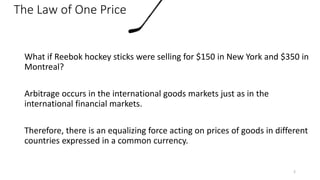
What if Reebok hockey sticks were selling for $150 in New York and $350 in
Montreal?
Arbitrage occurs in the international goods markets just as in the
international financial markets.
Therefore, there is an equalizing force acting on prices of goods in different
countries expressed in a common currency.
2
3
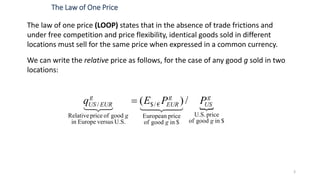
The law of one price (LOOP) states that in the absence of trade frictions and
under free competition and price flexibility, identical goods sold in different
locations must sell for the same price when expressed in a common currency.
We can write the relative price as follows, for the case of any good g sold in two
locations:
The Law of One Price

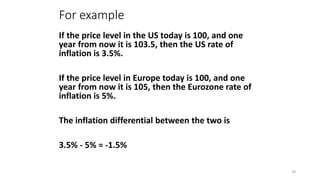
$ingoodof
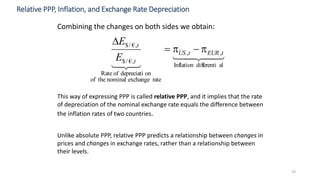
priceU.S.
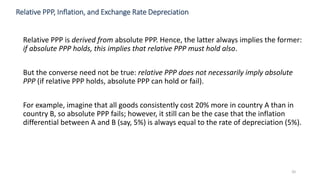
$ingoodof
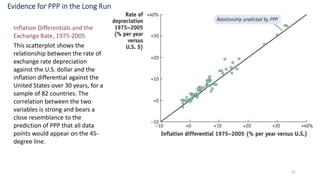
priceEuropean
€/$
U.S.versusEuropein
goodofpriceRelative
/ /)(
g
g
US
g
g
EUR
g
g
EURUS PPEq


4
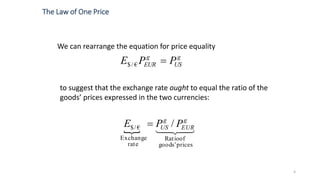
We can rearrange the equation for price equality
The Law of One Price
to suggest that the exchange rate ought to equal the ratio of the
goods’ prices expressed in the two currencies:
g
US
g
EUR PPE €/$
 
pricesgoods’
ofRatio
rate
Exchange
€/$ / g
EUR
g
US PPE 
Purchasing Power Parity
Suppose now one put together a basket of goods, including not just
hockey sticks, but milk, eggs and gasoline too.
What would happen if the same two baskets were selling for different
amounts of $$ in the US and Canada?
Same thing – goods arbitrage until the same basket of goods sells for
the same price in both countries when expressed in a common
currency.
5
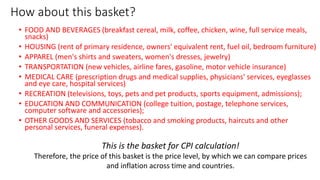
How about this basket?
• FOOD AND BEVERAGES (breakfast cereal, milk, coffee, chicken, wine, full service meals,
snacks)
• HOUSING (rent of primary residence, owners' equivalent rent, fuel oil, bedroom furniture)
• APPAREL (men's shirts and sweaters, women's dresses, jewelry)
• TRANSPORTATION (new vehicles, airline fares, gasoline, motor vehicle insurance)
• MEDICAL CARE (prescription drugs and medical supplies, physicians' services, eyeglasses
and eye care, hospital services)
• RECREATION (televisions, toys, pets and pet products, sports equipment, admissions);
• EDUCATION AND COMMUNICATION (college tuition, postage, telephone services,
computer software and accessories);
• OTHER GOODS AND SERVICES (tobacco and smoking products, haircuts and other
personal services, funeral expenses).
This is the basket for CPI calculation!
Therefore, the price of this basket is the price level, by which we can compare prices
and inflation across time and countries.
7
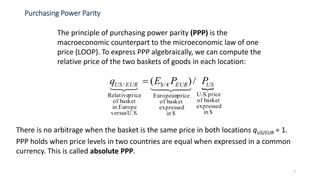
The principle of purchasing power parity (PPP) is the
macroeconomic counterpart to the microeconomic law of one
price (LOOP). To express PPP algebraically, we can compute the
relative price of the two baskets of goods in each location:
Purchasing Power Parity

$in
expressed
basketof
priceU.S.
$in
expressed
basketof
priceEuropean
€/$
U.S.versus
Europein
basketof
priceRelative
/ /)( USEUREURUS PPEq


There is no arbitrage when the basket is the same price in both locations qUS/EUR = 1.
PPP holds when price levels in two countries are equal when expressed in a common
currency. This is called absolute PPP.
For example
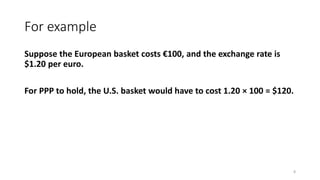
Suppose the European basket costs €100, and the exchange rate is
$1.20 per euro.
For PPP to hold, the U.S. basket would have to cost 1.20 × 100 = $120.
8
9
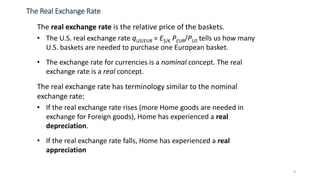
The real exchange rate is the relative price of the baskets.
• The U.S. real exchange rate qUS/EUR = E$/€ PEUR/PUS tells us how many
U.S. baskets are needed to purchase one European basket.
• The exchange rate for currencies is a nominal concept. The real
exchange rate is a real concept.
The real exchange rate has terminology similar to the nominal
exchange rate:
• If the real exchange rate rises (more Home goods are needed in
exchange for Foreign goods), Home has experienced a real
depreciation.
• If the real exchange rate falls, Home has experienced a real
appreciation
The Real Exchange Rate
10
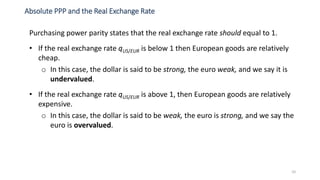
Purchasing power parity states that the real exchange rate should equal to 1.
• If the real exchange rate qUS/EUR is below 1 then European goods are relatively
cheap.
o In this case, the dollar is said to be strong, the euro weak, and we say it is
undervalued.
• If the real exchange rate qUS/EUR is above 1, then European goods are relatively
expensive.
o In this case, the dollar is said to be weak, the euro is strong, and we say the
euro is overvalued.
Absolute PPP and the Real Exchange Rate
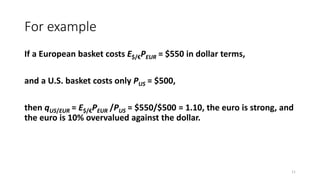
For example
If a European basket costs E$/€PEUR = $550 in dollar terms,
and a U.S. basket costs only PUS = $500,
then qUS/EUR = E$/€PEUR /PUS = $550/$500 = 1.10, the euro is strong, and
the euro is 10% overvalued against the dollar.
11
12
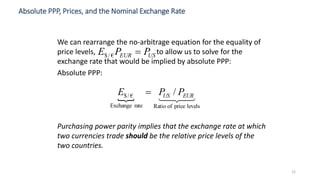
We can rearrange the no-arbitrage equation for the equality of
price levels, to allow us to solve for the
exchange rate that would be implied by absolute PPP:
Absolute PPP:
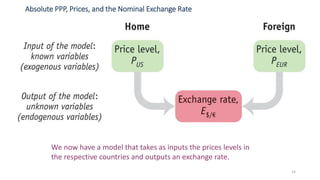
Absolute PPP, Prices, and the Nominal Exchange Rate
USEUR PPE €/$
 
levelspriceofRatiorateExchange
€/$ / EURUS PPE 
Purchasing power parity implies that the exchange rate at which
two currencies trade should be the relative price levels of the
two countries.
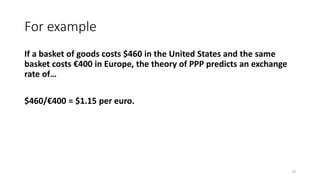
For example
If a basket of goods costs $460 in the United States and the same
basket costs €400 in Europe, the theory of PPP predicts an exchange
rate of…
$460/€400 = $1.15 per euro.
13
14
Absolute PPP, Prices, and the Nominal Exchange Rate
We now have a model that takes as inputs the prices levels in
the respective countries and outputs an exchange rate.
15
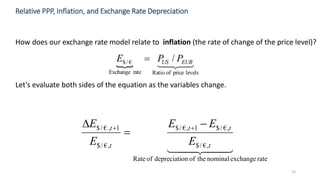
How does our exchange rate model relate to inflation (the rate of change of the price level)?
Let’s evaluate both sides of the equation as the variables change.
Relative PPP, Inflation, and Exchange Rate Depreciation
  
rateexchangenominaltheofondepreciatiofRate
,€/$
,€/$1,€/$
,€/$
1,€/$
t
tt
t
t
E
EE
E
E 

 
 
levelspriceofRatiorateExchange
€/$ / EURUS PPE 
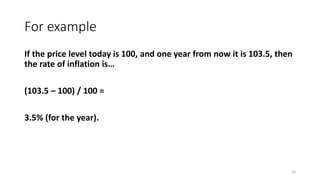
For example
If the price level today is 100, and one year from now it is 103.5, then
the rate of inflation is…
(103.5 – 100) / 100 =
3.5% (for the year).
16
17
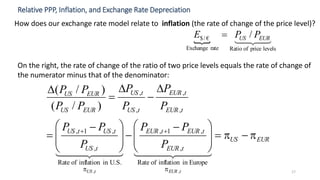
How does our exchange rate model relate to inflation (the rate of change of the price level)?
Relative PPP, Inflation, and Exchange Rate Depreciation
 
levelspriceofRatiorateExchange
€/$ / EURUS PPE 
On the right, the rate of change of the ratio of two price levels equals the rate of change of
the numerator minus that of the denominator:
EURUS
tEUR
tEURtEUR
tUS
tUStUS
tEUR
tEUR
tUS
tUS
EURUS
EURUS
tEURtUS
P
PP
P
PP
P
P
P
P
PP
PP







 







 










    
,,
EuropeininflationofRate
,
,1,
in U.S.inflationofRate
,
,1,
,
,
,
,
)/(
)/(
For example
If the price level in the US today is 100, and one
year from now it is 103.5, then the US rate of
inflation is 3.5%.
If the price level in Europe today is 100, and one
year from now it is 105, then the Eurozone rate of
inflation is 5%.
The inflation differential between the two is
3.5% - 5% = -1.5%
18
19
Combining the changes on both sides we obtain:
Relative PPP, Inflation, and Exchange Rate Depreciation
This way of expressing PPP is called relative PPP, and it implies that the rate
of depreciation of the nominal exchange rate equals the difference between
the inflation rates of two countries.
Unlike absolute PPP, relative PPP predicts a relationship between changes in
prices and changes in exchange rates, rather than a relationship between
their levels.

 aldifferentiInflation
,,
rateexchangenominaltheof
ondepreciatiofRate
,€/$
,€/$
tEURtUS
t
t
E
E


Relative PPP, Inflation, and Exchange Rate Depreciation
Relative PPP is derived from absolute PPP. Hence, the latter always implies the former:
if absolute PPP holds, this implies that relative PPP must hold also.
But the converse need not be true: relative PPP does not necessarily imply absolute
PPP (if relative PPP holds, absolute PPP can hold or fail).
For example, imagine that all goods consistently cost 20% more in country A than in
country B, so absolute PPP fails; however, it still can be the case that the inflation
differential between A and B (say, 5%) is always equal to the rate of depreciation (5%).
20
21
Evidence for PPP in the Long Run
Inflation Differentials and the
Exchange Rate, 1975-2005
This scatterplot shows the
relationship between the rate of
exchange rate depreciation
against the U.S. dollar and the
inflation differential against the
United States over 30 years, for a
sample of 82 countries. The
correlation between the two
variables is strong and bears a
close resemblance to the
prediction of PPP that all data
points would appear on the 45-
degree line.
22
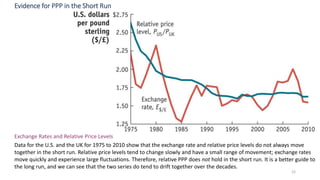
Evidence for PPP in the Short Run
Exchange Rates and Relative Price Levels
Data for the U.S. and the UK for 1975 to 2010 show that the exchange rate and relative price levels do not always move
together in the short run. Relative price levels tend to change slowly and have a small range of movement; exchange rates
move quickly and experience large fluctuations. Therefore, relative PPP does not hold in the short run. It is a better guide to
the long run, and we can see that the two series do tend to drift together over the decades.
23
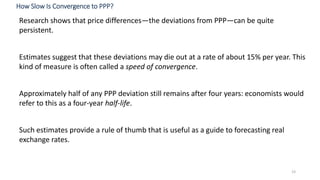
Research shows that price differences—the deviations from PPP—can be quite
persistent.
Estimates suggest that these deviations may die out at a rate of about 15% per year. This
kind of measure is often called a speed of convergence.
Approximately half of any PPP deviation still remains after four years: economists would
refer to this as a four-year half-life.
Such estimates provide a rule of thumb that is useful as a guide to forecasting real
exchange rates.
How Slow Is Convergence to PPP?
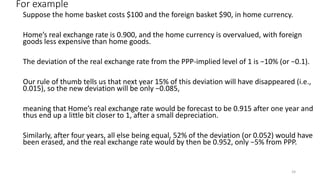
For example
Suppose the home basket costs $100 and the foreign basket $90, in home currency.
Home’s real exchange rate is 0.900, and the home currency is overvalued, with foreign
goods less expensive than home goods.
The deviation of the real exchange rate from the PPP-implied level of 1 is −10% (or −0.1).
Our rule of thumb tells us that next year 15% of this deviation will have disappeared (i.e.,
0.015), so the new deviation will be only −0.085,
meaning that Home’s real exchange rate would be forecast to be 0.915 after one year and
thus end up a little bit closer to 1, after a small depreciation.
Similarly, after four years, all else being equal, 52% of the deviation (or 0.052) would have
been erased, and the real exchange rate would by then be 0.952, only −5% from PPP.
24
25
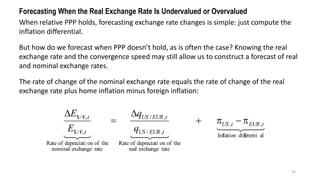
Forecasting When the Real Exchange Rate Is Undervalued or Overvalued
When relative PPP holds, forecasting exchange rate changes is simple: just compute the
inflation differential.
But how do we forecast when PPP doesn’t hold, as is often the case? Knowing the real
exchange rate and the convergence speed may still allow us to construct a forecast of real
and nominal exchange rates.
The rate of change of the nominal exchange rate equals the rate of change of the real
exchange rate plus home inflation minus foreign inflation:

 aldifferentiInflation
,,
rateexchangereal
theofondepreciatiofRate
,/
,/
rateexchangenominal
theofondepreciatiofRate
,€/$
,€/$
tEURtUS
tEURUS
tEURUS
t
t
q
q
E
E




26
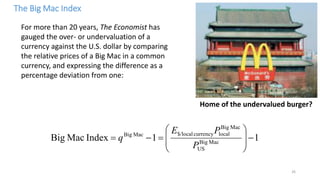
Home of the undervalued burger?
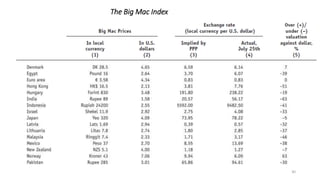
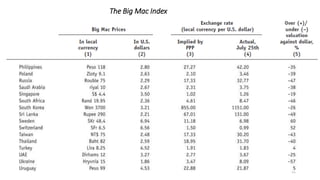
The Big Mac Index
For more than 20 years, The Economist has
gauged the over- or undervaluation of a
currency against the U.S. dollar by comparing
the relative prices of a Big Mac in a common
currency, and expressing the difference as a
percentage deviation from one:
11IndexMacBig MacBig
US
MacBig
localcurrency$/localMacBig










P
PE
q
For example
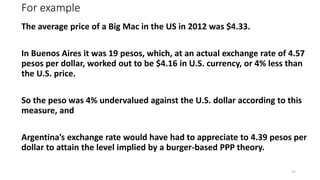
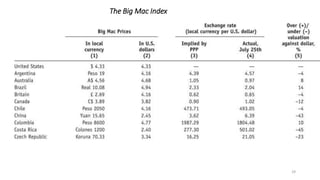
The average price of a Big Mac in the US in 2012 was $4.33.
In Buenos Aires it was 19 pesos, which, at an actual exchange rate of 4.57
pesos per dollar, worked out to be $4.16 in U.S. currency, or 4% less than
the U.S. price.
So the peso was 4% undervalued against the U.S. dollar according to this
measure, and
Argentina’s exchange rate would have had to appreciate to 4.39 pesos per
dollar to attain the level implied by a burger-based PPP theory.
27
Similarly
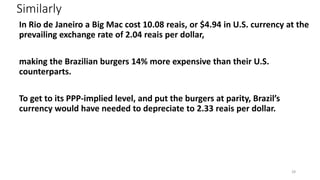
In Rio de Janeiro a Big Mac cost 10.08 reais, or $4.94 in U.S. currency at the
prevailing exchange rate of 2.04 reais per dollar,
making the Brazilian burgers 14% more expensive than their U.S.
counterparts.
To get to its PPP-implied level, and put the burgers at parity, Brazil’s
currency would have needed to depreciate to 2.33 reais per dollar.
28
29
The Big Mac Index
30
The Big Mac Index
31
The Big Mac Index
32
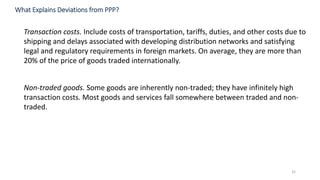
Transaction costs. Include costs of transportation, tariffs, duties, and other costs due to
shipping and delays associated with developing distribution networks and satisfying
legal and regulatory requirements in foreign markets. On average, they are more than
20% of the price of goods traded internationally.
Non-traded goods. Some goods are inherently non-traded; they have infinitely high
transaction costs. Most goods and services fall somewhere between traded and non-
traded.
What Explains Deviations from PPP?
33
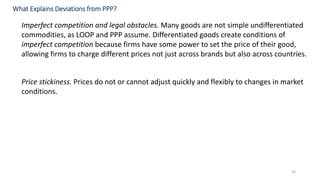
Imperfect competition and legal obstacles. Many goods are not simple undifferentiated
commodities, as LOOP and PPP assume. Differentiated goods create conditions of
imperfect competition because firms have some power to set the price of their good,
allowing firms to charge different prices not just across brands but also across countries.
Price stickiness. Prices do not or cannot adjust quickly and flexibly to changes in market
conditions.
What Explains Deviations from PPP?

Purchasing power parity

  • 1.
  • 2.
    The Law ofOne Price What if Reebok hockey sticks were selling for $150 in New York and $350 in Montreal? Arbitrage occurs in the international goods markets just as in the international financial markets. Therefore, there is an equalizing force acting on prices of goods in different countries expressed in a common currency. 2
  • 3.
    3 The law ofone price (LOOP) states that in the absence of trade frictions and under free competition and price flexibility, identical goods sold in different locations must sell for the same price when expressed in a common currency. We can write the relative price as follows, for the case of any good g sold in two locations: The Law of One Price  $ingoodof priceU.S. $ingoodof priceEuropean €/$ U.S.versusEuropein goodofpriceRelative / /)( g g US g g EUR g g EURUS PPEq  
  • 4.
    4 We can rearrangethe equation for price equality The Law of One Price to suggest that the exchange rate ought to equal the ratio of the goods’ prices expressed in the two currencies: g US g EUR PPE €/$   pricesgoods’ ofRatio rate Exchange €/$ / g EUR g US PPE 
  • 5.
    Purchasing Power Parity Supposenow one put together a basket of goods, including not just hockey sticks, but milk, eggs and gasoline too. What would happen if the same two baskets were selling for different amounts of $$ in the US and Canada? Same thing – goods arbitrage until the same basket of goods sells for the same price in both countries when expressed in a common currency. 5
  • 6.
    How about thisbasket? • FOOD AND BEVERAGES (breakfast cereal, milk, coffee, chicken, wine, full service meals, snacks) • HOUSING (rent of primary residence, owners' equivalent rent, fuel oil, bedroom furniture) • APPAREL (men's shirts and sweaters, women's dresses, jewelry) • TRANSPORTATION (new vehicles, airline fares, gasoline, motor vehicle insurance) • MEDICAL CARE (prescription drugs and medical supplies, physicians' services, eyeglasses and eye care, hospital services) • RECREATION (televisions, toys, pets and pet products, sports equipment, admissions); • EDUCATION AND COMMUNICATION (college tuition, postage, telephone services, computer software and accessories); • OTHER GOODS AND SERVICES (tobacco and smoking products, haircuts and other personal services, funeral expenses). This is the basket for CPI calculation! Therefore, the price of this basket is the price level, by which we can compare prices and inflation across time and countries.
  • 7.
    7 The principle ofpurchasing power parity (PPP) is the macroeconomic counterpart to the microeconomic law of one price (LOOP). To express PPP algebraically, we can compute the relative price of the two baskets of goods in each location: Purchasing Power Parity  $in expressed basketof priceU.S. $in expressed basketof priceEuropean €/$ U.S.versus Europein basketof priceRelative / /)( USEUREURUS PPEq   There is no arbitrage when the basket is the same price in both locations qUS/EUR = 1. PPP holds when price levels in two countries are equal when expressed in a common currency. This is called absolute PPP.
  • 8.
    For example Suppose theEuropean basket costs €100, and the exchange rate is $1.20 per euro. For PPP to hold, the U.S. basket would have to cost 1.20 × 100 = $120. 8
  • 9.
    9 The real exchangerate is the relative price of the baskets. • The U.S. real exchange rate qUS/EUR = E$/€ PEUR/PUS tells us how many U.S. baskets are needed to purchase one European basket. • The exchange rate for currencies is a nominal concept. The real exchange rate is a real concept. The real exchange rate has terminology similar to the nominal exchange rate: • If the real exchange rate rises (more Home goods are needed in exchange for Foreign goods), Home has experienced a real depreciation. • If the real exchange rate falls, Home has experienced a real appreciation The Real Exchange Rate
  • 10.
    10 Purchasing power paritystates that the real exchange rate should equal to 1. • If the real exchange rate qUS/EUR is below 1 then European goods are relatively cheap. o In this case, the dollar is said to be strong, the euro weak, and we say it is undervalued. • If the real exchange rate qUS/EUR is above 1, then European goods are relatively expensive. o In this case, the dollar is said to be weak, the euro is strong, and we say the euro is overvalued. Absolute PPP and the Real Exchange Rate
  • 11.
    For example If aEuropean basket costs E$/€PEUR = $550 in dollar terms, and a U.S. basket costs only PUS = $500, then qUS/EUR = E$/€PEUR /PUS = $550/$500 = 1.10, the euro is strong, and the euro is 10% overvalued against the dollar. 11
  • 12.
    12 We can rearrangethe no-arbitrage equation for the equality of price levels, to allow us to solve for the exchange rate that would be implied by absolute PPP: Absolute PPP: Absolute PPP, Prices, and the Nominal Exchange Rate USEUR PPE €/$   levelspriceofRatiorateExchange €/$ / EURUS PPE  Purchasing power parity implies that the exchange rate at which two currencies trade should be the relative price levels of the two countries.
  • 13.
    For example If abasket of goods costs $460 in the United States and the same basket costs €400 in Europe, the theory of PPP predicts an exchange rate of… $460/€400 = $1.15 per euro. 13
  • 14.
    14 Absolute PPP, Prices,and the Nominal Exchange Rate We now have a model that takes as inputs the prices levels in the respective countries and outputs an exchange rate.
  • 15.
    15 How does ourexchange rate model relate to inflation (the rate of change of the price level)? Let’s evaluate both sides of the equation as the variables change. Relative PPP, Inflation, and Exchange Rate Depreciation    rateexchangenominaltheofondepreciatiofRate ,€/$ ,€/$1,€/$ ,€/$ 1,€/$ t tt t t E EE E E       levelspriceofRatiorateExchange €/$ / EURUS PPE 
  • 16.
    For example If theprice level today is 100, and one year from now it is 103.5, then the rate of inflation is… (103.5 – 100) / 100 = 3.5% (for the year). 16
  • 17.
    17 How does ourexchange rate model relate to inflation (the rate of change of the price level)? Relative PPP, Inflation, and Exchange Rate Depreciation   levelspriceofRatiorateExchange €/$ / EURUS PPE  On the right, the rate of change of the ratio of two price levels equals the rate of change of the numerator minus that of the denominator: EURUS tEUR tEURtEUR tUS tUStUS tEUR tEUR tUS tUS EURUS EURUS tEURtUS P PP P PP P P P P PP PP                                  ,, EuropeininflationofRate , ,1, in U.S.inflationofRate , ,1, , , , , )/( )/(
  • 18.
    For example If theprice level in the US today is 100, and one year from now it is 103.5, then the US rate of inflation is 3.5%. If the price level in Europe today is 100, and one year from now it is 105, then the Eurozone rate of inflation is 5%. The inflation differential between the two is 3.5% - 5% = -1.5% 18
  • 19.
    19 Combining the changeson both sides we obtain: Relative PPP, Inflation, and Exchange Rate Depreciation This way of expressing PPP is called relative PPP, and it implies that the rate of depreciation of the nominal exchange rate equals the difference between the inflation rates of two countries. Unlike absolute PPP, relative PPP predicts a relationship between changes in prices and changes in exchange rates, rather than a relationship between their levels.   aldifferentiInflation ,, rateexchangenominaltheof ondepreciatiofRate ,€/$ ,€/$ tEURtUS t t E E  
  • 20.
    Relative PPP, Inflation,and Exchange Rate Depreciation Relative PPP is derived from absolute PPP. Hence, the latter always implies the former: if absolute PPP holds, this implies that relative PPP must hold also. But the converse need not be true: relative PPP does not necessarily imply absolute PPP (if relative PPP holds, absolute PPP can hold or fail). For example, imagine that all goods consistently cost 20% more in country A than in country B, so absolute PPP fails; however, it still can be the case that the inflation differential between A and B (say, 5%) is always equal to the rate of depreciation (5%). 20
  • 21.
    21 Evidence for PPPin the Long Run Inflation Differentials and the Exchange Rate, 1975-2005 This scatterplot shows the relationship between the rate of exchange rate depreciation against the U.S. dollar and the inflation differential against the United States over 30 years, for a sample of 82 countries. The correlation between the two variables is strong and bears a close resemblance to the prediction of PPP that all data points would appear on the 45- degree line.
  • 22.
    22 Evidence for PPPin the Short Run Exchange Rates and Relative Price Levels Data for the U.S. and the UK for 1975 to 2010 show that the exchange rate and relative price levels do not always move together in the short run. Relative price levels tend to change slowly and have a small range of movement; exchange rates move quickly and experience large fluctuations. Therefore, relative PPP does not hold in the short run. It is a better guide to the long run, and we can see that the two series do tend to drift together over the decades.
  • 23.
    23 Research shows thatprice differences—the deviations from PPP—can be quite persistent. Estimates suggest that these deviations may die out at a rate of about 15% per year. This kind of measure is often called a speed of convergence. Approximately half of any PPP deviation still remains after four years: economists would refer to this as a four-year half-life. Such estimates provide a rule of thumb that is useful as a guide to forecasting real exchange rates. How Slow Is Convergence to PPP?
  • 24.
    For example Suppose thehome basket costs $100 and the foreign basket $90, in home currency. Home’s real exchange rate is 0.900, and the home currency is overvalued, with foreign goods less expensive than home goods. The deviation of the real exchange rate from the PPP-implied level of 1 is −10% (or −0.1). Our rule of thumb tells us that next year 15% of this deviation will have disappeared (i.e., 0.015), so the new deviation will be only −0.085, meaning that Home’s real exchange rate would be forecast to be 0.915 after one year and thus end up a little bit closer to 1, after a small depreciation. Similarly, after four years, all else being equal, 52% of the deviation (or 0.052) would have been erased, and the real exchange rate would by then be 0.952, only −5% from PPP. 24
  • 25.
    25 Forecasting When theReal Exchange Rate Is Undervalued or Overvalued When relative PPP holds, forecasting exchange rate changes is simple: just compute the inflation differential. But how do we forecast when PPP doesn’t hold, as is often the case? Knowing the real exchange rate and the convergence speed may still allow us to construct a forecast of real and nominal exchange rates. The rate of change of the nominal exchange rate equals the rate of change of the real exchange rate plus home inflation minus foreign inflation:   aldifferentiInflation ,, rateexchangereal theofondepreciatiofRate ,/ ,/ rateexchangenominal theofondepreciatiofRate ,€/$ ,€/$ tEURtUS tEURUS tEURUS t t q q E E    
  • 26.
    26 Home of theundervalued burger? The Big Mac Index For more than 20 years, The Economist has gauged the over- or undervaluation of a currency against the U.S. dollar by comparing the relative prices of a Big Mac in a common currency, and expressing the difference as a percentage deviation from one: 11IndexMacBig MacBig US MacBig localcurrency$/localMacBig           P PE q
  • 27.
    For example The averageprice of a Big Mac in the US in 2012 was $4.33. In Buenos Aires it was 19 pesos, which, at an actual exchange rate of 4.57 pesos per dollar, worked out to be $4.16 in U.S. currency, or 4% less than the U.S. price. So the peso was 4% undervalued against the U.S. dollar according to this measure, and Argentina’s exchange rate would have had to appreciate to 4.39 pesos per dollar to attain the level implied by a burger-based PPP theory. 27
  • 28.
    Similarly In Rio deJaneiro a Big Mac cost 10.08 reais, or $4.94 in U.S. currency at the prevailing exchange rate of 2.04 reais per dollar, making the Brazilian burgers 14% more expensive than their U.S. counterparts. To get to its PPP-implied level, and put the burgers at parity, Brazil’s currency would have needed to depreciate to 2.33 reais per dollar. 28
  • 29.
  • 30.
  • 31.
  • 32.
    32 Transaction costs. Includecosts of transportation, tariffs, duties, and other costs due to shipping and delays associated with developing distribution networks and satisfying legal and regulatory requirements in foreign markets. On average, they are more than 20% of the price of goods traded internationally. Non-traded goods. Some goods are inherently non-traded; they have infinitely high transaction costs. Most goods and services fall somewhere between traded and non- traded. What Explains Deviations from PPP?
  • 33.
    33 Imperfect competition andlegal obstacles. Many goods are not simple undifferentiated commodities, as LOOP and PPP assume. Differentiated goods create conditions of imperfect competition because firms have some power to set the price of their good, allowing firms to charge different prices not just across brands but also across countries. Price stickiness. Prices do not or cannot adjust quickly and flexibly to changes in market conditions. What Explains Deviations from PPP?