Demand of Goods and Services
Classification of Goods and Services From conventional perspective Free goods Public goods Economic goods  From Islamic perspectives Al-tayyibat Al-Rizq
Conventional Perspectives Free Good Goods that have no production cost (air, sunlight, rain  water). Public Goods Goods that have a common use and are benefit to  everyone (public clinics, schools, hospital and others.) Economic goods Goods which supply is limited and require costs to purchase them (books, clothes, houses, movies)  Price is involved in obtaining them.
Islamic Perspective Al-Tayyibat Al-tayyibat   means good things, clean and pure things, and sustenance of the best. Bad goods are not considered as goods in Islam. Al- Rizq Al-rizq is used to denote the following meanings; - Godly sustenance, godly provision and heavenly gifts All these meanings denote that Allah s.w.t is the only sustainer and provider for all creatures.
Hierarchy of needs Dharuriyah Goods that are classified as basic needs and necessary for a living. eg: food, cloth Hajiyat Goods that will improve the quality of human life eg: refrigerator, radio Kamaliat Goods that contribute towards the perfection of human life (luxury goods). Eg: bungalow house, Mercedes cars Tarafiat Not permissible (haram). Bring negative impact on society. Not only extravagant and wasteful, but also cause harm to man. Eg: liquor
DEMAND OF GOODS AND SERVICES
Definition of demand The quantity of various goods that people are  willing and able to buy  at a particular time and  at a given range of prices.
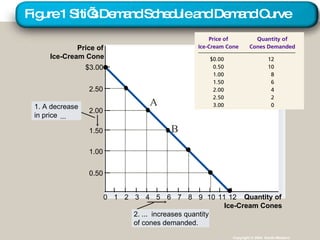
DEMAND SCHEDULE AND DEMAND CURVE Demand Schedule  The  demand schedule  is a table that shows the relationship between the price of the good and the quantity demanded Demand Curve  A  demand curve  is a graphical representation of a demand schedule. A graph of the relationship between the price of a good and the quantity demanded.  slopes downward and to the right.
Figure 1 Siti’s Demand Schedule and Demand Curve Copyright © 2004  South-Western Price of Ice-Cream Cone 0 2.50 2.00 1.50 1.00 0.50 1 2 3 4 5 6 7 8 9 10 11 Quantity of Ice-Cream Cones $3.00 12 A B 1. A decrease  in price ... 2.  ... increases quantity  of cones demanded.
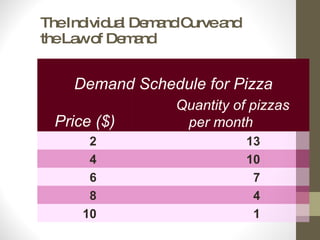
The Individual Demand Curve and the Law of Demand Demand Schedule for Pizza Price ($) Quantity of pizzas  per month 2 13 4 10 6 7 8 4 10 1
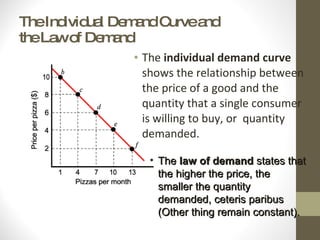
The Individual Demand Curve and the Law of Demand The  individual demand curve  shows the relationship between the price of a good and the quantity that a single consumer is willing to buy, or  quantity demanded. The  law of demand  states that the higher the price, the smaller the quantity demanded, ceteris paribus (Other thing remain constant).
WHY? The Substitution Effect consumers react to an increase in a good’s price by consuming less of that good and more of other goods. The Income Effect a person changes his or her consumption of goods and services as a result of a change in real income.
Market Demand Market demand  is the sum of all the quantities of a good or service demanded per period by all the households buying in the market for that good or service.
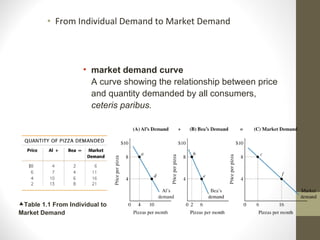
From Individual Demand to Market Demand market demand curve A curve showing the relationship between price and quantity demanded by all consumers,  ceteris paribus. Table 1.1 From Individual to Market Demand
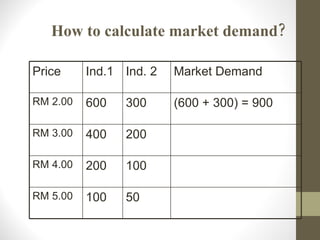
How to calculate market demand? Price Ind.1 Ind. 2 Market Demand RM 2.00 600 300 (600 + 300) = 900 RM 3.00 400 200 RM 4.00 200 100 RM 5.00 100 50
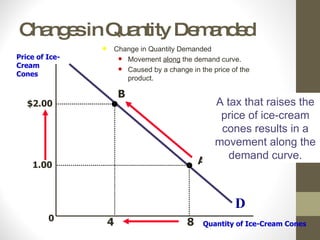
Changes in Quantity Demanded 0 D Price of Ice-Cream  Cones Quantity of Ice-Cream Cones A tax that raises the price of ice-cream cones results in a movement along the demand curve. A 8 1.00 Change in Quantity Demanded Movement  along  the demand curve. Caused by a change in the price of the product. B $2.00 4
DEMAND SHIFTER
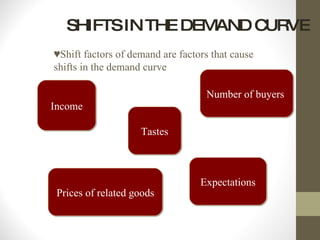
SHIFTS IN THE DEMAND CURVE Tastes Income Number of buyers  Expectations Prices of related goods ♥ Shift factors of demand are factors that cause shifts in the demand curve
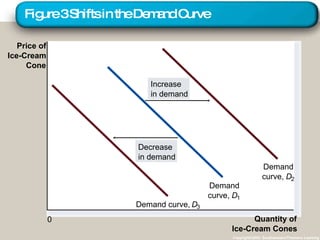
Shifts in the Demand Curve Recall our assumption hold other things constant – ceteris paribus allow only price to change But what if other factors do change? change in demand shift to a new demand curve,  either to the left or right. alters the quantity demanded at every price.
Figure 3 Shifts in the Demand Curve Copyright©2003  Southwestern/Thomson Learning Price of Ice-Cream Cone Quantity of Ice-Cream Cones 0 Increase in demand Decrease in demand Demand curve,  D 3 Demand curve,  D 1 Demand curve,  D 2
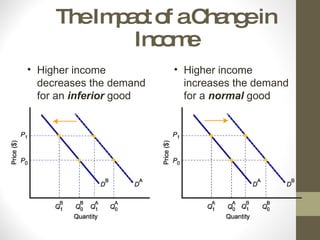
D 1 D 2 P QD 1 QD 2 Change in Income [Normal-Direct; Inferior-Inverse] More income results in more demand for new cars; less demand for used cars. New Cars Used Cars Less income results in more demand for used cars; less demand for new cars.
The Impact of a Change in Income Higher income decreases the demand for an  inferior  good Higher income increases the demand for a  normal  good
Change in Income An increase in income will lead to an increase in demand for most goods & services because the amount of purchasing power increases, vice versa As consumer’s income rises, the demand for higher quality goods will certainly increase (shown by the shift of dd curve to right)    normal good Products for which demand declines as income rises    inferior good
Complement [ Inverse ] Substitute [ Direct ] Milk Cereal Pop Tarts D 1 D 2 P P 1 QD 1 P 2 D 1 D 2 D P Prices of Related Goods [Substitutes-Direct; Complements-Inverse] QD 2
Prices of Related Goods Changes in the price of substitutes Rise in prices of one good lead to a contraction in the quantity of the good demanded & increase in the demand for its substitutes Changes in the price of complements Goods that are consumed together. When demand for one good rises, so does demand for the other.
D 1 D 2 P QD 1 QD 2 "Change in Taste" [Direct] An   increase in taste for DVDs  results in an increase in demand . A   decrease in taste for   videos  results in a decrease  in  demand . D 3 QD 3
D 1 D 2 P QD 1 QD 2 Expectations  [of consumers] [about future price, availibility, & income] iPhone $399 Buy it now to save money.
D 1 D 2 P QD 1 QD 2 Expectations  [of consumers] [about future availibility of toilet tissue] If there is expected to be a  major shortage of toilet tissue , then consumers will stock up now or risk not getting any.
D 1 D 2 P QD 1 QD 2 Expectations  [of consumers] [about future income] Let’s say that we are  coming out of recession  & consumers feel  secure  about  their  jobs.  [ Positive future income ]
D 1 D 2 P QD 1 QD 2 Expectations  [of consumers] [about future income] Let’s say that we are  going into a recession  and consumers don’t feel  secure  about  their  jobs.  [ Negative  future income ]
D 1 D 2 P QD 1 QD 2 Change in Market Size [Direct] [Number of Consumers] More demand for both normal &  inferior goods New Cars Used Cars
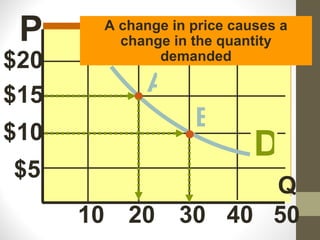
When price changes, what happens? The curve does not shift. There is a change in the  quantity demanded
$20 $15 $10 $5 10 20 30 40 A B A change in price causes a change in the quantity demanded D P Q 50
When something changes other than price, what happens? The whole curve shifts,there is a  change in demand
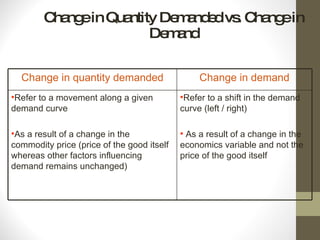
Change in Quantity Demanded vs. Change in Demand Change in quantity demanded Change in demand Refer to a movement along a given demand curve  As a result of a change in the commodity price (price of the good itself whereas other factors influencing demand remains unchanged) Refer to a shift in the demand curve (left / right) As a result of a change in the economics variable and not the price of the good itself
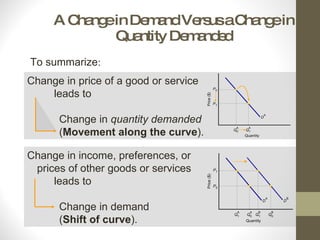
A Change in Demand Versus a Change in Quantity Demanded To summarize : Change in price of a good or service leads to Change in  quantity demanded ( Movement along the curve ). Change in income, preferences, or prices of other goods or services leads to Change in demand ( Shift of curve ).
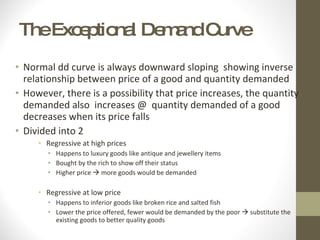
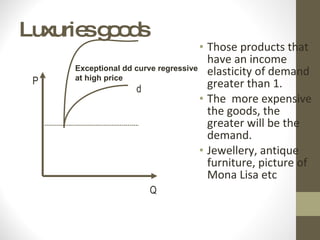
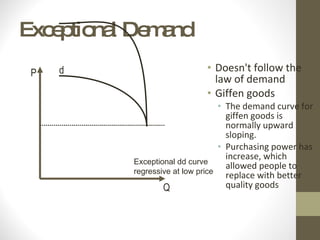
The Exceptional Demand Curve Normal dd curve is always downward sloping  showing inverse relationship between price of a good and quantity demanded However, there is a possibility that price increases, the quantity demanded also  increases @  quantity demanded of a good decreases when its price falls Divided into 2 Regressive at high prices Happens to luxury goods like antique and jewellery items Bought by the rich to show off their status Higher price    more goods would be demanded Regressive at low price Happens to inferior goods like broken rice and salted fish Lower the price offered, fewer would be demanded by the poor    substitute the existing goods to better quality goods
Luxuries goods Those products that have an income elasticity of demand greater than 1. The  more expensive the goods, the greater will be the demand. Jewellery, antique furniture, picture of Mona Lisa etc Exceptional dd curve regressive at high price Q P d
Exceptional Demand Doesn't follow the law of demand Giffen goods The demand curve for giffen goods is normally upward sloping. Purchasing power has increase, which allowed people to replace with better quality goods Exceptional dd curve regressive at low price P Q d
ELASTICITY OF DEMAND Definition: Elasticity means responsiveness or sensitivity. Therefore elasticity of demand means the responsiveness of demand due to the  changes of the factors that influence demand.
Types of Elasticity: Price elasticity of demand Cross elasticity of demand Income elasticity of demand Price elasticity of supply
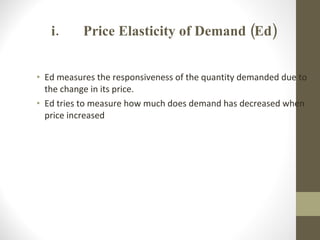
i.  Price Elasticity of Demand (Ed) Ed measures the responsiveness of the quantity demanded due to the change in its price. Ed tries to measure how much does demand has decreased when price increased
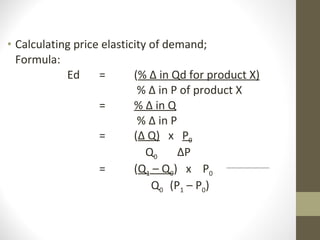
Calculating price elasticity of demand; Formula: Ed =  ( % ∆ in Qd for product X)   % ∆ in P of product X =    % ∆ in Q   % ∆ in P =  ( ∆ Q)   x  P 0   Q 0  ∆P  =  ( Q 1  – Q 0 )  x  P 0   Q 0   (P 1  – P 0 )
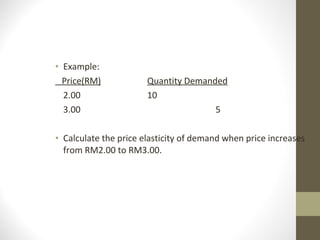
Example: Price(RM) Quantity Demanded 2.00   10 3.00       5 Calculate the price elasticity of demand when price increases from RM2.00 to RM3.00.
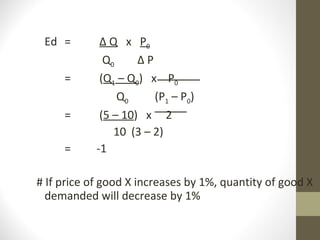
Ed =   ∆ Q   x  P 0   Q 0  ∆ P  =  ( Q 1  – Q 0 )  x  P 0   Q 0  (P 1  – P 0 )  =  ( 5 – 10 )  x  2   10  (3 – 2) = -1 # If price of good X increases by 1%, quantity of good X demanded will decrease by 1%
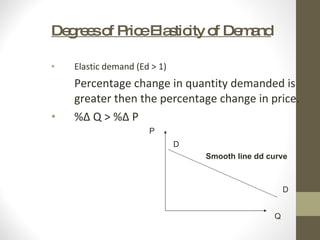
Degrees of Price Elasticity of Demand Elastic demand (Ed > 1) Percentage change in quantity demanded is greater then the percentage change in price. %Δ Q > %Δ P P Q D D Smooth line dd curve
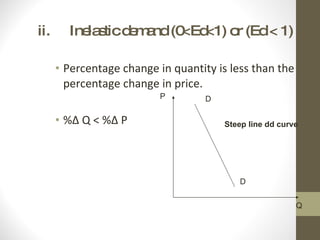
ii. Inelastic demand (0<Ed<1) or (Ed < 1) Percentage change in quantity is less than the percentage change in price. %Δ Q < %Δ P P Q D D Steep line dd curve
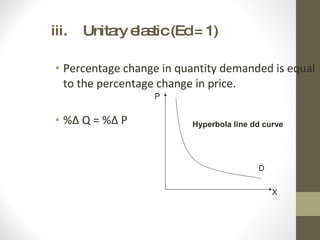
iii. Unitary elastic (Ed = 1) Percentage change in quantity demanded is equal to the percentage change in price. %Δ Q = %Δ P D P X Hyperbola line dd curve
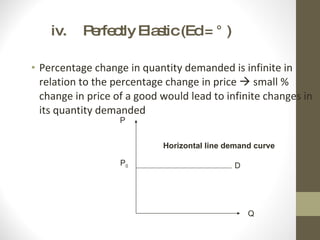
iv. Perfectly Elastic (Ed = ∞) Percentage change in quantity demanded is infinite in relation to the percentage change in price    small % change in price of a good would lead to infinite changes in its quantity demanded P Q D P 0 Horizontal line demand curve
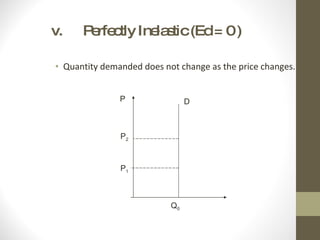
v. Perfectly Inelastic (Ed = 0 ) Quantity demanded does not change as the price changes.  P Q Q 0 D P 1 P 2
Determinants of Price Elasticity of Demand Availability of substitutes many substitutes    more elastic dd less/no substitutes    less elactic/ inelastic dd Eg: petrol and detergents (liquid, soap) Relative importance of the goods in the budget greater the income spent    more elastic dd Eg: dd for house is more elastic compared to demand for detergents because money spent on houses is greater than money spent on detergents.
Time frame In short run    less elastic/ inelastic dd In the long run demand    more elastic because consumers can make adjustment and find other substitutes. The importance of goods – necessity or luxury Necessity good    inelastic dd    eg: rice (great increase in price will not reduce the demand for rice very much).  Luxury goods/ less important goods    elastic dd The number of usage many number of usage    more elastic compared to goods that have fewer usage. Eg: demand for rubber is more elastic because it can be processed into rubber hoses, tyres, gloves, & etc
Income level higher income people    inelastic dd.  lower income group    elastic dd (sensitive to price changes) Habits habits    inelastic dd.  Eg: demand for cigarette by smokers.
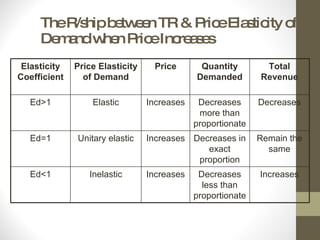
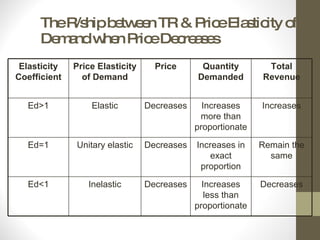
Relationship between price elasticity of demand and total revenue (TR) Important for producers to decide whether they should increase, decrease or maintain the price of the good they sold in the market to enable them to maximize their profit TR = price  x  quantity TR increases or decreases when there is price changes depend on the price elasticity of demand. i. If demand is elastic, to increase TR, price should be decreased. ii. If demand is inelastic, to increase TR, price should be increased. iii. If demand is unitary elastic, change in price would not affect and change in TR.
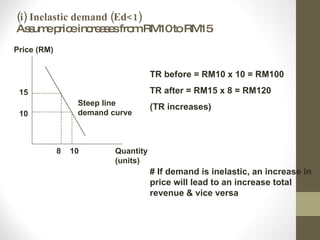
(i) Inelastic demand (Ed<1) Assume price increases from RM10 to RM15 Price (RM) Quantity (units) 8 10 10 15 Steep line demand curve TR before = RM10 x 10 = RM100 TR after = RM15 x 8 = RM120  (TR increases) # If demand is inelastic, an increase in price will lead to an increase total revenue & vice versa
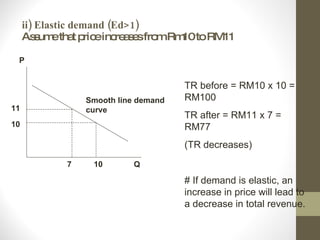
ii) Elastic demand (Ed>1) Assume that price increases from Rm10 to RM11 Smooth line demand curve P Q 7 10 10 11 TR before = RM10 x 10 = RM100 TR after = RM11 x 7 = RM77 (TR decreases) # If demand is elastic, an increase in price will lead to a decrease in total revenue.
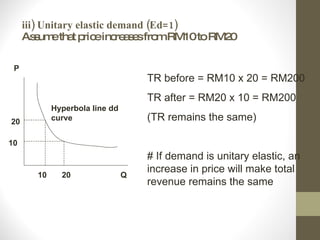
iii) Unitary elastic demand (Ed=1) Assume that price increases from RM10 to RM20 20 10 10 20 P Q TR before = RM10 x 20 = RM200 TR after = RM20 x 10 = RM200 (TR remains the same) # If demand is unitary elastic, an increase in price will make total revenue remains the same Hyperbola line dd curve
The R/ship between TR & Price Elasticity of Demand when Price Increases Elasticity Coefficient Price Elasticity of Demand Price Quantity Demanded Total Revenue Ed>1 Elastic Increases Decreases more than proportionate Decreases Ed=1 Unitary elastic Increases Decreases in exact proportion Remain the same Ed<1 Inelastic Increases Decreases less than proportionate Increases
The R/ship between TR & Price Elasticity of Demand when Price Decreases Elasticity Coefficient Price Elasticity of Demand Price Quantity Demanded Total Revenue Ed>1 Elastic Decreases Increases more than proportionate Increases Ed=1 Unitary elastic Decreases Increases in exact proportion Remain the same Ed<1 Inelastic Decreases Increases less than proportionate Decreases
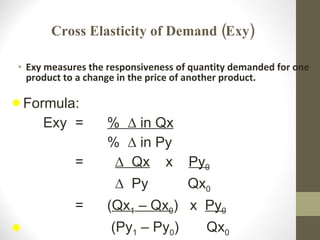
Cross Elasticity of Demand (Exy) Exy measures the responsiveness of quantity demanded for one product to a change in the price of another product. Formula: Exy = %  ∆ in Qx %  ∆ in Py =   ∆  Qx   x  Py 0   ∆  Py  Qx 0 = ( Qx 1  – Qx 0 )  x  Py 0   (Py 1  – Py 0 )  Qx 0
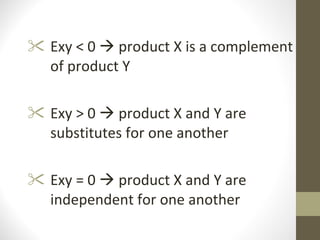
Exy < 0    product X is a complement of product Y Exy > 0    product X and Y are substitutes for one another Exy = 0    product X and Y are independent for one another
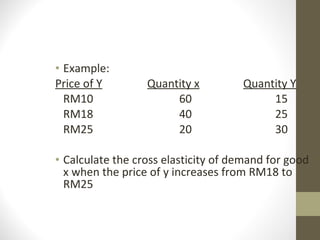
Example: Price of Y Quantity x Quantity Y RM10 60 15 RM18 40 25 RM25 20 30 Calculate the cross elasticity of demand for good x when the price of y increases from RM18 to RM25
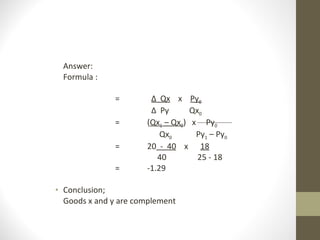
Answer: Formula : =   ∆  Qx   x  Py 0   ∆  Py  Qx 0 = ( Qx 1  – Qx 0 )  x  Py 0   Qx 0   Py 1  – Py 0 = 20   -  40   x  18   40   25 - 18 = -1.29 Conclusion; Goods x and y are complement
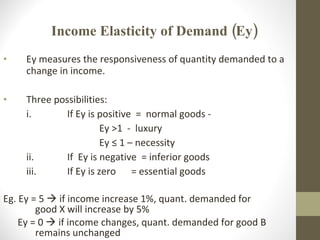
Income Elasticity of Demand (Ey) Ey measures the responsiveness of quantity demanded to a change in income. Three possibilities: i. If Ey is positive  =  normal goods -  Ey >1  -  luxury   Ey ≤ 1 – necessity ii. If  Ey is negative  = inferior goods iii. If Ey is zero = essential goods Eg. Ey = 5    if income increase 1%, quant. demanded for  good X will increase by 5% Ey = 0    if income changes, quant. demanded for good B  remains unchanged
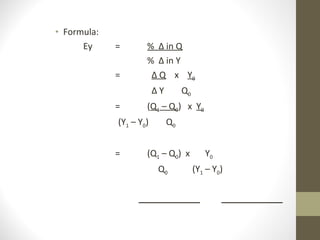
Formula: Ey = %  ∆ in Q %  ∆ in Y =   ∆ Q   x  Y 0   ∆  Y   Q 0 = ( Q 1  – Q 0 )  x  Y 0     (Y 1  – Y 0 )  Q 0 = (Q 1  – Q 0 )  x  Y 0   Q 0   (Y 1  – Y 0 )
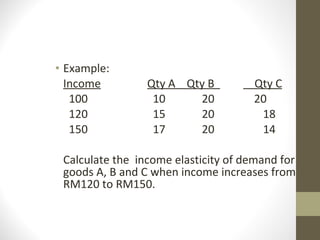
Example: Income Qty A  Qty B    Qty C   100   10   20  20   120   15   20   18   150   17   20   14 Calculate the  income elasticity of demand for goods A, B and C when income increases from RM120 to RM150.
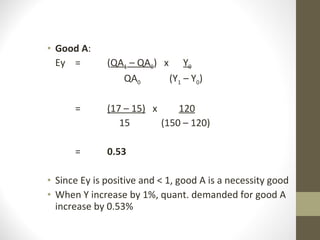
Good A : Ey = ( QA 1  – QA 0 )  x  Y 0   QA 0   (Y 1  – Y 0 ) = (17 – 15)   x  120     15  (150 – 120) = 0.53 Since Ey is positive and < 1, good A is a necessity good When Y increase by 1%, quant. demanded for good A increase by 0.53%
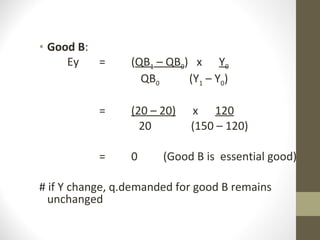
Good B : Ey = ( QB 1  – QB 0 )  x  Y 0   QB 0  (Y 1  – Y 0 ) = (20 – 20)   x  120   20  (150 – 120) =  0 (Good B is  essential good) # if Y change, q.demanded for good B remains unchanged
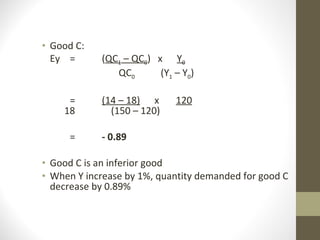
Good C: Ey = ( QC 1  – QC 0 )  x  Y 0   QC 0  (Y 1  – Y 0 ) = (14 – 18)   x  120       18  (150 – 120) = - 0.89 Good C is an inferior good When Y increase by 1%, quantity demanded for good C decrease by 0.89%

Chapter 2 Demand

  • 1.
    Demand of Goodsand Services
  • 2.
    Classification of Goodsand Services From conventional perspective Free goods Public goods Economic goods From Islamic perspectives Al-tayyibat Al-Rizq
  • 3.
    Conventional Perspectives FreeGood Goods that have no production cost (air, sunlight, rain water). Public Goods Goods that have a common use and are benefit to everyone (public clinics, schools, hospital and others.) Economic goods Goods which supply is limited and require costs to purchase them (books, clothes, houses, movies) Price is involved in obtaining them.
  • 4.
    Islamic Perspective Al-TayyibatAl-tayyibat means good things, clean and pure things, and sustenance of the best. Bad goods are not considered as goods in Islam. Al- Rizq Al-rizq is used to denote the following meanings; - Godly sustenance, godly provision and heavenly gifts All these meanings denote that Allah s.w.t is the only sustainer and provider for all creatures.
  • 5.
    Hierarchy of needsDharuriyah Goods that are classified as basic needs and necessary for a living. eg: food, cloth Hajiyat Goods that will improve the quality of human life eg: refrigerator, radio Kamaliat Goods that contribute towards the perfection of human life (luxury goods). Eg: bungalow house, Mercedes cars Tarafiat Not permissible (haram). Bring negative impact on society. Not only extravagant and wasteful, but also cause harm to man. Eg: liquor
  • 6.
    DEMAND OF GOODSAND SERVICES
  • 7.
    Definition of demandThe quantity of various goods that people are willing and able to buy at a particular time and at a given range of prices.
  • 8.
    DEMAND SCHEDULE ANDDEMAND CURVE Demand Schedule The demand schedule is a table that shows the relationship between the price of the good and the quantity demanded Demand Curve A demand curve is a graphical representation of a demand schedule. A graph of the relationship between the price of a good and the quantity demanded. slopes downward and to the right.
  • 9.
    Figure 1 Siti’sDemand Schedule and Demand Curve Copyright © 2004 South-Western Price of Ice-Cream Cone 0 2.50 2.00 1.50 1.00 0.50 1 2 3 4 5 6 7 8 9 10 11 Quantity of Ice-Cream Cones $3.00 12 A B 1. A decrease in price ... 2. ... increases quantity of cones demanded.
  • 10.
    The Individual DemandCurve and the Law of Demand Demand Schedule for Pizza Price ($) Quantity of pizzas per month 2 13 4 10 6 7 8 4 10 1
  • 11.
    The Individual DemandCurve and the Law of Demand The individual demand curve shows the relationship between the price of a good and the quantity that a single consumer is willing to buy, or quantity demanded. The law of demand states that the higher the price, the smaller the quantity demanded, ceteris paribus (Other thing remain constant).
  • 12.
    WHY? The SubstitutionEffect consumers react to an increase in a good’s price by consuming less of that good and more of other goods. The Income Effect a person changes his or her consumption of goods and services as a result of a change in real income.
  • 13.
    Market Demand Marketdemand is the sum of all the quantities of a good or service demanded per period by all the households buying in the market for that good or service.
  • 14.
    From Individual Demandto Market Demand market demand curve A curve showing the relationship between price and quantity demanded by all consumers, ceteris paribus. Table 1.1 From Individual to Market Demand
  • 15.
    How to calculatemarket demand? Price Ind.1 Ind. 2 Market Demand RM 2.00 600 300 (600 + 300) = 900 RM 3.00 400 200 RM 4.00 200 100 RM 5.00 100 50
  • 16.
    Changes in QuantityDemanded 0 D Price of Ice-Cream Cones Quantity of Ice-Cream Cones A tax that raises the price of ice-cream cones results in a movement along the demand curve. A 8 1.00 Change in Quantity Demanded Movement along the demand curve. Caused by a change in the price of the product. B $2.00 4
  • 17.
  • 18.
    SHIFTS IN THEDEMAND CURVE Tastes Income Number of buyers Expectations Prices of related goods ♥ Shift factors of demand are factors that cause shifts in the demand curve
  • 19.
    Shifts in theDemand Curve Recall our assumption hold other things constant – ceteris paribus allow only price to change But what if other factors do change? change in demand shift to a new demand curve, either to the left or right. alters the quantity demanded at every price.
  • 20.
    Figure 3 Shiftsin the Demand Curve Copyright©2003 Southwestern/Thomson Learning Price of Ice-Cream Cone Quantity of Ice-Cream Cones 0 Increase in demand Decrease in demand Demand curve, D 3 Demand curve, D 1 Demand curve, D 2
  • 21.
    D 1 D2 P QD 1 QD 2 Change in Income [Normal-Direct; Inferior-Inverse] More income results in more demand for new cars; less demand for used cars. New Cars Used Cars Less income results in more demand for used cars; less demand for new cars.
  • 22.
    The Impact ofa Change in Income Higher income decreases the demand for an inferior good Higher income increases the demand for a normal good
  • 23.
    Change in IncomeAn increase in income will lead to an increase in demand for most goods & services because the amount of purchasing power increases, vice versa As consumer’s income rises, the demand for higher quality goods will certainly increase (shown by the shift of dd curve to right)  normal good Products for which demand declines as income rises  inferior good
  • 24.
    Complement [ Inverse] Substitute [ Direct ] Milk Cereal Pop Tarts D 1 D 2 P P 1 QD 1 P 2 D 1 D 2 D P Prices of Related Goods [Substitutes-Direct; Complements-Inverse] QD 2
  • 25.
    Prices of RelatedGoods Changes in the price of substitutes Rise in prices of one good lead to a contraction in the quantity of the good demanded & increase in the demand for its substitutes Changes in the price of complements Goods that are consumed together. When demand for one good rises, so does demand for the other.
  • 26.
    D 1 D2 P QD 1 QD 2 &quot;Change in Taste&quot; [Direct] An increase in taste for DVDs results in an increase in demand . A decrease in taste for videos results in a decrease in demand . D 3 QD 3
  • 27.
    D 1 D2 P QD 1 QD 2 Expectations [of consumers] [about future price, availibility, & income] iPhone $399 Buy it now to save money.
  • 28.
    D 1 D2 P QD 1 QD 2 Expectations [of consumers] [about future availibility of toilet tissue] If there is expected to be a major shortage of toilet tissue , then consumers will stock up now or risk not getting any.
  • 29.
    D 1 D2 P QD 1 QD 2 Expectations [of consumers] [about future income] Let’s say that we are coming out of recession & consumers feel secure about their jobs. [ Positive future income ]
  • 30.
    D 1 D2 P QD 1 QD 2 Expectations [of consumers] [about future income] Let’s say that we are going into a recession and consumers don’t feel secure about their jobs. [ Negative future income ]
  • 31.
    D 1 D2 P QD 1 QD 2 Change in Market Size [Direct] [Number of Consumers] More demand for both normal & inferior goods New Cars Used Cars
  • 32.
    When price changes,what happens? The curve does not shift. There is a change in the quantity demanded
  • 33.
    $20 $15 $10$5 10 20 30 40 A B A change in price causes a change in the quantity demanded D P Q 50
  • 34.
    When something changesother than price, what happens? The whole curve shifts,there is a change in demand
  • 35.
    Change in QuantityDemanded vs. Change in Demand Change in quantity demanded Change in demand Refer to a movement along a given demand curve As a result of a change in the commodity price (price of the good itself whereas other factors influencing demand remains unchanged) Refer to a shift in the demand curve (left / right) As a result of a change in the economics variable and not the price of the good itself
  • 36.
    A Change inDemand Versus a Change in Quantity Demanded To summarize : Change in price of a good or service leads to Change in quantity demanded ( Movement along the curve ). Change in income, preferences, or prices of other goods or services leads to Change in demand ( Shift of curve ).
  • 37.
    The Exceptional DemandCurve Normal dd curve is always downward sloping showing inverse relationship between price of a good and quantity demanded However, there is a possibility that price increases, the quantity demanded also increases @ quantity demanded of a good decreases when its price falls Divided into 2 Regressive at high prices Happens to luxury goods like antique and jewellery items Bought by the rich to show off their status Higher price  more goods would be demanded Regressive at low price Happens to inferior goods like broken rice and salted fish Lower the price offered, fewer would be demanded by the poor  substitute the existing goods to better quality goods
  • 38.
    Luxuries goods Thoseproducts that have an income elasticity of demand greater than 1. The more expensive the goods, the greater will be the demand. Jewellery, antique furniture, picture of Mona Lisa etc Exceptional dd curve regressive at high price Q P d
  • 39.
    Exceptional Demand Doesn'tfollow the law of demand Giffen goods The demand curve for giffen goods is normally upward sloping. Purchasing power has increase, which allowed people to replace with better quality goods Exceptional dd curve regressive at low price P Q d
  • 40.
    ELASTICITY OF DEMANDDefinition: Elasticity means responsiveness or sensitivity. Therefore elasticity of demand means the responsiveness of demand due to the changes of the factors that influence demand.
  • 41.
    Types of Elasticity:Price elasticity of demand Cross elasticity of demand Income elasticity of demand Price elasticity of supply
  • 42.
    i. PriceElasticity of Demand (Ed) Ed measures the responsiveness of the quantity demanded due to the change in its price. Ed tries to measure how much does demand has decreased when price increased
  • 43.
    Calculating price elasticityof demand; Formula: Ed = ( % ∆ in Qd for product X) % ∆ in P of product X = % ∆ in Q % ∆ in P = ( ∆ Q) x P 0 Q 0 ∆P = ( Q 1 – Q 0 ) x P 0 Q 0 (P 1 – P 0 )
  • 44.
    Example: Price(RM) QuantityDemanded 2.00 10 3.00 5 Calculate the price elasticity of demand when price increases from RM2.00 to RM3.00.
  • 45.
    Ed = ∆ Q x P 0 Q 0 ∆ P = ( Q 1 – Q 0 ) x P 0 Q 0 (P 1 – P 0 ) = ( 5 – 10 ) x 2 10 (3 – 2) = -1 # If price of good X increases by 1%, quantity of good X demanded will decrease by 1%
  • 46.
    Degrees of PriceElasticity of Demand Elastic demand (Ed > 1) Percentage change in quantity demanded is greater then the percentage change in price. %Δ Q > %Δ P P Q D D Smooth line dd curve
  • 47.
    ii. Inelastic demand(0<Ed<1) or (Ed < 1) Percentage change in quantity is less than the percentage change in price. %Δ Q < %Δ P P Q D D Steep line dd curve
  • 48.
    iii. Unitary elastic(Ed = 1) Percentage change in quantity demanded is equal to the percentage change in price. %Δ Q = %Δ P D P X Hyperbola line dd curve
  • 49.
    iv. Perfectly Elastic(Ed = ∞) Percentage change in quantity demanded is infinite in relation to the percentage change in price  small % change in price of a good would lead to infinite changes in its quantity demanded P Q D P 0 Horizontal line demand curve
  • 50.
    v. Perfectly Inelastic(Ed = 0 ) Quantity demanded does not change as the price changes. P Q Q 0 D P 1 P 2
  • 51.
    Determinants of PriceElasticity of Demand Availability of substitutes many substitutes  more elastic dd less/no substitutes  less elactic/ inelastic dd Eg: petrol and detergents (liquid, soap) Relative importance of the goods in the budget greater the income spent  more elastic dd Eg: dd for house is more elastic compared to demand for detergents because money spent on houses is greater than money spent on detergents.
  • 52.
    Time frame Inshort run  less elastic/ inelastic dd In the long run demand  more elastic because consumers can make adjustment and find other substitutes. The importance of goods – necessity or luxury Necessity good  inelastic dd eg: rice (great increase in price will not reduce the demand for rice very much). Luxury goods/ less important goods  elastic dd The number of usage many number of usage  more elastic compared to goods that have fewer usage. Eg: demand for rubber is more elastic because it can be processed into rubber hoses, tyres, gloves, & etc
  • 53.
    Income level higherincome people  inelastic dd. lower income group  elastic dd (sensitive to price changes) Habits habits  inelastic dd. Eg: demand for cigarette by smokers.
  • 54.
    Relationship between priceelasticity of demand and total revenue (TR) Important for producers to decide whether they should increase, decrease or maintain the price of the good they sold in the market to enable them to maximize their profit TR = price x quantity TR increases or decreases when there is price changes depend on the price elasticity of demand. i. If demand is elastic, to increase TR, price should be decreased. ii. If demand is inelastic, to increase TR, price should be increased. iii. If demand is unitary elastic, change in price would not affect and change in TR.
  • 55.
    (i) Inelastic demand(Ed<1) Assume price increases from RM10 to RM15 Price (RM) Quantity (units) 8 10 10 15 Steep line demand curve TR before = RM10 x 10 = RM100 TR after = RM15 x 8 = RM120 (TR increases) # If demand is inelastic, an increase in price will lead to an increase total revenue & vice versa
  • 56.
    ii) Elastic demand(Ed>1) Assume that price increases from Rm10 to RM11 Smooth line demand curve P Q 7 10 10 11 TR before = RM10 x 10 = RM100 TR after = RM11 x 7 = RM77 (TR decreases) # If demand is elastic, an increase in price will lead to a decrease in total revenue.
  • 57.
    iii) Unitary elasticdemand (Ed=1) Assume that price increases from RM10 to RM20 20 10 10 20 P Q TR before = RM10 x 20 = RM200 TR after = RM20 x 10 = RM200 (TR remains the same) # If demand is unitary elastic, an increase in price will make total revenue remains the same Hyperbola line dd curve
  • 58.
    The R/ship betweenTR & Price Elasticity of Demand when Price Increases Elasticity Coefficient Price Elasticity of Demand Price Quantity Demanded Total Revenue Ed>1 Elastic Increases Decreases more than proportionate Decreases Ed=1 Unitary elastic Increases Decreases in exact proportion Remain the same Ed<1 Inelastic Increases Decreases less than proportionate Increases
  • 59.
    The R/ship betweenTR & Price Elasticity of Demand when Price Decreases Elasticity Coefficient Price Elasticity of Demand Price Quantity Demanded Total Revenue Ed>1 Elastic Decreases Increases more than proportionate Increases Ed=1 Unitary elastic Decreases Increases in exact proportion Remain the same Ed<1 Inelastic Decreases Increases less than proportionate Decreases
  • 60.
    Cross Elasticity ofDemand (Exy) Exy measures the responsiveness of quantity demanded for one product to a change in the price of another product. Formula: Exy = % ∆ in Qx % ∆ in Py = ∆ Qx x Py 0 ∆ Py Qx 0 = ( Qx 1 – Qx 0 ) x Py 0 (Py 1 – Py 0 ) Qx 0
  • 61.
    Exy < 0  product X is a complement of product Y Exy > 0  product X and Y are substitutes for one another Exy = 0  product X and Y are independent for one another
  • 62.
    Example: Price ofY Quantity x Quantity Y RM10 60 15 RM18 40 25 RM25 20 30 Calculate the cross elasticity of demand for good x when the price of y increases from RM18 to RM25
  • 63.
    Answer: Formula := ∆ Qx x Py 0 ∆ Py Qx 0 = ( Qx 1 – Qx 0 ) x Py 0 Qx 0 Py 1 – Py 0 = 20 - 40 x 18 40 25 - 18 = -1.29 Conclusion; Goods x and y are complement
  • 64.
    Income Elasticity ofDemand (Ey) Ey measures the responsiveness of quantity demanded to a change in income. Three possibilities: i. If Ey is positive = normal goods - Ey >1 - luxury Ey ≤ 1 – necessity ii. If Ey is negative = inferior goods iii. If Ey is zero = essential goods Eg. Ey = 5  if income increase 1%, quant. demanded for good X will increase by 5% Ey = 0  if income changes, quant. demanded for good B remains unchanged
  • 65.
    Formula: Ey =% ∆ in Q % ∆ in Y = ∆ Q x Y 0 ∆ Y Q 0 = ( Q 1 – Q 0 ) x Y 0 (Y 1 – Y 0 ) Q 0 = (Q 1 – Q 0 ) x Y 0 Q 0 (Y 1 – Y 0 )
  • 66.
    Example: Income QtyA Qty B Qty C 100 10 20 20 120 15 20 18 150 17 20 14 Calculate the income elasticity of demand for goods A, B and C when income increases from RM120 to RM150.
  • 67.
    Good A :Ey = ( QA 1 – QA 0 ) x Y 0 QA 0 (Y 1 – Y 0 ) = (17 – 15) x 120 15 (150 – 120) = 0.53 Since Ey is positive and < 1, good A is a necessity good When Y increase by 1%, quant. demanded for good A increase by 0.53%
  • 68.
    Good B :Ey = ( QB 1 – QB 0 ) x Y 0 QB 0 (Y 1 – Y 0 ) = (20 – 20) x 120 20 (150 – 120) = 0 (Good B is essential good) # if Y change, q.demanded for good B remains unchanged
  • 69.
    Good C: Ey= ( QC 1 – QC 0 ) x Y 0 QC 0 (Y 1 – Y 0 ) = (14 – 18) x 120 18 (150 – 120) = - 0.89 Good C is an inferior good When Y increase by 1%, quantity demanded for good C decrease by 0.89%

Editor's Notes