$Budgeting$
Aim: How can we learn the steps to
budget properly?
Do Now: What is a budget?
What are two main types of information
that appear on a budget?
Why Budget?
$ You need to develop a plan for using your
money to best meet your needs.
– Helps you live within your means
– Helps you decide how to spend your money
wisely
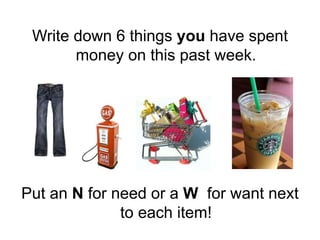
Write down 6 things you have spent
money on this past week.
Put an N for need or a W for want next
to each item!
Living within your means
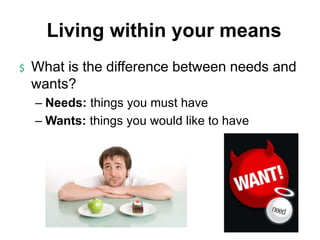
$ What is the difference between needs and
wants?
– Needs: things you must have
– Wants: things you would like to have
What happens if your expenses
are higher than your income?
$ Decrease your spending: ie: An expense
that can be adjusted or eliminated, such as
luxury items like designer clothes
$ Pay Cash Only- no credit cards or loans:
Keep all receipts or record all cash
purchases
$ Reduce impulse buying: spur of the
moment spending
$ Shop Smart: Coupons/Discounts
$ Increase income: look for a new job or an
additional job; ask for a raise
$ Decrease variable expenses
$ Before making purchases, consider
companion expenses: Hidden costs that
accompany a purchases
$ Carry a limited amount of cash
$ Shop smart: Discount/Coupons
What happens if your expenses
are higher than your income?
Steps to Budgeting:
1. Set Financial Goals: What would you like to
accomplish with this money?
– Make them specific!
• Short term: Takes 3 months or less
– Ex: saving for a trip
• Long term: Takes more than one year to achieve
– Ex: saving for a condo
2. Estimate Your Income : What money will be
coming in?
– Ex: Paycheck
• Gross Income – Money before taxes and other deductions
• Net Income – Money after taxes and other deductions
– Don’t include money that you cannot depend on
(Gifts/Bonuses) Wait until they are RECEIVED!!!!
Steps to Budgeting:
3. Budget for Unexpected Expenses and Savings: What if
I need money for an emergency?
– Allocate a designated amount to be put into savings
– Having an “emergency” 3-6 months worth of living
expenses in case someone loses a job, medical
expenses or other emergency situation.
– Always consider savings as an expense  10% of
income minimum
4. Budgeting for fixed expenses: How much do I know I
have to pay each month?
– Monthly expenses that remain the same from month to
month
• Ex: Car payment- Will always be $250 per month
• Ex: Mortgage- Will always be $3000 per month
Steps to Budgeting:
5. Budgeting for Variable Expenses: How much should I
estimate to pay each month?
– These expenses change from month to month depending on
needs, wants and Usage (ex: electric bill)
– Not as easy to budget for, when in doubt estimate higher
6. Record what you spend: What am I spending my
money on?
– Keep track of expenses and revise budget when necessary
– You may need to ADJUST (reduce/eliminate) spending to
achieve your goals. Examples:
• “Brown Bagging” Lunch
• Generic Vs. Name Brand
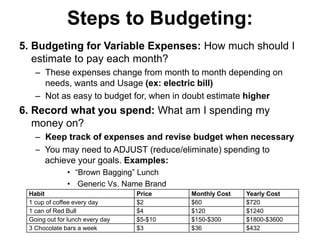
Habit Price Monthly Cost Yearly Cost
1 cup of coffee every day $2 $60 $720
1 can of Red Bull $4 $120 $1240
Going out for lunch every day $5-$10 $150-$300 $1800-$3600
3 Chocolate bars a week $3 $36 $432

Budgeting

  • 1.
    $Budgeting$ Aim: How canwe learn the steps to budget properly? Do Now: What is a budget? What are two main types of information that appear on a budget?
  • 2.
    Why Budget? $ Youneed to develop a plan for using your money to best meet your needs. – Helps you live within your means – Helps you decide how to spend your money wisely
  • 3.
    Write down 6things you have spent money on this past week. Put an N for need or a W for want next to each item!
  • 4.
    Living within yourmeans $ What is the difference between needs and wants? – Needs: things you must have – Wants: things you would like to have
  • 5.
    What happens ifyour expenses are higher than your income? $ Decrease your spending: ie: An expense that can be adjusted or eliminated, such as luxury items like designer clothes $ Pay Cash Only- no credit cards or loans: Keep all receipts or record all cash purchases $ Reduce impulse buying: spur of the moment spending $ Shop Smart: Coupons/Discounts
  • 6.
    $ Increase income:look for a new job or an additional job; ask for a raise $ Decrease variable expenses $ Before making purchases, consider companion expenses: Hidden costs that accompany a purchases $ Carry a limited amount of cash $ Shop smart: Discount/Coupons What happens if your expenses are higher than your income?
  • 7.
    Steps to Budgeting: 1.Set Financial Goals: What would you like to accomplish with this money? – Make them specific! • Short term: Takes 3 months or less – Ex: saving for a trip • Long term: Takes more than one year to achieve – Ex: saving for a condo 2. Estimate Your Income : What money will be coming in? – Ex: Paycheck • Gross Income – Money before taxes and other deductions • Net Income – Money after taxes and other deductions – Don’t include money that you cannot depend on (Gifts/Bonuses) Wait until they are RECEIVED!!!!
  • 8.
    Steps to Budgeting: 3.Budget for Unexpected Expenses and Savings: What if I need money for an emergency? – Allocate a designated amount to be put into savings – Having an “emergency” 3-6 months worth of living expenses in case someone loses a job, medical expenses or other emergency situation. – Always consider savings as an expense  10% of income minimum 4. Budgeting for fixed expenses: How much do I know I have to pay each month? – Monthly expenses that remain the same from month to month • Ex: Car payment- Will always be $250 per month • Ex: Mortgage- Will always be $3000 per month
  • 9.
    Steps to Budgeting: 5.Budgeting for Variable Expenses: How much should I estimate to pay each month? – These expenses change from month to month depending on needs, wants and Usage (ex: electric bill) – Not as easy to budget for, when in doubt estimate higher 6. Record what you spend: What am I spending my money on? – Keep track of expenses and revise budget when necessary – You may need to ADJUST (reduce/eliminate) spending to achieve your goals. Examples: • “Brown Bagging” Lunch • Generic Vs. Name Brand Habit Price Monthly Cost Yearly Cost 1 cup of coffee every day $2 $60 $720 1 can of Red Bull $4 $120 $1240 Going out for lunch every day $5-$10 $150-$300 $1800-$3600 3 Chocolate bars a week $3 $36 $432