Presented by- 
Yasha singh 
4113007007
• Relationship between Stock Market Returns, Inflationary 
Trends and real activity as it pertains to the Indian economy 
• Investing in developing countries – taking stakes in their 
growth prospects 
• The study examines fishers hypothesis and find results to be 
contingent upon the proxy employed for measuring 
expected inflation. 
• Inflation is found to be a significant determinant of stock 
returns even after controlling for current and future activity.
• Two hypothesis Examined : 
• The Fisher Hypothesis nominal Stock returns and inflationary 
expectations. 
• The “proxy effect” hypothesis Fundamental macro economic 
relation that characterize the economy. 
• ARIMA (Autoregressive integrated moving average) 
an autoregressive integrated moving average 
(ARIMA) model is a generalization of an autoregressive moving 
average (ARMA) model.
• These models are fitted to time series data either to better 
understand the data or to predict future points in the series. 
• ARIMA- based expectation model support the Fisher 
hypothesis and the commonly held belief that common 
stocks are a hedge against expected inflation. 
• The results also show that inflation is negatively linked to 
both current and future real activity.
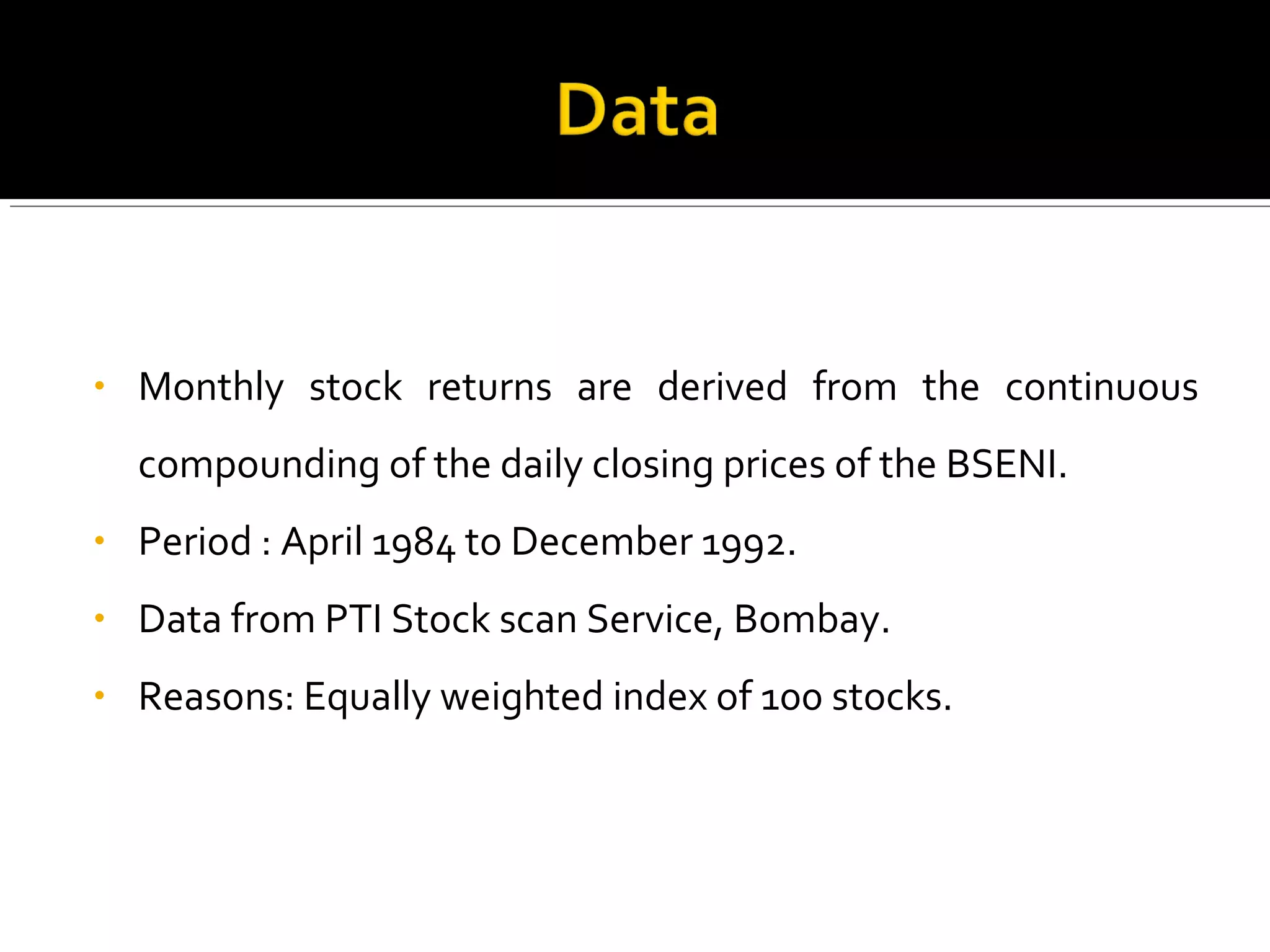
• Monthly stock returns are derived from the continuous 
compounding of the daily closing prices of the BSENI. 
• Period : April 1984 to December 1992. 
• Data from PTI Stock scan Service, Bombay. 
• Reasons: Equally weighted index of 100 stocks.
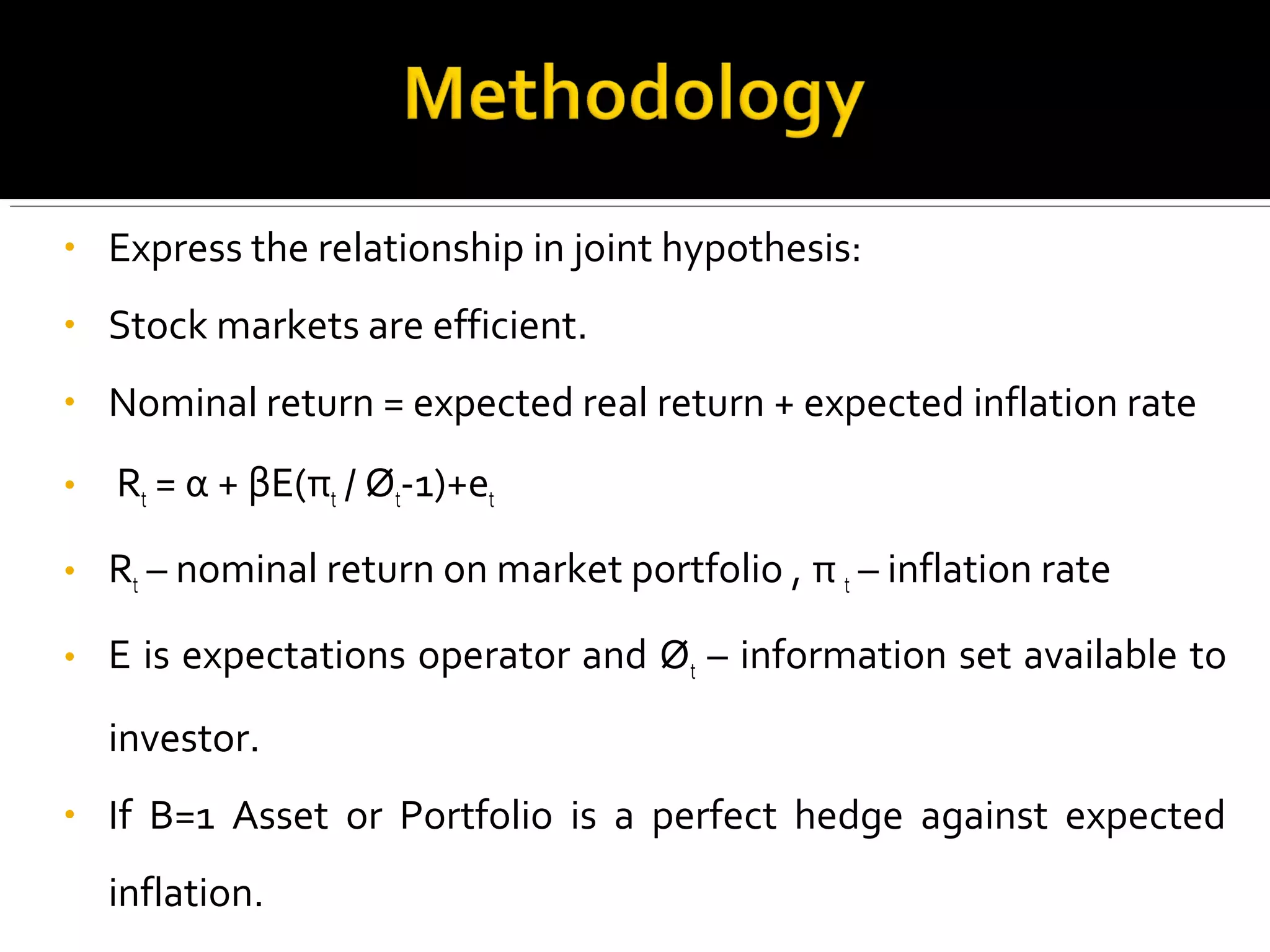
• Express the relationship in joint hypothesis: 
• Stock markets are efficient. 
• Nominal return = expected real return + expected inflation rate 
• Rt = α + βE(πt / Øt-1)+еt 
• Rt – nominal return on market portfolio , π t – inflation rate 
• E is expectations operator and Øt – information set available to 
investor. 
• If B=1 Asset or Portfolio is a perfect hedge against expected 
inflation.
• Real returns and expected inflation rate vary independent of 
each other. This extension involves decomposing of inflation 
rate into an expected and unexpected component. 
• Rt = α + β1E(π t / Øt-1)+β2[(π t –E(πt/ Øt-1)]+nt’ 
• unexpected component=Realized inflation rate and 
expected inflation rate. 
• Regression of real Stock returns on current and future real 
Activity. 
• (Rt- Πt)= α + βΣTt+I
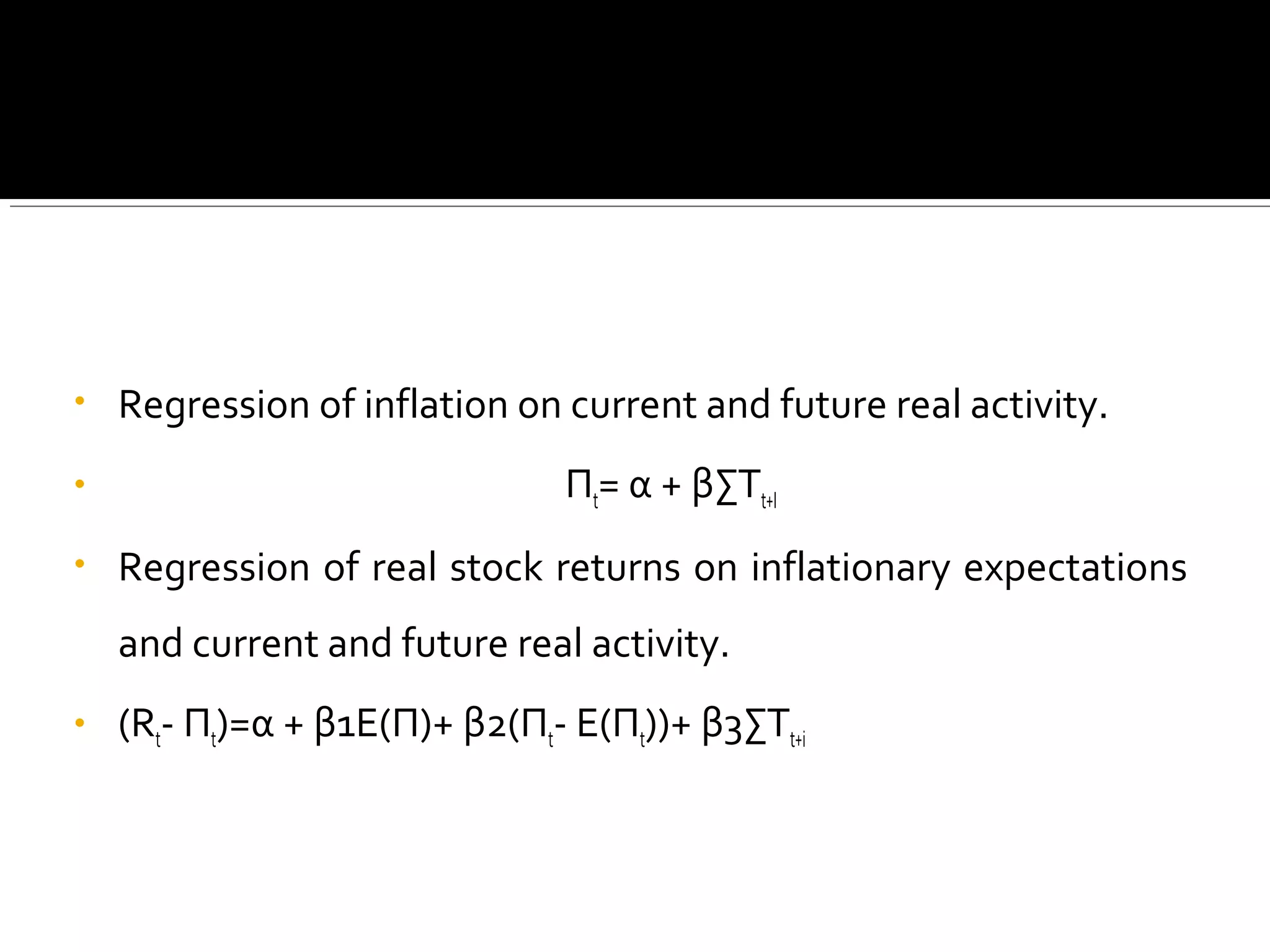
• Regression of inflation on current and future real activity. 
• Πt= α + βΣTt+I 
• Regression of real stock returns on inflationary expectations 
and current and future real activity. 
• (Rt- Πt)=α + β1E(Π)+ β2(Πt- E(Πt))+ β3ΣTt+i
• After examining two inter-related economic issues with 
respect to the Indian stock market 
• Fisher “There is a contingency on proxy employed in 
measuring inflationary expectations”. 
• ARIMA “Stock holding offer a hedge against expected 
inflation
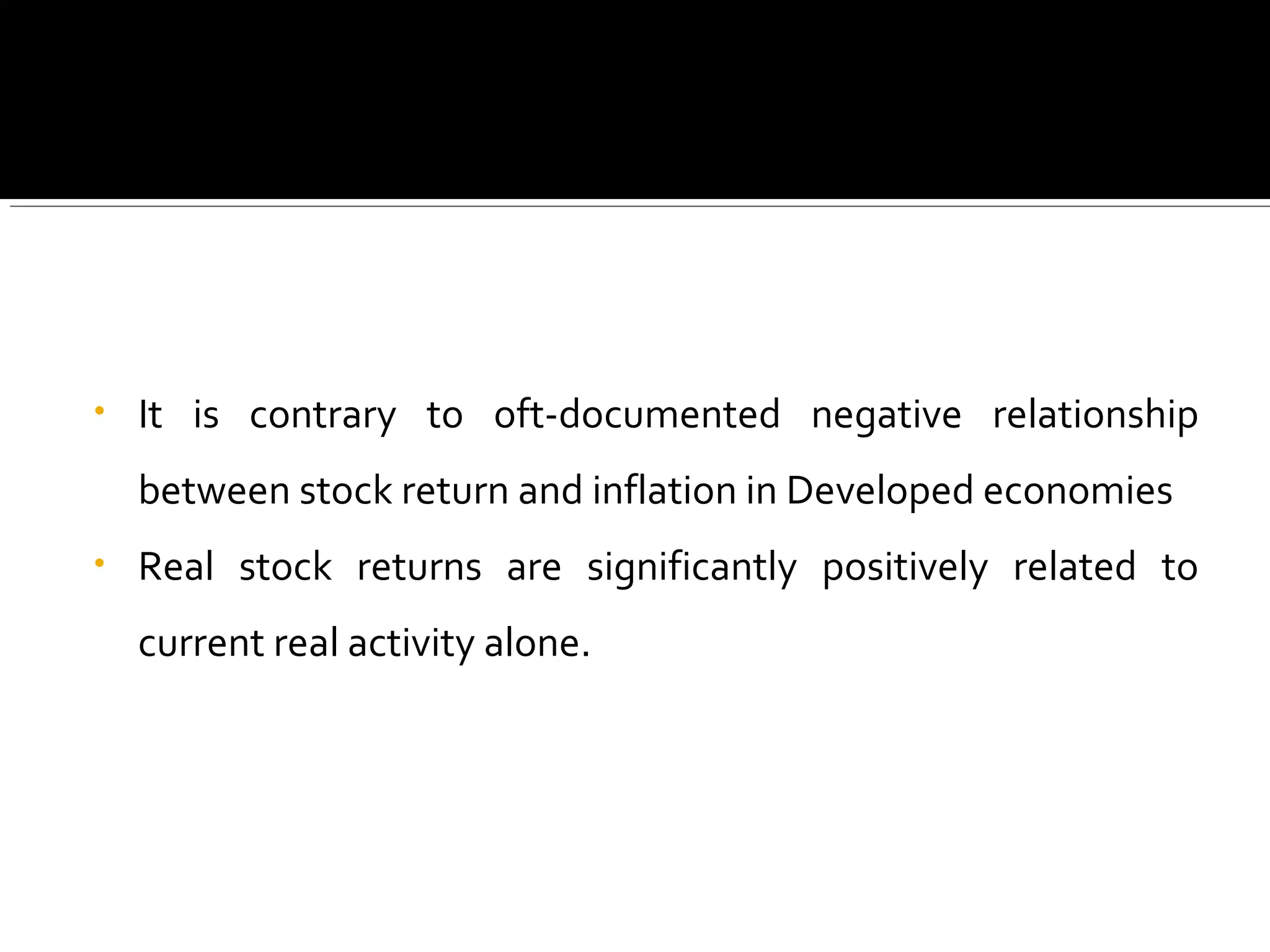
• It is contrary to oft-documented negative relationship 
between stock return and inflation in Developed economies 
• Real stock returns are significantly positively related to 
current real activity alone.

Stock market return

  • 1.
    Presented by- Yashasingh 4113007007
  • 2.
    • Relationship betweenStock Market Returns, Inflationary Trends and real activity as it pertains to the Indian economy • Investing in developing countries – taking stakes in their growth prospects • The study examines fishers hypothesis and find results to be contingent upon the proxy employed for measuring expected inflation. • Inflation is found to be a significant determinant of stock returns even after controlling for current and future activity.
  • 3.
    • Two hypothesisExamined : • The Fisher Hypothesis nominal Stock returns and inflationary expectations. • The “proxy effect” hypothesis Fundamental macro economic relation that characterize the economy. • ARIMA (Autoregressive integrated moving average) an autoregressive integrated moving average (ARIMA) model is a generalization of an autoregressive moving average (ARMA) model.
  • 4.
    • These modelsare fitted to time series data either to better understand the data or to predict future points in the series. • ARIMA- based expectation model support the Fisher hypothesis and the commonly held belief that common stocks are a hedge against expected inflation. • The results also show that inflation is negatively linked to both current and future real activity.
  • 5.
    • Monthly stockreturns are derived from the continuous compounding of the daily closing prices of the BSENI. • Period : April 1984 to December 1992. • Data from PTI Stock scan Service, Bombay. • Reasons: Equally weighted index of 100 stocks.
  • 6.
    • Express therelationship in joint hypothesis: • Stock markets are efficient. • Nominal return = expected real return + expected inflation rate • Rt = α + βE(πt / Øt-1)+еt • Rt – nominal return on market portfolio , π t – inflation rate • E is expectations operator and Øt – information set available to investor. • If B=1 Asset or Portfolio is a perfect hedge against expected inflation.
  • 7.
    • Real returnsand expected inflation rate vary independent of each other. This extension involves decomposing of inflation rate into an expected and unexpected component. • Rt = α + β1E(π t / Øt-1)+β2[(π t –E(πt/ Øt-1)]+nt’ • unexpected component=Realized inflation rate and expected inflation rate. • Regression of real Stock returns on current and future real Activity. • (Rt- Πt)= α + βΣTt+I
  • 8.
    • Regression ofinflation on current and future real activity. • Πt= α + βΣTt+I • Regression of real stock returns on inflationary expectations and current and future real activity. • (Rt- Πt)=α + β1E(Π)+ β2(Πt- E(Πt))+ β3ΣTt+i
  • 9.
    • After examiningtwo inter-related economic issues with respect to the Indian stock market • Fisher “There is a contingency on proxy employed in measuring inflationary expectations”. • ARIMA “Stock holding offer a hedge against expected inflation
  • 10.
    • It iscontrary to oft-documented negative relationship between stock return and inflation in Developed economies • Real stock returns are significantly positively related to current real activity alone.