RADIOBIOLOGY
Anjan Dangal
BS Medical Imaging , Final Year
National Academy of Medical Sciences,
Bir Hospital, Kathmandu, Nepal
Contents
• Law of Bergonie and Tribondeau
• Factors affecting Radiosensitivity
• Radiation effects on molecular and cellular level.
• Radiation effects on tissue/organ level.
• Deterministic and Stochastic Effects.
LAW OF BERGONIE AND TRIBONDEAU
• Theorized and observed by Bergonie and Tribondeau: Radiosensitivity
is a function of the metabolic state of tissue being irradiated.
Physical Factor affecting Radiosensitivity
• Linear Energy Transfer (LET)
• Relative Biological Effectiveness(RBE)
• Protraction and Fractionation
Physical factors that affect radiosensitivity
1. Linear energy transfer (LET): is a
measure of the rate at which energy is
transferred from Ionizing radiation to
soft tissue.
• Expressed in units of kiloelectron volt
of energy transferred per micrometer
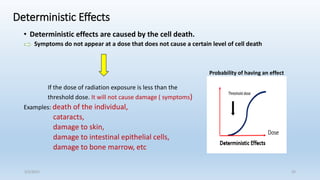
of track length.
• Higher LET increases the ability of
ionizing radiation to produce a biologic
effect and the probability of interaction
with target molecule.
• Relative Biologic Effectiveness:
Protraction and Fractionation
• If a dose of radiation is delivered over a long period of time rather
than quickly, the effect of that dose is less.
• Protraction: Dose is delivered continuously but at a lower dose rate.
• Fractionation: Dose is delivered with some interval and fraction but at
a same dose rate.
Dose protraction and fractionation causes less effect because
time is allowed for intracellular repair and tissue recovery.
Biologic Factors That Affect Radiosensitivity
• Oxygen Effect:Oxygen Effect: Tissue is more sensitive to radiation when
irradaited in the oxygenated state than when irradiated under anoxic or
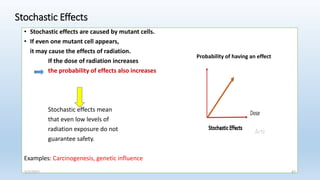
hypoxic conditions. Diagnostic X- ray Imaging is performed under the
conditions of full oxygen.
• Age
• Others:
• Recovery: Intracellular repair + Repopulation
• Chemical Agent: Radiosensitizer (halogenated pyrimidines) and Radioprotective agents
(cysteine and cysteamine).
• Hormesis: a little bit of radiation is good for you !
•Radiation Effects on the molecular/ cellular level
1. Targets of Biological Effects of Radiation
2. Radiation Induced DNA Damage and cellular radio responses.
3. Mutation
•Radiation Effects on Tissue/ Organism
1. Classification of Radiation exposure and its effects on Human Body
2. Radio sensitivity of cells and tissues
5/2/2021 10
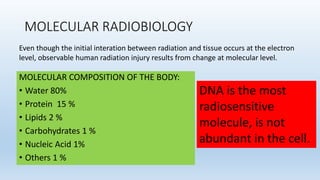
MOLECULAR RADIOBIOLOGY
MOLECULAR COMPOSITION OF THE BODY:
• Water 80%
• Protein 15 %
• Lipids 2 %
• Carbohydrates 1 %
• Nucleic Acid 1%
• Others 1 %
Even though the initial interation between radiation and tissue occurs at the electron
level, observable human radiation injury results from change at molecular level.
DNA is the most
radiosensitive
molecule, is not
abundant in the cell.
Subsequent studies revealed
that the major target of radiation
is
DNA
The Biological Effect of radiation is strongly
influenced by DNA
damage and its repair after irradiation
Targets of Biological Effects of Radiation
5/2/2021 12
• Orders of Frequency:
1. Damaged base only.
2. Damage that cause break of one strand.
3. Damage that causes two strands at the same location to
break
Radiation induced DNA Damage
5/2/2021 13
Cell Response to radiation Exposure
DNA
RNA
Protein
Normal Cell Function
radiation
DNA Damage
Stop of cell proliferation
Synthesis of repair Enzymes
DNA damage and its repair
Repairable
Cell death
2.Radiation Induced DNA Damage and cellular radio responses.
5/2/2021 14
• DNA molecule can be damaged without the production of a visible chromosome
aberration. Although reversible but can also lead to cell death. If enough cells of
same type respond similarly, then a particular organ or tissue can respond: This
describes the cause of deterministic effect.
• Damage to DNA can also result in abnormal metabolic activity. Uncontrolled
rapid proliferation of cells may occur, which is the reason for radiation induced
malignant disease: cause of stochastic effect.
Examples of Chromosomal Abnormalities
Radiation
Translocation
Inversion
Deletion
Normal
Dicentric
5/2/2021 16
• As the human body is an aqueous solution that contains 80% water
molecules, radiation interaction with water is the principal molecular
interaction in the body.
• When water is irradiated, it
disassociates into other molecule
product: this action is called
radiolysis of water.
The Cell Cycle and Radiation sensitivity
• Radiosensitivity of cells, differ depending on the
phase of the cell cycle. This is referred to as a
"cell cycle dependence" of radiosensitivity.
• The relationship between the cell cycle and
radiation sensitivity is shown in the graph below
• Early G1 phase: low sensitivity
• Late G1 phase to early S phase:
high sensitivity
• Late S phase to G2 phase: low
sensitivity
• M phase: high sensitivity
Cell division
5/2/2021 18
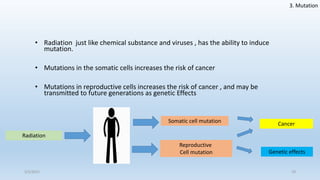
• Radiation just like chemical substance and viruses , has the ability to induce
mutation.
• Mutations in the somatic cells increases the risk of cancer
• Mutations in reproductive cells increases the risk of cancer , and may be
transmitted to future generations as genetic Effects
Reproductive
Cell mutation
Cancer
Genetic effects
Radiation
Somatic cell mutation
3. Mutation
5/2/2021 19
Effects of radiation on the Human Body
Genetic effects
Effects on the embryo and
fetus
( Mental retardation)
Acute effects
( erythema, hair loss)
Late effects : cataracts
(cancer, leukemia )
Harmful Tissue reactions
( Somatic Effects)
Hereditary disorder
( congenital anomalies)
5/2/2021 20
Types of Radiation Damage
• Acute effects ( Acute radiation damage)
1. These appear, at the least , after 2 to 3 months of exposure.
2. The casual relationship with radiation is easy to find.
( Examples) Death, leukopenia, skin reactions
• Late effects ( Late radiation damage )
1. These appears after a long incubation period following exposure.
2. The casual relationship with radiation is often difficult to find.
(Examples) Cancer, genetic effects, cataracts, growth failure.
B.1, Classification of radiation exposure and its effects on human body
5/2/2021 21
Radiosensitivity of Tissues and Organs
( Principle) High cell division frequency = high sensitivity
Radiation
sensitivity
Tissue/ Organ
Highest Lymphoid tissue ( thymus, spleen)
Bone marrow
Gonads ( testes) ( spermatogonia), ovary ( oocyte)
High Small intestine epithelium, mucuos membranes,
skin epithelium, capillaries,eye lens, hair follicles
Medium Kidney, liver, lung, salivary gland
Medium to low Thyroid, pancreas, adrenal gland, muscle, connective tissue
Lowest Bone, fat, nerve cells
B.2. Radiosensitivity of the cells and tissues
5/2/2021 22
Classification of biological effect of radiation
• The Biological effects of radiation are divided into deterministic effects and
stochastic effects
Threshold
Dose
As the exposed dose
increases
Damage
Deterministic
Effects
Yes Seriousness increases Excluding stochastic effects,
All harmful tissue reactions
Stochastic
Effects
No Frequency of occurrence
increases
Genetic Influence,
carciogenesis
Dose
Dose
Threshold dose
Deterministic Effects Stochastic Effects
5/2/2021 23
Deterministic Effects Of Radiation
• Deterministic radiation responses are those that exhibit increasing
severity with increasing radiation dose.
• There is dose threshold and dose response relationship is nonlinear.
Deterministic Effects
• Deterministic effects are caused by the cell death.
Symptoms do not appear at a dose that does not cause a certain level of cell death
If the dose of radiation exposure is less than the
threshold dose. It will not cause damage ( symptoms)
Examples: death of the individual,
cataracts,
damage to skin,
damage to intestinal epithelial cells,
damage to bone marrow, etc
Probability of having an effect
5/2/2021 25
Acute Radiation Lethality
• The sequence of events following high level radiation exposure
leading to death within days or weeks is called the acute radiation
syndrome.
Local Tissue Damage
• Follow a threshold type dose response
relationship.
• When threshold exceeded, the severity
of response increases with increasing
radiation dose in non-linear fashion.
Effects on the Skin
Effects on Gonads
• The cells of the testes (the male gonads) and the ovaries (the female
gonads) respond differently to radiation because of differences in
progression from the stem cell to the mature cell.
• The most radiosensitive cell during female germ cell development is
the oocyte in the mature follicle.
• The Spermatogonial stem cells signify the most sensitive phase in the
gametogenesis of the spermatozoa. Spermatocytes and spermatids
are relatively radiosensitive.
Effects on Gonads
Effects of Radiation on Gonads: Testicles and Ovaries
Radiation damage to the testes
0. 15 Gy of radiation exposure leads to temporary
Infertility
(due to decreased sperm count)
3.5 – 6 gy of acute radiation exposure leads to permanent
infertility
Chronic exposure of 2 Gy/year or more radiation causes
permanent infertility.
Radiation sensitivity
5/2/2021 32
1.5 Gy of acute exposure causes temporary
infertility and stops menstruation
2.5 – 8 Gy of acute radiation exposure leads to
permanent infertility
Effects of radiation on the gastrointestinal Tract
• The duodenum is the most
Radiosensitive part in the GI tract.
• The crypt cells ( stem cells, proliferation
Cells) in intestinal glands are especially
Sensitive to radiation.
• 10 Gy or more of radiation exposure will stop proliferation of crypt cells, and as
mature epithelial cells reach the end of their life, the submucosal tissues are
exposed.
• Tissue damage by radiation causes dehydration due to diarrhea, bleeding, and
abdominal pains. If the damage is severe, it leads to death.
5/2/2021 33
Effects of Radiation on mouse small Intestine
Normal 15 Gy
5/2/2021 34
Death by bone marrow damage
( 2.5 – 10 Gy)
Damage to hematopoietic stem cells and lymphocytes death in 1-2
months after radiation exposure mainly due to infection and
hemorrhage as a result of the loss of blood cells
Decrease in Bone marrow cells due to exposure of 10 Gy.
Normal 10 Gy
Hemopoietic System
Lymphocytes are the most radiosensitive whereas
Erythrocyte are the less radiosensitive.
Estimated Fetal Dose From Imaging
STOCHASTIC EFFECTS
• Stochastic effects of radiation are low doses delivered over a long period.
• The principal stochastic effects of low dose radiation over long period
consists of radiation induced malignancy and genetic effects.
• Effect has an increased likelihood with increasing exposure, but no
threshold.
• Due to DNA mutations which increase the probability of developing cancer.
• Relevant to routine clinical imaging, but risk remains low.
• Example: Leukemia, Lymphoma, Radiation induced sarcoma, Thyroid
cancer, breast and ovarian cancer.
Stochastic Effects
• Stochastic effects are caused by mutant cells.
• If even one mutant cell appears,
it may cause the effects of radiation.
If the dose of radiation increases
the probability of effects also increases
Stochastic effects mean
that even low levels of
radiation exposure do not
guarantee safety.
Examples: Carcinogenesis, genetic influence
Probability of having an effect
5/2/2021 42
LOCAL TISSUE EFFECTS
• SKIN:
Chronic irradiation of skin can result in severe non-malignant changes.
Radiodermatitis: tight and brittle appearance with severe crack.
• Chromosomes:
Low dose of radiation can produce chromosome abberation that may not be
apparent untill many years of radiation exposure.
• Cataracts:
The radiosensitivity of the lens of the eye is age dependent. As the age of the
individual increases, the radiation effect becomes greater and the latent period
becomes shorter. Latent periods ranging from 5 to 30 years have been observed in
humans, and the average latent period is approximately 15 years. If the lens dose is
high enough, in excess of approximately 10 Gyt (1000 rad), cataracts develop in
nearly 100% of those who are irradiated.
Most investigators would suggest
that the threshold after an acute x-
ray exposure is approximately 2 Gyt
(200 rad).
In computed tomography, the lens
dose can be 50 mGyt (5 rad).
• LIFE SPAN SHORTENING:
humans can expect a reduced life
span of approximately 10 days for
every 10 mGyt.
Risk of carcinogenesis from small doses of
radiation exposure
• 100 mSv or more of radiation exposure causes a significant
increase in the risk of carcinogenesis.
• At 100 mSv or less exposure , it is impossible to observe clear –
cut effects because of changes in risk due to other factors.
5/2/2021 45
Genetic Effects
• We do not have any data that suggests that radiation induced genetic
effects occur in humans.
• Radiation induced mutations are usually harmful.
• For most pre-reproductive life, the woman is less sensitive than the
man to the genetic effects of radiation.
• Most radiation induced mutations are recessive. These require that
the mutant genes must be present in both the male and female to
produce the triat.
Thankyou
References
• Book: Radiologic Science for Technologist, Stewart Carlyle Bushong,
11th Edition.
• MOOC: An Introduction to Radiation and Radioactivity, Hokkaido
University, Japan

Radiobiology

  • 1.
    RADIOBIOLOGY Anjan Dangal BS MedicalImaging , Final Year National Academy of Medical Sciences, Bir Hospital, Kathmandu, Nepal
  • 2.
    Contents • Law ofBergonie and Tribondeau • Factors affecting Radiosensitivity • Radiation effects on molecular and cellular level. • Radiation effects on tissue/organ level. • Deterministic and Stochastic Effects.
  • 3.
    LAW OF BERGONIEAND TRIBONDEAU • Theorized and observed by Bergonie and Tribondeau: Radiosensitivity is a function of the metabolic state of tissue being irradiated.
  • 5.
    Physical Factor affectingRadiosensitivity • Linear Energy Transfer (LET) • Relative Biological Effectiveness(RBE) • Protraction and Fractionation
  • 6.
    Physical factors thataffect radiosensitivity 1. Linear energy transfer (LET): is a measure of the rate at which energy is transferred from Ionizing radiation to soft tissue. • Expressed in units of kiloelectron volt of energy transferred per micrometer of track length. • Higher LET increases the ability of ionizing radiation to produce a biologic effect and the probability of interaction with target molecule.
  • 7.
    • Relative BiologicEffectiveness:
  • 8.
    Protraction and Fractionation •If a dose of radiation is delivered over a long period of time rather than quickly, the effect of that dose is less. • Protraction: Dose is delivered continuously but at a lower dose rate. • Fractionation: Dose is delivered with some interval and fraction but at a same dose rate. Dose protraction and fractionation causes less effect because time is allowed for intracellular repair and tissue recovery.
  • 9.
    Biologic Factors ThatAffect Radiosensitivity • Oxygen Effect:Oxygen Effect: Tissue is more sensitive to radiation when irradaited in the oxygenated state than when irradiated under anoxic or hypoxic conditions. Diagnostic X- ray Imaging is performed under the conditions of full oxygen. • Age • Others: • Recovery: Intracellular repair + Repopulation • Chemical Agent: Radiosensitizer (halogenated pyrimidines) and Radioprotective agents (cysteine and cysteamine). • Hormesis: a little bit of radiation is good for you !
  • 10.
    •Radiation Effects onthe molecular/ cellular level 1. Targets of Biological Effects of Radiation 2. Radiation Induced DNA Damage and cellular radio responses. 3. Mutation •Radiation Effects on Tissue/ Organism 1. Classification of Radiation exposure and its effects on Human Body 2. Radio sensitivity of cells and tissues 5/2/2021 10
  • 11.
    MOLECULAR RADIOBIOLOGY MOLECULAR COMPOSITIONOF THE BODY: • Water 80% • Protein 15 % • Lipids 2 % • Carbohydrates 1 % • Nucleic Acid 1% • Others 1 % Even though the initial interation between radiation and tissue occurs at the electron level, observable human radiation injury results from change at molecular level. DNA is the most radiosensitive molecule, is not abundant in the cell.
  • 12.
    Subsequent studies revealed thatthe major target of radiation is DNA The Biological Effect of radiation is strongly influenced by DNA damage and its repair after irradiation Targets of Biological Effects of Radiation 5/2/2021 12
  • 13.
    • Orders ofFrequency: 1. Damaged base only. 2. Damage that cause break of one strand. 3. Damage that causes two strands at the same location to break Radiation induced DNA Damage 5/2/2021 13
  • 14.
    Cell Response toradiation Exposure DNA RNA Protein Normal Cell Function radiation DNA Damage Stop of cell proliferation Synthesis of repair Enzymes DNA damage and its repair Repairable Cell death 2.Radiation Induced DNA Damage and cellular radio responses. 5/2/2021 14
  • 15.
    • DNA moleculecan be damaged without the production of a visible chromosome aberration. Although reversible but can also lead to cell death. If enough cells of same type respond similarly, then a particular organ or tissue can respond: This describes the cause of deterministic effect. • Damage to DNA can also result in abnormal metabolic activity. Uncontrolled rapid proliferation of cells may occur, which is the reason for radiation induced malignant disease: cause of stochastic effect.
  • 16.
    Examples of ChromosomalAbnormalities Radiation Translocation Inversion Deletion Normal Dicentric 5/2/2021 16
  • 17.
    • As thehuman body is an aqueous solution that contains 80% water molecules, radiation interaction with water is the principal molecular interaction in the body. • When water is irradiated, it disassociates into other molecule product: this action is called radiolysis of water.
  • 18.
    The Cell Cycleand Radiation sensitivity • Radiosensitivity of cells, differ depending on the phase of the cell cycle. This is referred to as a "cell cycle dependence" of radiosensitivity. • The relationship between the cell cycle and radiation sensitivity is shown in the graph below • Early G1 phase: low sensitivity • Late G1 phase to early S phase: high sensitivity • Late S phase to G2 phase: low sensitivity • M phase: high sensitivity Cell division 5/2/2021 18
  • 19.
    • Radiation justlike chemical substance and viruses , has the ability to induce mutation. • Mutations in the somatic cells increases the risk of cancer • Mutations in reproductive cells increases the risk of cancer , and may be transmitted to future generations as genetic Effects Reproductive Cell mutation Cancer Genetic effects Radiation Somatic cell mutation 3. Mutation 5/2/2021 19
  • 20.
    Effects of radiationon the Human Body Genetic effects Effects on the embryo and fetus ( Mental retardation) Acute effects ( erythema, hair loss) Late effects : cataracts (cancer, leukemia ) Harmful Tissue reactions ( Somatic Effects) Hereditary disorder ( congenital anomalies) 5/2/2021 20
  • 21.
    Types of RadiationDamage • Acute effects ( Acute radiation damage) 1. These appear, at the least , after 2 to 3 months of exposure. 2. The casual relationship with radiation is easy to find. ( Examples) Death, leukopenia, skin reactions • Late effects ( Late radiation damage ) 1. These appears after a long incubation period following exposure. 2. The casual relationship with radiation is often difficult to find. (Examples) Cancer, genetic effects, cataracts, growth failure. B.1, Classification of radiation exposure and its effects on human body 5/2/2021 21
  • 22.
    Radiosensitivity of Tissuesand Organs ( Principle) High cell division frequency = high sensitivity Radiation sensitivity Tissue/ Organ Highest Lymphoid tissue ( thymus, spleen) Bone marrow Gonads ( testes) ( spermatogonia), ovary ( oocyte) High Small intestine epithelium, mucuos membranes, skin epithelium, capillaries,eye lens, hair follicles Medium Kidney, liver, lung, salivary gland Medium to low Thyroid, pancreas, adrenal gland, muscle, connective tissue Lowest Bone, fat, nerve cells B.2. Radiosensitivity of the cells and tissues 5/2/2021 22
  • 23.
    Classification of biologicaleffect of radiation • The Biological effects of radiation are divided into deterministic effects and stochastic effects Threshold Dose As the exposed dose increases Damage Deterministic Effects Yes Seriousness increases Excluding stochastic effects, All harmful tissue reactions Stochastic Effects No Frequency of occurrence increases Genetic Influence, carciogenesis Dose Dose Threshold dose Deterministic Effects Stochastic Effects 5/2/2021 23
  • 24.
    Deterministic Effects OfRadiation • Deterministic radiation responses are those that exhibit increasing severity with increasing radiation dose. • There is dose threshold and dose response relationship is nonlinear.
  • 25.
    Deterministic Effects • Deterministiceffects are caused by the cell death. Symptoms do not appear at a dose that does not cause a certain level of cell death If the dose of radiation exposure is less than the threshold dose. It will not cause damage ( symptoms) Examples: death of the individual, cataracts, damage to skin, damage to intestinal epithelial cells, damage to bone marrow, etc Probability of having an effect 5/2/2021 25
  • 27.
    Acute Radiation Lethality •The sequence of events following high level radiation exposure leading to death within days or weeks is called the acute radiation syndrome.
  • 28.
    Local Tissue Damage •Follow a threshold type dose response relationship. • When threshold exceeded, the severity of response increases with increasing radiation dose in non-linear fashion.
  • 29.
  • 30.
    Effects on Gonads •The cells of the testes (the male gonads) and the ovaries (the female gonads) respond differently to radiation because of differences in progression from the stem cell to the mature cell. • The most radiosensitive cell during female germ cell development is the oocyte in the mature follicle. • The Spermatogonial stem cells signify the most sensitive phase in the gametogenesis of the spermatozoa. Spermatocytes and spermatids are relatively radiosensitive.
  • 31.
  • 32.
    Effects of Radiationon Gonads: Testicles and Ovaries Radiation damage to the testes 0. 15 Gy of radiation exposure leads to temporary Infertility (due to decreased sperm count) 3.5 – 6 gy of acute radiation exposure leads to permanent infertility Chronic exposure of 2 Gy/year or more radiation causes permanent infertility. Radiation sensitivity 5/2/2021 32 1.5 Gy of acute exposure causes temporary infertility and stops menstruation 2.5 – 8 Gy of acute radiation exposure leads to permanent infertility
  • 33.
    Effects of radiationon the gastrointestinal Tract • The duodenum is the most Radiosensitive part in the GI tract. • The crypt cells ( stem cells, proliferation Cells) in intestinal glands are especially Sensitive to radiation. • 10 Gy or more of radiation exposure will stop proliferation of crypt cells, and as mature epithelial cells reach the end of their life, the submucosal tissues are exposed. • Tissue damage by radiation causes dehydration due to diarrhea, bleeding, and abdominal pains. If the damage is severe, it leads to death. 5/2/2021 33
  • 34.
    Effects of Radiationon mouse small Intestine Normal 15 Gy 5/2/2021 34
  • 35.
    Death by bonemarrow damage ( 2.5 – 10 Gy) Damage to hematopoietic stem cells and lymphocytes death in 1-2 months after radiation exposure mainly due to infection and hemorrhage as a result of the loss of blood cells Decrease in Bone marrow cells due to exposure of 10 Gy. Normal 10 Gy
  • 36.
  • 37.
    Lymphocytes are themost radiosensitive whereas Erythrocyte are the less radiosensitive.
  • 40.
  • 41.
    STOCHASTIC EFFECTS • Stochasticeffects of radiation are low doses delivered over a long period. • The principal stochastic effects of low dose radiation over long period consists of radiation induced malignancy and genetic effects. • Effect has an increased likelihood with increasing exposure, but no threshold. • Due to DNA mutations which increase the probability of developing cancer. • Relevant to routine clinical imaging, but risk remains low. • Example: Leukemia, Lymphoma, Radiation induced sarcoma, Thyroid cancer, breast and ovarian cancer.
  • 42.
    Stochastic Effects • Stochasticeffects are caused by mutant cells. • If even one mutant cell appears, it may cause the effects of radiation. If the dose of radiation increases the probability of effects also increases Stochastic effects mean that even low levels of radiation exposure do not guarantee safety. Examples: Carcinogenesis, genetic influence Probability of having an effect 5/2/2021 42
  • 43.
    LOCAL TISSUE EFFECTS •SKIN: Chronic irradiation of skin can result in severe non-malignant changes. Radiodermatitis: tight and brittle appearance with severe crack. • Chromosomes: Low dose of radiation can produce chromosome abberation that may not be apparent untill many years of radiation exposure. • Cataracts: The radiosensitivity of the lens of the eye is age dependent. As the age of the individual increases, the radiation effect becomes greater and the latent period becomes shorter. Latent periods ranging from 5 to 30 years have been observed in humans, and the average latent period is approximately 15 years. If the lens dose is high enough, in excess of approximately 10 Gyt (1000 rad), cataracts develop in nearly 100% of those who are irradiated.
  • 44.
    Most investigators wouldsuggest that the threshold after an acute x- ray exposure is approximately 2 Gyt (200 rad). In computed tomography, the lens dose can be 50 mGyt (5 rad). • LIFE SPAN SHORTENING: humans can expect a reduced life span of approximately 10 days for every 10 mGyt.
  • 45.
    Risk of carcinogenesisfrom small doses of radiation exposure • 100 mSv or more of radiation exposure causes a significant increase in the risk of carcinogenesis. • At 100 mSv or less exposure , it is impossible to observe clear – cut effects because of changes in risk due to other factors. 5/2/2021 45
  • 46.
    Genetic Effects • Wedo not have any data that suggests that radiation induced genetic effects occur in humans. • Radiation induced mutations are usually harmful. • For most pre-reproductive life, the woman is less sensitive than the man to the genetic effects of radiation. • Most radiation induced mutations are recessive. These require that the mutant genes must be present in both the male and female to produce the triat.
  • 47.
  • 48.
    References • Book: RadiologicScience for Technologist, Stewart Carlyle Bushong, 11th Edition. • MOOC: An Introduction to Radiation and Radioactivity, Hokkaido University, Japan