Slack, Chambers and Johnston, Operations Management 5th
Edition © Nigel Slack, Stuart Chambers, and Robert Johnston 2007
Chapter 1
What is operations management?
Slack, Chambers and Johnston, Operations Management 5th
Edition © Nigel Slack, Stuart Chambers, and Robert Johnston 2007
Operations management is the activity
of managing the resources which are
devoted to the production and delivery
of products and services.
Operations management defined
Slack, Chambers and Johnston, Operations Management 5th
Edition © Nigel Slack, Stuart Chambers, and Robert Johnston 2007
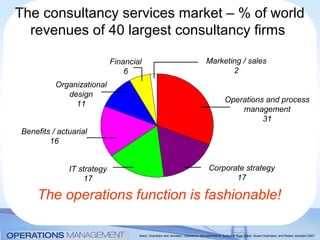
The operations function is fashionable!
The consultancy services market – % of world
revenues of 40 largest consultancy firms
Marketing / sales
2
Operations and process
management
31
Corporate strategy
17
IT strategy
17
Benefits / actuarial
16
Organizational
design
11
Financial
6
Slack, Chambers and Johnston, Operations Management 5th
Edition © Nigel Slack, Stuart Chambers, and Robert Johnston 2007
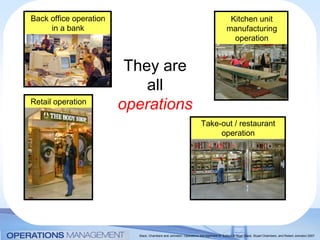
They are
all
operations
Back office operation
in a bank
Kitchen unit
manufacturing
operation
Retail operation
Take-out / restaurant
operation
Slack, Chambers and Johnston, Operations Management 5th
Edition © Nigel Slack, Stuart Chambers, and Robert Johnston 2007
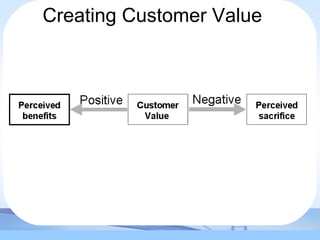
Creating Customer Value
Slack, Chambers and Johnston, Operations Management 5th
Edition © Nigel Slack, Stuart Chambers, and Robert Johnston 2007
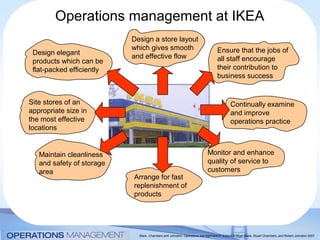
Design a store layout
which gives smooth
and effective flow
Design elegant
products which can be
flat-packed efficiently
Site stores of an
appropriate size in
the most effective
locations
Maintain cleanliness
and safety of storage
area
Arrange for fast
replenishment of
products
Monitor and enhance
quality of service to
customers
Continually examine
and improve
operations practice
Ensure that the jobs of
all staff encourage
their contribution to
business success
Operations management at IKEA
Slack, Chambers and Johnston, Operations Management 5th
Edition © Nigel Slack, Stuart Chambers, and Robert Johnston 2007
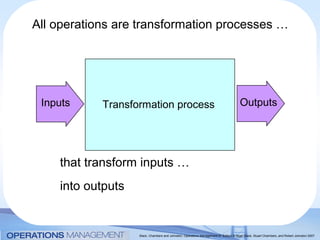
All operations are transformation processes …
Transformation processInputs
that transform inputs …
Outputs
into outputs
Slack, Chambers and Johnston, Operations Management 5th
Edition © Nigel Slack, Stuart Chambers, and Robert Johnston 2007
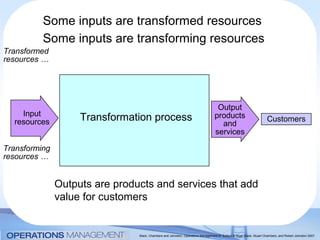
Transformed
resources …
Transforming
resources …
Customers
Output
products
and
services
Input
resources
Some inputs are transformed resources
Some inputs are transforming resources
Outputs are products and services that add
value for customers
Transformation process
Slack, Chambers and Johnston, Operations Management 5th
Edition © Nigel Slack, Stuart Chambers, and Robert Johnston 2007
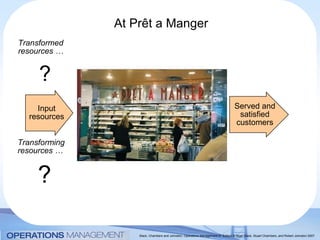
Transformed
resources …
?
Served and
satisfied
customers
Input
resources
Transforming
resources …
?
At Prêt a Manger
Slack, Chambers and Johnston, Operations Management 5th
Edition © Nigel Slack, Stuart Chambers, and Robert Johnston 2007
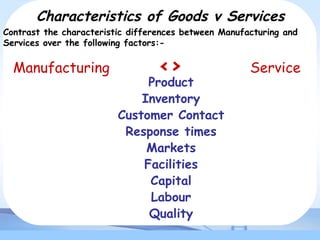
Characteristics of Goods v Services
Product
Inventory
Customer Contact
Response times
Markets
Facilities
Capital
Labour
Quality
Contrast the characteristic differences between Manufacturing and
Services over the following factors:-
Manufacturing <> Service
Slack, Chambers and Johnston, Operations Management 5th
Edition © Nigel Slack, Stuart Chambers, and Robert Johnston 2007
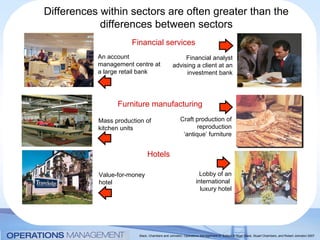
Differences within sectors are often greater than the
differences between sectors
Financial services
An account
management centre at
a large retail bank
Financial analyst
advising a client at an
investment bank
Furniture manufacturing
Mass production of
kitchen units
Craft production of
reproduction
‘antique’ furniture
Hotels
Value-for-money
hotel
Lobby of an
international
luxury hotel
Slack, Chambers and Johnston, Operations Management 5th
Edition © Nigel Slack, Stuart Chambers, and Robert Johnston 2007
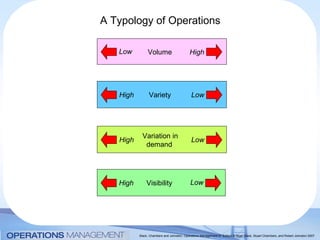
A Typology of Operations
Variation in
demand
High Low
VisibilityHigh Low
VarietyHigh Low
HighVolumeLow High
Slack, Chambers and Johnston, Operations Management 5th
Edition © Nigel Slack, Stuart Chambers, and Robert Johnston 2007
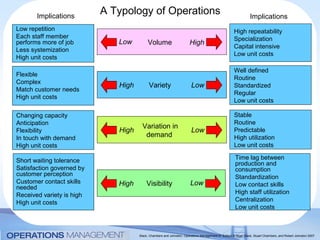
A Typology of OperationsImplications Implications
Changing capacity
Anticipation
Flexibility
In touch with demand
High unit costs
Stable
Routine
Predictable
High utilization
Low unit costs
Variation in
demand
High Low
VisibilityHigh Low
Short waiting tolerance
Satisfaction governed by
customer perception
Customer contact skills
needed
Received variety is high
High unit costs
Time lag between
production and
consumption
Standardization
Low contact skills
High staff utilization
Centralization
Low unit costs
Flexible
Complex
Match customer needs
High unit costs
Well defined
Routine
Standardized
Regular
Low unit costs
VarietyHigh Low
High
Low repetition
Each staff member
performs more of job
Less systemization
High unit costs
High repeatability
Specialization
Capital intensive
Low unit costs
VolumeLow High

What is Operation management?

  • 1.
    Slack, Chambers andJohnston, Operations Management 5th Edition © Nigel Slack, Stuart Chambers, and Robert Johnston 2007 Chapter 1 What is operations management?
  • 2.
    Slack, Chambers andJohnston, Operations Management 5th Edition © Nigel Slack, Stuart Chambers, and Robert Johnston 2007 Operations management is the activity of managing the resources which are devoted to the production and delivery of products and services. Operations management defined
  • 3.
    Slack, Chambers andJohnston, Operations Management 5th Edition © Nigel Slack, Stuart Chambers, and Robert Johnston 2007 The operations function is fashionable! The consultancy services market – % of world revenues of 40 largest consultancy firms Marketing / sales 2 Operations and process management 31 Corporate strategy 17 IT strategy 17 Benefits / actuarial 16 Organizational design 11 Financial 6
  • 4.
    Slack, Chambers andJohnston, Operations Management 5th Edition © Nigel Slack, Stuart Chambers, and Robert Johnston 2007 They are all operations Back office operation in a bank Kitchen unit manufacturing operation Retail operation Take-out / restaurant operation
  • 5.
    Slack, Chambers andJohnston, Operations Management 5th Edition © Nigel Slack, Stuart Chambers, and Robert Johnston 2007 Creating Customer Value
  • 6.
    Slack, Chambers andJohnston, Operations Management 5th Edition © Nigel Slack, Stuart Chambers, and Robert Johnston 2007 Design a store layout which gives smooth and effective flow Design elegant products which can be flat-packed efficiently Site stores of an appropriate size in the most effective locations Maintain cleanliness and safety of storage area Arrange for fast replenishment of products Monitor and enhance quality of service to customers Continually examine and improve operations practice Ensure that the jobs of all staff encourage their contribution to business success Operations management at IKEA
  • 7.
    Slack, Chambers andJohnston, Operations Management 5th Edition © Nigel Slack, Stuart Chambers, and Robert Johnston 2007 All operations are transformation processes … Transformation processInputs that transform inputs … Outputs into outputs
  • 8.
    Slack, Chambers andJohnston, Operations Management 5th Edition © Nigel Slack, Stuart Chambers, and Robert Johnston 2007 Transformed resources … Transforming resources … Customers Output products and services Input resources Some inputs are transformed resources Some inputs are transforming resources Outputs are products and services that add value for customers Transformation process
  • 9.
    Slack, Chambers andJohnston, Operations Management 5th Edition © Nigel Slack, Stuart Chambers, and Robert Johnston 2007 Transformed resources … ? Served and satisfied customers Input resources Transforming resources … ? At Prêt a Manger
  • 10.
    Slack, Chambers andJohnston, Operations Management 5th Edition © Nigel Slack, Stuart Chambers, and Robert Johnston 2007 Characteristics of Goods v Services Product Inventory Customer Contact Response times Markets Facilities Capital Labour Quality Contrast the characteristic differences between Manufacturing and Services over the following factors:- Manufacturing <> Service
  • 11.
    Slack, Chambers andJohnston, Operations Management 5th Edition © Nigel Slack, Stuart Chambers, and Robert Johnston 2007 Differences within sectors are often greater than the differences between sectors Financial services An account management centre at a large retail bank Financial analyst advising a client at an investment bank Furniture manufacturing Mass production of kitchen units Craft production of reproduction ‘antique’ furniture Hotels Value-for-money hotel Lobby of an international luxury hotel
  • 12.
    Slack, Chambers andJohnston, Operations Management 5th Edition © Nigel Slack, Stuart Chambers, and Robert Johnston 2007 A Typology of Operations Variation in demand High Low VisibilityHigh Low VarietyHigh Low HighVolumeLow High
  • 13.
    Slack, Chambers andJohnston, Operations Management 5th Edition © Nigel Slack, Stuart Chambers, and Robert Johnston 2007 A Typology of OperationsImplications Implications Changing capacity Anticipation Flexibility In touch with demand High unit costs Stable Routine Predictable High utilization Low unit costs Variation in demand High Low VisibilityHigh Low Short waiting tolerance Satisfaction governed by customer perception Customer contact skills needed Received variety is high High unit costs Time lag between production and consumption Standardization Low contact skills High staff utilization Centralization Low unit costs Flexible Complex Match customer needs High unit costs Well defined Routine Standardized Regular Low unit costs VarietyHigh Low High Low repetition Each staff member performs more of job Less systemization High unit costs High repeatability Specialization Capital intensive Low unit costs VolumeLow High