MATHEMATICAL FORMULAE
Algebra
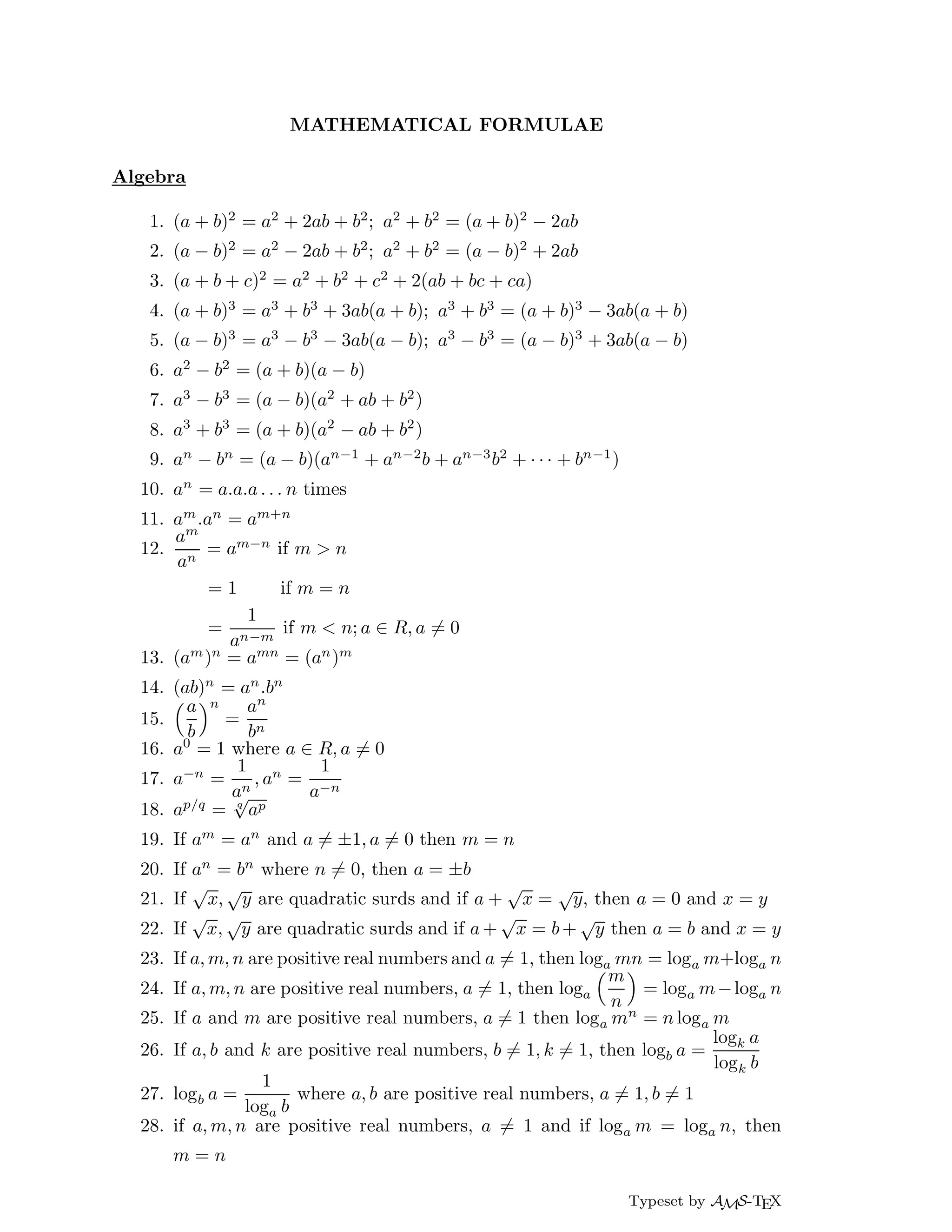
1. (a + b)2 = a2 + 2ab + b2 ; a2 + b2 = (a + b)2 − 2ab
2. (a − b)2 = a2 − 2ab + b2 ; a2 + b2 = (a − b)2 + 2ab
3. (a + b + c)2 = a2 + b2 + c2 + 2(ab + bc + ca)
4. (a + b)3 = a3 + b3 + 3ab(a + b); a3 + b3 = (a + b)3 − 3ab(a + b)
5. (a − b)3 = a3 − b3 − 3ab(a − b); a3 − b3 = (a − b)3 + 3ab(a − b)
6. a2 − b2 = (a + b)(a − b)
7. a3 − b3 = (a − b)(a2 + ab + b2 )
8. a3 + b3 = (a + b)(a2 − ab + b2 )
9. an − bn = (a − b)(an−1 + an−2 b + an−3 b2 + · · · + bn−1 )
10. an = a.a.a . . . n times
11. am .an = am+n
am
12. n = am−n if m > n
a
=1
if m = n
1
= n−m if m < n; a ∈ R, a = 0
a
13. (am )n = amn = (an )m
14. (ab)n = an .bn
a n
an
15.
= n
b
b
16. a0 = 1 where a ∈ R, a = 0
1
1
17. a−n = n , an = −n
a
a
√
18. ap/q = q ap
19. If am = an and a = ±1, a = 0 then m = n
20. If an = bn where n = 0, then a = ±b
√ √
√
√
21. If x, y are quadratic surds and if a + x = y, then a = 0 and x = y
√ √
√
√
22. If x, y are quadratic surds and if a + x = b + y then a = b and x = y
23. If a, m, n are positive real numbers and a = 1, then loga mn = loga m+loga n
m
24. If a, m, n are positive real numbers, a = 1, then loga
= loga m − loga n
n
25. If a and m are positive real numbers, a = 1 then loga mn = n loga m
logk a
26. If a, b and k are positive real numbers, b = 1, k = 1, then logb a =
logk b
1
27. logb a =
where a, b are positive real numbers, a = 1, b = 1
loga b
28. if a, m, n are positive real numbers, a = 1 and if loga m = loga n, then
m=n
Typeset by AMS-TEX
2

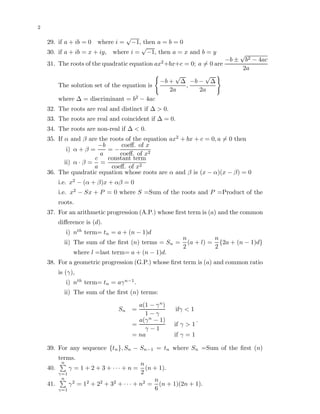
29. if a + ib = 0

√
−1, then a = b = 0
√
where i = −1, then a = x and b = y

where i =

30. if a + ib = x + iy,

31. The roots of the quadratic equation ax2 +bx+c = 0; a = 0 are

The solution set of the equation is

−b ±

√
b2 − 4ac
2a

√
√
−b + ∆ −b − ∆
,
2a
2a

where ∆ = discriminant = b2 − 4ac
32. The roots are real and distinct if ∆ > 0.
33. The roots are real and coincident if ∆ = 0.
34. The roots are non-real if ∆ < 0.
35. If α and β are the roots of the equation ax2 + bx + c = 0, a = 0 then
−b
coeff. of x
=−
i) α + β =
a
coeff. of x2
c
constant term
ii) α · β = =
a
coeff. of x2
36. The quadratic equation whose roots are α and β is (x − α)(x − β) = 0
i.e. x2 − (α + β)x + αβ = 0
i.e. x2 − Sx + P = 0 where S =Sum of the roots and P =Product of the
roots.
37. For an arithmetic progression (A.P.) whose first term is (a) and the common
difference is (d).
i) nth term= tn = a + (n − 1)d
ii) The sum of the first (n) terms = Sn =
where l =last term= a + (n − 1)d.

n
n
(a + l) = {2a + (n − 1)d}
2
2

38. For a geometric progression (G.P.) whose first term is (a) and common ratio
is (γ),
i) nth term= tn = aγ n−1 .
ii) The sum of the first (n) terms:
Sn

a(1 − γ n)
1−γ
a(γ n − 1)
=
γ−1
= na
=

ifγ < 1
if γ > 1

.

if γ = 1

39. For any sequence {tn }, Sn − Sn−1 = tn where Sn =Sum of the first (n)
terms.
n

n
(n + 1).
2
γ=1
n
n
41.
γ 2 = 12 + 22 + 32 + · · · + n2 = (n + 1)(2n + 1).
6
γ=1

40.

γ = 1 + 2 + 3 + ··· + n =
3
n

42.

γ 3 = 13 + 23 + 33 + 43 + · · · + n3 =

γ=1

n2
(n + 1)2 .
4

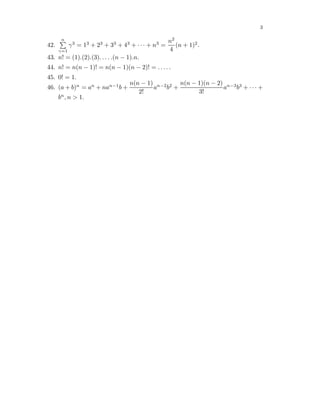
43. n! = (1).(2).(3). . . . .(n − 1).n.
44. n! = n(n − 1)! = n(n − 1)(n − 2)! = . . . . .
45. 0! = 1.
46. (a + b)n = an + nan−1 b +
bn , n > 1.

n(n − 1) n−2 2 n(n − 1)(n − 2) n−3 3
a
b +
a
b +···+
2!
3!

Formulas

  • 1.
    MATHEMATICAL FORMULAE Algebra 1. (a+ b)2 = a2 + 2ab + b2 ; a2 + b2 = (a + b)2 − 2ab 2. (a − b)2 = a2 − 2ab + b2 ; a2 + b2 = (a − b)2 + 2ab 3. (a + b + c)2 = a2 + b2 + c2 + 2(ab + bc + ca) 4. (a + b)3 = a3 + b3 + 3ab(a + b); a3 + b3 = (a + b)3 − 3ab(a + b) 5. (a − b)3 = a3 − b3 − 3ab(a − b); a3 − b3 = (a − b)3 + 3ab(a − b) 6. a2 − b2 = (a + b)(a − b) 7. a3 − b3 = (a − b)(a2 + ab + b2 ) 8. a3 + b3 = (a + b)(a2 − ab + b2 ) 9. an − bn = (a − b)(an−1 + an−2 b + an−3 b2 + · · · + bn−1 ) 10. an = a.a.a . . . n times 11. am .an = am+n am 12. n = am−n if m > n a =1 if m = n 1 = n−m if m < n; a ∈ R, a = 0 a 13. (am )n = amn = (an )m 14. (ab)n = an .bn a n an 15. = n b b 16. a0 = 1 where a ∈ R, a = 0 1 1 17. a−n = n , an = −n a a √ 18. ap/q = q ap 19. If am = an and a = ±1, a = 0 then m = n 20. If an = bn where n = 0, then a = ±b √ √ √ √ 21. If x, y are quadratic surds and if a + x = y, then a = 0 and x = y √ √ √ √ 22. If x, y are quadratic surds and if a + x = b + y then a = b and x = y 23. If a, m, n are positive real numbers and a = 1, then loga mn = loga m+loga n m 24. If a, m, n are positive real numbers, a = 1, then loga = loga m − loga n n 25. If a and m are positive real numbers, a = 1 then loga mn = n loga m logk a 26. If a, b and k are positive real numbers, b = 1, k = 1, then logb a = logk b 1 27. logb a = where a, b are positive real numbers, a = 1, b = 1 loga b 28. if a, m, n are positive real numbers, a = 1 and if loga m = loga n, then m=n Typeset by AMS-TEX
  • 2.
    2 29. if a+ ib = 0 √ −1, then a = b = 0 √ where i = −1, then a = x and b = y where i = 30. if a + ib = x + iy, 31. The roots of the quadratic equation ax2 +bx+c = 0; a = 0 are The solution set of the equation is −b ± √ b2 − 4ac 2a √ √ −b + ∆ −b − ∆ , 2a 2a where ∆ = discriminant = b2 − 4ac 32. The roots are real and distinct if ∆ > 0. 33. The roots are real and coincident if ∆ = 0. 34. The roots are non-real if ∆ < 0. 35. If α and β are the roots of the equation ax2 + bx + c = 0, a = 0 then −b coeff. of x =− i) α + β = a coeff. of x2 c constant term ii) α · β = = a coeff. of x2 36. The quadratic equation whose roots are α and β is (x − α)(x − β) = 0 i.e. x2 − (α + β)x + αβ = 0 i.e. x2 − Sx + P = 0 where S =Sum of the roots and P =Product of the roots. 37. For an arithmetic progression (A.P.) whose first term is (a) and the common difference is (d). i) nth term= tn = a + (n − 1)d ii) The sum of the first (n) terms = Sn = where l =last term= a + (n − 1)d. n n (a + l) = {2a + (n − 1)d} 2 2 38. For a geometric progression (G.P.) whose first term is (a) and common ratio is (γ), i) nth term= tn = aγ n−1 . ii) The sum of the first (n) terms: Sn a(1 − γ n) 1−γ a(γ n − 1) = γ−1 = na = ifγ < 1 if γ > 1 . if γ = 1 39. For any sequence {tn }, Sn − Sn−1 = tn where Sn =Sum of the first (n) terms. n n (n + 1). 2 γ=1 n n 41. γ 2 = 12 + 22 + 32 + · · · + n2 = (n + 1)(2n + 1). 6 γ=1 40. γ = 1 + 2 + 3 + ··· + n =
  • 3.
    3 n 42. γ 3 =13 + 23 + 33 + 43 + · · · + n3 = γ=1 n2 (n + 1)2 . 4 43. n! = (1).(2).(3). . . . .(n − 1).n. 44. n! = n(n − 1)! = n(n − 1)(n − 2)! = . . . . . 45. 0! = 1. 46. (a + b)n = an + nan−1 b + bn , n > 1. n(n − 1) n−2 2 n(n − 1)(n − 2) n−3 3 a b + a b +···+ 2! 3!