1
2
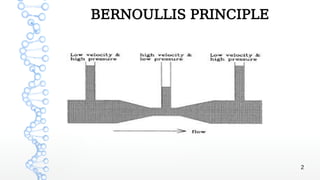
BERNOULLIS PRINCIPLE
3
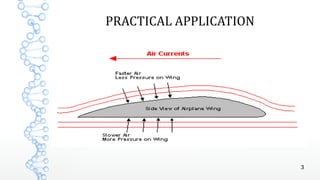
PRACTICAL APPLICATION
4
Applications in Aviation
●
Bernoulli's principle can be used to calculate the lift force on an
aerofoil, if the behaviour of the fluid flow in the vicinity of the foil
is known. For example, if the air flowing past the top surface of
an aircraft wing is moving faster than the air flowing past the
bottom surface, then Bernoulli's principle implies that the
pressure on the surfaces of the wing will be lower above than
below. This pressure difference results in an upwards lifting
force. Whenever the distribution of speed past the top and
bottom surfaces of a wing is known, the lift forces can be
calculated (to a good approximation) using Bernoulli's equations.
●
●
5
6
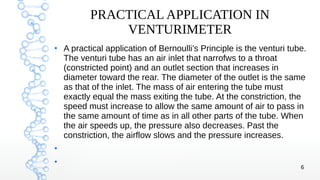
PRACTICAL APPLICATION IN
VENTURIMETER
●
A practical application of Bernoulli’s Principle is the venturi tube.
The venturi tube has an air inlet that narrofws to a throat
(constricted point) and an outlet section that increases in
diameter toward the rear. The diameter of the outlet is the same
as that of the inlet. The mass of air entering the tube must
exactly equal the mass exiting the tube. At the constriction, the
speed must increase to allow the same amount of air to pass in
the same amount of time as in all other parts of the tube. When
the air speeds up, the pressure also decreases. Past the
constriction, the airflow slows and the pressure increases.
●
●
7
P2
8
APPLICATION ON BLOWING OFF ROOF
TOP
●
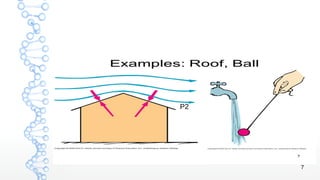
In olden days, the roofs of the huts or houses were designed
with a slope as shown previos slide. One important scientific
reason is that as per the Bernoulli’s principle, it will be
safeguarded except roof during storm or cyclone .During
cyclonic condition, the roof is blown off without damaging
the other parts of the house. In accordance with the
Bernoulli’s principle, the high wind blowing over the roof
creates a low-pressure P1. The pressure under the roof P2
is greater. Therefore, this pressure difference (P2–P1)
creates an up thrust and the roof is blown off.
9
Bernoulli’s Theorem
●
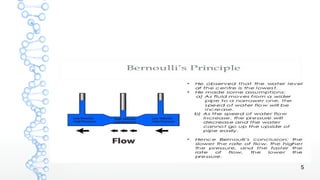
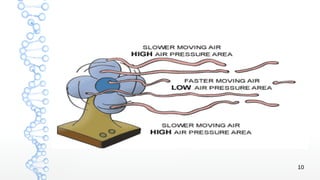
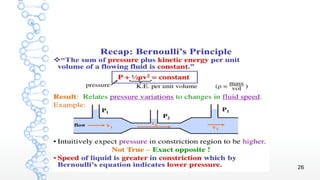
In Fluid Dynamics: Bernoulli’s Principle states that increase in speed
of a fluid occurs simultaneously with decrease in static pressure or a
decrease in fluids Potiental Energy
●
Meaning: It states that speed of a moving fluid increases when
.pressure decreases
10
11
BERN O U LLIS PRIN CIPLE
●
The total mechanical energy of the moving fluid comprising
the gravitational potential energy of elevation, the energy
associated with the fluid pressure and the kinetic energy of
.the fluid motion, remains constant
12
Bernoullis Prnciple
●
Bernoulli's principle can be applied to various types of fluid flow,
resulting in various forms of Bernoulli's equation; there are
.different forms of Bernoulli's equation for different types of flow
The simple form of Bernoulli's equation is valid for
incompressible flow
13
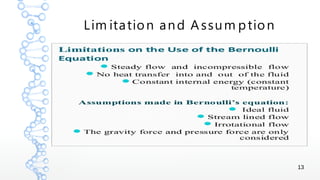
Lim itation and Assum ption
14
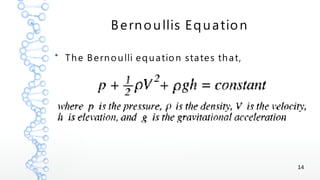
Bernoullis Equation
●
The Bernoulli equation states that,
●
●
15
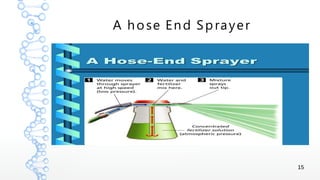
A hose End Sprayer
16
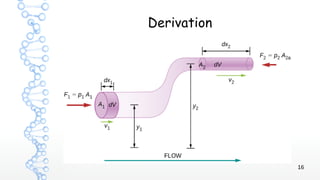
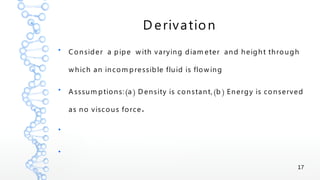
Derivation
17
D erivation
●
Consider a pipe w ith varying diam eter and height through
w hich an incom pressible fluid is flow ing
●
( ) ( )Asssum ptions: a D ensity is constant, b Energy is conserved
.as no viscous force
●
●
18
●
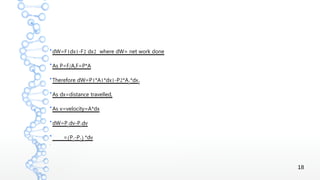
1 1 2 2dW=F dx -F dx where dW= net work done
●
/As P=F A,F=P*A
●
1 1 1 2Therefore dW=P *A *dx -P *A2*dx2
●
As dx=distance travelled,
●
As v=velocity=A*dx
●
dW=P1dv-P2dv
●
(= P1-P2) *dv
●
19
●
Work done on a fluid is due to conservation of gravitional force and
.change in K E
●
1/2dK= m2*v2
2 1/2- m1*v1
2
●
( ) / ( ) / ( )Since rho =m v,where rho =m Vh therefore m= rho *V therefore
●
1/2( ) [dK= rho dV v2
2-v1
2]
●
●
20
●
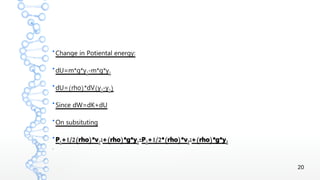
Change in Potiental energy:
●
dU=m*g*y2-m*g*y1
●
( ) (dU= rho *dV y2-y1)
●
Since dW=dK+dU
●
On subsituting
●
P1 1/2( )+ rho *v1
2 ( )+ rho *g*y1
=P2 1/2 ( )+ * rho *v2
2 ( )+ rho *g*y2
●
21
Potiental Energy
22
Potiental Energy head
●
In a flowing fluid, potential energy may in turn be subdivided into
energy due to position or elevation above a given datum, and energy
.due to pressure in the fluid Head is the amount of energy per Newton
( ) .or per pound of fluid
●
.P E=m*g*h
●
23
Examples of Potienatl Energy Head
24
Kinetic Energy Head
●
● – .Kinetic head: The kinetic head represents the kinetic energy of the fluid It is the height in feet that
.a flowing fluid would rise in a column if all of its kinetic energy were converted to potential energy
●
●
●
●
● I
25
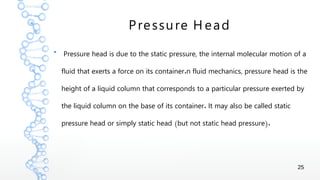
Pressure H ead
●
Pressure head is due to the static pressure, the internal molecular motion of a
.fluid that exerts a force on its container n fluid mechanics, pressure head is the
height of a liquid column that corresponds to a particular pressure exerted by
.the liquid column on the base of its container It may also be called static
( ).pressure head or simply static head but not static head pressure
26
27
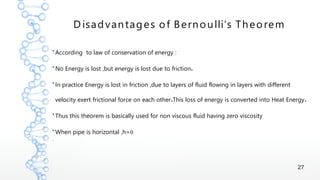
D isadvantages of Bernoulli’s Theorem
●
According to law of conservation of energy :
●
.No Energy is lost ,but energy is lost due to friction
●
In practice Energy is lost in friction ,due to layers of fluid flowing in layers with different
. .velocity exert frictional force on each other This loss of energy is converted into Heat Energy
●
Thus this theorem is basically used for non viscous fluid having zero viscosity
●
0When pipe is horizontal ,h=
●
28
● PROBLEMS
29
.......Problem s
●
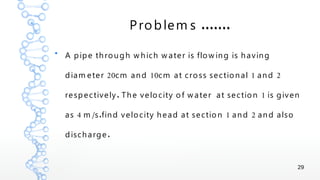
A pipe through w hich w ater is flow ing is having
20 10 1 2diam eter cm and cm at cross sectional and
. 1respectively The velocity of w ater at section is given
4 / . 1 2as m s find velocity head at section and and also
.discharge
30
●
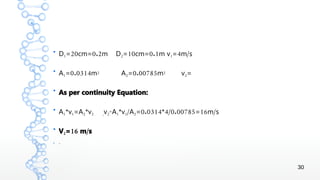
D1 20 0.2= cm= m D2 10 0.1= cm= m v1 4 /= m s
●
A1 0.0314= m2 A2 0.00785= m2 v2=
●
As per continuity Equation:
●
A1*v1=A2*v2 ,v2
=A1*v1/A2 0.0314 4/0.00785 16 /= * = m s
●
V2 16 /= m s
● =
31
●
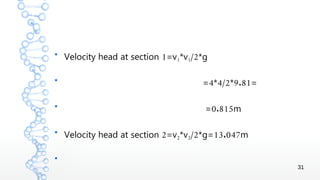
1Velocity head at section =v1*v1/2*g
●
4 4/2 9.81= * * =
●
0.815= m
●
2Velocity head at section =v2*v2/2 13.047*g= m
●
32
●
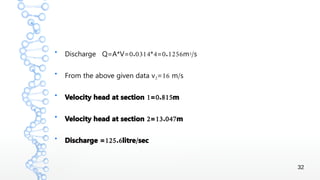
0.0314 4 0.1256Discharge Q=A*V= * = m3/s
●
From the above given data v2 16 /= m s
●
1 0.815Velocity head at section = m
●
2 13.047Velocity head at section = m
●
125.6 /Discharge = litre sec
33
●
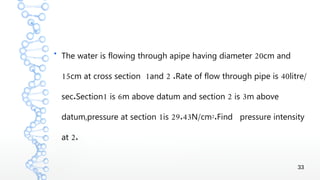
20The water is flowing through apipe having diameter cm and
15 1 2 . 40 /cm at cross section and Rate of flow through pipe is litre
. 1 6 2 3sec Section is m above datum and section is m above
1 29.43 /datum,pressure at section is N cm2.Find pressure intensity
2.at
34
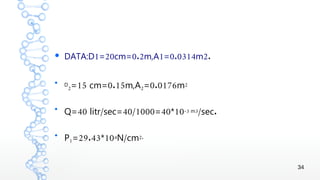
● 1 20 0.2 1 0.0314 2DATA:D = cm= m,A = m .
●
D
2 15 0.15= cm= m,A2 0.0176= m2
●
40 / 40/1000 40 10Q= litr sec= = * 3 3- m / .sec
●
P1 29.43 10= * 4 /N cm2.
35
●
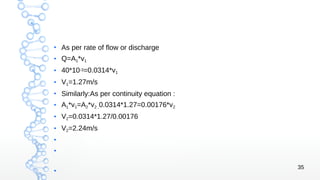
As per rate of flow or discharge
●
Q=A1*v1
●
40*10-3=0.0314*v1
●
V1=1.27m/s
●
Similarly:As per continuity equation :
●
A1*v1=A2*v2 ,0.0314*1.27=0.00176*v2
●
V2=0.0314*1.27/0.00176
●
V2=2.24m/s
●
●
●
36
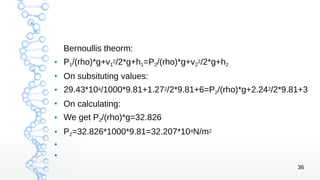
Bernoullis theorm:
●
P1/(rho)*g+v1
2/2*g+h1=P2/(rho)*g+v2
2/2*g+h2
●
On subsituting values:
●
29.43*104/1000*9.81+1.272/2*9.81+6=P2/(rho)*g+2.242/2*9.81+3
●
On calculating:
●
We get P2/(rho)*g=32.826
●
P2=32.826*1000*9.81=32.207*104N/m2
●
●
37
●
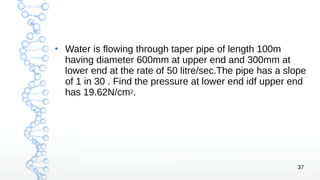
Water is flowing through taper pipe of length 100m
having diameter 600mm at upper end and 300mm at
lower end at the rate of 50 litre/sec.The pipe has a slope
of 1 in 30 . Find the pressure at lower end idf upper end
has 19.62N/cm2.
38
●
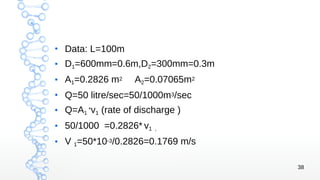
Data: L=100m
● D1=600mm=0.6m,D2=300mm=0.3m
● A1=0.2826 m2 A2=0.07065m2
●
Q=50 litre/sec=50/1000m3/sec
●
Q=A1
*v1 (rate of discharge )
●
50/1000 =0.2826* v1 ,
●
V 1=50*10-3/0.2826=0.1769 m/s
39
●
Similarly:
●
Q=A2*v2
●
50 10* 3- 0.07065= *v2
●
V2 50 10= * 3- /0.07065
●
0.7070 /= m s
●
100 1 30Since L= m slope is in h2 0= ,h1 1/30 100 3.33= * = m
40
●
By applying Bernoullis equation:
● P1/(rho)*g+v1
2/2*g+h1=P2/(rho)*g+v2
2/2*g+h2
●
19.62*104/1000*9.81+0.1762/2*9.81+3.33=
●
P2/(rho)*g+07072/2*9.81+0
● P2/(rho)*g=23.306
●
P2=23.306*1000*9.81=22.863*104N/m2
41
●
Water is flowing through pipe having diameter 300mm
and 200 mm at bottom and upper end respectively. The
intensity of pressure at bottom end is 24.525N/cm2 and
pressure at upper end is 9..81N/cm2.Determine
difference in datum head if rate of flow through pipe is
40 litre/sec.
42
DATA
●
D1=300mm=0.3m D2=200mm=0.2m
●
A1=0.07065m2 A2=0.0314m2
●
Q=40l/sec=40*10-3 m3/sec.
●
As per rate of discharge:
●
Q=A1*v1
●
40*10-3=0.07065*v1
●
V1=40*10-3/0.07065=0.567m/sec
●
●
43
●
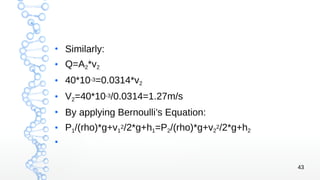
Similarly:
● Q=A2*v2
●
40*10-3=0.0314*v2
● V2=40*10-3/0.0314=1.27m/s
●
By applying Bernoulli’s Equation:
●
P1/(rho)*g+v1
2/2*g+h1=P2/(rho)*g+v2
2/2*g+h2
●
44
●
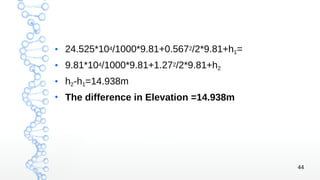
24.525*104/1000*9.81+0.5672/2*9.81+h1=
● 9.81*104/1000*9.81+1.272/2*9.81+h2
●
h2-h1=14.938m
●
The difference in Elevation =14.938m
45
Thank you

Bernoulli Theorem

  • 1.
  • 2.
  • 3.
  • 4.
    4 Applications in Aviation ● Bernoulli'sprinciple can be used to calculate the lift force on an aerofoil, if the behaviour of the fluid flow in the vicinity of the foil is known. For example, if the air flowing past the top surface of an aircraft wing is moving faster than the air flowing past the bottom surface, then Bernoulli's principle implies that the pressure on the surfaces of the wing will be lower above than below. This pressure difference results in an upwards lifting force. Whenever the distribution of speed past the top and bottom surfaces of a wing is known, the lift forces can be calculated (to a good approximation) using Bernoulli's equations. ● ●
  • 5.
  • 6.
    6 PRACTICAL APPLICATION IN VENTURIMETER ● Apractical application of Bernoulli’s Principle is the venturi tube. The venturi tube has an air inlet that narrofws to a throat (constricted point) and an outlet section that increases in diameter toward the rear. The diameter of the outlet is the same as that of the inlet. The mass of air entering the tube must exactly equal the mass exiting the tube. At the constriction, the speed must increase to allow the same amount of air to pass in the same amount of time as in all other parts of the tube. When the air speeds up, the pressure also decreases. Past the constriction, the airflow slows and the pressure increases. ● ●
  • 7.
  • 8.
    8 APPLICATION ON BLOWINGOFF ROOF TOP ● In olden days, the roofs of the huts or houses were designed with a slope as shown previos slide. One important scientific reason is that as per the Bernoulli’s principle, it will be safeguarded except roof during storm or cyclone .During cyclonic condition, the roof is blown off without damaging the other parts of the house. In accordance with the Bernoulli’s principle, the high wind blowing over the roof creates a low-pressure P1. The pressure under the roof P2 is greater. Therefore, this pressure difference (P2–P1) creates an up thrust and the roof is blown off.
  • 9.
    9 Bernoulli’s Theorem ● In FluidDynamics: Bernoulli’s Principle states that increase in speed of a fluid occurs simultaneously with decrease in static pressure or a decrease in fluids Potiental Energy ● Meaning: It states that speed of a moving fluid increases when .pressure decreases
  • 10.
  • 11.
    11 BERN O ULLIS PRIN CIPLE ● The total mechanical energy of the moving fluid comprising the gravitational potential energy of elevation, the energy associated with the fluid pressure and the kinetic energy of .the fluid motion, remains constant
  • 12.
    12 Bernoullis Prnciple ● Bernoulli's principlecan be applied to various types of fluid flow, resulting in various forms of Bernoulli's equation; there are .different forms of Bernoulli's equation for different types of flow The simple form of Bernoulli's equation is valid for incompressible flow
  • 13.
    13 Lim itation andAssum ption
  • 14.
    14 Bernoullis Equation ● The Bernoulliequation states that, ● ●
  • 15.
  • 16.
  • 17.
    17 D erivation ● Consider apipe w ith varying diam eter and height through w hich an incom pressible fluid is flow ing ● ( ) ( )Asssum ptions: a D ensity is constant, b Energy is conserved .as no viscous force ● ●
  • 18.
    18 ● 1 1 22dW=F dx -F dx where dW= net work done ● /As P=F A,F=P*A ● 1 1 1 2Therefore dW=P *A *dx -P *A2*dx2 ● As dx=distance travelled, ● As v=velocity=A*dx ● dW=P1dv-P2dv ● (= P1-P2) *dv ●
  • 19.
    19 ● Work done ona fluid is due to conservation of gravitional force and .change in K E ● 1/2dK= m2*v2 2 1/2- m1*v1 2 ● ( ) / ( ) / ( )Since rho =m v,where rho =m Vh therefore m= rho *V therefore ● 1/2( ) [dK= rho dV v2 2-v1 2] ● ●
  • 20.
    20 ● Change in Potientalenergy: ● dU=m*g*y2-m*g*y1 ● ( ) (dU= rho *dV y2-y1) ● Since dW=dK+dU ● On subsituting ● P1 1/2( )+ rho *v1 2 ( )+ rho *g*y1 =P2 1/2 ( )+ * rho *v2 2 ( )+ rho *g*y2 ●
  • 21.
  • 22.
    22 Potiental Energy head ● Ina flowing fluid, potential energy may in turn be subdivided into energy due to position or elevation above a given datum, and energy .due to pressure in the fluid Head is the amount of energy per Newton ( ) .or per pound of fluid ● .P E=m*g*h ●
  • 23.
  • 24.
    24 Kinetic Energy Head ● ●– .Kinetic head: The kinetic head represents the kinetic energy of the fluid It is the height in feet that .a flowing fluid would rise in a column if all of its kinetic energy were converted to potential energy ● ● ● ● ● I
  • 25.
    25 Pressure H ead ● Pressurehead is due to the static pressure, the internal molecular motion of a .fluid that exerts a force on its container n fluid mechanics, pressure head is the height of a liquid column that corresponds to a particular pressure exerted by .the liquid column on the base of its container It may also be called static ( ).pressure head or simply static head but not static head pressure
  • 26.
  • 27.
    27 D isadvantages ofBernoulli’s Theorem ● According to law of conservation of energy : ● .No Energy is lost ,but energy is lost due to friction ● In practice Energy is lost in friction ,due to layers of fluid flowing in layers with different . .velocity exert frictional force on each other This loss of energy is converted into Heat Energy ● Thus this theorem is basically used for non viscous fluid having zero viscosity ● 0When pipe is horizontal ,h= ●
  • 28.
  • 29.
    29 .......Problem s ● A pipethrough w hich w ater is flow ing is having 20 10 1 2diam eter cm and cm at cross sectional and . 1respectively The velocity of w ater at section is given 4 / . 1 2as m s find velocity head at section and and also .discharge
  • 30.
    30 ● D1 20 0.2=cm= m D2 10 0.1= cm= m v1 4 /= m s ● A1 0.0314= m2 A2 0.00785= m2 v2= ● As per continuity Equation: ● A1*v1=A2*v2 ,v2 =A1*v1/A2 0.0314 4/0.00785 16 /= * = m s ● V2 16 /= m s ● =
  • 31.
    31 ● 1Velocity head atsection =v1*v1/2*g ● 4 4/2 9.81= * * = ● 0.815= m ● 2Velocity head at section =v2*v2/2 13.047*g= m ●
  • 32.
    32 ● 0.0314 4 0.1256DischargeQ=A*V= * = m3/s ● From the above given data v2 16 /= m s ● 1 0.815Velocity head at section = m ● 2 13.047Velocity head at section = m ● 125.6 /Discharge = litre sec
  • 33.
    33 ● 20The water isflowing through apipe having diameter cm and 15 1 2 . 40 /cm at cross section and Rate of flow through pipe is litre . 1 6 2 3sec Section is m above datum and section is m above 1 29.43 /datum,pressure at section is N cm2.Find pressure intensity 2.at
  • 34.
    34 ● 1 200.2 1 0.0314 2DATA:D = cm= m,A = m . ● D 2 15 0.15= cm= m,A2 0.0176= m2 ● 40 / 40/1000 40 10Q= litr sec= = * 3 3- m / .sec ● P1 29.43 10= * 4 /N cm2.
  • 35.
    35 ● As per rateof flow or discharge ● Q=A1*v1 ● 40*10-3=0.0314*v1 ● V1=1.27m/s ● Similarly:As per continuity equation : ● A1*v1=A2*v2 ,0.0314*1.27=0.00176*v2 ● V2=0.0314*1.27/0.00176 ● V2=2.24m/s ● ● ●
  • 36.
    36 Bernoullis theorm: ● P1/(rho)*g+v1 2/2*g+h1=P2/(rho)*g+v2 2/2*g+h2 ● On subsitutingvalues: ● 29.43*104/1000*9.81+1.272/2*9.81+6=P2/(rho)*g+2.242/2*9.81+3 ● On calculating: ● We get P2/(rho)*g=32.826 ● P2=32.826*1000*9.81=32.207*104N/m2 ● ●
  • 37.
    37 ● Water is flowingthrough taper pipe of length 100m having diameter 600mm at upper end and 300mm at lower end at the rate of 50 litre/sec.The pipe has a slope of 1 in 30 . Find the pressure at lower end idf upper end has 19.62N/cm2.
  • 38.
    38 ● Data: L=100m ● D1=600mm=0.6m,D2=300mm=0.3m ●A1=0.2826 m2 A2=0.07065m2 ● Q=50 litre/sec=50/1000m3/sec ● Q=A1 *v1 (rate of discharge ) ● 50/1000 =0.2826* v1 , ● V 1=50*10-3/0.2826=0.1769 m/s
  • 39.
    39 ● Similarly: ● Q=A2*v2 ● 50 10* 3-0.07065= *v2 ● V2 50 10= * 3- /0.07065 ● 0.7070 /= m s ● 100 1 30Since L= m slope is in h2 0= ,h1 1/30 100 3.33= * = m
  • 40.
    40 ● By applying Bernoullisequation: ● P1/(rho)*g+v1 2/2*g+h1=P2/(rho)*g+v2 2/2*g+h2 ● 19.62*104/1000*9.81+0.1762/2*9.81+3.33= ● P2/(rho)*g+07072/2*9.81+0 ● P2/(rho)*g=23.306 ● P2=23.306*1000*9.81=22.863*104N/m2
  • 41.
    41 ● Water is flowingthrough pipe having diameter 300mm and 200 mm at bottom and upper end respectively. The intensity of pressure at bottom end is 24.525N/cm2 and pressure at upper end is 9..81N/cm2.Determine difference in datum head if rate of flow through pipe is 40 litre/sec.
  • 42.
    42 DATA ● D1=300mm=0.3m D2=200mm=0.2m ● A1=0.07065m2 A2=0.0314m2 ● Q=40l/sec=40*10-3m3/sec. ● As per rate of discharge: ● Q=A1*v1 ● 40*10-3=0.07065*v1 ● V1=40*10-3/0.07065=0.567m/sec ● ●
  • 43.
    43 ● Similarly: ● Q=A2*v2 ● 40*10-3=0.0314*v2 ● V2=40*10-3/0.0314=1.27m/s ● Byapplying Bernoulli’s Equation: ● P1/(rho)*g+v1 2/2*g+h1=P2/(rho)*g+v2 2/2*g+h2 ●
  • 44.
  • 45.