1
Fluid Mechanics
(MME-2252)
VISCOUS FLOW
IV Semester, Mechanical Engineering
Department of Mechanical and Manufacturing Engineering
Manipal Institute of Technology, MAHE, Manipal
Dr. Vijay G. S.
Professor, Dept. of Mech. & Ind. Engg., MIT, Manipal
email: vijay.gs@manipal.edu
Mob.: 9980032104
Topics
2
 Reynold’s experiment, laminar and turbulent flows
 Viscous flow through a circular pipe (Hagen Poiseuille flow)
 Viscous flow between two parallel plates (Plain Couette flow)
1) The shear stress distribution
2) The velocity distribution
3) The ratio of maximum velocity to average velocity
4) The drop of pressure for a given length
3
Viscous Flow
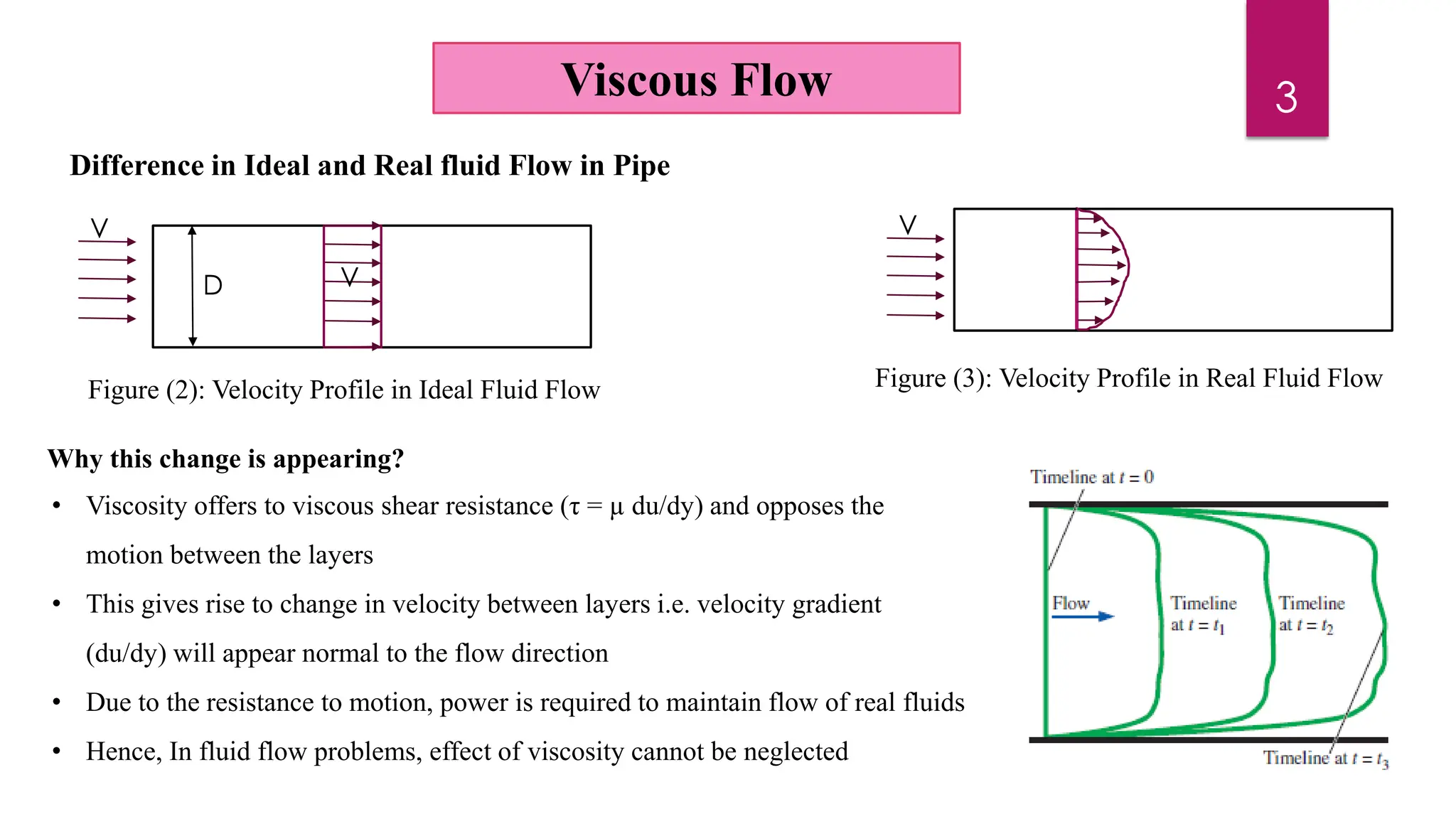
Difference in Ideal and Real fluid Flow in Pipe
V
Figure (3): Velocity Profile in Real Fluid Flow
V
D V
Figure (2): Velocity Profile in Ideal Fluid Flow
• Viscosity offers to viscous shear resistance (τ = µ du/dy) and opposes the
motion between the layers
• This gives rise to change in velocity between layers i.e. velocity gradient
(du/dy) will appear normal to the flow direction
• Due to the resistance to motion, power is required to maintain flow of real fluids
• Hence, In fluid flow problems, effect of viscosity cannot be neglected
Why this change is appearing?
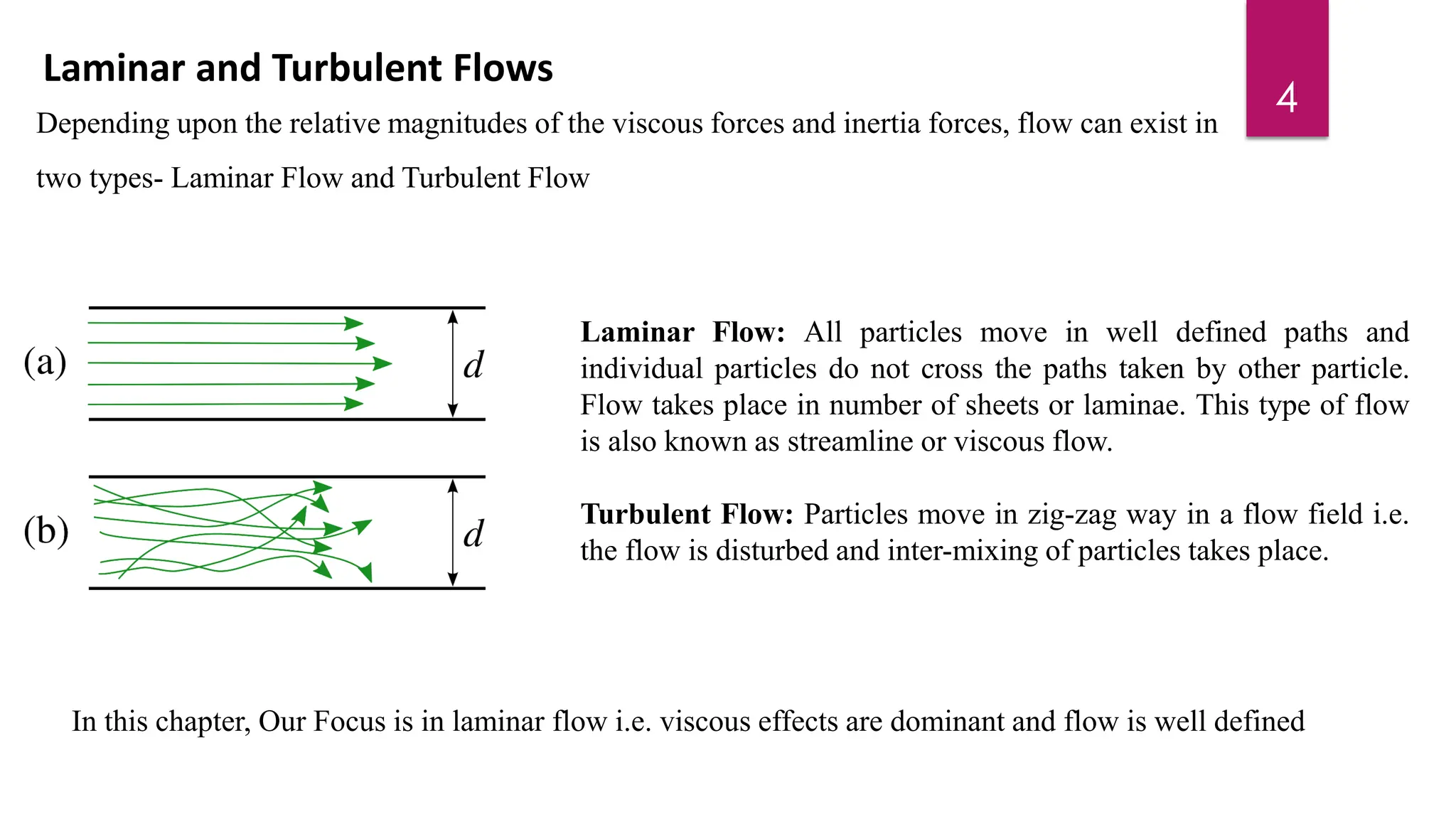
Laminar and Turbulent Flows
Depending upon the relative magnitudes of the viscous forces and inertia forces, flow can exist in
two types- Laminar Flow and Turbulent Flow
Laminar Flow: All particles move in well defined paths and
individual particles do not cross the paths taken by other particle.
Flow takes place in number of sheets or laminae. This type of flow
is also known as streamline or viscous flow.
Turbulent Flow: Particles move in zig-zag way in a flow field i.e.
the flow is disturbed and inter-mixing of particles takes place.
4
In this chapter, Our Focus is in laminar flow i.e. viscous effects are dominant and flow is well defined
5
1) Reynolds’s Experiment:
O. Reynold, a British professor demonstrated that a laminar flow changes to turbulent flow
Figure: Reynolds Dye Experimental setup and Observed dye streak lines [1]
Q V
Observations from the Reynold’s Dye Experiment
6
For general case, transition of flow is function of
• Velocity of fluid (V)
• Diameter of the pipe (V)
• Viscosity of the fluid (𝜇)
• Density of Fluid (ρ)
Figure: Time dependence of fluid velocity at a point [1]
𝑉𝐴 = 𝑢 Ƹ
𝑖
𝑉𝐴 = 𝑢 Ƹ
𝑖 + 𝑣 Ƹ
𝑗 + 𝑤෠
𝑘
ρ = Density of Fluid,
Vavg= Average Velocity,
D= Diameter of Pipe,
µ= Dynamic Viscosity
𝑅𝑒 =
𝜌𝑉
𝑎𝑣𝑔𝐷
𝜇
For a flow in circular pipe,
If Re < 2000, the flow is said to be laminar
If Re > 4000, the flow is said to be turbulent
If 2000 < Re < 4000, in transition from laminar to turbulent
Identifying the type of flow from Reynolds Number
Critical Reynolds Number: It is magnitude of Reynolds Number below
which the flow is definitely laminar.
7
Figure: Laminar and Turbulent
flow regimes in candle smoke [3]
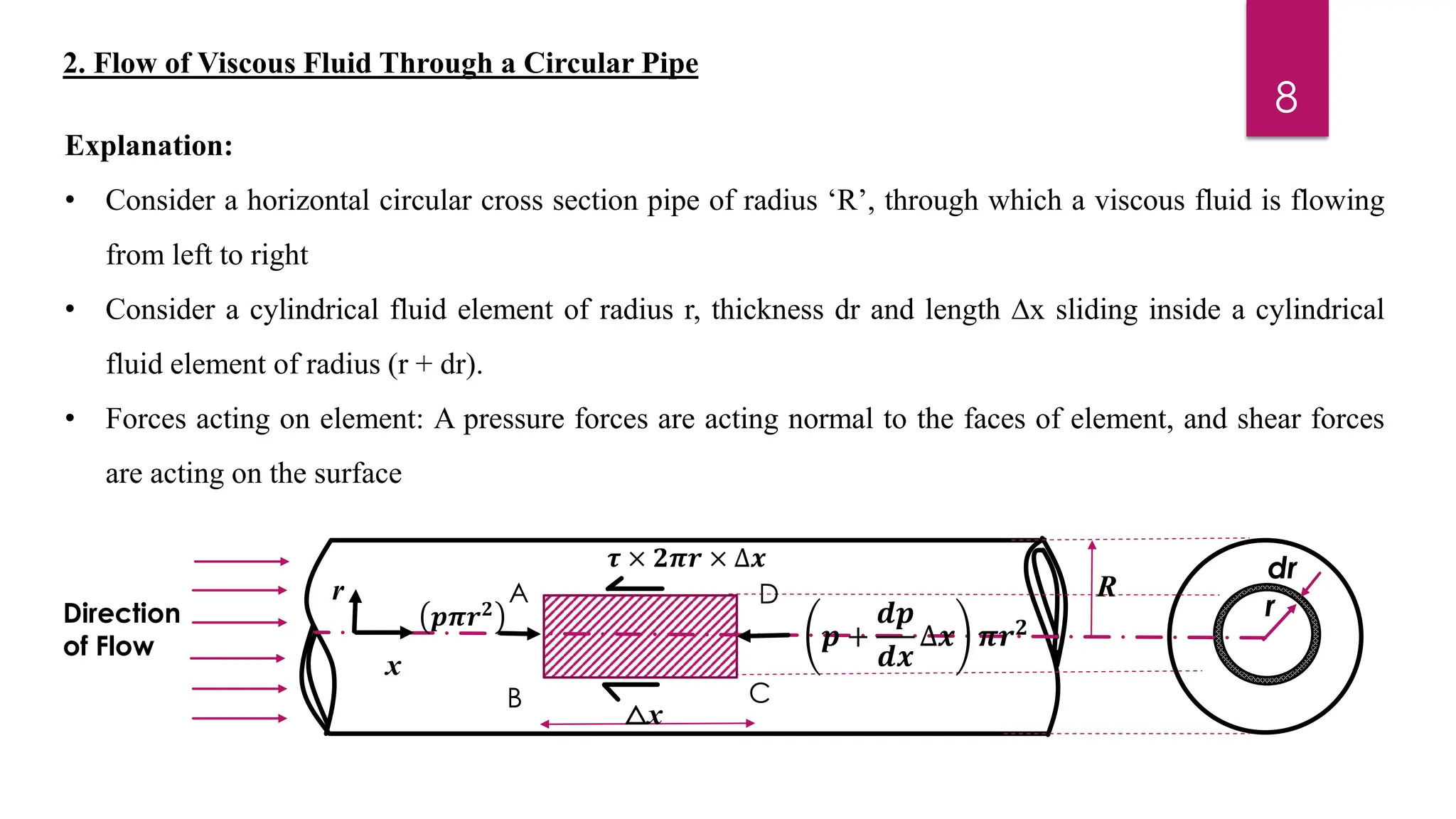
2. Flow of Viscous Fluid Through a Circular Pipe
Explanation:
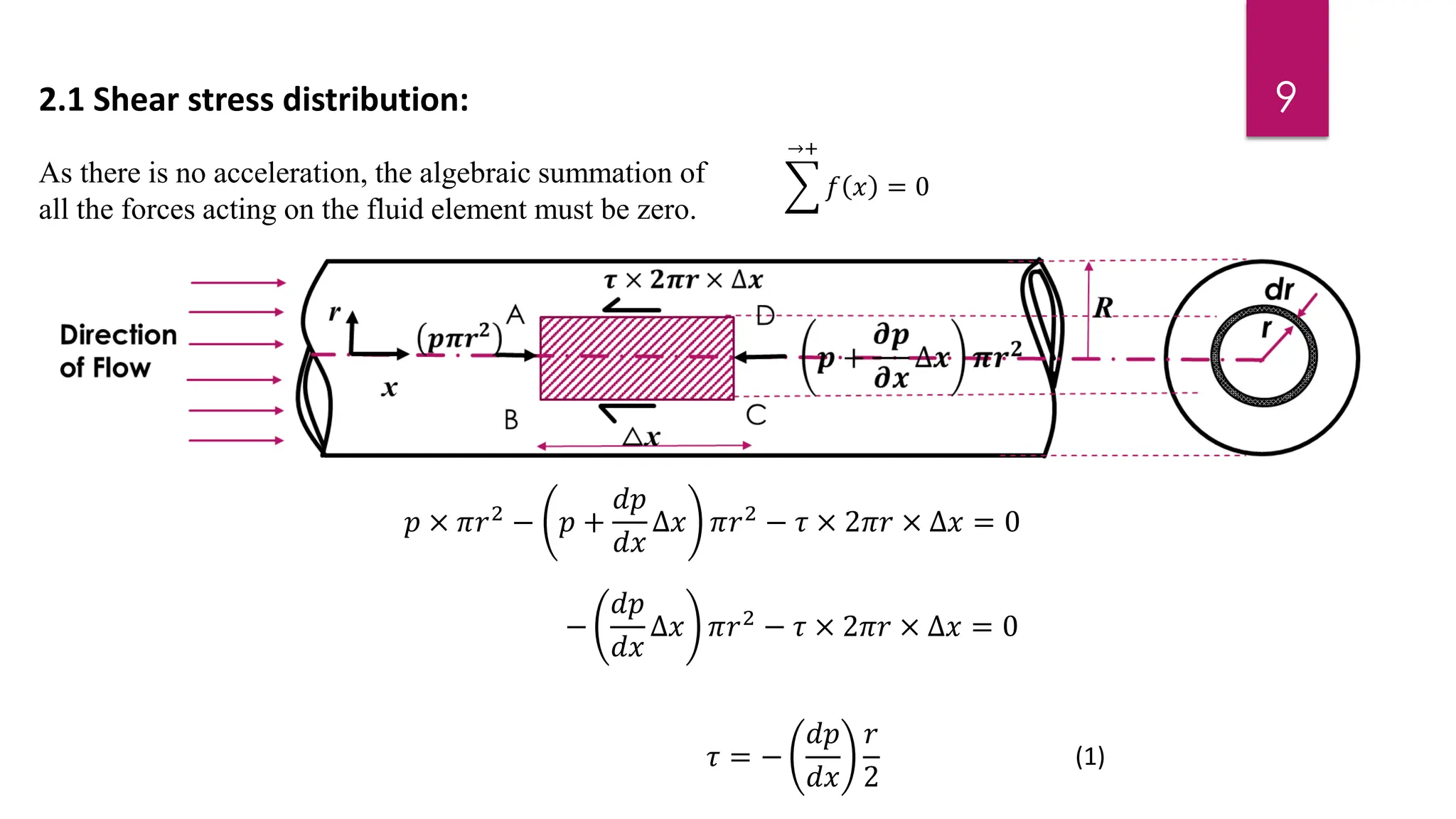
• Consider a horizontal circular cross section pipe of radius ‘R’, through which a viscous fluid is flowing
from left to right
• Consider a cylindrical fluid element of radius r, thickness dr and length x sliding inside a cylindrical
fluid element of radius (r + dr).
• Forces acting on element: A pressure forces are acting normal to the faces of element, and shear forces
are acting on the surface
Direction
of Flow
r
dr
A
B C
D
r
x
△x
R
𝒑𝝅𝒓𝟐
𝒑 +
𝒅𝒑
𝒅𝒙
∆𝒙 𝝅𝒓𝟐
𝝉 × 𝟐𝝅𝒓 × ∆𝒙
8
2.1 Shear stress distribution:
As there is no acceleration, the algebraic summation of
all the forces acting on the fluid element must be zero.
𝑝 × 𝜋𝑟2 − 𝑝 +
𝑑𝑝
𝑑𝑥
∆𝑥 𝜋𝑟2 − 𝜏 × 2𝜋𝑟 × ∆𝑥 = 0
−
𝑑𝑝
𝑑𝑥
∆𝑥 𝜋𝑟2
− 𝜏 × 2𝜋𝑟 × ∆𝑥 = 0
𝜏 = −
𝑑𝑝
𝑑𝑥
𝑟
2
(1)
9
෍
→+
𝑓 𝑥 = 0
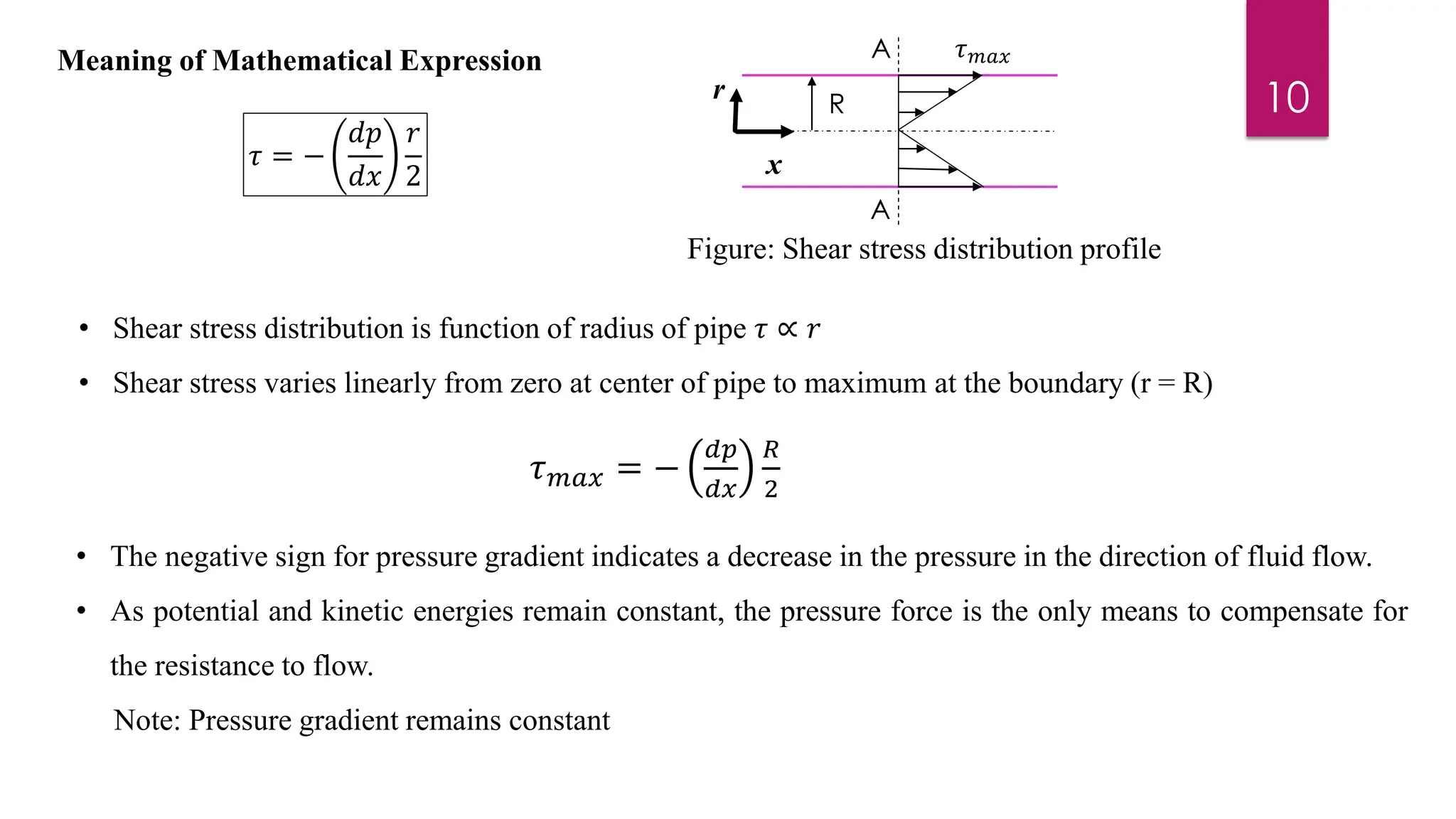
• Shear stress distribution is function of radius of pipe 𝜏 ∝ 𝑟
• Shear stress varies linearly from zero at center of pipe to maximum at the boundary (r = R)
• The negative sign for pressure gradient indicates a decrease in the pressure in the direction of fluid flow.
• As potential and kinetic energies remain constant, the pressure force is the only means to compensate for
the resistance to flow.
Note: Pressure gradient remains constant
𝜏𝑚𝑎𝑥 = −
𝑑𝑝
𝑑𝑥
𝑅
2
𝜏 = −
𝑑𝑝
𝑑𝑥
𝑟
2
10
Meaning of Mathematical Expression 𝜏𝑚𝑎𝑥
R
Figure: Shear stress distribution profile
A
A
r
x
2.2 Velocity Distribution
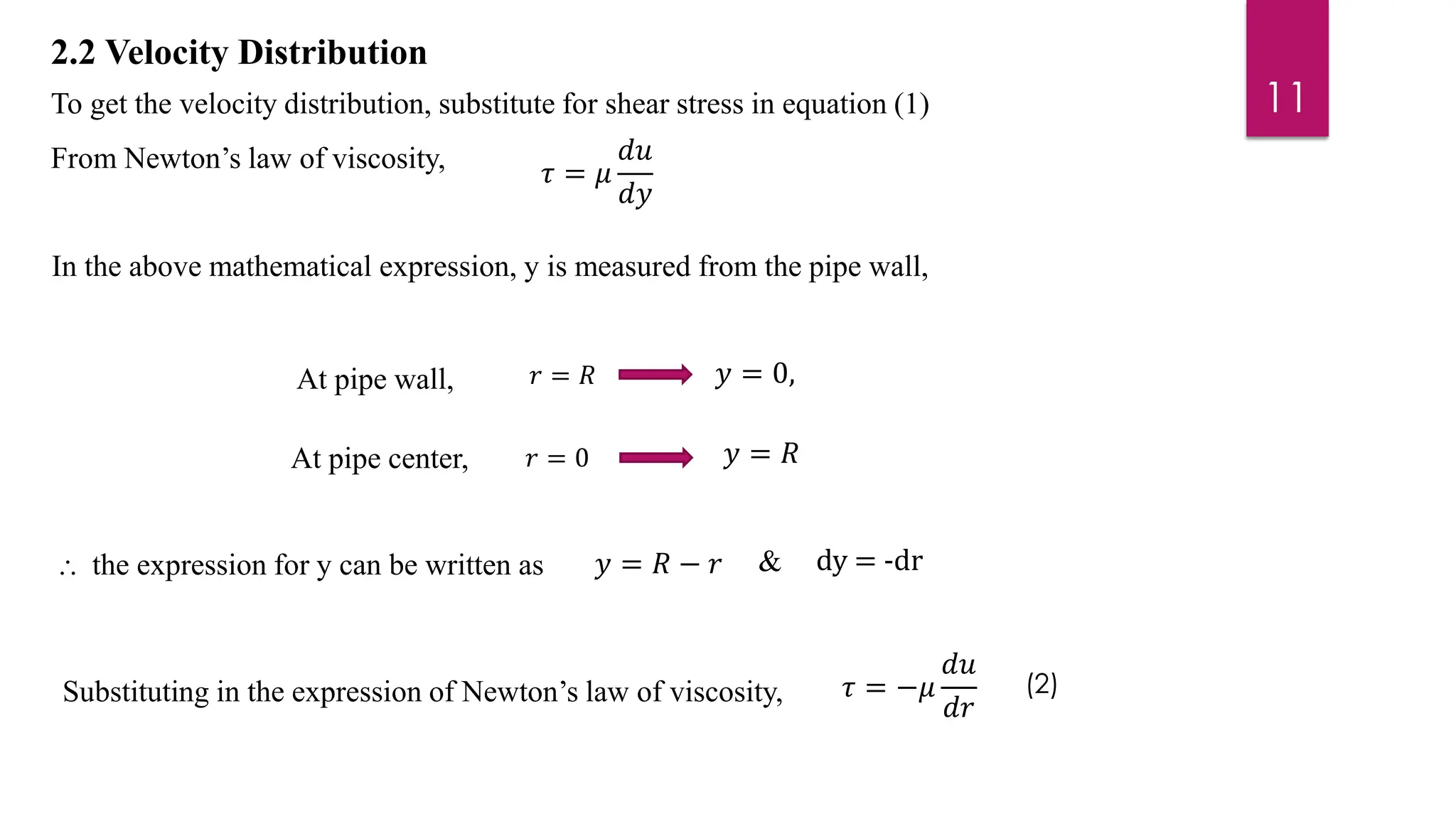
To get the velocity distribution, substitute for shear stress in equation (1)
From Newton’s law of viscosity,
In the above mathematical expression, y is measured from the pipe wall,
Substituting in the expression of Newton’s law of viscosity,
⸫ the expression for y can be written as
𝜏 = 𝜇
𝑑𝑢
𝑑𝑦
At pipe wall, 𝑦 = 0,
At pipe center, 𝑦 = 𝑅
𝑦 = 𝑅 − 𝑟
𝜏 = −𝜇
𝑑𝑢
𝑑𝑟
11
dy = -dr
𝑟 = 𝑅
𝑟 = 0
&
(2)
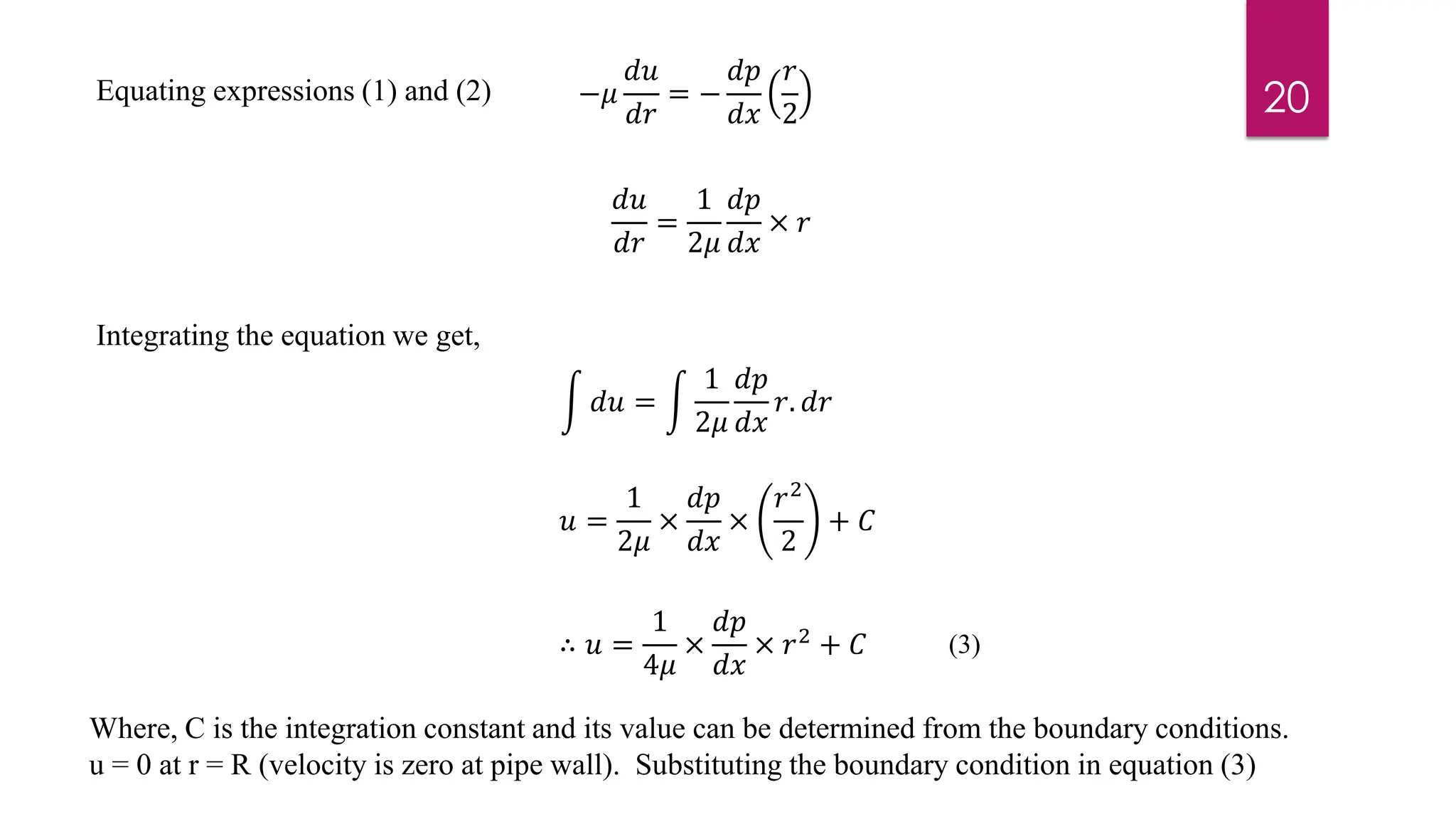
Integrating the equation we get,
Where, C is the integration constant and its value can be determined from the boundary conditions.
u = 0 at r = R (velocity is zero at pipe wall). Substituting the boundary condition in equation (3)
−𝜇
𝑑𝑢
𝑑𝑟
= −
𝑑𝑝
𝑑𝑥
𝑟
2
1
2
𝑑𝑢
𝑑𝑟
=
1
2𝜇
𝑑𝑝
𝑑𝑥
× 𝑟
න 𝑑𝑢 = න
1
2𝜇
𝑑𝑝
𝑑𝑥
𝑟. 𝑑𝑟
𝑢 =
1
2𝜇
×
𝑑𝑝
𝑑𝑥
×
𝑟2
2
+ 𝐶
∴ 𝑢 =
1
4𝜇
×
𝑑𝑝
𝑑𝑥
× 𝑟2 + 𝐶
Equating expressions (1) and (2) 20
(3)
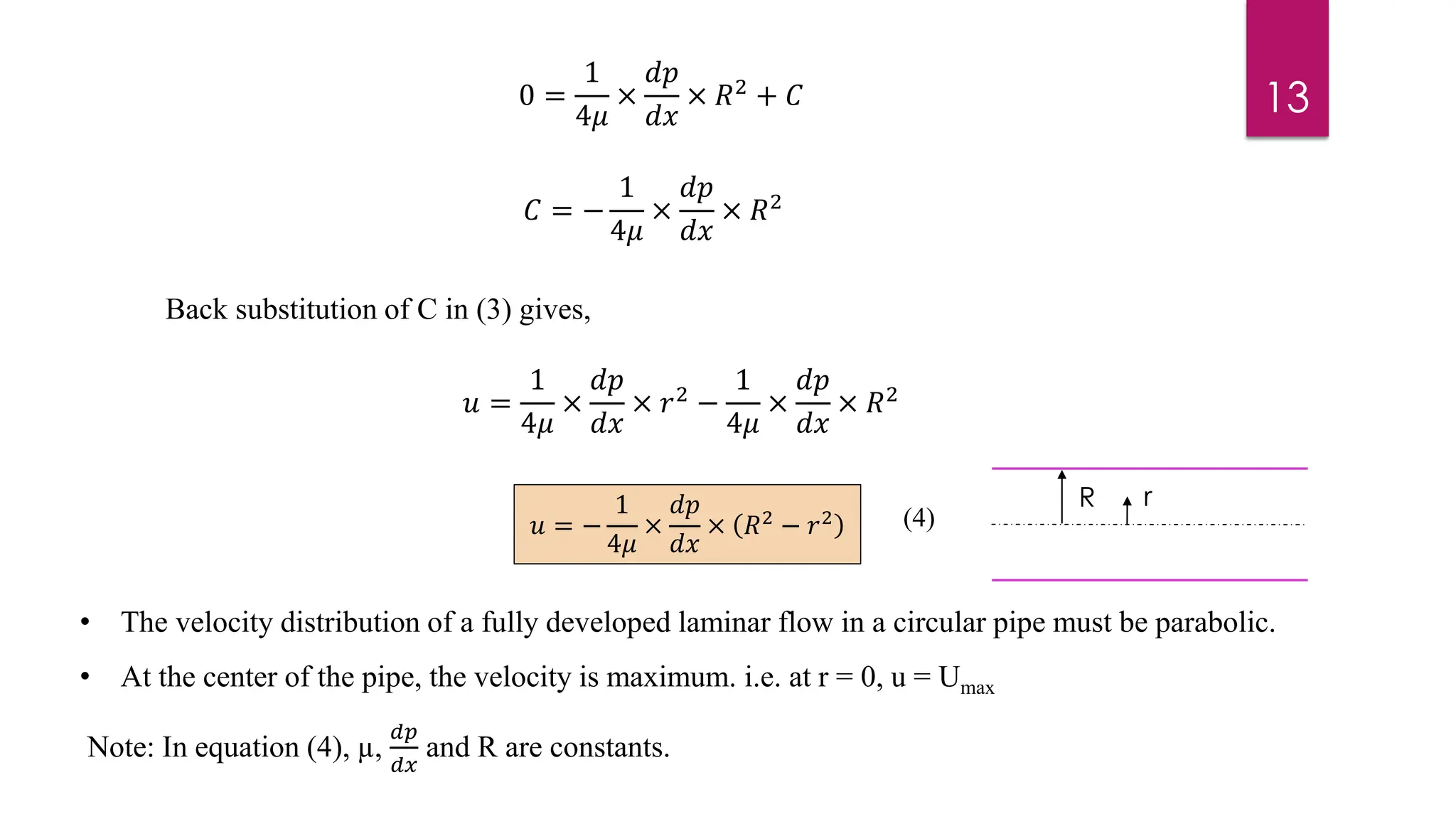
• The velocity distribution of a fully developed laminar flow in a circular pipe must be parabolic.
• At the center of the pipe, the velocity is maximum. i.e. at r = 0, u = Umax
Note: In equation (4), µ,
𝑑𝑝
𝑑𝑥
and R are constants.
13
0 =
1
4𝜇
×
𝑑𝑝
𝑑𝑥
× 𝑅2 + 𝐶
𝐶 = −
1
4𝜇
×
𝑑𝑝
𝑑𝑥
× 𝑅2
Back substitution of C in (3) gives,
𝑢 =
1
4𝜇
×
𝑑𝑝
𝑑𝑥
× 𝑟2 −
1
4𝜇
×
𝑑𝑝
𝑑𝑥
× 𝑅2
𝑢 = −
1
4𝜇
×
𝑑𝑝
𝑑𝑥
× 𝑅2 − 𝑟2
R r
(4)
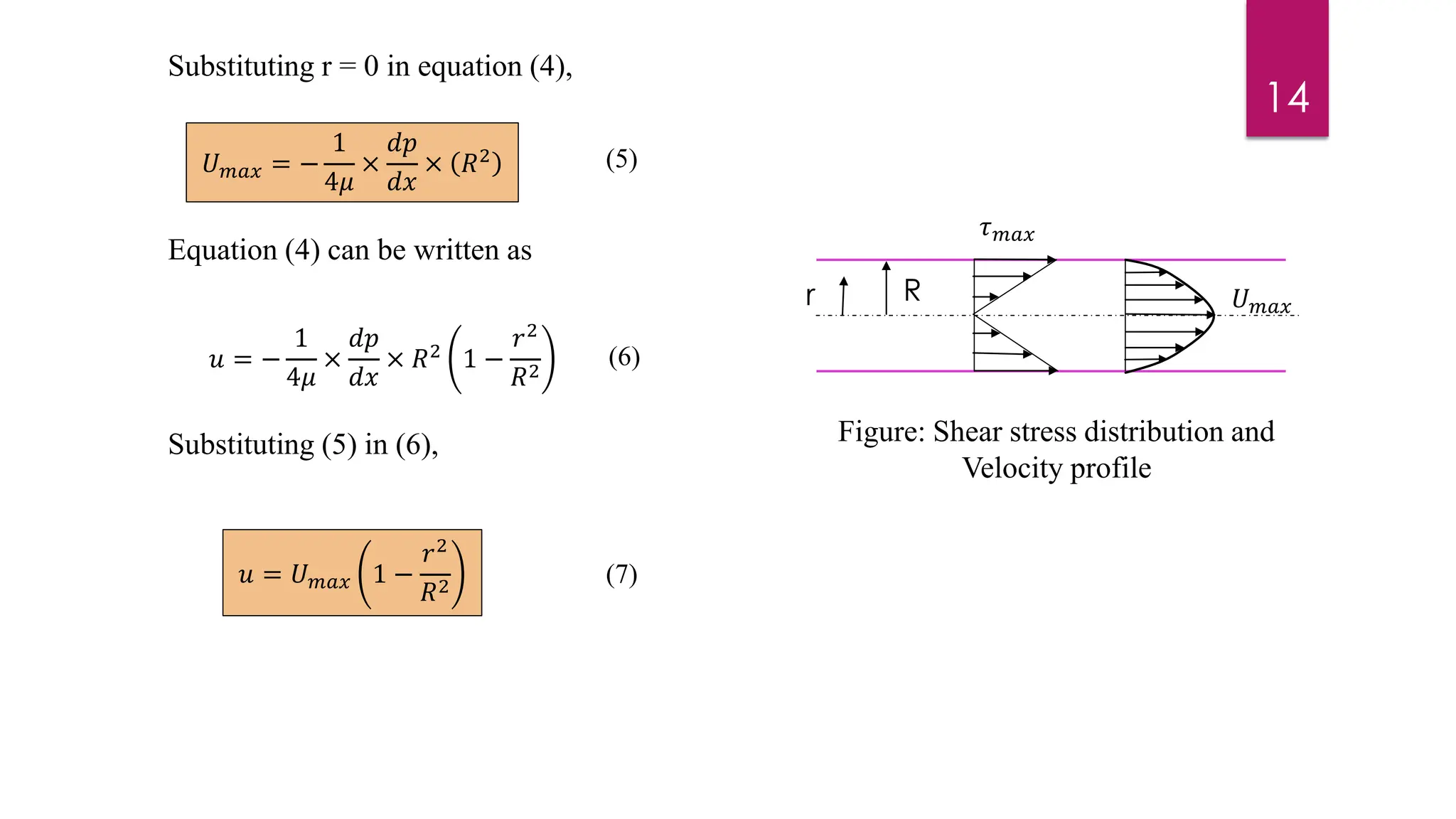
Substituting r = 0 in equation (4),
Equation (4) can be written as
Substituting (5) in (6),
14
𝑈𝑚𝑎𝑥 = −
1
4𝜇
×
𝑑𝑝
𝑑𝑥
× 𝑅2
𝑢 = −
1
4𝜇
×
𝑑𝑝
𝑑𝑥
× 𝑅2
1 −
𝑟2
𝑅2
𝑢 = 𝑈𝑚𝑎𝑥 1 −
𝑟2
𝑅2
𝜏𝑚𝑎𝑥
R
Figure: Shear stress distribution and
Velocity profile
r 𝑈𝑚𝑎𝑥
(5)
(6)
(7)
15
Figure: Changes in velocity profile and pressure changes along the flow in pipe [2]
16
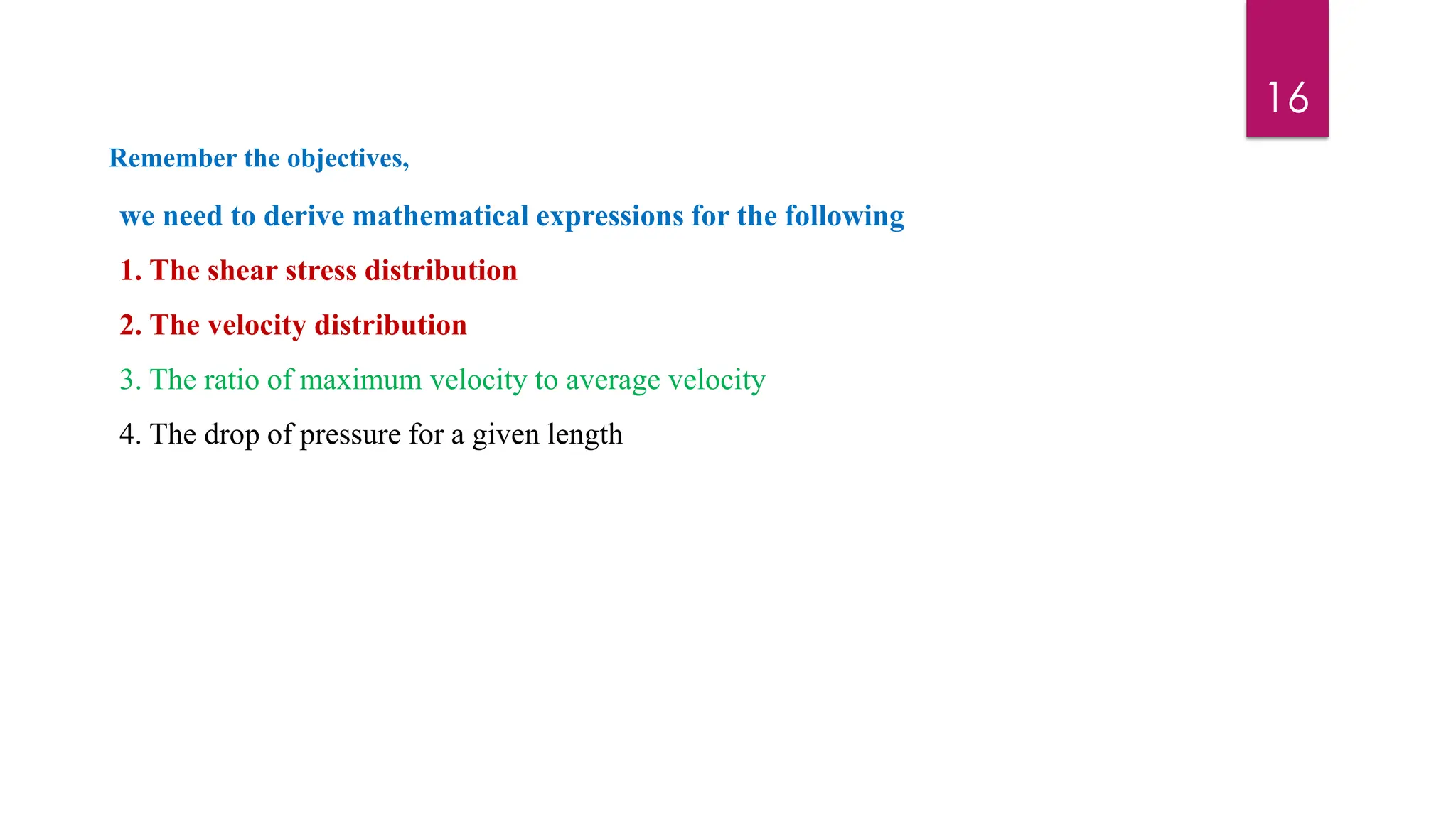
we need to derive mathematical expressions for the following
1. The shear stress distribution
2. The velocity distribution
3. The ratio of maximum velocity to average velocity
4. The drop of pressure for a given length
Remember the objectives,
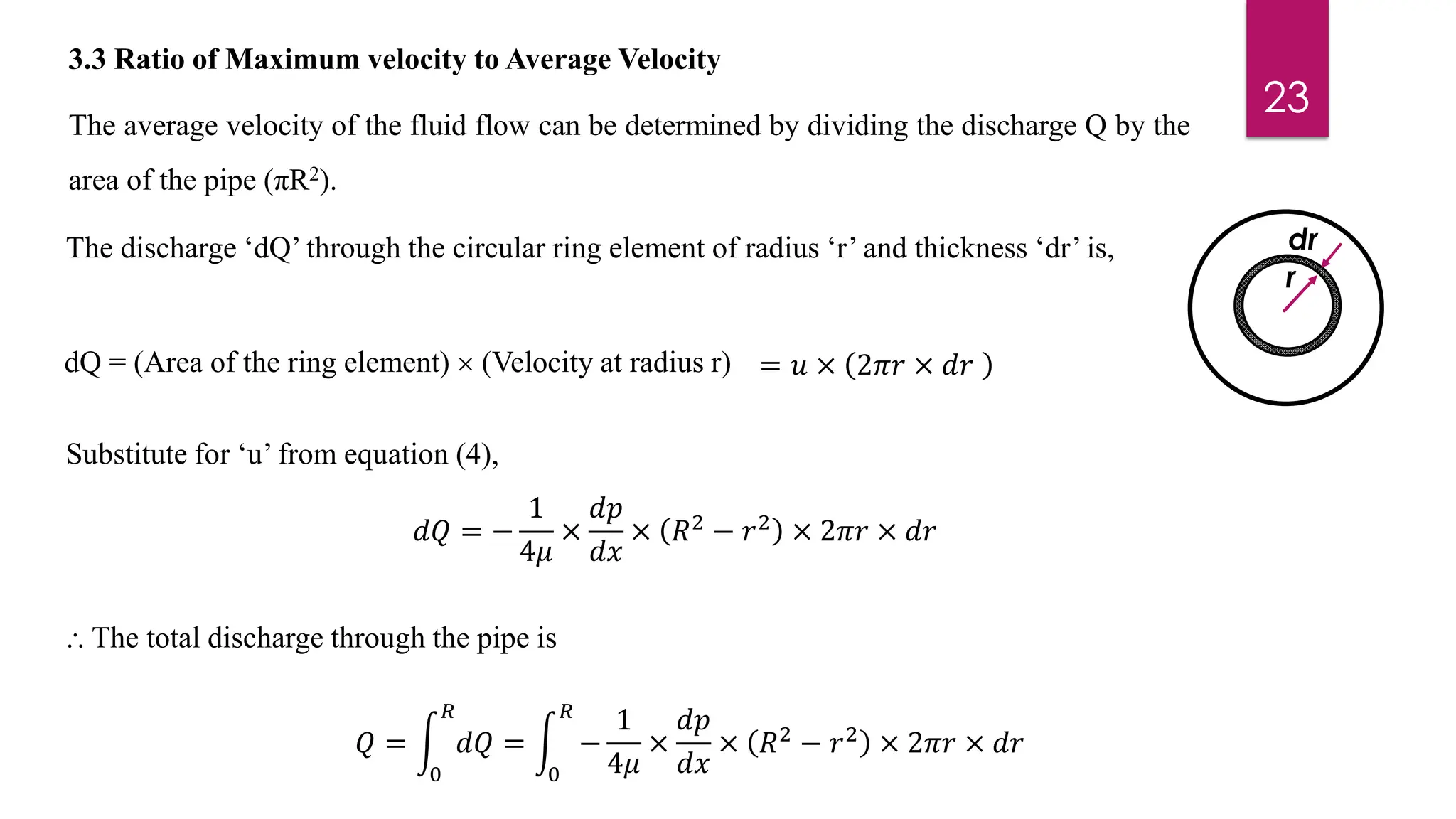
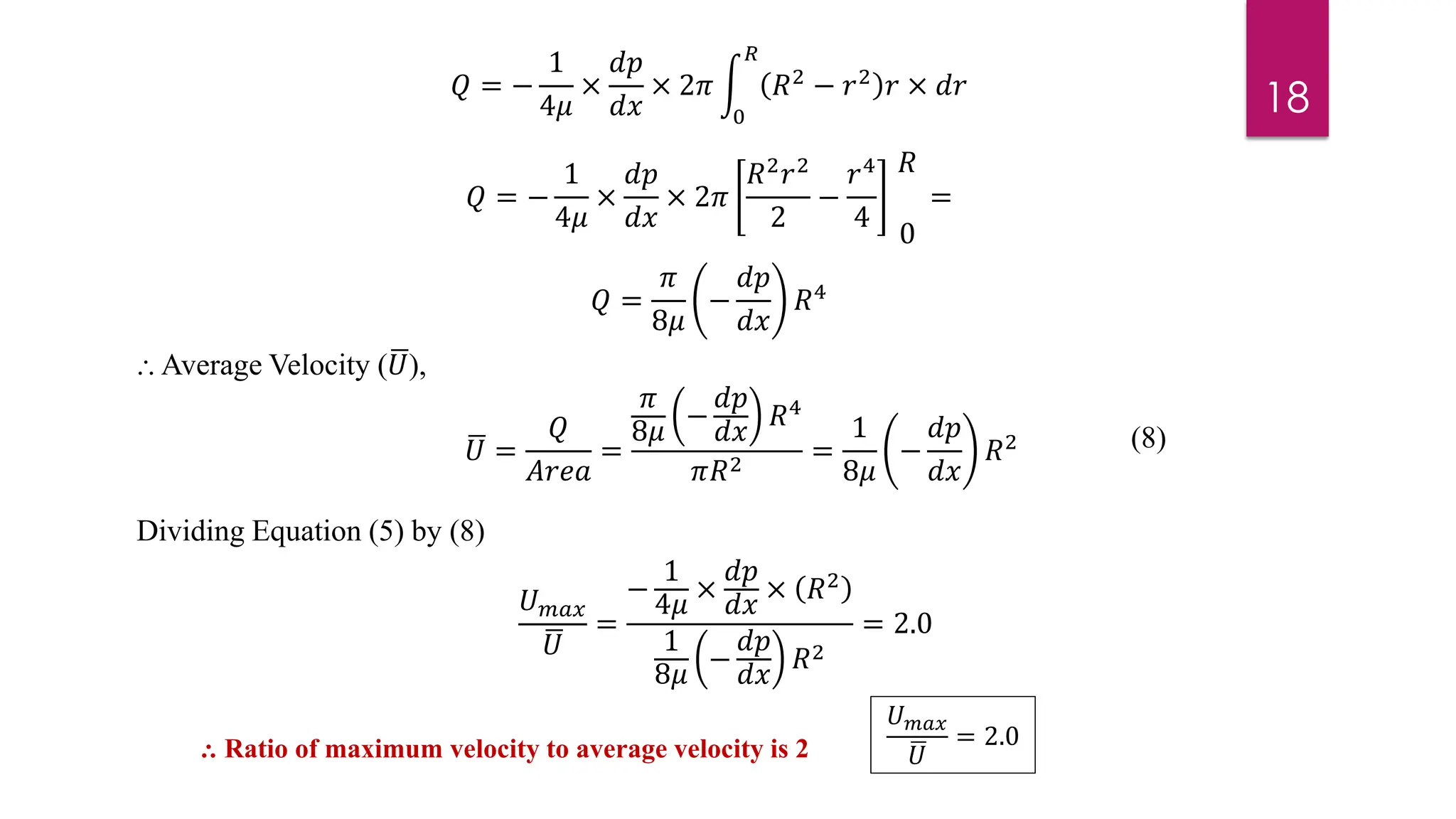
3.3 Ratio of Maximum velocity to Average Velocity
17
The average velocity of the fluid flow can be determined by dividing the discharge Q by the
area of the pipe (πR2).
dQ = (Area of the ring element)  (Velocity at radius r) = 𝑢 × 2𝜋𝑟 × 𝑑𝑟
Substitute for ‘u’ from equation (4),
𝑑𝑄 = −
1
4𝜇
×
𝑑𝑝
𝑑𝑥
× 𝑅2
− 𝑟2
× 2𝜋𝑟 × 𝑑𝑟
⸫ The total discharge through the pipe is
𝑄 = න
0
𝑅
𝑑𝑄 = න
0
𝑅
−
1
4𝜇
×
𝑑𝑝
𝑑𝑥
× 𝑅2
− 𝑟2
× 2𝜋𝑟 × 𝑑𝑟
23
r
dr
The discharge ‘dQ’ through the circular ring element of radius ‘r’ and thickness ‘dr’ is,
18
𝑄 =
𝜋
8𝜇
−
𝑑𝑝
𝑑𝑥
𝑅4
⸫ Average Velocity (ഥ
𝑈),
ഥ
𝑈 =
𝑄
𝐴𝑟𝑒𝑎
=
𝜋
8𝜇
−
𝑑𝑝
𝑑𝑥
𝑅4
𝜋𝑅2
=
1
8𝜇
−
𝑑𝑝
𝑑𝑥
𝑅2
Dividing Equation (5) by (8)
𝑈𝑚𝑎𝑥
ഥ
𝑈
=
−
1
4𝜇
×
𝑑𝑝
𝑑𝑥
× 𝑅2
1
8𝜇
−
𝑑𝑝
𝑑𝑥
𝑅2
= 2.0
⸫ Ratio of maximum velocity to average velocity is 2
𝑈𝑚𝑎𝑥
ഥ
𝑈
= 2.0
𝑄 = −
1
4𝜇
×
𝑑𝑝
𝑑𝑥
× 2𝜋 න
0
𝑅
𝑅2 − 𝑟2 𝑟 × 𝑑𝑟
(8)
𝑄 = −
1
4𝜇
×
𝑑𝑝
𝑑𝑥
× 2𝜋
𝑅2
𝑟2
2
−
𝑟4
4
𝑅
0
=
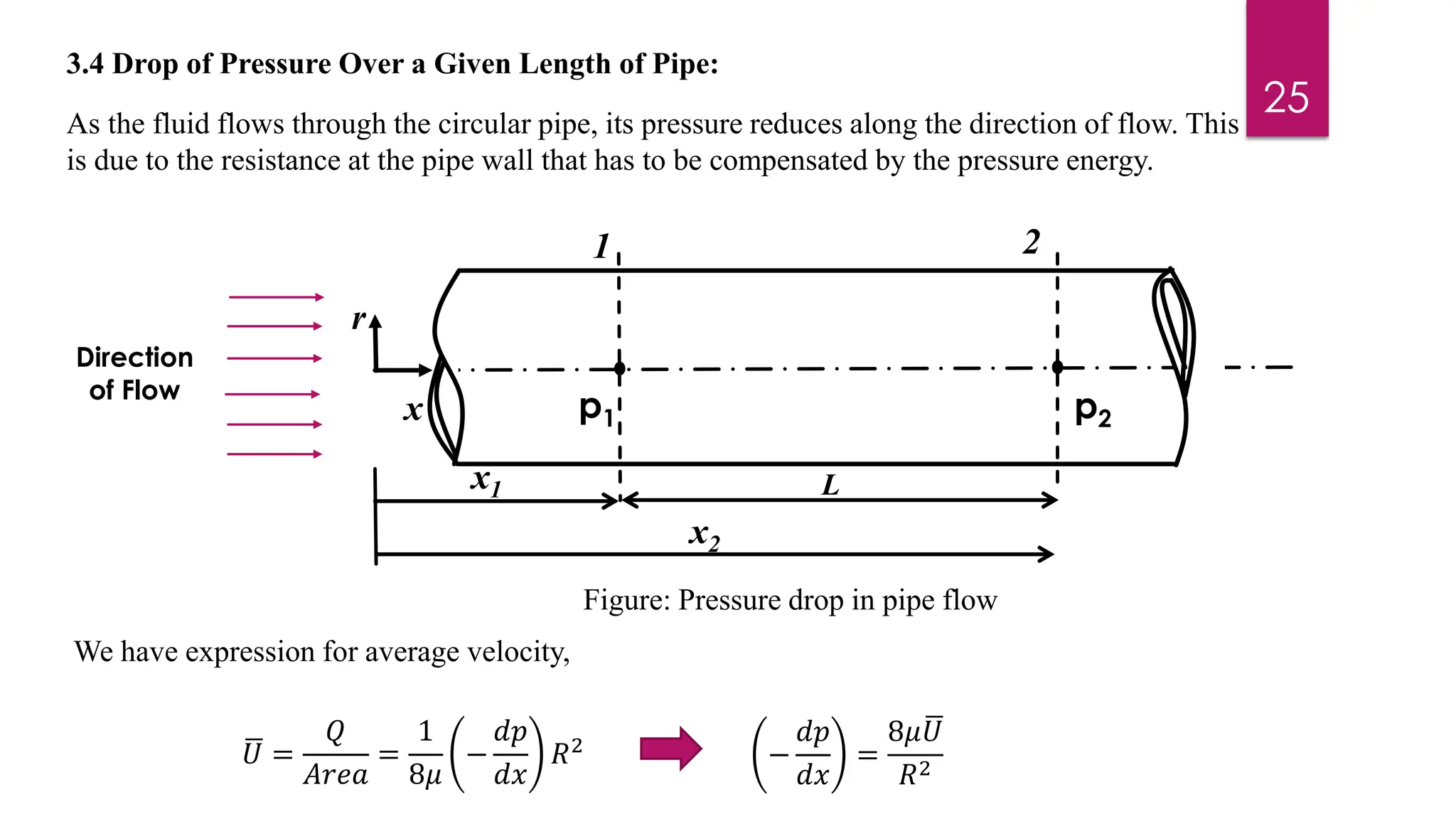
3.4 Drop of Pressure Over a Given Length of Pipe:
19
As the fluid flows through the circular pipe, its pressure reduces along the direction of flow. This
is due to the resistance at the pipe wall that has to be compensated by the pressure energy.
r
x p1 p2
x1
x2
L
1 2
Figure: Pressure drop in pipe flow
Direction
of Flow
We have expression for average velocity,
ഥ
𝑈 =
𝑄
𝐴𝑟𝑒𝑎
=
1
8𝜇
−
𝑑𝑝
𝑑𝑥
𝑅2
−
𝑑𝑝
𝑑𝑥
=
8𝜇 ഥ
𝑈
𝑅2
25
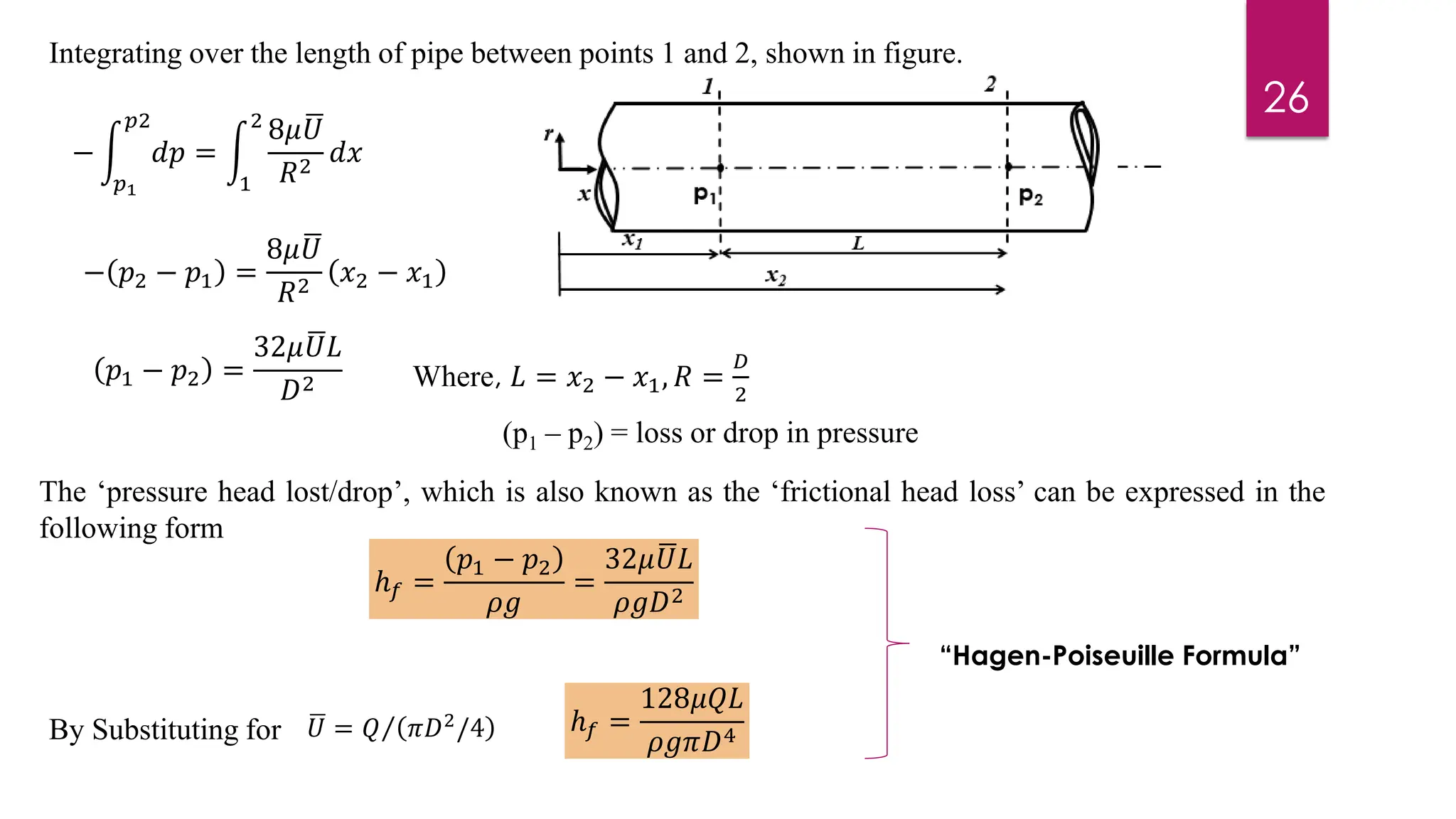
Integrating over the length of pipe between points 1 and 2, shown in figure.
− න
𝑝1
𝑝2
𝑑𝑝 = න
1
2
8𝜇 ഥ
𝑈
𝑅2
𝑑𝑥
− 𝑝2 − 𝑝1 =
8𝜇 ഥ
𝑈
𝑅2
𝑥2 − 𝑥1
𝑝1 − 𝑝2 =
32𝜇 ഥ
𝑈𝐿
𝐷2 Where, 𝐿 = 𝑥2 − 𝑥1, 𝑅 =
𝐷
2
The ‘pressure head lost/drop’, which is also known as the ‘frictional head loss’ can be expressed in the
following form
(p1 – p2) = loss or drop in pressure
ℎ𝑓 =
𝑝1 − 𝑝2
𝜌𝑔
=
32𝜇 ഥ
𝑈𝐿
𝜌𝑔𝐷2
By Substituting for ഥ
𝑈 = Τ
𝑄 𝜋𝐷2/4 ℎ𝑓 =
128𝜇𝑄𝐿
𝜌𝑔𝜋𝐷4
“Hagen-Poiseuille Formula”
26
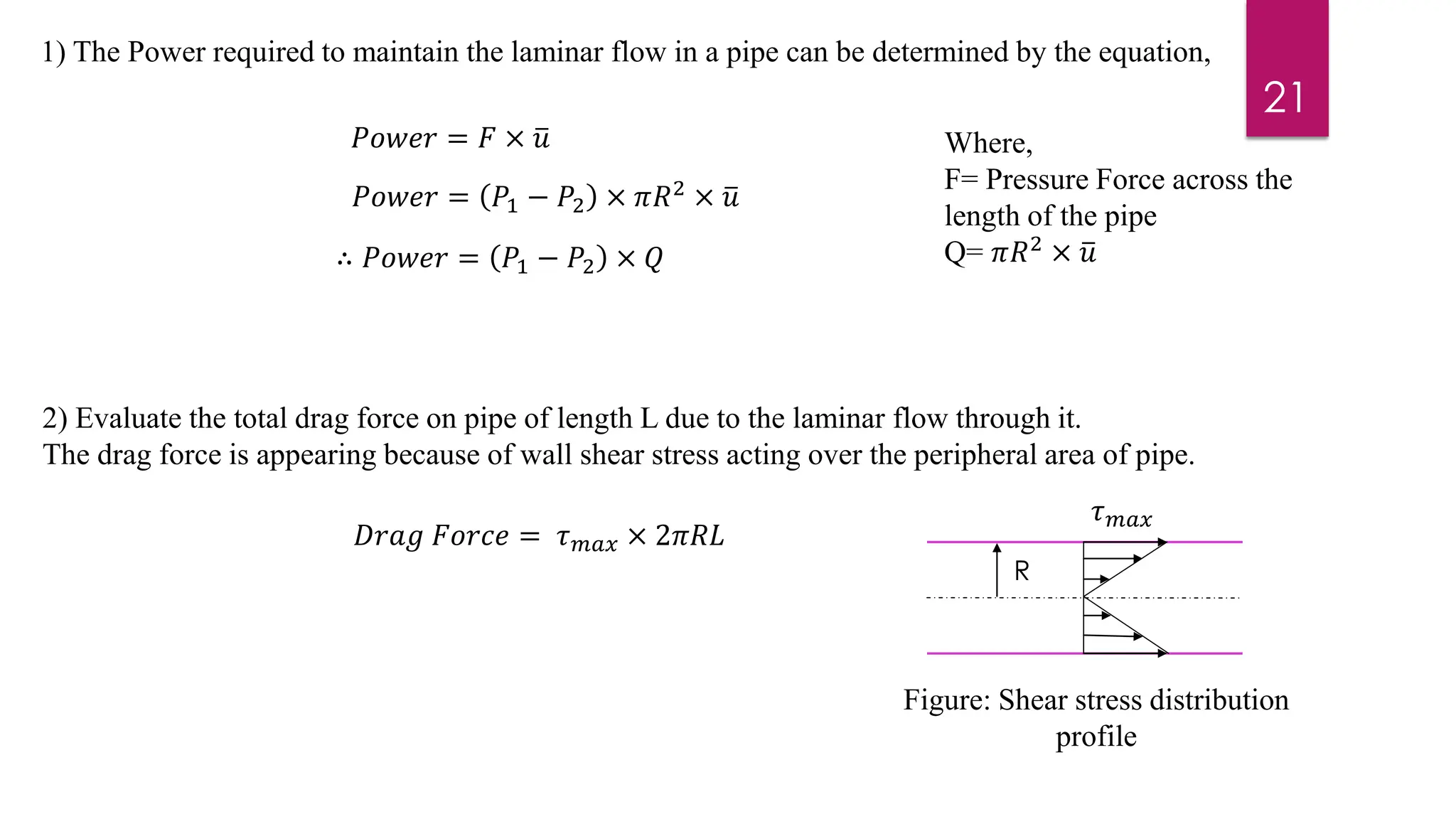
21
1) The Power required to maintain the laminar flow in a pipe can be determined by the equation,
𝑃𝑜𝑤𝑒𝑟 = 𝐹 × ത
𝑢 Where,
F= Pressure Force across the
length of the pipe
Q= 𝜋𝑅2
× ത
𝑢
𝑃𝑜𝑤𝑒𝑟 = 𝑃1 − 𝑃2 × 𝜋𝑅2 × ത
𝑢
∴ 𝑃𝑜𝑤𝑒𝑟 = 𝑃1 − 𝑃2 × 𝑄
2) Evaluate the total drag force on pipe of length L due to the laminar flow through it.
The drag force is appearing because of wall shear stress acting over the peripheral area of pipe.
𝐷𝑟𝑎𝑔 𝐹𝑜𝑟𝑐𝑒 = 𝜏𝑚𝑎𝑥 × 2𝜋𝑅𝐿
𝜏𝑚𝑎𝑥
R
Figure: Shear stress distribution
profile
22
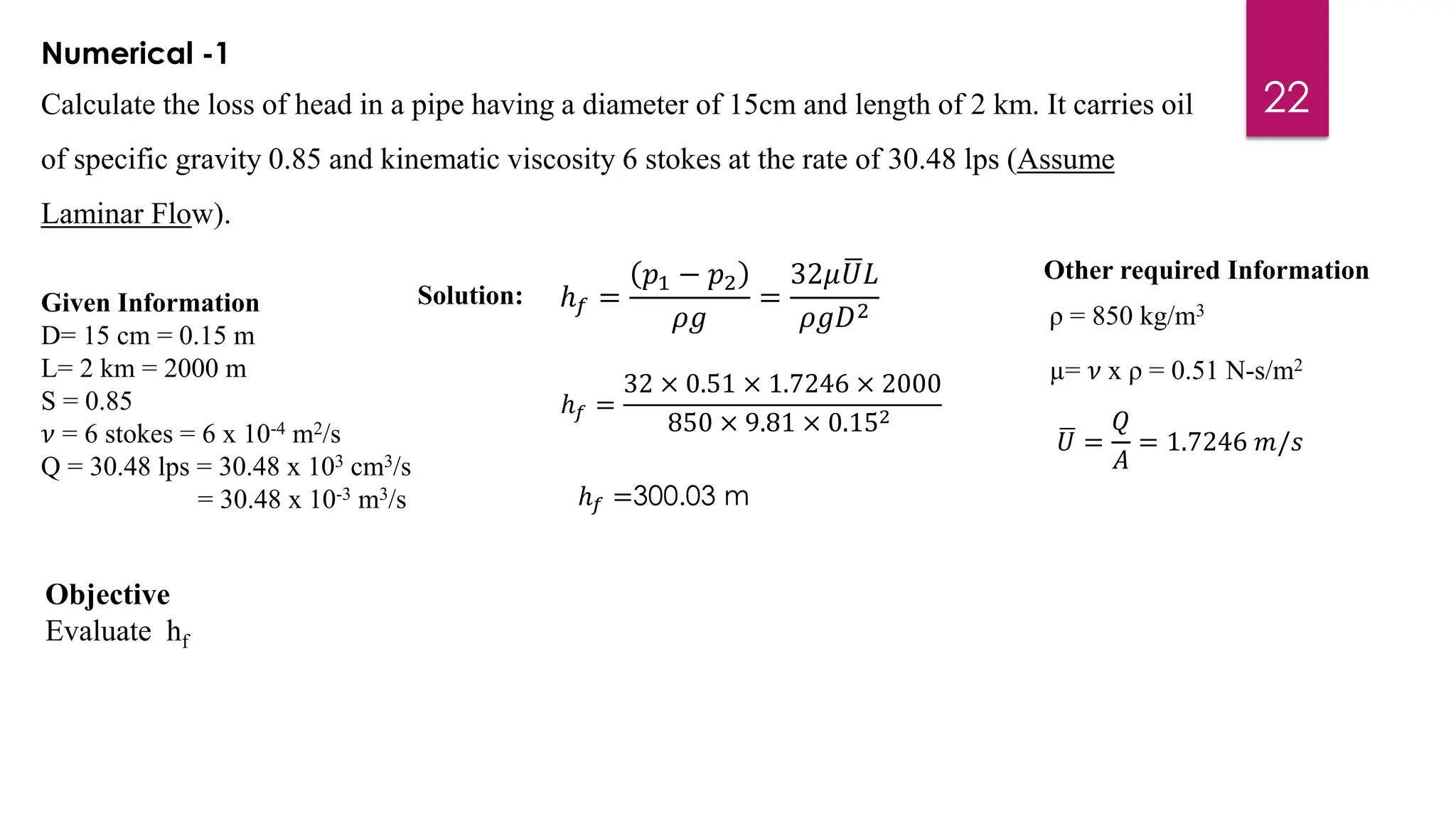
Numerical -1
Calculate the loss of head in a pipe having a diameter of 15cm and length of 2 km. It carries oil
of specific gravity 0.85 and kinematic viscosity 6 stokes at the rate of 30.48 lps (Assume
Laminar Flow).
Given Information
D= 15 cm = 0.15 m
L= 2 km = 2000 m
S = 0.85
𝜈 = 6 stokes = 6 x 10⁻⁴ m2/s
Q = 30.48 lps = 30.48 x 103 cm3/s
= 30.48 x 10⁻³ m3/s
ρ = 850 kg/m3
µ= 𝜈 x ρ = 0.51 N-s/m2
ഥ
𝑈 =
𝑄
𝐴
= 1.7246 𝑚/𝑠
Other required Information
ℎ𝑓 =
𝑝1 − 𝑝2
𝜌𝑔
=
32𝜇 ഥ
𝑈𝐿
𝜌𝑔𝐷2
ℎ𝑓 =
32 × 0.51 × 1.7246 × 2000
850 × 9.81 × 0.152
ℎ𝑓 =300.03 m
Objective
Evaluate hf
Solution:
23
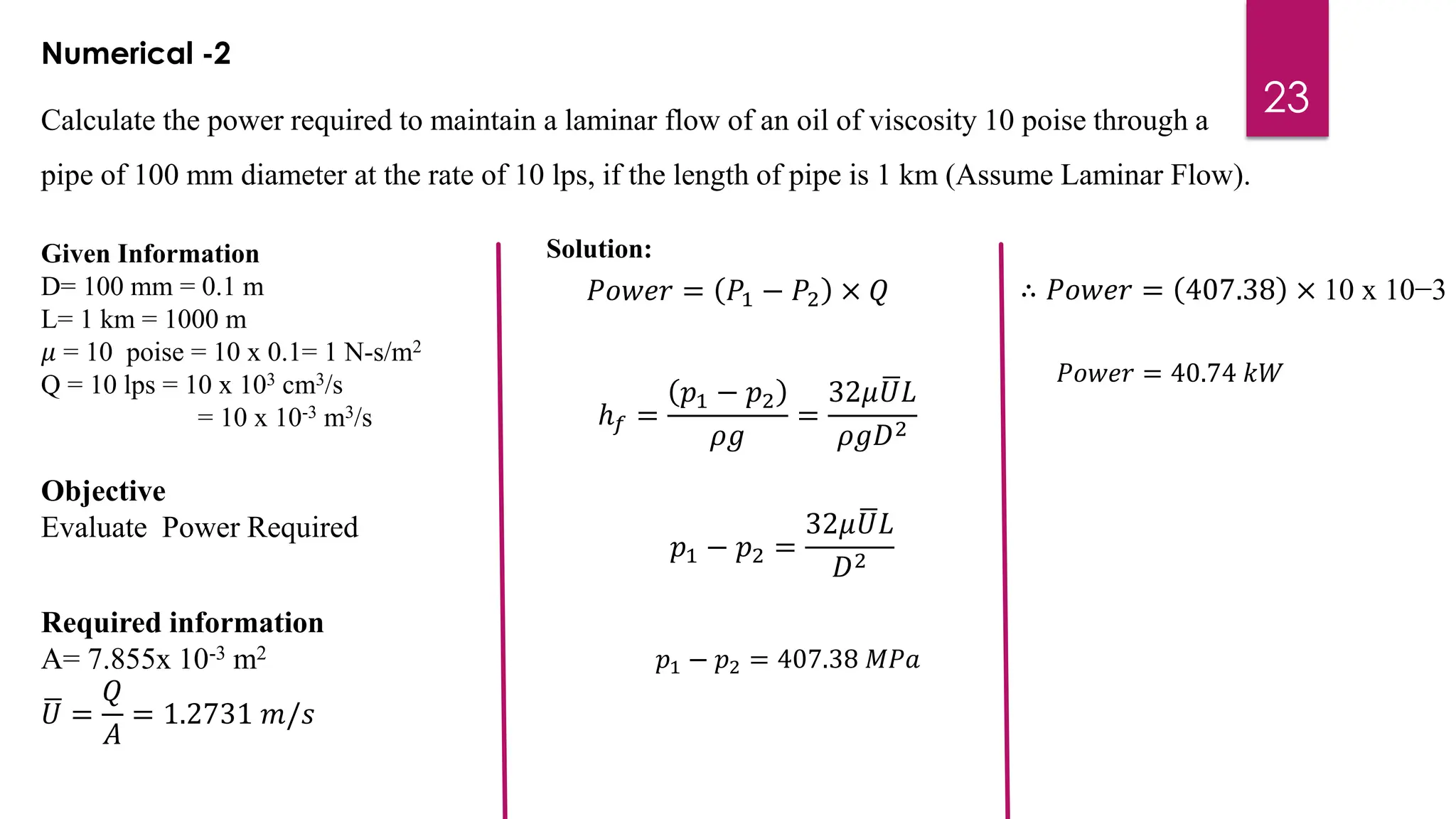
Calculate the power required to maintain a laminar flow of an oil of viscosity 10 poise through a
pipe of 100 mm diameter at the rate of 10 lps, if the length of pipe is 1 km (Assume Laminar Flow).
Numerical -2
Given Information
D= 100 mm = 0.1 m
L= 1 km = 1000 m
𝜇 = 10 poise = 10 x 0.1= 1 N-s/m2
Q = 10 lps = 10 x 103 cm3/s
= 10 x 10-3 m3/s
Objective
Evaluate Power Required
𝑃𝑜𝑤𝑒𝑟 = 𝑃1 − 𝑃2 × 𝑄
ℎ𝑓 =
𝑝1 − 𝑝2
𝜌𝑔
=
32𝜇 ഥ
𝑈𝐿
𝜌𝑔𝐷2
𝑝1 − 𝑝2 =
32𝜇 ഥ
𝑈𝐿
𝐷2
Required information
A= 7.855x 10⁻³ m2
ഥ
𝑈 =
𝑄
𝐴
= 1.2731 𝑚/𝑠
𝑝1 − 𝑝2 = 407.38 𝑀𝑃𝑎
Solution:
∴ 𝑃𝑜𝑤𝑒𝑟 = 407.38 × 10 x 10−3
𝑃𝑜𝑤𝑒𝑟 = 40.74 𝑘𝑊
24
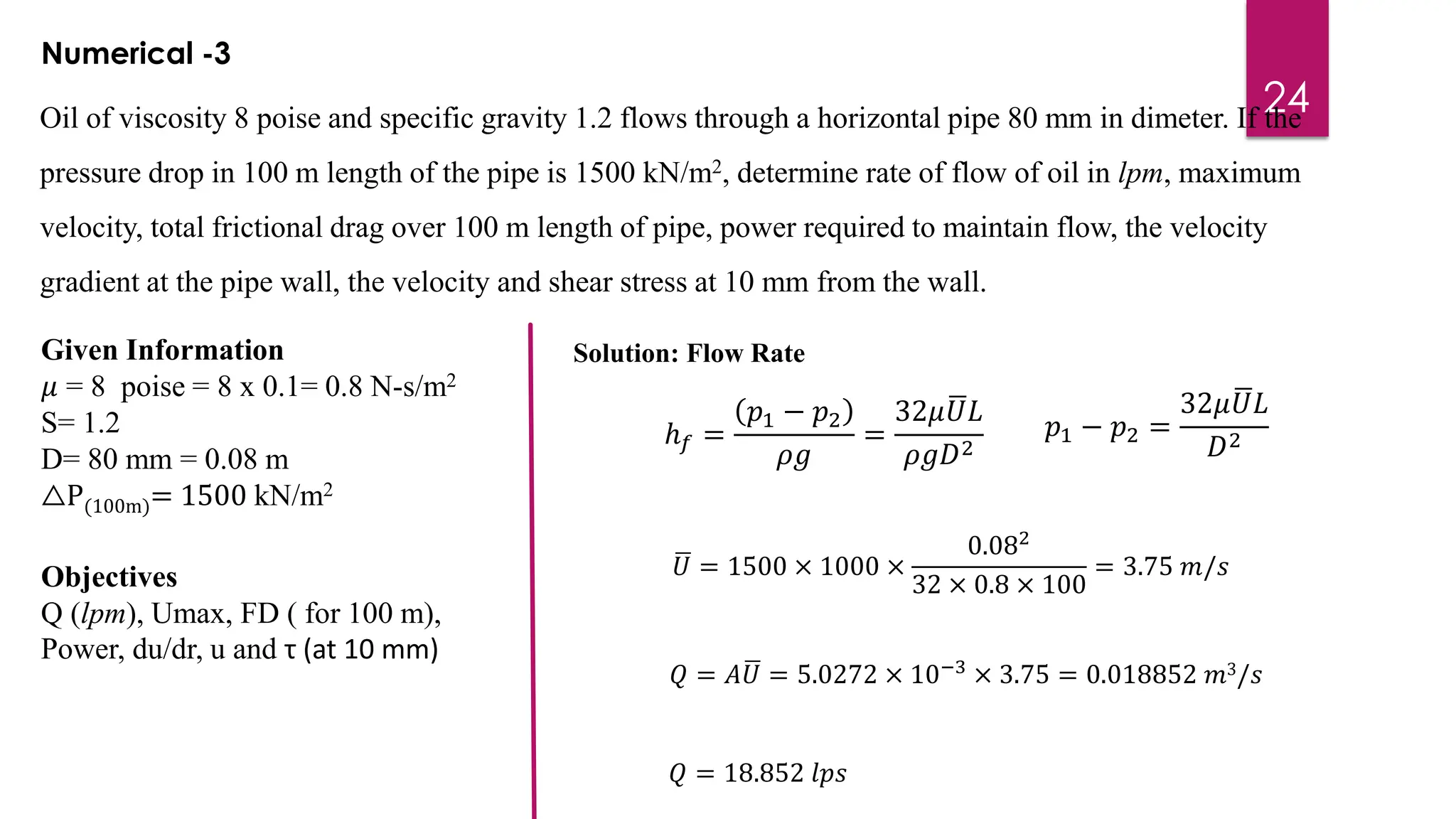
Oil of viscosity 8 poise and specific gravity 1.2 flows through a horizontal pipe 80 mm in dimeter. If the
pressure drop in 100 m length of the pipe is 1500 kN/m2, determine rate of flow of oil in lpm, maximum
velocity, total frictional drag over 100 m length of pipe, power required to maintain flow, the velocity
gradient at the pipe wall, the velocity and shear stress at 10 mm from the wall.
Numerical -3
Given Information
𝜇 = 8 poise = 8 x 0.1= 0.8 N-s/m2
S= 1.2
D= 80 mm = 0.08 m
△P(100m)= 1500 kN/m2
Objectives
Q (lpm), Umax, FD ( for 100 m),
Power, du/dr, u and τ (at 10 mm)
ℎ𝑓 =
𝑝1 − 𝑝2
𝜌𝑔
=
32𝜇 ഥ
𝑈𝐿
𝜌𝑔𝐷2
Solution: Flow Rate
𝑝1 − 𝑝2 =
32𝜇 ഥ
𝑈𝐿
𝐷2
ഥ
𝑈 = 1500 × 1000 ×
0.082
32 × 0.8 × 100
= 3.75 𝑚/𝑠
𝑄 = 𝐴ഥ
𝑈 = 5.0272 × 10−3
× 3.75 = 0.018852 𝑚3/𝑠
𝑄 = 18.852 𝑙𝑝𝑠
25
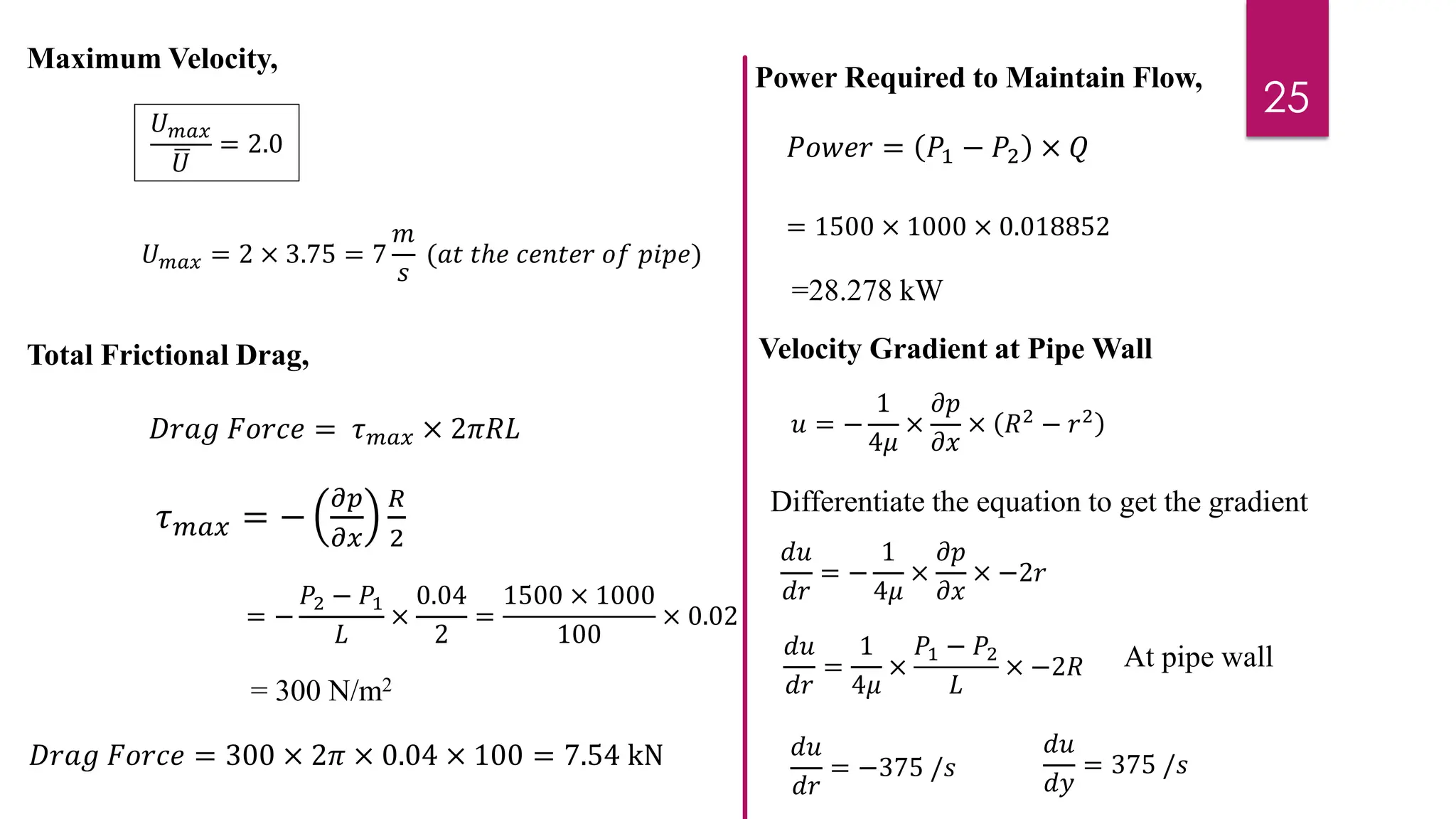
𝑈𝑚𝑎𝑥
ഥ
𝑈
= 2.0
Maximum Velocity,
𝑈𝑚𝑎𝑥 = 2 × 3.75 = 7
𝑚
𝑠
(𝑎𝑡 𝑡ℎ𝑒 𝑐𝑒𝑛𝑡𝑒𝑟 𝑜𝑓 𝑝𝑖𝑝𝑒)
Total Frictional Drag,
𝐷𝑟𝑎𝑔 𝐹𝑜𝑟𝑐𝑒 = 𝜏𝑚𝑎𝑥 × 2𝜋𝑅𝐿
= −
𝑃2 − 𝑃1
𝐿
×
0.04
2
=
1500 × 1000
100
× 0.02
𝜏𝑚𝑎𝑥 = −
𝜕𝑝
𝜕𝑥
𝑅
2
= 300 N/m2
𝐷𝑟𝑎𝑔 𝐹𝑜𝑟𝑐𝑒 = 300 × 2𝜋 × 0.04 × 100 = 7.54 kN
𝑃𝑜𝑤𝑒𝑟 = 𝑃1 − 𝑃2 × 𝑄
Power Required to Maintain Flow,
= 1500 × 1000 × 0.018852
=28.278 kW
Velocity Gradient at Pipe Wall
𝑢 = −
1
4𝜇
×
𝜕𝑝
𝜕𝑥
× 𝑅2 − 𝑟2
𝑑𝑢
𝑑𝑟
= −
1
4𝜇
×
𝜕𝑝
𝜕𝑥
× −2𝑟
𝑑𝑢
𝑑𝑟
=
1
4𝜇
×
𝑃1 − 𝑃2
𝐿
× −2𝑅 At pipe wall
𝑑𝑢
𝑑𝑟
= −375 /𝑠
𝑑𝑢
𝑑𝑦
= 375 /𝑠
Differentiate the equation to get the gradient
26
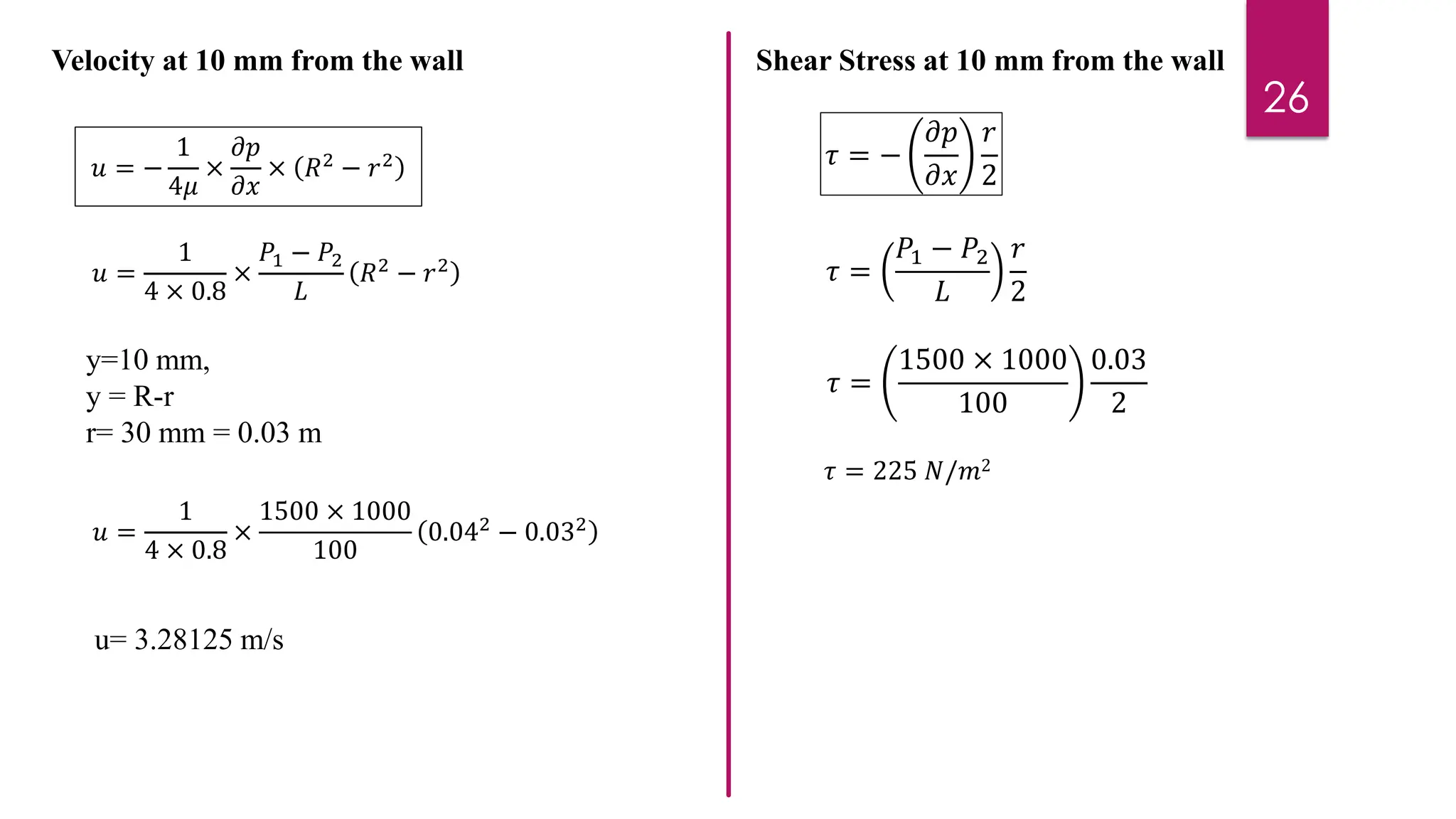
Velocity at 10 mm from the wall
𝑢 = −
1
4𝜇
×
𝜕𝑝
𝜕𝑥
× 𝑅2
− 𝑟2
𝑢 =
1
4 × 0.8
×
𝑃1 − 𝑃2
𝐿
𝑅2 − 𝑟2
y=10 mm,
y = R-r
r= 30 mm = 0.03 m
𝑢 =
1
4 × 0.8
×
1500 × 1000
100
0.042
− 0.032
u= 3.28125 m/s
Shear Stress at 10 mm from the wall
𝜏 = −
𝜕𝑝
𝜕𝑥
𝑟
2
𝜏 =
𝑃1 − 𝑃2
𝐿
𝑟
2
𝜏 =
1500 × 1000
100
0.03
2
𝜏 = 225 𝑁/𝑚2
27
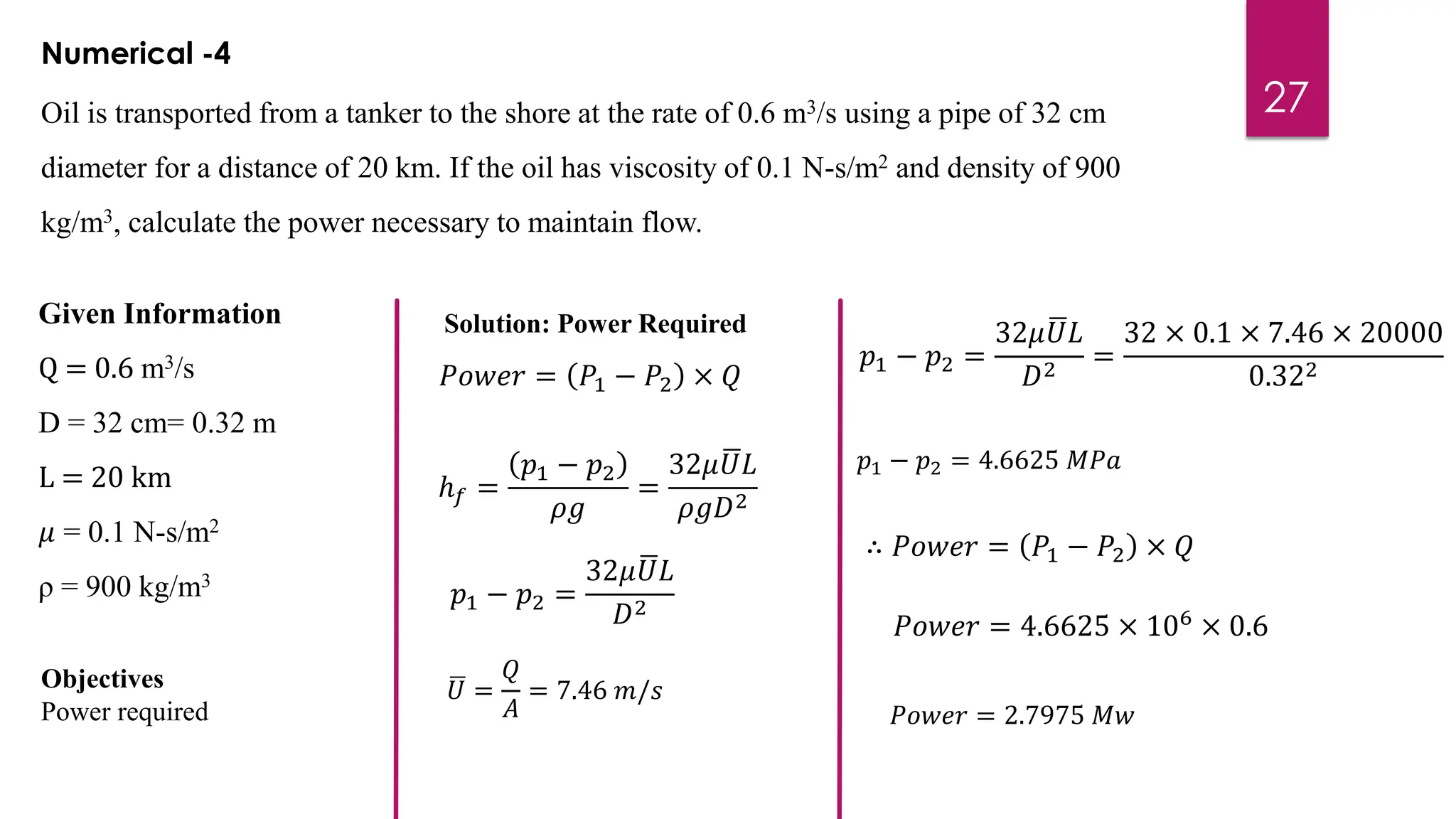
Numerical -4
Oil is transported from a tanker to the shore at the rate of 0.6 m3/s using a pipe of 32 cm
diameter for a distance of 20 km. If the oil has viscosity of 0.1 N-s/m2 and density of 900
kg/m3, calculate the power necessary to maintain flow.
Given Information
Q = 0.6 m3/s
D = 32 cm= 0.32 m
L = 20 km
𝜇 = 0.1 N-s/m2
ρ = 900 kg/m3
Objectives
Power required
Solution: Power Required
𝑃𝑜𝑤𝑒𝑟 = 𝑃1 − 𝑃2 × 𝑄
ℎ𝑓 =
𝑝1 − 𝑝2
𝜌𝑔
=
32𝜇 ഥ
𝑈𝐿
𝜌𝑔𝐷2
𝑝1 − 𝑝2 =
32𝜇 ഥ
𝑈𝐿
𝐷2
ഥ
𝑈 =
𝑄
𝐴
= 7.46 𝑚/𝑠
𝑝1 − 𝑝2 =
32𝜇 ഥ
𝑈𝐿
𝐷2
=
32 × 0.1 × 7.46 × 20000
0.322
𝑝1 − 𝑝2 = 4.6625 𝑀𝑃𝑎
∴ 𝑃𝑜𝑤𝑒𝑟 = 𝑃1 − 𝑃2 × 𝑄
𝑃𝑜𝑤𝑒𝑟 = 4.6625 × 106 × 0.6
𝑃𝑜𝑤𝑒𝑟 = 2.7975 𝑀𝑤
28
End of Session-1
Figure: Shear stress distribution and typical velocity profiles for fluid flow in a pipe [1].

009a (PPT) Viscous Flow-1 New.pdf .

  • 1.
    1 Fluid Mechanics (MME-2252) VISCOUS FLOW IVSemester, Mechanical Engineering Department of Mechanical and Manufacturing Engineering Manipal Institute of Technology, MAHE, Manipal Dr. Vijay G. S. Professor, Dept. of Mech. & Ind. Engg., MIT, Manipal email: vijay.gs@manipal.edu Mob.: 9980032104
  • 2.
    Topics 2  Reynold’s experiment,laminar and turbulent flows  Viscous flow through a circular pipe (Hagen Poiseuille flow)  Viscous flow between two parallel plates (Plain Couette flow) 1) The shear stress distribution 2) The velocity distribution 3) The ratio of maximum velocity to average velocity 4) The drop of pressure for a given length
  • 3.
    3 Viscous Flow Difference inIdeal and Real fluid Flow in Pipe V Figure (3): Velocity Profile in Real Fluid Flow V D V Figure (2): Velocity Profile in Ideal Fluid Flow • Viscosity offers to viscous shear resistance (τ = µ du/dy) and opposes the motion between the layers • This gives rise to change in velocity between layers i.e. velocity gradient (du/dy) will appear normal to the flow direction • Due to the resistance to motion, power is required to maintain flow of real fluids • Hence, In fluid flow problems, effect of viscosity cannot be neglected Why this change is appearing?
  • 4.
    Laminar and TurbulentFlows Depending upon the relative magnitudes of the viscous forces and inertia forces, flow can exist in two types- Laminar Flow and Turbulent Flow Laminar Flow: All particles move in well defined paths and individual particles do not cross the paths taken by other particle. Flow takes place in number of sheets or laminae. This type of flow is also known as streamline or viscous flow. Turbulent Flow: Particles move in zig-zag way in a flow field i.e. the flow is disturbed and inter-mixing of particles takes place. 4 In this chapter, Our Focus is in laminar flow i.e. viscous effects are dominant and flow is well defined
  • 5.
    5 1) Reynolds’s Experiment: O.Reynold, a British professor demonstrated that a laminar flow changes to turbulent flow Figure: Reynolds Dye Experimental setup and Observed dye streak lines [1] Q V
  • 6.
    Observations from theReynold’s Dye Experiment 6 For general case, transition of flow is function of • Velocity of fluid (V) • Diameter of the pipe (V) • Viscosity of the fluid (𝜇) • Density of Fluid (ρ) Figure: Time dependence of fluid velocity at a point [1] 𝑉𝐴 = 𝑢 Ƹ 𝑖 𝑉𝐴 = 𝑢 Ƹ 𝑖 + 𝑣 Ƹ 𝑗 + 𝑤෠ 𝑘
  • 7.
    ρ = Densityof Fluid, Vavg= Average Velocity, D= Diameter of Pipe, µ= Dynamic Viscosity 𝑅𝑒 = 𝜌𝑉 𝑎𝑣𝑔𝐷 𝜇 For a flow in circular pipe, If Re < 2000, the flow is said to be laminar If Re > 4000, the flow is said to be turbulent If 2000 < Re < 4000, in transition from laminar to turbulent Identifying the type of flow from Reynolds Number Critical Reynolds Number: It is magnitude of Reynolds Number below which the flow is definitely laminar. 7 Figure: Laminar and Turbulent flow regimes in candle smoke [3]
  • 8.
    2. Flow ofViscous Fluid Through a Circular Pipe Explanation: • Consider a horizontal circular cross section pipe of radius ‘R’, through which a viscous fluid is flowing from left to right • Consider a cylindrical fluid element of radius r, thickness dr and length x sliding inside a cylindrical fluid element of radius (r + dr). • Forces acting on element: A pressure forces are acting normal to the faces of element, and shear forces are acting on the surface Direction of Flow r dr A B C D r x △x R 𝒑𝝅𝒓𝟐 𝒑 + 𝒅𝒑 𝒅𝒙 ∆𝒙 𝝅𝒓𝟐 𝝉 × 𝟐𝝅𝒓 × ∆𝒙 8
  • 9.
    2.1 Shear stressdistribution: As there is no acceleration, the algebraic summation of all the forces acting on the fluid element must be zero. 𝑝 × 𝜋𝑟2 − 𝑝 + 𝑑𝑝 𝑑𝑥 ∆𝑥 𝜋𝑟2 − 𝜏 × 2𝜋𝑟 × ∆𝑥 = 0 − 𝑑𝑝 𝑑𝑥 ∆𝑥 𝜋𝑟2 − 𝜏 × 2𝜋𝑟 × ∆𝑥 = 0 𝜏 = − 𝑑𝑝 𝑑𝑥 𝑟 2 (1) 9 ෍ →+ 𝑓 𝑥 = 0
  • 10.
    • Shear stressdistribution is function of radius of pipe 𝜏 ∝ 𝑟 • Shear stress varies linearly from zero at center of pipe to maximum at the boundary (r = R) • The negative sign for pressure gradient indicates a decrease in the pressure in the direction of fluid flow. • As potential and kinetic energies remain constant, the pressure force is the only means to compensate for the resistance to flow. Note: Pressure gradient remains constant 𝜏𝑚𝑎𝑥 = − 𝑑𝑝 𝑑𝑥 𝑅 2 𝜏 = − 𝑑𝑝 𝑑𝑥 𝑟 2 10 Meaning of Mathematical Expression 𝜏𝑚𝑎𝑥 R Figure: Shear stress distribution profile A A r x
  • 11.
    2.2 Velocity Distribution Toget the velocity distribution, substitute for shear stress in equation (1) From Newton’s law of viscosity, In the above mathematical expression, y is measured from the pipe wall, Substituting in the expression of Newton’s law of viscosity, ⸫ the expression for y can be written as 𝜏 = 𝜇 𝑑𝑢 𝑑𝑦 At pipe wall, 𝑦 = 0, At pipe center, 𝑦 = 𝑅 𝑦 = 𝑅 − 𝑟 𝜏 = −𝜇 𝑑𝑢 𝑑𝑟 11 dy = -dr 𝑟 = 𝑅 𝑟 = 0 & (2)
  • 12.
    Integrating the equationwe get, Where, C is the integration constant and its value can be determined from the boundary conditions. u = 0 at r = R (velocity is zero at pipe wall). Substituting the boundary condition in equation (3) −𝜇 𝑑𝑢 𝑑𝑟 = − 𝑑𝑝 𝑑𝑥 𝑟 2 1 2 𝑑𝑢 𝑑𝑟 = 1 2𝜇 𝑑𝑝 𝑑𝑥 × 𝑟 න 𝑑𝑢 = න 1 2𝜇 𝑑𝑝 𝑑𝑥 𝑟. 𝑑𝑟 𝑢 = 1 2𝜇 × 𝑑𝑝 𝑑𝑥 × 𝑟2 2 + 𝐶 ∴ 𝑢 = 1 4𝜇 × 𝑑𝑝 𝑑𝑥 × 𝑟2 + 𝐶 Equating expressions (1) and (2) 20 (3)
  • 13.
    • The velocitydistribution of a fully developed laminar flow in a circular pipe must be parabolic. • At the center of the pipe, the velocity is maximum. i.e. at r = 0, u = Umax Note: In equation (4), µ, 𝑑𝑝 𝑑𝑥 and R are constants. 13 0 = 1 4𝜇 × 𝑑𝑝 𝑑𝑥 × 𝑅2 + 𝐶 𝐶 = − 1 4𝜇 × 𝑑𝑝 𝑑𝑥 × 𝑅2 Back substitution of C in (3) gives, 𝑢 = 1 4𝜇 × 𝑑𝑝 𝑑𝑥 × 𝑟2 − 1 4𝜇 × 𝑑𝑝 𝑑𝑥 × 𝑅2 𝑢 = − 1 4𝜇 × 𝑑𝑝 𝑑𝑥 × 𝑅2 − 𝑟2 R r (4)
  • 14.
    Substituting r =0 in equation (4), Equation (4) can be written as Substituting (5) in (6), 14 𝑈𝑚𝑎𝑥 = − 1 4𝜇 × 𝑑𝑝 𝑑𝑥 × 𝑅2 𝑢 = − 1 4𝜇 × 𝑑𝑝 𝑑𝑥 × 𝑅2 1 − 𝑟2 𝑅2 𝑢 = 𝑈𝑚𝑎𝑥 1 − 𝑟2 𝑅2 𝜏𝑚𝑎𝑥 R Figure: Shear stress distribution and Velocity profile r 𝑈𝑚𝑎𝑥 (5) (6) (7)
  • 15.
    15 Figure: Changes invelocity profile and pressure changes along the flow in pipe [2]
  • 16.
    16 we need toderive mathematical expressions for the following 1. The shear stress distribution 2. The velocity distribution 3. The ratio of maximum velocity to average velocity 4. The drop of pressure for a given length Remember the objectives,
  • 17.
    3.3 Ratio ofMaximum velocity to Average Velocity 17 The average velocity of the fluid flow can be determined by dividing the discharge Q by the area of the pipe (πR2). dQ = (Area of the ring element)  (Velocity at radius r) = 𝑢 × 2𝜋𝑟 × 𝑑𝑟 Substitute for ‘u’ from equation (4), 𝑑𝑄 = − 1 4𝜇 × 𝑑𝑝 𝑑𝑥 × 𝑅2 − 𝑟2 × 2𝜋𝑟 × 𝑑𝑟 ⸫ The total discharge through the pipe is 𝑄 = න 0 𝑅 𝑑𝑄 = න 0 𝑅 − 1 4𝜇 × 𝑑𝑝 𝑑𝑥 × 𝑅2 − 𝑟2 × 2𝜋𝑟 × 𝑑𝑟 23 r dr The discharge ‘dQ’ through the circular ring element of radius ‘r’ and thickness ‘dr’ is,
  • 18.
    18 𝑄 = 𝜋 8𝜇 − 𝑑𝑝 𝑑𝑥 𝑅4 ⸫ AverageVelocity (ഥ 𝑈), ഥ 𝑈 = 𝑄 𝐴𝑟𝑒𝑎 = 𝜋 8𝜇 − 𝑑𝑝 𝑑𝑥 𝑅4 𝜋𝑅2 = 1 8𝜇 − 𝑑𝑝 𝑑𝑥 𝑅2 Dividing Equation (5) by (8) 𝑈𝑚𝑎𝑥 ഥ 𝑈 = − 1 4𝜇 × 𝑑𝑝 𝑑𝑥 × 𝑅2 1 8𝜇 − 𝑑𝑝 𝑑𝑥 𝑅2 = 2.0 ⸫ Ratio of maximum velocity to average velocity is 2 𝑈𝑚𝑎𝑥 ഥ 𝑈 = 2.0 𝑄 = − 1 4𝜇 × 𝑑𝑝 𝑑𝑥 × 2𝜋 න 0 𝑅 𝑅2 − 𝑟2 𝑟 × 𝑑𝑟 (8) 𝑄 = − 1 4𝜇 × 𝑑𝑝 𝑑𝑥 × 2𝜋 𝑅2 𝑟2 2 − 𝑟4 4 𝑅 0 =
  • 19.
    3.4 Drop ofPressure Over a Given Length of Pipe: 19 As the fluid flows through the circular pipe, its pressure reduces along the direction of flow. This is due to the resistance at the pipe wall that has to be compensated by the pressure energy. r x p1 p2 x1 x2 L 1 2 Figure: Pressure drop in pipe flow Direction of Flow We have expression for average velocity, ഥ 𝑈 = 𝑄 𝐴𝑟𝑒𝑎 = 1 8𝜇 − 𝑑𝑝 𝑑𝑥 𝑅2 − 𝑑𝑝 𝑑𝑥 = 8𝜇 ഥ 𝑈 𝑅2 25
  • 20.
    Integrating over thelength of pipe between points 1 and 2, shown in figure. − න 𝑝1 𝑝2 𝑑𝑝 = න 1 2 8𝜇 ഥ 𝑈 𝑅2 𝑑𝑥 − 𝑝2 − 𝑝1 = 8𝜇 ഥ 𝑈 𝑅2 𝑥2 − 𝑥1 𝑝1 − 𝑝2 = 32𝜇 ഥ 𝑈𝐿 𝐷2 Where, 𝐿 = 𝑥2 − 𝑥1, 𝑅 = 𝐷 2 The ‘pressure head lost/drop’, which is also known as the ‘frictional head loss’ can be expressed in the following form (p1 – p2) = loss or drop in pressure ℎ𝑓 = 𝑝1 − 𝑝2 𝜌𝑔 = 32𝜇 ഥ 𝑈𝐿 𝜌𝑔𝐷2 By Substituting for ഥ 𝑈 = Τ 𝑄 𝜋𝐷2/4 ℎ𝑓 = 128𝜇𝑄𝐿 𝜌𝑔𝜋𝐷4 “Hagen-Poiseuille Formula” 26
  • 21.
    21 1) The Powerrequired to maintain the laminar flow in a pipe can be determined by the equation, 𝑃𝑜𝑤𝑒𝑟 = 𝐹 × ത 𝑢 Where, F= Pressure Force across the length of the pipe Q= 𝜋𝑅2 × ത 𝑢 𝑃𝑜𝑤𝑒𝑟 = 𝑃1 − 𝑃2 × 𝜋𝑅2 × ത 𝑢 ∴ 𝑃𝑜𝑤𝑒𝑟 = 𝑃1 − 𝑃2 × 𝑄 2) Evaluate the total drag force on pipe of length L due to the laminar flow through it. The drag force is appearing because of wall shear stress acting over the peripheral area of pipe. 𝐷𝑟𝑎𝑔 𝐹𝑜𝑟𝑐𝑒 = 𝜏𝑚𝑎𝑥 × 2𝜋𝑅𝐿 𝜏𝑚𝑎𝑥 R Figure: Shear stress distribution profile
  • 22.
    22 Numerical -1 Calculate theloss of head in a pipe having a diameter of 15cm and length of 2 km. It carries oil of specific gravity 0.85 and kinematic viscosity 6 stokes at the rate of 30.48 lps (Assume Laminar Flow). Given Information D= 15 cm = 0.15 m L= 2 km = 2000 m S = 0.85 𝜈 = 6 stokes = 6 x 10⁻⁴ m2/s Q = 30.48 lps = 30.48 x 103 cm3/s = 30.48 x 10⁻³ m3/s ρ = 850 kg/m3 µ= 𝜈 x ρ = 0.51 N-s/m2 ഥ 𝑈 = 𝑄 𝐴 = 1.7246 𝑚/𝑠 Other required Information ℎ𝑓 = 𝑝1 − 𝑝2 𝜌𝑔 = 32𝜇 ഥ 𝑈𝐿 𝜌𝑔𝐷2 ℎ𝑓 = 32 × 0.51 × 1.7246 × 2000 850 × 9.81 × 0.152 ℎ𝑓 =300.03 m Objective Evaluate hf Solution:
  • 23.
    23 Calculate the powerrequired to maintain a laminar flow of an oil of viscosity 10 poise through a pipe of 100 mm diameter at the rate of 10 lps, if the length of pipe is 1 km (Assume Laminar Flow). Numerical -2 Given Information D= 100 mm = 0.1 m L= 1 km = 1000 m 𝜇 = 10 poise = 10 x 0.1= 1 N-s/m2 Q = 10 lps = 10 x 103 cm3/s = 10 x 10-3 m3/s Objective Evaluate Power Required 𝑃𝑜𝑤𝑒𝑟 = 𝑃1 − 𝑃2 × 𝑄 ℎ𝑓 = 𝑝1 − 𝑝2 𝜌𝑔 = 32𝜇 ഥ 𝑈𝐿 𝜌𝑔𝐷2 𝑝1 − 𝑝2 = 32𝜇 ഥ 𝑈𝐿 𝐷2 Required information A= 7.855x 10⁻³ m2 ഥ 𝑈 = 𝑄 𝐴 = 1.2731 𝑚/𝑠 𝑝1 − 𝑝2 = 407.38 𝑀𝑃𝑎 Solution: ∴ 𝑃𝑜𝑤𝑒𝑟 = 407.38 × 10 x 10−3 𝑃𝑜𝑤𝑒𝑟 = 40.74 𝑘𝑊
  • 24.
    24 Oil of viscosity8 poise and specific gravity 1.2 flows through a horizontal pipe 80 mm in dimeter. If the pressure drop in 100 m length of the pipe is 1500 kN/m2, determine rate of flow of oil in lpm, maximum velocity, total frictional drag over 100 m length of pipe, power required to maintain flow, the velocity gradient at the pipe wall, the velocity and shear stress at 10 mm from the wall. Numerical -3 Given Information 𝜇 = 8 poise = 8 x 0.1= 0.8 N-s/m2 S= 1.2 D= 80 mm = 0.08 m △P(100m)= 1500 kN/m2 Objectives Q (lpm), Umax, FD ( for 100 m), Power, du/dr, u and τ (at 10 mm) ℎ𝑓 = 𝑝1 − 𝑝2 𝜌𝑔 = 32𝜇 ഥ 𝑈𝐿 𝜌𝑔𝐷2 Solution: Flow Rate 𝑝1 − 𝑝2 = 32𝜇 ഥ 𝑈𝐿 𝐷2 ഥ 𝑈 = 1500 × 1000 × 0.082 32 × 0.8 × 100 = 3.75 𝑚/𝑠 𝑄 = 𝐴ഥ 𝑈 = 5.0272 × 10−3 × 3.75 = 0.018852 𝑚3/𝑠 𝑄 = 18.852 𝑙𝑝𝑠
  • 25.
    25 𝑈𝑚𝑎𝑥 ഥ 𝑈 = 2.0 Maximum Velocity, 𝑈𝑚𝑎𝑥= 2 × 3.75 = 7 𝑚 𝑠 (𝑎𝑡 𝑡ℎ𝑒 𝑐𝑒𝑛𝑡𝑒𝑟 𝑜𝑓 𝑝𝑖𝑝𝑒) Total Frictional Drag, 𝐷𝑟𝑎𝑔 𝐹𝑜𝑟𝑐𝑒 = 𝜏𝑚𝑎𝑥 × 2𝜋𝑅𝐿 = − 𝑃2 − 𝑃1 𝐿 × 0.04 2 = 1500 × 1000 100 × 0.02 𝜏𝑚𝑎𝑥 = − 𝜕𝑝 𝜕𝑥 𝑅 2 = 300 N/m2 𝐷𝑟𝑎𝑔 𝐹𝑜𝑟𝑐𝑒 = 300 × 2𝜋 × 0.04 × 100 = 7.54 kN 𝑃𝑜𝑤𝑒𝑟 = 𝑃1 − 𝑃2 × 𝑄 Power Required to Maintain Flow, = 1500 × 1000 × 0.018852 =28.278 kW Velocity Gradient at Pipe Wall 𝑢 = − 1 4𝜇 × 𝜕𝑝 𝜕𝑥 × 𝑅2 − 𝑟2 𝑑𝑢 𝑑𝑟 = − 1 4𝜇 × 𝜕𝑝 𝜕𝑥 × −2𝑟 𝑑𝑢 𝑑𝑟 = 1 4𝜇 × 𝑃1 − 𝑃2 𝐿 × −2𝑅 At pipe wall 𝑑𝑢 𝑑𝑟 = −375 /𝑠 𝑑𝑢 𝑑𝑦 = 375 /𝑠 Differentiate the equation to get the gradient
  • 26.
    26 Velocity at 10mm from the wall 𝑢 = − 1 4𝜇 × 𝜕𝑝 𝜕𝑥 × 𝑅2 − 𝑟2 𝑢 = 1 4 × 0.8 × 𝑃1 − 𝑃2 𝐿 𝑅2 − 𝑟2 y=10 mm, y = R-r r= 30 mm = 0.03 m 𝑢 = 1 4 × 0.8 × 1500 × 1000 100 0.042 − 0.032 u= 3.28125 m/s Shear Stress at 10 mm from the wall 𝜏 = − 𝜕𝑝 𝜕𝑥 𝑟 2 𝜏 = 𝑃1 − 𝑃2 𝐿 𝑟 2 𝜏 = 1500 × 1000 100 0.03 2 𝜏 = 225 𝑁/𝑚2
  • 27.
    27 Numerical -4 Oil istransported from a tanker to the shore at the rate of 0.6 m3/s using a pipe of 32 cm diameter for a distance of 20 km. If the oil has viscosity of 0.1 N-s/m2 and density of 900 kg/m3, calculate the power necessary to maintain flow. Given Information Q = 0.6 m3/s D = 32 cm= 0.32 m L = 20 km 𝜇 = 0.1 N-s/m2 ρ = 900 kg/m3 Objectives Power required Solution: Power Required 𝑃𝑜𝑤𝑒𝑟 = 𝑃1 − 𝑃2 × 𝑄 ℎ𝑓 = 𝑝1 − 𝑝2 𝜌𝑔 = 32𝜇 ഥ 𝑈𝐿 𝜌𝑔𝐷2 𝑝1 − 𝑝2 = 32𝜇 ഥ 𝑈𝐿 𝐷2 ഥ 𝑈 = 𝑄 𝐴 = 7.46 𝑚/𝑠 𝑝1 − 𝑝2 = 32𝜇 ഥ 𝑈𝐿 𝐷2 = 32 × 0.1 × 7.46 × 20000 0.322 𝑝1 − 𝑝2 = 4.6625 𝑀𝑃𝑎 ∴ 𝑃𝑜𝑤𝑒𝑟 = 𝑃1 − 𝑃2 × 𝑄 𝑃𝑜𝑤𝑒𝑟 = 4.6625 × 106 × 0.6 𝑃𝑜𝑤𝑒𝑟 = 2.7975 𝑀𝑤
  • 28.
    28 End of Session-1 Figure:Shear stress distribution and typical velocity profiles for fluid flow in a pipe [1].