Flowers  Presented by: Geonyzl L. Alviola
Intro on flowers A diagnostic feature of the  angiosperm. Modified reproductive shoot The shoot is determinate
Flower parts
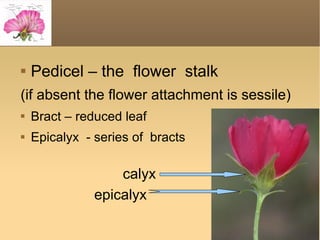
Pedicel – the  flower  stalk (if absent the flower attachment is sessile)‏ Bract – reduced leaf Epicalyx  - series of  bracts calyx epicalyx
 
Receptacle – region of the  flower which the floral parts are attached Perianth (perigonium)‏ receptacle
Tepals  – if  perianth is  undifferentiated/ the individual leaf parts - The term tepal is usually used when all segments of the perianth are of similar shape and color,
Perianth is differentiated into two groups A. Calyx – the  outermost series of the whorl and consist  of individual units of modified leaves called  SEPALS B. Corolla – the inner most  series that  consist a modified leaves called  PETALS
 
Hypanthium – Floral tube    - a cup like or  tubular structure   - around or  top of the ovary   - bearing along the  margin the sepals, petals and stamen
 
Nectary – a specialized  structure that secretes nectar - found on parianth parts , - or within the  receptacle   - or within the  androecium or  gynoecium
 
 
Androecium refers to all of the male organs - collectively called  STAMENS consist of the  following parts: a. filament (stalk-like) b. anther (pollen bearing)
 
Gynoecium refers to all female  organs of  a flower. - collective  called  CARPEL(pistil) consist of the  following  parts: a. ovary b. style c. stigma
gynoecium
Gynostegium - the male and female organs are fused as one structure
Androgynophore - A stalk that bears the  androecium and gynoecium
Flower Attachment
Pedicellate Flowers  with pedicel
 
Flower  cycly
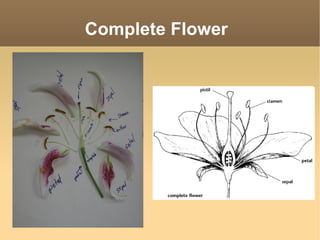
Flower  Cycly Refers to  the  number of cycles (series of  whorls) or floral parts. Two basic terms : 1. Complete – having  all four major series  (sepals, petals, stamens & carpels) 2. Incomplete – for a flowering lacking one or more of the four major whorls or parts.
Complete Flower
Incomplete flower Raspberry Tulip
Flower Sex and Plant Sex
Floral Sex or Flower  sex Refers to  the absence or  presence of male and female parts with  the  flower. two kinds : Perfect / bisexual – both stamen and carpel  are  present in  one flower Imperfect/ unisexual – only one  is  present
Imperfect Have two kinds : 1. Pistillate (female) – carpel present but stamen  absent
Imperfect Flower 2. Staminate – have only the stamen
Plant Sex Refers to the presence and distribution of  perfect and imperfect flower on individual of a  species. A. Hermaphroditic – only a perfect flower B. Monoecious –  a plant with only unisexual flowers both male and female on the same individual plant C. Dieocious – have unisexual flower  with staminate and  pistillate  on separate individuals
Monoecious Plant
Dioecious
Other  variations Polygamous  plant  –  having both bisexual and  unisexual flowers Andromonoecious  plant   -  having both staminate and perfect flowers on the same individual Gynomonoecious plant  – both  pistillate and perfect flowers on the same individual
Trimonoecious   – refers to a plant with pistillate, staminate and perfect flowers on the same individual Gynodiecious   – refers to a plant  with female flowers on some individuals and perfect flowers on the other
Androdioecious  –  refers to a plant with male flowers on  some and perfect  flowers on othe  individuals Trioecious  – refers to a plant with  pistillate, staminate and perfect  flowers on different individuals
Flower Symmetry

Flowers

  • 1.
    Flowers Presentedby: Geonyzl L. Alviola
  • 2.
    Intro on flowersA diagnostic feature of the angiosperm. Modified reproductive shoot The shoot is determinate
  • 3.
  • 4.
    Pedicel – the flower stalk (if absent the flower attachment is sessile)‏ Bract – reduced leaf Epicalyx - series of bracts calyx epicalyx
  • 5.
  • 6.
    Receptacle – regionof the flower which the floral parts are attached Perianth (perigonium)‏ receptacle
  • 7.
    Tepals –if perianth is undifferentiated/ the individual leaf parts - The term tepal is usually used when all segments of the perianth are of similar shape and color,
  • 8.
    Perianth is differentiatedinto two groups A. Calyx – the outermost series of the whorl and consist of individual units of modified leaves called SEPALS B. Corolla – the inner most series that consist a modified leaves called PETALS
  • 9.
  • 10.
    Hypanthium – Floraltube - a cup like or tubular structure - around or top of the ovary - bearing along the margin the sepals, petals and stamen
  • 11.
  • 12.
    Nectary – aspecialized structure that secretes nectar - found on parianth parts , - or within the receptacle - or within the androecium or gynoecium
  • 13.
  • 14.
  • 15.
    Androecium refers toall of the male organs - collectively called STAMENS consist of the following parts: a. filament (stalk-like) b. anther (pollen bearing)
  • 16.
  • 17.
    Gynoecium refers toall female organs of a flower. - collective called CARPEL(pistil) consist of the following parts: a. ovary b. style c. stigma
  • 18.
  • 19.
    Gynostegium - themale and female organs are fused as one structure
  • 20.
    Androgynophore - Astalk that bears the androecium and gynoecium
  • 21.
  • 22.
  • 23.
  • 24.
  • 25.
    Flower CyclyRefers to the number of cycles (series of whorls) or floral parts. Two basic terms : 1. Complete – having all four major series (sepals, petals, stamens & carpels) 2. Incomplete – for a flowering lacking one or more of the four major whorls or parts.
  • 26.
  • 27.
  • 28.
    Flower Sex andPlant Sex
  • 29.
    Floral Sex orFlower sex Refers to the absence or presence of male and female parts with the flower. two kinds : Perfect / bisexual – both stamen and carpel are present in one flower Imperfect/ unisexual – only one is present
  • 30.
    Imperfect Have twokinds : 1. Pistillate (female) – carpel present but stamen absent
  • 31.
    Imperfect Flower 2.Staminate – have only the stamen
  • 32.
    Plant Sex Refersto the presence and distribution of perfect and imperfect flower on individual of a species. A. Hermaphroditic – only a perfect flower B. Monoecious – a plant with only unisexual flowers both male and female on the same individual plant C. Dieocious – have unisexual flower with staminate and pistillate on separate individuals
  • 33.
  • 34.
  • 35.
    Other variationsPolygamous plant – having both bisexual and unisexual flowers Andromonoecious plant - having both staminate and perfect flowers on the same individual Gynomonoecious plant – both pistillate and perfect flowers on the same individual
  • 36.
    Trimonoecious – refers to a plant with pistillate, staminate and perfect flowers on the same individual Gynodiecious – refers to a plant with female flowers on some individuals and perfect flowers on the other
  • 37.
    Androdioecious – refers to a plant with male flowers on some and perfect flowers on othe individuals Trioecious – refers to a plant with pistillate, staminate and perfect flowers on different individuals
  • 38.