DIVERSITY OF FLOWERS
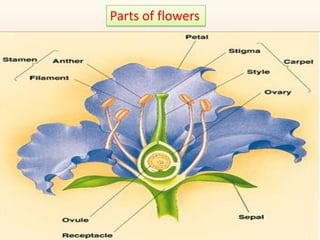
Parts of flowers
Arrangement of flowers

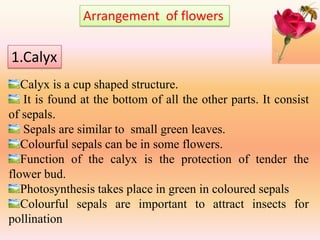
1.Calyx
   Calyx is a cup shaped structure.
   It is found at the bottom of all the other parts. It consist
of sepals.
   Sepals are similar to small green leaves.
   Colourful sepals can be in some flowers.
   Function of the calyx is the protection of tender the
flower bud.
   Photosynthesis takes place in green in coloured sepals
   Colourful sepals are important to attract insects for
pollination
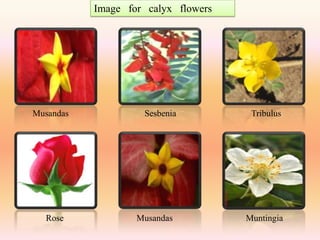
Image for calyx flowers


Musandas            Sesbenia          Tribulus


  Rose             Musandas          Muntingia
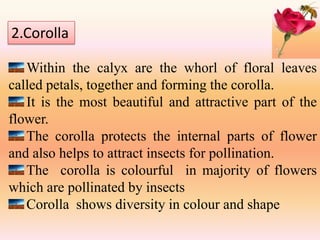
2.Corolla

   Within the calyx are the whorl of floral leaves
called petals, together and forming the corolla.
   It is the most beautiful and attractive part of the
flower.
   The corolla protects the internal parts of flower
and also helps to attract insects for pollination.
   The corolla is colourful in majority of flowers
which are pollinated by insects
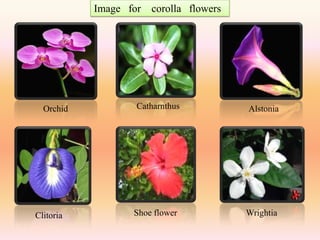
   Corolla shows diversity in colour and shape
Image for   corolla flowers


  Orchid           Catharnthus           Alstonia


Clitoria          Shoe flower            Wrightia
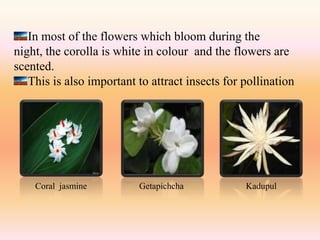
In most of the flowers which bloom during the
night, the corolla is white in colour and the flowers are
scented.
   This is also important to attract insects for pollination


    Coral jasmine         Getapichcha            Kadupul
3.Androecium

      Androecium is the male part of a flower.
      It is the whorl of floral leaves found inside
  the corolla.
      Androecium consists of stamens.
      A stamen consists of the another and the
  filament.
      The function of the androecium is to produce
  and release pollen grains.
      Stamens of flowers can be independent or
  connected to the petals.
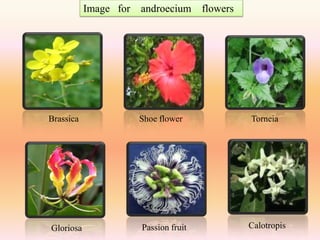
Image for   androecium flowers


Brassica               Shoe flower          Torneia


Gloriosa               Passion fruit        Calotropis
4.Gynoecium or pistil
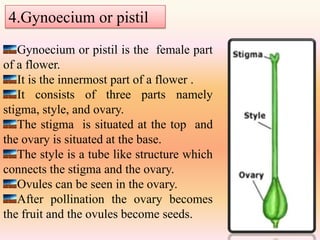
   Gynoecium or pistil is the female part
of a flower.
   It is the innermost part of a flower .
   It consists of three parts namely
stigma, style, and ovary.
   The stigma is situated at the top and
the ovary is situated at the base.
   The style is a tube like structure which
connects the stigma and the ovary.
   Ovules can be seen in the ovary.
   After pollination the ovary becomes
the fruit and the ovules become seeds.
5.Bisexual flowers
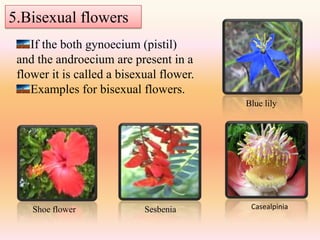
    If the both gynoecium (pistil)
 and the androecium are present in a
 flower it is called a bisexual flower.
    Examples for bisexual flowers.
                                          Blue lily


    Shoe flower             Sesbenia       Casealpinia
6. Unisexual flowers
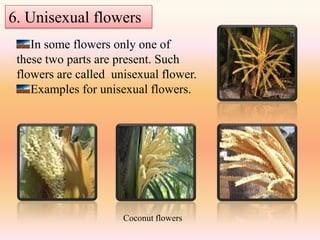
    In some flowers only one of
 these two parts are present. Such
 flowers are called unisexual flower.
    Examples for unisexual flowers.


                      Coconut flowers
Symmetry of flowers
1. Radially symmetrical flowers or an actinomorphic
                     flowers.

          If a flower can be divided into
       two similar halves by cutting
       vertically through any one of its
       axis which passes through the
       centre, such flowers are known as
       radially symmetrical flowers or
       an actinomorphic flowers.
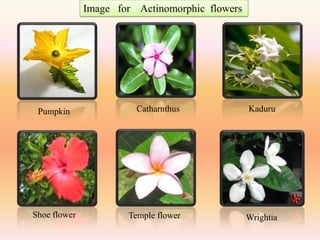
Image for Actinomorphic flowers


 Pumpkin                Catharnthus             Kaduru


Shoe flower           Temple flower             Wrightia
2. Zygomorphic flowers

   Some flowers can be divided into
two similar halves by cutting along
only one symmetrical axis.
   These flowers can be known as
bilaterally symmetrical flowers or
zygomorphic flowers.
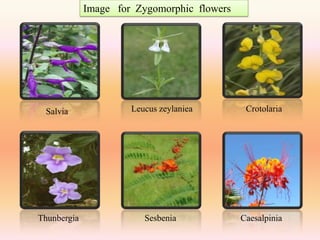
Image for Zygomorphic flowers


 Salvia               Leucus zeylaniea        Crotolaria


Thunbergia               Sesbenia            Caesalpinia
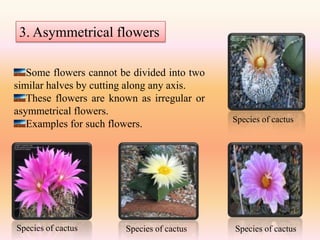
3. Asymmetrical flowers

   Some flowers cannot be divided into two
similar halves by cutting along any axis.
   These flowers are known as irregular or
asymmetrical flowers.
                                             Species of cactus
   Examples for such flowers.


Species of cactus       Species of cactus    Species of cactus
Structure of flowers


   There are some standard methods
to describe the structure of flowers.
   They are
      Whole flower
      Half flower
      Floral diagram
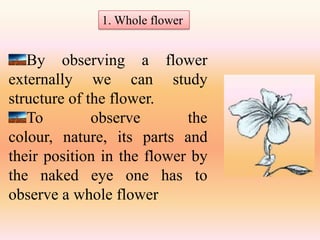
1. Whole flower


   By observing a flower
externally we can study
structure of the flower.
   To         observe       the
colour, nature, its parts and
their position in the flower by
the naked eye one has to
observe a whole flower
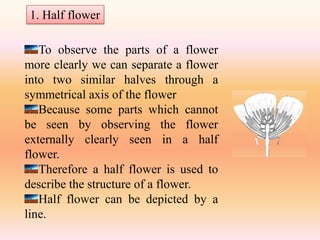
1. Half flower

   To observe the parts of a flower
more clearly we can separate a flower
into two similar halves through a
symmetrical axis of the flower
   Because some parts which cannot
be seen by observing the flower
externally clearly seen in a half
flower.
   Therefore a half flower is used to
describe the structure of a flower.
   Half flower can be depicted by a
line.
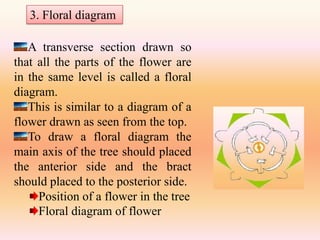
3. Floral diagram

   A transverse section drawn so
that all the parts of the flower are
in the same level is called a floral
diagram.
   This is similar to a diagram of a
flower drawn as seen from the top.
   To draw a floral diagram the
main axis of the tree should placed
the anterior side and the bract
should placed to the posterior side.
     Position of a flower in the tree
     Floral diagram of flower
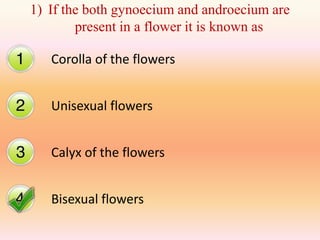
1) If the both gynoecium and androecium are
        present in a flower it is known as

   Corolla of the flowers


   Unisexual flowers


   Calyx of the flowers


   Bisexual flowers
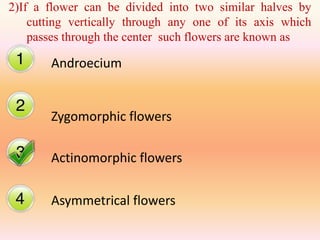
2)If a flower can be divided into two similar halves by
    cutting vertically through any one of its axis which
    passes through the center such flowers are known as

       Androecium


       Zygomorphic flowers

       Actinomorphic flowers

       Asymmetrical flowers
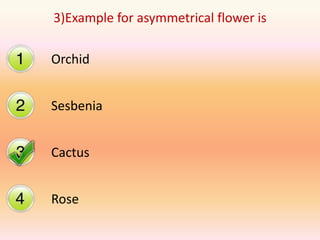
3)Example for asymmetrical flower is

Orchid


Sesbenia


Cactus


Rose
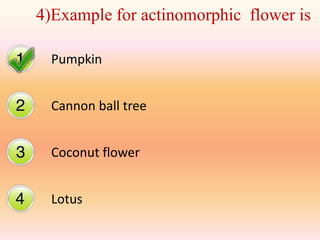
4)Example for actinomorphic flower is

  Pumpkin


  Cannon ball tree


  Coconut flower


  Lotus
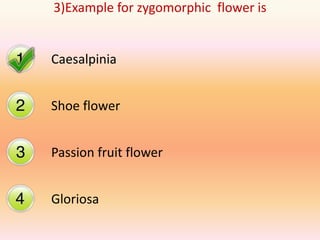
3)Example for zygomorphic flower is


Caesalpinia


Shoe flower


Passion fruit flower


Gloriosa
U.Vinusan
Jaffna Hindu College
       Grade 9
THANK YOU

Diversity of flowers

  • 1.
  • 2.
  • 3.
    Arrangement of flowers 1.Calyx Calyx is a cup shaped structure. It is found at the bottom of all the other parts. It consist of sepals. Sepals are similar to small green leaves. Colourful sepals can be in some flowers. Function of the calyx is the protection of tender the flower bud. Photosynthesis takes place in green in coloured sepals Colourful sepals are important to attract insects for pollination
  • 4.
    Image for calyxflowers Musandas Sesbenia Tribulus Rose Musandas Muntingia
  • 5.
    2.Corolla Within the calyx are the whorl of floral leaves called petals, together and forming the corolla. It is the most beautiful and attractive part of the flower. The corolla protects the internal parts of flower and also helps to attract insects for pollination. The corolla is colourful in majority of flowers which are pollinated by insects Corolla shows diversity in colour and shape
  • 6.
    Image for corolla flowers Orchid Catharnthus Alstonia Clitoria Shoe flower Wrightia
  • 7.
    In most ofthe flowers which bloom during the night, the corolla is white in colour and the flowers are scented. This is also important to attract insects for pollination Coral jasmine Getapichcha Kadupul
  • 8.
    3.Androecium Androecium is the male part of a flower. It is the whorl of floral leaves found inside the corolla. Androecium consists of stamens. A stamen consists of the another and the filament. The function of the androecium is to produce and release pollen grains. Stamens of flowers can be independent or connected to the petals.
  • 9.
    Image for androecium flowers Brassica Shoe flower Torneia Gloriosa Passion fruit Calotropis
  • 10.
    4.Gynoecium or pistil Gynoecium or pistil is the female part of a flower. It is the innermost part of a flower . It consists of three parts namely stigma, style, and ovary. The stigma is situated at the top and the ovary is situated at the base. The style is a tube like structure which connects the stigma and the ovary. Ovules can be seen in the ovary. After pollination the ovary becomes the fruit and the ovules become seeds.
  • 11.
    5.Bisexual flowers If the both gynoecium (pistil) and the androecium are present in a flower it is called a bisexual flower. Examples for bisexual flowers. Blue lily Shoe flower Sesbenia Casealpinia
  • 12.
    6. Unisexual flowers In some flowers only one of these two parts are present. Such flowers are called unisexual flower. Examples for unisexual flowers. Coconut flowers
  • 13.
    Symmetry of flowers 1.Radially symmetrical flowers or an actinomorphic flowers. If a flower can be divided into two similar halves by cutting vertically through any one of its axis which passes through the centre, such flowers are known as radially symmetrical flowers or an actinomorphic flowers.
  • 14.
    Image for Actinomorphicflowers Pumpkin Catharnthus Kaduru Shoe flower Temple flower Wrightia
  • 15.
    2. Zygomorphic flowers Some flowers can be divided into two similar halves by cutting along only one symmetrical axis. These flowers can be known as bilaterally symmetrical flowers or zygomorphic flowers.
  • 16.
    Image for Zygomorphicflowers Salvia Leucus zeylaniea Crotolaria Thunbergia Sesbenia Caesalpinia
  • 17.
    3. Asymmetrical flowers Some flowers cannot be divided into two similar halves by cutting along any axis. These flowers are known as irregular or asymmetrical flowers. Species of cactus Examples for such flowers. Species of cactus Species of cactus Species of cactus
  • 18.
    Structure of flowers There are some standard methods to describe the structure of flowers. They are Whole flower Half flower Floral diagram
  • 19.
    1. Whole flower By observing a flower externally we can study structure of the flower. To observe the colour, nature, its parts and their position in the flower by the naked eye one has to observe a whole flower
  • 20.
    1. Half flower To observe the parts of a flower more clearly we can separate a flower into two similar halves through a symmetrical axis of the flower Because some parts which cannot be seen by observing the flower externally clearly seen in a half flower. Therefore a half flower is used to describe the structure of a flower. Half flower can be depicted by a line.
  • 21.
    3. Floral diagram A transverse section drawn so that all the parts of the flower are in the same level is called a floral diagram. This is similar to a diagram of a flower drawn as seen from the top. To draw a floral diagram the main axis of the tree should placed the anterior side and the bract should placed to the posterior side. Position of a flower in the tree Floral diagram of flower
  • 22.
    1) If theboth gynoecium and androecium are present in a flower it is known as Corolla of the flowers Unisexual flowers Calyx of the flowers Bisexual flowers
  • 23.
    2)If a flowercan be divided into two similar halves by cutting vertically through any one of its axis which passes through the center such flowers are known as Androecium Zygomorphic flowers Actinomorphic flowers Asymmetrical flowers
  • 24.
    3)Example for asymmetricalflower is Orchid Sesbenia Cactus Rose
  • 25.
    4)Example for actinomorphicflower is Pumpkin Cannon ball tree Coconut flower Lotus
  • 26.
    3)Example for zygomorphicflower is Caesalpinia Shoe flower Passion fruit flower Gloriosa
  • 27.
  • 28.