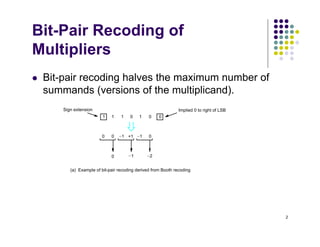
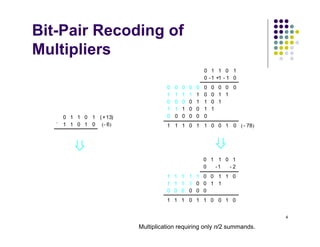
Bit-pair recoding is a technique that halves the maximum number of additions needed for multiplication by recoding the multiplier bits into pairs. It works by selecting the multiplicand (the number being multiplied) based on the values of bit pairs in the multiplier. For each bit pair, the selection table indicates which multiplicand (the regular value or the negative value) to use. This allows multiplication to be performed with only n/2 additions, where n is the number of bits in the multiplier.