In computing, an arithmetic logic unit (ALU) is a digital circuit that
performs arithmetic and logical operations. The ALU is a fundamental
building block of the central processing unit (CPU) of a computer, and
even the simplest microprocessors contain one for purposes such as
maintaining timers. The processors found inside modern CPUs and
graphics processing units (GPUs) accommodate very powerful and very
complex ALUs; a single component may contain a number of ALUs.
Mathematician John von Neumann proposed the ALU concept in 1945,
when he wrote a report on the foundations for a new computer called
the EDVAC. Research into ALUs remains an important part of computer
science, falling under Arithmetic and logic structures in the ACM
Computing Classification System.
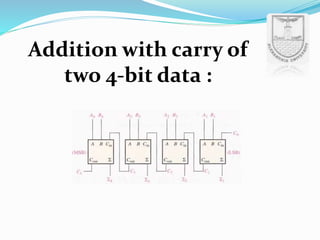
Addition with carry of
two 4-bit data :
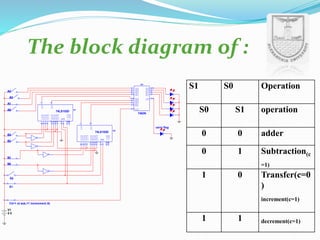
The block diagram of :
U2
7483N
A28
B27
A110
C013
B111
S4 15
S3 2
C4 14
A41
B416
A33
B34
S2 6
S1 9
V1
5 V
A3
A2
A1
A0
B3
B2
B1
B0
S0
U1
74LS153D
2Y92C010
2C111
2C212
2C313
A14
B2
~1G1
1Y71C06
1C15
1C24
1C33
~2G15
S1
U4
74LS153D
2Y92C010
2C111
2C212
2C313
A14
B2
~1G1
1Y71C06
1C15
1C24
1C33
~2G15
Ci(=1 at sub,=1 increament A)
carry flag
S1 S0 Operation
S0 S1 operation
0 0 adder
0 1 Subtraction(c
=1)
1 0 Transfer(c=0
)
increment(c=1)
1 1 decrement(c=1)
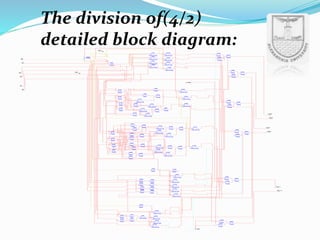
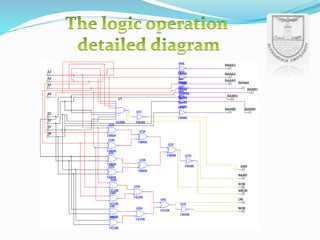
The division of(4/2)
detailed block diagram:U1A
74ALS11AM
U1B
74ALS11AM
U2B
74ALS11AM
U56C
74ALS11AM
U6B
7404N
GND
VCC
5V
U12A
7404N
U13B
7404N
U15B
7404N
U16B
7404N
U8A
7408J
U8B
7408J
U9B
7432N
U11B
7432N
U17A
74ALS11AM
U18A
74ALS11AM
U19A
74ALS11AM
U21B
7432N
U24B
7432N
U25B
7432N
U27A
74ALS11AM
U22B
74ALS21AM
U7B
7408J
U32B
7408J
U10B
7432N
U14B
7432N
U20B
7432N
U36D
7408J
U37D
7408J
U39B
7432N
U23A
74ALS11AM
U28B
74ALS11AM
U29D
74ALS21AM
U33D
7408J
U26D
7408J
U34B
7432N
U35B
7432N
U38B
7432N
U40D
7408J
U41D
7408J
U42B
7432N
U43A
74ALS11AM
U44B
74ALS11AM
U45A
7404N
U46B
7404N
U47B
7404N
U48B
7404N
U49D
7408J
U50D
7408J
U51D
7408J
U52C
7408J
U53A
7404N
U53B
7404N
U54B
7404N
U55B
7404N
U3A
7408J
U4A
7408J
U5A
74ALS32M
U31A
7404N
U31B
7404N
U61A
74ALS11AM
U62A
74ALS11AM
U63A
74ALS11AM
U64A
74ALS11AM
U65B
7404N
U66A
74ALS11AM
U67A
74ALS11AM
U68A
74ALS11AM
U70A
74ALS11AM
U71A
74ALS11AM
U72A
74ALS11AM
U73A
74ALS11AM
U74A
74ALS11AM
U75A
74ALS11AM
U77A
74ALS11AM
U78A
7404N
U79A
7404N
U80A
74ALS11AM
U81A
74ALS11AM
U82A
74ALS11AM
U83A
74ALS11AM
U84B
7404N
VCC
5V
U10A
7432N
U30B
7432N
U57A
7432N
U58A
7432N
U59B
7432N
U60A
7432N
U69A
7432N
U76B
7432N
U85A
7432N
U86A
7432N
U87B
7432N
U88A
7432N
U89A
7432N
U90B
7432N
U91A
7432N
U92A
7432N
U93B
7432N
U94A
7432N
GND
OUT0
OUT1
OUT2
OUT3
R0_1_4
R_1_2
A2
A3
S1
S0
A0
A1
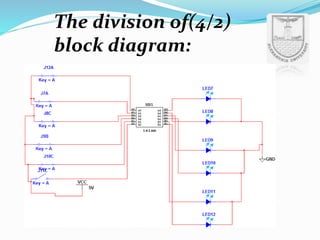
The division of(4/2)
block diagram:
U8
74LS283N
SUM_4 10
SUM_3 13
SUM_1 4
SUM_2 1
C4 9
B411
A412
B315
A314
B22
A23
B16
A15
C07
V3
5 V
A3
A2
A1
A0
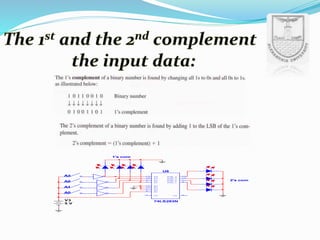
1's com
2's com
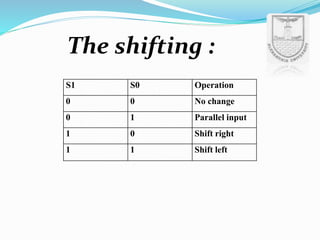
The shifting :
S1 S0 Operation
0 0 No change
0 1 Parallel input
1 0 Shift right
1 1 Shift left
V1
5 V
A3
A2
A1
A0
B3
B2
B1
B0
Ci
U2
74LS283N
SUM_4 10
SUM_3 13
SUM_1 4
SUM_2 1
C4 9
B411
A412
B315
A314
B22
A23
B16
A15
C07
U1
74LS283N
SUM_410
SUM_313
SUM_14
SUM_21
C49
B411
A412
B315
A314
B22
A23
B16
A15
C07
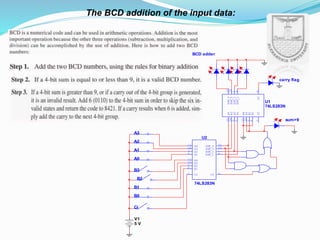
BCD adder
sum>9
carry flag
The BCD addition of the input data:
BCD SUBTRACTION
DECIMA
L
DIGIT
9’s
COMPLE
MENT
0 9
4 5
The step as flowing :
(a) ADD 9’s COMP. OF B TO A
(b) IF RESULT > 9, CORRECT BY
ADDING 0110
(c) IF MOST SIGNIFICANT CARRY
IS PRODUCED [i.e. =1] THEN
THE RESULT IS POSITIVE AND
THE END ARROUND CARRY MUST
BE ADDED.
(d) IF MOST SIGNIFICANT CARRY
IS 0 [i.e. NO CARRY] THEN THE
RESULT IS NEGATIVE AND WE
GET THE 9’s COMP. OF THE RESULT.
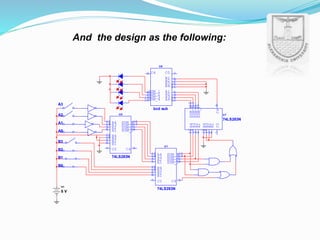
And the design as the following:
U1
74LS283N
SUM_410
SUM_313
SUM_14SUM_21
C4 9
B411
A412
B315
A314
B22
A23
B16
A15
C07
U2
74LS283N
SUM_410
SUM_313
SUM_14SUM_21
C4 9
B411
A412
B315
A314
B22
A23
B16
A15
C07
U7
74LS283N
SUM_410
SUM_313
SUM_14SUM_21
C49
B411
A412
B315
A314
B22
A23
B16
A15
C07
U8
bcd sub
SUM_410
SUM_313
SUM_14SUM_21
C49
B4 11
A4 12
B3 15
A3 14
B2 2
A2 3
B1 6
A1 5
C0 7
V1
5 V
A3
A2
A1
A0
B3
B2
B1
B0
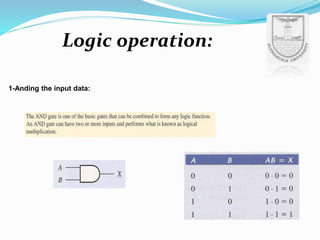
Logic operation:
1-Anding the input data:
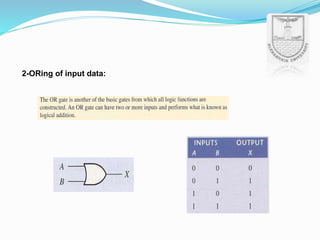
2-ORing of input data:
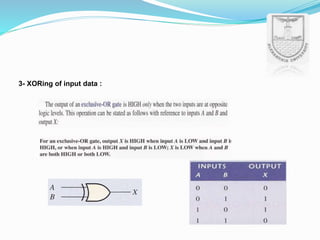
3- XORing of input data :
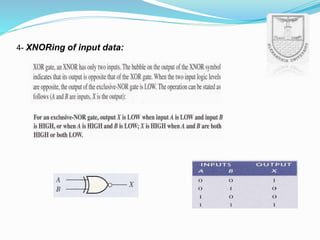
4- XNORing of input data:
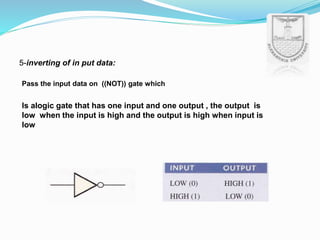
5-inverting of in put data:
Pass the input data on ((NOT)) gate which
Is alogic gate that has one input and one output , the output is
low when the input is high and the output is high when input is
low
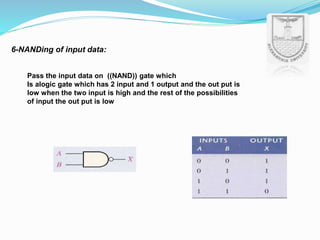
6-NANDing of input data:
Pass the input data on ((NAND)) gate which
Is alogic gate which has 2 input and 1 output and the out put is
low when the two input is high and the rest of the possibilities
of input the out put is low
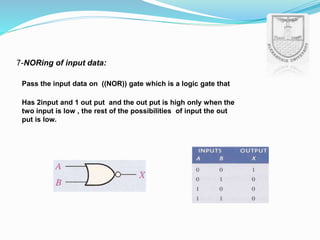
7-NORing of input data:
Pass the input data on ((NOR)) gate which is a logic gate that
Has 2input and 1 out put and the out put is high only when the
two input is low , the rest of the possibilities of input the out
put is low.
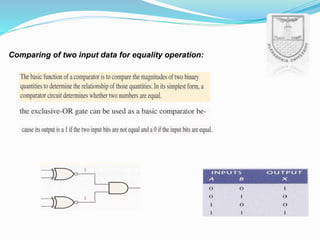
Comparing of two input data for equality operation:
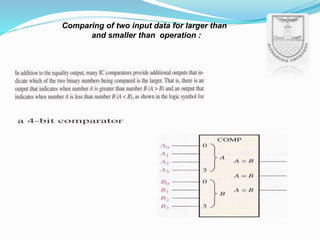
Comparing of two input data for larger than
and smaller than operation :
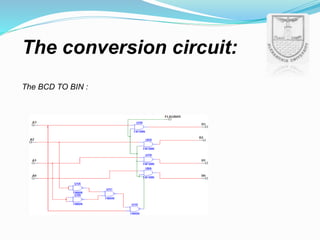
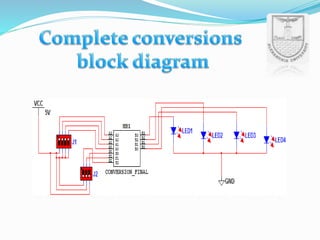
The conversion circuit:
The BCD TO BIN :
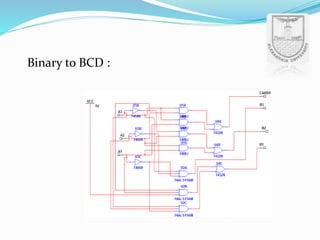
Binary to BCD :
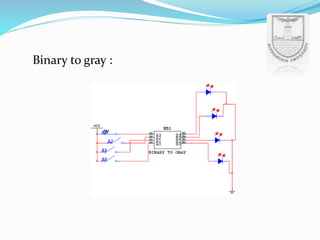
Binary to gray :
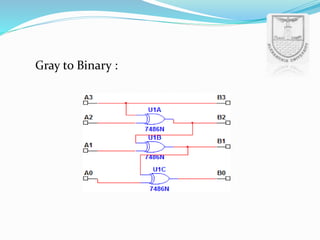
Gray to Binary :
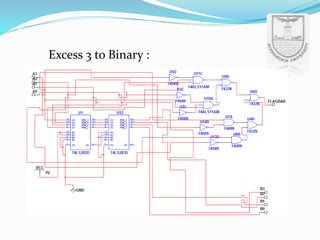
Excess 3 to Binary :
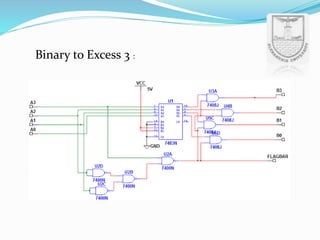
Binary to Excess 3 :
Arithmetic Logic Unit .

Arithmetic Logic Unit .

  • 4.
    In computing, anarithmetic logic unit (ALU) is a digital circuit that performs arithmetic and logical operations. The ALU is a fundamental building block of the central processing unit (CPU) of a computer, and even the simplest microprocessors contain one for purposes such as maintaining timers. The processors found inside modern CPUs and graphics processing units (GPUs) accommodate very powerful and very complex ALUs; a single component may contain a number of ALUs. Mathematician John von Neumann proposed the ALU concept in 1945, when he wrote a report on the foundations for a new computer called the EDVAC. Research into ALUs remains an important part of computer science, falling under Arithmetic and logic structures in the ACM Computing Classification System.
  • 6.
    Addition with carryof two 4-bit data :
  • 7.
    The block diagramof : U2 7483N A28 B27 A110 C013 B111 S4 15 S3 2 C4 14 A41 B416 A33 B34 S2 6 S1 9 V1 5 V A3 A2 A1 A0 B3 B2 B1 B0 S0 U1 74LS153D 2Y92C010 2C111 2C212 2C313 A14 B2 ~1G1 1Y71C06 1C15 1C24 1C33 ~2G15 S1 U4 74LS153D 2Y92C010 2C111 2C212 2C313 A14 B2 ~1G1 1Y71C06 1C15 1C24 1C33 ~2G15 Ci(=1 at sub,=1 increament A) carry flag S1 S0 Operation S0 S1 operation 0 0 adder 0 1 Subtraction(c =1) 1 0 Transfer(c=0 ) increment(c=1) 1 1 decrement(c=1)
  • 9.
    The division of(4/2) detailedblock diagram:U1A 74ALS11AM U1B 74ALS11AM U2B 74ALS11AM U56C 74ALS11AM U6B 7404N GND VCC 5V U12A 7404N U13B 7404N U15B 7404N U16B 7404N U8A 7408J U8B 7408J U9B 7432N U11B 7432N U17A 74ALS11AM U18A 74ALS11AM U19A 74ALS11AM U21B 7432N U24B 7432N U25B 7432N U27A 74ALS11AM U22B 74ALS21AM U7B 7408J U32B 7408J U10B 7432N U14B 7432N U20B 7432N U36D 7408J U37D 7408J U39B 7432N U23A 74ALS11AM U28B 74ALS11AM U29D 74ALS21AM U33D 7408J U26D 7408J U34B 7432N U35B 7432N U38B 7432N U40D 7408J U41D 7408J U42B 7432N U43A 74ALS11AM U44B 74ALS11AM U45A 7404N U46B 7404N U47B 7404N U48B 7404N U49D 7408J U50D 7408J U51D 7408J U52C 7408J U53A 7404N U53B 7404N U54B 7404N U55B 7404N U3A 7408J U4A 7408J U5A 74ALS32M U31A 7404N U31B 7404N U61A 74ALS11AM U62A 74ALS11AM U63A 74ALS11AM U64A 74ALS11AM U65B 7404N U66A 74ALS11AM U67A 74ALS11AM U68A 74ALS11AM U70A 74ALS11AM U71A 74ALS11AM U72A 74ALS11AM U73A 74ALS11AM U74A 74ALS11AM U75A 74ALS11AM U77A 74ALS11AM U78A 7404N U79A 7404N U80A 74ALS11AM U81A 74ALS11AM U82A 74ALS11AM U83A 74ALS11AM U84B 7404N VCC 5V U10A 7432N U30B 7432N U57A 7432N U58A 7432N U59B 7432N U60A 7432N U69A 7432N U76B 7432N U85A 7432N U86A 7432N U87B 7432N U88A 7432N U89A 7432N U90B 7432N U91A 7432N U92A 7432N U93B 7432N U94A 7432N GND OUT0 OUT1 OUT2 OUT3 R0_1_4 R_1_2 A2 A3 S1 S0 A0 A1
  • 10.
  • 11.
    U8 74LS283N SUM_4 10 SUM_3 13 SUM_14 SUM_2 1 C4 9 B411 A412 B315 A314 B22 A23 B16 A15 C07 V3 5 V A3 A2 A1 A0 1's com 2's com
  • 12.
    The shifting : S1S0 Operation 0 0 No change 0 1 Parallel input 1 0 Shift right 1 1 Shift left
  • 13.
    V1 5 V A3 A2 A1 A0 B3 B2 B1 B0 Ci U2 74LS283N SUM_4 10 SUM_313 SUM_1 4 SUM_2 1 C4 9 B411 A412 B315 A314 B22 A23 B16 A15 C07 U1 74LS283N SUM_410 SUM_313 SUM_14 SUM_21 C49 B411 A412 B315 A314 B22 A23 B16 A15 C07 BCD adder sum>9 carry flag The BCD addition of the input data:
  • 14.
    BCD SUBTRACTION DECIMA L DIGIT 9’s COMPLE MENT 0 9 45 The step as flowing : (a) ADD 9’s COMP. OF B TO A (b) IF RESULT > 9, CORRECT BY ADDING 0110 (c) IF MOST SIGNIFICANT CARRY IS PRODUCED [i.e. =1] THEN THE RESULT IS POSITIVE AND THE END ARROUND CARRY MUST BE ADDED. (d) IF MOST SIGNIFICANT CARRY IS 0 [i.e. NO CARRY] THEN THE RESULT IS NEGATIVE AND WE GET THE 9’s COMP. OF THE RESULT.
  • 15.
    And the designas the following: U1 74LS283N SUM_410 SUM_313 SUM_14SUM_21 C4 9 B411 A412 B315 A314 B22 A23 B16 A15 C07 U2 74LS283N SUM_410 SUM_313 SUM_14SUM_21 C4 9 B411 A412 B315 A314 B22 A23 B16 A15 C07 U7 74LS283N SUM_410 SUM_313 SUM_14SUM_21 C49 B411 A412 B315 A314 B22 A23 B16 A15 C07 U8 bcd sub SUM_410 SUM_313 SUM_14SUM_21 C49 B4 11 A4 12 B3 15 A3 14 B2 2 A2 3 B1 6 A1 5 C0 7 V1 5 V A3 A2 A1 A0 B3 B2 B1 B0
  • 17.
  • 18.
  • 19.
    3- XORing ofinput data :
  • 20.
    4- XNORing ofinput data:
  • 21.
    5-inverting of input data: Pass the input data on ((NOT)) gate which Is alogic gate that has one input and one output , the output is low when the input is high and the output is high when input is low
  • 22.
    6-NANDing of inputdata: Pass the input data on ((NAND)) gate which Is alogic gate which has 2 input and 1 output and the out put is low when the two input is high and the rest of the possibilities of input the out put is low
  • 23.
    7-NORing of inputdata: Pass the input data on ((NOR)) gate which is a logic gate that Has 2input and 1 out put and the out put is high only when the two input is low , the rest of the possibilities of input the out put is low.
  • 25.
    Comparing of twoinput data for equality operation:
  • 26.
    Comparing of twoinput data for larger than and smaller than operation :
  • 27.
  • 28.
  • 29.
  • 30.
  • 31.
    Excess 3 toBinary :
  • 32.