FLIPPED
CLASSROOM
AND
BLENDED LEARNING
Yaritza Ovalle
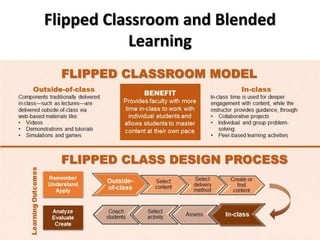
What is the Flipped Classroom?
It is a pedagogical model that transfers the work of
adjusting learning processes outside the classroom and
uses the class time, together with the experience of the
document, to facilitate and enhance other processes of
acquisition and practice of knowledge within the classroom.
It is an integral approach that combines direct instruction
with constructivist methods, increasing commitment and
involvement of students with course content and improving
their conceptual understanding. It is a holistic approach
that, when implemented successfully, will support all
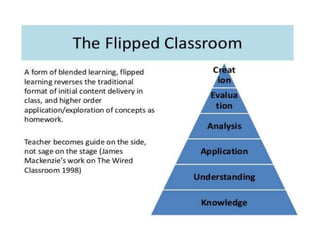
phases of a learning cycle. (Bloom Taxonomy)
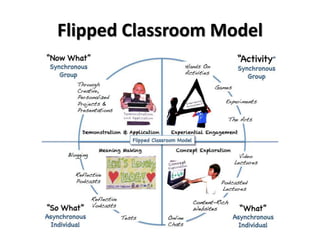
Flipped Classroom Model
Blended Learning
The term blended learning is generally applied to the practice of
using both online and in-person learning experiences when
teaching students. In a blended-learning course, for example,
students might attend a class taught by a teacher in a traditional
classroom setting, while also independently completing online
components of the course outside of the classroom. In this case,
in-class time may be either replaced or supplemented by online
learning experiences, and students would learn about the same
topics online as they do in class—i.e., the online and in-person
learning experiences would parallel and complement one
another.
Blended Learning Models
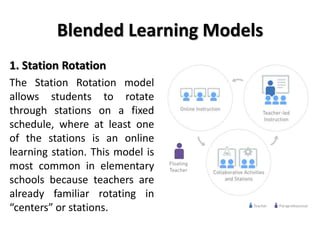
1. Station Rotation
The Station Rotation model
allows students to rotate
through stations on a fixed
schedule, where at least one
of the stations is an online
learning station. This model is
most common in elementary
schools because teachers are
already familiar rotating in
“centers” or stations.
Blended Learning Models
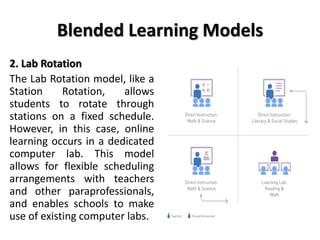
2. Lab Rotation
The Lab Rotation model, like a
Station Rotation, allows
students to rotate through
stations on a fixed schedule.
However, in this case, online
learning occurs in a dedicated
computer lab. This model
allows for flexible scheduling
arrangements with teachers
and other paraprofessionals,
and enables schools to make
use of existing computer labs.
Blended Learning Models
3. Individual Rotation
The Individual Rotation model
allows students to rotate
through stations, but on
individual schedules set by a
teacher or software
algorithm. Unlike other
rotation models, students do
not necessarily rotate to
every station; they rotate only
to the activities scheduled on
their playlists.
Blended Learning Models
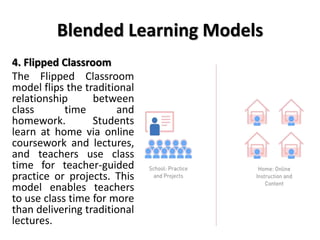
4. Flipped Classroom
The Flipped Classroom
model flips the traditional
relationship between
class time and
homework. Students
learn at home via online
coursework and lectures,
and teachers use class
time for teacher-guided
practice or projects. This
model enables teachers
to use class time for more
than delivering traditional
lectures.
Blended Learning Models
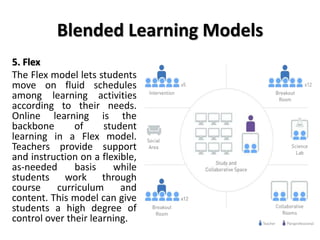
5. Flex
The Flex model lets students
move on fluid schedules
among learning activities
according to their needs.
Online learning is the
backbone of student
learning in a Flex model.
Teachers provide support
and instruction on a flexible,
as-needed basis while
students work through
course curriculum and
content. This model can give
students a high degree of
control over their learning.
Blended Learning Models
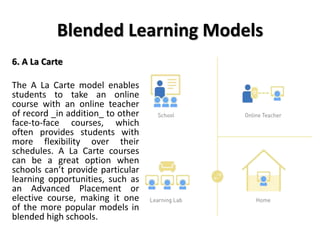
6. A La Carte
The A La Carte model enables
students to take an online
course with an online teacher
of record _in addition_ to other
face-to-face courses, which
often provides students with
more flexibility over their
schedules. A La Carte courses
can be a great option when
schools can’t provide particular
learning opportunities, such as
an Advanced Placement or
elective course, making it one
of the more popular models in
blended high schools.
Flipped Classroom and Blended
Learning

Flipped classroom

  • 1.
  • 2.
    What is theFlipped Classroom? It is a pedagogical model that transfers the work of adjusting learning processes outside the classroom and uses the class time, together with the experience of the document, to facilitate and enhance other processes of acquisition and practice of knowledge within the classroom. It is an integral approach that combines direct instruction with constructivist methods, increasing commitment and involvement of students with course content and improving their conceptual understanding. It is a holistic approach that, when implemented successfully, will support all phases of a learning cycle. (Bloom Taxonomy)
  • 4.
  • 5.
    Blended Learning The termblended learning is generally applied to the practice of using both online and in-person learning experiences when teaching students. In a blended-learning course, for example, students might attend a class taught by a teacher in a traditional classroom setting, while also independently completing online components of the course outside of the classroom. In this case, in-class time may be either replaced or supplemented by online learning experiences, and students would learn about the same topics online as they do in class—i.e., the online and in-person learning experiences would parallel and complement one another.
  • 6.
    Blended Learning Models 1.Station Rotation The Station Rotation model allows students to rotate through stations on a fixed schedule, where at least one of the stations is an online learning station. This model is most common in elementary schools because teachers are already familiar rotating in “centers” or stations.
  • 7.
    Blended Learning Models 2.Lab Rotation The Lab Rotation model, like a Station Rotation, allows students to rotate through stations on a fixed schedule. However, in this case, online learning occurs in a dedicated computer lab. This model allows for flexible scheduling arrangements with teachers and other paraprofessionals, and enables schools to make use of existing computer labs.
  • 8.
    Blended Learning Models 3.Individual Rotation The Individual Rotation model allows students to rotate through stations, but on individual schedules set by a teacher or software algorithm. Unlike other rotation models, students do not necessarily rotate to every station; they rotate only to the activities scheduled on their playlists.
  • 9.
    Blended Learning Models 4.Flipped Classroom The Flipped Classroom model flips the traditional relationship between class time and homework. Students learn at home via online coursework and lectures, and teachers use class time for teacher-guided practice or projects. This model enables teachers to use class time for more than delivering traditional lectures.
  • 10.
    Blended Learning Models 5.Flex The Flex model lets students move on fluid schedules among learning activities according to their needs. Online learning is the backbone of student learning in a Flex model. Teachers provide support and instruction on a flexible, as-needed basis while students work through course curriculum and content. This model can give students a high degree of control over their learning.
  • 11.
    Blended Learning Models 6.A La Carte The A La Carte model enables students to take an online course with an online teacher of record _in addition_ to other face-to-face courses, which often provides students with more flexibility over their schedules. A La Carte courses can be a great option when schools can’t provide particular learning opportunities, such as an Advanced Placement or elective course, making it one of the more popular models in blended high schools.
  • 12.
    Flipped Classroom andBlended Learning